




Abstract
The present study aims to investigate (1) the difference in polyvictimization rate between children left behind and those living with non-migrant parents in rural China, and (2) the social processes through which the effects of parental migration are conveyed through children’s behaviors and interaction with the immediate external environment (e.g., family, school, and peers). The research hypotheses were tested by using a probability sample consisting of 1,681 middle school students in rural areas in Guizhou province (Mean age = 13.55, SD = 1.01; 50% of the participants were boys). Findings from multivariate logistic regression models and indirect effect analyses suggest that (1) overall, left-behind children are exposed to a higher level of polyvictimization than children living with both non-migrant parents in rural China and (2) whereas all left-behind children face similar challenges in school and family settings, each type of parental migration and caretaking arrangement entails unique protective or risk factors of polyvictimization. As one of the first studies to systematically investigate the rate and etiology of polyvictimization among children left behind in rural China, this study highlights the prominent role of parental migration in reproducing and reinforcing children’s differential exposure to polyvictimization among China’s rural families.
Child victimization, in the form of child maltreatment by parents, peer and sibling bullying, neighborhood conventional crime, and witnessing violence against others, has drawn increasing public and academic attention in modern China (Ji & Finkelhor, 2015). Polyvictimization, defined as exposure to multiple types instead of just one single type of victimization (Turner et al., 2017), has been demonstrated to be a more powerful predictor of negative child outcomes (Finkelhor et al., 2007, 2009; Turner et al., 2017). The short- and long-term effects of polyvictimization include psychological problems such as depression, anxiety, posttraumatic stress disorder (PTSD), withdrawal, and low self-esteem (Finkelhor et al., 2007, 2009; Ford & Delker, 2020; Turner et al., 2017). Exposure to polyvictimization also leads to behavioral problems such as poor academic performance, alcohol and drug use, participation in delinquent and criminal activities, and re-victimization (Ford & Delker, 2020; Wright, 2015). Although most of these studies are conducted in Western societies, a small line of research targeting Chinese children reaches a similar conclusion, revealing a pervasive effect of polyvictimization, including but not limited to poor physical and mental health, low quality of life, feelings of insecurity, PTSD, depressive symptoms, and exhibition of aggression and violence (Chan, 2013, 2014; Chan et al., 2017; Dong et al., 2013; Le et al., 2018).
The prevalence as well as the detrimental effects of victimization and polyvictimization can be higher for socioeconomically disadvantaged populations (Chan, 2013, 2014). A particularly vulnerable group in China is left-behind children (LBC), referring to those who live with one parent, grandparents, other caretakers, or by themselves in rural areas when one or both parents migrate to more economically developed areas for better job opportunities. This population has grown considerably in the past 30 years (UNICEF, 2019), due to a combination of China’s rapid urbanization, massive rural-to-urban migration, and structural constraints (e.g., China’s long-lasting household registration system) that limit migrants and their children’s access to public services in urban space. Recent national statistics, for example, reveal that as many as 69.7 million children are left behind in rural China (UNICEF, 2019), constituting about a quarter of China’s total child population and about 40% of China’s rural child population (All-China Women’s Federation, 2013).
Despite a growing body of research investigating parental migration and its effects on Chinese children’s experience of victimization (Chen et al., 2017, 2019; Zhang et al., 2021; Zhou et al., 2020), there is a lack of emphasis on LBC within polyvictimization research to capture this especially vulnerable group’s experience. In fact, we only located two studies that directly addressed the correlates, causes, or consequences of polyvictimization among LBC (Chen & Chan, 2016; Hu et al., 2018). Consequently, we know little about whether parental migration in rural China increases children’s exposure to co-occurring types of victimization and what underlying social processes potentially explain such an association. Without fully investigating these topics, the effects of parental migration on children’s victimization experiences can be over or underestimated (Turner et al., 2017), and evidence-based prevention and intervention programs against polyvictimization among LBC will be hard to develop and/or implement.
This study seeks to fill the gap in the literature by examining the association between parental migration and children’s experience of polyvictimization in rural China. Utilizing a probability sample of middle school students in rural China, we ask two fundamental questions. First, is parental migration associated with children’s increased exposure to polyvictimization? Second, if there is such an association, what are the social processes that account for it? In other words, what are the individual, familial, and extra-familial factors that potentially amplify or diminish the effects of parental migration on rural children’s odds of being polyvictimized? Our results can potentially provide new insights into the hidden social costs of China’s historically large-scale internal migration and offer useful empirically tested evidence for prevention and treatment programs protecting LBC and caretakers against polyvictimization.
Parental Migration and Children’s Exposure to Victimization and Polyvictimization
China’s significant shifts in demographics in recent decades have spurred an emerging literature on parental migration and LBC’s exposure to varying types of victimization. In general, the literature reveals that compared with children living with nonmigrant parents, LBC report a higher level of exposure to conventional crime (Chen et al., 2017, 2019; Zhou et al., 2020), peer victimization (Wang & Liu, 2021; Xiong et al., 2019; Zhang et al., 2021), caretaker maltreatment and neglect (Chen et al., 2019; Wen et al., 2020; Yang et al., 2020), and sexual assault (Chen et al., 2021; Yan et al., 2018). Utilizing data from a large-scale national survey, Zhou and colleagues (2020) found that left-behind school-age children, particularly those during early adolescence, were more likely to be excluded from group activities or physically bullied than those living with nonmigrant parents. Peer victimization and bullying, in particular, are prevalent among LBC, including physical, verbal, relational, and property victimization (Wang & Liu, 2021; Zhang et al., 2021).
Although most research operationalizes parental migration as a dichotomous measure (i.e., LBC vs. children living with two nonmigrant parents), a small number of studies have importantly dissected the types of parental migration, investigating whether paternal migration, maternal migration, and both-parent migration can differentially influence children’s exposure to victimization. The results reveal that, compared with paternal migration, maternal migration has a more adverse effect, exposing LBC to higher levels of caretaker maltreatment and neglect (Liu et al., 2009; Parreñas, 2005) and sexual victimization (Chen et al., 2021), and other types of victimization. Similarly, children with both parents migrated and in the care of grandparents report a higher level of victimization than those living with nonmigrant parents (Chen et al., 2017). These results, however, are far from conclusive. In one study, Chen and colleagues (2017) found that paternal migration, instead of maternal migration, increased children’s exposure to conventional crime and peer victimization. Temporal, cultural, and geographical differences may collectively shape the effects of parental migration on children’s victimization experiences.
Despite a burgeoning literature examining the causes and consequences of victimization among LBC in rural China, there is a lack of research on polyvictimization in this highly vulnerable group. As aforementioned, to our knowledge, only two studies have investigated polyvictimization and parental migration in rural China (Chen & Chan, 2016; Hu et al., 2018). Using a sample of rural children in Sichuan Province, Chen and Chan (2016) investigated the differential effects of various forms of parental absence on children’s experience of polyvictimization. Whereas parental separation or divorce significantly increased children’s odds of polyvictimization, parental migration did not show any pronounced effect. Hu and colleagues (2018) revealed that poverty was a significant predictor of polyvictimization among LBC but neglected to address whether parental migration was a risk factor for children’s experience of polyvictimization. In summary, more research on the correlates, causes, and consequences of exposure to polyvictimization among LBC is needed.
Mediators Linking Parental Migration to Exposure to Polyvictimization
We utilize the ecological system theory (Darling, 2007), which suggests that individual, familial, and extra-familial domains collectively influence children’s behavior, as the primary theoretical framework to explore potential mediators linking parental migration and children’s exposure to polyvictimization. Applying this perspective, we argue that exposure to polyvictimization is the result of both independent effects of and the dynamic interplay between these interrelated domains. Specifically, we identify four general conditions under these domains that are potentially associated with children’s, particularly LBC’s, likelihood of polyvictimization: (a) caretaker monitoring and supervision and perceived familial cohesion, (b) academic performance and bonding with school and teachers, (c) perceived stress and anxiety, and (d) risky lifestyles reflected in association with deviant peers, unsupervised peer activities, and delinquency involvement.
First, supportive familial environment as indexed by adequate caretaker monitoring and supervision and family cohesion is the first set of potential mediators that link parental migration to polyvictimization. Substantial research demonstrates that compared with their counterparts with no parents migrating, LBC are less closely monitored by primary caretakers and experience higher levels of familial conflict (Chen & Jiang, 2019; Wen & Lin, 2012). Consequently, they suffer from a lack of “capable guardianship” attributable to caregivers’ unwillingness to supervise and/or inability to detect potential offenders and to intervene when conflict arises (Schreck et al., 2002; Tillyer et al., 2016; Zavala et al., 2019). Second, children’s academic performance and bonding with school and teachers potentially mediate the association between parental migration and experience of victimization. Children with strong bonding with teachers and prosocial peers have a lower probability of being victimized because they spend more time on structured activities (e.g., doing homework or playing sports) and are often under the watchful eyes of caretakers and other adult guardians (Schreck et al., 2002; Zavala et al., 2019). It should be noted, however, that the effect of parental migration on children’s school performance is not conclusive, with studies reporting mixed findings (Lu, 2012; Sun et al., 2015; Wen & Lin, 2012). Third, children’s experience of stress and anxiety, including that resulting from parental migration, leads to an increased level of victimization. Numerous studies have confirmed that parental migration—domestic or international—is associated with children’s development of internalizing behaviors such as loneliness, anxiety, depression, and withdrawal (e.g., Cheng & Sun, 2015; Wen & Lin, 2012). Although these internalizing behaviors may be sequelae of victimization, there is also evidence that they can put youth at risk of victimization (Le et al., 2018). Finally, children’s risky lifestyles serve as the fourth set of potential mediators. An emerging literature documents that LBC have more delinquent friends and higher levels of conduct disorder, problematic behaviors, and delinquency involvement (Chen & Jiang, 2019; Chen et al., 2017; Gao et al., 2010). As suggested by lifestyle and routine activity theories and empirically confirmed by numerous studies, these risky lifestyle activities directly increase children’s odds of victimization (Osgood et al., 1996; Schreck et al., 2002; Tillyer et al., 2016).
The Present Study
The present study aims to investigate the differences in polyvictimization between LBC and those living with nonmigrant parents in rural China, and the potential indirect effects of parental migration on polyvictimization through children’s interaction with the immediate external environment (e.g., family, school, and peers). On the basis of the outlined literature, we hypothesize that (a) LBC, in general, are more likely to be polyvictimized than children living with nonmigrant parents in rural China and (b) the association between parental migration and children’s experience of polyvictimization will be explained by children’s behaviors and their dynamic interactions with family, school, and peers. As one of the first studies to elucidate the dynamic interplays between parental migration and polyvictimization, this study provides crucial empirical evidence helpful for designing effective and culturally sensitive prevention and treatment programs targeting the well-being of LBC and caretakers in rural China.
Data and Methods
Data and Research Sites
The data for this study are from the Mental and Behavioral Health of Adolescents Survey, which collected information from a probability sample of middle school students in two districts of Guizhou Province in China: Guiyang and Qiannan Buyi and Miao Autonomous Prefecture. Conducted between November and December of 2019, the project aimed to examine the prevalence of children’s mental and behavioral problems (e.g., depression, delinquency, and exposure to victimization) and to identify individual and environmental factors associated with these outcomes.
We collected survey data from Guizhou province for two reasons. First, located in southwest China, Guizhou is one of the least developed regions in China. As a primary migrant-sending province since China’s reform and opening-up in the 1980s, Guizhou is an ideal site for our research on the LBC population. Second, boasting 17 ethnic minorities, Guizhou is one of the few multiethnic provinces from which a large probability sample of minority children can be readily drawn, who have often been overlooked by previous studies. We purposefully selected two districts, Guiyang and Qiannan Buyi and Miao Autonomous Prefecture, to capture the wide variations in socioeconomic status and ethnicity in this province. Guiyang district geographically encompasses Guiyang city, the capital of Guizhou province, and some bordering rural counties. It has a higher average income than the Qiannan Buyi and Miao Autonomous Prefecture and is dominated by the Han majority ethnicity. Qiannan Buyi and Miao Autonomous Prefecture, on the other hand, is remotely located in the southern part of Guizhou province and borders the Guangxi Zhuang Autonomous Region. This district is less developed than Guiyang and inhabited mostly by minority groups such as Buyi and Miao ethnicity.
We adopted a multistage cluster sampling design to select our sample from the two districts. First, a list of all middle schools in Guiyang and Qiannan, which include seventh, eighth, and ninth grades, was obtained from each of the local education administrative departments. From this list, we randomly selected 5 middle schools in each city, with a total of 10 schools, to participate in the study. In the second stage, we randomly selected two classes in each grade from the selected schools. These classes had a size of students ranging from 36 to 52. All students from the selected classes were invited to participate in the study. After obtaining consent from the teachers and adolescents themselves, we distributed questionnaires to participating students on regular school days, with teachers and school administrators not present on the site during the survey period. Researchers explained to the students the purpose of the research project and assured them that participation was voluntary, all personal information would be kept confidential, and students could withdraw from the study at any time.
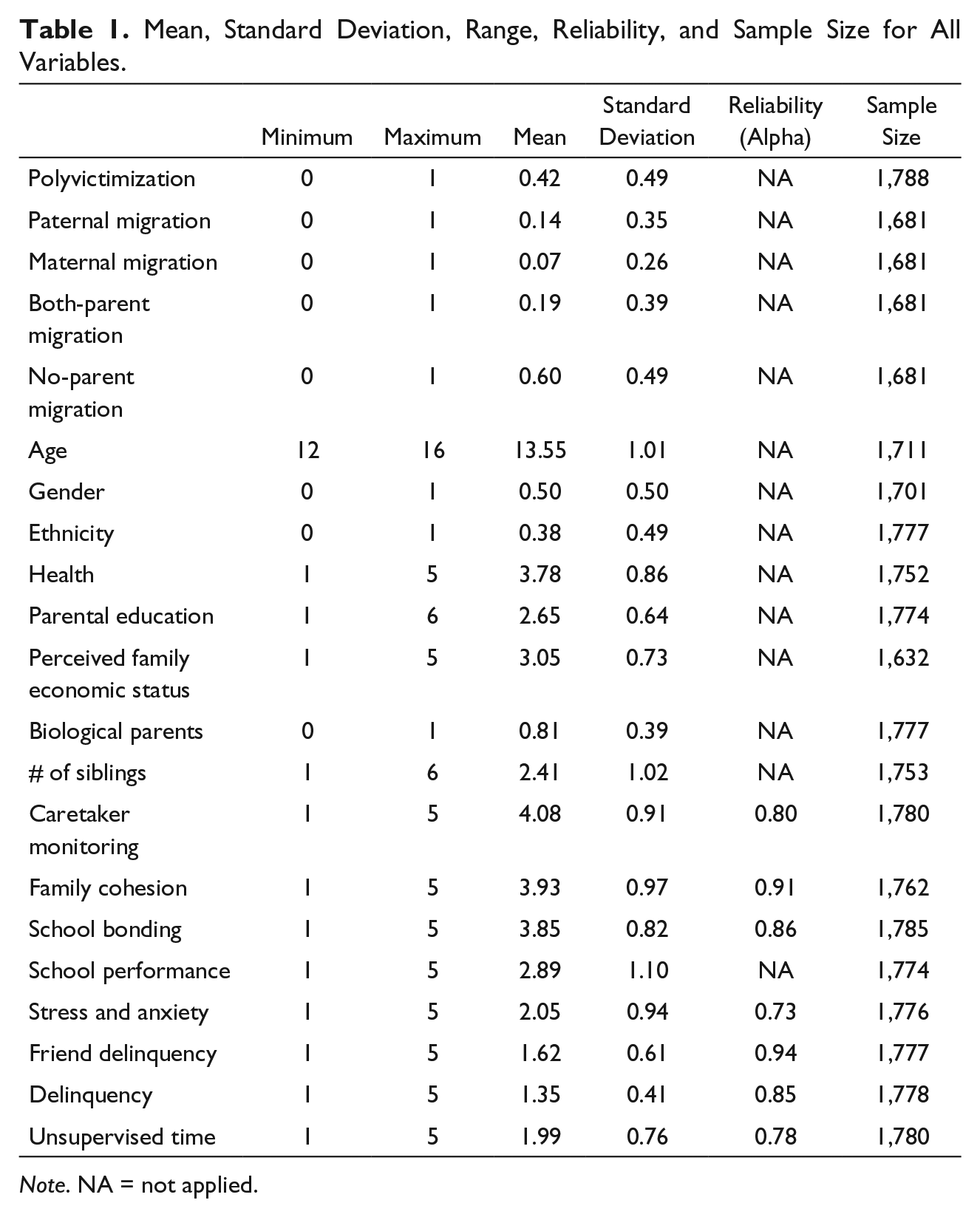
Mean, Standard Deviation, Range, Reliability, and Sample Size for All Variables.
Note. NA = not applied.
Measurement
Dependent Variable
Our dependent variable polyvictimization was derived from the Juvenile Victimization Questionnaire (Finkelhor et al., 2005), which collects information on 34 types of victimization that occurred within one year preceding the date of the interview. Because of cultural and political differences, we retained 32 forms of victimization and deleted the other two (i.e., exposure to shooting and exposure to war) from the scale. These 32 forms of victimization cover five general areas: conventional crime, child maltreatment, peer and sibling victimization, sexual victimization, and witnessing and indirect victimization. The response categories for each of the items were 1 = never, 2 = 1-2 times, 3 = 3-4 times, 4 = 5-7 times, and 5 = 8 times and more. Each of the items was then recoded, with 1 = at least one time and 0 = not in the preceding year. As recommended by prior research (Dong et al., 2013; Finkelhor et al., 2009), respondents who reported five types of victimization or more were considered to be polyvictims. Previous research has demonstrated that this measure has good predictive validity and reliability in both Western samples (Finkelhor et al., 2005) and Chinese samples (Chan, 2013; Hu et al., 2018).
Independent Variables
The key independent variable in the study is parental migration status which was assessed by asking children whether one of their parents currently worked in other cities or provinces or not. The variable was then recoded into four dummy variables, paternal migration (PM), maternal migration (MM), both-parent migration (BM), and no migration (NM). A total 60% of the students reported that none of their parents migrated to other cities, 14% reported paternal migration, 7% maternal migration, and 19% dual-parent migration.
Intervening Variables
The study hypothesizes that a series of variables, including family environment, school bonding, stress and anxiety, and risky lifestyles mediate the association between parental migration status and children’s exposure to polyvictimization. Two variables, caretaker monitoring and family cohesion, were used to capture children’s family environment. Caretaker monitoring was measured by five items asking students how often their primary at-home caretakers knew where they were after school or when they went out at night, how often they told caretakers whom they were with when they were out, how often caretakers asked where they went, and whether they were expected to call when they were late (Chen et al., 2017). Response categories for each item ranged from 1 = never to 5 = often. The final scale of caretaker monitoring was computed by averaging the five items, with a higher score indicating stricter caretaker monitoring and supervision (α = 0.80). Similarly, family cohesion was measured by five items asking respondents if they agreed with statements such as “Family members always provide upmost help and support to each other” and “Family members get along well with one another” (1 = strongly disagree, 5 = strongly agree) (Wen & Lin, 2012). The final scale was computed by averaging the five items, with a higher score indicating stronger family cohesion (α = 0.91).
We used two variables, school bonding and school performance, to measure children’s connection with school and teachers. The variable school bonding was measured by seven items asking students whether teachers in school cared about students, treated students fairly, were friendly to her/him, frequently communicated with him/her, and whether the student liked the campus environment, liked the school learning atmosphere, and studied hard (Shen & Zhong, 2018). Response categories for each item ranged from 1 = completely disagree to 5 = completely agree. Likewise, the final scale was computed by averaging the seven items, with a higher score indicating stronger bonding with schools (α = 0.86). Children’s school performance was measured by a single item, asking children how well their academic performance ranked in their classes, ranging from “the lowest level (1)” to “the highest level (5).”
The third potential mediator was children’s feeling of stress and anxiety, measured by three items asking whether children agreed that they were “very bothered” by the fact that they were not good looking, were not popular with the opposite sex, and that their parents could not afford to buy the kind of clothes they wanted (Agnew & White, 1992). Response categories ranged from 1 (do not agree at all) to 5 (totally agree). The final scale was computed by using the average of the three items (α = .73).
The fourth set of intervening variables taps into children’s delinquent and risky lifestyles, including measures of association with deviant peers, delinquent behavior, and unsupervised peer activities. Association with deviant peers was a scale adapted from the National Youth Survey (Huizinga et al., 1989), which consisted of 17 items asking participants how many of their current friends participated in a series of delinquent activities in the last year (e.g., damaging school properties, stealing, carrying weapons to school, fighting, cheating on tests, group fighting, drinking, smoking, graffiti, truancy, and taking money from other people). For each item, response categories ranged from 1 = none of them to 5 = all of them. The average of these indicators was used to create a composite score for association with delinquent peers (α = .94). The second scale, delinquency, asked respondents how often they were involved in each of these 17 deviant or delinquent activities in the last year (Elliott & Ageton, 1980). The final scale was computed by averaging the 17 items (α = .85). Finally, to capture children’s exposure to deviant opportunities, we created the scale unsupervised peer activities, which asked students how often they did things such as watching movies, riding bicycles, hanging around with friends, attending other gatherings or social activities, shopping and going out at night in the last month (Osgood et al., 1996). Response categories were 1 = never, 2 = 1-2 times, 3 = 3-4 times, 4 = 5-7 times, and 5 = 8 times and more. The final scale was computed by using the average of the six items (α = .78).
Control Variables
A range of individual and household characteristics associated with parental migration and risk of polyvictimization were controlled to account for selection bias. Specifically, we controlled for children’s characteristics such as age, gender (0 = female, 1 = male), ethnicity (0 = minority ethnicity, 1 = Han), and physical health (ranging from 1 = very bad to 5 = very healthy), as well as family characteristics including parental education (measured as the average of mother’s and father’s education), children’s perceived family economic status (ranging from 1 = not good to 5 = very good), whether biological parents are divorced or not (0 = no, 1 = yes), and the number of siblings.
Results
Bivariate Analysis
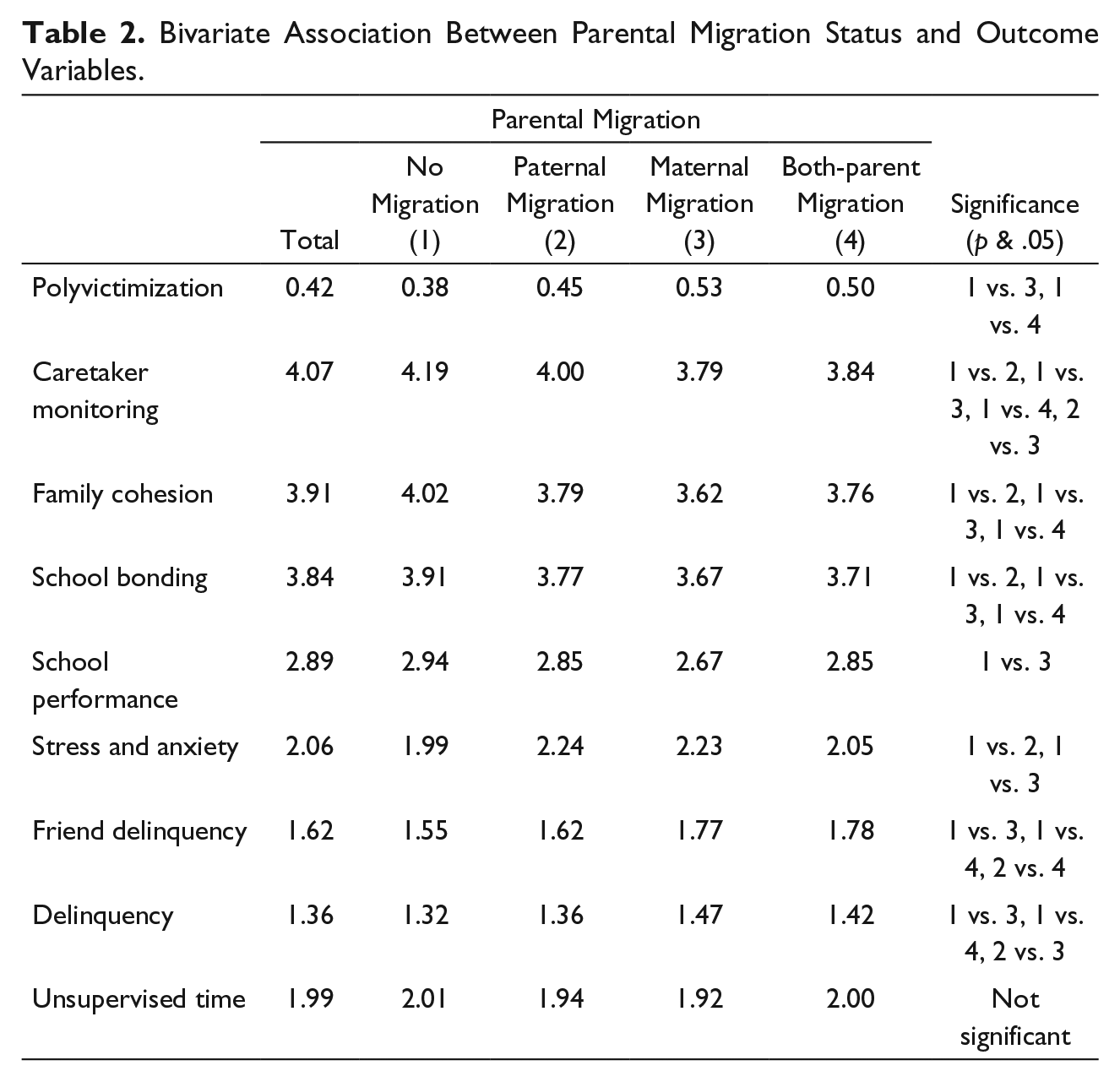
Table 2 illustrates the differences in children’s exposure to polyvictimization and the mediators across various parental migration subgroups in rural China. Overall, the rate of polyvictimization in this study was alarmingly high (42%), compared with the few studies investigating polyvictimization among Chinese children (Chan, 2013, 2014; Chan et al., 2017; Dong et al., 2013). A chi-square test revealed that the association between parental migration status and polyvictimization was, as hypothesized, statistically significant. Specifically, children of NM (no parents migrated) reported the lowest rate of polyvictimization (38%), PM (paternal migration) children the second lowest (45%), BM (both-parent migration) children the third (50%), and children of MM (maternal migration) the highest level of polyvictimization (53%). The multiple group comparison using the Bonferroni correction revealed that the NM group significantly differed in the rate of polyvictimization from MM and BM children.
Bivariate Association Between Parental Migration Status and Outcome Variables.
Multivariate Analysis
We investigated the effects of parental migration on children’s exposure to polyvictimization and the mediating roles of intervening variables (family, school, and individual behavior) in a series of logistic regression models (Table 3). To test the mediation using a multivariate regression approach, we used the two-step approach suggested by Hayes (2017). First, a set of nested logistic regression models were conducted to assess whether the hypothesized association between a key independent variable and a dependent variable was significant or not, and whether this association was substantially reduced when mediators were included in the model. We followed the approach proposed by MacKinnon and Dwyer (1993) and compared standardized regression coefficients—which makes the variance of residuals equivalent across nested regression models—to explore whether the mediation exists. Second, we adopted the bootstrapping approach (Hayes, 2017) and calculated indirect effects for each type of parental migration status on polyvictimization, formally testing whether the mediating effects were statistically significant. In all these analyses, we applied the full information maximum likelihood method to address missing data, which provides efficient estimations of statistical parameters and less biased estimates of standard errors compared with other missing data imputation methods (Schafer, 1997). All the multivariate analyses were conducted in the statistical program Mplus 7.4 (Muthén & Muthén, 2012).
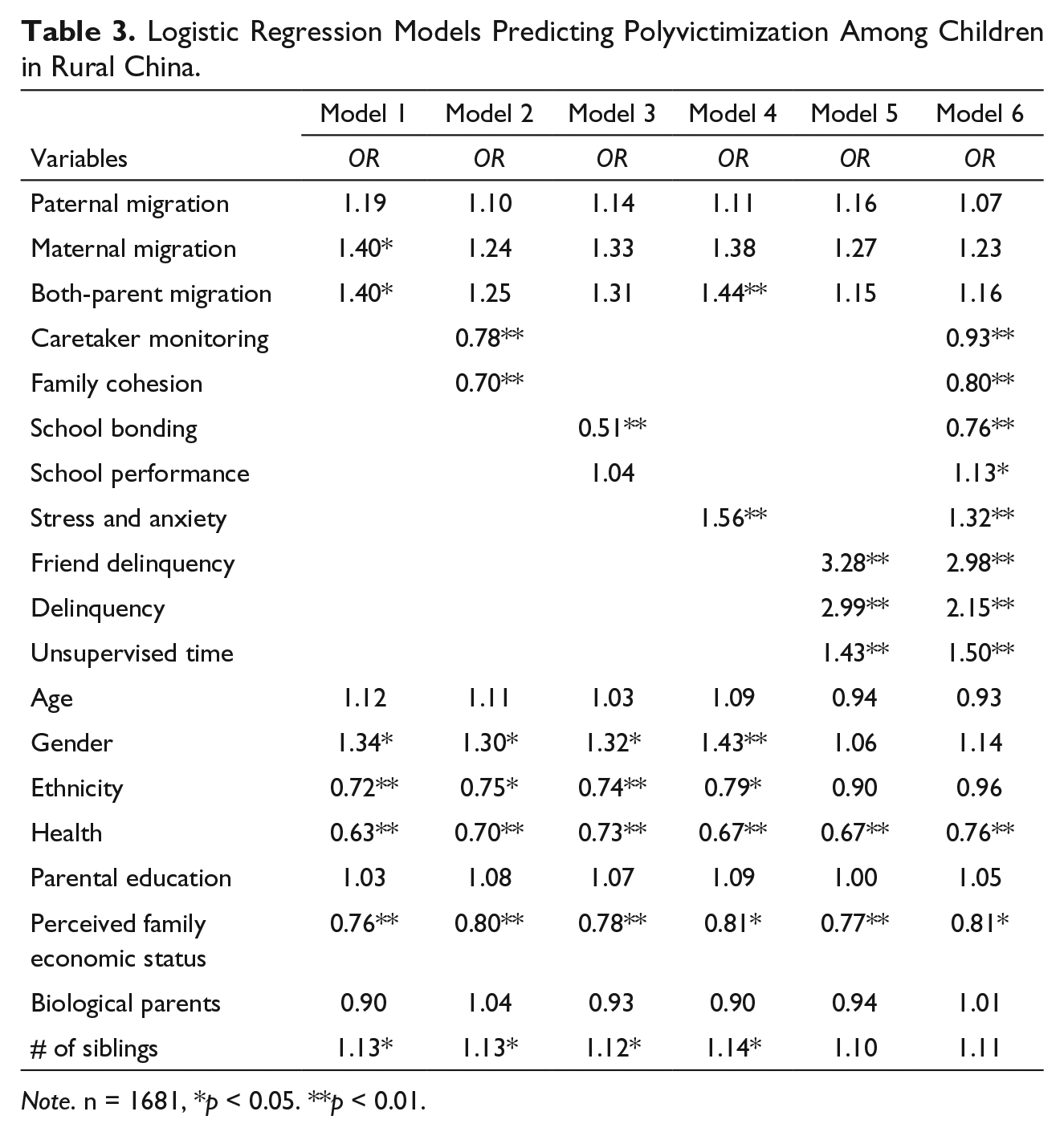
In Model 1, we examined the relationship between parental migration status and exposure to polyvictimization while taking all control variables into account. The results suggested that parental migration status was significantly associated with children’s experience of polyvictimization when demographic and family background factors were controlled. Compared with the reference group (NM children), maternal migration (OR [odds ratio] = 1.40, p & .05) and both-parent migration (OR = 1.40, p & 0.01) increased children’s odds to be polyvictimized by 40%. Paternal migration also increased children’s odds of being polyvictimized; this association, however, was not statistically significant at the .05 level (OR = 1.19, p > .05).
From Model 2 to Model 5, we explored the associations between family environment, school bonding, children’s stress and anxiety, participation in risky lifestyle activities, and experience of polyvictimization. A higher level of caretaker monitoring (OR = 0.78, p & .01) and family cohesion (OR = 0.70, p & .01) significantly reduced children’s experience of polyvictimization (Model 2). Children’s bonding with school and teachers was also a protective factor (OR = 0.51, p & .01, Model 3). Additionally, children’s level of anxiety (OR = 1.56, p & .01, Model 4), and risky lifestyle including peer deviance (OR = 3.28, p & .01), involvement in delinquency (OR = 2.99, p & .01), and unsupervised time spent with peers (OR = 1.43, p &.01, Model 5) were strong and significant risk factors promoting exposure to polyvictimization.
The final model (Model 6) included all the intervening and control variables in the model. All the significant correlates from Model 2 to Model 5 remained significant in the final model. Interestingly, school performance, which was nonsignificant in Model 3, became a statistically significant risk factor for polyvictimization (OR = 1.13, p & .05), suggesting that when bonding with family and involvement in risky lifestyles were controlled, children excelling academically would be more likely to be polyvictimized than their less well-performing counterparts. Finally, the comparison of standardized regression coefficients between Model 1 and the final model (Model 6) revealed that the coefficient dropped from 0.032 to 0.01 (a 69% decrease) for paternal migration, from 0.046 to 0.023 (a 50% drop) for maternal migration, and from 0.068 to 0.024 (a 65% decrease) for both-parent migration (results not shown but available upon request), suggesting that the four sets of mediators at least partially mediate the association between parental migration status and children’s exposure to polyvictimization (MacKinnon & Dwyer, 1993).
Logistic Regression Models Predicting Polyvictimization Among Children in Rural China.
Note. n = 1681, *p < 0.05. **p < 0.01.
Indirect Effect Analysis
The regression models suggest that a number of individual and environmental factors collectively mediate the associations between parental migration and children’s exposure to polyvictimization. However, it remains unclear which of these factors mediates these associations and how strong the mediating effect is. To answer these questions, we used the bias-corrected bootstrapping method with 5,000 resampling (Hayes, 2017) to calculate parameter estimations and confidence intervals for the total, direct, and indirect effects (Table 4). More specifically, we utilized family environment, school performance and bonding, level of anxiety, and risky lifestyles as parallel mediators, parental migration status as the independent variable, and polyvictimization as the dependent variable. The same demographic and socioeconomic status variables were controlled in the mediation analysis (Hayes, 2017).
Total Effects and Indirect Effects of Parental Migration on Polyvictimization Using the Bootstrapping Method.
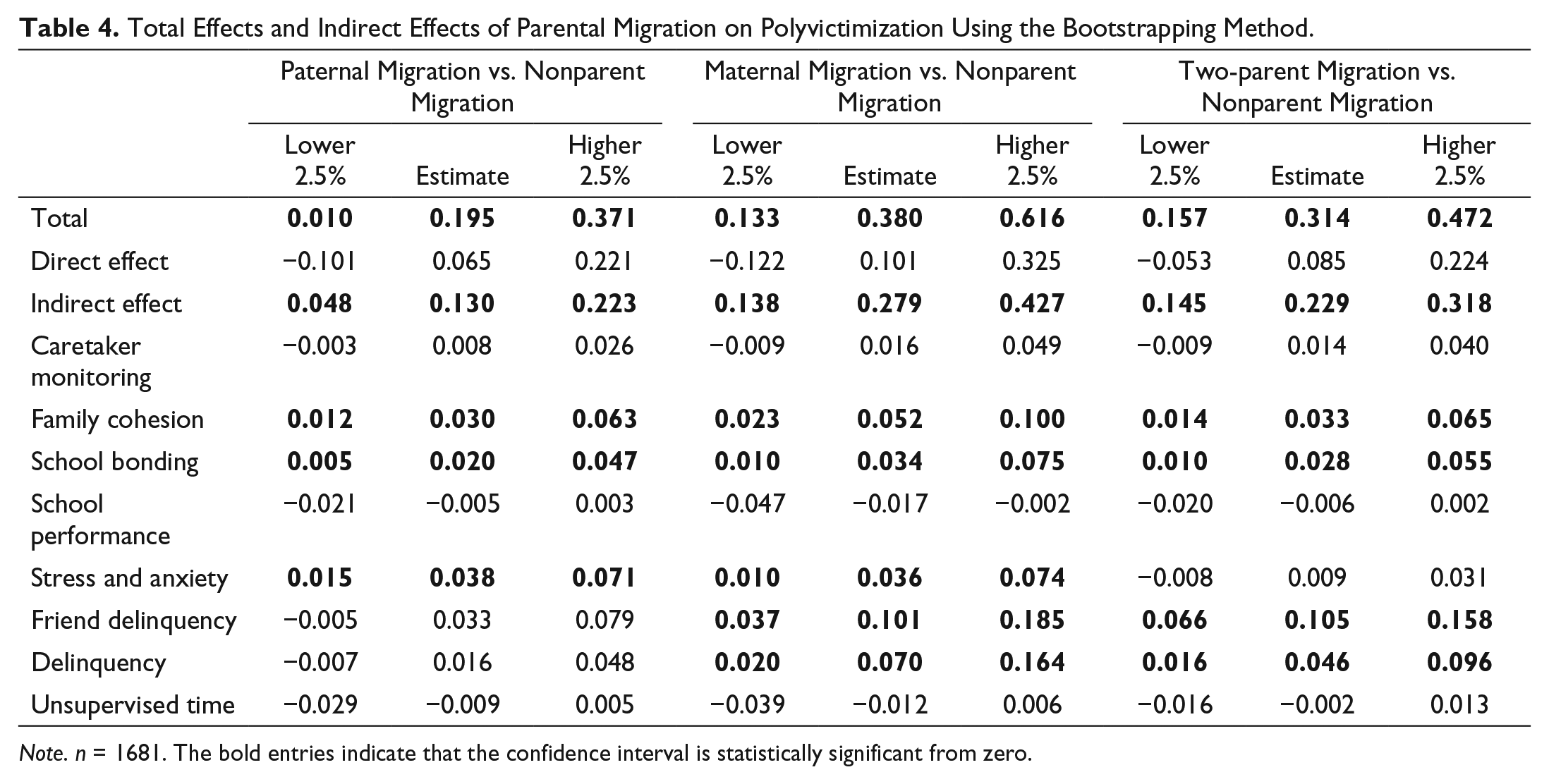
Note. n = 1681. The bold entries indicate that the confidence interval is statistically significant from zero.
Discussion and Conclusion
In the last three decades, the unprecedentedly massive rural-to-urban migration in China has significantly shifted its demographic composition, creating a subpopulation consisting of almost seventy million children left behind in rural China (UNICEF, 2019). Studies have since investigated whether and how the experiences of being “left behind” shape children’s physical and mental development (Asis, 2006; Chen et al., 2017; Gao et al., 2010; Lu, 2012). A fair share of prior research focuses on children’s victimization (Chen et al., 2017, 2019; Wang & Liu, 2020; Wen et al., 2020; Yang et al., 2020; Xiong et al., 2019; Zhang et al., 2021; Zhou et al., 2020); yet, few studies have investigated children’s exposure to multiple types of victimization, which produces more detrimental short- and long-term effects across multiple life domains (Chan, 2014; Chan et al., 2011; Turner et al., 2017). To address this research gap, the current study investigates two critical questions: (a) are children left behind exposed to a higher rate of polyvictimization than their rural counterparts? and (b) if so, what are the social mechanisms underlying such a relationship?
Our first hypothesis, children of migrant parents are more likely to be polyvictimized than those of nonmigrant parents in rural China, is empirically supported. The multivariate analyses demonstrate that parental migration, in general, increases children’s odds of being polyvictimized. Our results contradict the null finding in a recent study (Chen & Chan, 2016) but are in line with the larger literature, which finds that parental migration is associated with a myriad of poor mental and behavioral outcomes in general (Liu et al., 2009; Oliveira, 2018; Parreñas, 2005), and victimization in particular (Chen et al., 2019; Wang & Liu, 2021; Xiong et al., 2019; Zhang et al., 2021). Additionally, adding to a growing body of literature (Liu et al., 2009; Oliveira, 2018; Parrenas, 2009), our study provides strong evidence for the differential effects of types of parental migration, demonstrating that maternal migration and both-parent migration have larger detrimental effects on polyvictimization than that of paternal migration. In other words, while beneficial for improving family economic conditions and potentially increasing women’s financial independence, the absence of a mother due to maternal migration (and both-parent migration) creates antagonistic situations conducive to children’s exposure to polyvictimization.
Before delving into the underlying social processes linking parental migration to exposure to polyvictimization, the prevalence of polyvictimization in this sample, including non-LBC children, warrants further attention. Although differences in operational definitions of polyvictimization preclude direct comparison, it should be noted that our research reports a substantially higher level of polyvictimization than other studies in China (Chan, 2013; Chan et al., 2017; Dong et al., 2013) but has a similar rate reported in less economically developed countries and regions (Le et al., 2018). We speculate that at least three factors contribute to such a high rate of polyvictimization in our sample. First, our sample differs from other studies in that it consists of middle school students aged from 12 to 16 years old, a demographic group most vulnerable to polyvictimization (Chan, 2013, 2014; Dong et al., 2013). Other studies, instead, include students during their early childhood or late adolescence, during which children are, in general, exposed to lower rates of polyvictimization (Dong et al., 2013). Second, this study utilizes a sample of children living in remote and economically marginalized rural communities in Guizhou province, whereas other studies collect data from urban areas or cities outside of mainland China (e.g., Hong Kong, Chan, 2014; Chan et al., 2017; Dong et al., 2013). Previous studies have demonstrated that geographical differences (e.g., mainland vs. nonmainland and urban vs. rural) account for a significant portion of the variation in polyvictimization rates across studies (Ji & Finkelhor, 2015). The collective forces of widespread economic hardship (Hu et al., 2018), poor childrearing practices such as authoritarian parenting style (Ji & Finkelhor, 2015), low school quality, and a lack of effective guardianship due to parental migration in rural China contribute to such a geographic difference. Third, our sample differs from others in that it includes a large number of minority ethnic children (62%), who are disproportionally exposed to economic hardship, stigmatization, and discrimination in schools and in other social settings than the Han ethnicity (Gustafsson & Sai, 2009; Maurer-Fazio, 2012).
Our second hypothesis, positing that the association between parental migration and children’s exposure to polyvictimization is mediated by theoretically relevant individual, familial, and extra-familial factors, is partially supported. First, there exist shared and distinctive mediating social processes linking parental migration to polyvictimization. Consistent with prior research (Chan et al., 2019; Chen & Chan, 2016; Finkelhor et al., 2009; Williford et al., 2019), familial conflict and weakened school bonding are shared pathways for all LBC, collectively elevating their odds to be polyvictimized. When children left behind are confronted with stressful events and conditions across multiple life domains—particularly in the traditionally considered “safe haven” such as families and schools—their physical and mental coping resources may be substantially compromised, magnifying their vulnerability and leading to a higher level of polyvictimization (Turner et al., 2017).
Our results also highlight unique pathways linking types of parental migration to children’s exposure to polyvictimization. Increased stress and anxiety, for example, is a key pathway linking maternal or paternal migration, but not both-parent migration, to polyvictimization. Given that most BM children are primarily cared for by grandparents in rural China (Kong & Meng, 2010), this finding indicates that children cared for by one at-home parent, compared to those in the care of grandparents or non-migrant parents, experience significantly higher levels of stress and anxiety. The elevated stress and anxiety, in turn, increase children’s exposure to polyvictimization (Le et al., 2018; Turner et al., 2017). These results suggest that grandparenting in rural China has some advantage over one-parent caretaking, a finding that is consistent with some of the prior literature (Chen & Jiang, 2019; Wen & Lin, 2012) but is largely neglected by the public discourse. Grandparents in households of two-parent migration, for example, are often liberated from backbreaking farming duties due to improved household financial conditions, and hence are able to pay full attention to their grandchildren’s physical and emotional needs (Asis, 2006; Jingzhong & Lu, 2011; Silverstein & Zhang, 2021). In contrast, in the scenario of maternal or paternal migration, the at-home father or mother is often the sole primary caretaker, constantly struggling with heavily increased parenting duties along with their regular work responsibilities (Chang et al., 2011), which potentially leads to the neglect of children’s material or emotional needs and the accumulation of stress and anxiety.
Our findings also reveal that children’s involvement in risky lifestyles, particularly delinquency and association with delinquent friends, is another key pathway linking maternal migration and both-parent migration, but not paternal migration, to exposure to polyvictimization. Adding to a small but growing literature on delinquency among LBC (Chen & Jiang, 2019; Gao et al., 2010; Hu et al., 2014), our research provides further evidence that parental migration and caretaking arrangements impose differential effects on children’s involvement in risky lifestyle activities, which in turn, increases children’s exposure to polyvictimization. It should be noted that although both MM and BM increase children’s association with deviant friends and engagement in minor delinquent activities, the underlying social mechanism may differ. For BM children, caretaking by grandparents is often characterized by a lack of meaningful communication and less strict discipline, leading to children’s increased involvement in antisocial and delinquent activities (Chen, 2017; Kong & Meng, 2010). For MM children, the at-home father, who is now required to perform the role of dual parenting, is often ill prepared for the shift of gender roles and more likely to use authoritarian parenting style, pushing children to their circle of friends and peers for companionship and emotional support (Chen, 2017; Parreñas, 2005).
Overall, our study contributes to the literature by being one of the first studies, to the best of the authors’ knowledge, to systematically investigate the detrimental effects of parental migration on polyvictimization in rural China. Some limitations, however, should be noted and serve as a context for the interpretation of our findings. First, like most studies conducted in victimization research in China, the cross-sectional research design prevents us from making meaningful causal claims, and future research is needed to establish time order and to sequence the dynamic intervening social processes. We are, however, quite confident about the time order of the key independent and dependent variables, as rural-to-urban migration has become a rite of passage for young people in inland rural China (Ye, 2018), and specifically for our sample, an overwhelming majority of the participants have their parent(s) migrated long before the survey. Second, our classification of parental migration—although the same as most of the previous research—is still broad and fails to specify certain caretaking arrangements with small numbers of LBC. Children who live with extended family members other than grandparents (e.g., uncles or aunts), live independently by themselves, or live with aged grandparents who are physically or mentally incapable of caretaking, are small in size but are more vulnerable to polyvictimization. Future studies, ideally with a big sample size when survey data are used or using qualitative methods such as case studies, need to pay attention to these more disadvantaged subgroups.
Despite these limitations, our nuanced analyses highlight the prevalence of polyvictimization among mid-adolescents in rural China and the exacerbating effects of parental migration on producing such traumatic experiences. These findings carry important policy implications. First, our study can help migrant parents and left-behind grandparents better understand the social costs of rural-to-urban migration and the challenges and difficulties that LBC face, encouraging them to arrange caretaking in forms most beneficial for children and minimize the agony of this “painful necessity” of parental migration (Åkesson et al., 2012, p. 237). Second, our findings can potentially inform state and local agencies to develop culturally appropriate and context-sensitive prevention and treatment programs to address risk factors associated with children’s exposure to polyvictimization. Some rural communities in China, for example, have already begun to create structures to support LBC and their caretakers, including culturally based parenting lessons for migrant parents and left-behind grandparents.
In summary, our study contributes to the literature by being one of the first studies to systematically investigate the rate and etiology of polyvictimization among children left behind in rural China. Overall, LBC are exposed to higher levels of polyvictimization than children living with both parents in rural China. Additionally, whereas all LBC face similar challenges in school and family settings, each parental migration and caretaking arrangement entails unique protective or risk factors associated with exposure to polyvictimization. Our findings provide further evidence of the hidden social costs of China’s massive rural-to-urban migration and can potentially inform state and local agencies to develop effective programs to address these costs, protecting LBC from risks and harms including polyvictimization.
Footnotes
Declaration of Conflicting Interests
Funding
The author(s) disclosed receipt of the following financial support for the research, authorship, and/or publication of this article: The project was supported by a theoretical innovation grant awarded by the Guizhou Social Science Association (GZLCLH-2019-011).
Note

Author Biographies
Jia Qu, PhD, is an assistant professor in College of Public Administration at Guizhou University of Finance and Economics in Guizhou, China. Her current research interests include policing, law, and social research.