



Abstract
While an increasing body of literature has assessed police response to intimate partner violence (IPV), a dearth of this research has examined police decision-making with formal reports of IPV among Latina immigrants. Using a LatCrit theoretical framework, the current study addressed this substantive gap through the systematic methods of the grounded theory approach to assess a sample of 36 police case files drawn from an agency located in one of the fifth most populous and diverse US cities. Results from the current study identified five themes related to shortcomings in police response to Latina immigrant IPV victims. The themes included cultural coercive control, language barriers, victim participation, case clearance efforts, and service provision. Policy implications and avenues for future research are discussed.
Introduction
Intimate partner violence (IPV) among Latinas is just as common when compared to other racial and ethnic groups of women (Gonzalez et al., 2018); prevalence estimates have ranged from 15% to 80% (Cavanaugh et al., 2014; Sabina et al., 2015; Smith et al., 2018). 1 For Latina immigrant women specifically, community samples have estimated that 35–51% will experience some form of psychologically controlling behaviors, physical, and/or sexual violence from an intimate partner during their lifetime (Denham et al., 2007; Fedovskiy et al., 2008; Fife et al., 2008; Hass et al., 2000). Despite this frequency, only approximately one-quarter of Latina immigrant IPV victims will report these incidents to police (Ammar et al., 2005; Cuevas et al., 2014; Zadnik et al., 2016). To that end, police officers, as “gatekeepers” (Kerstetter, 1990) of the criminal legal system, hold the discretionary authority that has determined how these IPV incidents will be processed in terms of generating a formal report, investigation, and referral to the district attorney. 2 In other words, police are the first point of contact for victims and have the ability to intervene and make decisions among cases reported by Latina immigrant IPV victims.
Traditionally, the police response to IPV has been plagued by shortcomings, such that police officers perceived this violence as a private matter that did not necessitate formal intervention (Martin, 1975) and left women unprotected. Demeaning attitudes toward IPV victims, adherence to IPV myths (e.g., misconceptions about IPV, such as “most women can leave if they want to”), and limited suspect arrests underscored these historical deficiencies in police response (Belknap, 1995; Hirschel et al., 1992; Koss et al., 1994). Feminist efforts, legislative progress, and advocacy have improved police response to IPV through formalizing legal intervention (Lutze & Symons, 2003). Despite this evolution, police have been scrutinized for adherence to misinformation and stereotypes surrounding abusive relationships (Fleming & Franklin, 2020) and decisions that have produced case attrition (Durfee & Fetzer, 2016). Contemporary police response and related paradigm shifts regarding IPV have been credited to feminist efforts (Dicker, 2008; Freedman, 2003), though advances have positioned sex above other structures of oppression (Kendall, 2020; Lorde, 1984; Moraga & Anzaldua, 1984). In other words, progress regarding the criminal legal system response to IPV victims who have a multiplicity of identities that intersect sex with race, ethnicity, class, nationality, sexuality, and legal status, have been largely sidelined.
It is not surprising, then, that research regarding police interactions with Latina immigrant IPV victims has been scarce (but see Ammar et al., 2005; Mowder et al., 2018; Vidales, 2010). Limited research focused on IPV among Latina immigrants has relied on interviews after they have formally reported to police, which has produced some understanding of Latina immigrants’ experiences with the criminal legal system. Findings have illustrated an insufficient police response, including demeaning interactions with victims, limited advocacy and support, and difficulties associated with language and cultural barriers (Ammar et al., 2005; Mowder et al., 2018; Vidales, 2010). While instructive, existing research on police response to Latina immigrant IPV victims has not been considered from a decision-making perspective. Indeed, little is known surrounding how police make decisions regarding the case processing of IPV incidents reported by Latina immigrant victims. These limitations have warranted further consideration, particularly given recent calls to understand the IPV experiences of this population (Alvarez & Fedock, 2018; Garza, 2021; O’Neal & Beckman, 2017). To fill this gap, the current study draws on a LatCrit theory framework to understand the experiences of Latina immigrant IPV victims who turn to the criminal legal system for redress.
LatCrit Theory and Institutional Responses to Latina Immigrant IPV Victims
Recently, Garza (2021) argued for the use of LatCrit theory to understand institutional responses to Latina IPV victims. LatCrit 3 theory was originally developed in the mid 1990s in Puerto Rico as an extension of Critical Race Theory or CRT (Valdes, 2005). CRT emerged as an epistemological framework in response to the systematic exclusion and oppression of critical scholars from legal studies (Bell, 1995; Crenshaw et al., 1995). CRT has examined the social construction of race, racism, and power as it intersects with social and legal issues while focusing on liberation from oppressive systems (Bell, 1995; Crenshaw et al., 1995). Further, because CRT is reflexive and has welcomed theoretical expansions (Solorzano & Yosso, 2001), CRT has been scrutinized for centering the Black/White dichotomy at the forefront of racial discourse (Espinoza & Harris, 1998; Valdes, 1996), to the exclusion of other racial and ethnic groups. In response, LatCrit theory was developed to draw visibility to the Latinx community and to advance theory and practices focused on critical discourse related to law and policies that have affected the Latinx population (Valdes, 1996).
LatCrit theory, as it has been applied to Latina IPV victims, has provided a foundation that centers on Latina victims and extends frameworks for understanding responses to victims of Color, more generally. Through this LatCrit lens, Garza (2021) offered three interrelated themes to provide evidence of shortcomings in the institutional response to Latina IPV victims: (a) racialized indeterminacy, (b) hegemonic representation, and (c) the criminal legal system as a racialized organization. Racialized indeterminacy has highlighted the systemic failure of the criminal legal system to consider the multidimensionality of the Latina identity in terms of race, ethnicity, nationality, and acculturation, among other identities. This unidimensionality has limited the proper identification of IPV among Latinas in epidemiology studies and official agency data (Garza, 2021). CRT scholarship also theorized that organizations are racialized and maintain racial hierarchies through institutional policies, rules, and practices (see Ray, 2019). From this, Garza (2021) noted how the criminal legal system has failed to appropriately respond to Latina IPV victims through the inequitable distribution of resources, such as the lack of appropriately skilled translators for victims who activate the criminal legal system. Evidence has also pointed to diminished group agency through systemic racialized practices that predominantly affect Latinas. Racialized practices have included state and local police enforcement of federal immigration laws, and how this has limited accessibility of the criminal legal system for Latina immigrant IPV victims because of fears surrounding immigration enforcement and deportation by municipal agencies (Garza, 2021). Therefore, the current study draws and extends on this LatCrit framework by focusing on police response and interactions with Latina immigrant IPV victims who report to the criminal legal system.
Latina Immigrant IPV Victims
Contextual factors surrounding the intersections of sex, race, ethnicity, nationality, and migration have complicated IPV victimization and help-seeking for Latina immigrant victims. Aspects surrounding the experience of migration that exacerbate IPV consequences for Latina immigrants have included acculturation, social isolation, language barriers, limited knowledge about social services, entrenched cultural norms, fear surrounding documentation status, and economic insecurity (Erez et al., 2009; Menjívar & Salcido, 2002; Raj & Silverman, 2002; Reina et al., 2013; Rivera, 1994). Language has emerged as a dual barrier. Victims who are not fluent in English have been impeded from learning about available social and advocacy services for IPV victims (Ingram et al., 2010; Menjívar & Salcido, 2002). If Latina IPV victims access formal resources, they have encountered difficulties in navigating social and legal services due to language obstacles (Brabeck & Guzmán, 2009; Cuevas et al., 2014; Dutton et al., 2000; Vidales, 2010). Reina et al.’s (2014) study examining help-seeking decisions among Latina immigrant IPV victims noted how, for some victims who were unable to speak English, the police communicated with the English-speaking perpetrator—a problematic practice that can produce significant harm for Latina immigrant IPV victims and further marginalize them from legal protection.
For Latina immigrant IPV victims, legal status has also inhibited help-seeking behavior. Immigration status can be used as a form of control exercised by the suspect (Hass et al., 2000; Raj & Silverman, 2002) that has prevented victims from reporting abuse or cooperating with authorities. Mechanisms of control have included threats of deportation or of contacting authorities and withholding visa petitions (Reina & Lohman, 2015; Salcido & Adelman, 2004; Zadnik et al., 2016). When a victim is legally and/or financially dependent on the suspect, her mobility, agency, and autonomy are limited—only further entrenching her reliance on the suspect. Additionally, immigration status may impede eligibility for some social services (Dutton et al., 2000), highlighting the interrelated and multiple burdens experienced by Latina immigrant IPV victims. This has been coupled with fear surrounding deportation, so Latina immigrant IPV victims may be unlikely to seek formal legal assistance and instead, tolerate partner abuse. Together, these unique dynamics, along with the known hardships that IPV victims encounter more generally (see Koss et al., 1994 for an overview), have increased vulnerability to victimization and presented significant challenges for Latina immigrants IPV victims in terms of legal protection (Ammar et al., 2005; Menjívar & Salcido, 2002; Raj & Silverman, 2002; Sokoloff & Dupont, 2005) and their cooperation with formal IPV case processing.
Police Response to Latina Immigrant IPV Victims
The existing research on police response to Latina immigrant IPV victims has paralleled the way the criminal legal system has underserved and undercounted the experiences of this population as “worthy” victims (Garza, 2021). To that end, evidence has suggested these women have not been afforded equal protection under the law (Ammar et al., 2005; Mowder et al., 2018; Vidales, 2010). Further, this empirical erasure in the form of limited scholarly attention has only perpetuated continued oppression for Latina immigrant women (D’Ignazio & Klein, 2020).
Findings from three existing studies have demonstrated, at best, inadequate and culturally insensitive police responses for both documented and undocumented Latina immigrant IPV victims. Ammar et al. (2005) conducted face-to-face interviews with a non-random sample of 230 undocumented Latina immigrant IPV victims from local community institutions, including clinics, schools, and churches, in Washington, D.C. Among their sample, 53 women reported to police. Most victims reported satisfactory response times, from 15–30 minutes; in about 33% of incidents, officers did not communicate or interview the victim. Further, only 16 of these 53 incidents resulted in arrest.
More recently, Vidales (2010) conducted interviews with a clinical sample of 86 Latina immigrant IPV victims from a battered women’s shelter in California. Interviews identified significant obstacles in terms of cultural, structural, and institutional barriers that impeded informal and formal help-seeking. Institutional barriers inhibited formal reporting and victim cooperation with police that included the inability to communicate with police and the lack of appropriately skilled Spanish translators (Vidales, 2010). Victims also reported experiencing stigma and demeaning attitudes from police that were interpreted as perceptions of invalidation, a lack of support, and frustration by criminal legal actors (Vidales, 2010). Finally, Mowder et al. (2018) assessed help-seeking using interviews with 173 Latina immigrant IPV victims recruited from a battered women’s shelter in Washington state. Results demonstrated differences in perceptions of police response, where undocumented women reported experiencing more negative attitudes from police when compared to documented women.
Purpose of the Present Study
Existing studies are relevant as a starting point for understanding police response to Latina immigrant IPV victims and have provided an important foundation, particularly given the limited literature on the experiences of this population and their interactions with the criminal legal system. Research that has examined the experiences of Latina immigrant IPV victims has relied on retrospective interview data from victims. Gaps in knowledge regarding police decision-making and case processing as it pertains to Latina immigrant IPV victims remain. To that end, there has been a lack of research on IPV among Latina immigrant women using other sources, such as official agency data, and this has prevented insight as to how police investigate and process these cases. Given the paucity of research on these victims, the present study relied on a LatCrit theory framework to center the experiences of Latina immigrant IPV victims with police. This study used 36 IPV police case files reported by Latina immigrant victims from a police agency located in one of the fifth most populous and diverse U.S. cities and employed qualitative methods to conduct a document analysis using grounded theory (Glaser & Strauss, 1967) to identify themes related to police response and case processing.
Method
Sample
Data were derived from a larger federally funded grant awarded by the Office on Violence Against Women (OVW) that involved the collection of a stratified random sample of family violence incidents reported to a large, urban municipal police agency located in one of the five most populous and diverse US cities. 4 At the time of data collection, the partner agency employed 5,300 commissioned police personnel and approximately 1,200 citizens operating one central station and 14 substations across the city limits.
The sample for this analysis was derived in a multi-stage process for the larger OVW project. First, the population of 98,041 family violence case files were generated from January 1, 2014 to February 28, 2018 by the police partner. Incident numbers and case dispositions were provided to the Principal Investigator (PI), who created a stratified random sample to include 250 cases in each category by disposition: (a) cleared—arrest, (b) cleared—other, (c) open, and (d) inactive. Next, the population of unfounded family violence case files were added to the stratified random sample. A total of 1240 stratified randomly sampled family violence incident numbers were provided to the police partner agency by the PI and police personnel collected, printed, and redacted each case file so that victim, suspect, and officer information were de-identified. Files were coded and entered into a data spreadsheet (see Franklin et al., 2021 for an overview of the sampling coding strategy). From this random sample, the population of cases involving a Latina immigrant female complainant (or victim) were identified and retained for qualitative analysis.
From each case file, immigrant complainants were identified through information provided by the responding officer in the initial report. This included noting the citizenship of a country other than the United States and a redacted passport or identification number from a country other than the United States, when applicable. Due to the nature of report writing among officers, the complainant’s documentation status (e.g., temporary visa, permanent resident, awaiting status) was not consistently recorded. 5 Each case file included an initial administrative report and supplemental files for each additional investigative action (sworn statement, collecting evidence, repeat contact with victims, suspects, or witnesses). Files for the sample of 36 cases ranged from 3 to 28 pages, including supplements. Supplements ranged from 10 to 29 lines of text.
There are multiple benefits of using official, police case files for this study. First, there is utility for understanding police response to incidents reported by Latina immigrant IPV victims because these official accounts have been recorded by police following the initial response and investigation. This means that all information contained in the case file and subsequent supplemental files was meaningful for police in terms of what they believed was important enough to record (Charmaz, 2006). This information reflects decisions surrounding the information police actors perceived as relevant to the case and necessary to document (Tellis, 2010). Second, each case file allowed for the extraction of rich, qualitative information. Information included complainant, suspect, and witness narratives, incident characteristics, evidence descriptions, case assignment to an investigator, whether an officer provided resource referral, if an arrest occurred, and the initial district attorney decision to charge or dismiss the case. Finally, while there is no definitive sample size in qualitative research, scholars have noted that saturation is achieved at relatively low sample sizes (Charmaz, 2006; Creswell, 1998; Morse, 1994). Morse (1994) recommended that 30–50 cases or participants are sufficient to achieve saturation while Creswell (1998) suggested that 20–30 cases or participants can accomplish saturation. Finally, Charmaz (2006) deemed 25 cases or participants to be an appropriate sample size for qualitative research. Following prior qualitative research, the sample of 36 cases in this study allowed for appropriate identification, redundancy, constant comparison, and saturation of themes and patterns necessary for qualitative research.
It is important to note the diverse sample of women in this study. Latina immigrants are not a monolith or homogenous population and have multiple unique identity dimensions—echoing LatCrit theory principles. In this sample, several countries of national origin were represented. IPV victims were largely from Mexico (n = 15), Honduras (n = 12), El Salvador (n = 7), Cuba (n = 1), and Dominican Republic (n = 1). The mean age of victims was 38.77 years old. In terms of relationship proximity to the suspect, the majority of victims were married (n = 14), followed by currently dating (n = 13), and formerly dating (n = 9) the suspect. The majority of suspects were also immigrants (n = 20) compared to U.S. citizens (n = 9), though this information was not available for all suspects (n = 7).
Analytic Strategy
Given the purpose of the study, document analysis of the case files was guided by the systematic methods of Glaser and Strauss’ (1967) grounded theory approach to qualitative research and was conducted using computer-assisted qualitative data analysis (CAQDA) software. For context, ATLAS.ti is a CAQDA program that assists researchers with managing qualitative data, annotating, and searching codes, memo writing, and grouping codes into themes using raw counts of codes that appear. The lead author uploaded the case files into ATLAS.ti and conducted the first stage of coding, guided by the systematic methods of the grounded theory approach. Existing research has employed grounded theory to analyzing police case files (O’Neal, 2017; Tellis, 2010). This process entailed initial open coding through a comprehensive examination of the case files to assign individual codes to phenomena. To systematically and thoroughly undertake this, the lead author performed a line-by-line text analysis conducted in ATLAS.ti, version 8. Coding was inductive and performed without preconceived categories (Charmaz, 2014). In other words, the author created codes based on the occurrence of phenomena. During this process, detailed notes or memos were written about codes in each case file to ensure reliability and assist in the following stage of the process. Next, similar codes were condensed or reduced into broader related themes. For instance, codes related to initial victim preference for case processing signify participation with the criminal legal system and codes related to discontinued participation or “uncooperative” victims also speak to participation (or lack thereof) with the criminal legal system and were thus grouped as subthemes of the larger theme, Victim Participation.
After completing the coding for each case file, the next step involved the constant comparison method (Glaser & Strauss, 1967), which encompassed determining whether the patterns or codes generated in one case applied to other cases (Charmaz, 2014) and this was an iterative process. The constant comparison step is essential given that it facilitates theory development and enhances reliability and validity (Morse et al., 2002). To further enhance reliability, 25% of the sample cases were randomly selected and individually coded by the second author using the same systematic line-by-line analysis, memo writing, and constant comparison method. Comparison of themes by each coder demonstrated considerable congruence of findings.
Results
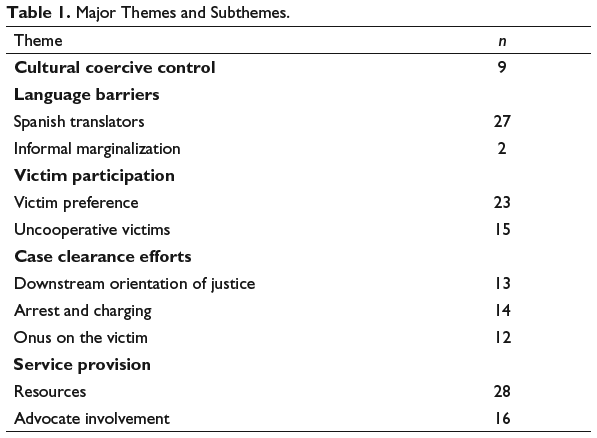
Five broad, overarching themes related to case processing and police response to IPV incidents involving Latina immigrants were identified from qualitative analysis of the case files. Each theme included subthemes that were not always mutually exclusive. To best present the findings, themes are situated within the three, broad, chronological time points of a case: (a) initial reporting, (b) investigation, and (c) case disposition.
Major Themes and Subthemes.
T1: Cultural Coercive Control
In terms of the initial reporting stage, the first major theme was identified as “cultural coercive control” and encompassed unique obstructions that hindered Latina immigrant victims from initially contacting and/or reporting the IPV incident to the police. Within the case files, police noted that suspects often engaged in culturally specific threats to maintain control over Latina immigrants. These ranged from threats to harm victims’ families in their countries-of-origin, intimidating the victim with deportation threats, and limiting or impeding their ability to apply for documentation status in the future if they were to contact police. In a case involving a 25-year-old Latina immigrant from Honduras, an officer documented, “[S]he never called the police because he told her that if she ever tried to leave him or had him arrested, he would have her family in the Honduras [sic] either hurt or killed.” This fear tactic hindered her ability to feel comfortable in accessing legal assistance for her own physical safety because she was forced to prioritize the safety of her family. Related, a case involving a 28-year-old Latina immigrant from El Salvador involved a responding officer who detailed similar impediments in the initial report, “She is new to the county and wants to become a citizen. She stated that he threatens her loss of citizenship if she tries to get help.” Again, threats by the suspect to eliminate access to legal citizenship were effective in limiting this victim’s ability to gain protection from partner violence by the very authorities tasked with preserving her physical safety.
Suspects also enacted power over Latina immigrant IPV victims using tactics to control their identification status. In multiple incident reports, the responding officer documented that a suspect would steal a green card or other forms of identification belonging to the victim from their country of origin, along with additional personal and necessary belongings. In an incident involving a 34-year-old Latina immigrant from Honduras, the responding officer noted, “He stole my green card, cell phone, and keys to my apartment.” This effectively limited her mobility and controlled her movements and autonomy—including her ability to get help.
T2: Language Barriers
Also within the context of the initial reporting stage, the second major theme identified was “language barriers.” This barrier related specifically to obstacles in communicating with police who responded to the initial call and/or were involved in the investigation of the IPV case. Language barriers consisted of two subthemes: (a) Spanish translators and (b) informal marginalization.
Spanish translators.
Spanish translators were essential to a victim’s ability to voice their experiences and provide a statement to police that detailed the violence. Often, however, the victim did not speak fluent English and/or was more conformable communicating in her native language. In these instances, a skilled Spanish translator was necessary for the appropriate documentation of the case. Qualitative data demonstrated that the Spanish translators used were not a commissioned officer or police employee. Instead, in many instances, the translator was a civilian located by the responding officer out of convenience or by proximity to the incident with no formal authority or police affiliation. Indeed, witnesses, reportees, bystanders, neighbors, apartment staff, and EMS personnel acted as informal Spanish translators for police. If a translator was a police employee, often, the victim had to wait for another police unit to arrive on the scene with a skilled Spanish translator. For example, in responding to a call involving a 33-year-old Latina immigrant from Honduras, the officer recorded, “I contacted officer [redacted] riding unit to translate over the phone and later he showed up on scene to translate.” In another instance involving a 28-year-old, Latina immigrant from Honduras, the officer noted, “I was able to have the details translated by complainants 14YO sister [sic].” In one case that moved from the initial report to a specialized investigator, involving a 39-year-old Latina immigrant from El Salvador, the investigator detailed,
I called complainant at her cell phone at 8:30
Informal marginalization.
Informal marginalization stemming from language barriers was present in several IPV cases in this sample. Put differently, because of the victim’s lack of English fluency, they were informally penalized and marginalized. For instance, in an IPV case involving a 28-old Latina immigrant from Honduras, police noted, “She stated that she did not call the police because she did not know that is was against the law [sic].” In other words, a lack of understanding surrounding family violence statutes in US jurisdictions limited these victims’ help-seeking behavior in terms of their willingness to call police for intervention because they remained unaware that violence in relationships was against the law. In another instance involving a 22-year-old Latina immigrant victim from El Salvador and a US citizen suspect, the responding officer described the actions at the scene, “I arrived and obtained the report information. I gave the suspect the case number and completed this report.” Nothing was documented in this case file in terms of providing the victim with information pertaining to the incident, which ultimately provided the suspect with continued control over the victim and the ability to potentially engage in continued partner violence without legal repercussions. Indeed, because of language barriers, the victims in these cases were underserved by limiting their access to information and legal recourse, which continued their dependency on the perpetrator who could then continue to use violence as a means of control in these intimate relationships.
T3: Victim Participation
The third major theme was identified as “victim participation” and was pertinent for the progression of a case during the investigation phase. Victim participation consisted of two subthemes: (a) victim preference and (b) uncooperative victims.
Victim preference.
In terms of case progression, Latina immigrant IPV victims overwhelmingly verbalized to police that they would pursue the case against the suspect. To that end, the women in this sample largely wanted to initially cooperate with police. In an IPV call involving a 33-year-old Latina immigrant from Honduras, police noted, “She is in fear of the suspect, but will press charges for the assault.” Similarly, in a case involving a 42-year-old Latina immigrant from Mexico, police noted, “She was offended by the susps actions and will aid in prosecution [sic].” Another instance concerning a 30-year-old, Latina immigrant from Honduras, police described, “[S]he stated she wished to press charges on him.” Qualitative evidence demonstrated the willingness of victims to exercise agency and initially participate in the formal case processing of these IPV incidents. This changed, however, as the case progressed.
Uncooperative victims.
While many of the women in this sample had initially indicated a strong preference for cooperating with police in the formal processing of the case, victims largely discontinued participation with the investigation as time passed. This was recorded in multiple ways, where victims did not return phone calls initiated by police, declined to meet a specialized investigator at the police station, or did not “show up” to pre-scheduled meetings. This lack of cooperation was also noted as recanting statements about the incident or because the victim had reconciled with the suspect. In a case involving a 20-year-old Latina immigrant from Mexico, one specialized investigator noted, “It has been approx. 21 days and listed complainant has not come into FVU to pursue charges.” Similarly, in one case involving a 22-year-old Latina immigrant from El Salvador, an investigator noted, “As of 04/16/15, the complainant has not come into nor contacted any of our family violence unit to follow up in this case.” Another case involved details from a responding officer: “[T]he statements obtained were conflicted. The complainant stated that an assault did not occur and that the suspect did not threaten her.” In a different instance involving a 33-year-old Latina immigrant from Honduras, one specialized investigator noted, “On 03/28/17 at 0807 hrs, I was in telephone contact with complainant who stated she will not file charges at this time as she said they are still together and they ‘worked it out’.”
T4: Case Clearance Efforts
In terms of case disposition, the fourth major theme was identified as “case clearance efforts” and encompassed police officer decisions about how to dispose of IPV incidents. Case clearance efforts consisted of three subthemes: (a) downstream orientation of justice, (b) arrest and charging, and (c) onus on the victim.
Downstream orientation of justice.
This subtheme, downstream orientation of justice, demonstrated that within this agency, responding officers or specialized investigators did not make arrest decisions in the IPV incidents without informally consulting or pre-screening cases with prosecutors. For example, in one case involving a 41-year-old Latina immigrant from Honduras, the investigator noted, “I will present the case to the District Attorney’s office to see if charges will be accepted.” This statement was included in the case file after this investigator had finalized contact with both the victim and suspect for follow-up statements, demonstrating that, despite corroborating accounts of the assault from both parties, the investigator was still compelled to obtain prior approval from the district attorney to make an arrest, even though probable cause existed to justify suspect apprehension. In a similar instance, an investigator noted, “On 04/18/17 at 15:27 hours, I contacted the D.A.O. and relayed all facts over to Assistant D.A. [redacted].” Officers who were on scene also engaged in this practice of downstream decision-making. An officer responding to a call involving a 25-year-old Latina immigrant from Honduras detailed, “I took pictures of the bruises on her arms and neck and called and spoke with ADA [redacted].” Again, it appears that the responding officer had physical evidence to corroborate the victim’s allegations of partner violence and thus, had established probable cause to make an arrest, but contacted the assistant district attorney for confirmation that the case was worthy of continued police efforts.
Arrest and charging.
Within the context of case clearance, qualitative data indicated that arrest and charging decisions made by police were largely reserved for IPV incidents involving cooperative victims, incidents with documented injuries or physical evidence, and offenses perceived as more severe by officers. In other words, officers made decisions regarding what constituted incidents worthy of police efforts and resources involving Latina immigrant IPV victims. For example, in an incident involving a 17-year-old Latina immigrant from Mexico, an officer chronicled, “I explained the facts and evidence of this case and he [ADA] accepted charges for assault bodily injury of a family member. This is the second offense on suspect [redacted].” In a different case involving a 25-year-old Latina immigrant from Honduras, an on-scene officer noted, “I examined the complainant and took pictures of the bruises on her arms and neck. I called and spoke with ADA [redacted] who took charges for felony strangulation.”
Onus on the victim.
Alternatively, in terms of case clearance efforts, the subtheme “onus on the victim” was identified. If victims did not participate or cooperate with case processing efforts, police disposed of these incidents without making an arrest or passing the case to the DA for charging. Investigators used the absence of victim cooperation as sufficient rationale to bypass investigative efforts and instead, close cases by ultimately putting the responsibility on the victim for lack of participation. In an incident involving a 30-year-old Latina immigrant from Cuba, an officer noted, “As of 1/09/17, the comp. [complainant] has not come in. This case will be cleared for lack of prosecution by the comp.” Similarly, in a case involving a 42-year-old Latina immigrant from El Salvador, an officer noted, “As of 8/26/15, the comp has not followed through … unless the comp come for follow up in this case, this case will be cleared as inactive pending she files before staute of limitation expires [sic].” Related, another incident involved a 37-year-old Latina immigrant from Mexico in which an officer detailed, “I presented this case to ADA [redacted] who refused charges due to lack of cooperation from compl[ainant] and her unwillingness to follow up. This case will be cleared.” The qualitative data demonstrated that, in practice, police closed cases when victims declined to participate or cooperate in the formal process, despite probable cause for arrest and charging.
T5: Service Provision
The final major theme was identified as “service provision” and identified police officer decision-making related to services offered for Latina immigrant IPV victims. Service provision consisted of two subthemes: (a) resources and (b) advocate involvement.
Resources.
Broadly, police officers in this agency did provide referrals to community and advocacy resources for Latina immigrant IPV victims. As a matter of policy in this agency, victims involved in gender violence offenses including IPV should be provided with a “blue form” that contained contact information about local resources, advocacy services, and crisis centers. Despite dissemination of this blue form, the victim was still responsible for initiating contact with service providers—behavior that would put the victim’s safety at risk for potential retaliatory violence by the perpetrator. An officer responding to an IPV call involving a 36-year-old Latina immigrant from Mexico noted, “I officer [redacted] gave the complainant her case number and a victims blue form card for this incident [sic].” Similarly, an officer on scene with a 23-year-old Latina immigrant from El Salvador noted, “I was able to get the story from [redacted] who helped a lot. I gave the compl[ainant] a blue family violence form and highlighted the number for victims of domestic violence for her.” Again, these are instances in which police did provide appropriate resource information, though the victim was responsible for initiating contact with service providers rather than being contacted by victims’ assistance for help in navigating the complex legal process surrounding case processing.
Advocate involvement.
In some incidents, police officers did involve a victim advocate who was embedded within the police agency in the investigation. This practice was not widespread among this sample of IPV cases. In a case involving a 30-year-old Latina immigrant from Cuba, for instance, the investigator contacted and assigned the advocate to follow up with the victim,
This case was assigned to counselor [redacted] by sergeant [redacted] on 12/16/16. On 12/16/16, I contacted the comp at her listed cell number at 9:47
Related, a sergeant assigned a counselor to a case involving a 34-year-old Latina immigrant from Mexico, “Counselor contacted complainant via phone at 2:15
Discussion
The current study employed a LatCrit theory framework and qualitative methods to examine 36 police case files drawn from an agency located in one of the fifth most populous and diverse US cities to investigate police response in IPV incidents reported by Latina immigrants. Five themes emerged from the qualitative data: (a) cultural coercive control, (b) language barriers, (c) victim participation, (d) case clearance efforts, and (e) service provision as related to case processing and police response. Several findings are worthy of additional discussion.
First, results of the analyses demonstrated that responding officers noted the ways suspects engaged in cultural coercive control. In line with existing research (Reina & Lohman, 2015; Salcido & Adelman, 2004; Zadnik et al., 2016), suspects often used threats in myriad ways to control and restrict victim behavior to silence any potential outcry of violence. This dependency and the overt control with which suspects exercised over victims prohibited mobility, agency, and autonomy among these women. As a result, findings presented the ways victims were unlikely to participate in the formal process during the initial stages, thereby contributing to case attrition. From a policy standpoint, implementing linguistically and culturally appropriate educational programming aimed at the Latinx immigrant community is necessary to increase awareness about social services and legal remedies available for crime victims (e.g., Violence Against Women Act, VAWA) (Menjívar & Salcido, 2002; Raj & Silverman, 2002; Reina & Lohman, 2015; Vidales, 2010). Officers in this instance are in a position to discuss their role in the U-visa process and how this tool may address fear surrounding deportation, status, and legal dependency (Ivie & Nanasi, 2009), specifically among Latina immigrant IPV victims. It may be that awareness surrounding available remedies facilitates reporting among Latina immigrants.
Second, findings demonstrated the significant language barriers between police and Latina immigrant IPV victims. This finding aligns with prior research (Ammar et al., 2005; Vidales, 2010) and is particularly interesting given that data are from one of the fifth largest and most diverse US cities. In this sample, Latina immigrant IPV victims had to rely on proximally close, non-police-affiliated, Spanish translators to relay pertinent information to responding officers. This obstacle has the potential to produce misinformation, delayed investigations, and frustrated victims who may withhold cooperation if they are unable to communicate with officers. As a result, victims are further disenfranchised and denied protection under the law. Indeed, language barriers identified in this sample had a profound impact on case processing, and, from a broader standpoint, may produce shortcomings for victim safety. In terms of policy, this finding speaks to the necessity of recruitment strategies that diversifies the policy agency with multilingual officers. Alternatively, it may be fruitful to deploy officer units with Spanish-speaking personnel or Spanish-speaking advocates if they are available.
Third, themes presented how important victim participation was for case progression, especially during the investigation phase. This reiterates research that has underscored the importance of victim preference and cooperation in IPV case processing (Dawson & Dinovitzer, 2001; Kingsnorth & Macintosh, 2004; O’Neal & Spohn, 2017). That said, the majority of Latina immigrant IPV victims indicated an initial preference for pursuing charges against the suspect, but largely discontinued cooperation during the investigation phase of case processing. While it is not uncommon for IPV victims more generally to limit cooperation due to fears surrounding retaliation and reprisal, the current study cannot speak exactly to why victims discontinued cooperation in this study. From a LatCrit lens, however, it may be that for Latina immigrant IPV victims specifically, this is further exacerbated by the police who are part of a racialized criminal legal system that has enacted policies, including federal immigration enforcement at the municipal level: This could be a contributing factor in terms of discontinued cooperation. This is to say that Latina immigrant IPV victim cooperation may be related to multiple systems of oppression and this phenomenon warrants further empirical consideration. It may also be beneficial to examine victim cooperation as a process or series of decisions at each point in the formal process, rather than a single event, in future research. From a policy standpoint, police would benefit from specialized training on the complex dynamics of IPV and immigration so that they may be more sensitive to how victims may behave without labeling them “uncooperative.”
Fourth, result demonstrated subthemes within case clearance efforts that were centered on the downstream orientation of justice, arrest and charging decisions, and placing onus on the victim. In this sample, officers exercised an informal reliance on consulting or pre-screening cases with the DA’s office that involved Latina immigrant IPV victims. This reiterates existing research where police and prosecutorial decision making cannot be disentangled (Spohn & Tellis, 2019), which is problematic because police often confer with prosecutors about how to progress forward, despite having established probable cause with the necessary evidence to proceed with arrest. Related, in this sample, officers reserved formal intervention for cases that were perceived as more serious, involved cooperative victims, and had tangible evidence of injury and abuse—potentially underscoring long-standing misconceptions surrounding IPV (Fleming & Franklin, 2021; Koss et al., 1994). Additionally, related to victim participation, cases without cooperation were cleared without any additional investigative efforts. This has underscored the importance of victim cooperation among Latina immigrant IPV victims as an area for intervention to facilitate successful IPV case processing.
Finally, contrary to prior research that has assessed police service referral to IPV victims (Jones & Belknap, 1999; Kernic & Bonomi, 2007), officers in this sample often provided Latina immigrant IPV victims with information pamphlets containing contact information for community resources, though officers did not provide U-visa referrals. It may be that officers have limited knowledge about this legal remedy and therefore, do not make these types of referrals. Alternatively, they may believe that victims “lie” in order to receive documentation status—that they are not legitimately in need of protection in the form of U-visas. These are both questions for future empirical research. It is also noteworthy that embedded advocates were involved in only about half of the cases in this sample. The importance of service referral and advocate involvement cannot be understated as this has the potential to mitigate trauma, facilitate victim cooperation, and enhance IPV case processing (Goodson et al., 2020, 2021; Camacho & Alarid, 2008). Resource provision may be particularly important for Latina immigrant IPV victims because they have encountered increased barriers and significant impediments from social and justice entities (Ammar et al., 2005; Menjívar & Salcido, 2002; Raj & Silverman, 2002; Sokoloff & Dupont, 2005). In terms of policy, it is necessary for officers to decide to involve a victim advocate in all cases. This may be expedited by ensuring that officers are familiar with advocates and hold positive perceptions of them (Goodson et al., 2020).
Findings from this study are instructive, though not without limitations. The case files used here were drawn from a larger sample collected from a sizeable police department located in one of the fifth largest and most diverse U.S. cities. Results should be interpreted accordingly; they may not be generalizable to smaller or more homogenous police departments or those departments located in more suburban or rural areas. Future research should assess police response to Latina IPV victims in these types of geographic jurisdictions to replicate qualitative findings. Additionally, from a LatCrit lens, it would be beneficial to further examine police response to Latina immigrant IPV victims with consideration to a focus on specific sub-nationality populations. Because Latina immigrants have a multidimensional identity, it may be that the experiences of Latina immigrants from Central America vary when compared to Latina immigrants from South America and Mexico. In other words, this is merely one study in advancing the effort to further diversify research that investigates police response to IPV victims and their multiple experiences of oppression and marginalization both as victims but also as women of color. While qualitative extraction of themes from case files can provide rich and detailed information involving an IPV incident, each case file is limited in terms of what is recorded by police who are directly involved in the response and investigation of the case. In other words, if an officer or investigator did not record information, it does not mean the information did not exist. The information may not have been explicitly mentioned, and therefore could not be extracted during analysis. Finally, researchers were unable to disentangle the victims’ precise documentation status of the victims in this sample (undocumented, awaiting status, permanent resident, etc.). It could be that documented and undocumented Latina IPV immigrants encounter different challenges or barriers when seeking help from police (Mowder et al., 2018). From a LatCrit perspective, this could result in a difference of experience for Latina immigrant IPV victims with and without documentation. Future research should assess police response and decision-making among undocumented and documented Latina immigrant IPV victims to identify and improve potential shortcomings.
Despite these limitations, the present study advanced the small body of literature on Latina immigrant IPV victims by contextualizing police response and decision-making using a LatCrit theory framework and case file data. The five overarching themes presented a glimpse into shortcomings, areas for improvement, and future research in terms of police response and case processing. Findings have underscored the need for police to provide culturally and linguistically appropriate responses, to help facilitate and maintain victim cooperation, and the importance of officer service referral; all of which could improve how the criminal legal system responds to partner abuse among Latina immigrants.
Footnotes
Acknowledgments
The authors would like to thank the police partner agency for providing access to redacted case files and Eryn O’Neal, Sarah Steele, and Ryan Randa for their helpful comments on earlier drafts of this manuscript.
Declaration of Conflicting Interests
Funding
The author(s) disclosed receipt of the following financial support for the research, authorship, and/or publication of this article: This project was supported by Grant No. 2016-SI-AX-0005 awarded by the Office on Violence Against Women, U.S. Department of Justice.
