




Abstract
Sexual assault (SA) decision-making literature primarily focuses on criminal-legal actors and often overlooks victim decision making. This relative dearth in research is problematic, as victims are principal gatekeepers of the criminal-legal process who influence whether perpetrators are arrested and prosecuted. Subsequent victim support is also contingent on the reporting decision. Overall, this body of research would benefit from a better understanding of how victims activate and participate with the criminal-legal system and the potential impact of these decisions on criminal-legal processes. Moreover, victim decision making is often situated in a theoretical analyses. Victim decision making is complex and should be studied within a criminological decision-making framework. Therefore, the current study relies on National Crime Victimization Survey (NCVS) data and applies a focal concerns perspective (FCP), informed by rape culture concepts, to examine why victims of sexual violence may or may not choose to report to legal authorities. The current study offers initial support for the application of FCP to victim reporting decisions. We found that victims consider each of the focal concerns (FC). Victims were more likely to report when offenders threatened them with harm (i.e., suspect blameworthiness), when the offense occurred in a private location (i.e., protection of the community), and when they sought help from victim support agencies or medical treatment (i.e., practical considerations). Additionally, we found that Black victims were more likely to report than other racial-ethnic groups (i.e., perceptual shorthand). These findings highlight a nexus between reporting to police and help-seeking via support agencies. Importantly, the results emphasize the importance for police to implement cultural competence and antiracist training to better support Black victims.
Introduction
Sexual assault (SA) and rape are serious violent crimes that impact millions of people worldwide every year. In 2018, in the United States alone, approximately 734,630 individuals self-reported experiencing sexual victimization (Morgan & Oudekerk, 2019). These prevalence rates contrast against low levels of formal reporting, where relatively few incidents come to the attention of the criminal-legal system. Unfortunately, the discrepancy in sexual victimization experiences and formal reporting is not new (O’Neal & Hayes, 2020a). Despite rape law reforms aimed at increasing victim reporting and enhancing the response to sexual victimization, the criminal-legal system has historically and continues to inadequately address and respond to sexual violence (Clay-Warner & Burt, 2005; Spohn, 2020). With the redefinition of rape, the removal of evidentiary requirements, the elimination of resistance requirements, and the establishment of rape shield laws, the idea was victims would be more willing to come forward to formally report their experiences (Clay-Warner & Burt, 2005; Horney & Spohn, 1991). However, despite sweeping changes to the laws governing SA, victims of sexual violence have remained reluctant to report these crimes to police (Bachman, 1993, 1998; Fisher et al., 2003; Wolitzky-Taylor et al., 2011).
These coinciding phenomena—that is, the high prevalence of sexual victimization and the number of sexual victimizations that go unreported—demonstrates the need to understand the factors that encourage or discourage official reporting (Skogan, 1977). The current study, therefore, aims to examine whether and how (i.e., what factors shape this decision-making point) victims choose to contact police after experiencing sexual victimization. Moreover, this research objective is important, as decision-making literature highlights the impact of victim decisions on case outcomes (Bouffard, 2000; Kingsnorth et al., 1999; Spohn & Tellis, 2012). Indeed, victims are “principal gatekeepers” of the criminal-legal process and the decision to report a crime (or not report a crime) influences whether a perpetrator will be brought to “justice” (Gottfredson & Gottfredson, 1988; Sylaska & Edwards, 2014). We enclose “justice” in quotations to address that people of Color are often arrested and sanctioned at higher rates and more harshly than their White counterparts (Kennedy, 2001). Additionally, victims of Color who seek criminal-legal resources are confronted with barriers that White victims do not experience, such as culturally incompetent support providers (Crenshaw, 1991). In light of issues such as these, questions still remain whether “justice” is truly attainable for all.
Research examining victim decision making has traditionally been situated within rational choice perspectives—or the decision to choose freely based on costs and benefits of the decision (Akers & Kaukinen, 2009; Bachman, et al., 1992; Felson et al., 2002; Kidd & Chayet, 1984; Kingsnorth & Macintosh, 2004). However, Kaiser et al. (2017) argue that the focal concerns perspective (FCP) can offer a more nuanced explanation of victim decision making in SA cases specifically. This perspective maintains that legal actors consider specific contextual factors during decision making steps (e.g., the sentencing decision) that determine case outcomes (Lynch, 2019; Steffensmeier et al., 1998). Focal concerns (FC) theorists posit that court actors consider the blameworthiness of the suspect (e.g., suspect injured victim) practical considerations (e.g., costs borne by the correctional system), and the protection of the community (e.g., suspect used weapon) during case processing decisions (Steffensmeier et al., 1998). When legal actors do not have all of the facts of the case, they develop a “perceptual shorthand” that is predicated on stereotypes, associated with race, age, and gender, regarding the individuals involved (Steffensmeier et al., 1998). Indeed, the FCP is one of the predominant theories used to explain criminal-legal decision making among actors in the system (Crow & Adrion, 2011; Higgins et al., 2012; O’Neal & Spohn, 2017). However, based on recent FCP research examining victim cooperation decisions in SA (Kaiser et al., 2017), it is possible that this theoretical approach can offer insight into why victims of sexual violence choose to report (or not report) to legal authorities. This study, therefore, expands recent applications of the FCP to victims’ decisions to cooperate during SA cases by focusing on the reporting stage using relevant, crime-specific, and rape culture measures of FC.
Literature Review
Rape Reporting
SA reporting rates range from approximately 25% to as low as 5% (Bachman, 1993, 1998; Fisher et al., 2003; Wolitzky-Taylor et al., 2011). These relatively low reporting statistics may seem alarming given Tjaden and Thoennes (2006) reported that one in six women are raped. Moreover, in 2018, 734,630 incidents of SA were reported to the National Crime Victimization Survey (NCVS; Morgan & Oudekerk, 2019). The large gap between sexual victimization and reporting has been a driving force behind victim decision-making research. Ultimately, this research attempts to understand the benefits and barriers associated with reporting these crimes to authorities. For example, reporting can be a means of receiving medical and psychological treatment from support agencies (Block, 1974; Rennison, 2002; Tjaden & Thoennes, 2006). Additionally, successful adjudication, conviction, and rehabilitation of perpetrators following reporting can prevent subsequent victimizations and promote deterrence of future offending (Bachman, 1993, 1998; Feldman-Summers & Norris, 1984). Importantly, victims are “principal gatekeepers” of the criminal-legal process; their decisions to report influence the criminal-legal system by determining which offenders are more likely to be detected and sanctioned (Gottfredson & Gottfredson, 1988; Sylaska & Edwards, 2014).
Although there are benefits to reporting, barriers to reporting are important to highlight. Victims who do not report their victimization have stated concerns regarding fear of reprisal from the suspect, fear of being blamed for the crime, and not wanting anyone to find out about their victimization experience (Bachman, 1993, 1998; Chen & Ullman, 2010; Felson et al., 2002; Wolitzky-Taylor et al., 2011). Victims have also cited fear that their report would not be taken seriously or they would not be believed by police (Felson & Paré, 2005; Fisher et al., 2003; Pinciotti & Seligowski, 2019). Additionally, fear of mistreatment by the criminal-legal system is a concern for some victims. This fear is not unwarranted; indeed, such mistreatment by the criminal-legal system is commonly referred to as “the second rape” (Campbell, 1998; Ullman, 2010). Fear, shame, and a lack of confidence in the criminal-legal system are some of the most well-established reasons for declining to report (James & Lee, 2015; Jones et al., 2009; Thompson et al., 2007).
Studies evaluating victim reporting decisions following SA crimes have established that both legal and extralegal factors affect victim reporting. Legal factors are variables that relate to case characteristics and have legal or law-based relevance. For example, research has established that victims of SA are more likely to report the crime when they are physically injured during the attack (Bachman, 1993, 1998; Clay-Warner & McMahon-Howard, 2009; Du Mont et al., 2003; Lizotte, 1985; Wolitzky-Taylor et al., 2011), when the suspect used a weapon (Addington & Rennison, 2008; Bachman, 1998; Clay-Warner & McMahon-Howard, 2009; Fisher et al., 2003), and when the crime occurred in a public location (Clay-Warner & McMahon-Howard, 2009). These legal factors often align with indicators of crime seriousness (i.e., measures of the severity of the crime including harm to the victim) and evidentiary strength (i.e., factors that provide evidence that the crime occurred including witness presence and physical evidence).
Victims also consider extralegal factors—legally irrelevant factors that center on victim, perpetrator, and contextual characteristics—in their decision to report to police. Prior scholarship has determined that victims who are of a lower socioeconomic status (Bachman, 1993; Block, 1974; Clay-Warner & McMahon-Howard, 2009), received little to no college education (Chen & Ullman, 2010; Wolitzky-Taylor et al., 2011), were married at the time of the incident (Avakame et al., 1999; Baumer, 2002; Lizotte, 1985), participated in alcohol/drug use at the time of the offense (Block, 1974; Fisher et al., 2003; Jones et al., 2009; Thompson et al., 2007) and did not know the suspect (Chen & Ullman, 2010; Estrich, 1987; Fisher et al., 2003; Lizotte, 1985; Wolitzky-Taylor et al., 2011) were more likely to report to police. The victim-suspect racial-ethnic dyad has also been shown to play a role in victim reporting decisions. Specifically, research suggests White victims are more likely to report to police when the perpetrator was Black (Clay-Warner & McMahon-Howard, 2009; Greenberg & Ruback, 1992; Lizotte, 1985). These concerns speak to norms regarding credible victims, culpable suspects, and “real rape” and rape culture ideologies (Estrich, 1987)—all of which may influence self-blame and hinder reporting. Importantly, rape myths affect women of Color differently than White women. Indeed, women of Color experience a “double dose” of rape myths given they experience both gender-based and race-based rape myths (Donovan & Williams, 2002). Indeed, women of Color have the added burden of oppressive stereotypes (e.g., Jezebel, Malinchismo, squaws), that depict them as unrapable, not only because of their “risky behavior” (e.g., walking alone at night, drinking and drug use, sex work) but because of their social identity (Crenshaw, 1991). Consequently, women of Color consider factors associated with their racial-ethnic identity during the decision to report.
Theoretical Frameworks: Rape Culture and the Focal Concerns Perspective
The findings highlighted above indicate that victims of SA may develop attitudes of self-blame, which are arguably influenced by rape culture. Rape culture is a theoretical construct in which a pervasive set of destructive societal beliefs and ideals normalize sexual violence and create an environment that justifies and allows rape to occur (Herman, 1988). A prominent aspect of rape culture is the widespread acceptance of rape myths, false beliefs, and/or ideas about the causes, characteristics, and consequences of sexual violence promoting violence against women (Brownmiller, 1975; Burt, 1980). Residing in a rape culture and the associated acceptance of rape myths influence an individual’s critical perception of rape, suspects, and victims. Particularly, subscribing to rape myths influences who is viewed as a “legitimate victim” and what constitutes “real rape” (Brownmiller, 1975; Burt, 1980; Estrich, 1987; LaFree, 1989). For example, American society predominantly defines “legitimate victims” of “real rape” as an unknown man assaulting a White, middle-class, conservatively dressed woman who has not consumed alcohol or engaged in any perceived risky behaviors. During the attack, she uses both physical and verbal resistance strategies which lead to injurious, medical, and physical evidence of the attack. Following the assault, she immediately discloses the rape to a fresh-complaint witness and promptly reports the rape to the police (Brownmiller, 1975; Estrich, 1987; LaFree, 1989; O’Neal, 2019; Ullman, 2010). These pervasive rape-culture attitudes, which act to disqualify victims from victimhood, may shape victims’ FC during their decision to activate the criminal-legal system.
Women of Color are further dismissed from these conversations given their victimhood is often scrutinized by race-based and gender-based rape myths. For example, when Black women’s victimization is not accompanied by severe visible injuries, the legitimacy of their victimization is questioned (Slatton & Richard, 2020). Black women are labeled as strong and capable of surviving challenges including victimization and therefore, do not receive adequate help when they do report rape (Donovan & Williams, 2002; Tillman et al., 2010). Black, Latina, and American Indian women’s subjections to sexuality-based stereotypes, which depict them as promiscuous women who tempt men and invite sexual violence (Collins, 1990; Donovan & Williams, 2002; hooks, 1981), also create barriers to their reporting. These stereotypes/rape myths work to justify the victimization of women of Color.
It is important to point out that FC are considered differently among women of different racial-ethnic backgrounds. For example, suspect blameworthiness is regarded differently for Black women who may consider the mass incarceration of Black men when the assailant is Black. Practical considerations. And protection of the community involves the protection of cultural norms, beliefs, and practices. Theoretical discussions regarding the victim reporting decision are often overlooked, which is troubling given victims’ critical role in the criminal-legal system (but see Avakame et al., 1999; Clay-Warner & McMahon-Howard, 2009; Felson & Paré, 2005; Kingsnorth & Macintosh, 2004). Indeed, victims are the personal gatekeepers of the criminal-legal system—if one does not report their victimization, it cannot be handled by authorities, and the likelihood of receiving necessary follow-up services decreases (Gottfredson & Gottfredson, 1988; Krug et al., 2002). Like police and prosecutorial decision making, victim decision making is complex and not automatic and deserves to be studied within a well-established criminal-legal decision-making framework. For example, the FCP, which is one of the predominant theories used to explain criminal-legal decision making (Crow & Adrion, 2011; Higgins et al., 2012; O’Neal & Spohn, 2017), may provide insight into why victims of sexual violence choose to report (or not report) to legal authorities. Importantly, FC theorists advocate for the expanded application of the perspective (Kramer & Ulmer, 2002; Ulmer & Johnson, 2004)
The FCP was originally theorized by Miller (1958) in an effort to study and understand lower-class culture and later applied by Steffensmeier (1980) to judicial decisions during sentencing. To assess disparities in sentencing outcomes, Steffensmeier et al. (1998) described three main FC relevant to judicial decision making: (a) the suspect’s blameworthiness, (b) the protection of the community, and (c) practical considerations. Overall, this approach maintained that court actors consider these contextual factors when making sentencing decisions.
The first FC, suspect blameworthiness, includes indicators of crime severity and offender culpability—such as victim injury—to assess an offender’s level of responsibility or guilt (Steffensmeier et al., 1998). This FC is connected to assertions that the defendant’s potential punishment should fit the crime (Steffensmeier & Demuth, 2001). Research finds that measures related to blameworthiness, as indicated by offense severity factors, affect the likelihood that victims will report to police. Factors such as penetrative rape (Bouffard, 2000; Du Mont et al., 2003), victim injury (Bachman, 1993, 1998; Block, 1974; Wolitzky-Taylor et al., 2011), a stranger offender (Block, 1974; Lizotte, 1985; Wolitzky-Taylor et al., 2011), and offender alcohol consumption (Block, 1974) are assessed to determine the degree of suspect culpability and harm caused to the victim (Steffensmeier et al., 1998).
The second FC, community protection, focuses on the incapacitation of offenders based on their perceived dangerousness. In this circumstance, judges focus on offenders’ probable future behaviors by assessing their dangerousness and potential for recidivism (Steffensmeier & Demuth, 2001). For example, judges’ decisions may be informed by whether the offender used a weapon during the crime, the offender’s history of criminal activity, and/or drug dependency (Steffensmeier et al., 1998). Like judges, victims may perceive weapon use and crime location as indications of possible future violence and decide to report their victimization to police to prevent future crimes by the perpetrator. Studies find that victims consider whether a weapon was used and the location of the attack during the reporting decision (Addington & Rennison, 2008; Bachman, 1998; Chen & Ullman, 2010; Clay-Warner & McMahon-Howard, 2009; Fisher et al., 2003; Lizotte, 1985; Xie et al., 2006).
Finally, FC scholars argue that judges think about practical considerations such as preserving courtroom relationships and maintaining case flow efficiency (Steffensmeier et al., 1998). Practical considerations for victims include whether and how to seek medical treatment or advocacy assistance while navigating through the legal process (Campbell, 1998; Patterson, 2011). Victims can gain access to these services on their own or through official police reporting (Campbell, 1998; Rennison, 2002; Tjaden & Thoennes, 2006). The reporting decision, however, is further complicated by practical considerations such as personal and social concerns. Block (1974) argues that the victim notification decision is informed by social and economic costs and benefits. For example, Block (1974) found that victims of a lower social class, measured by income, were more likely to report crimes to authorities. In another study, however, lack of resources including insurance coverage was cited as a barrier to reporting SA by female victims (Sable et al., 2006). Additionally, regarding employment status as an influential practical consideration for victims. participating in the criminal-legal process may mean victims have to take time off from work, which could affect reporting (Jones et al., 2009; Williams, 1984).
Determining an offender’s culpability, dangerousness, and “ability to do the time” requires complete case and offender information which judges rarely, if ever, possess (Steffensmeier et al., 1998, p. 767). Consequently, judges develop what has been labeled “perceptual shorthand”—or stereotypical judgments—through their reliance on extralegal factors, such as offender age, race, marital status, education, employment, and family history, during sentencing decisions. Judges may apply broadly held social stereotypes tied to racial and ethnic groups to inform their decisions. For example, judges who associate dangerousness with racial-ethnic minority groups, such as Black, Latino, and American Indian defendants, will deem these individuals as more deserving of punishment. In SA cases specifically, these stereotypes or “perceptual shorthand” reflect court actors’ perceptions and attitudes regarding “real rape” and who is rapeable (Estrich, 1987; LaFree, 1989). For example, women who engage in sex work are sometimes perceived as nondeserving of police resources (LaFree, 1989; O’Neal & Hayes, 2020b). Socially constructed stereotypes regarding “genuine victims” (LaFree, 1989) may be at the forefront of victims’ decisions to report.
Since the initial application of the FCP to judicial decision making, the perspective has been applied to other criminal-legal decision makers including police and prosecutors (Holleran et al., 2010; O’Neal & Spohn, 2017; Pattavina et al., 2016; Spohn et al., 2014). Collectively, these studies suggest police and prosecutors, like judges, consider the seriousness of the crime, the degree of injury to the victim, and the blameworthiness and dangerousness of the offender when making case processing decisions. This is in line with the original conceptualization of the perspective—as according to Miller (1958)—FC are a set of areas or issues which command widespread and persistent attention and a high degree of emotional involvement. Therefore, it makes theoretical sense to apply the FCP to victim reporting decisions, specifically for SA cases. Moreover, the FCP has been recently applied to victim cooperation at different stages of SA investigations (Kaiser et al., 2017). Importantly, Kaiser et al. (2017) found initial support for the application of the FCP to victim decision making using victim-specific measures of FC. Victim decisions are the “triggering mechanism for discretionary actions…of criminal justice functionaries” (Gottfredson & Gottfredson, 1988, p. 15), therefore, the current study focuses on victims’ gatekeeping decisions by assessing the FC that affect the reporting decision.
Current Focus
The current study contributes to SA decision-making literature by focusing on victim reporting following sexual victimization. This body of research would benefit from a theoretical analysis that highlights the intricacies of the reporting decision. Therefore, we extend the application of the FCP to the victim reporting decision by examining factors victims consider during the decision to report (or not to report) sexual violence. Research applying the FCP to victim decision making is in its infancy, therefore, we rely on the following research question as opposed to formal hypotheses,
Do sexual assault victims consider the blameworthiness of the suspect, the protection of the community, practical considerations, and perceptual shorthand when deciding whether (or not) to report their victimization to the police?
Methods
Data
The current study relies on NCVS data collected between 2006 and 2016 to examine the reporting decisions of SA victims. Conducted by the U.S. Census Bureau for the Bureau of Justice Statistics (BJS), the NCVS collects data on personal and household victimization through a survey of a nationally representative sample of households annually. Each year, 160,000 unique persons age 12 or older in about 95,000 households are interviewed on criminal victimization. Considering methodological changes implemented to the NCVS in 2006 (Rand & Catalano, 2007), the current study uses the concatenated NCVS data from 2006 to 2016.
The NCVS relies on self-reported victimizations that occurred within the prior six months. It is worth noting, however, that this timeframe can be problematic for SA victims, given the impact and lasting effects of trauma on memory caused by SA victimization (Campbell, 2012). Consequently, rape and SA are likely to be underreported during this six-month window compared to longer recall periods. To address this sampling design limitation, the current study evaluates NCVS data across multiple years to estimate rape and SA for subpopulations, as recommended by Kruttschnitt et al. (2014).
As captured by the NCVS, rape and SA include completed rape, attempted rape, sexual attack with serious assault, sexual attack with minor assault, SA without injury, unwanted sexual contact without force, verbal threat of rape, and verbal threat of SA (i.e., other SA). From 2006 to 2016, 879 cases fit in these types of victimizations. For the purpose of the study, we limit the data to single offenders only, which includes 802 cases (Bachman, 1993, 1998). In addition, missing values exist in the variables. The missing values across all the variables are 19.6%, which are mainly from the variables capturing offender age (11% missing) and offender weapon use (8.4% missing). Missing data analyses indicate the data are missing completely at random (chi-square = 2.40, df = 1, p = .121). The likelihood of reporting or nonreporting is consistent across cases with missing values and cases without missing values. Therefore, instead of using missing data imputation, listwise deletion is utilized in this analysis, resulting in a sample of 645 cases.
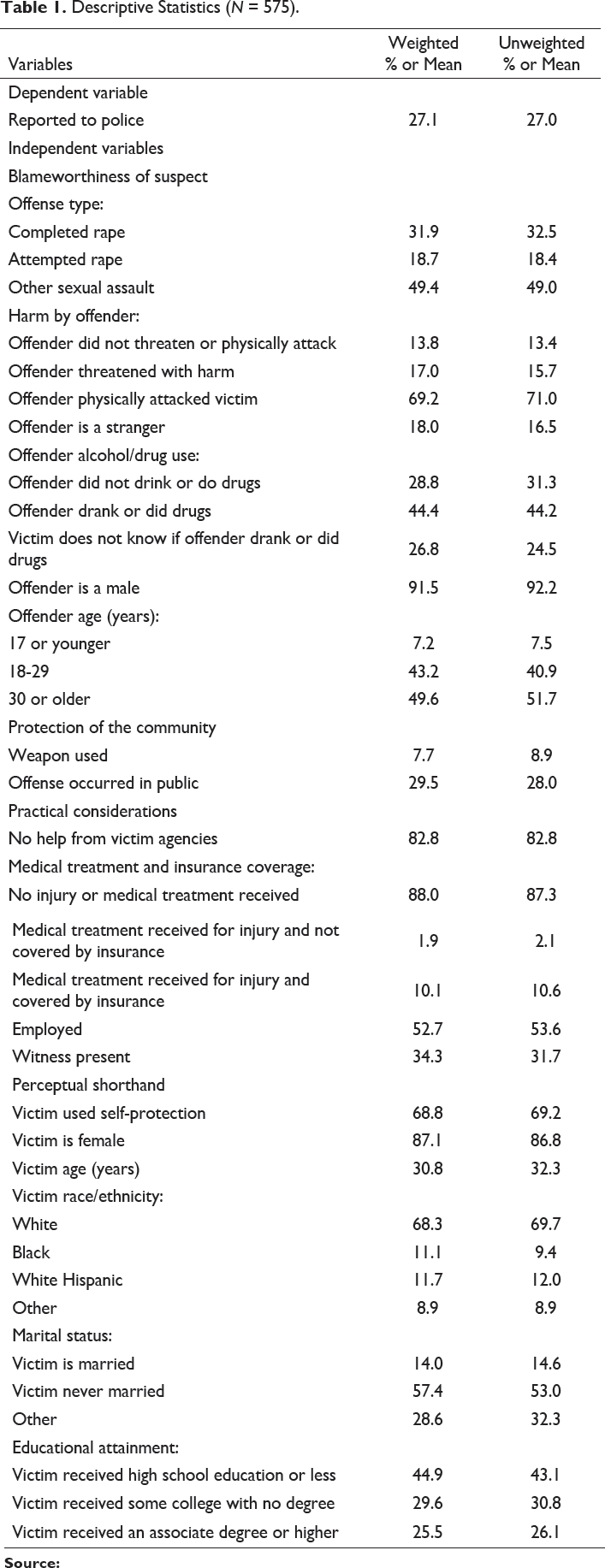
To effectively evaluate victims’ FC during the reporting decision, the current study includes only victims who self-reported their victimization experiences to the police. Cases reported to the police by individuals other than the victim (e.g., witnesses, family members, friends, school faculty, current or previous partners) were excluded (n = 89), resulting in a final sample size of 575.
Measures
Dependent variable.
The present study focuses on the victim reporting decision. Specifically, the current analysis will assess whether (or not) victims decide to contact police after sexual victimization. The dependent variable, therefore, is a dichotomous measure capturing whether the victim reported to the police (yes = 1, no = 0).
Independent variables.
This section presents four categories of variables aligning with the FCP but are specific to the victim reporting decision. Given the current study reoperationalized measures of the FCP to enhance relevancy and the application to victim reporting decisions, we provide theoretical arguments to support our selection of variables.
Blameworthiness of the suspect. Blameworthiness is captured using six variables related to offense severity, including offense type, harm by the offender, offender-victim relationship, offender use of alcohol and/or drug substances, offender sex, and offender age. These variables were included with the belief that victims consider the attributes of the suspect (e.g., offender age, offender-victim relationship) and the suspect’s actions during the offense (e.g., harm by the offender, offender alcohol/drug use) when making the decision to report to the police.
Offense type included three categories: completed rape, attempted rape, and other SA (reference group). Harm by the offender is a categorical variable that was dummy coded and measures whether the offender physically attacked or threatened to harm the victim. This variable includes three categories of offender did not threaten or physically attack victim, offender threatened victim with harm, and offender physically attacked victim (reference group). The victim-offender relationship measures whether the victim knows the offender (e.g., acquaintance, intimate partner) or if the victim does not know the offender (stranger = 1, known = 0). Offender substance use was captured by whether the victim stated the offender was drinking or on drugs at the time of the assault. This variable has three dummy coded categories including offender did not drink or do drugs, offender drank or did drugs, and victim does not know if offender drank or did drugs (reference group). Lastly, offender gender is a dichotomized variable (male = 1, female = 0). Offender age includes three categories of 17 or younger, 18 to 29, and 30 or older (reference group).
Protection of the community. Protection of the community—which is also related to the dangerousness of the suspect— is measured by two variables: suspect’s use of a weapon and the location of the offense. It is possible that victims would be more likely to report the crime to authorities to prevent future victimization of others. Therefore, to assess whether and how victims regard the dangerousness of the suspect during their reporting decision, we measured the suspect’s use of a weapon dichotomously (yes = 1, no = 0). The location of the offense is also measured dichotomously indicating whether the offense occurred in a public or private place (private = 1, public = 0).
Practical considerations. Practical considerations were measured by four variables, which include help from victim agencies, victim injury and medical care and insurance coverage, employment status, and witness presence. These four variables were included to measure the practical benefits and consequences related to reporting that victims may consider during the reporting decision. The first variable capturing these practical considerations assesses whether victims sought help from support agencies other than the police (yes = 1, no = 0). Regarding the second measure of practical considerations, since receiving medical care is contingent on whether the victim is injured, and using insurance is contingent on receiving medical care, this medical treatment and insurance coverage variable was therefore constructed based on the victim’s injury status, whether they received medical care for an injury, and whether the victim was covered by medical insurance at the time of the incident. The variable of medical treatment and insurance coverage contains three categories including no injury or medical treatment, medical treatment received for injury and not covered by insurance, and medical treatment received for injury and covered by insurance (reference group). The third variable, employment status, is a dichotomous measure of whether the victim was employed at the time of the incident (yes = 1, no = 0). Lastly, we included a binary measure of witness presence (yes = 1, no = 0) with the belief that victims may consider the evidentiary strength that witness presence would provide to help bolster the convictability of their case should they decide to report their victimization.
Perceptual shorthand. Perceptual shorthand is measured by six variables relating to victims’ characteristics including self-protection, gender, age, race and ethnicity, marital status, and education. Self-protection captures whether the victim took action to protect themselves during the incident (yes = 1, no = 0). Victim gender is a dichotomized variable with two categories (male = 0, female = 1). Age of the victim is a continuous variable measuring the victim’s age during the incident. Victim race and ethnicity includes four categories of White, Black, White Hispanic, and other race (reference group). Victim marital status is coded into a three-category variable including married, never married, and other (reference group). Victims’ education measures victims’ educational attainment, which contains three levels including high school or less, some college, and associate degree or higher (reference group).
Analytic Strategy
The dependent variable is a binary variable, with 27% (n = 155) of the victims having reported the incident to police. Therefore, a logistic regression model is appropriate for the purpose of the analysis. According to the BJS, NCVS uses a stratified, multistage cluster sampling design. Different from a simple random sample, the sampling design effect of a complex sample should be taken into consideration, in which the sampling bias introduced through unequal probability design can be controlled when making estimations. Therefore, the current study utilizes weighted data and a complex sampling procedure to conduct the logistic regression analysis.
Results
Descriptive Statistics (N = 575).
Logistic Regression of the Focal Concerns of Victim Reporting (N = 575).
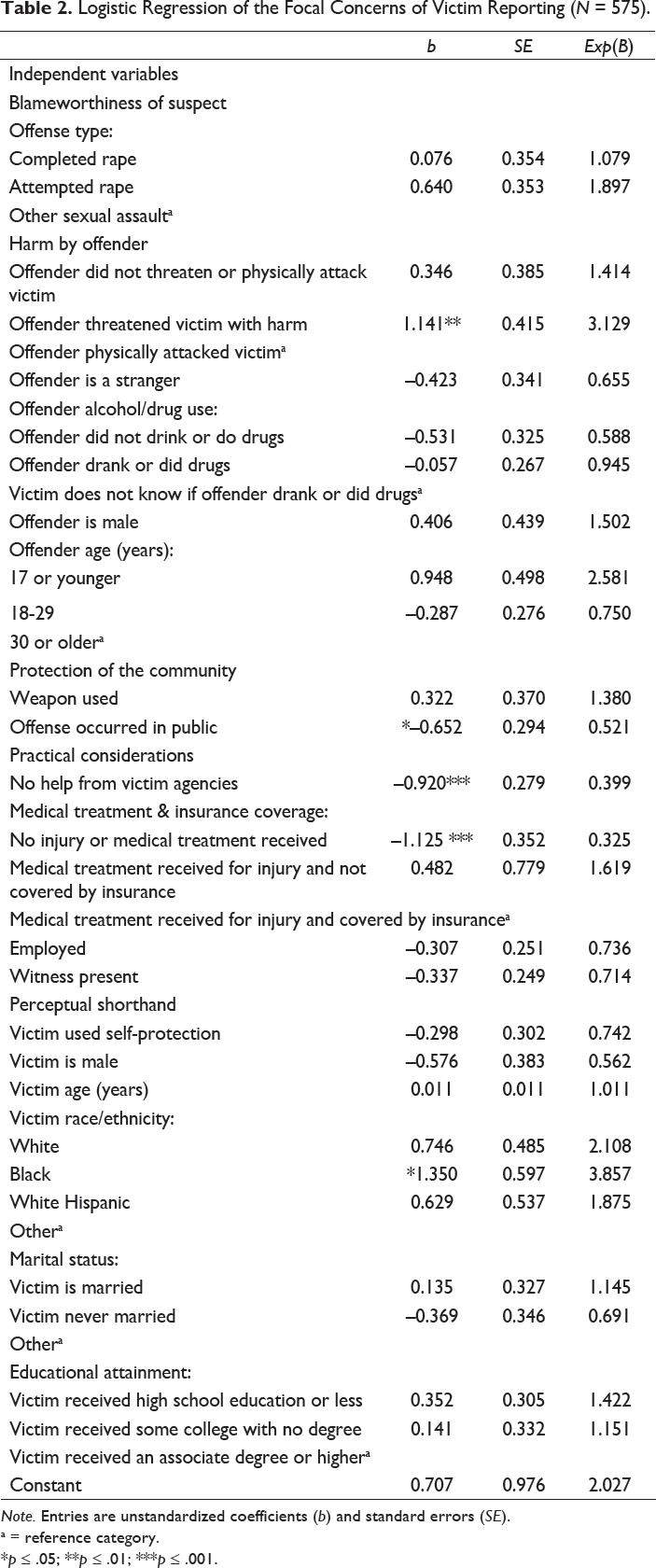
Note. Entries are unstandardized coefficients (b) and standard errors (SE).
a = reference category.
*p ≤ .05; **p ≤ .01; ***p ≤ .001.
Discussion
Research investigating victim decision making has traditionally been situated within rational choice perspectives (Akers & Kaukinen, 2009; Bachman et al., 1992; Felson et al., 2002; Galvin & Safer-Lichtenstein, 2018; Kidd & Chayet, 1984; Kingsnorth & Macintosh, 2004). Kaiser et al. (2017), however, argue that the FCP likely offers a more satisfactory and nuanced explanation of victim decision making in SA cases. Although Kaiser et al. (2017) were speaking specifically to victim cooperation decisions in SA cases, their arguments are instructive for the current study’s focus on reporting. Specifically, as Kaiser et al. (2017) point out, FC includes “areas or issues which command widespread and persistent attention and a high degree of emotional involvement” (Miller, 1958, p. 6). Relying on this definition, Kaiser et al. (2017) assert that SA victims have their own FC that impact their decision making within a criminal-legal context. Therefore, this study provided an application of this popular criminal-legal perspective to the decision to report sexual victimization using relevant, crime-specific measures of FC.
Although the FCP remains a popular framework for investigating criminal-legal decision making and scholars advocate for its application to victim decision making, the approach has been criticized and shortcomings exist. Generally, FC research to date has relied on few variables to assess the impact of the complex concepts that make up the perspective (O’Neal & Spohn, 2017). Moreover, and specific to the current study’s objectives, the conceptualization and operationalization of key FC concepts remain inconsistent across studies (Hartley et al., 2007; Pierce, 2012). In efforts of overcoming these shortcomings and expanding the approach’s theoretical relevance and generalizability, scholars suggest developing alternative tests of the FCP that are specific to the area of inquiry (Kaiser et al., 2017; O’Neal & Spohn, 2017). Therefore, following recent SA case processing research using an alternative FCP (Kaiser, et al., 2017; O’Neal & Spohn, 2017), we attempt to overcome methodological criticisms of the theoretical approach by developing an alternative test through an analytic strategy and selection of variables specific to the victim reporting decision.
This study offers initial support for the application of the FCP to the victim reporting decision. Overall, our results suggest that victims of SA consider each FC during the decision to report. It is important to note that prior to this study, the FCP, as it relates to victim decision making, had only been applied to victim cooperation (Kaiser et al., 2017). Therefore, it is likely that more research is needed to identify the specific FC influencing this specific decision stage (i.e., reporting). As mentioned above, we attempted to expand the approach’s theoretical relevance by developing an alternative conceptualization and operationalization of FC measures that are more appropriate to victim reporting decisions. However, because this is the first study to investigate victim reporting within this framework, further theorizing is necessary before making solid causal claims regarding FC as it applies to this unique crime and decision stage. The current study contributes to the FCP and victim decision making literature by identifying theoretically relevant variables and situating them with a mainstream criminological perspective while simultaneously considering the impact of rape culture.
Related to the point above, extant SA case processing research has situated criminal-legal actor decision making within a rape culture theoretical perspective. The current study builds on this research by drawing from rape culture research to theorize victim reporting decisions within a FC framework. Findings suggest one indicator of blameworthiness of the suspect influenced victim reporting. Victims were more likely to report an offense when perpetrators threatened them with harm. This finding suggests that victims evaluate suspect behavior during the assault to determine whether they will report sexual violence to police. This is consistent with similar findings that indicate that during the reporting decision, victims consider whether they perceived their lives to be threatened by the suspect (Chen & Ullman, 2010; Ullman & Lorenz, 2020). Further, this result suggests victims’ acceptance of rape culture ideologies pertaining to “real rape” (Estrich, 1987) in that victims may be more likely to define an offense as rape when there are indicators of crime seriousness, such as threatened harm. Additionally, results indicate that one factor was significant for the protection of the community. We found that victims were less likely to report their victimization if the offense occurred in a public location. This finding parallels prior research that finds victims were more likely to report when the assault occurred in or near victims’ homes (Baumer, 2002; Felson et al., 2002; Xie et al., 2006). Unfortunately, the current study did not allow for a more nuanced investigation of the incident location. However, future research could examine whether the type of public location influences reporting decisions among victims of sexual violence. It could be that victims may be more hesitant to report crimes that occurred in “questionable” public locations to avoid seeming complicit in their victimization (Block, 1974).
Our study also suggests that practical considerations, as it relates to victim service agencies and medical treatment, influence the victim’s decision to report their assault to the police. Specifically, victims of sexual violence were more likely to report their assault to the police if they received help from victim services agencies and less likely if they did not seek or require medical care as a result of their victimization. Previous studies have also found that receiving medical care was associated with reporting to police (Carbone-Lopez et al., 2016; Pino & Meier, 1999; Williams, 1984). These findings can be interpreted in two ways. However, before providing theoretical explanations, it is important to note that the data used for this study cannot establish the time ordering of events. It is impossible to know whether victims sought out victim services prior to reporting to the police or after. This time order issue will be further discussed in the limitations section below. Regarding the first potential explanation, these findings may highlight the importance of related institutions in encouraging and supporting victims of SA. Victim service agencies often provide comprehensive case management services including guidance in navigating the criminal-legal systems alongside general legal advocacy (Campbell, 1998). It is possible that victims who have contact with victim service providers are better situated to report their experiences to the police because they are offered tangible support. Second, these findings may suggest that victims who are willing to seek out victim services and medical services are simply more open to engaging in help-seeking behavior more generally, including activating the police by reporting their victimization. Ultimately, these findings suggest a need for further research regarding the practical considerations for reporting SA to the police within a FC framework.
Our study suggests that victims may draw on their perceptual shorthand when making reporting decisions, specifically as it relates to their race. Findings have been mixed regarding the relevance of victims’ race during the reporting decision. Our findings, however, indicate that Black victims were more likely to report their victimization compared to the “other” minority group, which is congruent with previous findings (Bachman, 1998; Fisher et al., 2003). This result deserves special attention given its salience to current national conversations regarding racial inequities within the criminal-legal system.
Black victims face a combination of racial/ethnic and gender-based discrimination that their racial counterparts do not experience. For example, Decker et al. (2019) revealed that Black women experience unique and intersecting challenges such as the minimization of violence against women (e.g., victim blaming) and social sanctions in response to police engagement (e.g., the Black community may respond negatively to violators of racial loyalty or individuals who do not abide by cultural practices of police avoidance). Moreover, coupled with fears of underenforcement in the police response to their victimization (McCormack & Hirschel, 2018; O’Neal, 2019), research finds that Black women may also face dual arrest (i.e., arrest of victim and offender) and police violence (Fedina et al., 2018; McCormack & Hirschel, 2018) when they report. Indeed, Black women are discredited and criminalized when they report their victimizations (Decker et al., 2019; Jacobs, 2017; McCormick & Hirschel, 2018). Historically, police were trained to associate Blackness with criminality—or “symbolic assailants”—as they conducted racialized police practices targeting Black people via slave patrols (Jones-Brown, 2007; Williams & Murphy, 1990). Antiracism scholars argue that these racialized police practices are time transcendent and continue to create barriers to Black people’s criminal-legal access today (Pokorak, 2006; Tillman et al., 2010). Recent research supports this notion. For example, McCormack and Hirschel’s (2018) study of intimate partner violence cases found that cases involving Black victims were least likely to end in arrest. Black women are cognizant of the historical mistreatment by police and laws that prevented the criminalization of their sexual victimization (Pokorak, 2006). Further, when Black women have reported to police, their victimizations were discredited (Holliday et al., 2019).
Against this backdrop, it makes sense that some Black women have developed a “culture of dissemblance” to protect the sanctity of their home (Hine, 1989). This result, therefore, may be surprising given the interplay between race and gender inequities which create barriers to Black women’s reporting of sexual violence to the police (Decker et al., 2019; Hine, 1989). However, there may be a reckoning on sexual violence within the Black community in which Black victims may be willing to set aside societal expectations, such as police avoidance, in the hopes of removing themselves from unsafe situations and obtaining some form of “justice.” Indeed, we used data collected during an era where discussions of sexual violence have drastically increased since the explosion of the #MeToo movement—which began in 2006 when civil rights activist Tarana Burke first used the phrase to increase awareness surrounding the ubiquity of SA. Ultimately, this finding articulates that, although historical tensions exist between the police and Black communities, the onus is on police. This finding emphasizes the importance of police—who are often victims’ first point of contact and gatekeepers to safety—to dismantle discriminatory practices by implementing cultural competence and antiracist training into all supporting practices by incorporating knowledge about the cultural beliefs, behaviors, and needs of Black women to better serve them during their calls for help (Abrams & Moio, 2009).
Although instructive, the current research is not without limitations. To begin, it is important to note that the present research relied on a pooled series of cross-sectional data, making it impossible to establish temporal order (Solem, 2015). Despite this limitation, the current research was able to establish associations between the dependent and independent variables of interest, an important contribution given the relative dearth of research investigating victim decision making within a FCP. Moreover, although this study contributes to knowledge regarding the FC that influence victim reporting behavior, findings are specific to the United States. Therefore, there remains a need to investigate these topics using samples from other geographical locations. The present study has provided some groundwork for such research, but replication is necessary to move closer to making causal claims. Additionally, the NCVS relies on survey and interviewing techniques and limitations exist when research relies on self-reported methodologies and data. Importantly, lasting traumatic effects of SA victimization affect memory recall and judgment of time, which affects victim decision making (Campbell, 2012). Consequently, SA victimization is likely to be underestimated in the NCVS. When participants do report, they may censor their responses to make them more palatable, they may provide imprecise answers due to poor memory recall, and they may be less knowledgeable about a topic than the researcher assumes they are (see Stone et al., 1999 for details regarding self-report data).
Finally, additional research is needed in several crucial areas to further extend our understanding of victim reporting decisions within a FCP and rape culture context. To begin, as mentioned above, further theorizing is needed regarding the conceptualization and operationalization of the FC variables as they specifically relate to victims’ reporting decisions. For the current study, we relied on rape culture-specific concepts when identifying FC-relevant variables. Although this approach makes theoretical sense, reimagining each FC will likely provide further insight regarding the applicability of the FCP to victim decision making. Additionally, given the current data allow for only a preliminary examination of victim-centered FC in the context of reporting, we echo Kaiser et al. (2017) in their call for additional applications of a victim-centered FCP to further the discussion and to evaluate the application of this framework. Overall, the theoretical development of victim decision making in SA remains in its infancy. Most importantly, given these experiences are not monolithic, there is a dire need for further research that examines the victimization and reporting experiences of Black women and other women of Color.
This study contributes to three broad areas of inquiry: SA reporting, the effects of rape culture on SA case processing, and the application of the FCP beyond criminal-legal actor decision making. This study builds on these existing bodies of literature in several important ways. First, similar to police and prosecutorial decision making in SA cases, victim decision making is complex and deserves to be studied within an established criminological decision-making framework (i.e., FCP). Second, the current research contributes to SA case processing research by situating victim reporting within a rape culture context. Indeed, we rely on rape culture concepts to operationalize FC specific to the victim reporting decision in SA. Third, this study provides additional support for the continued inquiry of victim decision making in SA using a FCP (Kaiser et al., 2017).
Supplemental Material
Supplemental material for this article is available online.
Supplemental Material for To Report or Not to Report? A Focal Concerns Analysis of Victim Reporting Decisions Following Victimization by Shamika M. Kelley, Yan Zhang, and Eryn Nicole O’Neal, in Journal of Interpersonal Violence
Footnotes
Declaration of Conflicting Interests
Funding
The author(s) received no financial support for the research, authorship, and/or publication of this article.

Author Biographies
References
Supplementary Material
Please find the following supplemental material available below.
For Open Access articles published under a Creative Commons License, all supplemental material carries the same license as the article it is associated with.
For non-Open Access articles published, all supplemental material carries a non-exclusive license, and permission requests for re-use of supplemental material or any part of supplemental material shall be sent directly to the copyright owner as specified in the copyright notice associated with the article.
