




Abstract
Drawing on insights from moral psychology, we examine the influence of moral intuitions on Americans’ divergent reactions to reports of sexual assault and harassment. We hypothesize that Americans whose moral intuitions emphasize care and protection of the vulnerable will show a greater willingness to believe reports of sexual assault and harassment, while those whose moral intuitions emphasize social order and cohesion will show greater skepticism toward such reports. Using data from a nationally representative sample of USA adults (N =1050), we find strong support for both hypotheses. We also find that the influence of moral intuitions on reactions to reports of sexual assault and harassment is partially mediated by respondents’ willingness to attribute responsibility to victims of sex crimes. Our results hold when females and males are examined separately. The study provides compelling evidence that a moral intuitionist approach is useful for understanding Americans’ divergent reactions to reports of sexual assault and harassment.
Keywords
Americans’ divergent reactions to reports of sexual assault and harassment have become a staple of U.S. public discourse (Kunst et al., 2019). On one side are those concerned with what they perceive as an alarming pattern of sexually exploitive behavior toward women in American society. Proponents of this view argue that sexual assault and harassment are widespread, that most women are victimized at some point in their lives, and that due to a realistic fear of being ostracized or retaliated against, women are too often silent about the abuses they suffer (Brown & Battle, 2019; Bergman et al., 2002; Raihani, 2017). Proponents of this view further argue that, as a corrective to the longstanding culture of questioning women, people ought to err on the side of “believing women” when incidents of sexual assault and harassment are reported.
On the other side are those concerned with what they perceive as an alarming proliferation of illegitimate claims of sexual assault and harassment in American society (Mac Donald, 2018). Proponents of this view argue that the current tendency in American culture to overreact to minor or unsubstantiated reports of sexual assault and harassment threatens to damage gender relations and undermine the rule of law (Kipnis, 2017). Proponents of this view worry, for example, that social media movements such #MeToo put undue pressure on employers, universities, and the government to fire, expel, or remove from office those accused of sexual assault or harassment without the full benefit of legal due process and before proper evidentiary standards for conviction under the law can be met (Kipnis, 2017; Sullivan, 2018). They also worry that the broad depiction of all men as potential perpetrators and all women as potential victims incorrectly characterizes the state of gender relations in American society (Kipnis, 2017; Mac Donald, 2018; Sullivan, 2018). From this perspective, the advice to “believe women” is viewed not as a solution but as part of the problem.
At the heart of this debate are fundamentally different perspectives on the credibility—and therefore victim status—of those who claim to have been sexually assaulted or harassed (Bokat-Lindel, 2020; Niemi &Young, 2016). Which raises the question: Why are some Americans more willing than others to “believe women,” and what influences their willingness to believe? Surprisingly, despite the morally charged nature of the debate, no prior studies have examined the moral underpinnings of Americans’ attitudes toward reports of sexual assault and harassment. This gap is especially noteworthy given the results of recent research showing that Americans’ moral intuitions are linked to victim blaming (Milesi et al., 2019; Niemi & Young, 2016), retributive punishment policies (Silver & Silver, 2017; Vaughn et al., 2019), and culture war issues more generally (Koleva et al., 2012).
In the current study, we extend prior research by drawing on Moral Foundations Theory (MFT) (Graham et al., 2011; Haidt, 2012) to explore the influence of moral intuitions on Americans’ attitudes toward reports of sexual assault and harassment. MFT is grounded in the assumptions that moral judgments (1) are rooted in a “dual process” system in which intuitive moral cognitions precede and influence deliberate moral reasoning (Haidt, 2012); (2) are focused within distinct domains (care, fairness, loyalty, etc.) and vary in intensity across domains (Graham et al., 2009); and (3) guide a person’s stance—whether consciously or not—on social, cultural, and ethical issues (Koleva et al., 2012). In addition, MFT scholars have done extensive psychometric work to develop an instrument—the Moral Foundations Questionnaire (described below)—that measures moral intuitions independent of related factors, such as political ideology and religiosity (Graham et al., 2011). MFT thus holds considerable promise as a guide for research aimed at better understanding the influence of morality on Americans’ divergent attitudes toward reports of sexual assault and harassment.
We draw on MFT to argue that individualizing moral intuitions that put care and protection of the vulnerable at the center of moral concern and binding moral intuitions that put social order and cohesion at the center of moral concern, are key to understanding Americans’ divergent reactions to reports of sexual assault and harassment. We further argue that the reason those with strong individualizing and binding moral intuitions differ in their willingness to believe reports of sexual assault and harassment is that they tend to possess different views regarding victim responsibility in sex crimes. These ideas are tested below.
Prior Research
Studies of Americans’ attitudes toward reports of sexual assault and harassment have centered largely on the effects of sex and political ideology. A recent study by the Pew Research Center (2018) found that 52% of women and 39% of men believe that women’s claims of sexual assault and harassment “are too often not taken seriously enough,” and that 55% of women and 44% of men believe that “men too often get away with” sexual assault or harassment. A recent Gallup poll found that 70% of women and 53% of men believe that sexual harassment faced by women in the workplace is a “major problem in the US today” (up from 55% of women and 45% of men in 1998) and that 61% of women and 46% of men believe that “people in the workplace are not sensitive enough to the problem of sexual harassment” (up from 40% and 32% in 1998) (Gallup, 2019). At the same time, approximately one-third of both men and women believe that “women falsely claiming sexual harassment/assault” and “employers firing accused men before finding out all the facts” are major problems. Regarding political ideology, the Pew data show that whereas a majority of liberals (60%) believe that “women not being believed when they claim to have been sexually harassed is a major problem,” only 28% of conservatives believe so. Moreover, studies show that, on average, men tend to respond less punitively toward sexual assault and harassment and are more likely to attribute at least some amount of responsibility to victims (Anderson et al., 1997; Rotundo et al., 2001; Russell & Trigg, 2004; van der Bruggen & Grubb, 2014). To our knowledge, however, no studies have examined the influence of people’s moral intuitions on their divergent reactions to reports of sexual assault and harassment.
A Moral Intuitionist Approach
For decades, research in moral psychology has sought to understand how and why individuals make moral judgments and the effects such judgments have on their perceptions and behavior. Insights from this work are thus highly relevant for studying the relationship between morality and attitudes toward crime- and punishment-related issues (Niemi & Young, 2016; Silver & Silver, 2017, 2021; Vaughn et al., 2019). Because Moral Foundations Theory (MFT) has been used successfully to study the link between individual’s moral judgments and their attitudes toward and involvement in a variety of criminal and deviant behaviors (e.g., Koleva et al., 2012; Silver et al., 2021; Silver & Silver, 2017), we find MFT particularly well-suited to exploring why people differ in their reactions to reports of sexual assault and harassment.
Moral Foundations Theory organizes people’s moral intuitions into two broad domains, one in which the primary moral concern is to avoid harming or mistreating others—referred to as “individualizing moral intuitions”—and another in which the primary moral concern is to safeguard the order and cohesion of social groups—referred to as “binding moral intuitions.” According to MFT, individualizing moral intuitions evolved within human societies to enhance interpersonal relationships through the promotion of rights, autonomy, and reciprocity, whereas binding moral intuitions evolved to enhance group cohesion through the promotion of loyalty, hierarchy, and appreciation of the sacred (Graham et al., 2011). However, because of social learning, individuals and groups vary in how intensely they experience moral intuitions within the individualizing and binding domains (Graham et al., 2009).
Haidt and colleagues derive individualizing and binding moral intuitions from five more specific intuitions referred to as “moral foundations” (Graham et al., 2011). Two of the five moral foundations contribute to a person’s individualizing moral intuitions. The Care/harm foundation, which is rooted in the evolutionary challenge of child rearing, “makes us sensitive to signs of suffering and need” and “makes us despise cruelty and want to care for those who are suffering” (Haidt, 2012, p. 153). The Fairness/cheating foundation, which is rooted in the evolutionary challenge of forming cooperative non-kin relationships, “makes us want to shun or punish cheaters” (Haidt, 2012, p. 153). The remaining three moral foundations contribute to an individual’s binding moral intuitions. The Loyalty/betrayal foundation, which is rooted in the evolutionary challenge of forming cohesive groups, emphasizes loyalty to nations, families, and teams and “makes us sensitive to signs that another person is (or is not) a team player” (Haidt, 2012, p.154). The Authority/subversion foundation, which is rooted in the evolutionary challenge of maintaining functioning hierarchies, “makes us sensitive to signs of rank or status, and to signs that other people are (or are not) behaving properly, given their position” (Haidt, 2012, p. 154). Finally, the Sanctity/degradation foundation, which is rooted in the evolutionary challenge of avoiding pathogens and revering sacred totems, makes “people feel that some things, actions, and people are noble, pure, and elevated; [while] others are base, polluted, and degraded” (Haidt, 2012, p. 174).
Categorizing people’s moral intuitions as individualizing and binding suggests that certain ways of interpreting social issues may appeal to one set of intuitions more strongly than the other (Silver & Silver, 2017). Specifically, we argue that people with strong individualizing moral intuitions, which emphasize care and protection of the vulnerable, will be more willing to believe reports of sexual assault and harassment because such reports resonate with their intuitive understanding of society as embodying a conflict between oppressors and the oppressed, and in which women are vulnerable to abuses of male power (Brown & Battle, 2019; Bergman et al., 2002; Haidt 2012; Kling, 2019; Raihani, 2017). Individuals with strong individualizing moral intuitions thus tend to react with reprehension to reports of sexual assault and harassment, particularly when the victim claims to have been hurt or traumatized even if no physical harm is apparent (Sullivan, 2018).
Conversely, we argue that people with strong binding moral intuitions, which emphasize social order and cohesion, will be less willing to believe reports of sexual assault and harassment because such reports conflict with their intuitive understanding of society as a complex, interdependent system to which different groups, including women and men, bring complementary interests and skills (Haidt 2012; Kling, 2019). Individuals with strong binding moral intuitions thus tend to “underreact” intuitively to reports of sexual assault and harassment, particularly when no physical harm is apparent, or when evidence of criminal wrongdoing is unavailable (Sullivan, 2018).
The Mediating Role of Victim Responsibility
Having described in a general way why individualizing and binding moral intuitions may be related to people’s divergent reactions to reports of sexual assault and harassment, we now consider a potential mediating factor in this association: people’s willingness to attribute responsibility to victims of sex crimes. We believe that this general tendency accounts for why moral intuitions are related to people’s divergent reactions to reports of sexual assault and harassment.
According to Gilovich (1991), when people are confronted with new information their moral intuitions signal to them immediately whether that new information is consistent with or a challenge to their current beliefs (see also, Haidt, 2012). When new information is consistent, people will tend to ask themselves, “Can I believe it?” But when new information is inconsistent, they will tend to ask themselves, “Must I believe it?” Thus, people demonstrate a lower threshold for believing new information that is consistent with their current beliefs (i.e., Can I believe?) and a higher threshold for believing new information that is inconsistent with their current beliefs (i.e., Must I believe?).
Based on Gilovich’s (1991) idea, we hypothesize that, people with strong individualizing moral intuitions will be less willing to attribute responsibility to victims of sex crimes because doing so runs counter to their moral intuitions regarding the importance of caring for and protecting the vulnerable. More specifically, their individualizing moral intuitions motivate them to avoid attributing responsibility to victims of sex crimes because to do so would be to inflict further injury on the accuser in the form “victim blaming,” an option which their individualizing moral intuitions lead them to want to avoid. People with strong individualizing moral intuitions are thus more likely to empathize with the alleged victim and steer clear of victim blaming. 1 In Gilovich’s terms, they are more likely to ask themselves, “Can I believe in the victim status of the accuser?”, and their intuitive desire to answer this question in the affirmative makes them less likely to attribute responsibility to victims by, for example, questioning their behavior during the incident or their motives for reporting it.
In contrast, we hypothesize that those with strong binding moral intuitions will be more willing to attribute responsibility to victims of sex crimes because doing so is consistent with their moral intuitions regarding the importance of social order and cohesion, including order and cohesion between women and men. Their binding moral intuitions predispose them to question the alleged victim’s behavior during the incident or their motives for reporting it, especially when the victim fails to provide sufficient evidence to support their claim, or when the incident occurred a long time ago. In Gilovich’s terms, people with strong binding moral intuitions are more likely to ask themselves “Must I believe in the victim status of the accuser?”, and their intuitive desire to answer this question in the negative makes them more apt to want to “explain the incident away” by attributing responsibility to victims.
The idea that moral intuitions drive a person’s willingness to attribute responsibility to victims of sex crimes is consistent with findings reported by Milesi et al. (2019). Using a sample of 553 college students from Spain, Germany, Italy, and Sweden, Milesi et al. (2019) found that individualizing moral intuitions were associated with a reluctance to attribute responsibility to victims of acquaintance rape. Meanwhile, binding moral intuitions, most notably Sanctity/degradation, were associated with a greater willingness to attribute responsibility to such victims—among students in Spain and Italy, which the authors attributed to the existence of honor cultures in both countries (see also, Niemi & Young, 2016). Although Milesi et al. (2019) did not control for ideological factors, such as political conservatism and religiosity, or prior experience with sexual harassment, and although their study was based on a convenience sample of college students and therefore has unknown generalizability, their results nonetheless are consistent with our hypothesis that people’s general willingness to attribute responsibility to victims of sex crimes are driven in part by their moral intuitions.
Based on these ideas and findings, we hypothesize that the desire of people with strong individualizing moral intuitions to avoid attributing responsibility to victims of sex crimes makes them more likely to believe reports of sexual assault and harassment when they encounter them, while the willingness of people with strong binding moral intuitions to attribute responsibility to such victims makes them less likely to believe such reports.
The Current Study
Using a nationally representative sample of U.S. adults, we test the following four hypotheses:
People with strong individualizing moral intuitions will show less skepticism toward reports of sexual assault and harassment.
People with strong binding moral intuitions will show more skepticism toward reports of sexual assault and harassment.
The degree to which people attribute responsibility to victims of sex crimes will mediate the association between their moral intuitions (individualizing and binding) and their skepticism toward reports of sexual assault and harassment. Finally, building on a core argument of Moral Foundations Theory, that moral intuitions are a universal feature of human moral cognition (Haidt, 2012), we hypothesize that:
The influence of individualizing and binding moral intuitions on people’s skepticism toward reports of sexual assault and harassment will be sex-invariant, that is, similar in direction and magnitude for female and males. To our knowledge, no prior study has so thoroughly investigated the moral-intuitive underpinnings of Americans’ attitudes toward reports of sexual assault and harassment.
Methods
Data
Data for this study come from a nationally representative survey of 1050 U.S. adults conducted between October 4 and October 9, 2018, by YouGov, a leading academic survey research firm. The study was initiated 1 year after the highly publicized Harvey Weinstein sex scandal. YouGov has provided public opinion data for numerous crime- and deviance-related studies (e.g., Enns & Ramirez, 2018; Lee et al., 2020; Lehmann & Pickett, 2017). We use the sample weight provided by YouGov, which brings key sample characteristics into alignment with the U.S. general population.
Descriptive Statistics.

Measures
Sex Offense Skepticism
Our dependent variable is skepticism toward reports of sexual assault and harassment, which we refer to as sex offense skepticism. We measure sex offense skepticism by averaging responses to three items (coded from 1 = strongly disagree to 5 = strongly agree). Specifically, respondents were asked, “How much do you agree or disagree with the following statements?”: (1) Victims of sexual offenses usually exaggerate what happened to them. (2) In many instances, sex offenses are reported when the behaviors involved were actually consensual. (3) Women often falsely accuse men of sexually harassing or assaulting them when they are angry at them for other reasons. The scale alpha is .88.
Moral Intuitions
The individualizing and binding moral intuitions indices are measured using the 20-item Moral Foundations Questionnaire (MFQ) shown in Appendix B. Individualizing moral intuitions are measured by averaging the eight items included in MFT’s Care/harm and Fairness/cheating foundations (alpha = .81). Binding moral intuitions are measured by averaging the 12 items included in MFT’s Loyalty/betrayal, Authority/subversion, and Sanctity/degradation foundations (alpha = .86). The correlation between the individualizing and binding moral intuitions scales is r = .41, p < .001. 3
Victim Responsibility
To measure victim responsibility, respondents were asked the following question: “Thinking about victims of sex crimes, how much do you agree or disagree with the following statements (response options ranged from 1 = strongly disagree to 5 = strongly agree): (1) The main reason for many sex crimes is carelessness on the part of the victim. (2) Sex crime victims are usually responsible for getting victimized. (3) Most of the time, people can avoid becoming sex crime victims by making smarter choices. (4) A lot of sex crime victims deserve to be victimized. The four items were averaged. The scale alpha is .84.
Control Variables
Women are 10 times more likely than men to become victims of sexual violence (National Violence Resource Center, 2015) and 59% of women compared to 27% of men say they have been sexually harassed (Pew Research Center, 2018). Therefore, women as a group, and those among women and men who have been sexually harassed may be more sympathetic to reports of sexual assault or harassment. It is thus important that we control for both sex and prior experience with sexual harassment. Sex is measured by a variable called female, coded 1 for females and zero for males. Sexual harassment frequency is measured by averaging responses to three items asking how many times a supervisor, boss, or more established employee ever did the following in a professional setting: (1) gave you unwanted sexual attention; (2) implied that you had to engage in sexual activities with him or her in order to be well-treated; and (3) offered you preferential treatment if you engaged in sexual activities with him or her. This measure includes the two legally recognized aspects of sexual harassment, quid pro quo requests and hostile workplace environment (Benavides Espinoza & Cunningham, 2010). Response options were 0 = never, 1 = once, 2 = twice, and 3 = three times or more. The scale alpha is .77. We recognize that sexual victimization may occur in settings other than the work setting, however, our data do not allow us to measure other such experiences.
Attitudes toward sexual assault and harassment have been linked to political ideology (Pew Research Center, 2018). In addition, MFT research shows that liberals tend to exhibit stronger individualizing moral intuitions and weaker binding moral intuitions than conservatives, while conservatives tend to be evenly distributed in their moral intuitions (Graham et al., 2009). It is therefore important that we control for political ideology, which we do by measuring respondent’s self-placement on a scale from 1 = very liberal to 7 = very conservative, referred to below as political conservatism.
To further minimize risk of omitted variable bias, we also control for religiosity, age, race, Hispanic heritage, education, income, and marital status. Religiosity is measured by the average of three items (alpha =.83): frequency of church attendance (1 = never to 6 = more than once a week), frequency of prayer (coded 1= never to 7 = several times a day), and the importance of religion in the respondent’s daily life (coded 1=very unimportant to 5= very important). Age is measured in years. Race is measured as a series of dummy variables for Black, Asian, and Other Race with White as the reference category. Hispanic ethnicity coded 1 for respondents who self-identified as Hispanic and 0 otherwise. Education is measured on a scale from 1 = less than high school to 5 = graduate degree. Household income is measured on a scale from 1 = less than $10K per year to 8 = $259K or more per year. Finally, marital status is measured by an indicator variable coded 1 for respondents who have ever been married.
Analysis
The analysis proceeds as follows. First, we use OLS regression to examine the associations between the individualizing and binding moral intuitions measures and respondents’ attributions of victim responsibility. Second, we use OLS regression to examine the influence of individualizing and binding moral intuitions on sex offense skepticism (Hypotheses 1 and 2). Next we examine the degree to which attributions of victim responsibility mediate these associations (Hypothesis 3). In describing the mediation results, we report total, direct, and indirect effects (via victim responsibility) for each of the moral intuitions measures. We use KHB analysis to test the significance of the indirect (mediation) effects (Breen et al., 2013). 4 We conclude the analysis by presenting the models predicting sex offense skepticism separately for females and males to examine the degree to which the effects of the moral intuitions are sex-invariant (Hypothesis 4).
To check for multicollinearity, we examined the variance inflation factors (VIFs) for all measures and found that none exceeded 2.20, which is less than the critical value of 4.00 usually employed to indicate multicollinearity problems (Fisher & Mason, 1981). As shown in Table 1, missing data rates varied, with the highest rates observed for income, religiosity, and conservatism. Altogether, 1006 respondents (96%) provided answers to all relevant dependent and independent variables. To recover this small amount of missing data, we used chained multiple imputation (M = 20). Supplemental analyses indicate that the direction, significance, and size of all model coefficients were substantively the same as those obtained using listwise deletion. Finally, since our measure of sexual harassment focuses on the work setting, and since some respondents (N = 95) reported never having worked, we conducted supplemental analyses with these cases removed and observed no notable differences in results. All analyses were conducted using the sample weight provided by YouGov.
Results
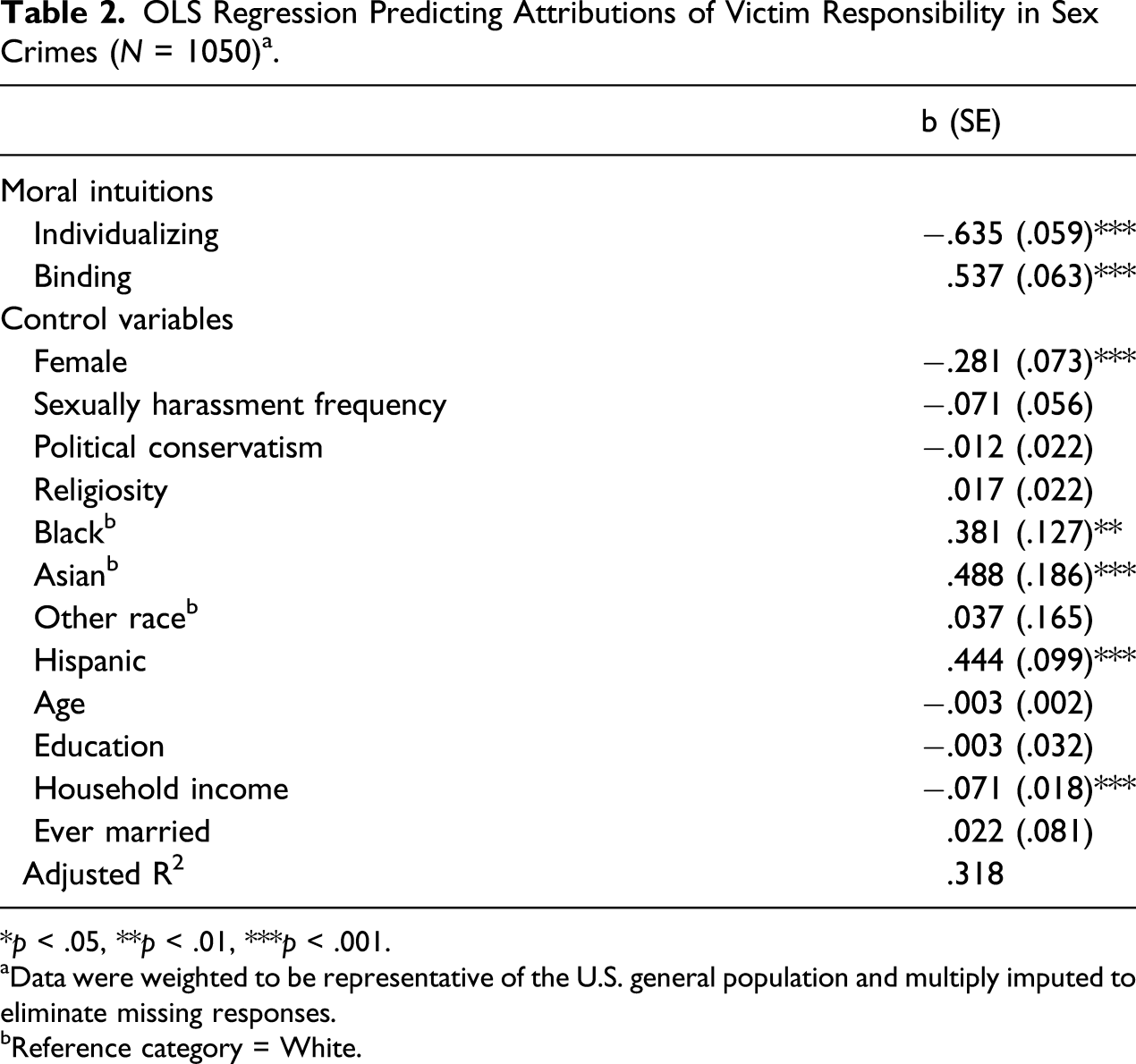
OLS Regression Predicting Attributions of Victim Responsibility in Sex Crimes (N = 1050) a .
*p < .05, **p < .01, ***p < .001.
aData were weighted to be representative of the U.S. general population and multiply imputed to eliminate missing responses.
bReference category = White.
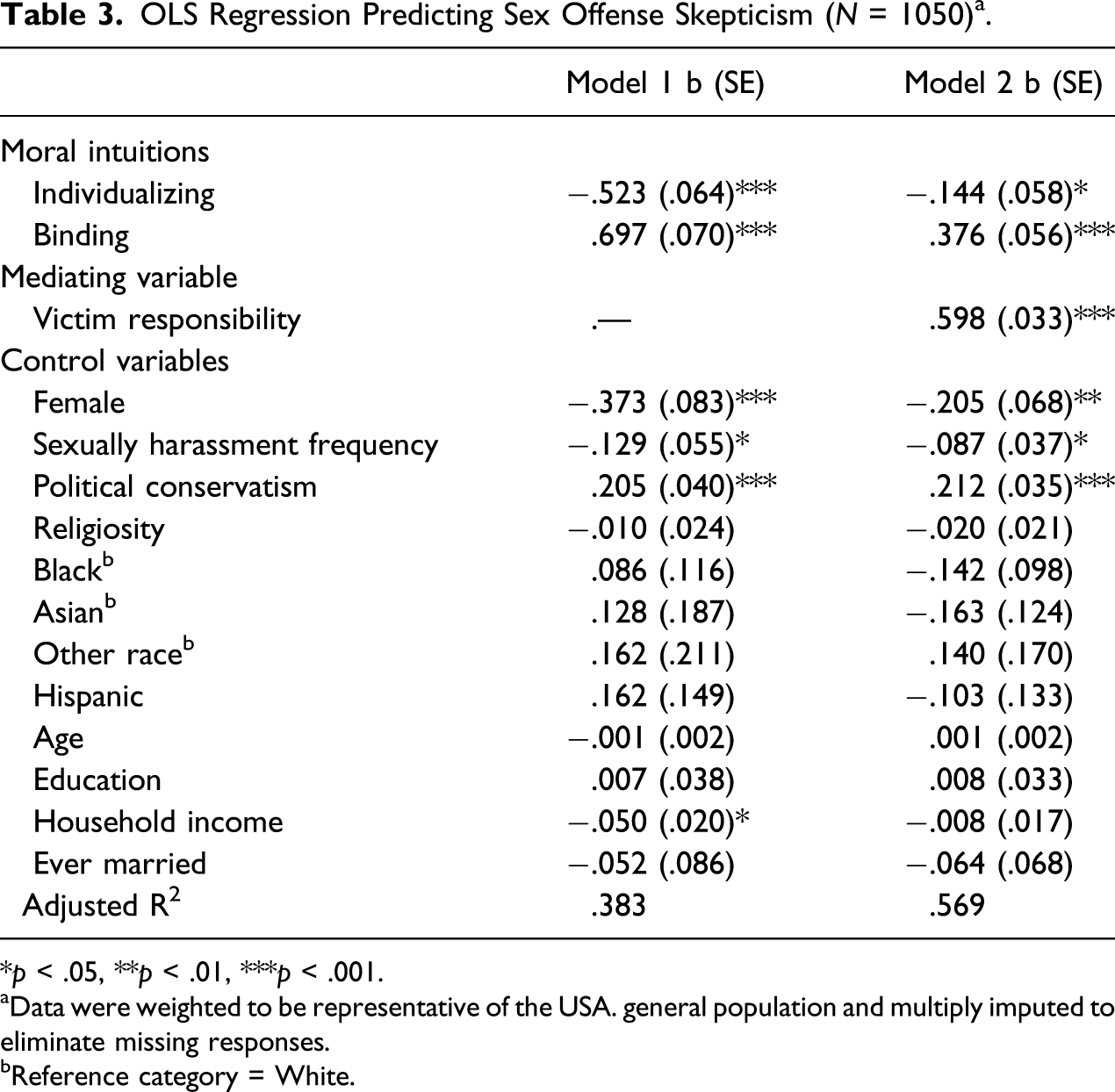
OLS Regression Predicting Sex Offense Skepticism (N = 1050) a .
*p < .05, **p < .01, ***p < .001.
aData were weighted to be representative of the USA. general population and multiply imputed to eliminate missing responses.
bReference category = White.
Next, we turn to the question of whether attributions of victim responsibility mediate the relationship between moral intuitions and sex offense skepticism (Hypothesis 3). These results are shown in Table 3 and summarized in Figure 1. As shown in Model 2 of Table 3, attributions of victim responsibility are strongly and positively associated with sex offense skepticism (b = .598, p < .001). Comparing Models and 1 and 2, the results of Table 3 also show that the associations between both moral intuitions measures and sex offense skepticism are reduced when victim responsibility is added to the equation. The coefficient for individualizing moral intuitions is reduced from b = −.523 (p < .001) to b= −.144 (p < .05) and the coefficient for binding moral intuitions is reduced from b = .697 (p < .001) to b = .376 (p < .001). These results suggest partial mediation.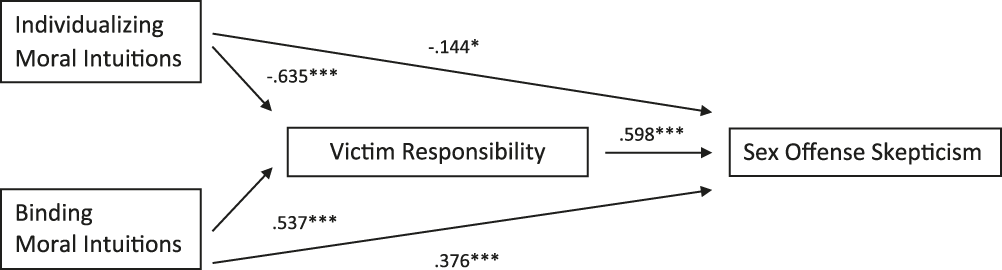
Further, combining information from Tables 2 and 3 reveals an indirect effect (individualizing moral intuitions -> victim responsibility -> sex offense skepticism) of b = −.380 (b = −.635 × b = .598); and KHB analysis indicates this indirect effect is significant at the p < .001 level. This means that 73% of the total effect of individualizing moral intuitions on sex offense skepticism occurs because people with stronger individualizing moral intuitions are less likely to attribute responsibility to victims of sex crimes (73% equals the indirect effect of −.380 divided by the total effect of −.523 shown in Table 3). Turning to binding moral intuitions, combining information from Tables 2 and 3 reveals an indirect effect (binding moral intuitions -> victim responsibility -> sex offense skepticism) of b = .321 (b = .537 × b = .598); and KHB analysis indicates this indirect effect is significant at the p < .001 level. This means that 46% of the total effect of binding moral intuitions on sex offense skepticism occurs because people with stronger binding moral intuitions are more likely to attribute responsibility to victims of sex crimes (46% equals the indirect effect of .321 divided by the total effect of .697 shown in Table 3).
Consistent with Hypothesis 3, the multivariate path analysis results indicate that part of the reason why respondents with different moral intuitions exhibit different levels of sex offense skepticism is that they differ in their attributions of victim responsibility. However, the coefficients for both moral intuitions measures remain significant after victim responsibility is added to the equation, indicating either that the moral intuitions measures directly affect sex offense skepticism or that mediating variables not measured in the current study are involved (we speculate on what these may be in the discussion section). Finally, regarding the control variables, Table 3 also shows that even after controlling for moral intuitions and attributions of victim responsibility, women and respondents who have been sexually harassed remain significantly less skeptical of reports of sexual and harassment, while political conservatives remain significantly more skeptical. The former results are likely due to identification with those who claim to have been sexually assaulted or harassed, while the latter is likely due to the politically polarized nature of public debates about sexual assault and harassment in the U.S.
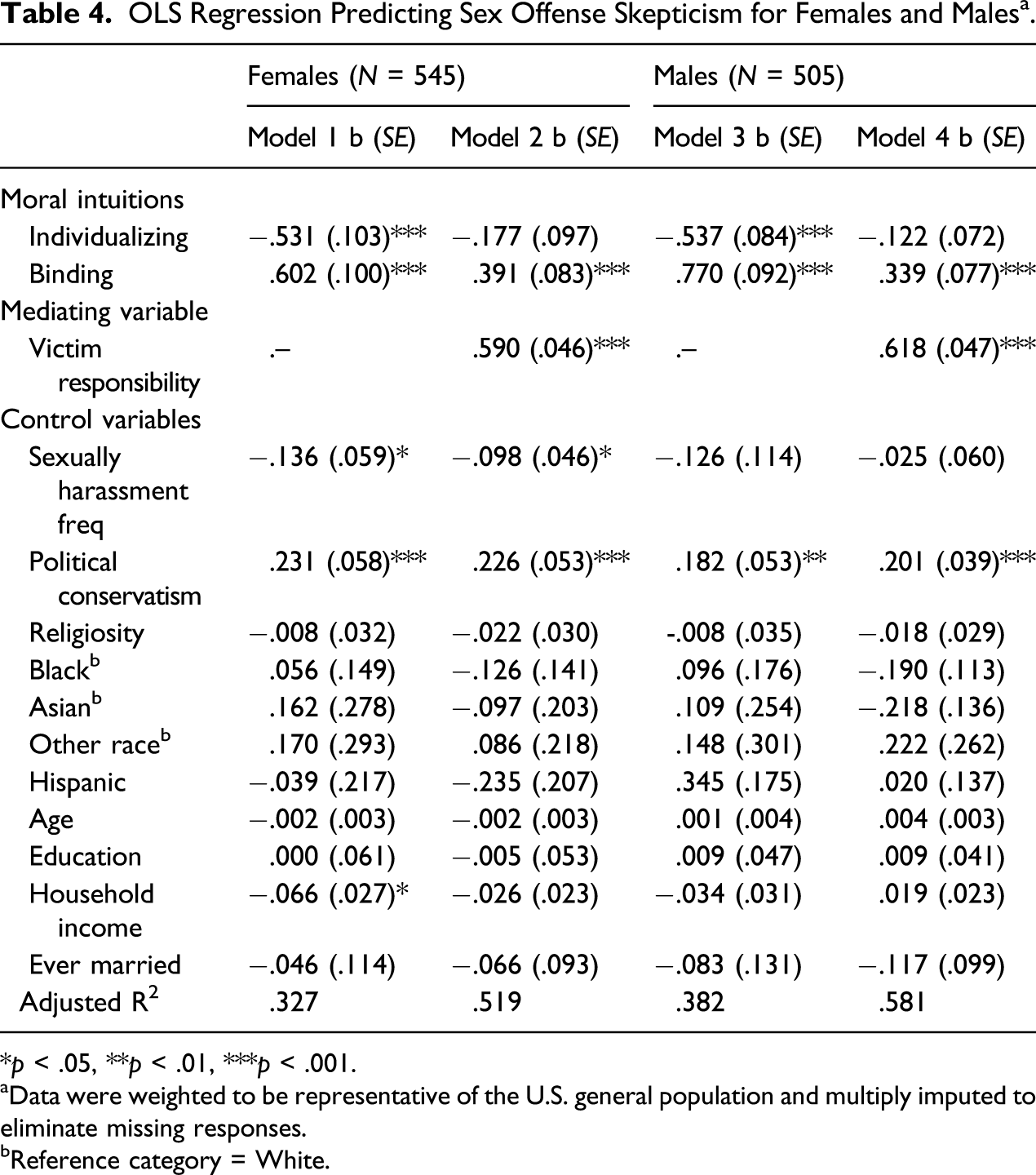
OLS Regression Predicting Sex Offense Skepticism for Females and Males a .
*p < .05, **p < .01, ***p < .001.
aData were weighted to be representative of the U.S. general population and multiply imputed to eliminate missing responses.
bReference category = White.
Discussion
This study drew on Moral Foundations Theory (MFT) (Graham et al., 2011; Haidt, 2012) to examine the influence of individualizing and binding moral intuitions on Americans’ attitudes toward reports of sexual assault and harassment. We conceptualized individualizing and binding moral intuitions as intuitive drivers of a person’s receptivity to the belief that sex crime victims are in some part responsible for their victimization, and we argued that this belief, in turn, influences one’s tendency to greet reports of sexual assault and harassment with either belief or skepticism. Specifically, we argued that those with strong individualizing moral intuitions—for whom care and protection of the vulnerable is morally central—are less likely to attribute responsibility to victims and are thus less skeptical toward reports of sexual assault and harassment, while those with strong binding moral intuitions—for whom social order and cohesion are morally central—are more likely to attribute responsibility to victims and are thus more skeptical toward reports of sexual assault and harassment, particularly when no physical harm is apparent, or when evidence of criminal wrongdoing is unavailable.
Our hypotheses were supported by the data after controlling for a wide range of factors known to be associated with people’s attitudes toward sexual assault and harassment and crime- and justice-related issues more generally, including sex, sexual harassment victimization, political ideology, religiosity, and SES. Explaining variation in attitudes toward reports of sexual assault and harassment amidst a strong lineup of control variables was a high bar for the moral intuitions measures to have cleared. Our results thus provide compelling evidence that a moral intuitionist approach is useful for understanding Americans’ divergent reactions to reports of sexual assault and harassment.
Why is it important to study differences in people’s attitudes toward reports of sexual assault and harassment through a moral lens? First, moral intuitions are likely implicated in the trade-off between protecting vulnerable victims (or what we would call a social justice perspective) and maintaining social order and cohesion (or what we would call a social order perspective). Individuals with strong binding moral intuitions may be less inclined to believe reports of sexual assault harassment because, at a moral-intuitive level such reports—particularly when they seem trivial or are unsubstantiated—may be perceived as needlessly threatening the stability of the social order by casting gender relations as adversarial and combative rather than as interdependent and cooperative, particularly when no physical harm is apparent, or when evidence of criminal wrongdoing is unavailable. In contrast, people with strong individualizing moral intuitions may be more inclined to believe reports of sexual assault and harassment because such reports appeal to their moral-intuitive inclination to aggressively fight against injustice in society, particularly when the welfare of vulnerable victims is at stake, as is the case with sexual assault and harassment.
The second reason involves due process. Those whose morality emphasizes protecting the social order are more easily alarmed by what they perceive as a growing tendency within American society to subject accused males to “trials by media” before an accuser’s statements have been properly and legally vetted (Sullivan, 2018). In contrast, those whose morality emphasizes protecting vulnerable victims may be more easily alarmed by what they perceive as females’ vulnerability to routine mistreatment from a patriarchal system in which males (and the courts) minimize women’s claims of victimization. If we are correct in arguing that these different responses are morally rooted, then it is important that future research continues to examine the different moral intuitions that underlie them.
Importantly, our results showed that even after controlling for victim responsibility, the moral intuitions measures remained significantly related to sex offense skepticism. Regarding individualizing moral intuitions, we speculate that a pronounced concern with gender disparities and gender oppression (i.e., a social justice perspective) may accounts for the variation that remained unexplained in the mediation analysis. Regarding binding moral intuitions, we speculate that a pronounced concern with social stability and cohesion, including stability and cohesion in female-male relations (i.e., a social order perspective) may account for the variation that remained unexplained in the mediation analysis. In short, we suggest that individualizing and binding moral intuitions reflect and motivate divergent beliefs about women, men, and their relation to one another that go beyond attributions of victim responsibility in explaining sex offense skepticism. Moral intuitions may also reflect and motivate divergent beliefs about the perceived need for, and preferred pace of, social change in gender relations. People with a social justice perspective characterized by strong individualizing moral intuitions are likely to favor rapid social change aimed at ending gender oppression as soon as possible, while people with a social order perspective characterized by strong binding moral intuitions are likely to favor gradual change that does not disrupt the social order. We encourage researchers to explore these additional morally rooted dimensions in future studies.
Limitations
This study is not without limitations. The most notable is that our data did not permit us to examine Americans’ attitudes toward reports of sexual assault and harassment made by men. Yet, sex offense skepticism is likely to be as salient for male victims as for female victims, perhaps even more so due to pervasive gender stereotypes. Data from the Pew Research Center (2018) shows that 27% of U.S. males report having been sexually harassed. And while the self-reported suffering of men who have been sexually assaulted or harassed has been shown to be equal to that of women, men are generally perceived by others as suffering less (Studzinska & Hilton, 2017). When it comes to speaking out about their experiences, therefore, fear of ostracization may be as much or more of a barrier for men as for women. While recognizing the importance and urgency of addressing women’s experiences of sexual assault and harassment, we hope that future research will expand the focus to include the negative experiences of male victims.
The second limitation relates to the use of survey data. Because our data are cross-sectional, we were unable to definitively distinguish the causal order of the variables. It is therefore possible that the theoretical model used in this study, in which moral intuitions drive attitudes toward victim responsibility, punitiveness, and culture war issues more generally (Koleva et al., 2012; Milesi et al., 2019; Niemi & Young, 2016; Silver & Silver, 2017), is incorrect and that an alternative model, in which attitudes toward such issues promote the development of moral intuitions, would be preferable. It is also possible that one’s skepticism toward reports of sexual assault and harassment drives rather than is driven by one’s overall willingness to attribute responsibility to victims of sex crimes. While these possibilities seem to us unlikely, future studies assessing the direction of influence among these constructs would be valuable.
A third limitation is that we were not able to measure prior sexual assault and harassment experiences outside the work setting. Given the ubiquity of such experiences, it is likely that we undercounted people’s experiences of sexual assault and harassment. Had we used a more expansive measure, we may have found a stronger association between the number of previous sexual assault and harassment incidents and sex offense skepticism. We encourage future research to address this shortcoming.
A final limitation is that, while one of the three statements in our sex offense skepticism scale refers directly to women (i.e., “Women often falsely accuse men of sexually harassing or assaulting them when they’re angry at them for other reasons”), two do not (i.e., “Victims of sexual offenses usually exaggerate what happened to them” and “In many instances, sex offenses are reported when the behaviors involved were actually consensual”). Although we believe that most respondents interpreted the latter two statements as referring to women, we cannot be certain this is the case. It would thus be useful for future research to replicate our results using a measure of sex offense skepticism that clearly identifies the sex of the claimant.
Conclusion
American’s divergent reactions to reports of sexual assault and harassment are a puzzling phenomenon both in the U.S. and around the world (Kunst et al., 2019; Milesi et al., 2019). In the current study, we found that a significant aspect of this divergence involves differences in people’s moral intuitions. Unlike in the past, today’s global communication infrastructure provides unique opportunities for stakeholders and social movement organizers to communicate with large numbers of people to foster positive social change on the issue of sexual assault and harassment. However, movement messages, such as the #MeToo movement’s advice to “believe women,” may be met with enthusiastic support from some segments of the population and resistance from others. Having a better understanding of the moral-intuitive underpinnings of Americans’ divergent reactions to reports of sexual assault and harassment may help movement organizers and other stakeholders to address the problem of sexual assault and harassment in a manner that is simultaneously more effective and less polarizing. For example, in addition to appeals to “believe women,” which tend to attract people with strong individualizing moral intuitions, public educators and activists might also emphasize the importance of “standing by,” “defending,” or “respecting” women, or emphasize the importance of seeking justice through the formal channels of the criminal justice system (rather than media and social media outlets), to appeal more strongly to those with strong binding moral intuitions. In addition to informing future research, we hope the results of this study will help movement organizers and other interested stakeholders craft messages that reach the broadest possible audience so that the problem of sexual assault and harassment in society can be most effectively addressed.
Footnotes
Declaration of Conflicting Interests
The author(s) declared no potential conflicts of interest with respect to the research, authorship, and/or publication of this article.
Funding
The author(s) received no financial support for the research, authorship, and/or publication of this article.

Notes
Bivariate Correlations.
ap < .001, b = p < .01, c = p < .05.
1
2
3
4
5
6
7
8
9
10
11
12
13
14
15
1 Sex offense skepticism
.−
2 Individualizing
−.19
a
.−
3 Binding
.40
a
.41
a
.−
4 Victim responsibility
.65
a
−.30
a
.22
a
.−
5 Female
−.21
a
.19
a
.08b
−.17
a
.−
6 Sexually harassment freq
−.17
a
.15
a
.01
−.15
a
.23
a
.−
7 Political conservatism
.45
a
−.15
a
.39
a
.18
a
−.08c
−.05
.−
8 Religiosity
.23
a
.05
.44
a
.16
a
.13
a
.06
.36
a
.−
9 Age
.05
.22
a
.29
a
−.10b
.07c
.12
a
.21
a
.15
a
.−
10 Blackc
.02
.00
.07c
.13
a
.01
.01
−.14
a
.13
a
−.08c
.−
11 Asianc
.02
−.05
−.01
.10b
.01
−.06
.05
−.04
−.14
a
Na
.−
12 Other racec
−.01
.10b
.02
−.06c
.00
.06
−.01
.01
.00
Na
Na
.−
13 Hispanic
.06c
−.10b
−.02
.19
a
−.00
−.04
−.07c
.04
−.14
a
−.16
a
−.09b
−.09b
.−
14 Education
−.15
a
.08c
−.12
a
−.17
a
.05
.03
−.13
a
.00
.05
−.09b
.14
a
−.02
−.18
a
.−
15 Household income
−.10b
.04
−.02
−.18
a
−.09b
.04
.01
.01
.12
a
−.09b
.01
.03
−.16
a
.41
a
.−
16 Ever married
.04
.11
a
.23
a
−.04
.15
a
.20
a
.20
a
.20
a
.48
a
−.19
a
−.03
.02
.03
.05
.22
a
Moral Foundations Questionnaire (MFQ-20).
MFQ Item
Moral Intuition
Moral Foundation
Part 1: How relevant/irrelevant?
Whether or not someone suffered emotionally
Individualizing
Care/harm
Whether or not someone cared for someone weak or vulnerable
Individualizing
Care/harm
Whether or not someone acted unfairly
Individualizing
Fairness/cheating
Whether or not some people were treated differently than others
Individualizing
Fairness/cheating
Whether or not someone conformed to the traditions of society
Binding
Authority/subversion
Whether or not someone showed a lack of respect for authority
Binding
Authority/subversion
Whether or not someone did something to betray his or her group
Binding
Loyalty/betrayal
Whether or not someone’s action showed love for his or her country
Binding
Loyalty/betrayal
Whether or not someone did something disgusting
Binding
Sanctity/degradation
Whether or not someone violated standards of purity and decency
Binding
Sanctity/degradation
Part 2: Agree/Disagree
Compassion for those who are suffering is the most crucial virtue
Individualizing
Care/harm
One of the worst things a person could do is hurt a defenseless animal
Individualizing
Care/harm
When the government makes laws, the number one principle should be ensuring that everyone is treated fairly
Individualizing
Fairness/cheating
Justice is the most important requirement for a society
Individualizing
Fairness/cheating
Respect for authority is something all children need to learn
Binding
Authority/subversion
Men and women each have different roles to play in society
Binding
Authority/subversion
I am proud of my country’s history
Binding
Loyalty/betrayal
People should be loyal to their family members, even when they have done something wrong
Binding
Loyalty/betrayal
People should not do things that are disgusting, even if no one is harmed
Binding
Sanctity/degradation
I would call some acts wrong on the grounds that they are unnatural
Binding
Sanctity/degradation