



Abstract
In-school fighting often results in severe punishment and compromised learning outcomes, without adequate consideration of contextual factors or student vulnerabilities. In this study, using a large, nationally representative data sample from the 2019 Youth Risk Behavior Survey (N = 13677), we assessed associations between a history of bullying victimization (at school and online) and past year fighting at school among U.S. high school students. Multiple regression models were used, adjusting first for demographics, and then for demographics and emotional-behavioral risks (depressive symptoms, alcohol consumption, and sexual violence victimization), for the total sample and then stratified by gender/sex. Both cyberbullying and in-school bullying were significantly associated with past year in-school fighting for the total sample, with associations retained, but marginally attenuated in fully adjusted models (cyberbullying: AOR: 1.30; 95% CI: 1.01–1.66 and in-school bullying: AOR: 1.96, 95% CI: 1.57–2.45). Gender/sex-stratified models demonstrated retained associations for males (cyberbullying: AOR: 1.93; 1.51–2.46 and in-school bullying: AOR: 2.70, 95% CI: 2.18–3.34) and females (cyberbullying: AOR: 1.89; 1.33–2.68 and in-school bullying: AOR: 1.66, 95% CI: 1.19–2.33) after adjusting for demographics, but only for males after adjusting for demographics and emotional-behavior risk factors (cyberbullying: AOR: 1.43; 95% CI: 1.07–1.93 and in-school bullying: AOR: 2.25; 95% CI: 1.73–2.92). These results demonstrate a significant association between bullying victimization and fighting, which was amplified for male students, and partially explained by social and emotional risks. This suggests that punitive approaches to fighting in school may be resulting in compounded harms for already vulnerable adolescents and that support-oriented approaches emphasizing conflict resolution, social-emotional well-being, positive gender identity development, and bullying prevention may be more appropriate.
Introduction
Nationally representative data from U.S. high school students find that more than one in 10 boys and more than one in 25 girls had been in a physical fight at school in the past 12 months, prior to COVID-19–related shutdowns (CDC, 2020). Due in part to the pervasiveness and increasing scope of zero tolerance discipline policies, physical altercations are the most commonly reported reason for suspension from school nationwide (Martinez, 2009). Originally focused on curbing gun violence, amidst the rising crime rates and school shootings of the 1980s and 90s, many of these policies expanded, from mandating the immediate removal of students possessing firearms, to the alternative placement of students deemed a “threat,” to the majority of schools with zero-tolerance policies including fights as grounds for automatic suspension (Dunning-Lozano, 2018; Huang & Cornell, 2017). Consequently, the total number of students suspended in the U.S. doubled (from 1.7 million in 1974 to 3.4 million in 2012), while the U.S. high school population only increased by about 18% (Rudatsikira et al., 2008a; Yang et al., 2018). The resulting loss of education is particularly alarming, as males, Black students, and economically disadvantaged students have been most likely to be suspended, and more likely to receive longer suspensions for similar infractions (Huang & Cornell, 2017). Growing evidence from international contexts also suggests a link between bullying victimization and fighting at school (Carvalho et al., 2021; Muula et al., 2009): the focus of our current study.
Bullying Victimization: Forms and Prevalence. Bullying is socially, physically, or verbally aggressive behavior of one individual or group towards another, online or in person, typically based on the desire to exert dominance or control (Rettew & Pawlowski, 2016). Severe negative consequences for the bullied include poorer mental and physical health, school phobia, and declines in academic performance (Rettew & Pawlowski, 2016). Cross-nationally, between 20% and 40% of adolescents have ever been bullied (Cosma et al., 2020; Kubwalo et al., 2013; Muula et al., 2009; Seldin & Yanez, 2019). In the US, over 20% of high school students reported past year bullying, prior to the COVID-19 pandemic (Basile et al., 2020). Bullying victims commonly link their victimization to social dynamics, with bullies judged to be more popular and socially powerful (Seldin & Yanez, 2019): 13% of bullying involves mocking and 13% involves spreading rumors (Doll et al., 2003). Bullies’ greater perceived physical strength plays a role in many cases as well; however, approximately 1 in 25 cases of bullying include threats of physical harm (Seldin & Yanez, 2019).
Cyberbullying, or bullying via digital technologies, has many of the same traits as in-school bullying, including intent to harm and establishment of power over another (Englander et al., 2017). Cyberbullying is less common than in-person bullying (Basile et al., 2020; Carvalho et al., 2021), but the two are highly correlated (Englander et al., 2017). Both in-person and online bullying perpetration are also associated with having been bullied (Englander et al., 2017; Rudatsikira et al., 2008a), and with increased odds of fighting in school (Carvalho et al., 2021; Seldin & Yanez, 2019). However, cyberbullying also includes an increased capacity for the abuse to circulate beyond bullies’ control, beyond school and home environments and across time, further exacerbating damage and deepening feelings of helplessness (Englander et al., 2017). More than one-fourth of cyberbullying victims never report the abuse (Rudatsikira et al., 2008a), and mental health effects of cyberbullying may be even greater than those seen for in-person bullying (Englander et al., 2017). This may also be due, in part, to the linkage between cyberbullying and intimate partner violence, particularly for females, as cyber sexual harassment is commonly perpetrated by intimate partners (Englander et al., 2017).
Bullying and In-School Fighting: Associations between bullying perpetration and in-school fighting, conceptualizing both as forms of aggression, have been well-documented in U.S. contexts (Nansel et al., 2003; Perlus et al., 2014). Though links between bullying victimization and in-school fighting have been found across European, African, Asian, and Latin American contexts (Acquah et al., 2014; Carvalho et al., 2021; Muula et al., 2009; Rudatsikira et al., 2008b; Šmigelskas et al., 2018), this link has been studied much less in the U.S. Studies using 2016–2017 national data from U.S. middle- and high-school students found significant associations between being bullied and fighting, though fighting in school was not specifically assessed (Alhajji et al., 2019; Seldin & Yanez, 2019).
Socio-demographics and In-School Fighting: Sex/gender is one of the strongest risk factors for in-school fighting. YRBS data from 2019 indicate that boys are more than twice as likely to have fought in school in the past year (CDC, 2020); a consistent differential cross-nationally (Elgar et al., 2015; Muula et al., 2009; Šmigelskas et al., 2018; Swahn et al., 2013). Muula et al. (2009) attributed this discrepancy to greater societal tolerance for fighting among males. Alhajji et al. (2019) reported stronger associations between cyberbullying victimization and fighting for boys than girls, despite girls being victimized more often. Girls may also be more likely to report bullying victimization when it happens, both online and in school (CDC, 2020). These gender differences suggest a need to further analyze observed associations.
U.S. data indicate that gender non-conforming youth are also more vulnerable to being bullied and have increased odds of fighting, in response to harassment and feeling unsafe (Gordon et al., 2018). While national YRBS data, unfortunately, is not structured to allow for systematic analysis of non-binary gender, available variables on gender/sex and sexual identity remain important components of our study. Lesbian, gay, bisexual, and unsure-identifying students (LGBU, a single category created by the YRBS) have reported higher rates of in-school fighting and in-person and online bullying victimization, relative to their heterosexual peers (Basile et al., 2020; CDC, 2020). LGBU youth are also more likely to attribute their fighting to fear and to bullying victimization (Gayles & Garofalo, 2012; Russell et al., 2014).
Racial/ethnic differences are also seen in terms of fighting in school, with Black students more likely than White, Hispanic, and Asian students to report in-school fighting, and Asian students least likely to have fought (CDC, 2020). Hispanic students have reported more in-school fighting than White and Asian students in separate studies as well (Rudaksikira et al., 2008b; Shetgiri et al., 2010). These differences, as well as the odds of reporting fighting when it happens, may be attributable to social and contextual factors. Regardless, these differences lead to a greater vulnerability to punitive in-school fighting policies for Black students.
Emotional-Behavioral Risks and In-School Fighting. In addition to demographics, we must also consider modifiable, emotional, and behavioral risk factors. Sexual violence victimization has been associated with higher odds of fighting and aggression among adolescents, and with higher odds of being bullied (Baiden et al., 2021; Constantin & Boyett, 2020; DuRant et al., 2000; Vivolo-Kantor et al., 2016). It is of particular concern from a gendered perspective, as females are disproportionately victimized, while male sexual violence victims have sometimes demonstrated poorer outcomes (Vivolo-Kantor et al., 2016). Depressive symptoms have been shown to strongly predict adolescent fighting as well (Acquah et al., 2014; Shetgiri et al., 2010) and to attenuate this association between sexual violence and aggressive behavior (Baiden et al., 2021). Bullying victimization also increases adolescents’ risk of depression, for both males and females (Alhajji et al., 2019; Beeson et al., 2020; Ford et al., 2021; Llorca et al., 2016). Lastly, we consider alcohol use: well-documented as a key risk factor for fighting (Ferguson & Meehan, 2010; Jones et al., 2009; Shetgiri et al., 2010; Swahn et al., 2013), and adolescent aggression in general (Garofalo & Wright, 2017). Ferguson and Meehan (2010) found it to be the strongest predictor of fighting during later teen years. Numerous studies have found alcohol consumption to be linked to bullying victimization as well (Hertz et al., 2015; Maniglio, 2017; Rospenda et al., 2013).
Study Objective, Theoretical Foundation, and Hypotheses: In this study, we examine in-school fighting, and its associations with bullying victimization, in school and online, using a nationally representative 2019 sample of high school students. Based on General Strain Theory (GST), we hypothesize that both in-school and cyberbullying victimization are associated with higher odds of in-school fighting, with stronger associations for males than females. We expect these associations to be attenuated, but persistent across analytic models that account for demographic and emotional-behavioral risk factors. GST attributes negative behavior to the “strains” or stressors that a person has experienced (Agnew, 1992). The greater the magnitude, duration, recency, or cumulative effect of those strains, the more pronounced the person’s emotional reactions and subsequent, maladaptive coping behaviors are likely to become (Agnew, 2001). Fighting in school, from a GST perspective, can thus be understood in our current study context as a coping response triggered by the heightened emotions stemming from bullying victimization and the accumulation of other strains. Those who are most likely to be physically aggressive may be feeling the most fearful and threatened, lashing out to protect themselves (Agnew, 2007). We hypothesize that strains that are less common for one’s gender/sex (e.g., bullying victimization for males) may be perceived as a threat to one’s gender identity or social standing, and may thus elicit more extreme negative emotions and more aggressive behavioral responses. This breaking of gender norms coupled with higher societal tolerance for male aggression may, therefore, partially explain boys’ increased odds of fighting.
This study will add to the research on victimization and aggression in several important ways. First, we assess these associations using the most recently available and nationally representative data from the U.S., which is currently lacking in the literature. Second, our consideration of modifiable emotional-behavior risk factors allows our findings to inform concrete, practical recommendations for education policy and teaching practice. Finally, our gender/sex-stratified analyses, allow our recommended interventions to be tailored appropriately around gender/sex differences.
Methods
Study Design and Sample
Data used for these analyses came from a 2019 Youth Risk-Behavior Survey (YRBS), a publicly available dataset on social and health behaviors collected from a representative sample of high school students over a period of 12 months in 2019. The sample includes students attending 184 physical schools (public, charter, and private schools) across 50 states and the District of Columbia (Underwood et al., 2019). Excluded from the YRBS data collection were vocational schools serving only students who also attended another school, special education schools, schools operated by the U.S. Department of Defense, the Bureau of Indian Education, alternative schools, and schools with an enrollment of less than 40 students across grades 9–12. Overall, school response rate was 75.1%. Prior to implementation of the YRBS at a school, local parental permission procedures were conducted. Students at participating schools completed the YRBS questionnaire during one class period of a regular school day, recording their responses directly in a computer-scannable booklet. Participation was anonymous and voluntary, and informed consent was obtained directly from students prior to survey administration. The overall student response rate was 80.3%. YRBS 2019 data exclude n = 195 questionnaires that failed quality control, resulting in a final available dataset with N = 13,872 surveys. For further details on the methods and measures of the YRBS, please refer to the 2019 YRBS report (Underwood et al., 2019). The protocol for the YRBS 2019 was approved by the CDC’s Institutional Review Board. Our analyses are exempt from review due to use of a de-identified, publicly available dataset. This study is restricted to the subsample of N = 12,827 participants, for whom we had data on our independent and dependent variables (bullying and fighting) and our stratification variable (gender/sex). Low bias was expected from this loss, as we retained 93% of study participants: 1.1% of participant had missing data for cyberbullying victimization, 1.2% for bullied in school, 4.2% for fighting in school, and 0.9% for sex.
Measures
The YRBS questionnaire used in the survey consisted of 99 questions, all of which underwent test–retest analysis and demonstrated good reliability before being administered. All questions, except those assessing demographic factors, such as height, weight, and race/ethnicity, were multiple choice, with a maximum of eight mutually exclusive response options.
Independent Variables. Bullying in school was assessed via a single item which asked, “During the past 12 months, have you ever been bullied on school property?” Responses could be yes or no. Cyberbullying was assessed via a single item which asked “During the past 12 months, have you ever been electronically bullied? (Count being bullied through texting, Instagram, Facebook, or other social media.)” We dichotomized the counts as yes for 1 or greater, and no for 0.
Dependent Variable. Fighting at school was assessed via a single item which asked, “During the past 12 months, how many times were you in a physical fight on school property?” Answer choices ranged from 0 to 12 times. We dichotomized this variable as yes or no, with responses of “0 fights” recoded as no, and numbers of fights ranging from 1 to 12 recoded as “yes.” This dichotomization was based on the skew of the results, with very small cell sizes for each number of fights.
Covariates. Demographics characteristics examined in this study were gender/sex, grade level, race/ethnicity, and sexual identity. Gender/sex was assessed via a single item which asked, “What is your sex?” with answer choices being “male” or “female.” (Note: gender/sex was also included as a stratification variable in secondary analyses.) Grade level was assessed via a single item which asked, “In what grade are you?” with five response options: 9th grade, 10th grade, 11th grade, 12th grade, or “ungraded or other grade.” Race/ethnicity was assessed via a single item which asked, “What is your race?” with the 4 answer choices being: White, Black, Hispanic, and Other. Sexual identity was assessed via a single item which asked, “which of the following best describes you?” with answer choices being, “heterosexual (straight),” “gay or lesbian,” “bisexual,” and “not sure.” This variable was recoded as a dichotomous variable, with “heterosexual” left as heterosexual, and all other answer choices recoded as “LGBU.” This dichotomization was based on the skew of the results, with very small numbers of cases for each LGBU category.
Our emotional-behavioral risk covariates included sexual violence victimization, depressive symptoms, and alcohol use. Sexual violence victimization was assessed in YRBS via a single item which asked “During the last 12 months, how many times did anyone force you to do sexual things that you did not want to? (Count such things as kissing, touching, or being physically forced to have sexual intercourse)” with answer choices ranging from “0 times” to “6 or more times.” This variable was also recoded as a dichotomous yes/no variable, with responses of “0 times” recoded as “0,” and number of times victimized from 1 to 6 or more recoded as “yes.” Again, we dichotomized this variable due to small cell sizes for the number of times >0 categories. Depressive symptoms were assessed in YRBS via a single item which asked, “During the past 12 months, did you ever feel so sad or hopeless almost every day for two weeks or more in a row that you stopped doing some usual activities?” with answer choices being yes or no. Alcohol consumption was assessed in YRBS via a single item which asked, “During the past 30 days, on how many days did you have at least one drink of alcohol?” with answer choices ranging from 0 to 30 days. This variable was recoded as a dichotomous, yes/no variable, with responses of “0 days” recoded as no, and numbers of days drinking ranging from 1 to 30 recoded as “yes.” This dichotomization was based on the skew of the results, again with small to missing cells for each number of days.
Data Analyses
Frequency data were calculated for the independent and dependent variables, being bullied online and at school and engaging in physical fighting at school, as well as our demographic covariates (gender/sex, grade level, race/ethnicity, and sexual identity) and our emotional-behavioral risk covariates (sexual violence victimization, depressive symptoms, and alcohol consumption). These frequencies were expressed as total unweighted numbers and the weighted percentages. Given our inclusion of gender-stratified hypotheses, we also stratified descriptive data by gender/sex and calculated gender/sex differences across variables using chi-square analyses.
To address potential biases due to missing data for our sample, we also assessed associations between our demographic variables of interest and missingness of data on our outcome variable, in-school fighting, which was missing for 4.2% of the total sample. We found that missingness on this variable was significantly associated with grade (2.6% of 10th graders missing vs. < 4.0% for the other grades) and race/ethnicity (5.6% of Black students, 6.9% of Hispanic students, and 3.1% of others vs. 1.4% for White students). While missingness remained fairly low across groups, these analyses suggest that we may have under-representation bias for Black and Hispanic students in our analyses, and thus findings should be considered with this limitation. We did not assess for additional potential biases related to missingness for our independent and stratification variables, as missingness was < 2% for these variables.
Prior to conducting regression models, we tested for multicollinearity across our independent variables and covariates using Virtual Inflation Factors (VIFs). Our VIFs were all below 1.52, well below the 4.0 threshold at which multicollinearity becomes a concern (Hair et al., 2010). We then conducted our regression models as follows: In Model 1, bivariate logistic regression analyses were conducted in order to determine the odds of fighting based on each other variable of interest, examined individually, including the independent variables, cyberbullying and bullying at school, as well as moderating variables and covariates. In Model 2, a multivariate logistic regression analysis was conducted in order to determine the odds of fighting based on a.) being cyberbullied and b.) being bullied in school, adjusting for no other variables. In Model 3, an additional multivariate regression model was then conducted with both independent variables as well as demographic covariates. In Model 4, a final multivariate regression model was then conducted with both independent variables and demographic covariates, in addition to social and behavioral risk covariates (depressive symptoms, alcohol consumption, and sexual violence victimization as covariates). Models 1 through 4 were then stratified by sex. Finally, we conducted goodness of fit testing of our regression models using Hosmer and Lemeshow tests; these showed goodness of fit for all of our adjusted models of focus, Models 3 and 4, for the total sample and gender-stratified.
Significance levels in all analyses were set at p < 0.05. All statistical analyses were performed using SPSS version 26 software.
Results
Characteristics of Sample. Our analytic sample included 12,827 cases (n = 6366 females [49.6%] and n = 6461 males [50.4%]). Grade distribution was largely comparable: 26.5% in 9th grade, 25.5% in 10th grade, 24.3% in 11th grade, and 23.7% in 12th grade. In terms of race/ethnicity, 52.6% identified as White, 11.5% as Black, 25.3% as Hispanic, and 10.6% identified as “other.” In terms of sexual identity, 84.7% identified as heterosexual, while 15.3% identified as one of the categories that were grouped together as LGBU.
Characteristics of the YRBS 2019 Representative Sample of U.S. High School Students, total sample and by sex (N = 12827).

*p < .05 **p < .001 ***p < .001.
aChi-square analyses by group to detect differences by sex.
bCases are missing for the following variables: grade (n = 40), race/ethnicity (n = 239), sexual identity (n = 761), current alcohol (n = 860), depressive symptoms (n = 41), and sexual violence victimization (n = 2013).
Unadjusted bivariate and adjusted multivariate logistic regression models to assess associations between bullying (cyberbullying and bullied at school) and fighting in school, among US high school students, total sample (N = 12,827).
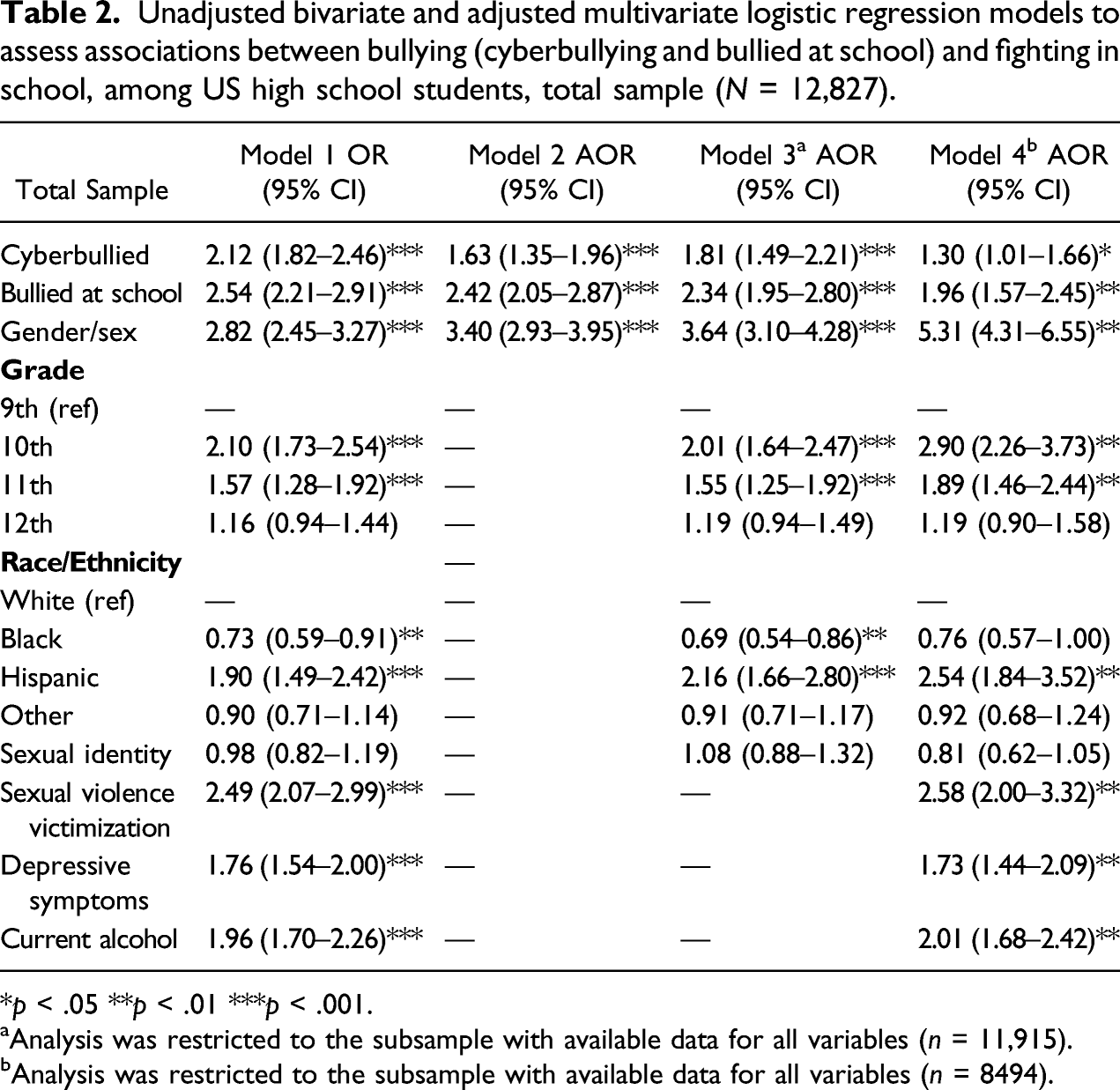
*p < .05 **p < .01 ***p < .001.
aAnalysis was restricted to the subsample with available data for all variables (n = 11,915).
bAnalysis was restricted to the subsample with available data for all variables (n = 8494).
For adjusted models 3 and 4 with the total sample, gender/sex, grade, and race/ethnicity were associated with our outcome variable. In Model 3, for example, male versus female gender/sex (AOR = 3.64; 3.10–4.28), being in 10th and 11th grade versus 9th grade (10th: AOR = 2.01; 95% CI = 1.64–2.47; 11th: AOR = 1.55; 95% CI = 1.25–1.92), and being Hispanic compared to White (AOR = 2.16; 95% CI = 1.66–2.80) were associated with higher odds of having fought in school. Black compared with White students were significantly less likely to report having fought at school (AOR = 0.69; 95% CI = 0.54–0.86). Adjusted Model 4, which also included emotional-behavioral risks, further demonstrated that sexual violence victimization (AOR = 2.58; 95% CI = 2.00–3.32), depressive symptoms (AOR = 1.73; 95% CI = 1.44–2.09), and alcohol consumption (AOR = 2.01; 95% CI = 1.68–2.42) were all significantly and positively associated with greater odds of having fought at school. Notably, the association with gender/sex increased in each model as more covariates were included, such that the effect size was almost double from Model 1 (OR = 2.82; 95% CI = 2.45–3.27) to Model 4 (AOR = 5.31; 95% CI = 4.31–6.55), demonstrating that male gender/sex is a very strong predictor of in school fighting.
Unadjusted bivariate and adjusted logistic regression models to assess associations between bullying (cyberbullying and bullied at school) and fighting in school, among US high school students, stratified by gender/sex, Female subsample (n = 6366).

*p < .05 **p < .01 ***p < .001.
aAnalysis was restricted to the subsample with available data for all variables (n = 6135).
bAnalysis was restricted to the subsample with available data for all variables (n = 4351).
Unadjusted bivariate and adjusted logistic regression models to assess associations between bullying (cyberbullying and bullied at school) and fighting in school, among US high school students, stratified by gender/sex, Male subsample (n = 6461).

*p < .05, **p < .01, ***p < .001.
aAnalysis was restricted to the subsample with available data for all variables (n = 5780).
bAnalysis was restricted to the subsample with available data for all variables (n = 4143).
Among male students, bivariate logistic regression showed that cyberbullying victims had more than three times the odds of getting in a fight at school (OR = 3.09; 95% CI = 2.55–3.77). Significantly attenuated associations were found across subsequent adjusted Models 2–4, as indicated by the lack of overlap in confidence intervals compared with Model 1 (Model 2: AOR = 1.71; 95% CI = 1.36–2.15; Model 3: AOR=1.93; 95% CI = 1.51–2.46; Model 4: AOR = 1.43 95% CI = 1.07–1.93).
Findings from the unadjusted odds model (Model 1) also demonstrated a significant association between being bullied at school and fighting at school (OR = 3.60; 95% CI = 3.03–4.27). Significantly attenuated effect sizes were seen in our adjusted models compared with Model 1 (Model 2: AOR = 2.87; 95% CI = 2.34–3.50; Model 3: AOR = 2.70; 95% CI = 2.18–3.34; Model 4: AOR = 2.25; 95% CI = 1.73–2.92), as indicated by non-overlapping confidence intervals.
Discussion
Simple regression findings from this study indicate that students who have been bullied, in school or online, have more than twice the odds, respectively, of fighting in school, consistent with prior research from the US and elsewhere (Carvalho et al., 2021; Muula et al., 2009; Sattler et al., 2016; Seldin & Yanez, 2019). The independent contribution of each form of bullying victimization was maintained, though attenuated, even after accounting for socio-demographics and emotional-behavioral vulnerabilities. These findings, along with observed gender/sex differences, align with General Strain Theory and our hypotheses.
Consistent with older YRBS data (Sattler et al., 2016), we find that bullying–fighting associations hold true for males across all models, and for females across Models 1–3. Among females, the loss of the association is only seen after accounting for emotional-behavioral risks: sexual violence victimization, depressive symptoms, and alcohol use. Sexual violence, in particular, appears to be a major risk factor for fighting in school, such that girls with this history had three-fold the odds of fighting at school and boys with this history had six-fold the odds. Girl being bullied more often online and in person is often tied to their sexualization or the degradation of their sexual appeal, and is thus also linked to sexual harassment and sexual violence (Englander et al., 2017). Associations with fighting were significantly stronger for boys, however, highlighting that, while girls may be more likely to experience sexual violence, reactions may be greater for boys, in some ways. This aligns with our GST-related hypothesis regarding social norms: being subjected to stressors that are less commonly associated with traditional male experiences, such as bullying and sexual violence victimization, may increase boys’ emotional distress. Perceived threats to their male identity, coupled with perceived societal tolerance of male aggression, may thus lead to fighting as a compensatory response, in some of these cases. Increased teacher and parent modeling and reinforcement of non-violent male and non-sexualized female counterexamples may be necessary in order to alter these mindsets and resultant behaviors. More research is needed to examine the role of sexual violence in bullying and in-school fighting, with consideration of these gender differences.
Depressive symptoms and alcohol use were also strongly associated with increased odds of fighting, suggesting the need to recognize in-school fights as indicators of social and emotional need. Given the cross-sectional nature of the study, we cannot presume causality, and the observed associations are possibly bidirectional. Identifying as gay/lesbian, bisexual, or unsure, relative to heterosexual, was not associated with higher odds of fighting in school, for the total sample or the female subsample. However, for the male subsample, a crude association between gay/bisexual/unsure identity and fighting in school was seen, though it was lost in adjusted analyses. This suggests a greater vulnerability for male students, but one that is less meaningful after accounting for bullying victimization and other demographics. Nevertheless, given the greater risk for bullying among gay/bisexual/unsure relative to heterosexual males (CDC, 2020), bullying prevention efforts may benefit from integration with anti-homophobia curricula, particularly for male students. These findings correspond with other research highlighting that school bullying can often come in the form of homophobic and transphobic remarks, and that this occurs more against boys than girls (Espelage et al., 2018; Moyano & Sánchez-Fuentes, 2020; Smith et al., 2020).
This research calls into question ongoing zero tolerance policies in cases of in-school fighting, mandating suspension as a punishment for fighting, without consideration of situational factors or the educational costs. Carvalho et al. (2021) theorize that fights may often be the result of bullying victims’ efforts to defend themselves: self-protection, in the absence of adequate school-based intervention. Given bullying victims’ already elevated academic and attendance concerns, these punitive responses may be exacerbating educational inequalities and compromising the mental health and opportunity of already vulnerable youth, while decreasing feelings of belonging (Christie et al., 2004; Gordon et al., 2018). Furthermore, they do not appear to be having the desired remedial or deterring effects: longitudinal studies reveal that first time suspension is associated with increased odds of future behavioral problems and additional suspensions (Heilbrun et al., 2015). Trauma-informed, healing-centered discipline approaches, focused on developing students’ self-regulation and de-escalation skills, including the usage of sensory puzzles, weighted blankets, fidget toys, exercise equipment, and designated “cool-down” spaces (Thomas et al., 2019) may be more effective. Expanding social work and mental health staffing and their roles in helping build educators’ understanding of students’ aggression, facilitating student-centered skill and relationship-building interventions, and supporting teachers’ self-care may be necessary as well (Thomas et al., 2019).
In terms of teaching practice, detection of bullying may be the first key to its reduction. Doll et al. (2003) found that about half of bullying victims do not report it to any adult, and those who do are more likely to tell parents than teachers, sometimes because of fear of retaliation from their bully. Disparities in students’ and teachers’ perceptions of adult intervention often result from teachers’ lack of awareness of when bullying is taking place, particularly the more clandestine acts (Doll et al., 2003). This suggests the need for improved bullying prevention training, as well as the establishment of trusting relationships with students, where sharing about personal difficulties is frequent and comfortable. Costenbader & Markeson (1998) found that the most common student request, when asked how teachers could better support them, was “giving me someone to talk to about problems with my friends” and “problems at home” (p. 72).
The next key may be social intervention: monitoring and shaping social dynamics to combat the high percentage of bullying related to social status imbalances (Seldin & Yanez, 2019). Actively promoting closer social connections, through fun, collaborative partner activities, and skill-building in areas of communication and conflict resolution may help youth to better negotiate interpersonal relationships without the use of violence, given the vulnerability of friendless students, and the improved likelihood of amicable reconciliation between friends (Doll et al., 2003). This can include modeling and guided practice around compromising and brainstorming alternative solutions to conflicts, as well as the use of linguistic cues to redirect students during this learning process (Doll et al., 2003).
Findings of this study should be considered in light of certain limitations. As noted, since analyses were cross-sectional, causality cannot be assumed. Prospective longitudinal research will be important to provide further insight into whether bullying precedes fighting. Since these survey data were also all based on students’ self-reports, they also may be subject to recall bias or social desirability bias, increasing the possibility of some inaccuracies. As noted in the methods, we did find some bias in the missing data for our variable on fighting in school, with higher prevalence of missing data for Black and Hispanic students. This may be attributable to social desirability and students recognizing both greater assumptions and greater risk regarding certain racial/ethnic groups’ involvement in fighting in school. However, this missingness of data was low (<5%), and missingness was even lower on our independent variables on bullying (<2%). The details on the nature of the bullying and fighting, the nature of the relationships, the duration of the problematic interactions, and repercussions including disclosure and help-seeking were unavailable and would offer important insight. In particular, it would be helpful to know if the bullying and fighting were connected to the same individual(s). Numerous risk factors that are known to affect peer aggression could not be considered in our analyses due to their omission from this dataset. These include lack of parental supervision, exposure to violence, abuse, family or peer antisocial behavior (Dishion & Tipsord, 2011; Gilgoff et al., 2020; Pettit, 1997), neighborhood crime, poverty (Huang & Cornell, 2017), and education spending (Elgar et al., 2015). Bullying and fighting may be components of a larger trauma reproduction mechanism in communities with high concentrations of poverty and insufficient support services (Elgar et al., 2015). Unfortunately, poverty is not an indicator reliably reported by adolescents, but rather requires parental response, which is unavailable in YRBS (Gennetian et al., 2015). Lastly, since the time frames during which data related to different variables were collected may have varied across schools and regions, these periods of time may have differed in regards to other unknown, confounding variables that may have affected the results.
Conclusion. Overall, main findings from this study show associations between bullying victimization and fighting in school, amplified in cases of sexual violence victimization, feelings of hopelessness, and alcohol consumption. These findings suggest a need for immediate reform in terms of educational policy and practice, including the elimination of zero tolerance policies mandating suspension as a consequence for fighting. Teachers and school administrators may benefit from further training on the topics of bullying detection and prevention, building conflict resolution skills into required curricula, and promoting positive social networks. Social norms that support gender stereotypes related to male aggression and the acceptability of sexual violence need to be altered, as these may be reinforcing the occurrence and nature of bullying and fighting in school. With recognition of the strong connection between depressive symptoms and school fighting, as well as alcohol use and fighting, school-based social and mental health supports should be strengthened, particularly, in cases where unfavorable adult-to-child ratios stretch faculty too thin. Parents must also be engaged, given the fact that cyberbullying is almost as common as bullying in school; parent training and oversight of high school students’ technology use may be as effective a means of preventing cyberbullying as anything that teachers can do. All of these problems are interconnected, so that while educators and parents have the potential to make a meaningful impact by helping to reduce bullying and fighting and many of their harmful effects, the most holistic, effective, sustainable solution of all will address these larger societal problems, as well as those students’ behaviors.
Footnotes
Acknowledgments
The authors wish to thank the US Centers for Disease Control YRBS Team for making these data publicly available to scholars, and the students who participated in the YRBS.
Declaration of Conflicting Interests
The author(s) declared no potential conflicts of interest with respect to the research, authorship, and/or publication of this article.
Funding
The author(s) received no financial support for the research, authorship, and/or publication of this article.
