




Abstract
Few studies have reported problem behaviors in adulthood related to the timing of child neglect. The objective was to examine the relationship between classes of child neglect and later behavior. The sample included 473 participants from the prospective Longitudinal Studies of Child Abuse and Neglect (LONGSCAN); their mean age was 23.8 years. They completed an online survey regarding behaviors and experiences in early adulthood. Neglect was assessed via Child Protective Services (CPS) and self-reports of neglect. Latent class analysis (LCA) identified three classes: Late Neglect, Chronic Neglect, and Limited Neglect. There were significant differences between Limited and Late Neglect regarding later intimate partner aggression and violence (IPAV) and psychological distress, and among all classes for criminal behavior. High-risk youth experiencing neglect beginning in mid-adolescence appear especially vulnerable to later criminal behavior, psychological distress, and IPAV. Those working with such youth can help ensure that their needs are adequately met, to prevent or mitigate problems in adulthood.
Introduction
Neglect remains the most common form of child maltreatment (CM). There were approximately 674,000 children with substantiated abuse or neglect in 2017 in the U.S. (U.S. Department of Health & Human Services, Administration for Children and Families, Administration on Children Youth and Families, Children’s Bureau, 2019); 75% were neglected, 18% were physically abused and 8.6% were sexually abused. Despite striking reductions in reports of physical and sexual abuse in recent decades, reports of neglect have not changed substantially (Finkelhor, et al., 2015; Petersen, et al., 2014; Simmel, et al., 2016).
A review of 30 studies (Maguire, et al., 2015) found an array of effects of neglect, including difficulty regulating emotion, maintaining relationships with peers, and low self-esteem (Gross, 1998; Kulkarni, et al., 2013; Maguire et al., 2015). Other problems include lower intelligence scores (Fishbein, et al., 2009; Kantor, et al., 2004), having to repeat grades (de Paúl & Arruabarrena, 1995), and requiring more special education services (Reyome, 1993) than non-neglected children. These early outcomes likely have implications for later development and functioning, but most reports of the effects of CM and particularly of neglect on adult behavior rarely utilize prospective longitudinal data. In an exception, however, Widom and Kuhns (1996) found that in females, sexual abuse (OR = 2.54) and neglect (OR = 2.58) were associated with prostitution. Similarly, Klein et al. (2007) found that neglect predicted negative attitudes toward condom use and increased HIV-related risky sexual behaviors. With respect to intimate partner aggression and violence (IPAV), neglect has been associated with a greater likelihood of physical injury (Widom, et al., 2014). Renner and Whitney (2012) reported that neglect was associated with later perpetration, victimization and bi-directional IPAV for females. In males with bi-directional IPAV, they identified CM retroactively.
Regarding mental health outcomes, Norman et al.’s (2012) meta-analysis of the long-term health consequences of child physical abuse, emotional abuse and neglect suggested a causal relationship between types of CM other than sexual abuse and an array of mental health disorders, substance use, suicide attempts, sexually transmitted infections, and risky sexual behavior. The impact of neglect alone however was not examined. Spinhoven et al. found an association between childhood adversity and later affective disorders. Emotional neglect was linked to depressive disorder, dysthymia, and social phobia (Spinhoven et al., 2010). Hildyard and Wolfe (2002) found the effects of physical neglect to be unique from those of abuse. Neglected children had more severe cognitive and academic deficits, social withdrawal and limited peer interactions, and internalizing behavior problems.
Regarding criminal behavior, Mersky and Reynolds (2007) used data from the Chicago Longitudinal Study to show that neglect had a somewhat stronger effect than did physical abuse on either juvenile or adult arrests for violent offending. Williams and colleagues showed a clear link between neglect and physical abuse on the one hand and delinquency on the other (Williams, et al., 2010). A study using Add Health data found that both sexual abuse and neglect alone predicted offending; physical abuse did not (Yun, et al., 2011). A longitudinal study of criminal career trajectories did not observe that offenders were more likely to be male and abused or neglected compared to non-offenders, but they did not analyze the maltreatment types separately (Widom, et al., 2018). Bland and others concluded that research on whether childhood neglect predicts adult violent behavior is still “limited” (Bland, et al., 2018).
Variations in outcomes are partly due to neglect being a very heterogenous phenomenon. There has been little exploration of differing patterns of neglect according to when in a child’s life it may have occurred, or whether the neglect is an isolated event or chronic. Two ecological-developmental theoretical perspectives—developmental psychopathology (Sameroff, 2009; Sroufe & Rutter, 1984) and the multifactorial model of complex disorders (Falconer, 1965; Lander & Schork, 1994; Tarter, 2002)—help explain the underlying processes. The two perspectives suggest that individual behavior is the product of complex reciprocal interactions between characteristics of the individual and life experiences. Both emphasize the dynamic nature of multiple risk and protective factors over time as they interact with the developing individual (Glantz & Leshner, 2000). Thus, a developmental and longitudinal perspective is needed to better understand how timing, chronicity, and patterns of neglect impact later outcomes and risk behaviors. However, with limited exceptions, there are few longitudinal prospective studies examining young adult outcomes related to patterns of neglect throughout childhood and adolescence. Thornberry and colleagues assessed timing of maltreatment based on CPS substantiations between birth and age 18 finding that maltreatment occurring only in childhood was associated with young adult drug use and depressive symptoms; in contrast maltreatment during adolescence was associated with a much broader array of criminal and health risk behaviors (Thornberry et al., 2010). Although these findings suggest timing of maltreatment may have important implications on maladaptive outcomes, abuse and neglect were combined, limiting understanding of the impact of neglect specifically on outcomes. Further, the type of neglect was not examined and those in the adolescent maltreatment group could also have been neglected in early childhood potentially conflating chronicity and timing.
As neglect is a heterogenous phenomenon, it is important to consider that both its timing and pattern may differentially impact domains of young adult functioning. Measuring neglect is inherently difficult, as it generally involves covert acts of omission rather than overt acts of commission (Oshri, et al., 2016). Neglect has few objective criteria for measuring the risk of harm, and this problem manifests in many ways (Oshri et al., 2016). Moreover, child neglect research often relies on child welfare records, which do not fully capture experiences, or retrospective accounts, which may be influenced by recall bias (Jonson-Reid et al., 2012).
To try circumventing these challenges, the present study uses latent class analysis (LCA) to integrate both child welfare and self-report data regarding neglect to probe patterns of the timing and chronicity of neglect during childhood. Using data from the Longitudinal Studies of Child Abuse and Neglect (LONGSCAN), we hypothesized that those who had experienced more chronic neglect would be at increased risk for IPAV, psychological distress, risky sexual behavior, and criminality in early adulthood compared to those who did not experience neglect or whose neglect decreased over time. The present paper complements an earlier one focused on just substance use in early adulthood (Dubowitz et al., 2019).
Methods
Sample
Longitudinal Studies of Child Abuse and Neglect involved a consortium of five prospective studies of the antecedents and consequences of CM in Baltimore, Chicago, North Carolina, San Diego, and Seattle (Runyan et al., 1998). The original sample consisted of 1354 maltreated or high-risk children and their primary caregivers. Data were gathered when the children were recruited at 4–6 years of age, and every 2 years until age 18, between 1991 and 2012. Data from Child Protective Services (CPS) were obtained at regular intervals. Each site’s procedures were approved by its Institutional Review Board. Families were paid a nominal amount for their time and transportation.
The data presented here include a follow-up online survey examining behavioral health, criminal justice involvement, IPAV (both as victim and perpetrator), and risky sexual behavior as young adults. To be eligible, participants had to have had at least one interview at age 14, 16, or 18 and at least four interviews between ages 4 and 18. There were 1053 eligible subjects; 473 completed the follow-up survey (“Completers”). The average age of completion of the young adult interview was 23.8 years (SD = 1.89; range = 19–29).
There were few statistically significant differences between Completers and those who did not complete the survey. The Seattle site had a somewhat higher percentage of Completers than did the other sites (26.6% vs. 14.5%), and there were fewer Completers from the North Carolina site (11.2% vs. 21.6%) relative to the rest of the sample (χ2 [df = 4] = 50.60, p<.001). More females than males completed the survey (61.5% vs. 46.1%, χ2 [df=1] = 29.37, p<.001). CM, race/ethnicity, family income, and caregiver education, employment, and marital status were not associated with completion status.
Measures
Independent measures and variables
CPS reports of neglect
Child Protective Services reports were coded according to the Modified Maltreatment Classification System (English & LONGSCAN Investigators, 1997). Neglect included Failure to Provide (FTP) and Lack of Supervision (LOS). Failure to Provide reflected the primary caregiver not adequately meeting the child’s physical needs related to food, clothing, shelter, medical care, or hygiene. Lack of Supervision reflected children not receiving adequate protection from environmental hazards. Of note, CPS rarely accepts reports of LOS concerning adolescents. The presence of one or more CPS reports for each category was computed for each child during ages 0–4, 5–8, 9–12, and 13–17 years, regardless of whether the report was substantiated. No significant differences in behavioral outcomes have been found related to whether reports were substantiated (Hussey et al., 2005).
Self-reports of neglect
Self-reported neglect at ages 12 and 14 was assessed using a modified version of the Multidimensional Neglectful Behavior Scale (Dubowitz et al., 2011). Using factor analysis, three subscales represented neglect at 12 and 14: Physical Needs, Emotional Support, and Monitoring/Supervision. Each participant had a score on each subscale, at each age. The young adolescents rated their care during elementary school and in the past year. Cronbach’s alphas were 0.78 (12) and 0.75 (14) for Physical Needs, 0.80 (12) and 0.82 (14) for Emotional Support, and 0.62 (12) and 0.64 (14) for Monitoring/Supervision.
At 16 and 18, a shorter version of the neglect measure was used. To determine potential domains, we placed items into conceptual categories guided by the earlier findings. This resulted in four subscales at both ages (Emotional Support; Monitoring; Nurturance; Protection from Hazards), as well as Physical Needs at 16 and Future Planning at 18. An inter-item correlation matrix was computed within each subscale. If an item pair had r > 0.70, only one item was retained. A reliability analysis was performed on each subscale and items were deleted if their removal improved reliability. A score was computed for each subscale and an inter-scale correlation matrix was calculated. Subscales that were highly correlated were consolidated into new subscales. This resulted in four subscales at age 16 with alphas of 0.87 for Physical Needs, 0.79 for Emotional Support, 0.84 for Nurturance, and 0.75 for Protection from Hazards. At age 18, the alphas were 0.90 for Emotional Support, 0.79 for Protection from Hazards, and 0.83 for Future Planning.
Control variables
Sex and race/ethnicity were ascertained from caregiver reports. Study site was also included as a covariate in the predictive models described below.
Outcome measures
Young Adult Report of interpersonal aggression and violence (IPAV-A)
The IPAV-A is a project-developed measure based on the Conflict Tactics Scale (Partner to Partner; Straus, 1979). The young adults reported whether they had experienced or perpetrated psychological, physical, or sexual aggression or violence in a relationship with a romantic partner. These were aggregated into six outcome variables related to being a victim or a perpetrator of any of these types of aggression or violence in the past year.
Young adult report of risky sexual behavior
Young adults were asked questions developed by the researchers whether they had experienced any of the following six risky sexual behaviors: number of partners, transactional sex, sex with a risky partner, coerced sex, combining substance use and sex, and unprotected sex. These variables were scored categorically (yes/no).
Young adult report of psychological distress
This was measured by the Brief Symptom Inventory 18 (BSI 18), an 18-item self-report screen for psychological distress (Derogatis, 2001). Participants rated their distress related to symptoms on a scale (0 = Not at all, 1 = A little bit, 2 = Moderately, 3 = Quite a bit, and 4 = Extremely). Scores for each subscale were calculated by summing the ratings of the six items for each of three conditions (somatization, anxiety, depression), with a range of 0–24. The Total score was computed by summing the ratings for all 18 items, with a range from 0 to 72.
Young adult report of criminality
This measure was developed by the researchers to assess “engagement in any criminal behavior” and/or “criminal justice system involvement.” The former includes behavior that could have led to an arrest. The latter only includes actual arrests, convictions, orders of protection, and time in jail. We created two dichotomous Yes/No variables for engagement in criminal behavior and for involvement in the criminal justice system.
Data analysis
Latent class analysis assuming conditional independence was used to derive classes or patterns of the occurrence and timing of neglect. A full exposition of the LCA approach and solution was presented in a previous paper (Dubowitz, et al., 2019). Categorical and continuous outcome variables associated with class membership were explored using the R3Step approach in MPlus (Asparouhov & Muthén, 2004). This approach simultaneously estimates the best-fitting LCA solution while evaluating the associations between class membership and variables of interest, thus accounting for the uncertainty of the best-fitting class solution in the prediction of outcomes. This approach was also used to test for differences in individual problem behavior outcomes as a function of neglect class in regression models; site, sex, and race/ethnicity were dummy-coded and entered simultaneously. Because the individual outcomes displayed non-normality, the Full-Maximum Likelihood Robust procedure in MPlus was used to estimate all models. This approach adjusts for both the non-normality and missing data.
Results
Model Fit Indices.
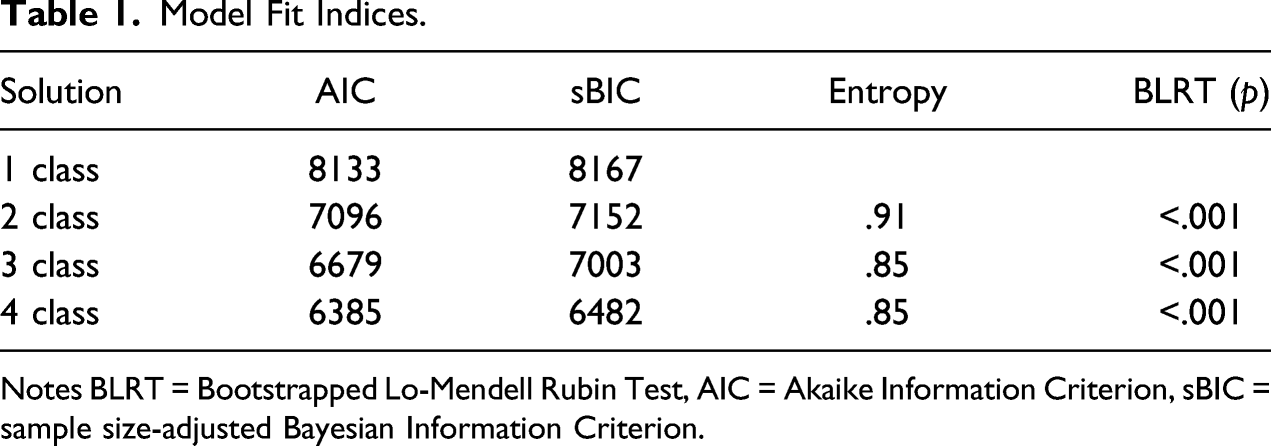
Notes BLRT = Bootstrapped Lo-Mendell Rubin Test, AIC = Akaike Information Criterion, sBIC = sample size-adjusted Bayesian Information Criterion.
Mean Scores by Measure and Neglect Class.
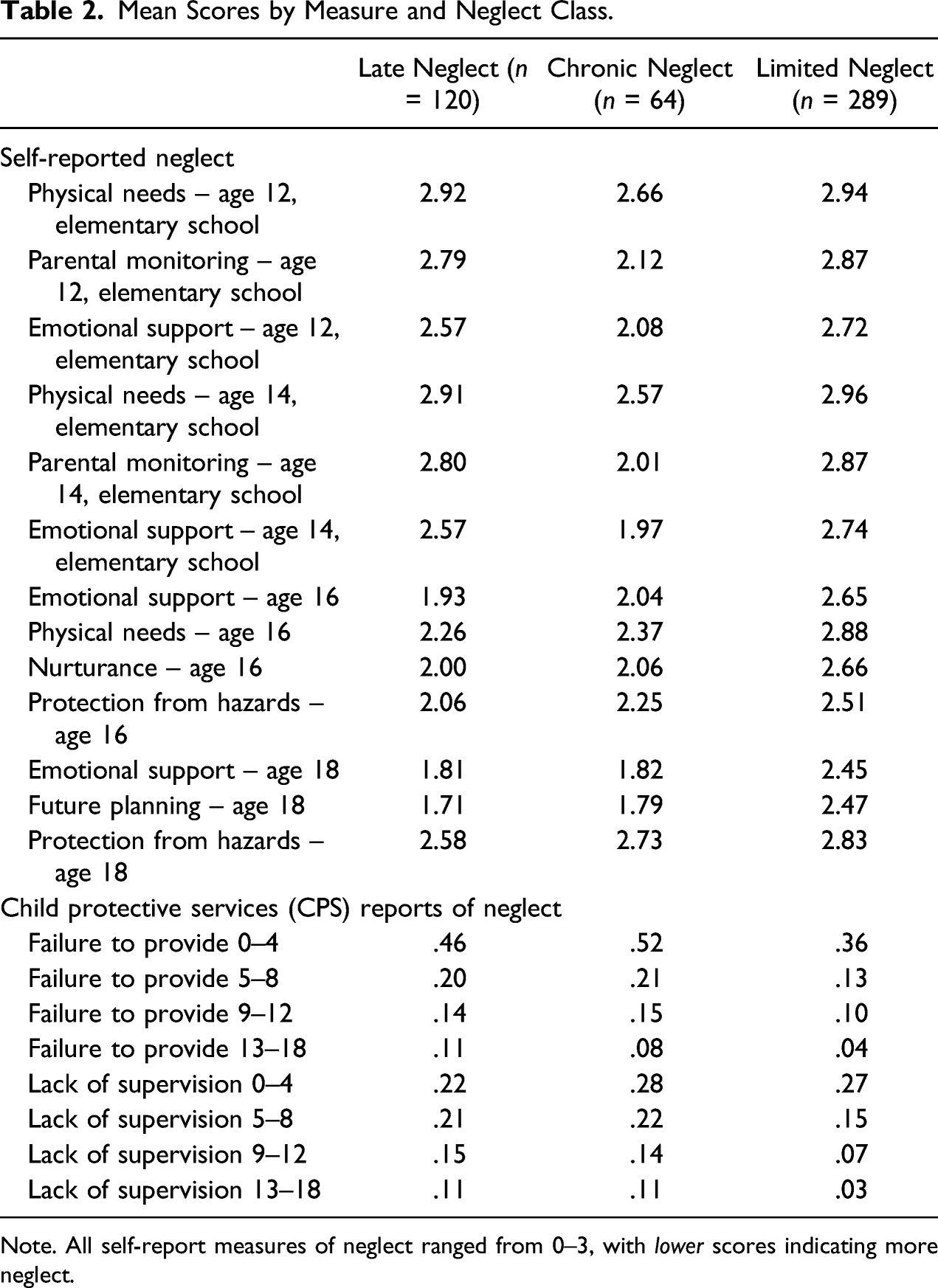
Note. All self-report measures of neglect ranged from 0–3, with lower scores indicating more neglect.
Young Adult Outcomes by Child Neglect Classes.
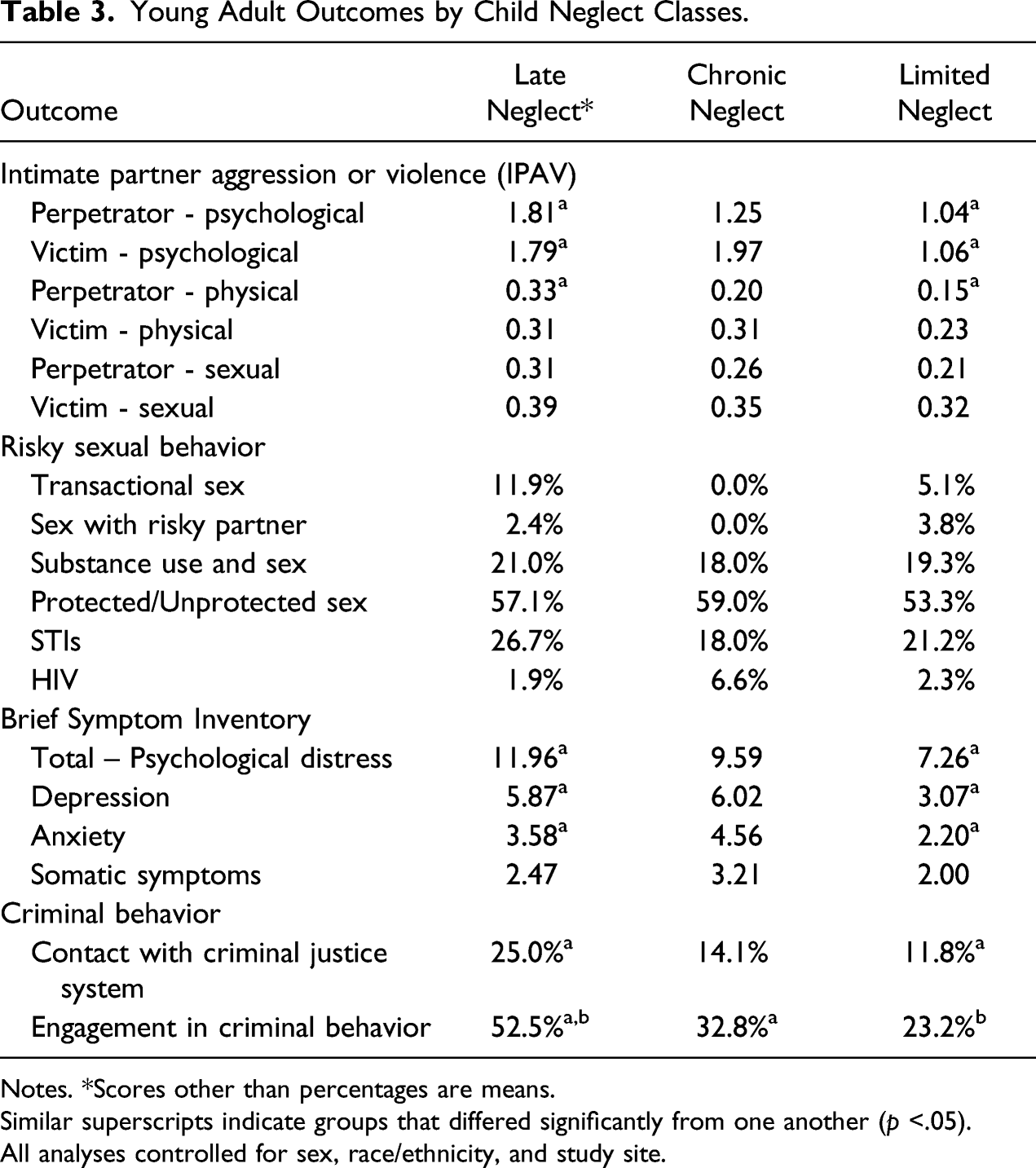
Notes. *Scores other than percentages are means.
Similar superscripts indicate groups that differed significantly from one another (p <.05).
All analyses controlled for sex, race/ethnicity, and study site.
Discussion
There were different patterns in the occurrence and timing of neglect in this high-risk sample of children and youth who were either maltreated or at risk for maltreatment. Despite the high-risk nature of the sample, the largest class was the one with relatively little evidence of neglect, based on both CPS and/or self-reported data. As part of this longitudinal study, it was striking that the youth rated their relationships with their parent or primary caregiver quite positively. While these are encouraging findings, they do not however preclude possible neglect. Neglected children and youth might not know what to expect and might not perceive themselves to be lacking care or supervision. A relatively small subgroup experienced chronic neglect during adolescence. Neglect is generally construed as an ongoing pattern of unmet needs; it is a form of CM that is often especially recalcitrant to intervention (Child Welfare Information Gateway, 2019). A striking finding concerns the Late Neglect class that self-reported neglect in several domains starting in mid-adolescence. Earlier on, they resembled the Limited Neglect group, but in mid-adolescence they appeared more like those in the Chronic Neglect class. It is unclear why this shift occurred. Examination of their recent life events and changes in their financial situation did not differ among the groups; this is grist for future research. This research underscores the importance of self-report measures of neglect.
Compared to the self-report data, the distinctions among the neglect classes were less clear regarding CPS reports. The Limited Neglect group did however have the lowest proportion who had been reported. CPS reports are a crude measure of CM, limited to what is identified, reported, and investigated; youths’ perceptions of their experiences and unmet needs are likely more sensitive indicators of neglect, albeit with the usual limitations of self-reported information (Dubowitz et al., 2011).
Our primary aim was to discern the impact of the occurrence and timing of neglect on important aspects of functioning in early adulthood. One major finding was that neglect was associated with impaired functioning in several domains—IPAV (both as perpetrator and recipient), psychological distress and criminal behavior. These results support research cited earlier regarding the impact of child neglect (Maguire et al., 2015). In addition, Currie and Widom (2010) found that adults who were neglected as children suffered worse economic outcomes than did controls; they completed fewer years in school, and neglected women were less likely to be employed, own a home or car, or have a bank account. In a recently reported large prospective longitudinal study, neglect was associated with several mental health problems in adulthood, such as anxiety, depression, and delinquency in men, as well as other areas of impaired functioning (Strathearn et al., 2020). The array of associated outcomes supports the principle of multifinality, the process by which the same risk and/or protective factors may ultimately lead to different developmental outcomes (Cicchetti & Rogosch, 1996). Clearly, neglect is not a benign phenomenon.
The association between child neglect and IPAV, in both directions, has been previously demonstrated (Renner & Whitney, 2012; Straus & Savage, 2005; Widom et al., 2014). The pathway however is not clear. Widom and colleagues speculated that neglect may lead to greater emotion dysregulation, which may predispose to IPAV. They also refer to the work of Dutton and colleagues regarding neglect’s impact on attachment with parent figures, perhaps contributing to later violence in attempting to control a partner and prevent abandonment (Dutton, 2003; Godbout et al., 2017). In addition, other effects of neglect, such as difficulty with peer relationships and poor self-esteem, may also play a role (Maguire et al., 2015).
Research has demonstrated the strong links between childhood adversities, including neglect, and adult psychopathology. Several of the above outcomes during childhood associated with neglect may mediate its impact on later mental health. For example, insecure attachment with a parent may impede later functioning, such as forging healthy relationships (McLaughlin, 2016). Neglect has also been associated with internalizing and externalizing behavior problems during adolescence, perhaps impeding learning and later functioning such as unhealthy substance use (Dubowitz, et al., 2020). Neglect also has been linked to externalizing and anti-social behavior, juvenile delinquency and adult criminality (Grogan-Kaylor & Otis, 2003; Smith, et al., 2005), albeit not in all studies (Wang et al., 2012). It is likely that some of these social and psychological problems linked to neglect also contribute to criminality (Bland, et al., 2018). For example, Braga and colleagues found in their literature review that neglect was associated with antisocial behavior and delinquency and postulated that neglected youth may be more exposed to deviant peers and violent behavior (Braga et al., 2017).
Interestingly, neglect was not associated with risky sexual behavior in adulthood. A few factors may explain this. There were trends such as the higher albeit not statistically significant rates of transactional sex and of sexually transmitted infections in the Late Neglect group; limited statistical power may have been a factor. In addition, some of the behaviors, such as having sex with a risky partner or contracting HIV, were rarely reported by this sample. Also, the entire sample was quite high risk; neglect may not have had an incremental and/or specific impact on sexual behavior in the context of other adversities. One study that found neglect linked to female prostitution had a particularly high-risk sample with court adjudicated neglect (Widom & Kuhns, 1996). Strathearn and colleagues (2020) did however find that neglect was associated with early onset of sexual activity, youth pregnancy, and having multiple sexual partners.
The refined approach to measuring neglect in this prospective longitudinal study offers a nuanced and valuable view. McLaughlin (2016) pointed to the possibility that experiences during different developmental periods may have varying impact. With regarding to the timing of experiences and their impact, there are two competing hypotheses. Developmental psychopathology and multifactorial perspectives posit that factors occurring early in life exert a particularly strong effect on subsequent outcomes. Dodge and colleagues for example found support for the primacy of early influences on early-onset drug use (Dodge et al., 2009). The second hypothesis emphasizes more proximal causes of behavior (Elder, 1998). For example, researchers have found stronger effects of maltreatment during adolescence than that limited to earlier childhood (Thornberry, et al., 2001).
Neglect during adolescence, however, has been seldom examined; rather, the primary focus has been on young children. Despite their increasing autonomy, adolescents remain quite dependent on their caregivers. In this context, it is striking that the Late Neglect group appeared at highest risk for problems in early adulthood, even compared to those chronically neglected throughout adolescence. This matched our finding regarding young adults’ use of substances (Dubowitz et al., 2019). We speculate that those in the Chronic Neglect group may have learned previously to be more self-reliant and perhaps less likely to perceive and/or experience later deficiencies in their care. This might have led to adoption of “adult-like” roles and responsibilities that are associated with less likelihood of substance use (Staff, et al., 2010). A sudden or late onset of neglect may actually be more traumatic than consistent neglect. It is also possible that limited power was an issue given the rather small Chronic Neglect group (n = 64).
This study has limitations. The relationships among neglect and the outcomes were perhaps confounded by unexamined variables. Self-report data are limited to participants’ perceptions and what they are willing to disclose. Social desirability was likely diminished by using an audio computer assisted self-interview format (Black & Ponirakis, 2000; Turner, et al., 1998). CPS data are subject to several biases (English and the LONGSCAN Investigators, 1997; Hampton & Newberger, 1985; Lane, et al., 2002). We partly addressed this by using a refined coding schema based on CPS narratives (Barnett, et al., 1993; English, et al., 2005; Zuravin, 2001), although this still relies upon what CPS caseworkers documented.
The study has strengths. The repeated measurement of neglect throughout childhood, consisting both of self-report by adolescents as well as the CPS data, offers a longitudinal and prospective view of children’s and youth’s experiences, and a nuanced understanding of the timing and chronicity of neglect. The prospective study design allows for discerning the temporal relationship with later outcomes in early adulthood. Additional strengths are the diversity of the sample in terms of the degree of risk and the different geographic regions. In addition, the sample is somewhat diverse in terms of race/ethnicity; the findings may be generalizable to high-risk youth across races and ethnicities. In addition, limited power was a consideration.
Despite a common perception that neglect is relatively benign (Dubowitz, 1994), this study points to its seriousness given the link to three of four important aspects of early adult functioning. Neglect beginning in mid-adolescence deserves special attention. This period is commonly a challenge for parent–youth relationships. Those working with adolescents can play a valuable role by being sensitive to their needs, recognizing when their needs are not being adequately met (i.e., neglect), and helping ensure that these are better addressed. Added attention may be especially important for high-risk youth such as those who have been maltreated or are at risk for this problem. In addition, there is a need to help ensure that young adults with mental health and relational problems as well as those involved with the criminal justice system receive necessary services and treatment. Future research should aim to elucidate the processes whereby neglect and other adversities lead to later problems. Such information should help guide the development of appropriate interventions and prevention efforts.
Footnotes
Declaration of Conflicting Interests
The author(s) declared no potential conflicts of interest with respect to the research, authorship, and/or publication of this article.
Funding
The author(s) disclosed receipt of the following financial support for the research, authorship, and/or publication of this article: This research was funded by grants from the Office of Child Abuse and Neglect, This research was funded by grants from the Office of Child Abuse and Neglect, Administration on Children and Families, US DHHS (Grants Nos. 90CA1401, 90CA156901, 90CA1681, and 90CA1749), and the National Institute on Drug Abuse (Grant no. 5R01DA031189–04).
