



Abstract
Intimate partner violence (IPV) affects men and women worldwide. However, a comprehensive examination of the etiology of IPV perpetration across national contexts is limited. Since Aker’s Social Structure and Social Learning (SSSL) theory was developed as a general theory of crime, national differences in social structure should explain social learning, which in turn should explain IPV perpetration. Therefore, the current study tests the applicability of SSSL and the mediation effect of the social learning process on the connection between social structural factors and IPV perpetration. Data on IPV perpetration by both male and female college students in 30 nations were taken from the International Dating Violence Study. Structural-level indicators of gender equality for individual nations were taken from Global Gender Gap Index. Findings suggest that national-level gender equality is partially mediated by definitions favorable to breaking the law; a component of SSSL theory. However, other components of the social learning process, such as differential association, differential reinforcement, and imitation, were not found to have mediating effects. The findings only partially support SSSL theory that social learning variables mediate the effect of gender equality on IPV perpetration. Implications of the findings are discussed.
Keywords
Introduction
Intimate partner violence1 (IPV) is a public health issue that affects men and women worldwide. As defined by the World Health Organization, IPV is “any behavior within an intimate relationship that causes physical, psychological, or sexual harm to those in the relationship” (World Health Organization, 2012, p. 1). The World Health Organization (2013) has documented that women experience more IPV victimization than men. Almost one-third of women in samples from 56 countries have experienced physical and/or sexual assault by an intimate male partner during their lifetimes. Men are also victims of IPV. However, estimates of the prevalence of IPV against males globally are very limited in the literature. Data from the National Intimate Partner and Sexual Violence Survey in the United States showed that one in three men (30.9%) have been victims of sexual violence, physical abuse, and/or stalking from an intimate partner in their lifetimes (S. G. Smith et al., 2017). Therefore, it is clear that both males and females perpetrate various forms of IPV.
Research has shown a number of individual- and structural-level risk factors for IPV perpetration. At the level of the individual, childhood exposure to parental violence and having deviant peers are the most significant risk factors for later violence perpetration (Kaukinen, 2014). This points to the importance of social learning process as a possible explanation of IPV. At the structural level, the prevalence of violence against women perpetrated by an intimate male partner also varies by country. IPV was more prevalent in South-East Asia (37.7%), the Eastern Mediterranean (37%), and Africa (36.6%) than in the Americas (29.8%), the European region (25.4%), and the Western Pacific region (24.6%) (García-Moreno, 2005). A cross-national study with 40 countries suggested that empowerment of women through education and employment is the strongest predictor of IPV, after controlling for the effects of economic development and globalization (Kaya & Cook, 2010). Therefore, consideration of gender equality at the national level in combination with individual level predictors may be helpful for understanding the perpetration of IPV against males and females across nations.
Despite a large body of research enhancing our understanding of IPV, there is still a lack of a comprehensive examination of the etiology of IPV. Researchers have called for a systematic, logical, contextual and comprehensive approach that acknowledges the influence of multilevel forces on IPV (Chesworth, 2018). Within the field of criminology and criminal justice, Social Structure and Social Learning (SSSL) theory was developed as a general theory of crime. SSSL theory is a multilevel (structural-processual) integrated theory which links the structural/macro level to individual involvement in IPV perpetration through a social learning process (Akers, 2011). SSSL theory may provide the needed contextual and comprehensive approach that its proponents have called for. Therefore, the current study examines the applicability of SSSL theory to explaining IPV perpetration.
Literature Review
Individual and Contextual Risk Factors for IPV Perpetration
At the individual level, parents and peers may provide the context where the social learning process takes place. Having parental support and monitoring are protective against IPV perpetration (Gorman-Smith et al., 2001). It was because parents could help socializing their children and providing encouragement of appropriate behaviors. A systematic review found that both witnessing parental IPV as a child and experiencing child abuse are risk factors for IPV perpetration (Kaukinen, 2014). A possible explanation is that children who have violent parents may not be exposed to non-violent ways of solving conflicts, effective communication, and negotiation (Foshee et al., 1999). Previous studies also identified peer contexts as the most significant risk factor in predicting IPV perpetration (Arriaga & Foshee, 2004; De Keseredy & Kelly, 1995; Kinsfogel & Grych, 2004). A meta-analysis of 27 articles examining IPV perpetration by adolescents identified three main peer-related predictors: peers’ IPV perpetrating behaviors, peers’ aggressive behavior, and victimization by peers (Garthe et al., 2017). The authors explained that an individual may imitate peers’ behaviors within a romantic relationship and hence may experience positive reinforcement from peers. Therefore, associating with deviant peers may increase opportunities for reinforcement and imitation of IPV. In addition, the literature suggests that holding attitudes justifying the use of IPV is strongly related to IPV perpetration (Stith et al., 2004). These findings establish the need to include multiple indicators of the social learning process in a test of the SSSL theory as an explanation of IPV.
The literature also suggests that patriarchal social structure may contribute to country-level variation in the prevalence of IPV (Jewkes, 2002). In societies that were characterized by higher levels of gender inequality, women were more likely to be abused by their male partners (Chan & Straus, 2008; Ozaki & Otis, 2017). The prevalence of IPV against women is fostered by economic and socio-cultural factors, such as social norms that encourage male’s use of authority and acceptance of violence against women, childhood exposure to violence, women’s economic rights, gender inequality in wages, employment, and access to education (World Health Organization, 2013). However, men were more likely to experience IPV by their female partners in societies that were characterized by greater female emancipation (Archer, 2006; Levinson, 1989; Yllö, 1983). Therefore, consideration of gender equality at the national level in combination with individual level predictors may be helpful for understanding the perpetration of IPV against males and females across nations.
Key Concepts in Akers’ Social Structure and Social Learning
Social structure and social learning theory assumes that “social learning is the primary process linking social structure to individual behavior” (Akers, 2011, p. 322). SSSL theory builds on Social Learning Theory (SLT) (Akers, 1973), which proposes that all human behavior is learned and modified through the same four social psychological mechanism: 1) differential association, 2) differential reinforcement, 3) imitation, and 4) definitions favorable towards breaking the law. The social learning process starts when a person differentially associates with others who commit and model criminal behavior, and who support violations of legal and social norms. These groups not only act as observable behavioral models. They also provide reinforcement for criminal or conforming behaviors through rewards and punishments. In the context of IPV perpetration, the theory predicts that the probability of IPV perpetration is greater when one associates more frequently with persons or groups that engage in IPV perpetration, hold definitions favorable to IPV perpetration, or provide differential reinforcement for IPV perpetration.
The social learning process begins with differential associations because learning most often takes place when people interact with intimate personal groups, such as parents, close friends, peers, and family members. Differential reinforcement refers to “the balance of anticipated or actual rewards and punishments that follow or are consequences of behavior” (Akers, 2011, pp. 66–67). A behavior can be increased through the presentation of a positive stimulus (positive reinforcement) or the removal of a negative stimulus (negative reinforcement). Usually, reinforcement provided by the intimate personal groups has the greatest influence on a person’s behavior. Imitation refers to behavior that is modeled by observing the behaviors of role models. These role models could be their intimate personal groups and significant others. Imitation is more important in an initiation of behavior than in the persistence or cessation of a behavior. According to SSSL theory, definitions are the motives, drives, rationalizations, and attitudes that a person attaches to a certain behavior. They are not direct motivators but act as internal discriminative stimuli that drive a person’s willingness to engage in criminal or deviant behaviors. Definitions function as the cues signaling that certain behavior is acceptable or unacceptable and is more likely to be rewarded or punished. Definitions are developed through imitation and differential reinforcement. Therefore, criminal behavior is learned through a dynamic social learning process.
Social structure and social learning theory, an extension of SLT, includes social structure as an influence on learning, which in turn influences behavior. Akers (2011) proposed that the social psychological process is influenced by cultural traditions, norms, social organization, and social control systems. Social structure provides the context where the social learning process occurs. One feature of social organization, gender equality, may be helpful for understanding the variations of IPV perpetration by country. Although gender equality is not incorporated into SSSL theory, feminist perspectives are helpful for understanding the potential effect of gender equality on IPV perpetration. Feminist criminologists describe IPV against women as rooted in one partner’s abuse of power and control over the other partner due to patriarchal social structure (Dobash & Dobash, 1979). Patriarchy has two components, patriarchal cultural norms (which were described above) and a social structure that rationalizes and encourages male dominance (M. D. Smith, 1990). In this social context, men have control over resources. In the public sphere, patriarchal social structure manifests itself in different dimensions, such as women’s social status being inferior to men’s, females having less access to the political system, a lower survival rate for female infants, a gender wage gap that disadvantages women, females having less physical mobility, less economic opportunities for women, and a culture that accepts the above arrangements (Connell, 2005). When gender equality is studied as a predictor of IPV against women, Archer (2006) found a linear and negative relationship, with higher gender equality related to lower IPV. The explanation for this distribution is that when the level of gender equality is low, men feel entitled to keep women in their place. When IPV against men is studied, a linear and positive relationship was found (Archer, 2006; Levinson, 1989; Yllö, 1983). Societies that are characterized by greater female emancipation have higher levels of men’s victimization by female partners. Therefore, theoretically, SSSL predicts that men living in patriarchal societies where the domination of men over women is accepted are more likely to associate with people who use IPV against women and similarly, women living in liberal societies where the domination of women over men is accepted are more likely to associate with people who use IPV. They are more likely to observe people in their social circles using IPV. They are more likely to anticipate a greater balance of rewards than costs from using IPV. Also, they are more likely to hold attitudes supportive of the use of IPV. Therefore, considering gender equality as a country-level structural factor affects both IPV against women and men, it may be helpful for understanding the tendency of individuals to perpetrate IPV.
The Empirical Status of Social Learning Theory and Social Structure and Social Learning
Social learning theory, as a general theory of deviant and non-deviant behaviors, has strong empirical support from studies on deviant behaviors (e.g., meta-analysis (Pratt et al., 2010); cyber deviance (Holt et al., 2010), marijuana use (Akers & Lee, 1999), and alcohol use (Akers et al., 1989). SLT has been tested against other theories of crime and still has empirical support (Akers & Cochran, 1985; Akers & Lee, 1999; Li et al., 2016; Matsueda, 1982; Matsueda & Heimer, 1987). SLT has also been tested in multiple cultures, including Korea (Hwang & Akers, 2003), Taiwan (Wang & Jensen, 2003), and China (Zhang & Messner, 1995). However, only a few studies have empirically tested the ability of SLT to explain variation in IPV perpetration (Boeringer et al., 1991; Cochran et al., 2017; Sellers et al., 2005; Sellers, Cochran, & Winfree Jr., 2003; Wareham et al., 2009; Zavala, 2017). These studies partially supported SLT. They showed that differential association, differential reinforcement, and imitation significantly predicted IPV perpetration. Only Cochran et al. (2017) found that definitions were significantly related to IPV perpetration. The findings of the above empirical studies were largely inconsistent with a meta-analysis study which examined the empirical status of SLT. The meta-analysis study demonstrated that definitions were the most powerful predictors among other social learning variables (Pratt et al., 2010). Perhaps norms against IPV are also very strong, so definitions, which were operationalized as the attitudes towards the use of IPV in the above studies, are less predictive. Therefore, the measurement of definitions in the above studies did not yield a significant association with IPV perpetration. Moreover, the empirical studies above illustrated an existing gap in the literature. Only sexual and physical IPV were studied. No psychological IPV was measured in the empirical studies. Compared to SLT, SSSL theory has only been tested as an explanation of a small number of problematic behaviors in a limited number of empirical studies (e.g., alcohol use (Kim et al., 2013), deviant drinking (Orcutt & Schwabe, 2012), and deviance (Tolle, 2017)). More research is needed to test the empirical validity of SSSL theory. To my knowledge, no empirical study has tested the applicability of SSSL theory, including the mediating role of social learning variables in the prediction of IPV from any structural variable, to understanding IPV. Therefore, an empirical study testing the applicability of SSSL theory to explaining IPV perpetration is needed.
Study Purpose
The primary purpose of the present research, and one of the main contributions to the literature, is to address this gap by examining the applicability of SSSL theory, with a full model of the social learning process, to explaining the perpetration of three types of severe IPV, that is, severe physical assault, severe psychological aggression, and severe sexual coercion. The present research is designed to advance understanding of SSSL theory as an explanation of IPV perpetration by testing SSSL theory’s theoretical scope as an explanation of IPV perpetration and assessing how the social structural concept, gender equality, and indicators of the social learning process explain IPV perpetration.
This research also will examine the cross-cultural applicability of SSSL theory. Since SSSL theory was developed as a “general” theory of crime, national differences in social structure and culture should explain social learning, which in turn should explain IPV perpetration. Previous studies have explored the possibility that patriarchal social structure (an element of gender inequality) predicts IPV (Jewkes, 2002; Ozaki & Otis, 2017). However, no empirical study has examined the influence of patriarchal social structure or its manifestation in gender inequality on IPV as a result of the effects of gender inequality on social learning. Therefore, the current study will test for the mediation effect of the social learning process on the association between gender equality and IPV perpetration (see figure 1 for a conceptual model). Conceptual model of the social learning process as a mediator of the connection between gender equality and intimate partner violence perpetration.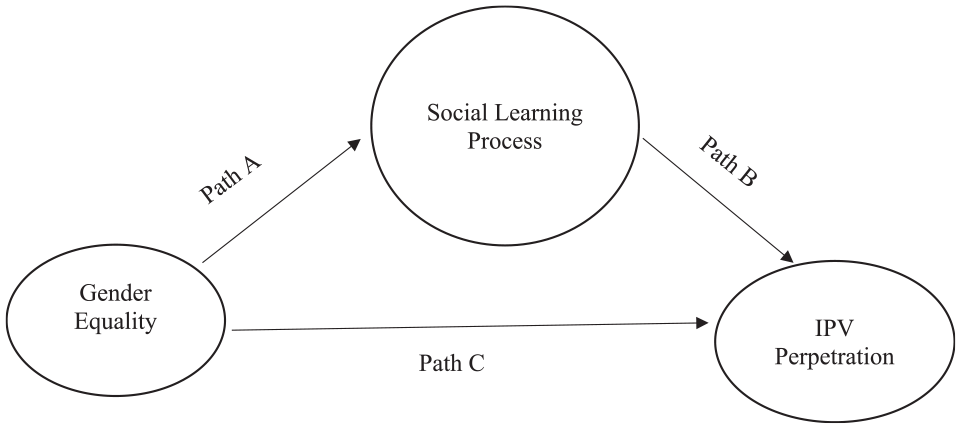
Methodology
Data
The current study joined data from two available datasets. One is the International Dating Violence Study (IDVS) which was a survey of 17,404 college students in 32 nations regarding their experiences with dating violence and risk factors for dating violence (Straus, 2011). Participants were college students attending psychology, sociology, criminology, and family studies classes at the universities. Their participation was entirely voluntary and responses were anonymous. Response rates ranged from 42% to 100%. The majority of response rates in classrooms ranged between 85% and 95%. Although the sample only includes college students and may not be representative of the universities or of youth in each nation, Straus (2009) found that the sample still provided valid nation-to-nation comparisons for theory testing about differences between nations.
The second dataset used is the Global Gender Gap Index (GGGI), created by the World Economic Forum (Hausmann et al., 2006). Data from 2006 were matched with Straus’ IDVS data, which was collected from 2001 to 2006. The GGGI has been used in a number of studies as an operationalization of the variable, gender equality (Fryer & Levitt, 2010; Yeganeh & May, 2011).
Students who had been in a heterosexual 2 relationship lasting more than 1 month are included in this research. A subsample of 13,586 students from the IDVS sample fulfilled these criteria. A total of 30 nations were selected for the study due to the availability of the GGGI score; the scores for Hong Kong and Taiwan were not available. Therefore, 12,910 students from 30 nations were included in the analyses.
Measurements
Dependent Variable
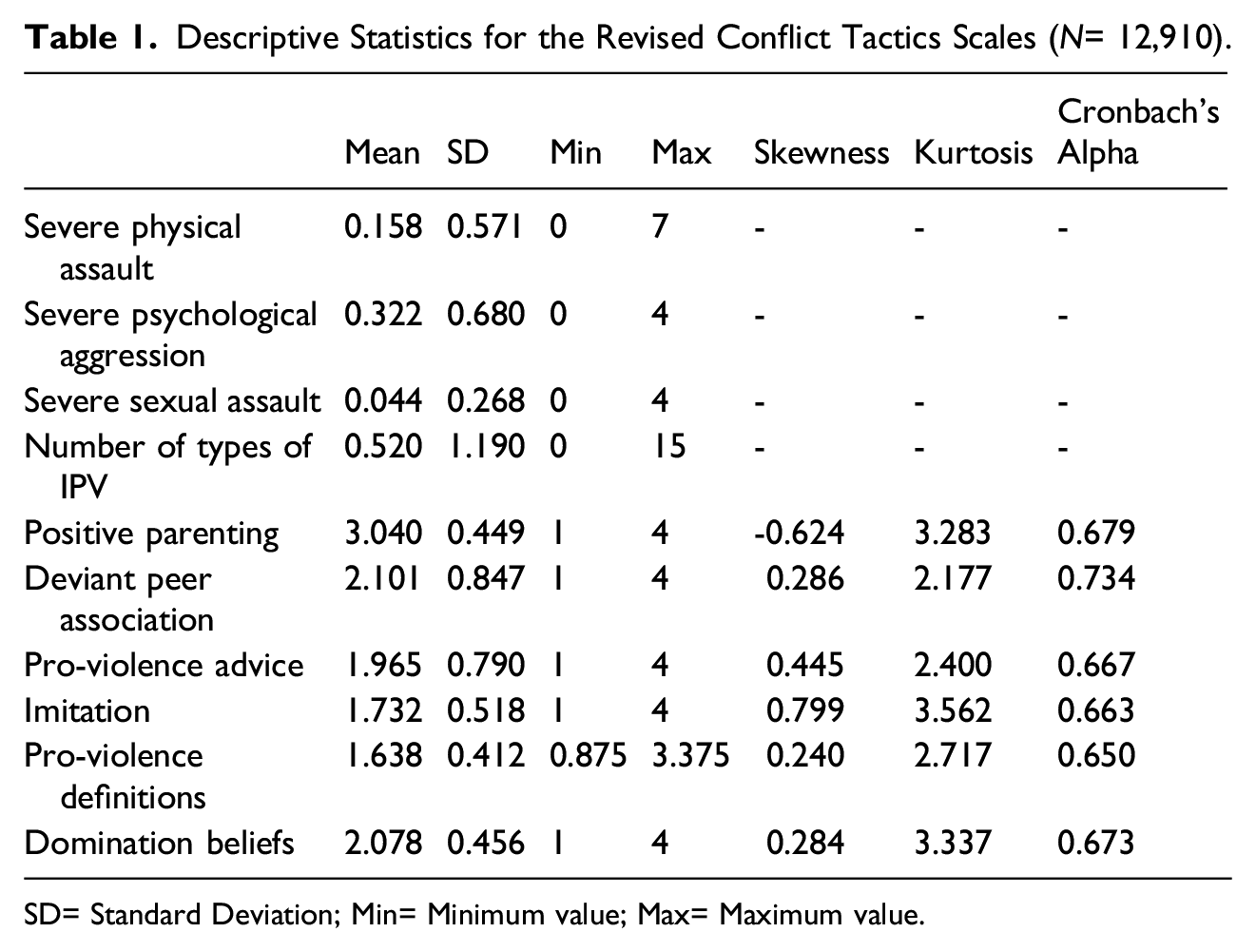
Descriptive Statistics for the Revised Conflict Tactics Scales (N= 12,910).
SD= Standard Deviation; Min= Minimum value; Max= Maximum value.
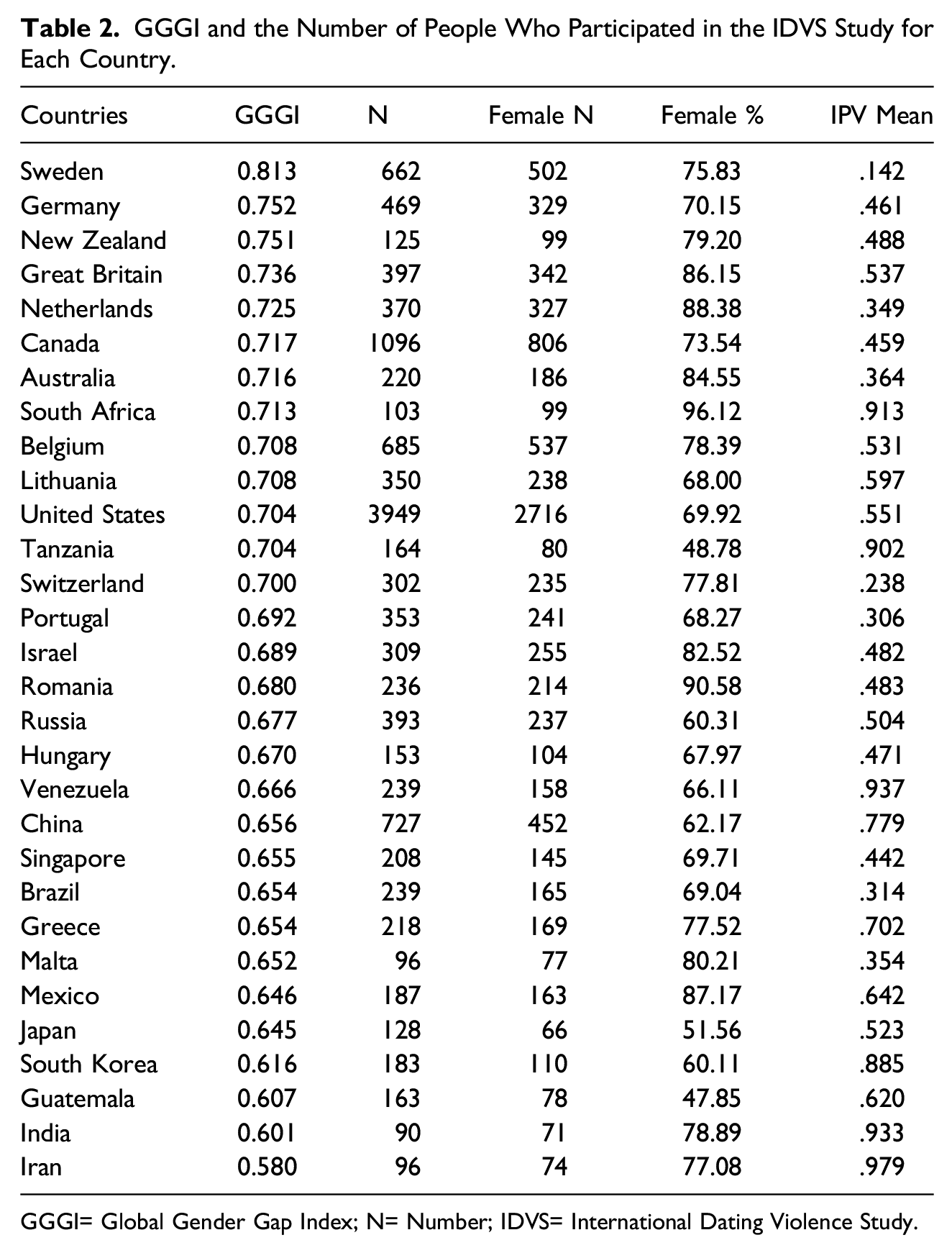
GGGI and the Number of People Who Participated in the IDVS Study for Each Country.
GGGI= Global Gender Gap Index; N= Number; IDVS= International Dating Violence Study.
Independent Variables
Gender Equality
Gender equality is the only structural-level independent variable in the current study. According to SSSL theory, gender inequality is an indicator of Social Disorganization and Conflict, which is a structural variable. It is operationalized by the World Economic Forum’s Global Gender Gap Index (GGGI; Hausmann et al., 2006). The GGGI measures the gender-based gaps between males and females for four dimensions, namely, Economic Participation and Opportunity, Educational Attainment, Health and Survival, and Political Empowerment. The index ranges from zero to one, with one being maximum gender equality. Table 2 shows the number of participants in the IDVS from each nation and the GGGI in each country. The GGGI values are in rank order, from Sweden, with the highest gender equality level, to Iran, with the lowest.
Social Learning Variables
The available data included measures of the four social learning variables in a part of the IDVS survey, the Personal Relationships Profile (Straus et al., 1999). For all of these measures, response options were on a Likert scale with 1 = Strongly Disagree; 2 = Disagree; 3 = Agree; and 4 = Strongly Agree. The scores on each scale were computed by taking the average response for the items. Cronbach’s alpha for each scale was calculated for the sample used in the present analyses and are presented in Table 1.
Differential Association
Differential association is operationalized by two scales called “positive parenting” and “having deviant peers.” Positive parenting measures the degree to which parents were loving and supportive and did not support illegal behavior. Examples of the statements were “My parents helped me when I had trouble understanding something” and “My parents did not care if I did things like shoplifting” (reverse coded). The higher the level of positive parenting, the more likely the respondents have supportive parents, and thus they are spending time with adults who do not support criminality. Using data for 17 nations from the IDVS, Straus (2009) found that the scale has good cross-cultural reliability and validity.
The deviant peers scale in the IDVS is adopted from Ross and Straus (1995). It is comprised of two items that capture the amount of association with deviant peers. The statements were “I spend time with friends who have been in trouble with the law” and “I have friends who have committed crimes.” The higher the level, the more likely the respondents associate with peers who approve of illegal behavior.
Differential Reinforcement. Differential reinforcement is operationalized as a measure of pro-violence advice which has two items that reflect the extent of receiving pro-violence advice from family and non-family members. The two items are adapted from the violent socialization measures in the PRP (Straus et al., 1999). The higher the score, the more likely the respondents feel that family and non-family members would positively reinforce them if they used violence.
Imitation. Imitation is operationalized as being exposed to violence. It is a 6-item scale that measures the extent of witnessing and experiencing violence from family and non-family members. It is adapted from the violent socialization scale in the PRP (Straus et al., 1999). The higher the score, the more likely the respondents experienced and witnessed physical violence, for example, push, shove, or slap from family and non-family members.
Definitions
The construct, definitions favorable to breaking the law, is operationalized by two scales, pro-violence definitions and domination beliefs. Pro-violence definitions is an eight-item scale that measures supportive attitudes towards family violence, sexual aggression, and breaking the law. For example, “It is sometimes necessary to discipline a child with a good, hard spanking.” The scale is adapted from the measures of violence approval and criminal belief in the PRP (Straus et al., 1999). The higher the score, the more likely the respondents find the use of family violence, sexual aggression, and breaking the law to be acceptable. Domination beliefs is a six-item scale which assesses the extent to which the respondents agree with the use of authority and restrictiveness in an interpersonal relationship (Hamby, 1996). The higher the level, the more likely the respondents are to believe in the exertion of authority and use of restrictiveness in a relationship.
Control Variables
Self-control
Apart from social learning theory, another theory that has been frequently applied to explain IPV perpetration is General Theory of Crime (Gottfredson & Hirschi, 1990). The theory proposes that low self-control is a stable predictor and primary motivator of criminal behavior across the life course. A number of studies found that low self-control may influence the perpetration of IPV (Avakame, 1998; Finkel et al., 2009; A. R.; Gover et al., 2011; Angela R; Gover et al., 2008). Therefore, self-control needs to be controlled. Six items in the self-control scale of the PRP correspond to the components of self-control specified by Gottfredson and Hirschi (1990). A high score for this scale indicates high self-control.
Social Desirability. A second control variable is social desirability. Research suggests that individuals tend to report in a socially desirable way and underreport their violence (A. R. Gover et al., 2011). It was found that the higher the social desirability score, the lower the level of self-reported physical assault, sexual coercion, and injury (Straus, 2004). Therefore, social desirability has to be controlled as well. The social desirability scale has 13 items, and was adapted from Reynolds (1982). For example, “I am always willing to admit it when I make a mistake.” It measures the tendency of respondents to minimize the disclosure of socially undesirable behavior. A high score indicates a strong tendency to avoid disclosing socially undesirable behavior.
Length and Type of Relationship. A third control variable is the length of the relationship. Self-reported relationship duration is a categorical variable with five categories (1= about one month; 2= about two months; 3= three to 5 months; 4= six to 11 months; 5= 1 year or more). A fourth control variable that may account for IPV is the nature of the relationship. Because most of the students were in a dating relationship, relationship status was recoded into a dichotomous variable as dating= 1 and other (engaged, married, and cohabitating) = 0.
Socio-demographic Variables
Age and socioeconomic status (SES) will also be controlled for. Race/ethnicity was not measured by the questionnaire, so it cannot be included as a control variable.
SES is a scale created by using the three variables that indicate father’s education, mother’s education, and family income. Each of the variables was transformed into to a z-score. The three z-scores were summed to create the SES measure. In the analyses, the composite SES measure was again transformed into another z-score. Therefore, the final z-score for the composite SES variable can account for the variation in socio-economic status within students’ families.
Analytic Plan
In the current study, all analyses are carried out by using STATA 14.2 (StataCorp, 2015). Due to the nesting structure of the dataset, multilevel modeling was considered. Unconditional models showed that the country accounted for 7.2%–23.7% of the variation in the dependent variable. The findings indicated that when examining the number of types of IPV perpetration and social learning variables as predictors of IPV, it is necessary to use multilevel models instead of using single-level regression models.
To test for mediation, Baron and Kenny (1986) approach was followed. For there to be a mediation effect of a social learning variables on the relationship between gender equality and IPV perpetration, the following three pre-conditions must be met: a) gender equality has an influence on the social learning variables (Path A); b) the social learning variables has an influence on IPV perpetration (Path B); and c) gender equality has an influence on IPV perpetration (Path C). See Figure 1 for a diagram of this conceptual mediation model.
Results
Sample Characteristics
In the current study, 12,910 students from 30 nations were included in the analyses. More than 70% of respondents were female, because the questionnaire was usually administered in psychology, sociology, and criminology classes, where female students predominate (Straus, 2004). More than 60% of the students were in relationships that had lasted for 1 year or more. Nearly 80% of the students were dating at the time they responded to the survey, 4.83% were cohabitating, 8.54% were engaged, and 8.2% were married. Annual family income ranged from zero to 60 million US dollars with a median of 44,200 US dollars.
Descriptive Statistics and Bivariate Correlations
Descriptive statistics for each social learning variable are presented in Table 1. Students, on average, agreed that they received positive parenting. They tended to disagree that they associated with deviant peers, and they reported a tendency to receiving low to moderate levels of pro-violence advice. They reported that they were seldom exposed to violent situations. Furthermore, they hold low to moderate levels of pro-violence definitions and beliefs about domination in a relationship. In general, their level of social desirability bias and self-control were moderate. Bivariate correlation analyses were conducted. All independent variables, except SES, are significantly correlated with the number of types of IPV perpetration. Before conducting multivariate analyses, the VIFs were checked. The VIFs are low (VIFs <1.78), indicating that multicollinearity is not a problem among independent variables.
Multivariate Analyses
Path A. Path A is the estimated effects of gender equality on social learning variables. Six multilevel mixed effects linear regression models are tested, one for each social learning variable. The effect of gender equality on positive parenting, pro-violence advice, and being exposed to violence are non-significant. The estimated effect of gender equality on deviant peer association is positive and significant (γ= 3.435, p ≤ 0.001). Students living in countries with higher gender equality are more likely to associate with deviant peers. The effect of gender equality on pro-violence definitions and domination beliefs are both negative and significant (γ= −1.763, p ≤ 0.001 and γ= −1.560, p ≤ 0.01). Students living in countries with higher gender equality are less likely to approve of the use of violence and hold beliefs about domination in relationships between partners.
Path B.
The following analyses tested the effect of social learning variables on the number of types of IPV perpetration by conducting multilevel negative binomial regression models. Positive parenting, deviant peers, and pro-violence advice are not significantly related to the number of types of IPV perpetrated. Imitation is statistically significantly associated with the number of types of IPV (γ= 0.317 and IRR= 1.374, p ≤ .001). The second variable that is statistically significantly associated with the number of types of IPV is pro-violence definitions (γ= 0.307 and IRR= 1.359, p ≤ .001). Finally, domination beliefs is statistically significantly associated with the number of types of IPV (γ= 0.596 and IRR= 1.814, p ≤ .001). Thus, students who are exposed to IPV, hold pro-violence definitions, and hold domination beliefs against intimate partners are more likely to use more types of IPV.
Path C
Path C is the association of gender equality with IPV perpetration. Multilevel negative binomial model shows that as the GGGI increases, the number of types of IPV that an individual uses decreases (γ= −4.454 and IRR= 0.012, p ≤ 0.001). Students living in countries with a higher level of gender equality are less likely to perpetrate IPV. Additionally, this path was analyzed by gender to examine the gendered effect of gender equality on IPV perpetration. No gendered effect was found as shown in Figure 2. It shows a linear and negative relationship between gender equality and the number of types of IPV perpetration against males and females. The higher the level of gender equality, the lower the number of types of IPV perpetration. Regardless of the GGGI value, females report using more IPV tactics than do males, but the difference narrows as gender equality increases. The relationship between gender equality and the number of types of IPV perpetration.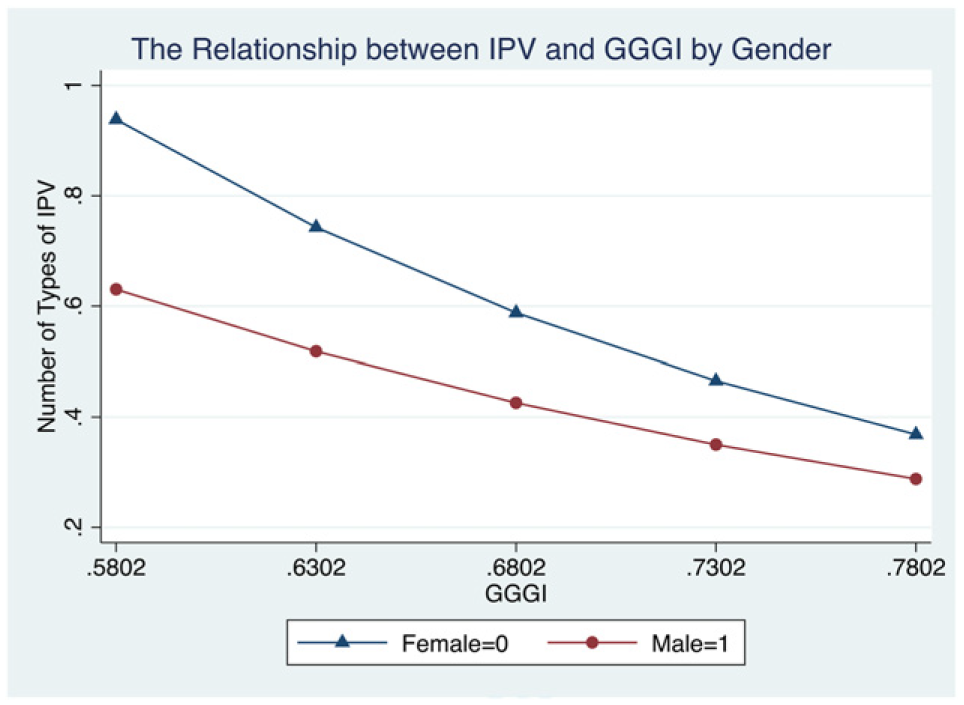
To summarize, the above findings show that the association of gender equality with IPV (Path C) is statistically significant, but no gendered effect was found. Of all of the social learning variables, pro-violence definitions and domination beliefs fulfill the Path A and Path B pre-conditions for mediation analyses. Therefore, gender and other social learning variables, such as differential association, differential reinforcement, and imitation, are treated as control variables in the following mediation analyses.
Mediation Analyses
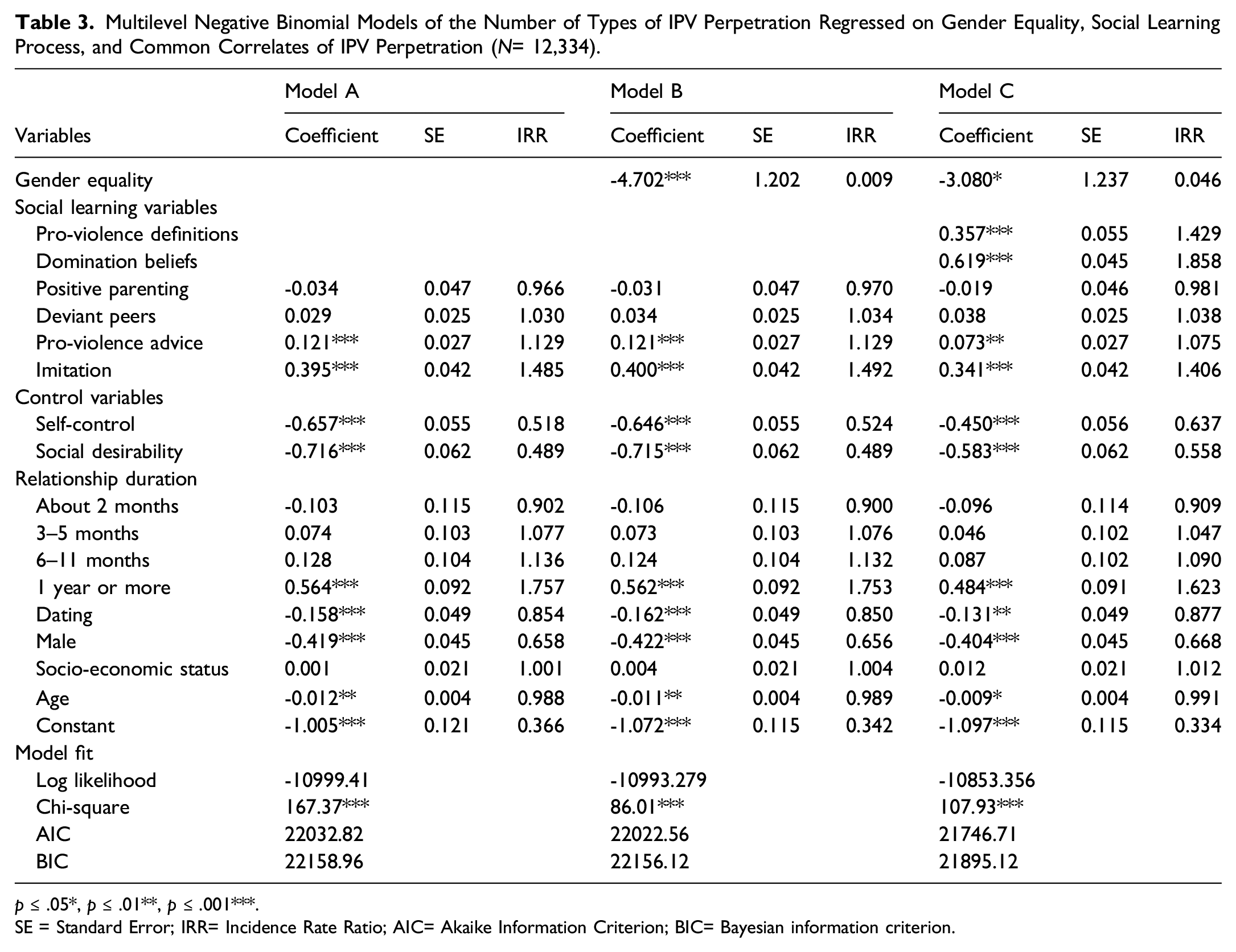
Multilevel Negative Binomial Models of the Number of Types of IPV Perpetration Regressed on Gender Equality, Social Learning Process, and Common Correlates of IPV Perpetration (N= 12,334).
p ≤ .05*, p ≤ .01**, p ≤ .001***.
SE = Standard Error; IRR= Incidence Rate Ratio; AIC= Akaike Information Criterion; BIC= Bayesian information criterion.
In Model C, pro-violence definitions and domination beliefs were added. The effects of pro-violence definitions and domination beliefs are positive and significant (IRR= 1.429, p ≤ 0.001 and IRR= 1.858, p ≤ 0.001). The findings suggest that individuals who approve of the use of violence and hold domination beliefs towards their partners are more likely to use more types of IPV.
When examining the mediation effects of definitions favorable to IPV, pro-violence definitions and domination beliefs did not fully mediate the effect of gender equality on IPV perpetration. In model C, the IRR for gender equality are still statistically significant (IRR= 0.046, p ≤ 0.05). The coefficients for GGGI are reduced in model C after adding pro-violence definitions and domination beliefs to the models. The coefficient for GGGI decreased from −4.702 in model B to −3.080 in model C. GGGI is the strongest predictor and is negatively related to IPV perpetration. Positive parenting and deviant peers association are not significantly associated with IPV perpetration. Pro-violence advice and being exposed to violence are positively related to IPV perpetration. In other words, receiving more pro-violence advice from family and non-family members was estimated to increase the number of types of IPV perpetration. Also, individuals who are exposed to IPV are more likely to use different types of IPV. In addition, lower self-control, lower social desirability bias, younger age, longer length of relationship, and being a female are statistically significantly related to an increased number of types of IPV perpetration. In terms of relationship status, being engaged, being married, and cohabitating are more likely than being in a dating relationship to be associated with IPV perpetration. SES is not statistically significantly related to IPV perpetration.
To conclude, the estimated impact of gender equality on IPV perpetration is partially mediated by pro-violence definitions and domination beliefs. Only one of the four types of social learning process, definitions, partially mediates the effect of gender equality on IPV perpetration. Therefore, there is limited support for SSSL theory.[Table 3 here]
Discussion
Support for SSSL Theory
The current study aimed to examine the applicability of Aker’s SSSL theory as an explanation of IPV perpetration across national contexts. The main finding of the current study is that the concept of definitions favorable to breaking the law partially mediates the effect of gender equality on IPV perpetration. In other words, gender equality was estimated to have a direct effect on IPV perpetration and an indirect effect on IPV perpetration through definitions that support the use of IPV. The findings only partially support SSSL theory because only one of the four social learning constructs has a mediating effect. Taken together, the findings suggest that college students in countries with higher gender equality are less likely to learn pro-violence definitions and domination beliefs. Individuals who are less likely to hold pro-violence definitions and domination beliefs are less likely to commit IPV, and they are likely to use fewer IPV tactics.
The estimated effect of gender equality on definitions that support IPV is consistent with the research suggesting the cultural justification for IPV against women was found in more traditional societies, such as Bangladesh, Cambodia, India, Mexico, Nigeria, Pakistan, Papua New Guinea, the United Republic of Tanzania, and Zimbabwe (Krug et al., 2002). The estimated effect of gender equality on definitions also suggests that supportive attitudes towards the use of IPV by women against men are more likely to be found in traditional societies.
The current study found that association with deviant peers was not significantly related to the number of types of IPV perpetration. It contradicts previous studies that found that having deviant peers is the most significant risk factor for IPV perpetration (Cochran et al., 2017). Perhaps this is due to the different operationalizations of deviant peer association. The current study measured agreement with statements about currently spending time with deviant peers and having friends who committed crimes. However, prior studies have measured differential association with indicators of significant others’ attitudes towards IPV (Cochran et al., 2017). This seems to measure differential reinforcement rather than differential association. The current study used a better operationalization that measured the concept of differential association. On the other hand, the operationalization of different reinforcement, which was pro-violence advice, was found to be related to the number of types of IPV perpetration. Therefore, inconsistencies in measurement across studies may be the reason why the current study had inconsistent findings with the literature. Future studies should collect better measures of the concepts that reflects the social learning process.
Evidence of the Effect of Gender Equality
In the current study, the findings show that in countries with lower levels of gender equality, college students are more likely to report having used IPV. This finding lends support to the literature that suggests that levels of gender equality affect IPV perpetration (Fleming et al., 2015; García-Moreno, 2005; Jewkes, 2002). The finding also supports work by Morash (1999) that presented the argument that gender does not always have its influence on crime and deviance primarily through social learning. Morash (1999) further suggested that gender differences are not produced solely through how boys and girls are taught and socialized, but also through systematic differences in power, opportunities, and resources within a country and a family. Therefore, these findings imply that narrowing the gender-based gaps at the structural level may reduce IPV perpetration.
The Form of the Relationship between Gender Equality and IPV Perpetration for Men and Women
Prior research showed that societies with greater female emancipation have higher level of men’s victimization (Archer, 2006; Levinson, 1989; Yllö, 1983). Inconsistent with the present research, the findings indicate that society with greater female emancipation, and therefore with more gender equality, have lower level of women’s perpetration of IPV against men. The present research also found that women reported using more types of IPV than did men regardless of the level of gender equality. This finding does not support previous studies that suggest that in societies that were characterized by high gender inequality, women were more likely than men to be abused by their partners (M. D. Smith, 1990). This finding contradicts feminist theories, which highlights the higher levels of violence against women, especially in patriarchal societies. The higher rates of female IPV perpetration may be due to differential reporting behaviors between males and females. Males are less likely to take responsibility for their use of IPV and are more likely to blame their partners (LeJeune & Follette, 1994). Additionally, males are less likely to report their perpetration compared to their partners’ reports of victimization (Schluter et al., 2007). Therefore, it is apparent that males tend to underreport IPV perpetration, which may account for findings of women’s greater use of IPV.
Limitations and Recommendations for Future Research
The current study is not without limitations. Firstly, this study only measured a social structural variable at the country level. Future studies should incorporate social structural variables at the familial level, for instance, patriarchal family structure. A patriarchal family structure is characterized as a household where the decision-making power is inequal between women and men (Blood & Wolfe, 1960). Women living in these households are more likely to experience IPV victimization (Yingling et al., 2015). The patriarchy family structure is also related to an individual’s definition favorable to IPV (Ahmad et al., 2004). Therefore, patriarchal family structure could be an indicator of differential social location in primary, secondary, and reference groups at the structural level.
Secondly, mediation analyses require a time-ordered longitudinal data to disentangle the relationship between the mediators and IPV. The mediators that were measured as current attitudes and beliefs could be influenced by the prior involvement in IPV. Therefore, the cross-sectional nature of the current dataset may not allow researchers to properly test the temporal ordering between social learning variables and IPV.
Thirdly, Baron and Kenny’s mediation approach has a shortcoming. The reduction in the direct effect after adding mediating variables may not be statistically significant. While a Sobel (1986) test answers this, the test may not be used in nonlinear models, such as logistic and count models, as used in the current study (Mustillo et al., 2018).
Conclusion
Despite the limitations, the current study contributes to the SSSL theory and the literature. The current study examined the cross-cultural applicability of SSSL theory. Although not all four social learning variables mediated the social learning process, the structural level measure of gender equality and the individual level social learning variables are useful in explaining IPV across national contexts. Also, multilevel models are suitable to test the SSSL theory because they allow us to understand how well the theory works in explaining IPV perpetration across national contexts.
Footnotes
Declaration of Conflicting Interests
The author(s) declared no potential conflicts of interest with respect to the research, authorship, and/or publication of this article.
Funding
The author(s) received no financial support for the research, authorship, and/or publication of this article.
