



Abstract
Sexual harassment is a serious problem, and with a growing population of college students in China, the phenomenon is becoming prevalent. Using the 2010 data from the Third Survey on Chinese Women’s Social Status, we examined relationships between understanding of sexual harassment and experience/response among Chinese college students. The results show that college students understand physical sexual harassment better (88%; unwanted sexual requests: 92%) than verbal and visual sexual harassment (54% and 70%, respectively). Understanding is higher among females than males, with a margin between eight to 21%. At a prevalence of 30%, the experience of verbal sexual harassment is the highest compared to other forms of harassment. Males were more likely to experience verbal and visual sexual harassment, while females were more likely to experience physical sexual harassment. In any event of sexual harassment, expressing dissatisfaction and stopping it is the response strategy that most resonates with respondents. It varied between 62% and 70% across forms of sexual harassment. Reporting to teachers or school authorities resonates least, varying between 0.30% and 2.28%. Understanding sexual harassment was strongly associated with a reduced likelihood of harassment. The equivalent odds ratios varied between 0.41 and 0.33 (p < .001), or 59–67% reduced likelihood across the forms of sexual harassment. Understanding sexual harassment was also strongly associated with an increased likelihood of not reacting passively or staying silent. Odds ratio varied between 1.99 and 3.86 (p < .001), about a minimum of twofold increased likelihood. Parents should strive to involve in their children’s sex and sexual rights education, particularly during adolescence, to help them inculcate values against sexual harassment. Also, colleges and universities can bolster their curriculum with elective courses on sex education and regularly organize symposiums on sexual harassment to create a better understanding and awareness among students.
Keywords
Introduction
College students in Chinese higher education institutions numbered 41.83 million in 2020, making up a sizable demographic group (Ministry of Education of the People’s Republic of China, 2021). In recent years, sexual harassment of college students in Chinese institutions has become a severe social concern. In 2018, 20 cases made news headlines, and 11 cases did in 2019 (Zeng & Jiang, 2020). Among 6592 college students surveyed by Guangzhou Gender Education Center in 2016, 69.3% of respondents reported having experienced sexual harassment (Wang, 2018).
Sexual harassment is an act of violating one’s sexual rights against one’s will through physical, verbal, and non-verbal means that inflict hurt or trauma on a victim (Oni et al., 2019). Sexually harassed college students typically suffer consequences that affect their physical and mental health and academic performance. These consequences have been identified to include blue moods, depression, anxiety, and lack of confidence (McGinley et al., 2016; Jirek & Saunders, 2018; Bondestam & Lundqvist, 2020), risk behaviors such as smoking, alcohol, and drug abuse (Gidycz et al., 2008; Wolff et al., 2016), decreased academic performance, difficulty in concentration, fear, and inferiority (Imonikhe et al., 2011).
Awareness for preventing and addressing sexual harassment is relatively low among Chinese college students (Zhang et al., 2018). It is partly due to shortages of counselors, teaching materials, and a structured curriculum on sex education, particularly sexual rights (Liu & Li, 2020). This factor is further compounded by cultural attitudes toward sexual harassment in Chinese society, with its meaning often distorted, narrowly, or unclearly defined (Li & Fang, 2015). Given this phenomenon, there is the possibility for misclassification or outright failure to report cases of sexual harassment (Thapalia et al., 2020). As such, sexual harassment may evolve into sexual assault, molestation, or rape (Bondestam & Lundqvist, 2020).
Studies on sexual harassment among college students have witnessed robust attention from Western and relatively egalitarian cultures, including the United States (Kearney & Gilbert, 2012; Newins & White, 2018) and Norway (Sivertsen et al., 2019), among others. Studies have also been based out of countries that lean toward patriarchal values, including South Africa (Oni et al., 2019) and Nepal (Thapalia et al., 2020). While there are studies equally based on the context of China—also leaning towards patriarchal values, the attention has been chiefly focused on the discussion of prevalence (Lian et al., 2012; Wang et al., 2016; Wu, 2021).
Using data from the Third Survey on Chinese Women’s Social Status, this article explores the relationship and mechanisms of awareness, experience, and responses to sexual harassment among Chinese college students. Given the inadequate sex education and awareness on sexual harassment taught to college students in China, the misconception on forms, and countermeasures, this study will be a barometer to gauge the nature of the problem of sexual harassment and what policies are necessary. Also, considering the dearth of literature in this realm, we hope that our research will inspire the development of sex education and enhance awareness of sexual harassment for Chinese college students.
Understanding of Sexual Harassment
As already defined, sexual harassment relates to an unwelcomed act that carries a sexual connotation. Three types of behaviors classified as sexual harassment are as follows: visual sexual harassment, which involves the perpetrator displaying pornographic content, obscene pictures, or objects; verbal harassment refers to sexual-related teasing (including comments or compliments), insults, threats, and other offensive utterances; and physical harassment that includes hugging, groping, and making obscene gestures to others (Thapalia et al., 2020).
Most studies have shown that college students have a vague understanding or misconception of sexual harassment. For instance, dirty jokes are often perceived as jokes rather than labeled as verbal sexual harassment (Li & Bai, 2013), and some even consider it as usual social relation (Shi, 2019). Thus, the actual occurrence of sexual harassment among college students tends to be underreported in surveys. In a survey involving 1631 Chinese college students, only 6.6% reported having experienced sexual harassment, while as many as 58.1% of the respondents indicated that their classmates or friends had experienced sexual harassment (Pan, 2020). A similar pattern was also observed by Ramos (2000) in a study based out of the United States.
Regarding sex differences, male students have been shown to understand sexual harassment better than females (Chang et al., 2020). On the other hand, female students tend to identify a broader range of behaviors as sexual harassment than male students (Rotundo et al., 2001; Rosenthal et al., 2016). Females are usually more vulnerable to sexual harassment (Sutton et al., 2021), which may allude to why they have a broad list of what qualifies as sexual harassment—for self-protection.
Experience of Sexual Harassment
Experience of sexual harassment among college students is prevalent in relatively egalitarians societies, just as it is in conventionally patriarchal societies. A study based out of the United States found that more than 80% of college students reported having experienced sexual harassment more than once before entering universities (Kearney & Gilbert, 2012). In Australia, a study involving over 30,000 student participants reported that more than 50% of respondents experienced sexual harassment, a significant proportion occurring within the university environment (Australian Human Rights Commission, 2017). A similar level of prevalence has also been reported among college students in the United Kingdom (Haidrani, 2013) and Norway (Sivertsen et al., 2019). A study based out of South Africa found that 42.8% of college students reported experiencing physical sexual harassment (Oni et al., 2019). A survey of 441 students in Nepal revealed that 76% of the respondents had experienced sexual harassment (Thapalia et al., 2020).
The phenomenon also has a similar landscape in China. A survey of 1099 college students in Shanghai in 2012 found that 28.48% of the respondents reported having experienced verbal sexual harassment (Lian et al., 2012). Another survey in 2016 involving two universities in Liaoning Province found that 38.7% of college students had experienced different forms of sexual harassment (Wang et al., 2016). A questionnaire administered to almost 700 college students in East China University in 2021 indicated that as high as 579 respondents (83.3%) had experienced at least one type of sexual harassment (Wu, 2021).
Response Strategies to Sexual Harassment
College students who have experienced sexual harassment often fail to follow up on actions due to a lack of knowledge on approach or what classifies as sexual harassment. Even with a high incidence of sexual harassment, few students speak up or file complaints (Clery, 2015). The majority of college students usually stay silent. For example, in the study by Thapalia et al. (2020) conducted in Nepal, nearly 60% of female college students who had suffered sexual harassment chose to ignore it or take no action. About 67.5% told their friends, and 2.7% reported to a teacher. Only 5.7% filed a police report, and 15.5% did not tell anyone.
Sexual harassment is seldom reported by Chinese college students, making it seem less prevalent (Aguilar & Baek, 2020). Feeling of shame, embarrassment, or attrition are general reasons why survivors of sexual harassment tend not to report incidences (Sivertsen et al., 2019). In China, it is further coupled by a culture of collective interpersonal harmony and reverence to the elderly or persons of authority (Huang, 2016). It is not unusual that teachers are often perpetrators of the sexual harassment of college students (Zeng, 2020); the unequal social statuses and power differences usually lead student survivors to remain silent. The Guangzhou Gender Education Center surveyed 6592 college students in China’s mainland in 2016. Their finding showed that 69.3% reported having experienced sexual harassment, but among them, more than half chose to remain silent (Wang, 2018). Majority of female college students who take action against sexual harassment only go as far as verbal warning, whether explicitly or implicitly (Wang et al., 2016).
A clear understanding of sexual harassment makes victims better equipped to deal with the incidence (Jacobson & Eaton, 2017). Some studies have shown that individuals who have received sex education courses are 1.86 times more aware of sexual harassment than others (Chang et al., 2020). Evidence has also shown that individuals with a higher understanding of sexual harassment and behaviors are less tolerant of it (Zeng & Jiang, 2020).
Apart from the fact that most studies on sexual harassment among college students have come from Western, developed countries, most studies have primarily focused on determining the prevalence. With a vast population of college students in China, there have been limited studies on the interactions and mechanisms of college students’ understanding, experience, and response strategy to sexual harassment. Therefore, it is necessary to explore further the issue of sexual harassment among college students in the Chinese context. It is hoped that the study and findings will complement existing research and offer perspectives for future theoretical frameworks in this realm.
Methods
Data and Setting
The data is taken from the Third Survey on Chinese Women’s Social Status, an authoritative, nationwide survey jointly conducted by the All-China Women’s Federation and the National Bureau of Statistics. This survey used a three-stage unequal probability proportionate to size sampling, stratified by regional development levels. Questionnaires were designed for individuals and the community (including village and neighborhood committees). The individual questionnaire was administered to males and females aged 18–64 in China’s mainland in 2010. It lasted about 1 month (from December 1–31). Questionnaire contents varied on a case basis.
The survey sampled five specific groups, including children, elderlies, college students, migrants, and well-educated professionals. The college student group is the focus of this research study, and it consists of undergraduates and postgraduates. They were recruited from 15 universities (including Peking and Hubei Universities), using quota and random sampling methods. A total of 5032 college students were surveyed. Ethical approval for the study was obtained from the All-China Women’s Federation and the National Bureau of Statistics. Approval was also obtained from the respective schools prior to approaching the students, and all the participants gave their written informed consent.
Variables
Dependent Variables
Experiences of sexual harassment: This variable includes visual, verbal, and physical sexual harassment. Visual sexual harassment is measured by the experience of “being shown unwanted pornographic images and pictures”; verbal sexual harassment is measured by the experience of “being told unsolicited pornographic stories and jokes”; physical sexual harassment is measured by the experience of “being touched or groped against your will”; and “being asked for unwanted sexual activities.” Each question was coded as “0” if the respondent had no such experience and “1” if the person had.
Response strategies to sexual harassment: This variable measures how college students would deal with visual, verbal, and physical sexual harassment incidences. In the questionnaire, six options were posed: (1) “putting up with it and remaining silent,” (2) “expressing dissatisfaction directly or stopping it,” (3) “speaking to friends and/or discussing countermeasures,” (4) “reporting to teachers or school authorities,” (5) “reporting to public security authorities,” and (6) “other options.” For this analysis, the answer of option one (“putting up with it and remaining silent”) was coded as “0”, indicating that the respondent would do nothing. All other five options were coded as “1”, indicating that positive measures will be taken in one way or another.
Independent Variables
Understanding sexual harassment: This variable measures the understanding of visual, verbal, and physical sexual harassment among college students. In this study, we measured the understanding of visual sexual harassment by asking respondents whether “being shown unwanted pornographic images and pictures” was considered sexual harassment; we measured the understanding of verbal sexual harassment by asking respondents whether “being told unwanted pornographic stories and jokes” was considered sexual harassment, and we measured the understanding of physical sexual harassment by asking respondents whether “being touched or groped against your will” and “being asked for unwanted sexual activities” were considered as sexual harassment. For each question, a “negative” answer was coded as “0”, which meant that the respondent did not consider the behavior to be sexual harassment; an “affirmative” answer was coded as “1”, which meant that they considered it sexual harassment.
Control Variables
The control variables included in the analysis are sex (male = 0, female = 1), household registration type (rural = 0, urban = 1), and education level (undergraduate = 0, graduate = 1, doctoral = 2). Based on literature evidence, prevalence and understanding of sexual harassment are likely to vary between males and females (Chang et al., 2020; Sivertsen et al., 2019). Household registration (hukou) is a vital social characteristic in Chinese society, related to the accessibility of social policies. Not only can the urban/rural factor influence the internalization of gender-related ideologies, but it can also determine sibship status as it was a criterion for birth quotas in China’s birth policies until 2016 (Shi & Zheng, 2020). Also, education level may be related to age, experience, and familiarity with various school administrative structures.
Statistical Analysis
First, the characteristic of the analysis sample was presented using proportions and percentage distribution across sociodemographic factors. Secondly, descriptive statistics on the experience of sexual harassment were presented based on the forms of harassment and sex of respondents. Chi-square test statistic was utilized to examine group differences. In order to gain a better insight into the nature of the diversity, a cross-tabulation comparison of the range of responses to sexual harassment versus the understanding and experience of sexual harassment was also presented. The latter part of the analysis involved logistics regression models reporting odds ratios (OR) and standard errors to determine the association between variables of interest. All analyses were performed in Stata version 15.0 (StataCorp, College Station, TX, USA).
Results
Characteristics of Analysis Sample
Demographic Characteristics of Sample (N = 4694).

Descriptive Statistical Results
Understanding of Sexual Harassment Among College Students.

Experiences of Sexual Harassment Among College Students.

Response to Sexual Harassment Among College Students (%).

Note. 1: putting up with it and remaining silent; 2: expressing dissatisfaction directly or stopping it; 3: telling it to friends; 4: reporting to teachers or school authorities; 5: reporting it to public security authorities; 6: other strategies.
Furthermore, the respondents indicated the least tolerance for physical sexual harassment than visual and verbal harassment. In the event of visual or verbal harassment, a higher proportion of respondents indicate they will put up with it and remain silent, with the percentage being 21.1% and 28.3%, respectively. In contrast, fewer respondents indicated they would make the same choice when facing physical sexual harassment (only 3.8%). Also, for visual or verbal harassment, only 1.8% and about one percent of respondents indicated reporting to public security authorities, respectively. In the case of physical sexual harassment, the percentage of respondents who indicated following the same line of action was relatively higher, 18.7%. Regarding differences based on sex, male respondents are more likely than females to put up with sexual harassment by staying silent. The expression of dissatisfaction or stopping it was reported more among females than males.
Relationship Between the Understanding and Responding Strategies of Sexual Harassment Among College Students (%).
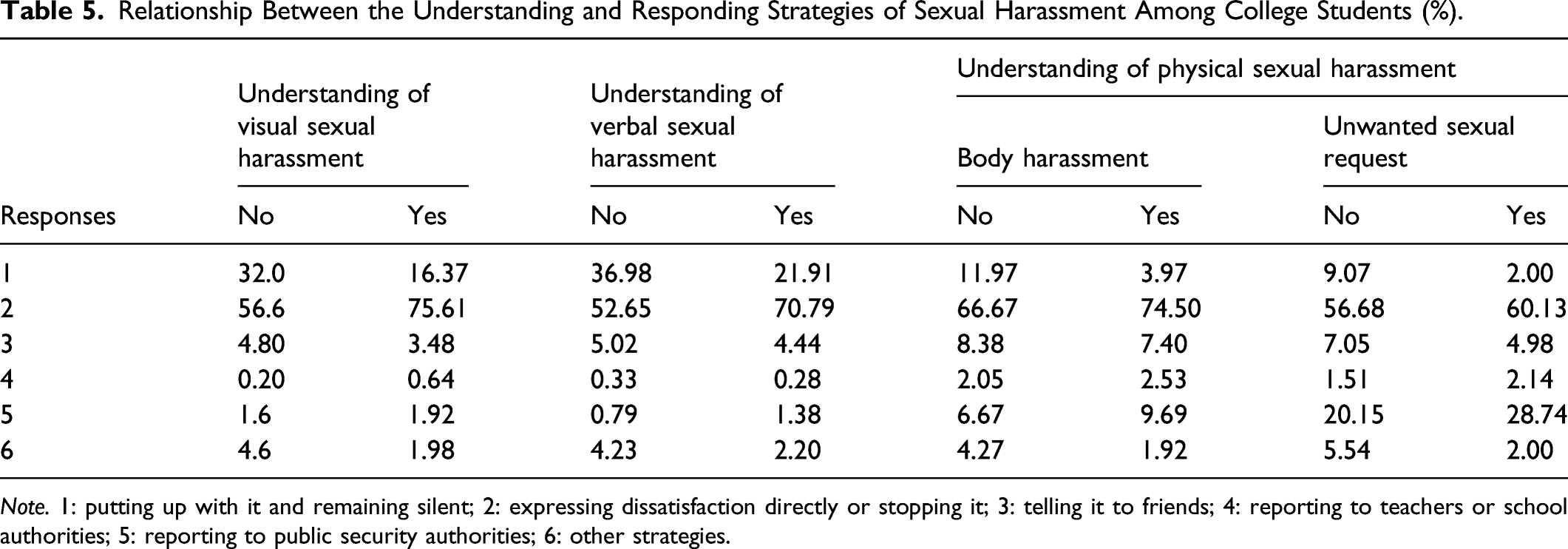
Note. 1: putting up with it and remaining silent; 2: expressing dissatisfaction directly or stopping it; 3: telling it to friends; 4: reporting to teachers or school authorities; 5: reporting to public security authorities; 6: other strategies.
Regression Results
Logistic regression for the understanding of sexual harassment on the experience of sexual harassment.
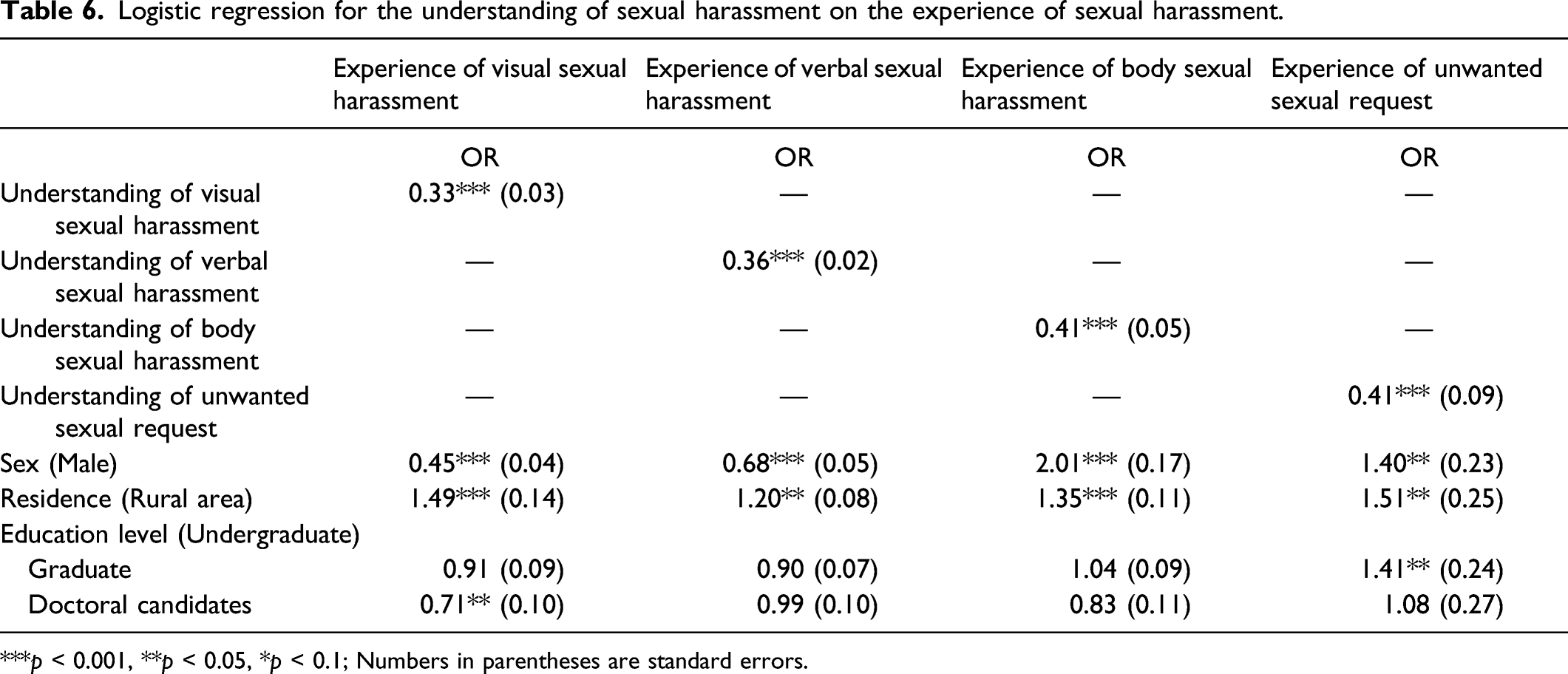
***p < 0.001, **p < 0.05, *p < 0.1; Numbers in parentheses are standard errors.
Some degree of diversity was also observed in relation to the characteristics of the analysis sample. Compared to males, being a female was associated with a lower likelihood of visual and verbal sexual harassment among respondents (visual sexual harassment: OR = 0.45, verbal harassment OR = 0.68) but was associated with a higher risk of physical sexual harassment than males (body harassment OR = 2.01, unwanted sexual request OR = 1.40). Respondents from urban-registration households were more likely to experience all forms of sexual harassment (all p < .05) compared to their counterparts from rural-registration households. Compared to undergraduate students, being a graduate student was associated with an increased likelihood of experiencing unwanted sexual requests (OR = 1.41), or 41% increased likelihood, whereas being a doctoral candidate was associated with some degree of protection against visual sexual harassment (OR = 0.71), or 29% reduced likelihood.
Logistic Regression for the Understanding of Sexual Harassment on the Responding Strategies of Sexual Harassment.

***p < 0.001, **p < 0.05, *p < 0.1; Numbers in parentheses are standard errors.
Compared to males, female respondents had a higher likelihood of indicating not to be passive or remain silent in reaction to all forms of sexual harassment. The magnitude of the odds ratio was highest for unwanted sexual requests (OR = 4.23), that is, more than quadrupled. In terms of urban-rural household registrations, urban-registration holders were more likely to be passive or stay silent in reaction to visual and verbal sexual harassment than rural-registration holders.
Discussions and Conclusions
Sexual harassment of college students is common and growing more serious (Holland et al., 2018; Newins & White, 2018; Streng & Kamimura, 2015). It negatively influences students’ lives, physical and mental health, and academic performance (Jordan et al., 2014; Yoon et al., 2010). With a large population of college students, China is facing prominent sexual harassment in higher education institutions. This study drew the following conclusions based on the Third Survey on Chinese Women’s Social Status data.
In terms of understanding, college students generally have a weak understanding of verbal and visual sexual harassment but a greater understanding of physical sexual harassment. Being told obscene jokes, comments, or shown pornographic images is less considered sexual harassment by the students. The result indicated that this phenomenon is more common among males than females. Nearly half of the male students would not consider being told unwanted obscene jokes as verbal harassment. Nor would they consider being shown unwanted pornographic pictures as visual sexual harassment. According to Li and Bai (2013), males are generally more inclined to obscene talks in peer interactions. Also, Chi et al. (2012) noted that male college students are more likely than female students to watch pornography together in dormitories. On the other hand, because females are more vulnerable to harassment (Hinze, 2004), they take sexual harassment more seriously and have a broader perspective of what constitutes it (Rosenthal et al., 2016). Based on these factors, males could have a narrower perspective than females in their definition of sexual harassment.
In terms of experience, verbal sexual harassment had the highest prevalence among college students. Males were more likely to experience verbal and visual sexual harassment, while physical sexual harassment was more prevalent for females. This finding is consistent with previous studies (Cantalupo & Kidder, 2018; Vega-Gea et al., 2016). The reason may also be connected with the above explanation that males are easily exposed to pornographic or obscene behaviors. Furthermore, the patriarchal beliefs that characterize the Chinese culture could also contribute to women’s susceptibility to experiencing physical sexual harassment. Patriarchy is characterized by value systems that tend to subordinate women’s relative position to men’s. In this study, the understanding of sexual harassment was strongly correlated with a lower risk of the experience, similar to Wang et al. (2016). College students with a clear understanding of sexual harassment have a strong awareness of prevention and self-protection, thus reducing the risk or exposure.
In terms of response to sexual harassment, students with a clear understanding of the concept of sexual harassment are more likely to indicate the intent of not acting passively or staying silent. With the Chinese culture heavily influenced by traditional values and conservatism, topics on sex have long been treated as taboo, hardly discussed in public fora. Students, right from adolescence, mainly learn about sex from the Internet, media (prints or electronics), and books (Huang, 2020). As reported in a study by Zhang et al. (2018), students who have never received sex education were significantly higher and less likely to have a good awareness of sexual matters. With murky understandings of sexual harassment, and in dealing with it, the risk of exposure is likely to be higher, and response is likely to be ineffective.
Also, the analysis finding showed that students with rural household registration were more likely than their counterparts with urban household registration not to remain passive or silent in the event of sexual harassment. Taking into consideration China’s birth policies, particularly the 1.5 child policy that applied to rural households beginning from the late 1980s (Jiang & Liu, 2016), it means that respondents with rural household registration are more likely than their urban counterparts to have siblings, and most likely, one of the opposite sex (Jiang et al., 2016). Since siblings are a vital source of social learning (Whiteman et al., 2011), perhaps it may explain the differences in the findings on rural-urban household registrations. While our data and analysis cannot authoritatively substantiate this argument, future studies are welcomed to investigate how sibship status or composition influences response to sexual harassment among Chinese college students.
Some limitations are associated with this study. First, we cannot establish a causal relationship because we have used cross-sectional data. Additionally, the data on sexual harassment was captured in a broader sense with no indication of whether it was hetero- or homosexual. As a result, we could not explore this aspect of diversity. Also, the sex of the respondents has only been considered in the binary of male and female. Lastly, data on “response to sexual harassment” was based on hypothetical and not retrospective context. Future surveys could consider using retrospective data for better insight. Despite these limitations, the study’s strength lies in using a large dataset that offers the opportunity to generalize to a national context. This study contributes to the extant literature by providing evidence on the context of China, which has been vastly left out of previous literature in the growing quest to understand factors related to the dimensions, experience, and strategies in dealing with sexual harassment among college students.
Based on the findings in this analysis, the following points are articulated for policy and practice. Parents should break free from their traditional views and take a leading role in their children’s sex and sexual rights education. In a wave of uncontrolled exposure to sexual themes on the Internet and media, parents’ guidance, particularly during the adolescent phase, could go a long way in ensuring content consumed is structured, age-specific, and proper values internalized. Studies have shown that personality traits imbibed at adolescence usually remain unchanged at young adulthood (Elkins et al., 2017).
At the school level, elective courses on sex education could be added to the curriculum. Also, symposiums should be organized regularly by the school and students’ associations to sensitize students on sexual harassment and the channels through which cases can be addressed. Through regular symposiums, students can better understand the school’s stance against sexual harassment and become confident to file complaints. The analysis revealed that graduate students were more likely than others to experience physical sexual harassment (unwanted sexual requests). Perhaps, a case of perceived “soft target,” whether from the perspective of age-maturity or vulnerability. Be as it may, the symposiums will arm them with better awareness and get them acquainted with legal or administrative mechanisms to deal with sexual harassment.
Footnotes
Declaration of Conflicting Interests
The author(s) declared no potential conflicts of interest with respect to the research, authorship, and/or publication of this article.
Funding
The author(s) received no financial support for the research, authorship and/or publication of this article.
