



Abstract
Lack of consent is an essential characteristic of sexual violence. The present study was conducted to analyze the relation between sexual consent and the risk of perpetrating sexual aggression by men and victimization suffered by women in more depth. The sample consisted of 1681 heterosexual Spanish men and women aged 18–66 years. The participants completed an online survey containing the Spanish versions of the Sexual Consent Scale Revised and the Sexual Experiences Survey. The results showed that 70.2% of the women had been sexual victims, and 20.8% of men reported having perpetrated sexual violence. On the one hand, sexual aggressors, unlike non aggressors, underestimated the relevance of obtaining sexual consent, and more aggressors reported lack of perceived behavioral control for requesting sexual consent and endorsed less positive attitudes to obtain sexual consent than non aggressors. On the other hand, sexual victims, compared to non victims, considered requesting explicit sexual consent relevant, but held certain ideas, attitudes, and behaviors that did not go along with obtaining sexual consent, which leaves women in a position of vulnerability.
Introduction
Sexual violence is an endemic problem in today’s society (Bogen et al., 2019; Fernández-Fuertes et al., 2018; Gidycz et al., 2006) with serious consequences for both physical and psychological health (Banyard et al., 2017; Cook et al., 2011; Pemberton & Loeb, 2020). World data reveal that around 30% of women aged 15–49 years have suffered physical or sexual violence at some point in their lives (World Health Organization, 2018). In the European Union, after the European Union Agency for Fundamental Rights (FRA, 2014) conducted one of the most complete surveys on violence against women (Shreeves & Prpic, 2020), it was found that one in 10 women had suffered some type of sexual violence since the age of 15, one in 20 had been raped, and one in five had suffered physical and/or sexual violence by a former partner. According to the Macrosurvey on Violence against Women 2019 (Ministry of Equality of the Spanish Government, 2020), specifically in Spain 13.7% (corresponding to almost three million women) have suffered sexual violence at some point in their lives. It is noteworthy that the person responsible for violence is usually a man, and is generally someone that the victim knows (Centers for Disease Control and Prevention [CDC], 2021). Along these lines, sexual violence in Spanish women has been perpetrated by a man in 99.6% of cases (Ministry of Equality of the Spanish Government, 2020). Therefore, sexual violence is one of the most extreme manifestations of gender-based violence because those suffering it are mostly girls and women.
No consensus has been reached on what sexual consent is and how it should be communicated (Beres, 2007; Righi et al., 2021). In this regard, and after reviewing this term, Muehlenhard et al. (2016), concluded that sexual consent has been conceptualized in several ways: as an internal state (i.e., feeling or decision) of will, as an act of explicit acceptance of something, and as a behavior that someone else interprets as being voluntary. They also specified that it could also be assumed. They added that consent can be a specific event or a continuous process. At this point, it is worth noting the definition by Humphreys and Brousseau (2010) because they determine and specify the elements needed to explain this concept. For these authors, sexual consent refers to verbal or non verbal communication that is freely given to the will to participate in sexual activities. The freedom and will indicated in the definition imply that people must be able to grant said consent. It also maintains the internal and external dimensions of the act, along with the various ways in which it is communicated.
Traditional gender roles maintain and reinforce the differentiation and dominant status of men over women (Dotti Sani & Quaranta, 2017; Jozkowski et al., 2017). In the sexual sphere, men are expected to play an active role and initiate sexual contact, while women play a more passive role; that is, women wait for the sexual approach from men, and men decide whether or not this sexual relationship occurs (Hust et al., 2017; Jozkowski, 2011; Jozkowski & Peterson, 2012). According to these social rules about carrying out sexual interactions (Ruvalcaba & Eaton, 2020) or sexual scripts (Gagnon & Simon, 2009), women should reject sexual activity proposed by men, at least initially. It is assumed that men should ignore these rejects and insist on engaging in the sexual act (Jozkowski et al., 2014). This can be the origin of different forms of violence against women (Lynch & Renzetti, 2017), including sexual violence (Rollero & Tartaglia, 2019). Apart from these behaviors, we should also consider how both men and women interpret signals for consent. Accordingly, men tend to consider behaviors from a more sexual perspective by perceiving friendly interactions with women as sexual advances on their part (Farris et al., 2008; Lee et al., 2020). Furthermore according to Humphreys and Herold (2007), men prefer assuming consent, while women choose to clarify it before sexual activity takes place.
Summary and Study Objectives
Consent is considered a formal minimum requirement for “OK” sex (Beres, 2014). Therefore, knowledge and understanding sexual consent are key factors for healthy sexual relationships (Mark & Vowels, 2020). Currently, sexual consent is considered an important social factor as it is believed to be essential when relating it to the right to exercise freedom and sexual autonomy (World Health Organization, 2021). It is also an essential factor to ensure gratifying and non violent sexual relations (Pérez, 2017).
Based on the above-described literature, the present study aimed to investigate the relation between sexual consent and the risk of sexual aggression by men and sexual victimization in women in more depth. This knowledge can help propose interventions for the prevention and promotion of sexual and gender health, with special emphasis on equality and the empowerment of women. We expected the relevance conferred to negotiate sexual consent prior to sex to be significantly associated with the risk of both sexual aggression (in men) and sexual victimization (in women); that is, the men who would not consider it important to obtain explicit sexual consent would be more likely to engage in sexual aggression, while the women who reported having suffered sexual violence would be less likely to consider obtaining sexual consent relevant (the latter is proposed based on the social differentiation of gender, where the less active and accommodating role of women towards men, may be influencing).
Method
Participants
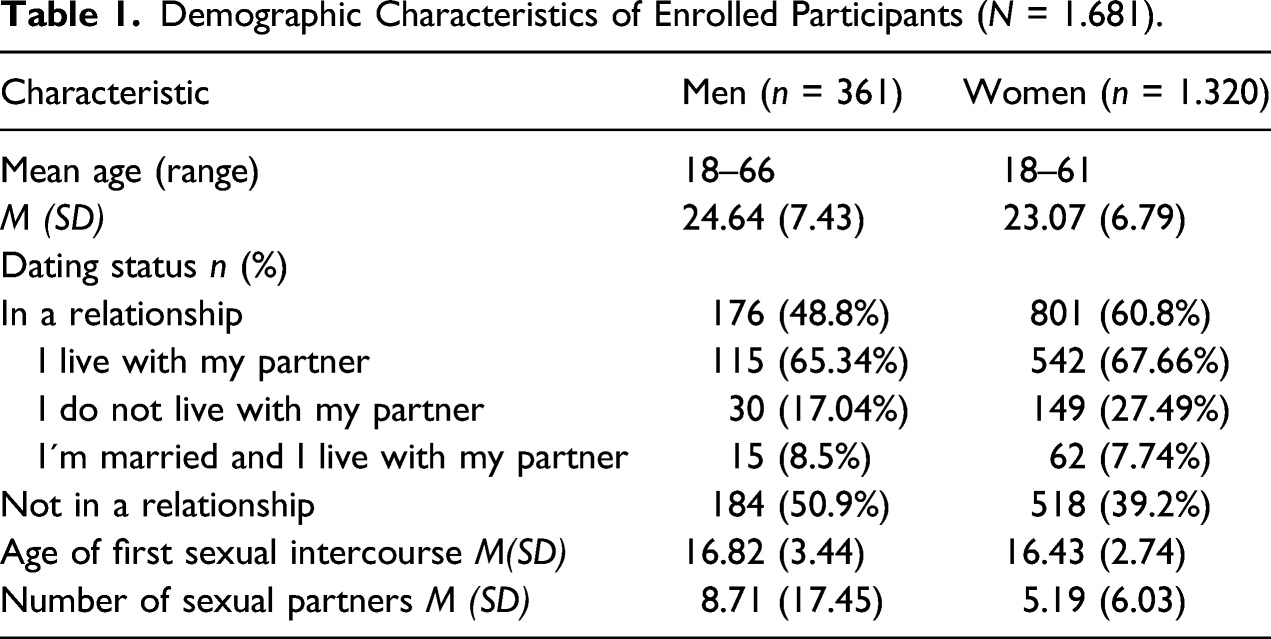
Demographic Characteristics of Enrolled Participants (N = 1.681).
Measures
Socio-demographic questionnaire
The participants were asked about their sex, age (in years), education, nationality, sexual orientation, whether they were in a relationship, age of their first sexual intercourse, number of sexual partners and marital status (single, married, cohabiting couple, separated/divorced, widowed, other).
Sexual consent
The Sexual Consent Scale Revised (SCSR; Humphreys & Brousseau, 2010) was used to assess beliefs, attitudes, and behaviors as to how sexual consent should be negotiated. This self-report was developed based on the Theory of Planned Behavior (Ajzen & Fishbein, 2005). The present study employed the Spanish version of Moyano et al. (manuscript being prepared). The Spanish validation is made up of 26 items distributed into four factors: Factor 1: Lack of Perceived Behavioral Control (includes items such as: “I would have difficulty asking for consent because it would spoil the mood”); Factor 2: Positive Attitude Toward Obtaining Consent (includes items such as: “I think it is equally important to obtain sexual consent in all relationships regardless of whether or not they have had sex before”); Factor 3: Indirect Behavioral Approach (includes items such as: “Typically I communicate sexual consent to my partner using nonverbal signals and body language”); Factor 4: Norms of Sexual Consent (includes items such as: “I think that obtaining sexual consent is more necessary in a casual sexual encounter than in a committed relationship”). Their items are answered on a Likert-type response scale with seven alternatives (1 = totally disagree to 7 = totally agree). Cronbach’s alpha for the Spanish version is between .66 and .85. In the present study, the reliability for men was .75, .87, .62, and .81 for all four factors, and .70, .83, .60, and .74 for women and all four factors, both respectively.
Sexual aggression and sexual victimization
The Sexual Experiences Survey (SES; Koss & Gidycz, 1985) was used to assess having been a sexual aggressor (only for men) and having been a sexual victim (only for women) from the age of 14 years. We used the adapted version (O'Sullivan et al., 1998), in which items in all sections were edited to be gender-neutral and to apply to both heterosexual and homosexual relationships, and it has been used in Spain (Moyano et al., 2017). It distinguishes four sexual violence types: unwanted sexual contact, sexual coercion, attempted rape, rape. An example of an item in the aggressor version is: “Have you had sex acts with someone (fondling, kisses) when he/she didn’t want to, because he/she felt overwhelmed by your arguments and pressure?” An example of an item in the victim version is: “Have you had sex acts (anal or oral intercourse or penetration by objects other than the penis) when you didn’t want to because someone threatened you or used some degree of physical force (twisting your arm, holding you down, etc.).” Both versions are composed of 10 items and the participants can choose among six response alternatives (0 = never to 5 = 5 times or more). Higher scores indicate higher sexual violence frequency. For the present study, when men reported having perpetrated any type of sexual violence at least once, it was considered “sexual aggressor”; when women indicated having suffered any type of sexual violence at least once, it represented “sexual victim”. Finally, O'Sullivan et al. (1998) report adequate psychometric properties, specifically a Cronbach’s alpha of .70. In the present study, the reliability values were .79 for the aggression form in men and .70 for victimization in women.
Procedure
An incidental non probabilistic procedure was followed. The participants answered an online survey. Online surveys allowed the recruitment of a higher diversity of participants and this procedure was as reliable as traditional pencil and paper ones (Moyano et al., 2017; Mustanski, 2001). The survey was disseminated via a link that was distributed on social networks and by the news service of the universities that participated in this study. The participants were informed of the study purpose, the characteristics of the scales and what their participation implied. Both the anonymity and confidentiality of their responses were guaranteed. When the participant clicked on the link, the informed consent first appeared. Once the person had read it and accepted to participate in the study, questionnaires appeared. None of the questions was mandatory, except for the informed consent question. As questionnaires were completed on one occasion, no code or participant identification system was necessary. The present research work was approved by the Ethical Committee of the University of Jaén, Granada and ethics Committee of the Government of Aragón.
Results
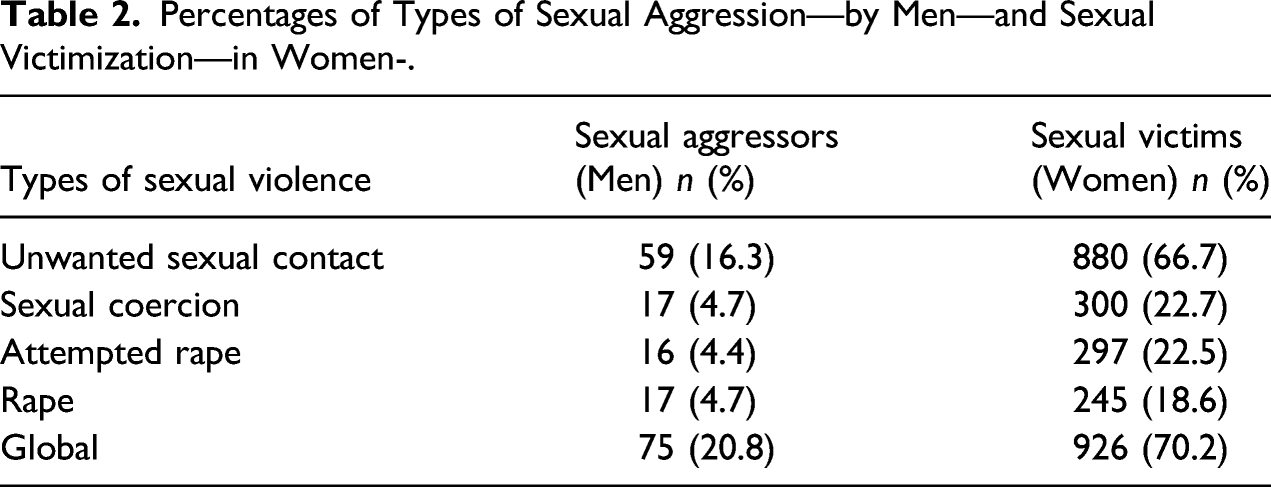
Percentages of Types of Sexual Aggression—by Men—and Sexual Victimization—in Women-.
Medians of the Subscales of Sexual Consent by aggressors and non-aggressors and victims and non-victims.

Factor 1: Lack of Perceived Behavioral Control; Factor 2: Positive Attitude Towards Establishing Consent; Factor 3: Indirect Behavioral Approach to Consent and Factor 4: Sexual Consent Norms.
Medians of the Subscales of Sexual Consent by Type of Sexual Aggression in Men.

Factor 1: Lack of Perceived Behavioral Control; Factor 2: Positive Attitude Towards Establishing Consent; Factor 3: Indirect Behavioral Approach to Consent and Factor 4: Sexual Consent Norms.
Medians of the Subscales of Sexual Consent by Type of Sexual Victimization in Women.

Factor 1: Lack of Perceived Behavioral Control; Factor 2: Positive Attitude Towards Establishing Consent; Factor 3: Indirect Behavioral Approach to Consent and Factor 4: Sexual Consent Norms.
Discussion
Lack of sexual consent is an essential element for considering sexual violence (Beres, 2007; Jaffe et al., 2021). Therefore, our main goal was to examine the risk of sexual aggression by men and women’s sexual victimization based on some indicators related to the negotiation of sexual consent. First on sexual violence prevalence, 20.8% of the men had perpetrated some type of sexual violence and 70.2% of the women had been sexual victims of some type of sexual violence. Second, sexual aggressors (especially of sexual coercion) versus non aggressors, were more likely to consider it less important to obtain sexual consent. Moreover, sexual victims, unlike non sexual victims, considered negotiating sexual consent important and indicated adhering to more norms about sexual consent, such as obtaining consent is needed even in a relationship context. However, victims perceived themselves as being less able to negotiate and acquire consent. This means that although obtaining consent was relevant for sexual victims, they seemed to be in a position of vulnerability for not having the strategies to manage sexual negotiation. Third, differences appeared between aggressors and non aggressors, and also between victims and non victims, in the importance they attached to each sexual consent dimension based on the violence that they had respectively perpetrated/suffered. This provides further evidence for the multidimensionality of sexual consent and the sexual violence continuum.
On prevalence, our data are alarming because the sample consisted of participants from the general population, most of whom were young and highly educated. Our percentages also exceed those reported by the Macrosurvey on Violence against Women (Ministry of Equality of the Spanish Government, 2019), which concluded that 40.4% of Spanish women aged 16 or over had suffered sexual harassment, and 13.7% sexual violence. There are some possible explanations for these findings. First, our study did not distinguish whether sexual violence had been committed by a stranger, a partner or a former partner, or if victims had reported what happened, unlike previous studies (Domenech del Rio & Sirvent Garcia del Valle, 2017; Ministry of Equality of the Spanish Government, 2019). Second, previous research has shown that university students more frequently act as male aggressors and female victims, compared to adults (Fedina et al., 2018; Muehlenhard et al., 2017; Smith et al., 2017), which could explain why our percentages were higher than the representative data of the Spanish population (Ministry of Equality of the Spanish Government, 2019). Third, it is possible that based on group rape known as the “La Manada” case (Faraldo & Acale, 2018) and the recent approval of the Organic Law for the Comprehensive Guarantee of Sexual Freedom (Ministries of Equality and Justice of the Spanish Government, 2021), where expresses the importance of sexual consent in crimes of sexual violence, and could have made it easier for women to acknowledge having suffered some type of sexual violence. Rousseau et al. (2020) reported that some women are unaware of having suffered sexual violence or do not express it out of shame. However, feminist movements like #MeToo (Rentschler, 2018), as well as the aforementioned “La Manada” case (Faraldo & Acale, 2018) or the Organic Law draft on the Comprehensive Guarantee of Sexual Freedom have encouraged women to report having been victims of sexual violence. Despite these possible explanations, future research is recommended.
After the comparison made of the SCS-R subscales to separate the type of sexual violence in each type to compare aggressors and non aggressors, our findings indicate that: (1) Sexual aggressors do not attach importance to negotiate sexual consent. This result is not altogether unexpected. Some factors like gender, cultural norms, and the sexual double standard (attitude that implies a different assessment of the same sexual behavior depending on the sex (man vs. woman) of the person exhibiting the said behavior; Milhausen & Herold, 2002) can explain the relation between lack of sexual consent and sexual aggression. For example, the social dominance of men over women, in accordance with traditional gender roles (Gagnon & Simon, 2009), reinforces men’s role of initiating sexual activity and women’s role of accepting or rejecting sexual activity. Women are expected to reject sexual activity even if they want it, while men insist or ignore women’s refusal (Jozkowski & Humphreys, 2014; Jozkowski & Peterson, 2014) and coercive behaviors may occur, which is perceived as necessary according to traditional gender roles (Ward et al., 2005). Therefore, the sexual double standard comes into play by allowing more sexual freedom for men and restricting women’s expression. It is also able to influence communicating sexual consent (Gómez Berrocal et al., 2019; Jozkowski et al., 2017; Sánchez-Fuentes et al., 2020) because the importance attached to negotiating sexual consent by sex may reflect power dynamics (Hust et al., 2017). (2) Sexual aggressors, especially those who have performed touching behavior and placed pressure on having sex (i.e., unwanted sexual contact and coercive sexual behaviors, respectively) report greater lack of perceived behavioral control for requesting sexual consent. Likewise, those men who committed sexual coercion against women took a less favorable attitude toward obtaining sexual consent. In line with this, a qualitative research work has demonstrated that men consider having sexual relations and consent to be competition with winners and losers (Jozkowski et al., 2017). Thus men aspire to have sexual relationships and be winners, for which conquest is more important than women’s consent. This means that men attempt to “convince” women to have sex with them without perceiving it as being coercive (Jozkowski et al., 2017).
On the differences in the SCS-R dimensions and types of sexual victimization, for sexual victims and non victims: (1) Sexual victims take a more favorable attitude toward negotiating sexual consent. However, one striking result was that sexual victims reported greater lack of perceived behavioral control in different types of sexual victimization, except attempted rape. Hence it is likely that sexual victims have less assertiveness to request sexual consent. Previous studies have concluded that there is a relation between assertiveness and sexual consent (Darden et al., 2019) and, in addition, the women who have suffered sexual violence show less sexual assertiveness (Bhochhibhoya et al., 2021; Kelley et al., 2016). This result can also be explained by considering the Sexual Scripts Theory (Gagnon & Simon, 2009). As previously mentioned, according to traditional gender roles, men are expected to propose and request sexual consent, while women are assigned the role to accept or reject sexual consent and, thus, determine whether sexual activity occurs or not (Jozkowski & Peterson, 2014). (2) Sexual victims consider that consent should be obtained independently of the context to a greater extent than non victims and, therefore, gaining consent is also needed in a relationship context or if previous sexual activity has taken place (Factor 4: Norms of Sexual Consent). These findings confirm that sexual violence and sexual consent are mutually related because having suffered sexual victimization can provoke a process to reflect on sexual consent (Rousseau et al., 2020), including the importance and need to obtain consent explicitly and with less ambiguity in order to be effective (Humphreys & Brousseau, 2010).
Limitations
Intentional non probabilistic sampling was used and, therefore, the results cannot be generalized to the general Spanish population. Our sample of men was not very large and the participants were relatively young, highly educated and self-identified as heterosexual. Further studies should explore sexual consent in more diverse samples and with sexual minorities. Another limitation of the study is its cross-sectional nature. That is, the importance given to sexual consent can increase the risk of sexual assault or victimization or vice versa, that is, being a sexual aggressor or victim can increase influence on the importance given to sexual consent. Therefore, future research is recommended to analyze whether being a victim of sexual violence or a sexual aggressor predicts sexual consent. Finally, it is also important refer to as a limitation that the reliability of internal consistency was low for Factor 3 of the SCSR.
Conclusions
As far as we know, this is the first study to provide findings on the link between sexual consent and the risk of sexual aggression and sexual victimization in men and women, respectively. On the one hand, sexual aggressors do not consider it relevant to obtain explicit sexual consent, and they also lack behavioral control to request it and take a negative attitude toward this practice. On the other hand, although sexual victims are aware of the relevance of obtaining explicit sexual consent, they still hold some ideas, attitudes and behaviors that do not go along with gaining sexual consent, which leaves women in a position of vulnerability.
Footnotes
Acknowledgments
All the participants who volunteered in the study.
Declaration of Conflicting Interests
The author(s) declared no potential conflicts of interest with respect to the research, authorship, and/or publication of this article.
Funding
The author(s) disclose receipt of the following financial support for the research, authorship, and/or publication of this article.
