



Abstract
The bystander intervention (BI) model recognizes a range of prosocial helping behaviors individuals can perform to support sexual and dating violence (S/DV) prevention efforts. Individuals can demonstrate a commitment to ending violence through proactive BI, such as participating in prevention initiatives or talking with peers about ways to keep safe, which are different than reactive BI behaviors when violence is underway. Given the anchoring of the BI model in Diffusion of Innovation Theory, which articulates the uptake of new behaviors throughout a population or community and the role of change agent aids in that process, investigating demographic, and other individual-level correlates, of proactive behaviors may help identify those students who are particularly positioned to help diffuse and normalize anti-violence behaviors. The purpose of this study was to examine (1) the occurrence of students’ engagement in peer discussions about violence prevention in the past year and (2) the correlates of reporting to have those discussions among university students in a cross-sectional study implemented on two campuses in the Mid-Atlantic U.S. Results showed that the most common discussion was talking to friends about being safe in dating relationships and the least common was talking with friends about participating in violence-prevention-related activities, with 66.2% and 22.5% having done so, respectively. Women, younger students, and those reporting to know a survivor of either DV or SV were more likely to report having discussions, compared to men, older students, and those not knowing a survivor. Additional relationships were detected between other individual characteristics, knowledge about violence/victimization, and climate-related variables but differed depending on whether participants participated in the DV or SV-related survey module. Findings suggest the need for BI training initiatives to emphasize proactive engagement and peer discussions, and that gender continues to be a robust indicator of violence-prevention actions.
The bystander intervention (BI) model for sexual and dating violence (S/DV) prevention, which seeks to change violence-perpetuating norms (Banyard, 2008), is common among institutions of higher education. There is a range of opportunities for prosocial intervention, including those that are in response to violence that appears imminent or is currently underway, as well as proactive, such as engaging in activities that have broader missions to prevent violence (McMahon & Banyard, 2012). Although the bulk of BI research focuses on individuals’ reactive responses, participating in conscious-raising and anti-violence activities, like joining prevention-related events and talking with others about violence prevention, likely reflects critical awareness of violence as a social justice issue (Johnson et al., 2019), and engaging in such is necessary for realizing its end (McMahon & Banyard, 2012). The extent to which students engage in these types of activities is increasingly recognized as an important aspect of violence-prevention research (Banyard et al., 2014; Hoxmeier et al., 2018; Johnson et al., 2019; McMahon & Banyard, 2012), given its connection to, and relevance for, thinking about BI as innovative, anti-violence behaviors whereby its diffusion (Butler & Fisher, 2020; Coker et al., 2016; Rogers, 1983; 2003; 2010) is critical for ending violence.
Diffusion of Innovation Theory (Rogers, 1983) is one theory that underlies the BI model for violence prevention. It describes how new behaviors are adopted on a large scale via an initial uptake of such by change-makers, or those individuals who are willing to break with community norms, From this lens, bystanders’ pro-social and anti-violence actions can disrupt violence-perpetuating norms as they diffuse through populations as change-makers perform and, thus, model them for others in the community (Butler & Fisher, 2020; Coker et al., 2016; Rogers, 2002). This theoretical framework, coupled with the evidence showing that adolescents’ social networks are salient contexts for influencing health-related behaviors (Valente, 2010), establishes the investigation of the role peer communication plays in disseminating information about violence as an important area of research (Butler & Fisher, 2020; Coker et al., 2016; Edwards et al., 2022; McMahon, 2009; Waterman et al., 2021). Learning more about which students engage peers in discussions about prevention is a critical component of the BI line of inquiry. The purpose of this study, therefore, is to describe the proportion of students who reported to have engaged in violence-prevention-related communication with peers in the past year and examine how students’ demographic characteristics, and other individual-level characteristics, relate to that peer communication.
BI Models for Violence Prevention
McMahon and Banyard’s (2012) conceptual framework organizes prosocial BI into four areas, including reactive and proactive actions. Reactive interventions are those intervention opportunities in situations where violence is imminent, already underway, or has already occurred. Proactive BI are actions taken to address violence more broadly, which can pave the way for shifts in the very social norms that perpetuate violence. Johnson et al. (2019) asserted the need to examine BI beyond the scope of direct helping in situations demonstrating risk for violence. “In order to combat the root cause [of violence]” (p. 734), they write, “individuals’ involvement in anti-violence activism reflects the critical-consciousness necessary to realize its end.” Proactive engagement in anti-violence efforts is of clear importance to the BI model, as evidenced by their inclusion on widely used measurement tools, such as Bystander Behavior Scale (Banyard et al., 2014), such as encouraging others to learn about, and get involved with, violence prevention and talking with a friend about keeping safe at parties. At the same time, measurement of BI that accounts for proactive behaviors generally includes reactive actions as well (i.e., Cascardi et al., 2020; Johnson et al., 2019; McMahon et al, 2015), such that it is difficult to parse out the specific engagement in violence prevention students are demonstrating across the continuum of violence. Because proactive behaviors have demonstrated distinction from reactive BI (Cascardi et al., 2020), focusing on proactive engagement via peer communication about violence is an important, yet understudied aspect of BI, and understanding the correlates of peer discussion can help shed light on violence prevention-related change agent aids (Butler & Fisher, 2020).
Mavens of BI
Coined by Butler and Fisher (2020), “mavens of bystander intervention” (p. NP2126) refer to individuals who “spread bystander intervention norms to others by communicating with peers” (p. NP2126). “Social contacts, social interaction, and interpersonal communication” (Valente & Davis, 1999, p. 57) are central for the adoption of new behaviors (Valente & Rogers, 1995). Innovative practices diffuse when early adopters model the behaviors for the early and late majority. Peer relationships and friendships have been shown to be an important, micro-level source of information about violence (O’Connor et al., 2021); thus, BI norms may more readily diffuse through campus communities when early adopters engage their friends in discussions about the ways they can prevent violence. These discussions are an important component of changing norms that perpetuate violence (Butler & Fisher, 2020), and focusing students’ BI opportunities within their friendships has the potential to make positive gains in reducing violence (Blayney et al., 2021). Here, we build on Butler and Fisher’s (2020) work by extending the knowledge on identifying the “change agents aids” (p. NP2130) who are willing to break with norms by talking about violence prevention with their friends.
Butler and Fisher (2020) argue that identifying mavens, or change agent aids, is important for increasing the effectiveness of training initiatives. Their focus was understanding whether high school students who participated in BI training were more likely to engage in violence-related peer communication than non-participants. They found no differences, suggesting that students who participate in training are not the only individuals who can, and do, spread BI norms. Although quantitative investigations of students’ discussions about violence prevention are limited, there is evidence suggesting that students may discuss ways they can prevent violence. Often described as party safety, scholars have examined students’ strategies to reduce risk of SV in these contexts, including talking “with a/n ____ about going to parties together, staying together, and leaving together” (Banyard et al., 2014, p. 112), among others. One qualitative study of how women leveraged relationships to reduce vulnerability to violence found women experienced barriers in identifying risk for violence and thus, intervening to protect against (Blayney et al., 2021), underscoring the importance of programmatic strategies to increase communication between friends prior to discuss violence prevention.
Several studies suggest the importance of demographic, and other individual-level characteristics in engaging in BI, including peer discussions about violence. Butler and Fisher’s (2020) study, who hypothesized that those “with a greater stake” (p. NP2141) in violence prevention would likely report having engaged in violence-prevention discussions with peers. They argued that students with “extensive knowledge about or a vested interest in preventing [violence]” (p. NP2142) could be potential change agent aids. Gender identity has been a robust predictor of BI engagement across the spectrum of risk for violence (Banyard, 2011), and Butler and Fisher (2020) found (using a measure of sex) female students were more likely to engage in violence-prevention-related peer discussions compared to male students. Scholars have theorized that women’s increased BIs and behavior (often measured with reactive, violence-risk-related BI behaviors) reflect their vulnerability to victimization; because women are more likely to experience sexual/dating violence relative to men (Black et al., 2011; Cantor et al., 2020), they are more likely to intervene when they observe risky situations (Burn, 2009; Fisher & Butler, 2020). Those with minoritized gender (Hoxmeier & Madlem, 2018) and sexual identities (Edwards et al., 2015) are also vulnerable to victimization, and previous research demonstrates differences in reactive intervention based on sexual/gender identity (Hoxmeier et al., 2020), such that it is important to account for these identities in BI research. Butler and Fisher (2020) found that non-white students, relative to white students, were more likely to discuss prevention with friends. Although racial identity was included as a control variable in their study, scholars have urged violence-related research to be more inclusive of diverse identities (Klein et al., 2020; Linder & Harris, 2019; McMahon et al., 2020).
Knowledge about S/DV, and thus, a vested interest in its prevention may also result from various experiences, including a history of victimization, for which current research is mixed (Butler & Fisher, 2020; Cascardi et al., 2020), and knowledge of others’ victimization. In addition to history of victimization, we account for other indicators of students’ knowledge of violence, including whether students’ report to know a survivor, have received a disclosure of victimization, and to have attended a campus event about violence. Although knowledge of campus resources and perceptions of institutional handling are individual-level characteristics, students’ experiences with violence prevention are influenced by a social-ecological landscape that may include campus prevention messages and community support (McMahon et al., 2019).
The Current Study
Friendships are important opportunities for individuals to engage prosocial BI (Blaney et al., 2020), yet intervening when violence is imminent is just one part of the BI conceptual framework (McMahon & Banyard, 2012). Friendships also provide opportunities to discuss violence prevention more broadly, such as strategizing for safety or participating in initiatives aimed to address violence. Importantly, while much of the BI literature includes prosocial actions in both S/DV risk situations, there are differences in these experiences. Although SV may be experienced within a romantic relationship, in addition to other forms of abuse (Shorey et al., 2008), SV may occur between people who do not know one another. SV may occur only once, while DV is a pattern of abusive behaviors. While evidence shows that women are more likely to be victims than perpetrators of SV (Shorey et al., 2008), research demonstrates that DV is bidirectional (Cornelius et al., 2010). We should not assume that students engage in discussions about each of these issues similarly nor that students’ own S/DV victimization experiences will similarly relate to peer discussions. We sought to build on Butler and Fisher’s (2020) study of mavens of peer communication in several ways, including examination of whether LGBTQ+ individuals engage in peer discussions more than their cisgender, straight/heterosexual counterparts. We broadened racial/ethnic identity categories beyond “non-white” and accounted for additional individual-level characteristics, including disability. Wu (2021) argued that social science research should seek to understand how not race but racism relates to health outcomes; thus, we included measures that assessed students’ experience with social identity-based discrimination with respect to racial/ethnic identity, as well as gender, sexual identity, and/or disability status. Regarding knowledge about S/DV, in addition to personal history of S/DV victimization, we examined accounted for receiving a disclosure of and/or knowing someone who has experienced victimization. In addition, we examined whether and how climate-related variables—knowledge of victimization-related reporting resources, perceptions of institutional responses to incidence of S/DV, and attending a violence-related campus event—related to peer discussions because, like the individual characteristics previously discussed, these factors may also reflect students’ investment in prevention. This study aims to answer the following questions:
RQ1: How many times in the past year do students report engaging in violence-related peer communication, and what proportion of students report to have never engaged in violence-related peer communication in the past year?
RQ2: How are students’ demographic characteristics (gender, sexual identity, racial/ethnic identity, etc.), personal knowledge of violence (victimization history, knowing a victim, receiving a disclosure of victimization), and climate-related variables (student awareness of resources, perceptions of institutional handling of violence, and attending a campus event about violence) related to their frequency of engaging in violence-related peer communication?
Methods
Recruitment and Sample
Data for the current study were collected as a part of a larger campus climate study designed to assess experiences and perceptions related to S/DV conducted at two college campuses in the mid-Atlantic. All students, graduate and undergraduate, enrolled in courses on the two campuses during the fall 2020 semester were invited to participate. Importantly, students were asked about past year peer communication, for which occurred during the COVID-19 pandemic, and we recognize the potential impact of campus and community restriction to have impacted the occurrence of peer communication. To reduce the burden on participants, students were randomly assigned to either an SV or DV survey module. A broad outreach campaign tailored to each campus (including print materials, social media, and direct communications) publicized the survey, which was open for 6 weeks. Participants were recruited over email and were entered into raffles to receive several cash and electronic prizes. All procedures were approved by the university’s Institutional Review Board.
A total of 2,424 students completed the survey. On Campus 1, 17.5% of eligible students accessed the survey; 9% of eligible students accessed the survey on Campus 2. Students were removed from the sample if they had declined informed consent (n = 148), failed to answer any questions on the survey (n = 10), reported that they were not a university student (n = 1), or reported that they did not tell the truth or did not pay attention (n = 36). Students not assigned to either the SV or DV module (n = 51) and those assigned to the DV module who indicated that they had not been romantically involved with anyone while at the university (and thus did not receive questions about dating violence victimization, n = 412) were excluded from the sample, leaving a final analytic sample of 1,766 students (1,087 from the SV module and 679 from the DV module). Since students assigned to the SV and DV modules received different sets of questions about victimization, missing data imputation and analyses were conducted separately. Table 1 presents the detailed sample characteristics. Because the samples from both campuses participated in the study within the same time and were demographically similar (e.g., with respect to gender and age), they were merged for the purpose of this study.
Sample Characteristics.
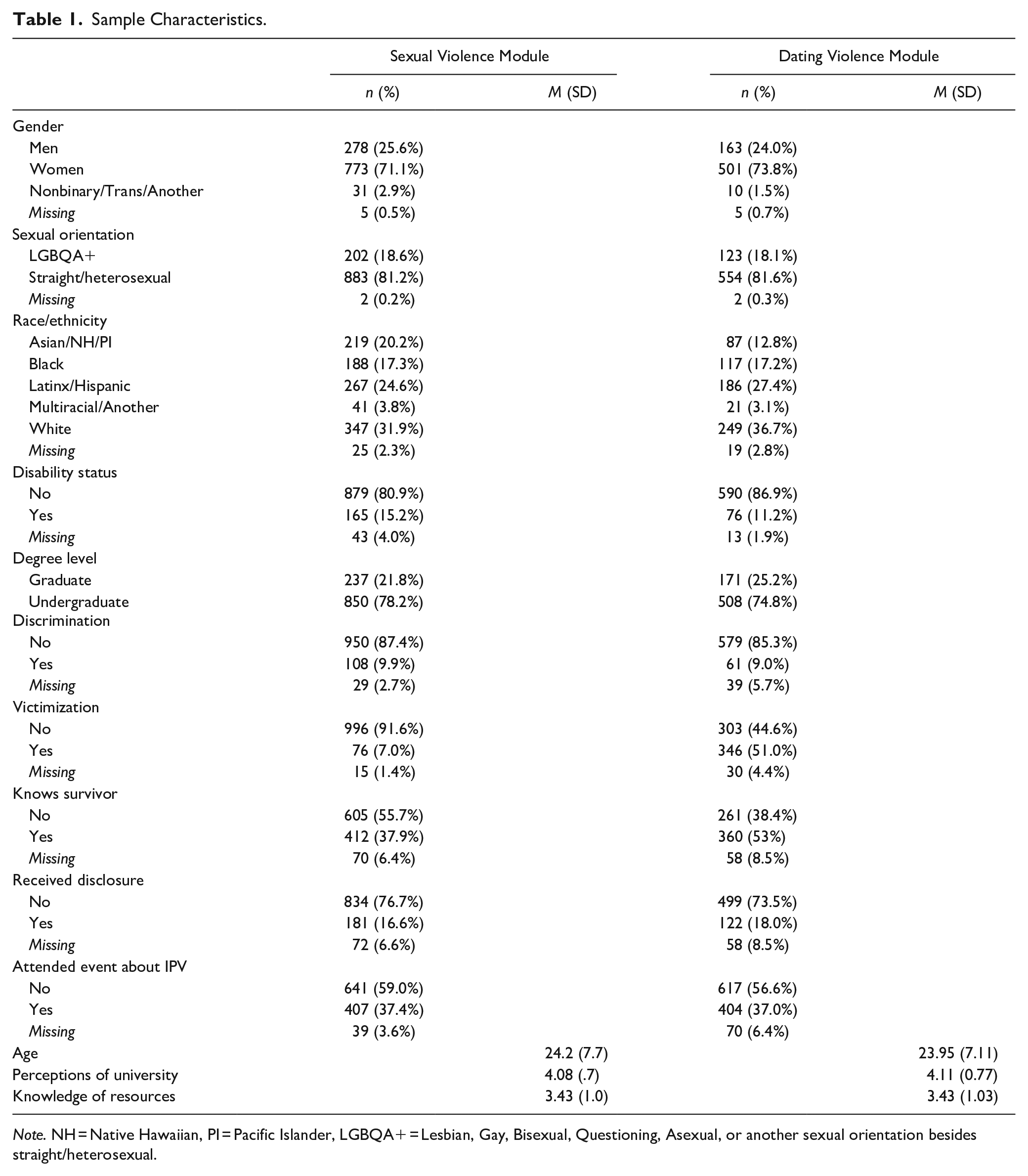
Note. NH = Native Hawaiian, PI = Pacific Islander, LGBQA+ = Lesbian, Gay, Bisexual, Questioning, Asexual, or another sexual orientation besides straight/heterosexual.
Measures
Dependent Variable
Violence-Related Peer Communication
The four items from Butler and Fisher (2020) were used to assess past year violence-related communication with peers (see Table 2). Response options were measured on a 5-point scale (0 = 0 times, 1 = 1–2 times, 2 = 3–5 times, 3 = 6–9 times, and 4 = 10+ times). As in Butler and Fisher (2020), these four items were used to create a dichotomous variable indicating whether the students engaged in any one of the peer discussion behaviors in the past 12 months (1 = yes; 0 = no), which was used in regression analyses.
Frequencies and Percentages for Violence-Related Peer Communication Items.

Note. Frequencies and percentages for violence-related peer communication items are based on students from both modules with non-missing data prior to imputation.
Demographics and Individual-level Characteristics
The following demographic and individual-level variables were assessed in the survey and included in the current study: gender identity (collapsed into man, woman, nonbinary/trans/other); sexual orientation (dichotomized into straight/heterosexual, LGBQA+); racial/ethnic self-identity (Asian, Native Hawaiian, or Pacific Islander; Black; Multiracial or another racial/ethnic group; Latinx or Hispanic; White); degree level (undergraduate or graduate, from institutional records); age (continuous, from institutional records); and disability status (yes, report to have a disability and no, reported to not have a disability). Students were also asked about experiences of identity-based discrimination. A dichotomous composite of experiencing discrimination was created for students who indicated “yes” to any of the following checklist items: Because of my sexual orientation (actual or as perceived by others); gender or gender identity, racial or ethnic identity, socioeconomic status, or disability status.
Knowledge about Violence Victimization
Sexual Violence Victimization
Participants who were randomized into the SV module received survey items assessing history of sexual violence victimization. A series of items inquired about different types of unwanted sexual contact, with definitions of the behaviors that qualified as unwanted sexual contact, including both “unwanted touching of a sexual nature” and “unwanted penetrative contact.” The definition aligned with university’s definition of nonconsensual or unwanted sexual contact as well as the White House Task Force to Protect Students from Sexual Assault’s recommended survey instrument and Krebs, Lindquist, Warner, Fisher, and Martin (2007). To assess victimization that occurred while a university student, items inquired about three types of unwanted sexual contact: those occurring by physical force, coercion, or threats, and while the victim was unable to consent or stop what was happening, that is, due to being passes out, drugged, drunk, incapacitated, or asleep. These questions were asked about completed incidents as well as attempted (not successful) unwanted sexual contact by physical force or coercion/threats. Response options were yes/no. A composite measure was created for the purpose of this study so that students who indicated any experience of unwanted sexual contact (excluding attempted acts or acts that the student was uncertain occurred) were coded as experiencing SV victimization.
Dating Violence Victimization
Participants who were randomized into the DV module received items assessing history of DV victimization using items from Foshee et al. (1998). For DV victimization, students were first asked whether they have been romantically involved (dating/hooking up with/married to/living with/or other involvement) since coming to [this institution]. Response options were yes/no. For those reporting “yes,” a series of items inquired about different types of dating abuse experiences, including physical (scratched, slapped, etc.), digital (looked through phone or other device at my texts, social media, or apps, when I did not want them to do that, spread rumors, gossip or secrets about me using texts, social media, or apps, etc.), psychological (said things to hurt my feelings, insulted me in front of others, etc.), and sexual (forced or pressured to do something sexual, etc.) dating abuse. Those reporting “no” to the question about romantic involvement were excluded from the analytic sample. Response options were rated on a 4-point scale (0 = never, 1 = once [1 time], 2 = sometimes [2–5 times], and 3 = often [6+ times]). A dichotomous composite measure of dating violence victimization was created; students who reported experiencing any DV behavior that meets the threshold for a Title IX violation were coded as experiencing dating violence victimization.
Received Disclosure of Victimization
In each module, one item assessed whether students had received a disclosure of S/DV from a fellow student: Since coming to [this institution], have any other students at [this institution] told you they were a victim of an unwanted sexual experience (SV module)/dating or domestic violence (DV module)? Response options were yes/no.
Knowledge of a Survivor of Violence
Knowledge of a survivor of SV (SV module only) was assessed with one item: Has anyone you know—a friend or a family member—ever been forced or coerced (pressured) by another person to do something sexually that they did not want to do, that you know of? Knowledge of a survivor of DV (DV module only) was assessed with one item: Has anyone you know—a friend or a family member—ever been in a relationship that involved dating or domestic violence, that you know of? Response options were yes/no.
Climate-Related Variables
Knowledge of Campus Resources for Violence
Students assigned to the SV module completed a four-item measure of Knowledge of Campus Resources for Sexual Violence (White House Not Alone Toolkit, 2008). They rated the extent to which they agreed with the following statements: (1) if a friend or I experienced unwanted sexual contact, I know where to get help on [this institution’s] campus; (2) if a friend or I experienced unwanted sexual contact, I know where to get help off [this institution’s] campus; (3) I am aware of and understand [this institution’s] procedures for dealing with the reported incidents of sexual misconduct, and (4) I know what services are available for people who experience sexual misconduct. Response options ranged from 1 = strongly disagree to 5 = strongly agree. Cronbach's alpha for this measure was .88.
Students assigned to the DV module completed a similar four-item measure of Knowledge of Campus Resources for Dating Violence, in which the words “unwanted sexual contact” and “sexual misconduct” were replaced with “dating and domestic violence.” Cronbach's alpha for this measure was .89.
Perceptions of Institutional Handling of Incidence of Violence
Students assigned to the SV module responded to seven items assessing Perceptions of Institutional Handling of Incidence of Sexual Violence (White House Task Force, 2014). Students were asked to rate the extent (1 = very unlikely to 5 = very likely) to which the following statements are likely to occur, including (1) [This institution] would take the report seriously; 2) [This institution] would maintain the privacy of the person making the report; (3) if requested by the victim, [this institution] would forward the report to criminal investigators (e.g., the police); (4) [this institution] would take steps to protect the safety of the person making the report; (5) [this institution] would support the person making the report; (6) [this institution] would take action to address factors that may have led to the unwanted sexual contact; and (7) [this institution] would handle the report fairly. Internal consistency reliability (Cronbach’s alpha) of these items in this sample was .93.
Students assigned to the DV module completed a measure of Perceptions of Institutional Handling of Incidence of Dating Violence, in which they rated the extent to which the same seven statements (α = .94) would occur in relation to incidents of dating or domestic violence.
Attended Campus Event about Interpersonal Violence
Students in both modules were asked whether they had attended an event about interpersonal violence or an orientation program where BI was discussed since attending the university. The two items were combined to create an indicator of whether a student had attended any type of event related to interpersonal violence (1 = yes, 0 = no).
Missing Data
Missing data were minimal (no individual item was missing more than 10% of cases). However, further examination revealed that missingness was related to several demographic variables (e.g., age, racial/ethnic identity), suggesting that the missing data could not be assumed to be missing completely at random. Thus, an imputation model containing all relevant variables was constructed and multiple imputation was performed using the mice R package (van Buuren & Groothuis-Oudshoorn, 2011), resulting in 20 complete datasets for each module.
Analysis Plan
Descriptive analyses were performed to examine the frequency of students' discussions with peers over the last year (RQ1). Two logistic regression analyses, one for each module, were conducted to assess correlations between students' demographics and victimization history and their frequency of engaging in violence-related peer communication (RQ2). All categorical variables were dummy coded (0 and 1). Age and Perceptions of Institutional Handling of Incidence of Dating Violence and Sexual Violence were mean-centered prior to analysis.
Results
Research Question 1: Students’ Engagement in Prevention-Related Discussions
The first research question sought to understand the extent to which students were engaging in violence-prevention discussions with peers. Table 2 presents frequencies and percentages for Violence-Related Peer Communication items from students across both modules. Overall, two-thirds of students (66.3%) reported that they had engaged in at least one violence-related peer communication in the past year, and one-third of students (33.7%) reported that they had not engaged in any violence-related peer communication in the past year. Among those reporting engaging in any of the four discussions, most students reported to have done so one to two times. Engagement varied by type of discussion. The most frequently reported was talking about being safe in dating relationships, with 62.2% (n = 1,233) having done so at least once, and the least common was talking about participation in prevention activities in one's school or community, with 22.5% (n = 446) having done so at least once.
Research Question 2: Correlates of Engaging in Prevention-Related Discussions
Demographics and Individual-Level Characteristics
The second research question examined demographic and individual-level correlates of reporting to have engaged in violence-prevention-related discussions with peers. Table 3 presents the results of the logistic regression analysis for students assigned to the SV module, and Table 4 presents the results for students assigned to the DV module. The odds of engaging in peer communication about interpersonal violence were significantly higher for cisgender women relative to cisgender men (1.72 times higher in the SV module; 1.96 higher in the DV module). Sexual orientation was not significantly related engaging in discussions, and engagement did not significantly differ between cisgender men and trans/nonbinary individuals. Age was negatively correlated with peer discussion (odds ratio [OR] = .94 in the SV module; OR = .93 in the DV module).
Logistic Regression of Peer Discussion: Sexual Violence Module.

Note. CI = confidence interval; NH = Native Hawaiian, OR =”odds ratio; PI = Pacific Islander; SE = standard error.
p < 0.05, **p < 0.01, ***p < 0.001.
Logistic Regression of Peer Discussion: Dating Violence Module.

Note. CI = confidence interval; NH = Native Hawaiian, OR = odds ratio; PI = Pacific Islander; SE = standard error.
p< 0.05, **p < 0.01, ***p < 0.001.
Several significant relationships emerged for the DV sample that were not present in the SV module sample. Relative to white students, Latinx/Hispanic students had greater odds of engaging in peer communication about violence (OR = 1.84) and odds of engaging in peer discussion were lower for graduate students relative to undergraduate students (OR = .59).
Knowledge About Violence Victimization
Individuals who reported knowing a survivor of S/DV had greater odds (OR = 2.91 in the SV module; OR = 2.16 in the DV module) of engaging in peer communication relative to those who did not. However, SV nor DV victimization was associated with peer discussion. In the DV module, but not the SV module, receiving a disclosure from another student was positively associated with engagement in peer discussion (OR = 2.65).
Campus-Climate-Related Variables
Students in the SV module who had attended an event about interpersonal violence since enrolling at the university had greater odds of engaging in peer discussion (OR = 1.51) than those who had not, but this relationship was not significant for students in the DV module. In the DV module sample, knowledge of campus resources for DV was positively associated with engagement in peer discussion (OR = 1.29), but this relationship was not significant in the SV module sample. Perceptions of institutional handling of S/DV were not significantly related to peer discussion for either module.
Discussion
The purpose of this study was to explore the proportion of students who reported to have engaged in violence prevention related discussions with peers and to investigate individual-level correlates thereof. The proportion of students reporting to have done so in the past year differed depending on the nature of the discussion. The most reported discussion was talking about being safe in dating relationships, with 62.2% of the sample reported to have done so in the last year. Only 22.5% of the sample reported to have discussed activities they could do or join that might help prevent S/DV. Among those who did engage in these behaviors, most reported to have done so one to two times in the previous 12 months; however, 8.1% of those reporting to have discussed being safe in dating relationship had done so 10 or more times in the previous 12 months. These results are higher than in the Butler and Fisher’s (2020) study, which found that 42% of their high school sample reported to engage in at least one peer discussion in the previous 12 months. This difference could be the result of older adolescents—those in college or university—having greater knowledge of, or exposure to, S/DV, but there are limited comparisons between high school and college/university students that could add clarity to differences in their BI experiences. Given the limited data on these behaviors for college/university students generally, we cannot conclude whether this proportion or frequency is expected, or whether, and how, the COVID-19 pandemic impacted these results; however, there are several studies that help contextualize these findings. Hoxmeier et al. (2020) found few students reported high scores on “Taking Action” outcomes, which included participating in prevention initiatives. Blayney et al. (2020) found evidence of students’ lack of clarity over how to help friends avoid victimization in party settings, which suggested limited discussions about the specifics of what friends can do to help prevent violence. Strategies to help students talk to peers about violence prevention, as well as to promote participation in violence-prevention initiatives as part of students’ anti-violence engagement, must be emphasized in BI training programs in addition to the strategies that help students intervene in risk situations.
Correlates of Violence-Related Peer Discussions
The second research question sought to understand demographic and other personal-level correlates, including perceptions of SDV-related campus climate, of reporting to have engaged in violence-prevention-related discussions with peers. Consistent with research on gender identity and intervention (Banyard, 2011; Hoxmeier et al., 2020), theorizing women are more inclined to intervene given their own vulnerability to victimization (Burn, 2009), and the findings of Butler and Fisher (2020), the odds of engaging in peer communication about interpersonal violence were higher for cisgender women relative to cisgender men.
Contrary to prior research finding differences in intervention based on sexual identity (Hoxmeier et al., 2020), and hypothesizing that having violence-prevention-related discussions with peers may reflect a vested interested in prevention given individuals’ own vulnerability to victimization (Butler & Fisher, 2020), LGBTQ+ individuals in our sample did not have a greater likelihood of engaging in peer discussions than their cisgender, straight/heterosexual counterparts. Regarding other demographic correlates, we found that, among our DV module sample, Latinx/Hispanic-identified students were more likely to report having violence prevention discussions with peers. Butler and Fisher (2020) found that non-white students were more likely to engage in peer discussions than white counterparts and underscored the importance of inclusivity in prevention initiatives. Increasingly, research is examining how individuals’ racial/ethnic identity relates to their BI actions. Hoxmeier et al. (2020) found students identifying as Hispanic reported more missed opportunities to intervene, while Hoxmeier et al. (2021) found no differences in BI opportunities and actions among those identifying as Hispanic; thus, mixed findings and, more broadly, limited examination of racial/ethnic identity in the BI field, underscore the importance of continued examination. Scholars have called for science research, including investigations related to interpersonal violence and BI, specifically (Klein et al., 2020; Linder & Harris, 2019; McMahon et al., 2020), to consider and account for individuals’ experiences of identity-based discrimination rather than exclusively relying on identities (Wu, 2021). Although these experiences, as measured in our study, were unrelated to discussions of peer communication, we echo assertions made by others to continue research in this area. Given the different ways in which violence impacts diverse communities, and that students with marginalized identities may have unique experiences with, or perceptions of, campus prevention initiatives (Klein et al., 2020; Linder & Harris, 2019; McMahon et al., 2020), continued examination of identity-based discrimination is important to work toward a more intersectional approach to this field of study.
Older students in our study were less likely to engage in discussions, compared to younger students. Risk for victimization is high among younger university students (Cranney, 2015), and a review of BI-based programs (Kettery & Marx, 2018) demonstrated that these programs had a stronger effect on younger students’ BI intent, suggesting prevention may be particularly salient of discussion topic for younger students. Related to age, we found that graduate students were less likely to report discussions compared to undergraduate students. Although graduate students’ experiences have received limited attention in the BI literature, there is evidence that they may face greater barriers to intervening compared to undergraduates (Palmer and Hoxmeier, in press). McMahon and colleagues (2018) found this population to report less knowledge about campus violence-related resources, less confidence in seeking assistance, as well as lower sense of community, the latter of which has been linked to BI among undergraduates (Jourlies et al., 2020). Initiatives that build upon one another to engage students across age and year in school, in addition to reaching graduate students, is critical, in addition to continued research that includes graduate students as part of the campus community.
Regarding students’ knowledge of violence, victimization history was unrelated to violence-related peer discussions, consistent with Butler and Fisher (2020). Reporting to know someone who has experienced DV or SV was related to engaging in prevention-related discussions, and students who received a disclosure of DV, but not SV, were more likely to report talking to peers about violence prevention. Given the exploratory nature of this study, we encourage future research to consider these experiences. However, it could be knowing a survivor of S/DV prompts discussions about violence prevention as empathy for victims increases. How knowing someone else who has experienced victimization, but not a personal history of victimization, is linked to peer discussions warrants investigation, as does why the relationship between receiving a disclosure and peer discussions differ depending on the nature of the victimization—DV but not SV.
Attending an event about SV, but not DV, was related to increased odds of discussing violence prevention; knowledge of campus resources for DV, but not for SV, was also related to increased odds of discussing violence prevention. For neither module did we find a relationship between perceptions of institutional handling of S/DV and peer discussions. Butler and Fisher (2020) characterized “mavens” as those invested in prevention, and although fostering students’ responsibility for prevention is a critical part of the BI model (Banyard et al., 2014), which may be reflected in participation in campus initiatives, these events—and students’ motivation for participating in them—may differ. Additional research to understand how the specific components, or messaging, in events is linked to anti-violence behaviors of those who participate, as well as the format for these events, given the impact of the COVID-19 pandemic had on hosting in-person events and utilization of online platforms during this time.
Limitations and Conclusions
It is important to note several limitations. This survey was implemented during the COVID-19 pandemic, and with campus activities limited and many students taking courses online, it is possible that more students would have engaged in discussions without safety protocols in place. We did not investigate the nature of these discussions such that we cannot conclude that they represent conversations about prevention, or violence in general, that are healthy and accurate. Given the study was conducted with two campuses of one university, the findings cannot generalize to other institutions; similarly, the findings may not generalize to the larger student populations at these campuses because a convenience sample may introduce selection bias. Given the exploratory nature of this study, and that the findings are similar to those of Butler and Fisher (2020), we believe an important contribution is made in terms of understanding proactive intervention behaviors and those students demonstrating greater likeliness of engaging in peer discussions. It remains important, however, to foster responsibility for violence prevention among all students.
Banyard et al.’s (2014) adapted the Transtheoretical Model of Change for thinking about students’ readiness to help campus sexual assault; the Readiness to Help model demonstrated that students’ BI increased as a reflection of their heightened awareness, greater responsibility for prevention, and engagement in prevention activities. Hoxmeier et al. (2019) found that students who reported past reactive BI were more likely to have greater readiness to help campus violence, such as awareness of the issue, responsibility for its prevention, and participation in prevention programming. Butler and Fisher (2020) also found that those who performed more reactive BI—such as talking to a friend who was being physically hurt by a boyfriend or girlfriend—reported to engage in more peer discussions about violence. Although BI research might largely focus on reactive intervention actions, we encourage more investigation into proactive engagement to contribute to a fuller understanding of how students are demonstrating their commitment to addressing violence.
Footnotes
Declaration of Conflicting Interests
The authors declared no potential conflicts of interests with respect to the authorship and/or publication of this article.
Funding
The authors received no financial support for the research and/or authorship of this article.
