




Abstract
Institutes of higher education have been called to action to address and prevent sexual violence perpetrated against college students. Based on legislation, one potential pathway is the extension of sex offender registration and notification (SORN) to the campus community. No research has assessed public perceptions of extending SORN, and in particular the perceived importance of notifying faculty, staff, and/or students about an enrolled student on campus that is registered. Via an online survey, this research assessed public perceptions of 1,269 U.S. adults in relation to campus notification. Using logistic regression, influencing factors that increased the odds respondents would find notification important for faculty/staff and students included their level of concern about registered persons attending college, number of children, and perceptions of social problems being worse now compared to 10 years ago. In regard to notifying students, African American respondents were more likely to think notifying students was important. Findings are discussed in relation to prior work on SORN as well as policy implications and considerations.
Campus sexual assault (CSA) is a pressing social problem, which has resulted in different strategies from various levels of government, as well as institutions of higher education (IHE), to address and prevent sexual victimization (McMahon et al., 2019). As part of a general U.S.-wide strategy, the federal government has crafted multiple pieces of legislation with the goal of protecting the public from sex crimes (Levenson, 2018). One of the primary pieces of legislation pertains to sex offender registration, which requires persons convicted of sex crimes to provide law enforcement with certain information such as their home address, place of employment, and school address if a student for specified periods of time; the second prong of notification occurs when the public is alerted to the presence of a person who is on the sex offender registry (e.g., typically publicly available online, but also targeted notification such as fliers, mailings, community meetings; Zgoba & Mitchell, 2023). As this legislation as well as other legislation pertaining to higher education has evolved, sex offender registration and notification (SORN) has expanded to include IHE and their responsibilities as it pertains to persons convicted of sex crimes, particularly registrants who are enrolled as students.
The public generally supports SORN and being notified about an adult who has been convicted of sex crime and living in their community (Berryessa, 2021; Cain et al., 2017; Harris & Cudmore, 2018; Kernsmith et al., 2009; Koon-Magnin, 2015), but research is essentially non-existent about public opinion as it pertains to targeted notification for IHE. The public are one set of stakeholders in higher education, because a portion of their tax dollars are put toward supporting publicly funded colleges and universities. The public also plays a role in policymaking, which has been seen with sex crime legislation (Burstein, 2003; Burstein, 2010; Enns, 2016). There may be even greater public concern about SORN on college and university campuses given the widely publicized cases of CSA. In essence, while we see public support for community notification, we do not know if such support extends to notifying faculty, staff, and/or students, if there is an enrolled student on a college or university campus who is on the sex offender registry.
Given the current state of research on college and university SORN, it seems especially salient to evaluate how colleges and universities are undertaking campus notification regarding student registrants who are enrolled at their institution. It seems appropriate to assume, at minimum, IHE are following federal law under the Clery Act which dictates that IHE issue a statement in their federally mandated annual security report where to find information on registered persons. In addition, based on survey responses from 150 individuals from public and private institutions, when an IHE knew there was a registered student enrolled on campus, the registered student met campus officials to discuss community and individual safety planning (Tabachnick, 2020). While amended federal legislation allows IHE to disclose (i.e., notify) information about student registrants, a paucity of research exists on whether the public thinks it is important to, in short, notify the campus community (e.g., faculty, staff, students). Therefore, this research is one of the first steps to assess public perceptions in regard to notifying certain populations on campus about student registrants. First though, we provide a brief backdrop on federal sex crime legislation and how it intersects with IHE obligations to provide registrant information to the campus community.
The Evolution of Federal Law
Amendments to the following federal legislation have set the scene for the potential of public campus sex offender notification: the Jacob Wetterling Crimes Against Children and Sexually Violent Offender Registration Act (1994), the Jeanne Clery Disclosure of Campus Security Policy and Campus Crime Statistics Act (1990;), and the Family Educational Rights and Privacy Act (1972). Pertaining to the Jacob Wetterling Crimes Against Children Act, there was a federal amendment that required registered persons to tell a college or university that they were registered on the sex offender registry. The amendment to the Clery Act then mandated that IHE had to include in their annual security report where constituents could find information on registered persons on the sex offender registry. Disclosure to the campus community is most forthright with the amendment to the Family Educational Rights and Privacy Act of 1974 when the federal government allowed IHE to disclose information about students who were registrants on the sex offender registry. As noted by scholars, this amendment in particular opened up the door for IHE to not only create university-level registries as a means for notification, but also gave them wide-ranging discretion on whether to directly notify faculty, staff, and/or students and by what method (Garland et al., 2018; Tewksbury & Lees, 2006). Next, we provide background literature and a theoretical framework to explore potential influencers of public opinion and their judgment about the importance of targeted sex offender notification on college and university campuses.
Student Perceptions
While the focus of this study is centered on understanding the general public perceptions’ concerning notification in higher education, we turn first to providing a brief overview of scholarship examining college students. Large majorities of students favor SORN policies generally or hold positive views about their accuracy and utility (e.g., Herman & Malesky, 2009; Rosselli & Jeglic, 2017). When asked specifically about notification as applied to colleges and universities, most students felt it was either “slightly important” or “important” to be notified about the presence of registrants who may attend classes and work on campus, with stronger support evident for notification in cases involving employee registrants (Garland et al., 2018, p. 247). There are some notable divergences in attitudes among students. Students who express pessimistic attitudes toward the prospect of registrant rehabilitation (Corăbian et al., 2023; Wurtele, 2021), those who are more fearful of sexual victimization (Garland et al., 2018), students who hold conservative values (e.g., Corăbian et al., 2023), and women (Garland et al., 2018) are groups most in favor of state-mandated control strategies like community notification (Garland et al., 2018). In contrast, reduced support for notification procedures are highest among students who have had contact with registrants and those who are more knowledgeable about the reality of sex crime (relative to those who endorse myths about registrants) (Corăbian et al., 2023; Wurtele, 2021).
The Role of Parents
While student perceptions have likely factored into public policy debates concerning the extension of SORN to higher education, arguably, parental opinion might surface as an even stronger force. Parents have emerged as an influential group in the creation of public policy, particularly when it involves sex crime (Mancini et al., 2010). One of the factors parents take into consideration when sending their children to college is campus safety (Sells, 2002; Turrentine et al., 2000). This may be even more relevant today given continued media coverage on sexual assault happening on college campuses (e.g., Donegan, 2021, Nittle, 2021). In addition, an accumulation of evidence exists that parents will take protective measures when it comes to sexual assault and potential risk to their children. Parents compared to non-parents have more visceral reactions (e.g., fear, anger) to being notified a person convicted of a sex crime has moved into their neighborhood which has been found to spur them into protective action for their children (Bandy, 2011; Koon-Magnin, 2015). Pertaining to other sex crime laws, like residence restrictions, parents are also supportive of such laws and their support gets even stronger as the number of children they have increases (Budd & Mancini, 2016; Mancini et al., 2010). Given this, it would make sense to anticipate parents would find it important to have sex offender notification on a college campus. Therefore, one could hypothesize that individuals who have children, and possibly a greater number of children, would be more likely to think sex offender notification would be important for faculty and staff (i.e., possible capable guardians) and potentially other students on campus (i.e., possible capable guardians and/or targets).
Fear about Sex Crimes and other Social Problems
There are also theoretical frameworks to help us understand public support for certain laws and/or policy that focus on a specific crime type. Here, we focus on two prior perspectives applied to understanding public views toward sex crime. One, “fear of crime,” is related to Shippee’s “vulnerability perspective” (Garland et al., 2018, p. 244). For example, as discussed earlier, students who express more concern about their risk of victimization and endorse myths that overstate the likelihood of sexual victimization, particularly crimes committed by strangers, demonstrate stronger approval for notification and other “get tough” monitoring efforts (Corăbian et al., 2023; Wurtele, 2021). Thus, we might expect a similar response among the general public. Another perspective purports to explain views about notification as driven by perceptions of other social problems (Warr, 1984; Warr & Ellison, 2000). Generally speaking, there is fear and anxiety among certain populations—women in particular and also college aged women—to the perceived risk of being a victim of sexual assault (Ferraro, 1996; Fisher & Sloan, 2003; Özascilar, 2013; Warr, 1984; see also, Garland et al., 2018). Moreover, persons convicted of sex crimes also elicit fear from the general public (Comartin et al., 2009; Manchak & Fisher, 2019; Quinn et al., 2004). Given that we know there is fear surrounding sex crimes, and that perceptions of other social problems may influence community members opinions on responses to crime (Budd et al., 2017; King & Maruna, 2009; Warr & Ellison, 2000;), it would be important to measure these facets when studying perceptions of potential policy responses to registered students on a college campus. Importantly, as suggested by Warr and Ellison (2000), it is beneficial to distinguish between personal fear of crime victimization and altruistic fear (i.e., concern for others’ safety). Distinguishing between personal and altruistic fear of crime has been shown to matter when deciding on criminal justice responses to other types of interpersonal violence (Budd et al., 2017) and this approach has yet to be explored in relation to sex offender notification on college and university campuses (Kyle et al., 2017; Schafer et al., 2018; Warr & Ellison, 2000).
To illustrate the role of fear in public assessments of policy responses, fear of sexual offending in a broader context has driven public support for a variety of responses to manage the registrant population, particularly those initiatives aligned with “getting tough” and increasing surveillance and monitoring of such persons. For example, Kernsmith et al. (2009) in a study of the public (N = 703) found that higher levels of fear of crime (assessed by asking respondents, “How fearful of sex offenders are you?”) were associated with increased support for SORN (Kernsmith et al., 2009). Fear had its strongest effect in increasing approval for SORN requirements for those convicted of committing sex crimes against children (Kernsmith et al., 2009). Fear of crime is also a driver of support for other reforms, particularly those aligned with punitive and severe sanctioning of those who perpetrate sex offenses—such as chemical castration, residence restrictions, and electronic monitoring (Comartin et al., 2009).
At the same time, it is not simply fear—whether personal or altruistic—that could impact public views about policies designed to protect college students from sexual victimization. Perceptions about social problems getting worse over time, like school violence, dating and intimate partner violence, and sexual assault, may also have the potential to influence community member’s views on the importance of policy responses (e.g., Budd et al., 2017; Warr & Ellison, 2000). Such perceptions of social problems worsening over time would not be a drastic surprise given media depictions of crime, news media narratives on crime, as well as coverage of crime types like school violence and CSA (e.g., Baranauskas & Drakulich, 2018; Kort-Butler & Habecker, 2018; Kupchik & Bracy, 2009; O’Boyle & Li, 2019). Hence, it would be feasible to hypothesize that if community members perceive social problems are worse now compared to in the past, they may feel an extension of sex offender notification to IHE may be important to implement.
Methods
This research analyzes public opinion data on responses to CSA that were collected using an online survey via Qualtrics. The survey included questions on how to address sexual violence on college and university campuses, including but not limited to mandatory reporting laws and policies, registration and notification as it pertains to student registrants, strategies to address CSA (e.g., increasing tax revenue to support CSA programing, hiring more campus law enforcement), and perceptions about crime victimization and social problems like sexual assault, as well sociodemographic information. This research specifically focused on the perceived importance about notifying faculty, staff, and/or students about enrolled students who are also registered on the sex offender registry.
To recruit participants we used Amazon Mechanical Turk (or MTurk), a crowdsourcing platform, which has become a tool in the social sciences to collect public opinion data on a variety of criminal justice- and law-related topics including CSA (see, e.g., Holland et al., 2021; Li et al., 2017). The MTurk human intelligence task (HIT) description included the purpose of the research, detailed what the participants would do (e.g., answer questions to an online survey), the requirements to participate (detailed below), and directions on how to receive the incentive. They were then directed to click on the Qualtrics link to read the informed consent form. The consent form reiterated aspects of the HIT description (e.g., purpose of research) and also detailed participation is voluntary, questions could be skipped if they made the respondent feel uncomfortable, and four specific consent prompts which participants had to agree to before Qualtrics allowed them to enter the full survey (“I would like to participate in this survey”; “I verify I am 18 years of age or older”; “I understand that I may withdraw from the study for any reason at any time”; and “I understand I may only take this survey once”). 1 At the completion of the survey, respondents were thanked for their time and participation as well as given resources to support survivors of sexual assault.
To participate in this research, respondents had to be U.S. residents and have a U.S. IP address, at least 18 years of age, and fluent in English. 2 We followed recommended best practices for MTurk recruitment and data quality control—MTurk workers had to have at least a 97% approval rating on MTurk HITs and also have an extensive HIT completion history (Arndt et al., 2022; Berinsky et al., 2014; Peer et al., 2014). The workers were offered a monetary payment ($0.50) upon completion of the survey which was in relation to the amount of time to complete the survey (Berinsky et al., 2012). 3 At the end of data collection, 1,638 persons responded to some or all of the survey questions. In all, 30 participants were removed because they failed the attention check question (“The color test is simple, when asked for our favorite color you must select the word puce below. Based on the text you read above, what color have you been asked to select? Black, Yellow, Puce, Green, Pink”; Arndt et al., 2022; Berinsky et al., 2014) and nine participants were removed because they answered “no” to the following question: “Realistically, some MTurk respondents do not pay close attention to the questions they are answering. This affects the quality of the data. Your answer to this question will not affect whether or not you receive payment . . . did you pay attention and answer the survey questions honestly?” This left 1,599 respondents in the sample.
Dependent Variables
We analyzed two models which each correspond to a dependent variable of interest. Model 1 focuses on the importance to alert faculty and staff of a student who is on the sex offender registry. The survey asked respondents to answer the following question: “How important is it for a college or university to alert faculty and staff that an enrolled student on campus is registered on the sex offender registry?” Response choices ranged from 1 = not at all important, 2 = not very important, 3 = somewhat important to 4 = very important. Approximately 2% of the sample thought it was not at all important to alert faculty and staff followed by 5% not very important, 24% somewhat important, and 69% very important. Model 2 focuses on the importance to alert students of a student who is on the sex offender registry. The survey asked, “How important is it for a college or university to alert students that an enrolled student on campus is registered on the sex offender registry?” The response choices are the same as detailed above. Approximately 3% of the sample thought it was not at all important to alert faculty and staff followed by 7% not very important, 27% somewhat important, and 62% very important. For both models, the dependent variables of interest were transformed into a (0) not at all important/not very important (hereafter, not important) and (1) very important/somewhat important (hereafter, important) due to the distribution of the responses. Such coding also mirrors prior research on sex crime law/policy and public opinion (e.g., Budd & Johnston, 2021; Mancini, 2014).
Independent Variables
Respondents were asked how concerned they would be if a student attending a college or university was registered on the sex offender registry ranging from 1 = not concerned at all, 2 = not very concerned, 3 = somewhat concerned to 4 = very concerned. Given the prominent role of parents in supporting sex crime policies, including public notification, as well as support getting stronger as the number of children increase, we included the number of children respondents had as a proxy for parent (see, e.g., Bandy, 2011; Budd & Johnston, 2021; Budd & Mancini, 2016; Mancini et al., 2010). Respondents were asked to report on the number of children they have and could choose from 0, 1, 2, 3, or 4 or more. Both of these variables were treated as continuous in the model. The fear of crime questions were constructed from prior scholarship (see, e.g., Budd et al., 2017; Warr, 1984, Warr & Ellison, 2000). To reduce the number of independent variables in the model, we used principal components factor analysis to create three scales: (1) safety for others, a single factor solution summarizing when it comes to crime how worried the respondent is for the safety of their closest relative, their closest friend, young adult males (18–24), and young adult females (18–24) (4-point scale from 1 = not at all worried, 2 = not very worried, 3 = somewhat worried to 4 = very worried; Cronbach’s alpha coefficient = 0.81); (2) worry for self, a single factor solution summarizing how true respondents believe the following statements to be—I worry about: being a victim of crime during the night, having my property stolen, being sexually harassed, and being raped or sexually assaulted (5-point scale from 1 = never true, 2 = rarely true, 3 = sometimes true, 4 = usually true to 5 = always true; Cronbach’s alpha coefficient = 0.92); and (3) perceptions of social problems, a single-factor solution, that measures respondents perceptions of how serious social problems are today compared to 10 years ago; here, school violence, dating violence, intimate partner violence, sexual assault, stalking, violence crime, and property crime (4-point scale from 1 = not at all serious, 2 = not very serious, 3 = somewhat serious to 4 = very serious; Cronbach’s alpha coefficient = 0.89).
Control Variables
We included control variables, which have been used in prior public opinion work such as those cited above and in the literature review. Respondents were asked about their political ideology on a scale from 0 (extremely conservative) to 10 (extremely liberal). Respondents were asked to report their highest level of education completed which included 1 = some high school, 2 = high school graduate, 3 = some college, 4 = college graduate, or 5 = advanced degree. Income gauged respondent’s best estimate of their annual household income, which included 1 = up to $24,999, 2 = $25,000–$34,999, 3 = $35,000–$49,999, 4 = $50,000–$74,999, 5 = $75,000–$99,999, and 6 = $100,000 or more. The aforementioned variables were treated as continuous in the models. Respondents were asked to identify their sex (female (1), male (0)). Respondents also reported their current age (range: 18–84). For race, respondents could choose from Caucasian, African American, American Indian, Alaskan Native, Asian, Pacific Islander, and Other. Due to cell sizes, we created three variables to capture race: Caucasian, African American, and Other race (American Indian, Alaskan Native, Asian, Pacific Islander, and Other). Caucasian was used as the omitted comparison category in the models. Last, respondents were asked if they were of Hispanic, Latino/a, or Spanish origin (yes (1), no (0)).
Statistical Analysis
Descriptive statistics are provided in Table 1. Table 1 also includes a series of bivariate logit comparisons to assess the initial relationships between the explanatory variables in relation to the two outcome variables of interest: predicting whether a respondent finds it important (1) versus not important (0) for a college or university to alert faculty and staff that an enrolled student on campus is registered on the sex offender registry and whether a respondent finds it important (1) versus not important (0) for a college or university to alert students that an enrolled student on campus is registered on the sex offender registry. The full models, Model 1 (faculty and staff notification) and Model 2 (student notification) both use multivariate logistic regression due to the binary nature of the outcome variables. Effect sizes are interpreted in percent change in odds, which are also more intuitive compared to log-odds (Long & Freese, 2006). Missing data, or item nonresponse, were removed from all variables using listwise delete resulting in a final sample size of 1,269 respondents. In addition, variance inflation factors (VIFs) for both models averaged 1.33 with all variables well below acceptable VIF levels suggesting no issues with multicollinearity.
Descriptive Statistics and Bivariate Comparisons of Perceptions of Importance for Sex Offender Notification When an Enrolled Student is Registered on the Sex Offender Registry (N = 1,269).
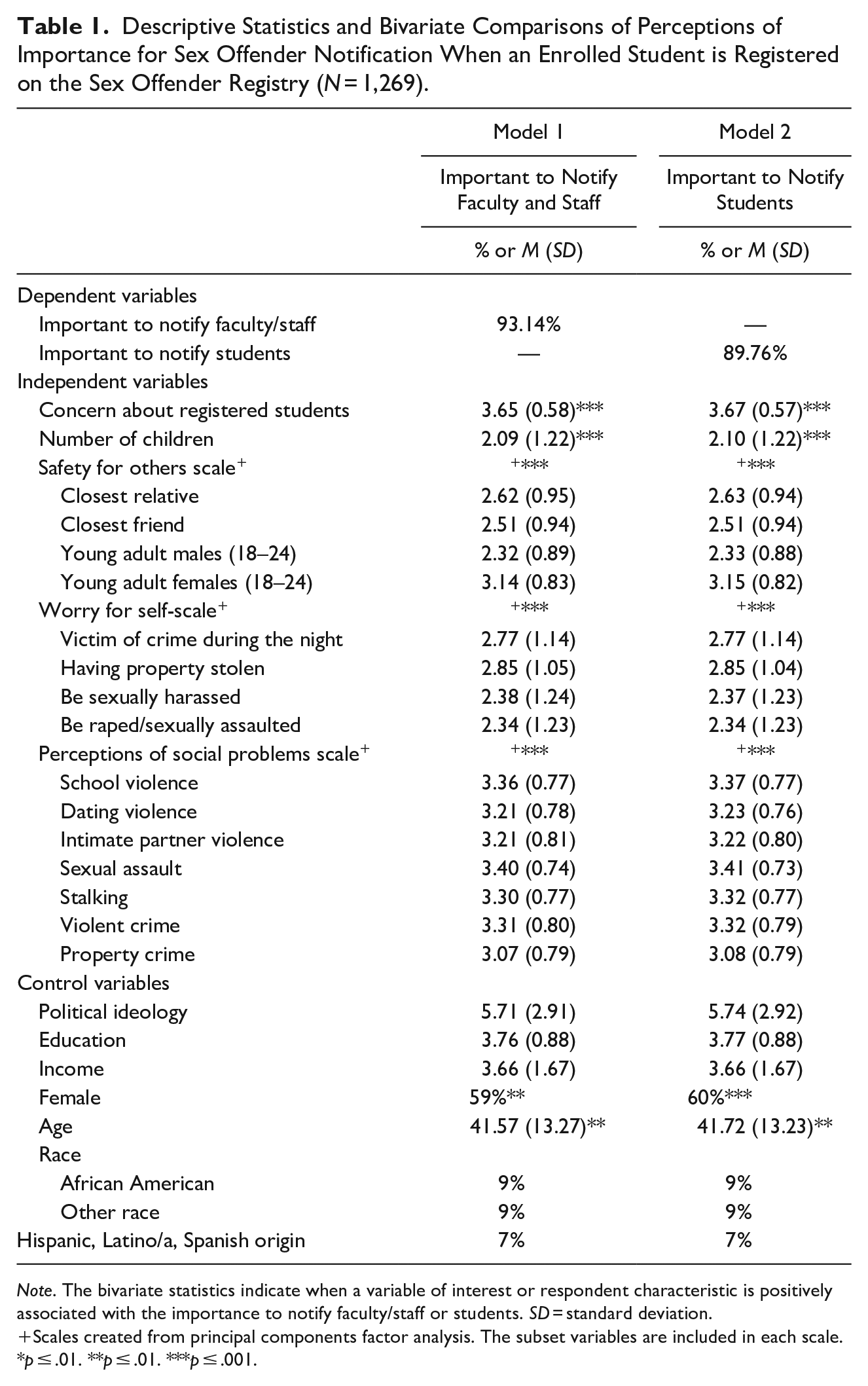
Note. The bivariate statistics indicate when a variable of interest or respondent characteristic is positively associated with the importance to notify faculty/staff or students. SD = standard deviation.
Scales created from principal components factor analysis. The subset variables are included in each scale.
p ≤ .01. **p ≤ .01. ***p ≤ .001.
Findings
Description of Respondents
As typical with public opinion surveys, some sociodemographic groups are over- or under-represented, although MTurk samples do produce more robust samples compared to other sampling strategies (e.g., college student convenience samples; Casler et al., 2013; Gerlich et al., 2018; Peterson, 2001). When compared to 2010 U.S. Census data, in this sample, there are more female respondents (58% vs. 51%) compared to the general population (U.S. Census Bureau, 2011). The median age in the United States during the 2010 census was 37 years old (U.S. Census Bureau, 2011). This sample’s median age is approximately 41 years old. Approximately 82% of the sample is White (vs. 72%), 9% Black (vs. 13%), 19% “Other” (vs. 6%), and 7% Hispanic (vs. 16%; U.S. Census Bureau, 2013). About 47% of the sample do not have children while the remaining 53% are parents of one or more child. In regard to education level, about 8% of the respondents have either some high school or are a high school graduate and about 92% of the sample has had some college up to earning an advanced terminal degree. While our educational categories do not perfectly align with the categories provided by the U.S. Census Bureau, census data indicate 58.9% of adults had some college or more (U.S. Census Bureau, 2016); hence, our sample has more educational attainment compared, roughly, to the general population.
Bivariate Relationships
Bivariate statistics helped to explore initial relationships, although there is the possibility of omitted variable bias. With that said, the same variables flagged as significant in Model 1 and Model 2 which indicated increased odds that respondents felt it would be important to notify faculty and staff and to notify students that there is an enrolled student registered on the sex offender registry: respondent concern if a student attending a college or university was registered on the sex offender registry (p < .001), the number of children (proxy for parent; p < .001), if the respondent was worried about the safety of others (altruistic fear; p < .001), if the respondent was worried about their own crime victimization (personal fear; p < .001), if the respondent felt social problems are worse now compared to 10 years ago (p < .001), if the respondent was female (faculty and staff notification, p < .01; student notification, p < .001), and age (p < .01). Next, we turn to the multivariate logistic regression results.
The Full Models
Notifying faculty and staff
Three variables predicted an increase in the odds that respondents thought it would be important to notify faculty and staff that an enrolled student was registered on the sex offender registry while holding all other variables constant: concern about a student attending a college or university being a registrant, the number of children, and perceptions about social problems being worse now compared to 10 years ago. Most prominent was the influence of concern about registered individuals attending college. As this concern increased, the odds increased by roughly 285% respondents felt it was important to alert faculty and staff a registered student was enrolled at the college/university, holding all other variables constant (95% CI [1.00, 1.69], p < .001). As the number of children increased for respondents, a proxy for parental status, the odds increased by about 68% respondents felt it was important to alert faculty and staff that a registered student was enrolled at the college/university, holding all other variables constant (95% CI [0.23, 0.80], p < .001). Respondents who felt social problems were worse now compared to 10 years ago also increased the odds that they felt it was important to alert faculty and staff to the presence of students who were on the sex offender registry, holding all other variables constant (percent change in odds = 44.7%, 95% CI [0.09, 0.64], p < .01).
One variable predicted a decrease in the odds of respondents finding it important to alert faculty and staff about a registered student: education. As respondents became more educated (i.e., for each unit increase in education level), the odds decreased by approximately 32% that respondents felt it was important to notify faculty and staff that an enrolled student was registered, holding all other variables constant (95% CI [−0.71, −0.07], p < .05; Table 2).
Multivariate Logistic Regression Predicting Perceptions of Importance for Sex Offender Notification when an Enrolled Student is Registered on the Sex Offender Registry (N = 1,269).
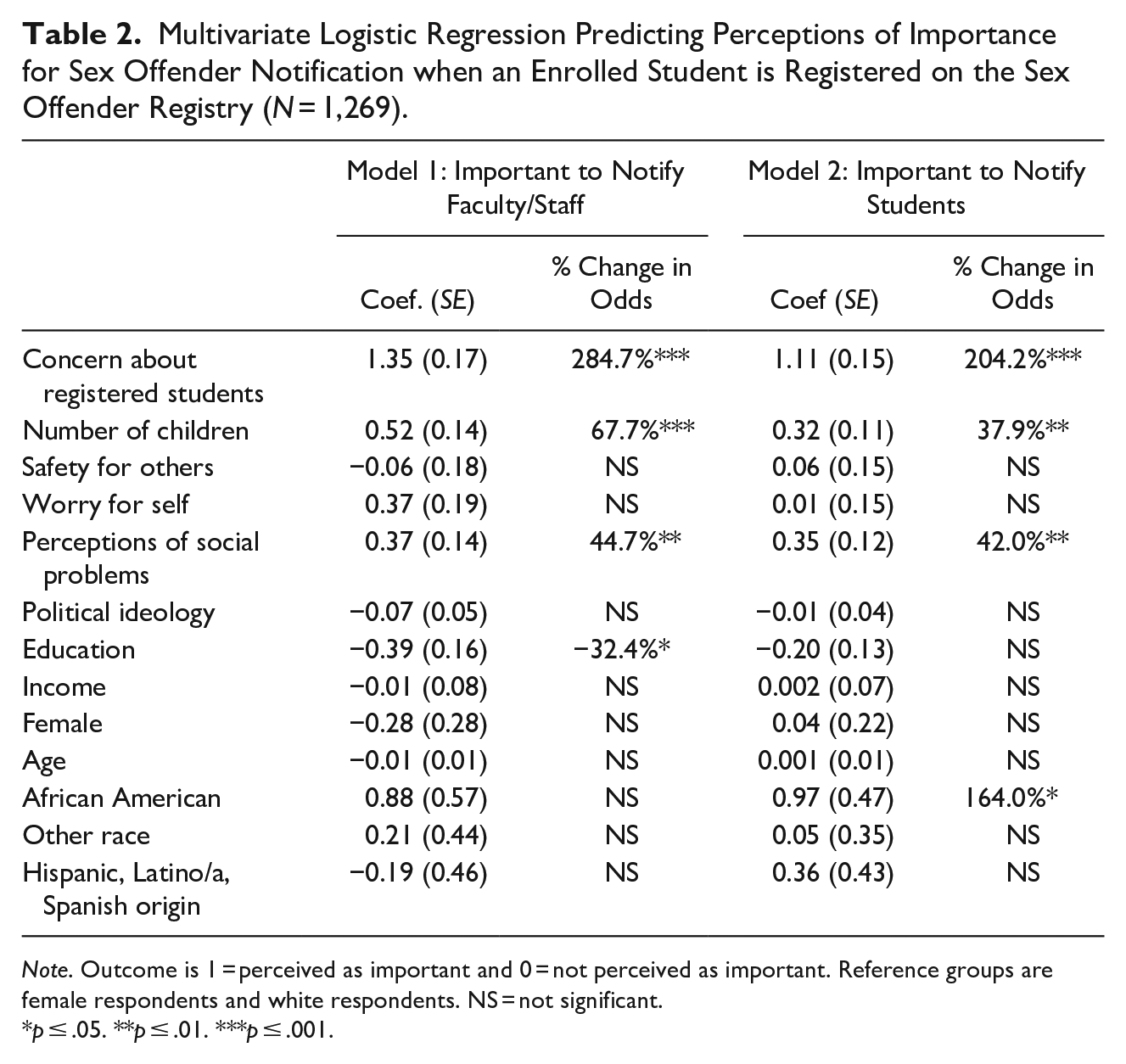
Note. Outcome is 1 = perceived as important and 0 = not perceived as important. Reference groups are female respondents and white respondents. NS = not significant.
p ≤ .05. **p ≤ .01. ***p ≤ .001.
Notifying students
Four variables predicted an increase in the odds that respondents thought it would be important to notify students that an enrolled student was registered on the sex offender registry while holding all other variables constant: concern about a student attending a college or university being a registrant, the number of children, perceptions about social problems being worse now compared to 10 years ago, and being an African American respondent (compared to Caucasian). Again, we find the most prominent was the influence of concern about registered individuals attending college. As this concern increased, the odds increased by roughly 204% respondents felt it was important to alert students a registered student was enrolled at the college/university, holding all other variables constant (95% CI [0.83, 1.40], p < .001). As the number of children increased for respondents, the odds increased by about 38% that respondents felt it was important to alert faculty and staff a registered student was enrolled at the college/university, holding all other variables constant (95% CI [0.11, 0.54], p < .01). For respondents who felt social problems were worse now compared to 10 years ago, the odds increased by 42% (95% CI [0.12, 0.58], p < .01) that it was important to alert students to the presence of students who were on the sex offender registry, holding all other variables constant. Last, if a respondent was African American, the odds increased by 164% (95% CI [0.05, 1.88], p < .05) that they felt it was important to notify students of a registrant, holding all other variables constant.
Discussion
This study contributes to extant scholarship centered on understanding public perceptions of SORN, particularly the prong of notification. First, it extends the focus of prior investigations by tapping the general public’s views concerning notification as it applies to IHE (e.g., Garland et al., 2018). Second, there are new findings about public views concerning whether it is important that faculty/staff or students be notified about the presence of an enrolled student who is also on the sex offender registry. With that said, the vast majority of the sample thought there was some level of importance to alerting faculty and staff and also to alerting students that a registered student was on campus. Perhaps this corresponds to what might be considered a “knee-jerk” reaction to support an additional sex offense policy based on public myths and misperceptions of sex offenses (e.g., stranger-danger, high recidivism; Budd & Mancini, 2016). As we will discuss below, while there may be public support for such strategies to combat the commission of repeat sex crimes, those strategies are not without their consequences nor may they be in the best interest of public safety. First, we turn to the findings from our research.
Prior work shows that fear and concern about crime, especially those of a sexual nature—are factors associated with greater support for surveillance and notification measures for registrants in general (Comartin et al., 2009; Kernsmith et al., 2009). This research contributes to that line of work, because perceptions of the importance for notifying faculty and staff and notifying students was highest among respondents expressing concern about a student attending a college or university who was also registered on the sex offender registry. While this work is unable to speak directly to why there are these high levels of concern, we do know there are still many myths circulating about persons who sexually offend (e.g., high recidivism, stranger danger, untreatable; Galeste et al., 2012; Quinn et al., 2004). Buying in to myths has also been show to increase support for sex crime laws (Budd & Mancini, 2016; Pickett et al., 2013). Hence, such myths may be in part shaping respondent’s level of concern and by extension their support of campus community notification.
We find whether or not a respondent has children, and how many children, matters which echoes prior research assessing support for sex crime law and policy when applied to communities. Hence, being a parent and having one or more children continues to find support, as theoretically expected, to increase the odds of favoring policy responses designed to address sex crimes (Harris & Cudmore, 2018; Mancini et al., 2010). Given the safety concerns parents have about sending their children to college, in conjunction with parents being more likely to take protective actions for their children (vs. themselves) when notified about a person on the sex offender registry, it makes sense that parents would find it important to alert both faculty/staff and students that there is a registered student on campus (Bandy, 2011; Budd & Mancini, 2016; Koon-Magnin, 2015; Sells, 2002; Turrentine et al., 2000). This is the second study that also finds support that number of children matters (see Mancini et al., 2010); in short, there is an accumulation effect for each additional child pertaining to community members finding it important to have campus community notification.
In the same direction, our findings accord with extant scholarship demonstrating support for the “scary world” hypothesis—namely that perceiving worsening social conditions amplifies support for a range of punitive measures, especially those aimed at increasing state oversight and monitoring (King & Maruna, 2009; Tyler & Boeckmann, 1997). We theorize that support among these groups extend to the college context because respondents may view students—most of whom are adults—still as vulnerable and in need of protection and monitoring, and this belief is particularly influential for respondents who view larger social conditions are worsening. For example, traditionally aged first-year students are still quite young (e.g., 18), may be away from parents for the first time, and may be more willing to experiment and engage in risky behaviors in college. In addition, while future work should include a media measure, there is the potential that media coverage, including coverage of campus crime (e.g., Sloan & Fisher, 2010), influenced respondent’s perceptions of social problems, which, in turn, influenced perceptions of importance for campus community notification. Generally, this finding supports including such measures that have been suggested to influence opinions on responses to social problems (Warr, 1984; Warr & Ellison, 2000). Hence, perceiving social problems to be worse now compared to 10 years ago did influence respondent’s perceptions of the importance for campus community notification.
With student notification, African American respondents were more likely to find notifying students of another registered student important. While we lack the intervening factors to explore why African American respondents felt notification for students was important for students but not among faculty and staff, we speculate, based on prior scholarship, that it may be due to generalized mistrust toward official university responses (which faculty and staff represent) to address sexual assault. For example, minority students and other marginalized groups tend to express skepticism about official administrative interventions (e.g., mandatory reporting policies) to address sexual victimization (Brubaker, 2019). Accordingly, African American respondents may be better sensitized to the unintended effects of institutional policies designed to assist victims and survivors, relative to their White counterparts, and so would not prioritize notification among official representatives of the institution—faculty/staff. At the same time, racial and ethnic minorities are at higher risk for experiencing sexual assault while attending college (Krebs et al., 2011; Lindquist et al., 2016; Porter & Williams, 2011). Thus, Black residents might recognize the value of arming students with knowledge about potential threats to their safety, and so for this reason, would judge notification as important to pursue under that condition. Still, these expectations are speculative and so for this reason, future work should further distill these race findings.
Relatedly, the effect of educational attainment is not so easily explained as it was associated with a reduced likelihood of believing notification was important for faculty and staff, whereas no impact was observed in the models examining student notification. In the sex crime literature, generally, higher educational attainment has been associated with more positive attitudes toward registrants (Shackley et al., 2014) and reduced support for sex crime initiatives—including SORN (Comartin et al., 2009). From this prism then, perhaps respondents with more education were aware of the potential drawbacks of sex crime reforms. It follows then those educated individuals may see notification as problematic when it applies to university employees given the potential for labeling or discrimination to occur. Future scholarship should follow the lead of other studies (e.g., Harris & Cudmore, 2018) by teasing out the specific reasons why individuals might not view notification as an important policy to pursue to prevent sexual victimization.
Limitations
First, the research question asked how important it would be to alert faculty/staff or students if an enrolled student on campus is registered on the sex offender registry. The survey question did not specify the type of alert (e.g., campus town hall meeting, an emailed school safety bulletin). Hence, this research cannot speak to perceptions of importance based on the type of alert, although this is an avenue for future research (e.g., alerts to directly affected classmates vs. a general alert to the entire campus community). Second, we did not have certain measures to further investigate some of the findings that are not so easily explained. It is not entirely clear why African Americans would be more likely to support student notification but not notification among faculty and staff or why educational attainment was not a consistent predictor of views. In addition, we know that myth buy-in and media consumption can influence policy responses but those measures were not available in the data. At the same time, the study was cross-sectional in nature so we are unable to evaluate whether public preferences may change over time or are influenced by highly publicized cases or incidents of high-profile sex crimes involving college students. Finally, the study relied on data collected through the MTurk survey platform, an increasingly popular method to test hypotheses about crime control preferences, particularly involving CSA (Holland et al., 2021). Research has demonstrated that MTurk samples do lack diversity (Levay et al., 2016). Therefore, due to this, the reliance on MTurk data may limit the generalizability of our findings to a wider population (e.g., Graham et al., 2021) and should be replicated with more diverse samples.
Policy Implications
While well intentioned, notification policies in the United States as applied to the general registrant population have been critiqued on many fronts. For example, notification has been linked to higher levels of fear of crime and emotional distress among those who access and view the registries or who have been notified of registrants living in close proximity (Beck & Travis, 2004; Caputo & Brodsky, 2004; generally, Comartin et al., 2009). We hypothesize this fear and distress would be more so pronounced in the United States where the public can freely access the registry for “notification purposes” versus other countries around the world where access to the registry is often restricted from public use (e.g., in Germany the registry is not public and only the police department where the registrant resides may access the information) and/or more cumbersome in terms of public use (e.g., in Nigeria the public can freely search convicted sex crime cases but there is a monetary fee to search reported or arraigned sex crime cases; Library of Congress, 2022). Even more problematic is the observation that such fear serves little practical purpose as notification is not linked with a decline in reports of sex offenses, particularly among individuals with known criminal histories (Agan, 2011). The lack of efficacy may be due to the tendency for most of the public, even after learning about registrants living nearby, to not engage in protective behaviors that would presumably reduce the likelihood of sexual victimization (e.g., installing additional locks, talking to children about registrants) (Harris & Cudmore, 2018).
Moreover, there are well-documented collateral consequences of being a registrant on a publicly accessible registry (e.g., losing a job and/or housing, losing friends and/or partners/spouses, harassment, stigma), including complications in obtaining higher education (Frenzel et al., 2014). Tewksbury (2013) found that students who were on IHE-specific registries reported social isolation to avoid identification (e.g., not participating in activities on campus) and feeling vulnerable (e.g., about being confronted). Their one safe place was the classroom where these students felt like they could let down their guard and engage (Tewksbury, 2013). If faculty and staff and/or students were notified about a classmate who was a registrant, this may make these students feel like the classroom is no longer a safe place and cause them to disengage in learning. Given these consequences, one should consider how SORN, and notification in particular, would affect students on campus who are registered. This is particularly important as education is a pro-social tool that may help promote successful reintegration and reduce recidivism. For example, research supports the role of education in reducing crime when incarcerated persons receive education and earn a college degree (Kim & Clark, 2013).
In addition, the sheer volume of individuals who are required to abide by community notification may dilute any perceived value of awareness as the public could become overwhelmed in assessing the extent to which specific registrants represent a threat to their safety (Tewksbury & Jennings, 2010). This may be an especially important consideration in the college context given that sexual assault tends to involve other students who have no prior official history of committing sexual assault (e.g., Moore & Baker, 2018; Sinozich & Langton, 2014) and so, would not be privy to notification. This leads to the question of how effective such measures would be in preventing sexual victimization while attending college.
All of this context is critical for guiding future policy discussions about the application of notification to IHE. To be clear, policymakers and university administrations are in a tough spot when it comes to addressing sexual violence. On the one hand, the public supports a range of initiatives to address sexual victimization when students attend college, including strengthening reporting procedures, such as policies that require faculty and staff to report student disclosures of sexual victimization (Streng & Kamimura, 2017). Moreover, in the wake of high-profile campus sex crime scandals, particularly those that have emphasized administrative “cover-ups,” Americans now expect institutional accountability (Mancini et al., 2019). On the other hand, post-secondary institutions must provide a safe and equitable learning environment for all members of the university community, even those with who have perpetrated sex crimes in the past (Noreika, 2017).
Notably, the Campus Sex Crimes Prevention Act, enacted in 2000, requires that registrants notify post-secondary institutions upon their enrollment. The Act also mandates that schools share where interested parties can find information about registrants (e.g., a state registry website; Tewksbury & Lees, 2006). While it is currently unknown how many universities and colleges use some type of active campus notification strategy, which would be an informative line of inquiry for future research, there have been calls for colleges to adopt more stringent notification procedures, notifying all students about the presence of specific registrants on campus (Noreika, 2017). Accordingly, it is not surprising then that a range of new initiatives—including efforts to arm university members with information about potential threats—are currently on the table. As our study indicates, while most of the public perceives the utility of such measures, there is substantial variation across views—with “extracurricular” factors, such as fear and concern about larger social issues—driving the more positive impressions of such measures. While public views about sex crime policy are important to examine and explore (Budd & Mancini, 2016), such perceptions should not determine the adoption of large-scale reforms, particularly those that affect post-secondary institutions. This means policymakers—as gatekeepers of information and protectors of the entire university community—should carefully consider the potential negative impacts of expanding notification to higher education against any presumed benefits.
Footnotes
Author’s Note
Kristen M. Budd is now affiliated to The Sentencing Project, Washington, DC, USA.
Declaration of Conflicting Interests
The authors declared no potential conflicts of interests with respect to the authorship and/or publication of this article.
Funding
The author(s) disclosed receipt of the following financial support for the research, authorship, and/or publication of this article: We would like to thank Miami University for their financial support to conduct this research via an Undergraduate Research Award.
