



Abstract
There has been a growth of domestic violence courts aimed at increasing offender accountability and victim safety. Although research has examined the effectiveness of these courts compared to typical court processing on recidivism, little is known about the mechanism of judicial accountability. Specifically, judicial review hearings, in which judges have discretion on whether and how to sanction for noncompliance, are common in these courts. This study examines whether incarceration sanctions for noncompliance affect recidivism among a sample of 347 probation review hearings in a Midwestern domestic violence court. Using logistic regression and survival analysis, we find that jail sanctions do not impact likelihood of recidivating but do result in significantly shorter periods of time until recidivating. The findings also signify the importance of addressing substance abuse issues in the prevention of recidivism. Further implications of the findings are discussed.
Domestic violence (also known as intimate partner violence [IPV]) has been recognized as a serious social and public health issue. Domestic violence encompasses violence within intimate relationships (e.g., marital, partners, former partners) that includes physical, emotional, sexual, and financial abuse. Over the course of the past 40 years, the criminal justice system has worked to find the best responses to deter IPV. Many of the first critical justice system changes began in the 1980s with policing efforts, such as mandatory arrest (e.g., Sherman & Berk, 1984). Since the 1990s, more attention has been focused on criminal courts, with many jurisdictions establishing domestic violence courts and judicial monitoring (e.g., Gover et al., 2003). 1 In fact, the number of domestic violence courts grew to over 300 by 2012 (Strong et al., 2016). Similar to other problem-solving courts, these courts typically involve ongoing court appearances before a judge to review compliance with treatment participation and supervision restrictions (Labriola et al., 2005). If offenders violate the terms of their supervision or fail to attend a mandated program, the judge can determine them to be noncompliant, which triggers a host of sanctions available to judges including verbal reprimand, increased court appearances, short jail stays, or revocation from the program (Rempel et al., 2008). This judicial oversight allows for swift and certain punishments for noncompliance and may encourage treatment program completion (see Labriola et al., 2005; Taxman, 2002).
While previous examinations have been conducted on the effectiveness of judicial monitoring for cases involving IPV (e.g., Cissner et al., 2015; Rempel et al., 2008), programs vary greatly by jurisdiction, and no studies to date have examined the effectiveness of jail sanctions on recidivism. Therefore, it is imperative that more studies are conducted to determine which aspects of programs are most effective to inform best practices that can be widely adapted across jurisdictions. Additionally, it is important to consider what offender and offense characteristics are correlated with recidivism. The current study contributes to this objective by providing an examination of the impact of sanctioning for noncompliance on recidivism rates for participants in a domestic violence court in Milwaukee County, Wisconsin who were on probation.
Literature Review
Domestic violence courts have been established as potentially more effective in responding to the unique challenges IPV offenses present to the criminal justice system. As a type of problem-solving court, these courts rely on therapeutic jurisprudence in their goals of rehabilitation, offender accountability, and victim safety (Buzawa & Buzawa, 2003; Worrall, 2008). These courts have separate court calendars, dedicated judges, and the ability to monitor offenders through treatment programing (Golestani et al., 2021; Jeffries & Bond, 2013). Additionally, they often are paired with local IPV service providers to enhance victim safety and advocacy (Cissner et al., 2013). Although most problem-solving courts utilize more frequent meetings with defendants, such as weekly staffing with team members (e.g., case managers, treatment providers, attorneys, judges), to determine treatment progress and compliance with court conditions, some domestic violence courts process defendants similarly to traditional courts. In this setting, judges rely on probation for most offenders—requiring batterer intervention programming (BIP) and other individualized conditions (Healey et al., 1998; Worrall, 2008). To ensure offender accountability, these courts often utilize review hearings (i.e., judicial oversight) to track progress and compliance (Labriola et al., 2005). Probationers who are noncompliant face the threat of verbal reprimand as well as the threat of jail time. 2
Research on the effectiveness of these courts has largely focused on comparing recidivism rates of those sentenced in a domestic violence court with those sentenced in a traditional court. In general, the literature is mixed on the effectiveness of these courts. While studies have found a decrease in recidivism for defendants processed in domestic violence courts, compared to those processed in traditional courts (Cissner et al., 2015; Gover et al., 2003; Gutierrez et al., 2016; Harrell et al., 2006), others have found no difference in recidivism between the two groups (Visher et al., 2008). Further, one study found that while recidivism decreased for those processed through domestic violence courts, probationers in this court had higher rates of revocation compared to those on probation in traditional courts (Harrell et al., 2006), and one study found an increase in recidivism for those processed in the specialty court (Peterson, 2004). Peterson (2004) suggested that this finding was due to increased oversight, therefore, increasing detection of new offenses. Research into best practices demonstrates that courts with risk-needs-responsivity principles are more likely to be effective at reducing recidivism (see Cissner & Hauser, 2021; Guiterrez et al., 2016).
Judicial Court Monitoring and Recidivism
No previous research has examined how sanctions imposed while in the domestic court impact later rates of recidivism, yet there is some evidence from drug treatment courts that jail sanctions may increase recidivism. Shannon et al. (2016) examined defendant and processing factors in a drug treatment court and found that participants who were given a jail sanction for noncompliance were more likely to recidivate than those who were not sanctioned in this manner. Other research, however, finds no relationship between jail sanctions and recidivism in drug treatment courts (Sheeran & Heideman, 2021), or more importantly, the incenstives should be used more than sanctions to facilitate compliance (e.g., Wodahl et al., 2011). Although there is no prior research on this aspect of processing in domestic violence courts, several studies have examined the use and frequency of judicial monitoring on recidivism. It should be noted, however, that not all domestic violence courts engage in routine monitoring, and of those that do, there is variation in frequency (see Rempel et al., 2008).
Evidence supporting the notion that judicial monitoring in these courts is effective in reducing recidivism comes from Cissner et al. (2015). In their multisite study in New York State, the authors examined the impact of judicial monitoring and sanction philosophy in 24 criminal domestic violence courts. The results provided insight into characteristics of the most successful domestic violence courts. Courts that focused on victim safety, rehabilitation, offender accountability, and deterrence were more successful. In particular, courts that emphasized accountability through a sanction schedule, sanctioning all noncompliance, and/or utilizing more punitive sanctions tended to have lower recidivism rates. Yet they also found that factors associated with judicial monitoring (e.g., judges’ activities and statements during these hearings, scheduling of review sessions) had no impact on recidivism.
However, not all studies in the context of domestic violence courts have found monitoring to be effective. For instance, Rempel et al. (2008) found that those mandated to judicial monitoring did not have significantly different odds of reoffending nor did these individuals significantly differ in time until rearrest when compared to those not mandated to judicial monitoring. Individuals who were mandated to judicial monitoring did, however, have significantly fewer rearrests than those not monitored. Similarly, Labriola et al. (2005) found no difference across frequency of monitoring (i.e., monthly versus graduated) or combining monitoring with required BIP programming on the likelihood of rearrest or time until rearrest. Taken together, the literature presents a mixed picture when it comes to the effectiveness of monitoring in domestic violence courts, as no studies found a direct impact of monitoring on recidivism, yet one study found that program policies regarding sanctions did impact recidivism.
Defendant Characteristics and Recidivism
Additional research has explored the possibility that defendant and case factors may impact recidivism rates. Age has most consistently been found to be a significant predictor of rearrest in previous studies, with older offenders less likely to recidivate than younger offenders (Collins et al., 2021; Fowler et al., 2016; Gross et al., 2000; Labriola et al., 2005; Lauch et al., 2017; Rempel et al., 2008). Other defendant characteristics such as race and sex have produced more mixed findings. Gross et al. (2000) found that non-White offenders had higher rates of recidivism than White offenders. Lauch et al. (2017) also found that Black defendants were more likely to recidivate than White defendants. Other studies, however, did not find race to be a significant predictor of recidivism (e.g., Collins et al., 2021; Fowler et al., 2016). It may be that studies finding racial differences in recidivism are due to systemic racism present in the criminal legal system (see Rapping, 2013). While many studies are limited to examining only men defendants (e.g., Fowler et al., 2016), those that did include women have typically found that men are significantly more likely to recidivate than women (Collins et al., 2021). It is important to note, however, that women are more likely to be IPV survivors than involved in the criminal courts as perpetrators.
Similar to other recidivism studies, more prior offenses have often been found to be significantly related to higher levels of recidivism (Collins et al., 2021; Fowler et al., 2016; Gross et al., 2000; Labriola et al., 2005; Ventura & Davis, 2005), as well as current offense severity (Labriola et al., 2005). Substance use has also been linked to higher rates of recidivism (Bennett et al., 2007; Petrucci, 2010), while completion of treatment programs has been associated with lower recidivism rates (Bennett et al., 2007; Petrucci, 2010). One study to date has examined the influence of various forms of noncompliance on recidivism in domestic violence courts. Kindness et al. (2009) found defendants who were arrested for more than one new crime pre-adjudication were more likely to recidivate 1 year after sentencing. No significant differences were found, however, when examining treatment noncompliance or other aspects of court-ordered noncompliance on recidivism.
Current Study
The purpose of this study is to examine the impact of jail sanctions in domestic violence courts that utilize judicial monitoring on recidivism. Several studies have been conducted to determine whether domestic violence courts are effective at reducing recidivism, as well as the impact of judicial monitoring with mixed results. Some of this may be due to wide variation in practices and policies of these courts, while little is known about the impact of jail sanctions for noncompliance on recidivism. Given the limited body of literature on secondary preventative interventions, it is imperative to examine whether punitive practices (e.g., sanctions) in these types of courts has an impact on recidivism. Drawing on findings from drug courts on this specific issue (e.g., Shannon et al., 2016), we examine the following hypothesis: Participants on probation in a domestic violence court who were sanctioned for noncompliance will be more likely to recidivate than those who were not sanctioned for their noncompliance. The current study utilizes data from an urban Midwestern domestic violence court in 2016 to address this issue, as well as participant and case factors that are associated with recidivism. The findings will be connected to the broader implications of judicial monitoring in these courts to further inform the creation of best practices in responding to IPV.
Methods
Sample and Data Sources
This study utilizes data from a sample of probation review hearings in three domestic violence courts in a large, Midwestern County from April through September 2016 as part of a larger mixed-methods study. Most defendants processed through these courts are men (~90%), with 67% of defendants Black, 24% White, and approximately 8% Hispanic (Freiburger, 2018). In terms of racial representation, Black defendants are over-represented compared to county racial makeup (~27%), while White defendants are underrepresented (~54%) (US Census Bureau, n.d.). In these domestic violence courts, cases are processed similar to traditional courts with the exception of utilizing probation for most of the convicted defendants as a mechanism to require treatment such as BIP and any other aspects identified from individual risks and needs. All probationers are required to have a judicial review hearing 60 days after sentencing to increase offender accountability and victim safety (Buzawa & Buzawa, 2003). Judges sometimes require additional review hearings for probationers who are partially compliant to track improvement with compliance. All cases in which the probationer had at least one technical violation were included in the sample (n = 350), given that sanctions are only given to those who were at least partially noncompliant. Because there were too few “Other” race probationers (n = 3) in the sample, we excluded them from the analysis (n = 347).
We collected data from three sources to examine sanctioning decisions for noncompliance and recidivism, as part of a larger mixed methods study on sanctioning decisions for noncompliance. 3 This quantitative study examines an additional avenue of inquiry into the effect of sanctions on recidivism. One author conducted participant observations for each hearing and recorded extensive field notes, including who was present at the hearings, compliance issues raised, and the sanction decision. This author then used these field notes to code many of the variables included in this study (e.g., all variables of noncompliance and sanctions).
Second, we collected additional data on case processing through matching probationer names and birthdates from the court docket. The docket was printed for the three judges presiding over the domestic violence courts for scheduled review hearing days, and the case number was used to collect probationer background data from the court record on a publicly available website. From this record, probationer birthdates were collected to search for prior record and recidivism on the court website (i.e., new charges, date of charges). Finally, we obtained police reports related to the incident (which were matched based on defendant name, birthdate, date of offense from the court record) via open records requests. The information collected from the police reports include additional information on the offence (e.g., weapon, victim injury). The first author completed test-retest reliability of a sample of 10 cases to ensure reliability, as one single researcher completed the coding from all data sources (r > .70; Maxfield, 2015).
Dependent Variable
We examine recidivism with two measures that were collected through the court record website. First, we examine whether probationers recidivated as a dichotomous variable (1 = yes, 0 = no). Recidivism in this study is defined as any new criminal charges filed within a 24-month period of the review hearing date, as is common in the recidivism literature (e.g., Shannon et al., 2018). Second, we examine the time until recidivism, as measured in the number of months until a new charge is filed from the date of the review hearing.
Independent Variables
The main variable of interest is whether probationers received a jail sanction for a technical violation at their review hearing. In this jurisdiction, judges would sentence domestic violence probationers to probation with condition time. This approach was a mechanism for judicial discretion during review hearings to ensure accountability through the threat of jail time. Therefore, we measure this as a dichotomous indicator (1 = short jail stay, 0 = verbal warning). Second, we included the number of days sanctioned to jail, as probationers who commit more technical violations are likely to receive longer jail sanctions than someone who commits one or two violations. We measured the number of days jailed (range 1–60) to address this issue. An additional variable of interest is the influence of drug or alcohol use while on probation. All probationers were required to maintain sobriety and were routinely required to submit drug/alcohol tests to demonstrate compliance. We measured drug and alcohol use as 1 coded as a positive drug test and 0 coded as a negative drug test. These variables were captured from review hearing observation field notes.
Additional control variables included probationer background factors and case seriousness. Probationer race, gender, and age were collected from court records. Race was a trichotomous variable with Black (=1) and Hispanic (=1) compared to White (=0). Men were coded as 1 and women as 0. The authors measured age as continuous (range 18–62). We also included a squared age term, given that research has demonstrated a curvilinear effect of age and crime (e.g., Golestani et al, 2021). Probationer prior record was measured in two ways and captured from court records. First, we included the number of prior violent convictions (range 0–4), and second, the number of prior felony convictions (range 0–7), which has been used in prior literature on domestic violence courts (e.g., Kingsnorth et al., 2001; Kingsnorth & MacIntosh, 2007). Finally, we included a measure of offense severity at conviction as a continuous measure from the offense and class severity of the state statues (range 1–8), with higher numbers indicating a more serious offense and was captured from court records. For example, a Level 3 corresponds to a Class A misdemeanor; Level 1 corresponds to Unclassified misdemeanor, while Level 8 corresponds to a Class F felony, or the highest serious case in the dataset.
Analytical Strategy
To examine the effects of sanctioning decisions on criminal recidivism, we utilized two different analytical procedures to answer two distinct, but related, questions. First, we ask which factors increase the likelihood of a new charge. Second, we ask which factors are associated with longer times to the first new charge. To address our first question, we used a logistic regression model to estimate the odds of being charged with a new criminal offense within the 2-year period. For the second question, we utilized a Cox proportional hazard model, which allows us to assess the time to the first new charge in the first 2 years after the review hearing. This model assumes no specific shape for the underlying survival function (Yamaguchi, 1991). 4
Results
Descriptive Statistics
Table 1 presents the descriptive summary of the key variables included in the analysis. As can be seen, most probationers did not face new charges (72.9%), and of those who did recidivate, the average number of months until new charges were filed was 10.95 months (SD = 10.47). It was less common for probationers to receive a jail sanction for technical violations (23.92%), with an average of 9.57 jailed days (SD = 13.03). Interestingly, although jail sanctions were less common among the sample, almost half of the probationers tested positive for drugs or alcohol (43.51%). Most probationers were men (82.71%) and Black (66.28%), followed by White (20.74%) and Hispanic (12.97%), with an average age of 32.26 years (SD = 9.67). Most probationers did not have prior violent convictions (M = 0.23, SD = 0.60) or prior felony convictions (M = 0.52, SD = 1.20), and the average severity at conviction was 2.85 (SD = 1.05) which corresponds roughly to a Class A Misdemeanor.
Descriptive Statistics.

Table 2 presents the proportion of probationers who received each type of sanction and the percentage of each group that was charged with a new offense. Of those who received a jail sanction, about 31% recidivated, while 26% of those who received verbal sanctions recidivated. Therefore, the majority of those who recidivated received a verbal sanction (about 72%), while only about 28% of those who recidivated received jail sanctions. It appears that there was little difference between groups of probationers on recidivism; however, a more detailed analysis follows.
Recidivism by Sanctioning.

Factors Associated With Likelihood of Recidivism
Table 3 presents the results of the logistic regression model examining whether sanctioning at review hearings impact probationers’ likelihoods of recidivism (Akaike Information Criteria (AIC) = 409.01). The results of our primary variable of interest, the use of jail sanctions, suggest that the use of jail sanctions did not impact the likelihood of recidivism. This finding was consistently null across a number of different model specifications. 5
Generalized Logistic Regression Results Predicting Recidivism.

Note. OR = odds ratio.
p < .05.
A few factors were found to impact recidivism odds. Drug and/or alcohol use while on probation had a statistically significant association with recidivism (odds ratio [OR] = 1.139). Additionally, probationers with a greater number of prior felony convictions were at increased odds of recidivism (OR = 1.053). This relationship is illustrated in Figure 1. All else equal, the probability of recidivism with 0 prior felonies was 0.243. One prior felony increased the probability to 0.296. The maximum value found in our data—seven—increased this likelihood to 0.61, a cumulative effect of 0.367. The results also indicated that of the probationers’ demographic characteristics, only gender was associated with the probability of recidivism, with men more likely than women to reoffend (OR = 1.196). Race/ethnicity, offense severity, and prior violent convictions did not significantly predict recidivism. 6
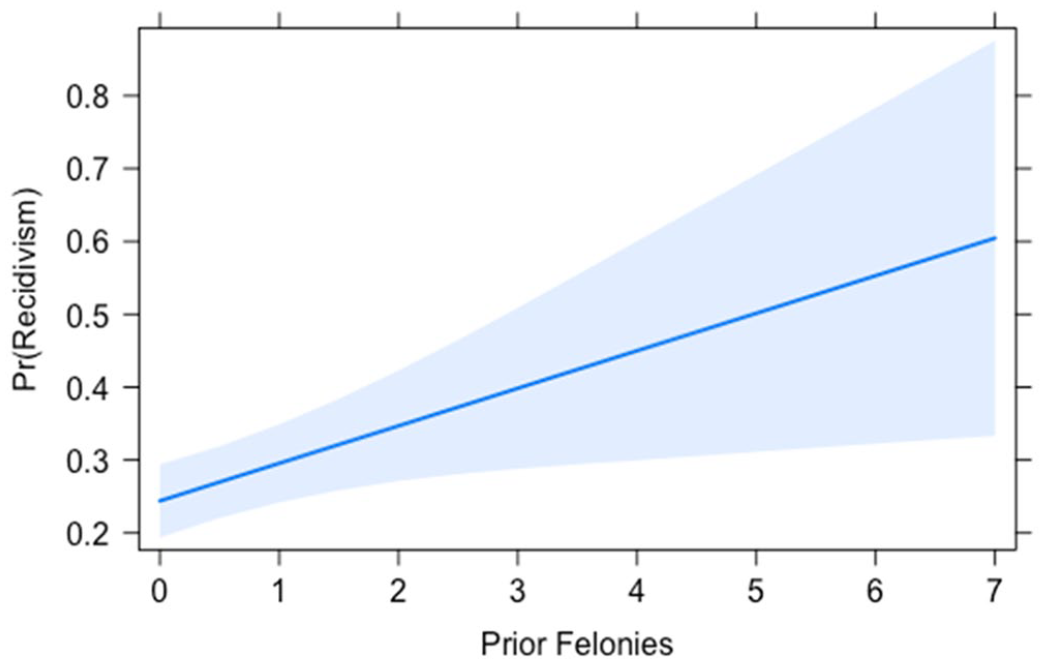
Probability of recidivism based upon number of prior felonies.
Factors Associated With Time Until Recidivism
Although it is important to examine whether recidivism occurs, another related question is the length of time until recidivism. We estimated the time to re-offense (measured in months) using a Cox proportional hazard model. Failure was measured as any new criminal charges filed within two years of the review hearing. Individuals who were not classified as reoffenders during the study period were right censored. The results, presented in Table 4, indicated that the recidivism rate of probationers was affected by several of the predictors in the model. For interpretability, we computed hazard ratios (HRs) by exponentiating the parameter estimates. The hazard rates and 95% confidence intervals derived from the model results in Table 4 are shown in Figure 2 and indicate the instantaneous rate of occurrence of the event (recidivism) for those who are still at risk of reoffending.
Cox Proportional Hazard Results of Time Until Recidivism.

Note. OR = odds ratio.
p < .05.

Recidivism hazard ratio based upon each variable.
While the use of jail sanctions did not have a statistically significant relationship with the likelihood of reoffending, it did have a significant and positive effect on the hazard of receiving a new charge (see Table 4). There was a 0.657 unit increase in the expected log of the relative hazard for individuals receiving jail sanctions as compared to those who receive verbal sanctions, holding all other predictors constant (HR = 1.929). In other words, the expected hazard was about 1.93 times greater for those who received jail sanctions as compared to those who received a verbal warning. By contrast, having positive drug tests did not significantly influence time until recidivism.
Similar to the findings from logistic regression, prior felonies significantly and positively affected the hazard of receiving a new charge. Therefore, probationers with a greater number of prior felonies reoffend at a faster rate than those with fewer prior felonies. The influence of other aspects of probationer background (e.g., race, gender, age), offense severity, and prior violent convictions did not significantly predict time until recidivism.
Discussion
This study seeks to examine whether jail sanctions for technical violations had an impact on recidivism for offenders processed through a domestic violence court that regularly uses judicial monitoring (i.e., review hearings) for accountability. The results demonstrate that there is no difference on the likelihood of recidivism between probationers who were jailed for noncompliance and those verbally warned; however, probationers who were jailed for noncompliance recidivated faster than their non-jailed (but still noncompliant) counterparts. Although we cannot discern whether this is due to individual behavior (i.e., propensity to violate court orders and laws) or prior decision making (i.e., judges’ sanctioning), it suggests that probationers who are sanctioned to jail for violating conditions of probation commit new offenses sooner than those who are not sanctioned.
These findings are somewhat consistent with the broader literature on domestic violence courts and monitoring. As Cissner et al. (2015) noted, courts that focus on offender accountability and rehabilitation are associated with lower recidivism rates than those that do not place emphasis on these goals. Much of the prior literature examines the influence of these courts on rearrest rates (e.g., Gover et al., 2003; Rempel et al., 2008), which may account for our divergent findings, as we examine new charges. Further, Rempel et al. (2008) found mixed effects when they examined the effect of judicial monitoring on recidivism—as they found no difference in the likelihood of and time until recidivism for those ordered to judicial monitoring compared to those not ordered, yet they also had fewer instances of recidivism. Our study, which focuses on a related aspect of monitoring—namely, the sanctioning of offenders who commit technical violations—suggests that holding offenders accountable via sanctions has limited impact on their offending trajectory. It also suggests that underlying risk and need factors (e.g., substance use disorders, unemployment, housing, and transportation fragility), which are associated with conditions of probation and offending (Norman et al., 2021; Zgoba et al., 2020), need to be adequately addressed within court-ordered services to better impact defendants.
Perhaps more important is probationers’ behaviors during the offense and while on probation, rather than monitoring as a mechanism to induce prosocial behavior. Petrucci (2010) examined rearrests of domestic violence offenders who were required to participate in five to seven judicial monitoring sessions. They found that not using drugs or alcohol increased the likelihood of successful completion of the court program, and offenders who used alcohol and drugs during the offense were rearrested faster than those who did not use substances. Our findings are similar, in that violating sobriety orders increased the odds of recidivism. Taken together, our findings suggest that underlying drug and alcohol abuse issues are associated with both noncompliance while under supervision (thus resulting in increased likelihood of sanctions) and recidivism (see Romain Dagenhardt, 2021). We do not have information on whether the offender was using drugs or alcohol at the time of the offense to fully parse out the direct influence of substance abuse, however, research has demonstrated its impact on the risk of domestic violence (Cafferky et al., 2018; Hirschel et al., 2010; Humphreys et al., 2005) and offending more broadly (e.g., Wilson et al., 2011). We also found no racial differences in the likelihood of, or time until, recidivism, which is consistent with prior research (e.g., Collins et al., 2021; Gover et al., 2003; Ventura & Davis, 2005).
Limitations and Future Research
Although this study is one of the first to examine sanctioning for noncompliance on recidivism, there are limitations. First, the sample size of 347 cases is somewhat small when utilizing survival analysis (Cohen, 1992). Future research should utilize larger sample sizes to more adequately examine the factors associated with recidivism, particularly related to conditions at the time of the offense (i.e., weapon use, inebriation). Second, recidivism is measured by new criminal charges, rather than victim reports. It is likely that recidivism in this study is underreporting domestic violence; future research should examine both victim reports and criminal justice system involvement measures to better understand how jail sanctions affect defendants and victims. Third, prior research has demonstrated a link between past trauma and IPV offending (Hilton et al., 2019), as well as past trauma and attrition from mandated programs such as BIP (Priester et al, 2019). This study did not have measures of trauma history; future research should examine whether higher adverse childhood experiences scores have an impact on noncompliance and recidivism.
Finally, this study examined recidivism of domestic violence offenders in one urban, Midwestern County. The results found here may not extend to courts in other jurisdictions, which likely have their own practices and requirements of offenders. The nature of review hearings in this jurisdiction is somewhat unique, as all domestic violence probationers receive at least one hearing. Other domestic violence courts do not utilize judicial monitoring, and some require routine interaction between defendants and judges to ensure compliance, similar to the models found in drug treatment courts (e.g., Petrucci, 2010; Rempel et al., 2008). Future research should examine the structure of judicial monitoring for its impact on compliance and recidivism to facilitate developing best practices in these courts.
Policy Implications
The results of this paper suggest that jail sanctions are associated with a faster time until recidivism. These findings add to scholarly and practitioner discussion of how to best serve IPV perpetrators in the criminal justice system. Recent literature argues that traditional approaches based on punishment, including the use of sanctions in these types of courts, do not promote accountability and healing for both victims and perpetrators (e.g., Decker et al., 2022; Miller & Iovanni, 2013). Therefore, we recommend domestic violence courts integrate restorative justice principles into their programming, which allow for victim empowerment and safety, while also creating spaces for perpetrators to learn empathy and take accountability.
Additionally, we found that positive drug tests while on probation are associated with an increased likelihood of recidivism. It is likely that those using substances while on probation were using them during the offense and is indicative of dependency. Given that substance use dependency is a risk factor for domestic violence, it is imperative that specialized domestic violence courts adopt a more treatment-focused approach to defendants that present with this issue (Humphreys et al., 2005; Hutchinson, 2003; Plant et al., 2002). Although some domestic violence courts are modeled similar to drug treatment courts, and may have increased focus on treatment, other courts may emphasize on accountability more strongly. Research has demonstrated that treatment is more effective at reducing substance use and recidivism than traditional punishments, such as jail sanctions, which may exacerbate other risks and needs, such as employment fragility (see, Lurigio, 2000; Prendergast et al., 2002; Wormith et al., 2007). Domestic violence courts often operate very differently than other problem-solving courts such as drug and OWI courts, yet they often involve offenders that have similar underlying risks and needs. Providing trainings and learning groups among judges involved in all types of problem-solving courts may be one way to develop best practices in reducing substance use for domestic violent offenders. Further, linking the domestic violence courts with the treatment providers contracted for the county drug treatment courts could assist judges in pursuing other options to problem-solve these issues.
Supplemental Material
sj-docx-1-jiv-10.1177_08862605221145708 – Supplemental material for Examining the Impact of Jail Sanctions on Recidivism for Domestic Violence Probationers
Supplemental material, sj-docx-1-jiv-10.1177_08862605221145708 for Examining the Impact of Jail Sanctions on Recidivism for Domestic Violence Probationers by Danielle M. Romain Dagenhardt, Amanda Heideman and Tina L. Freiburger in Journal of Interpersonal Violence
Footnotes
Data Availability
The data that support the findings of this study are available on request from the corresponding author. The data are not publicly available due to privacy or ethical restrictions.
Declaration of Conflicting Interests
The author(s) declared no potential conflicts of interests with respect to the authorship and/or publication of this article.
Funding
The author(s) received no financial support for the research and/or authorship of this article.
Ethical Approval
This study was approved by the University of Wisconsin—Milwaukee Institutional Review Board.

Supplemental Material
Supplemental material for this article is available online.
Notes
Author Biographies
References
Supplementary Material
Please find the following supplemental material available below.
For Open Access articles published under a Creative Commons License, all supplemental material carries the same license as the article it is associated with.
For non-Open Access articles published, all supplemental material carries a non-exclusive license, and permission requests for re-use of supplemental material or any part of supplemental material shall be sent directly to the copyright owner as specified in the copyright notice associated with the article.
