




Abstract
In the Netherlands, as in many other countries, victims of intentionally committed violent crimes may apply for state compensation if the offender is unknown or unable to pay for the damages of the crime. This state compensation scheme is run by the Dutch Violent Offences Compensation Fund (VOCF). Lawyers who work for this fund need to evaluate applicants´ eligibility for state compensation on the basis of two criteria: (1) the plausibility of the applicant’s victimization story and (2) the severity of the injury sustained by the applicant. Whether these criteria are fulfilled is largely left to the discretion of the lawyer who evaluates the application. This discretionary power makes the decision-making process prone to biased outcomes. Inspired by previous research, this study investigated whether information from mental health care providers, such as psychiatrists or clinical psychologists, serves as a potential source of bias. Although this type of information may or should sometimes be used to evaluate an applicant’s eligibility for compensation, in most cases it should not affect the outcome of this evaluation because of its potential unreliability. A statistical association between availability of information from mental health care providers and adjudication of state compensation is therefore not to be expected. Analyzing 246 applications submitted to the Dutch VOCF between July 1st 2016 and July 1st 2017, this study tested the empirical validity of this expectation. Results indicated that the availability of information of mental health care providers was associated with adjudication of state compensation. This finding was discussed in view of the literature on heuristic thinking and biased decision making and the study’s limitations.
Keywords
Introduction
Violent crime victims often experience severe physical and psychological harm. For example, it has been estimated that the prevalence of genital injury following rape and sexual assault lies between 50 and 90% (Sommers, 2007), and that between 10 and 25% of all violent crime victims develop a posttraumatic stress disorder (Kunst & Koster, 2017). Such adverse consequences are often associated with huge economic costs, such as payments for mental health services and income loss due to sick leave (Snijders et al., 2016), and may affect victims’ career prospects (Macmillan, 2001).
To deal with the consequences of crime, Western criminal justice systems used to focus on the punishment of offenders. However, since the 1960s, many of them have become more victim oriented (Groenhuijsen, 2014). This shift in focus from the offender to the victim is largely due to the influence of victim rights’ movements and has been accelerated by supra- and international legislation which has compelled national states to improve crime victims’ legal position in and outside the criminal justice system (Groenhuijsen, 2014). An important goal of this legislation is to ensure that crime victims are compensated for the damages they suffer, either by the offender who committed the crime, or by the state on whose territory the crime was committed (Groenhuijsen, 2008).
In the Netherlands, as in many other countries, state compensation serves as a last resort for victims of intentionally committed violent crimes who cannot get compensation from the offender or through any other means. According to the annual reports of the Dutch Violent Offences Compensation Fund (VOCF), 1 the number of victims who use this last resort option has increased from less than 1,000 in the late 1980s to more than 7,000 per year in the 2010s and early 2020s, while the total amount of adjudicated state compensation during this period has increased from less than €900.000 to around €16.000.000.
Nevertheless, still only 25% of violent crime victims actually apply for compensation from the Dutch VOCF (Van Leiden et al., 2016). Applicant proportions do not vary by sex, but the proportion of victims of physical or violent robbery is larger than the proportions of victims of other types of violence and the proportion of victims between 18 and 30 years old is larger than the proportions of victims belonging to other age categories (Van Leiden et al., 2016). 2
Lawyers who work for state compensation funds such as the Dutch VOCF have a lot of discretionary power when evaluating requests for state compensation. Although applicants are free to submit any kind of information that might support their application, VOCF lawyers often need to deal with a lack of information about the crime and its consequences when evaluating a request for state compensation. As a consequence they run the risk of letting legally irrelevant factors influence their decisions about adjudication or denial of state compensation (cf. Spears & Spohn, 1997). For example, they may base their decisions on their feelings of sympathy for the applicant (Kunst & Schiltkamp, 2019). If they consistently take such factors into account during the decision-making process, they may unintentionally create legal inequality between cases in which such factors are present and cases in which such factors are absent. However, to date, it is largely unknown which legally irrelevant factors Dutch VOCF lawyers take into account when evaluating requests for state compensation. It is of vital importance that this gap in the literature is addressed, because this can help Dutch VOCF lawyers to improve their decision-making practices and because it can help victims to get compensation from the Dutch state. This study focuses on one such factor in particular: availability of information from mental health care providers, such as psychiatrists or clinical psychologists. A recent qualitative but somewhat anecdotal study suggests that the availability of such information increases the likelihood of compensation adjudication (Huibers et al., 2019). Using file data from the Dutch VOCF, we verified the validity of this suggestion by statistically testing the association between availability of information from mental health care providers and state compensation adjudication/denial. We deemed this important, as using this type of information in the evaluation of state compensation eligibility is confined to exceptional circumstances. In this respect information from mental health care providers differs from other sources of information, whose use is not limited to particular cases.
Legal Framework
According to the Dutch VOCF Act, only intentionally committed violent crimes which have resulted in severe physical or psychological harm for the victim are eligible for state compensation (article 3 Dutch VOCF Act). To determine whether these requirements are fulfilled, two criteria need to be evaluated: (1) the plausibility of the applicant’s victimization story and (2) the severity of the injury sustained by the applicant. 3 According to the Dutch VOCF’s policy guidelines, the evaluation of the first criterion is primarily to be based on the crime report drawn up by the police. If the applicant did not report the crime to the police, then information from mental health care providers may be used to evaluate this criterion. If, on the other hand, the applicant did report the crime to the police, then information from mental health care providers should not be used to evaluate this criterion. Whether the second criterion is fulfilled, depends, according to the Dutch VOCF’s policy guidelines, on the type of violence committed. If the applicant has experienced a home robbery, a sexual offence, a direct threat with a knife or fire weapon, systematic domestic violence, human trafficking, stalking, or arson, then severe injury is presupposed. In these cases the fulfillment of this criterion is given and information from mental health care providers should therefore not be used to determine the fulfillment of this criterion. If, on the other hand, the applicant has experienced another type of violent crime, then compensation for psychological injuries can only be adjudicated on the basis of information from mental health care providers. In these cases VOCF lawyers should therefore use this type of information to evaluate the severity of sustained injuries.
The circumstances under which information from mental health care providers can and cannot play a role in decision making about state compensation adjudication/denial are summarized in Figure 1.
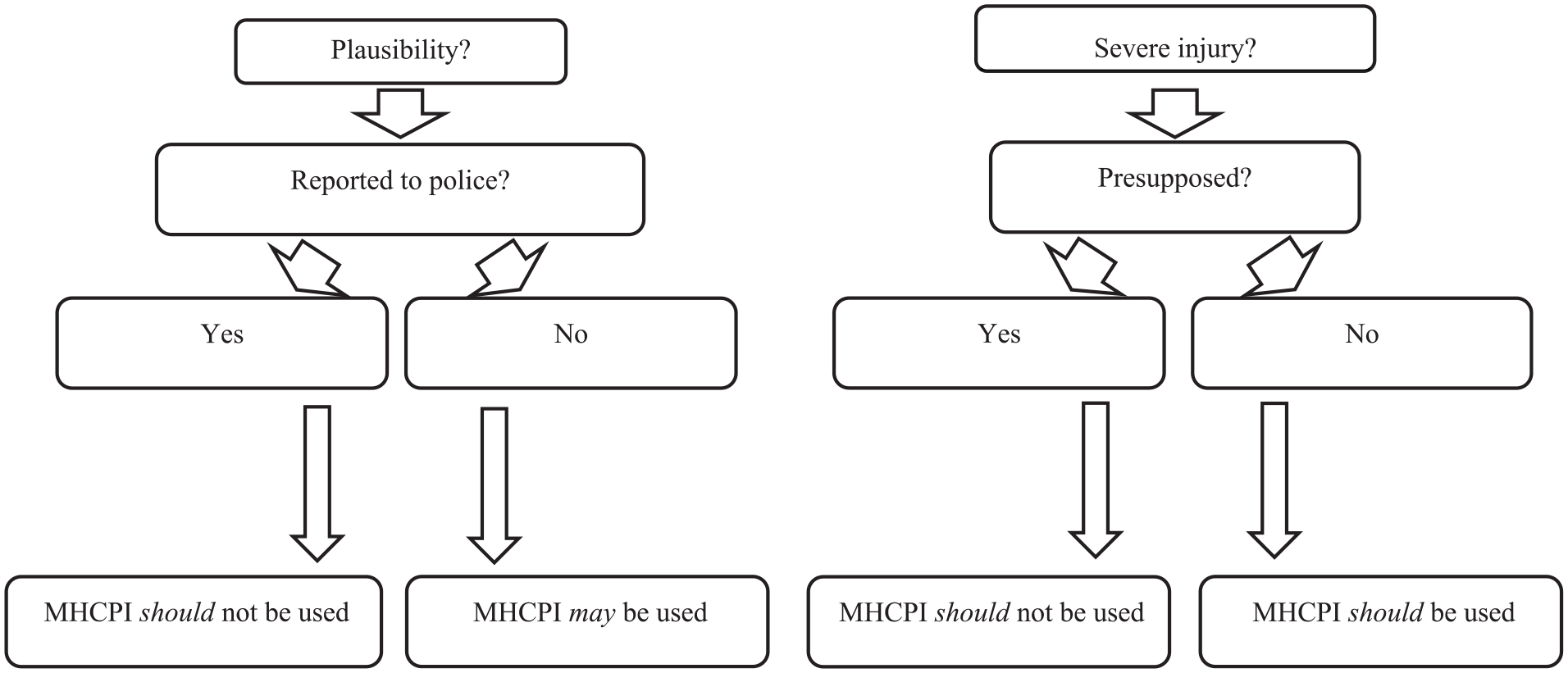
Dutch VOCF decision criteria and use of information from mental health care providers.
The proportion of cases in which the circumstances allow or require Dutch VOCF lawyers to use information from mental health care providers during the decision-making process is low. This is due to the fact that only in a minority of cases a police report is absent and severe injury cannot be presupposed. 4 It follows, that a statistical association between availability of information from mental health care providers and state compensation adjudication/denial is not to be expected. If such an association nevertheless exists, this should be reason for concern because information from mental health care providers may be unreliable, unless it is supported by independent psychological expert testimony. Its use in evaluating requests for state compensation should therefore remain the exception and should not be or not become the rule.
The Potential Unreliability of Information From Mental Health Care Providers
For three reasons, information from mental health care providers may be unreliable if it is not supported by independent psychological expert testimony. First, applicants may lie about the crime or its consequences for their mental health to increase the chance of a positive decision on their request for state compensation (Kunst & Winkel, 2015). Second, but related to the first reason, lying is rarely detected by mental health care providers, because they think most patients are honest (Rosenfeld, 2000), because questioning the patient’s sincerity does not fit with their professional role (Vrij et al., 2010), and because most of them are very bad at unmasking liars without the help of adequate detection tools (Hickling et al., 2002). Third, previous research suggests that mental health care providers more often tend to classify their clients’ psychological symptoms in terms of a psychiatric disorder when they know the potential cause of these symptoms than when they lack this knowledge (Kunst & Van de Wiel, 2016). However, in many cases, information from mental health care providers nevertheless appears to play a role in the decision-making process (Huibers et al., 2019). In the next paragraph, we explain why this may increase the likelihood of a decision which is in favor of the applicant.
Theoretical Framework
Why would information from mental health care providers increase the likelihood of receiving state compensation? This question can be answered using Bounded Rationality Theory (BRT). BRT stems from criticism on Rational Choice Theory (RCT). According to RCT, each decision-making process involves three consecutive stages (see Hastie & Dawes, 2009). First, the decision maker considers all alternative outcomes. Then it estimates the probability of each possible outcome and attaches a value to each outcome based on her/his personal preferences. Finally, it calculates the expected value for each possible outcome by multiplying the estimated probability with the attached value and makes a decision that logically follows from these steps. Behavioral economists and other behavioral scientists have criticized RCT, because it assumes that the decision maker has sufficient knowledge of all relevant alternative outcomes, their consequences, and their probabilities (Simon, 1979). This condition may be met in hypothetical game situations, but it is rarely met in real-life situations. In such situations, rationality is ‘bounded’ by the limited availability of information (Simon, 1957). In order to deal with this lack of information, BRT argues that one needs to rely on the use of heuristics to make a ‘satisficing’ decision (i.e., a decision that is satisfactory and sufficient rather than optimal). Heuristics are “strategies that ignore part of the information, with the goal of making decisions more quickly, frugally, and/or accurately than more complex methods” (Gigerenzer & Gaissmaier, 2011, p. 454). They are typically used when decision makers lack time or sufficient information to make a well-weighted decision (Gigerenzer, 2008). In such situations, heuristics are generally very useful. However, unfortunately, “sometimes they lead to severe and systematic errors” (Kahneman & Tversky, 1974, p. 1124).
Relying on Taleb (2007) and Kahneman and Tversky (1974), we argue that lawyers who work for VOCFs may use two heuristics in particular when evaluating information from mental health care providers to determine an applicant’s eligibility for state compensation. First, when assessing the plausibility of the applicant’s victimization story, they may use the narrative heuristic. Taleb (2007, pp. 63–64) has defined the narrative heuristic as follows: The narrative [heuristic] addresses our limited ability to look at sequences of facts without weaving an explanation into them, or, equivalently, forcing a logical link, an arrow of relationship upon them. Explanations bind facts together. They make them all the more easily remembered; they help them make more sense. Where this propensity can go wrong is when it increases our impression of understanding.
This quote suggests that we always want to explain why things happen. This characteristic helps us to create plausible stories. This also applies to Dutch VOCF lawyers; when evaluating the plausibility of the applicant’s victimization story, they may create such a story by unconsciously establishing a causal link between the alleged victimization experience and information from a mental health care provider about its psychological injuries (cf. Hastie et al., 2013). For example, if a mental health care provider informs a VOCF’s lawyer about its client’s symptoms of posttraumatic stress disorder, the lawyer may consider this information as a validation of the applicant’s victimization story (cf. Kunst & Van de Wiel, 2016).
Second, when assessing the severity of the injury sustained by the applicant, they may use the anchoring and adjustment heuristic. In their seminal paper on judgment under uncertainty, Kahneman and Tversky (1974, p. 1128) have defined this heuristic as follows: In many situations, people make estimates by starting from an initial value that is adjusted to yield the final answer. The initial value, or starting point, may be suggested by the formulation of the problem, or it may be the result of a partial computation. In either case, adjustments are typically insufficient. That is, different starting points yield different estimates, which are biased toward the initial values. We call this phenomenon anchoring.
This quote suggests that we, when making a decision, rely too much on initially available information, because we fail to weigh such information against other, contrasting information or knowledge, and because we tend to not search for contrasting information or knowledge either. This also applies to Dutch VOCF lawyers; when evaluating the severity of the injury sustained by the applicant, they usually use information from a mental health care provider as the only source of information about its psychological injuries and do not have this information checked by an independent psychological expert. They therefore run the risk of assigning too much weight to it (cf. King, 2015).
Previous Research
To our knowledge, the impact of information from mental health care providers on decisions about state compensation has only been studied once before. Using a sample of child sexual assault victims, an Australian study found that this information did not correlate with the amount of state compensation among those who had been awarded this type of compensation (Swanston et al., 2001). However, this study did not assess the impact of information from mental health care providers on the adjudication/denial of state compensation in itself.
In spite of the dearth of research on the impact of information from mental health care providers on the adjudication/denial of state compensation, three lines of prior empirical research suggest that this type of information may indeed bias the decision-making process toward adjudication of state compensation. First, a number of studies indicate that court-appointed therapists’ testimonies about psychological injury severity affect jury judgments in both civil and criminal cases. For example, using mock data of civil trials about acts of sexual harassment, both Winter and Vallano (2012) and Vallano et al. (2013) found that such testimonies were positively associated with jury members’ ratings of defendant’s liability and with adjudication of compensation to the victim. Similarly, in a study of a mock criminal trial, Pickel and Gentry (2017) found that a therapist’s report about the severity of a rape victim’s psychological injuries affected jury members’ judgments of the victim’s credibility, of the defendant’s credibility, responsibility, and guilt, and their sentencing recommendations. These findings are relevant to our study, since the outcome variables of these studies resemble the criteria Dutch VOCF lawyers need to evaluate when determining applicants’ eligibility for state compensation.
Second, several studies have shown that juries in mock criminal cases are more likely to be affected by psychological expert testimony when the expert relates its testimony to the specific case under consideration or to similar prior cases than when they relate their testimony to scientific research or when such testimony is absent (e.g., Gabora et al., 1993; Kraus & Sales, 2001). These findings are relevant to our study, since information from mental health care providers as considered by the lawyers who work for the Dutch VOCF is, by definition, related to an individual case.
Third, a few studies have found that allegations of sexual abuse and rape victimization are more likely to be believed by criminal trial jury members when such allegations are supported by Sexual Assault Nurse Examiner (SANE) testimonies than allegations which are not supported by such testimonies (e.g., Golding et al., 2015; Wasarhaley et al., 2012). These findings are relevant to our study, since SANEs, just as mental health care providers in state compensation procedures, may be called upon to testify on the credibility of the victim’s story and its physical and psychological injuries in legal procedures (Campbell et al., 2007).
This Study
The current study investigated the impact of information from mental health care providers on decisions about state compensation. According to the Dutch VOCF’s policy rules, this type of information may be used to estimate the plausibility of the applicant’s victimization story and the severity of its injuries, though only under exceptional circumstances, namely when the applicant did not report the crime to the police or if severe injury could not be presupposed given the type of violence committed (i.e., acts of violence other than home robbery, sexual offence, direct threat with a knife or fire weapon, systematic domestic violence, human trafficking, stalking, or arson). Under these circumstances, information from mental health care providers may or should be used to evaluate the applicant’s eligibility. But since this applies to only a minority of cases, a statistical association between availability of information from mental health care providers and state compensation adjudication/denial is not to be expected. However, based on BRT and previous empirical research, it cannot be ruled out that such an association nevertheless exists. Using file data from the Dutch VOCF, the purpose of the study was to test which of these two options is true. If no association between information from mental health care providers and state compensation adjudication exists, this suggests that the Dutch VOCF generally decides in line with its own policy rules. But if such an association does exist, this suggests that the Dutch VOCF violates its own policy rules by generally treating victims who add information from mental health care providers to their application more favorable than those who do not add such information to their application instead of only in exceptional cases. In view of the potential unreliability of this type of information, this would be very unwelcome.
Methods
Data Collection
We randomly selected 350 cases from all applications for state compensation submitted to the Dutch VOCF between July 1, 2016, and July 1, 2017 (N = 6.913). One hundred and four cases were eliminated from this sample, because the applicant had requested state compensation for a non-violent and therefore not eligible event (n = 2) or a not intentionally committed crime (n = 102). The remaining 246 cases were used to investigate the impact of information from mental health care providers on state compensation adjudication. Applicants’ electronic files were consulted to collect data on study variables. The study was approved by the Dutch VOCF’s Committee and Board of Directory.
Study Variables
Background variables
Applicant age
This variable was created by computing the time elapse between an applicant’s date of birth and the date of the application request.
Applicant sex and amount of state compensation
These variables were copied from the application files.
Dependent variables
Adjudication of state compensation
This variable was created on the basis of the variable ‘amount of state compensation’. A case was assigned a score of ‘1’ on this variable when any amount of state compensation had been adjudicated by the Dutch VOCF and a score of ‘0’ when no state compensation had been adjudicated.
Independent variables
Crime report
A case was assigned a score of ‘1’ on this variable when a crime report was present in the application files and a score of ‘0’ when such a report was absent.
Presupposition of psychological injury
A case was assigned a score of ‘1’on this variable when the applicant had requested state compensation for an offence for which psychological injury can be presupposed (i.e., a home robbery, a sexual offence, a direct threat with a knife or fire weapon, a systematic domestic violence, an act of human trafficking, an act of stalking, or an act of arson) and a score of ‘0’ when the applicant had requested state compensation for an offence for which such injury cannot be presupposed (i.e., all other offences).
Information from mental health care providers
Case files were assigned a score of ‘1’ on this variable when such information was present and a score of ‘0’ when such information was absent. If information from a mental health care provider was available, the profession of this provider was recorded as well. Information from forensic psychologists or psychiatrists hired by the VOCF to evaluate the reliability of an applicant’s mental health complaints did not qualify as information from a mental health care provider.
Statistical Analyses
Several analyses were conducted to study the collected data. First, a series of descriptive analyses was run to get an idea of how applicants and their cases scored on each of the study variables in terms of frequencies and percentages or in terms of means, standard deviations, and scoring ranges. Next a chi-square analysis was performed to explore the association between availability of information from a mental health care provider and state compensation adjudication. Finally, a multivariate logistic regression was carried out to test whether this association would hold or would emerge when adjusting for the availability of a crime report and presupposition of severe injury. All statistical analyses were executed using IBM SPSS Statistics 27.
Results
Applicant and Case Descriptives
Table 1 provides an overview of how applicants and their cases scored on each of the study variables. As can be seen from this table, 138 applicants were male. On average, applicants were almost 36 years old. One hundred sixty-six cases resulted in adjudication of state compensation. In those cases in which state compensation was adjudicated, the average amount of awarded state compensation was €3.855. The lowest amount of awarded state compensation was €1.000 and the highest €20.000. A crime report was present in 216 cases. In 108 cases, state compensation was requested for a crime for which severe injury could be presupposed. Within these cases, state compensation was most frequently requested for a home robbery or a sexual offence. Information from a mental health care provider was present in 58 cases. Usually, this type of information was provided by a psychiatrist or a clinical psychologist.
Case Descriptives (N = 246).
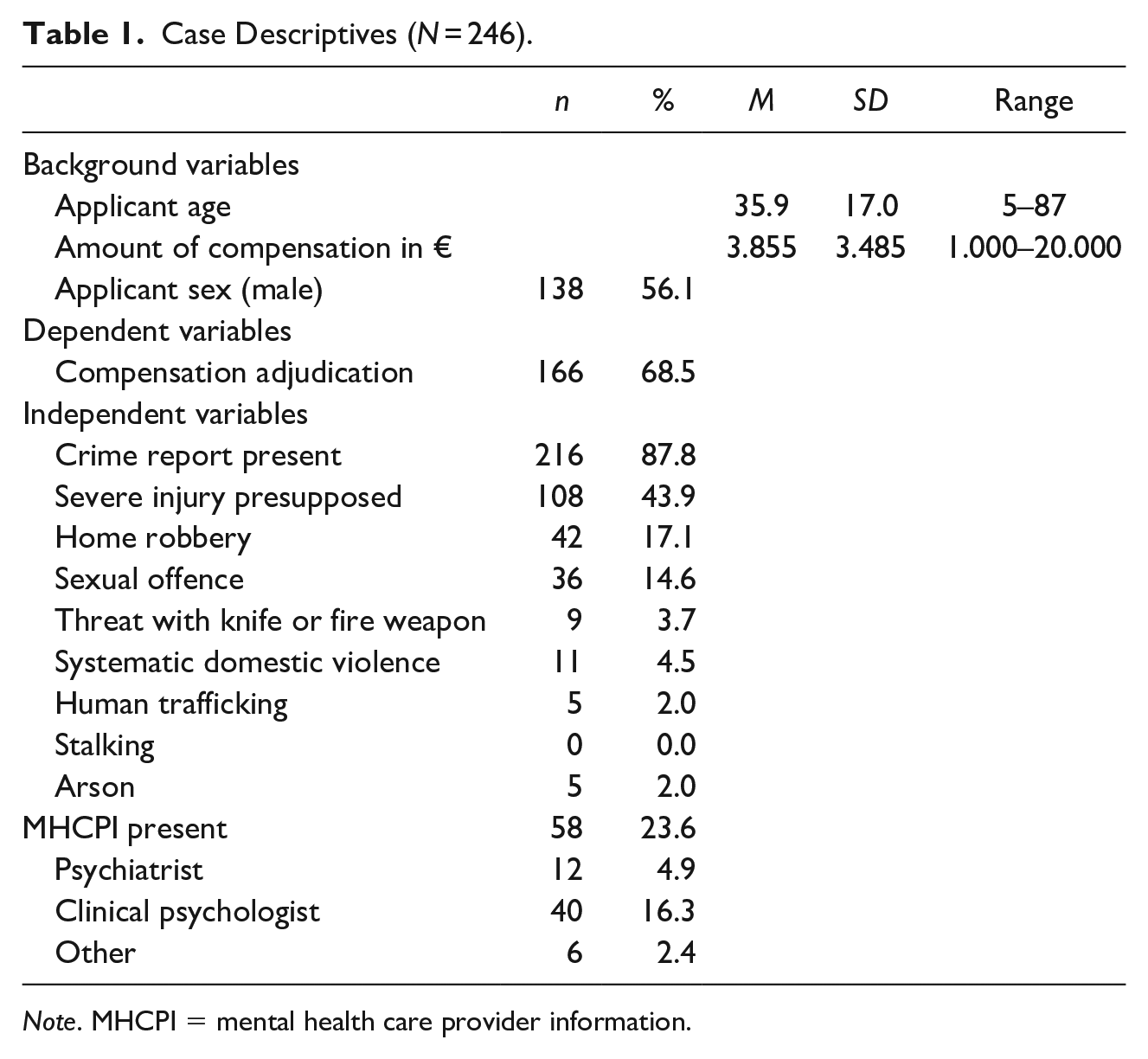
Note. MHCPI = mental health care provider information.
Information From Mental Health Care Providers and State Compensation Adjudication/Denial
Figure 2 presents the differences in state compensation adjudication/denial between cases in which information form a mental health care provider was present and cases in which such information was absent. As can be seen from this figure, the percentage of state compensation adjudication was higher for cases in which information from a mental health care provider was present than for cases in which this type of information was absent; in the former subset, state compensation was adjudicated in almost 88% of cases, while in the latter, state compensation was adjudicated in slightly more than 61% of cases. This difference was statistically significant, χ² (1, N = 246) = 14.5, p = .000.
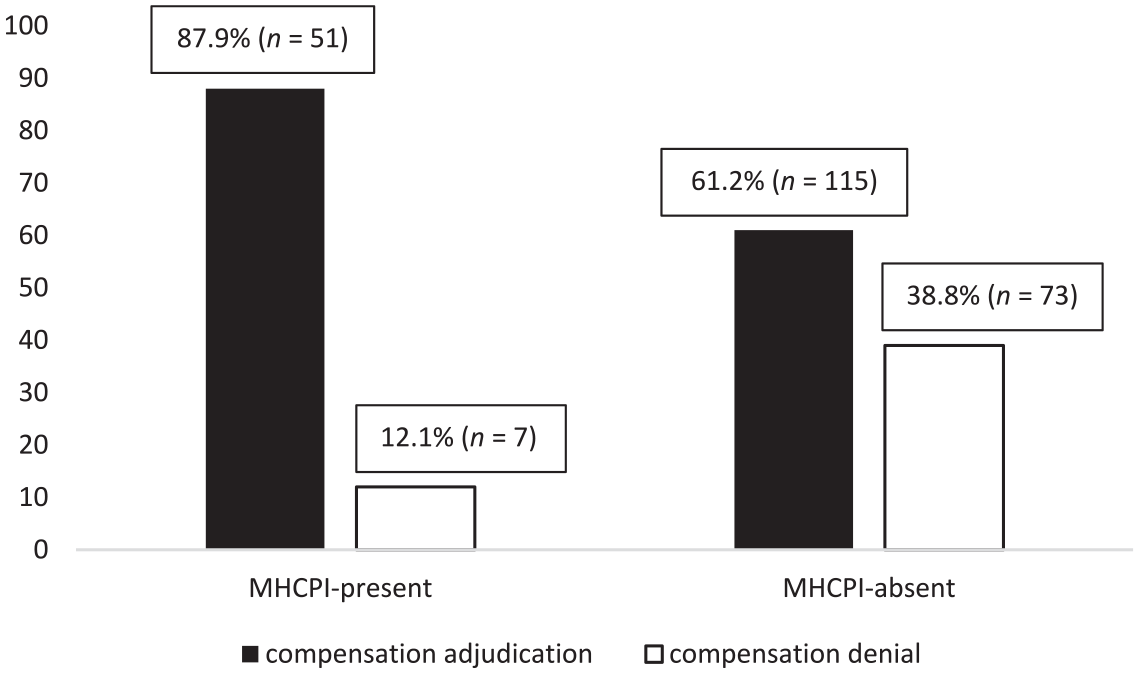
Compensation adjudication/denial by information from mental health care provider.
The multivariate logistic regression analysis yielded a similar result as the chi-square analysis; information from mental health care providers was positively associated with state compensation adjudication when adjusting for the availability of a crime report and presupposition of severe injury, odds ratio = 3.37, 95% confidence interval [1.40, 8.12], p = .007. This means that the odds for obtaining state compensation adjudication is 3.37 times higher for cases in which information from a mental health care provider was added to the application than in cases in which this had not been done.
Discussion
This study investigated whether information from mental health care providers is associated with adjudication of state compensation by the Dutch VOCF. Results indicated that this was the case; applications which were supported by information from mental health care providers more often resulted in adjudication of state compensation than applications which were not supported by such information. In view of the legal criteria upon which decisions about state compensation in the Netherlands should be based and in view of the potential unreliability of information from mental health care providers (e.g., due to undetected lying by the applicant), this is an unwelcome finding.
The data we used strengthen our assumption that lawyers who work for the Dutch VOCF may be prone to heuristic thinking. We speculated that they may use the narrative heuristic when evaluating the plausibility of an applicant’s victimization story and the anchoring and adjustment heuristic when estimating the severity of its injuries. The first heuristic relates to our need to explain why things happen (Taleb, 2007). Due to this need, we tend to create plausible stories by searching for potential causes of the consequences we observe. Therefore, if such a consequence is presented to us, we will attribute these consequences to that cause. This also applies, we argued, to state compensation procedures in which the victim has added information from a mental health care provider to its application; in such cases, the lawyer who evaluates the plausibility of the applicant’s victimization story may see the information about the applicant’s psychological injuries as a validation of its victimization claim. The second heuristic concerns our tendency to attribute too much weight to information that was already available during the initial stages of the decision-making process (Kahneman & Tversky, 1974). We argued that this can happen in state compensation application procedures too; if the victim adds information from its mental health care provider to its request for application, the lawyer who evaluates this request runs the risk of overestimating the severity of the applicant’s psychological injury, as they usually do not account or look for contrasting information. Although we could not explicitly test which heuristics they use when deciding about applicants’ requests for state compensation, our results are in line with this argumentation.
Our results corroborate with other studies about the impact of extra-legal factors on adjudication of state compensation to victims of violent crime. These studies provide a few alternative explanations for our findings. For example, based on a study by Kunst and Schiltkamp (2019), it can be argued that the impact of information from mental health care providers on adjudication of state compensation is mediated by Dutch VOCF lawyers’ feelings of sympathy for the applicant. In this study, it was found that Dutch VOCF lawyers’ feelings of sympathy for the applicant were associated with adjudication of state compensation, even when their estimations of the plausibility of the applicant’s victimization story were adjusted for. The authors argued that this is due to the nature of such feelings; feelings of sympathy are characterized, among other things, by an urge to alleviate another’s suffering (cf. Wispé, 1991). Lawyers working for state compensation funds can satisfy this need by awarding state compensation to the applicant. Presumably this applies even stronger to cases in which the type and level of suffering becomes apparent from the applicant’s files. If so, it is the affect heuristic rather than the narrative or anchoring and adjustment heuristic which is responsible for the impact of information from mental health care providers on adjudication/denial of state compensation. According to this heuristic, people’s emotions shape the decisions they take (Finucane et al., 2000).
Another alternative explanation for our findings can be found in an Australian study by Daly and Holder (2019). This study found that male child victims received more compensation for severe sexual offences from an Australian state compensation fund than female child victims (Daly & Holder, 2019). The authors used Christie’s (1986) ‘ideal’ victim concept to explain this finding. An ideal victim is “a person or a category of individuals who—when hit by crime—most readily are given the complete and legitimate status of being a victim” (Christie, 1986, 18). In other words, an ‘ideal’ victim is a victim who best fits prevailing victim stereotypes. According to the authors, male child victims better fit prevailing stereotypes of child victims of sexual offences than female child victims, because the perpetrator of such an offence is usually a male. The offence is therefore “unambiguously wrong” and “cannot be ( . . . ) interpreted as ‘sex’, or caused by child seduction, as is possible for a female child victim” (Daly & Holder, 2019, p. 1115). In line with this reasoning, it can be argued that victims who add information from mental health care providers to their application are more ‘ideal’ than those who do not do this. After all, suffering—as becomes apparent from mental health care provider information—is a defining characteristic of victimhood (Van Dijk, 2009). If so, it is the representativeness heuristic rather than the narrative or anchoring and adjustment heuristic (or affect heuristic) which is responsible for the impact of information from mental health care providers on adjudication/denial of state compensation. According to this heuristic, people rely on their stereotypes when making their decisions (Kahneman & Tversky, 1972).
When interpreting our study’s results, we should not forget its limitations. First, they only apply to applications for state compensation submitted to the Dutch VOCF. For this reason they cannot be generalized to populations of violent crime victims who apply for state compensation in countries other than the Netherlands. This limitation can be overcome by replicating our study in other jurisdictions. However, in order to do this properly, it is necessary to first learn whether and how information from mental health care providers can play a role in the evaluation of applications for state compensation. It is particularly important to find out under which circumstances this type of information may, should, or should not be used. Gaining this insight may be difficult without help from lawyers engaged in the adjudication of state compensation, as rules concerning the use of information from mental health care providers are not always explicitly expressed in policy documents. Speaking with such lawyers can help researchers to better design and prepare their studies. Second, it could not be ascertained whether and to what extent Dutch VOCF lawyers had actually used information from mental health care providers to base their decisions upon. It can therefore not be ruled out that our findings are due to other, unmeasured factors. Future studies can overcome this limitation by interviewing Dutch VOCF lawyers during the decision-making process and asking them to reflect on the sources of information that play a role in this process and on how different sources of information are weighed against each other to reach a decision. Third, we do not know whether the files we studied contain all the information upon which the decision to adjudicate or deny state compensation was based. This particularly applies to telephone conversations between the lawyer who evaluates the application and the applicant or its legal representative. Although the evaluating lawyer should take notes of these conversations, we cannot discard the possibility that they failed to do this. This problem can be resolved in future research by asking Dutch VOCF lawyers to take notes of telephone conversations in cases it wants to investigate. And finally, we were not able to test whether our findings varied by ethnic background and/or race. It is important that future studies attempt to overcome this limitation, as prior research suggests that mental health care utilization varies by ethnic and racial differences (e.g., Chiu et al., 2018). Adjusting for ethnic background and/or race may therefore increase the reliability of the association between mental health care provider information and adjudication of compensation.
Notwithstanding these limitations, our study was only the second to study the impact of mental health care provider information on adjudication of state compensation for violent crime victimization. Its results are reason for concern, as this type of information may favor applicants only under exceptional circumstances. Due to its potential unreliability, it should not be—as was the case in our study—associated with receipt of state compensation. If future studies replicate our findings, the Dutch VOCF and other state compensation funds for violent crime victims should adapt their decision-making practices to ensure that availability of information from mental health care providers is confined to those cases in which this is legally justified by the specific circumstances of an individual case. It would, after all, be very cynical if funds which serve as a last resort for those who cannot get compensation through other means differentiate, though maybe not deliberately, between applicants on the basis of legally irrelevant factors. To achieve this, it might consider a change in the administrative processing of applications. Currently, application files typically contain the application form and all other documents attached to this form by the applicant or his/her legal representative. If documents irrelevant to the evaluation of the application are removed from the application file before it is sent to the lawyer who decides about the applicant’s eligibility for state compensation, then such documents are less likely to influence the outcome of the decision-making process.
Footnotes
Declaration of Conflicting Interests
The author(s) declared no potential conflicts of interests with respect to the authorship and/or publication of this article.
Funding
The author(s) received no financial support for the research and/or authorship of this article.
