



Abstract
Research has drawn attention to the stigma and high rates of victimization among people with intellectual disabilities (ID) and an overlap between bias and non-bias victimization. However, studies of bias events or hate crime involving persons with ID are scarce. Using a self-report measure, we analyze lifetime bias victimization in a sample of 260 adults diagnosed with ID (age M = 41.7, SD = 12.0; 59.2% men), of whom 92 experienced bias victimization (age M = 41.2, SD = 11.9; 54.3% men), and compare the number of different types of victimization and the poly-victimization status between bias and non-bias victims. We also examine the following features: the victim, offender(s), victim–offender relationship, and location. Results show that bias victims experience a higher number of different types of victimization than non-bias victims (M = 7.74 and 4.96, respectively; p <.001, rrb=.37, ξ=.42) and are four times more likely to be poly-victims than non-bias victims (odds ratio [OR] = 4.37; 95% CI, p <.001). Most of the victims experienced a number of bias victimization episodes (89.1%; n = 82), and more than a quarter were injured (27.2%, n = 25) as a result of the victimization. All the bias victimizations by strangers were carried out in public places, as were most of the bias victimizations by acquaintances. Schoolmates and work colleagues perpetrated attacks at school and in the workplace, respectively. More than half of the victims, 63% (n = 58), spoke of the experience with someone, but only one reported it to the authorities. The paper provides a valuable descriptive and bivariate analysis of bias victimization of people with ID. The findings will help to understand bias violence against this population, highlighting the need for targeted and effective interventions.
Keywords
Introduction
The rates and contexts of bias victimization or hate crimes targeting people with intellectual disabilities (ID)—also known as learning disabilities in the United Kingdom—have not been assessed in depth. Previous reports have suggested that the bias victimization of people with ID may be underreported compared with other forms (Macdonald et al., 2017). During the last two decades, official records and victimization surveys in Western countries have produced statistics that reflect the occurrence of bias victimization but are far from elucidating its extent. The U.S. National Crime Victimization Survey (NCVS) 2019 report recorded 25,238 violent and 16,276 property hate crime victimizations against persons with disabilities, with the corresponding figures for the whole series between 2005 and 2019 standing at 117,930 and 54,300, respectively (Kena & Thompson, 2021). However, the study did not disaggregate the data across types of disability. U.S. law enforcement data reported only 116 offenses classified as anti-mental disability in 2019, and the accumulated count for the 2010 to 2019 series was 620 (Smith, 2021). In Europe, only a few countries collect data on hate crimes against people with disabilities, and the procedures and recordings are heterogeneous (FRA, 2018). For instance, official data from England and Wales reported 14,242 non-disaggregated incidents in the 2021 to 2022 financial year (Home Office, 2022), whereas Scotland reported 666 crimes aggravated by disability prejudice in 2021 to 2022 (Crown Office & Procurator Fiscal Service, 2022), and Northern Ireland 123 in 2021 to 2022 (Police Service of Northern Ireland, 2022). Spanish law enforcement data recorded 28 incidents of hate crimes against people with disabilities in 2021 (Ministry of Home Affairs, 2022).
To date, very few quantitative studies on the subject have been conducted. The most comprehensive study so far, the Life Opportunities Survey in the UK used a representative sample in which 26% were people with disabilities. A study using the first wave of this survey (2009–2010) showed that people with disabilities were significantly more likely to experience bias victimization than their non-disabled counterparts (Emerson & Roulstone, 2014). According to that study, the last 12-month rate of self-reported hate crime victimization motivated by disability was 7%. The rates varied across type of disability, ranging from 1% to 2% for physical and sensory and up to 7% for cognitive. However, only 1.2% of the sample had intellectual or learning disabilities (n = 309), a fact that made it difficult to draw conclusions regarding this group.
Victims of bias violence experience detrimental effects on their health and well-being, such as psychological distress, depression, anxiety, fear, post-traumatic stress disorder, feelings of vulnerability, negative behavioral health outcomes, and an increased concern for crime and safety (Díaz-Faes & Pereda, 2022). The life experience of people with ID is subject to the influence of cultural and social drivers of poorer health, such as oppression, stigma, ableism, and implicit negative attitudes (Ditchman et al., 2016). The most obvious issue is the effect of the ID label itself, which tends to be socially perceived as a pathological attribute (Nario-Redmond et al., 2019; Snipstad, 2022) and is strongly associated with negative prejudices that often revolve around infantilization, inferiority, incapacity, dehumanization, objectification, and hostility (Meer & Combrinck, 2015; Nario-Redmond et al., 2019). These social phenomena are often neglected or denied, despite the disempowerment and discriminatory treatment that they may cause (Dunn, 2019; Hollomotz, 2013; Sherry & Neller, 2016).
Existing qualitative studies have disentangled and elucidated how targeted violence affects the health and well-being of people with ID (Wiseman & Watson, 2022), and have helped to understand their experience of discrimination and spatial exclusion (Hall & Bates, 2019). That is to say, they have shown how control and spatial domination dynamics have been established, promoting marginalization and preventing persons with disabilities from occupying spaces in particular environments (e.g., physical and cultural barriers, or the lack of institutional knowledge and support).
Despite these studies, people with ID are usually conceived quite narrowly through the construct of ID; the dominant conceptions of disability are notably essentialist and simplistic. However, this population is a highly heterogeneous group in terms of their etiology, genotype, and phenotype, which are not reducible to simply diagnostic criteria (for a review of developmental perspectives of ID, see Burack et al., 2021). Current perspectives reflect a more nuanced understanding of ID, which acknowledges its intrinsic complexity.
Under the hate crime classification, the intersectionality of bias violence tends to be overlooked due to the focus on criminality and the individual or hierarchical distinction between categories, which means that incidents are classified only under specific headings (Chakraborti & Garland, 2012). This may blur the fact that the victims may have multiple social categories or stigmatized identities related to the bias event (Díaz-Faes & Pereda, 2022)—for instance, ethnicity, disability, gender identity, sexual orientation, or social class, which are produced through each other. Intersectionality posits that multiple social identities interact at different levels of individual experience, reflecting the intertwining macro systems of oppression and privilege (e.g., ableism, ethnocentrism, racism, or heterosexism) informing the person’s experience (Nash, 2008). Such a stance helps to understand bias events more comprehensively through the lens of perceived vulnerability and difference rather than through single motivations or particular strands alone (Chakraborti & Garland, 2012). Macdonald et al. (2021) showed how the disability of victims may be masked through identification solely according to group membership, with the result that they are often classified only under one of the categories.
At the same time, certain detrimental behaviors do not legally qualify as hate crimes, but they are equally bias-motivated and cause victims’ exclusion and harm. This is why it is crucial to account for noncriminal bias events (Farrell & Lockwood, 2023). Concerning persons with disabilities, as the “mate crime” framework has underlined (Thomas, 2011), in some cases victim and perpetrator are known to each other; they have a mutual relationship as “friends” or “relatives” or share a degree of domesticity. Bias events in this context are seldom recognized and/or reported as bias victimizations, since the widespread conception is that such acts must be perpetrated by an “outsider,” as opposed to members of the victim’s household or social network (i.e., “mates”).
It is also important to highlight the concept of poly-victimization, which emphasizes the idea of an intersection between different types of victimization. Poly-victims are a group of individuals who suffer from high levels of different types of victimization in multiple life contexts, resulting in increased levels of psychological distress and adverse mental health outcomes (Finkelhor et al., 2009). Studies assessing multiple victimizations across people with ID have identified substantial victimization rates (Fisher et al., 2016; Horner-Johnson & Drum, 2006). The few assessments of poly-victimization among this population have shown a high number of adverse events (Codina et al., 2022; Turner et al., 2011). Cuevas et al. (2021) reported that in this framework of multiple victimizations, bias victimization seems to be significantly associated with other non-bias victimizations both as a predictor and as an outcome.
In view of the above, we might expect an overlap between bias and non-bias victimization and an increased risk of high victimization levels among bias victims. In the case of people with ID, those who experience bias victimization are likely to be the most victimized due to their increased vulnerability or disempowerment related to individual or environmental factors. The present exploratory study aims to broaden our understanding of violence against people with ID by applying an intersectional approach. We have three main objectives: first, to identify bias victimization in a sample of people with ID using self-report measure to capture physical bias attacks; second, to compare the number of different types of victimization and the poly-victimization status between bias victims and non-bias bias victims; and third, identify the victim, offender(s), victim–offender relationship, and location.
Method
Participants
A convenience sample of 260 adults with an ID diagnosis (154 men and 106 women) aged between 20 and 71 years (M = 41.7; SD = 12.0) was recruited from specialized organizations that are members of the Catalan Federation of Non-profit Entities for People with ID (DINCAT) in Catalonia. These organizations provide services and employment opportunities to people with ID in Catalonia. The organizations that agreed to enroll invited their users to participate voluntarily in the study. Individuals who had experienced bias victimization (n = 92; age M = 41.2, SD = 11.9; 54.3 % men) or non-bias victimization (n = 160; age M = 41.6; SD = 12.0; 61.9% men) comprised the sample for the present study. The participants who did not experience any victimization were excluded (n = 8).
Procedure
A collaboration agreement with DINCAT was signed, and consent was obtained from all participants before enrolling. Easy-to-read versions of the consent and an information sheet were created to ensure that the participants understood the objectives and the nature of the study. Ten volunteer psychologists familiar with IDs were trained in the application of the questionnaire (described below). The questionnaire was administered individually in an interview format with the visual support of pictograms when necessary.
Measures
Sociodemographic data
A datasheet was created ad hoc for the study. It included age, gender, country of origin, education, accommodation, disability information (legal incapacity, support needed, type of care services received), as well as diagnoses of other disabilities.
Bias victimization
A tailored adult retrospective version of the Juvenile Victimization Questionnaire (JVQ) was administered (Pereda et al., 2018). The questionnaire explores 28 different victimization events distributed in five modules: (a) common victimization, six items; (b) caregiver victimization, six items; (c) sexual victimization, six items; (d) witnessing and indirect victimization, four items; and (e) electronic victimization, six items. The JVQ gives information on victimization rates and specific details of each type of victimization and allows the calculation of poly-victimization. It has shown good psychometric properties (Finkelhor et al., 2005), and the Cronbach’s alpha for the JVQ in this study was .84.
The bias attack victimization item from the common crime module was used to capture bias-related violent experiences. The wording of the item is as follows: “At any time in your life, have you been hit or attacked because of your skin color, religion, or where your family comes from? Because of your disability or a physical problem you have? Or because someone said you were homosexual?” The response to this item is dichotomous (yes/no). Its wording reflects possible perceived biases or prejudices on which the attack was based but does not break them down. (i.e., into disability, skin color, sexual orientation, etc.). This item comes with a set of follow-up questions which are asked only if the participant initially answers “yes.” They contain relevant information about the victim, the experience of victimization, frequency, perpetrator, harm, and disclosure. Poly-victimization status was calculated using the complete questionnaire. Poly-victims were defined as those at or above the 90th percentile in the number of victimization items (Finkelhor et al., 2009).
Data Analysis
Before conducting the statistical analysis, we examined the missing values. Overall missing data were low (<2%). We scrutinized the missing data pattern visually and used Little’s Missing Completely at Random (MCAR) test (X2 = 769.61, p = .189). We considered that missing data were MCAR, and performed the imputation by the mice package in R using the multiple chained equation solution (van Buuren & Groothuis-Oudshoorn, 2011). First, we ran a descriptive analysis for the sociodemographic characteristics of the bias and non-bias victims. We also calculated the total number of different types of victimizations and the poly-victimization score using the other 27 victimization items. We then compared the number of victimizations and the poly-victimization status between the two groups using Chi-squared (X2) and Mann–Whitney U (U), and rank-biserial correlation (rrb) and odds ratio (OR) as measures of effect size. To mitigate the risk of Type I error associated with the presence of outliers identified using Tukey’s method, we also conducted Yuen’s trimmed mean test (Yuen’s t-test) and compute its effect size (ξ ) as a robust alternative to confirm the results of the standard nonparametric test when comparing the scores of the two groups (Yuen, 1974). Finally, we broke down the features of the bias events accounting for characteristics of the victim, offender(s), victim–offender relationship, and location. We set the p-value at 5%. We used R version 4.2.2 to perform the analysis (R Core Team, 2022) and the WRS2 package for robust statistics (Mair & Wilcox, 2020).
Results
Ninety-two participants (35.4%) reported experiencing bias victimization at some point in their lifetime. The age in this subsample ranged between 20 and 71 years (M = 41.2; SD = 11.9); 42 (45.7%) were women and 50 were men (54.3%). Further sociodemographic information is presented in Table 1. There were no significant sociodemographic differences between bias and non-bias victims.
Sample’s Sociodemographic Characteristics.
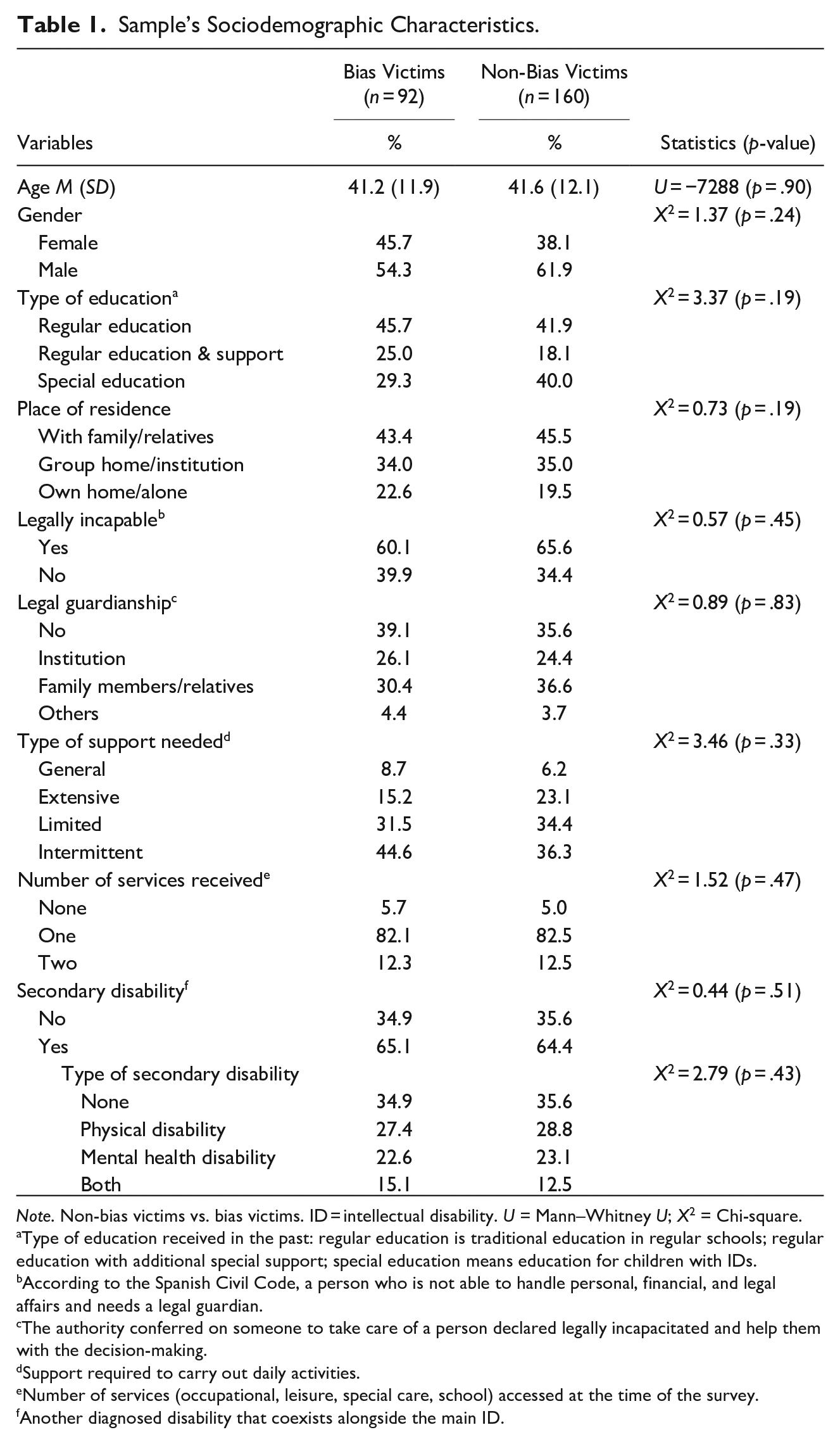
Note. Non-bias victims vs. bias victims. ID = intellectual disability. U = Mann–Whitney U; X2 = Chi-square.
Type of education received in the past: regular education is traditional education in regular schools; regular education with additional special support; special education means education for children with IDs.
According to the Spanish Civil Code, a person who is not able to handle personal, financial, and legal affairs and needs a legal guardian.
The authority conferred on someone to take care of a person declared legally incapacitated and help them with the decision-making.
Support required to carry out daily activities.
Number of services (occupational, leisure, special care, school) accessed at the time of the survey.
Another diagnosed disability that coexists alongside the main ID.
The mean number of different types of victimizations in the sample was 5.98 (SD = 4.45, Mdn = 5). It was significantly higher for bias victims (M = 7.74; SD = 4.78; Mdn = 7) than non-bias victims (M = 4.96; SD = 3.93; Mdn = 4), with a medium effect size (rrb = .37; ξ = .42). Figure 1 breaks down its distribution for bias and non-bias victims by gender. Victims of bias experienced significantly more victimizations of different types (e.g., robbery, online or caregiver victimization, and physical or sexual abuse) during their lifetime than their peers who had not undergone bias victimization (Table 2). The threshold for poly-victims was set at 12 different types of victimization. Poly-victims were more likely to be among the victims who had experienced bias victimization (n = 28, of which 67.9% belong to the bias victim group), with a fourfold higher risk (OR = 4.37; 95% CI [1.88, 10.10]; p <.001) than non-bias victims.
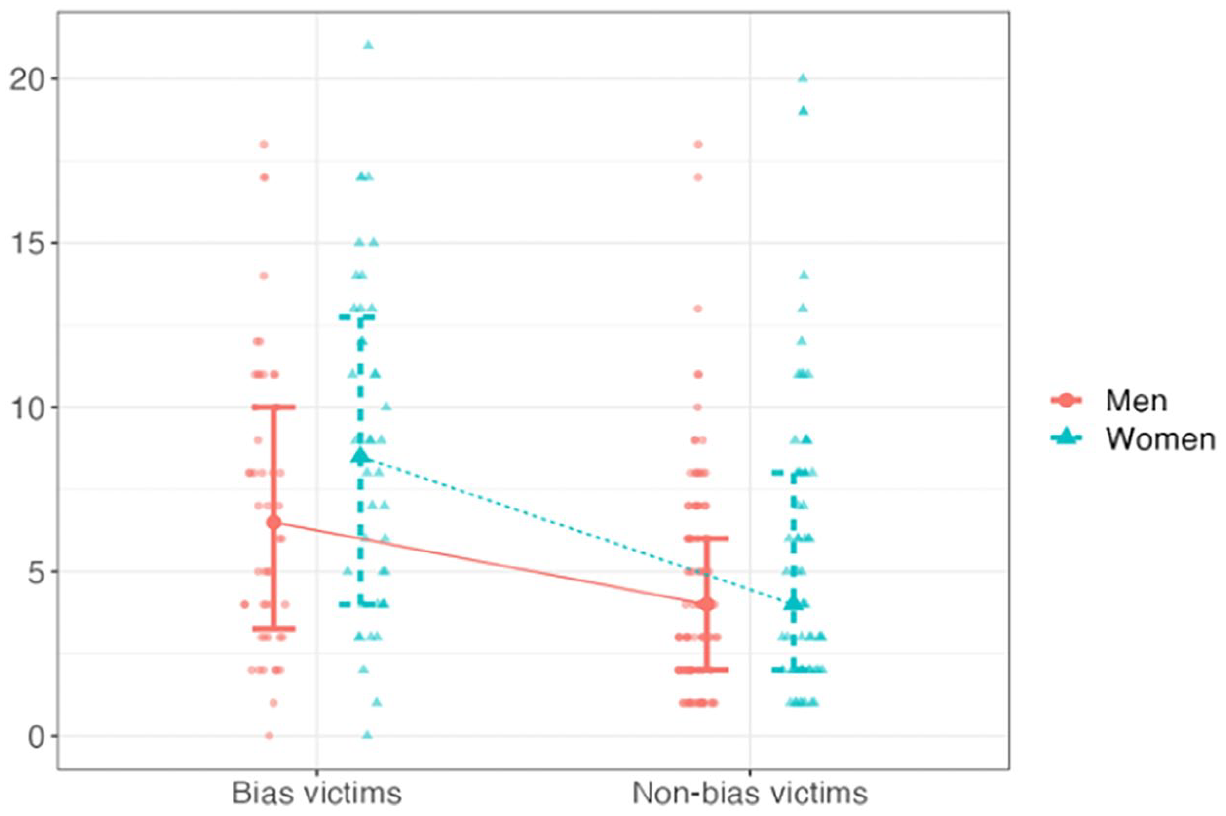
Number of exposures to different types of victimization across bias and non-bias victims by gender.
Victimization and Poly-Victimization Among Bias and Non-Bias Victims.
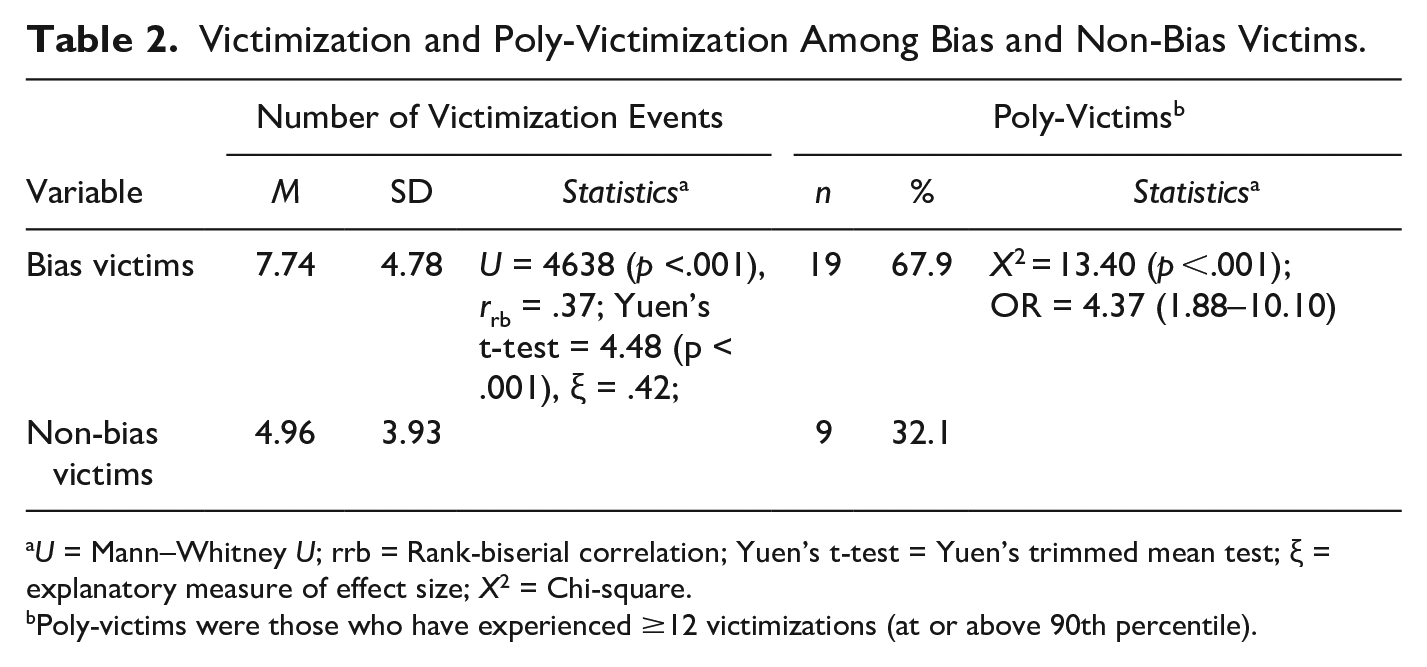
U = Mann–Whitney U; rrb = Rank-biserial correlation; Yuen’s t-test = Yuen’s trimmed mean test; ξ = explanatory measure of effect size; X2 = Chi-square.
Poly-victims were those who have experienced ≥12 victimizations (at or above 90th percentile).
Most of the victims experienced various episodes of bias victimization (89.1%; n = 82). Occurrences were reported to be “few” by 42.4% (n = 39) and “many” by 46.8% (n = 43). To obtain further details of the victimization, the participants were asked about the last incident (Table 3). All incidents involving strangers (67.4%; n = 29) occurred in public places, as did most involving friends, neighbors, and other acquaintances (30.2%; n = 13). Schoolmates and fellow employees perpetrated the victimizations in schools and places of work. More than a quarter of the victims were injured (27.2%, n = 25) as a result of the incident.
Bias Victimization: Characteristics of the Victim, Offender(s), Victim–Offender Relationship, and Location.
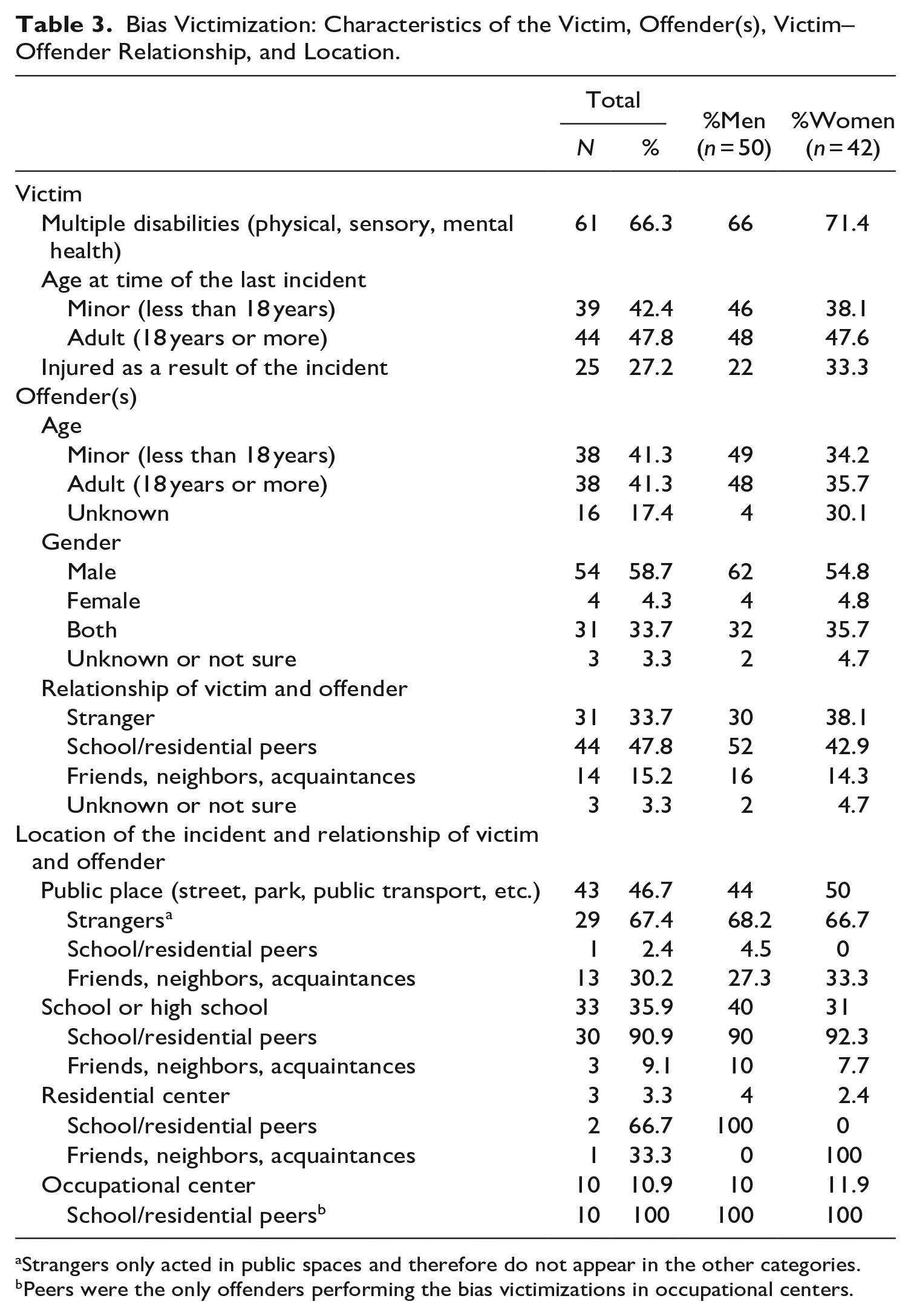
Strangers only acted in public spaces and therefore do not appear in the other categories.
Peers were the only offenders performing the bias victimizations in occupational centers.
Regarding disclosure, 63% (n = 58) of the victims had described the event to someone else, while the remaining 37% (n = 34) kept the experience to themselves. In the cases where the event was disclosed, the person to whom the disclosure was made was usually a family member or a close friend (56.9%; n = 33) or a social care professional (29.3%; n = 17). Only 6.9% (n = 4) informed a psychologist and just 5.2% (n = 3) a schoolteacher. Only one victim reported the event to the police.
Discussion
The scant available evidence at present suggests high rates of victimization among people with ID (Brendli et al., 2022; Codina et al., 2022). Bias victimization and hate crime involving this population is a neglected area of research.
This study has found that one in three people with ID have suffered bias victimization and that they are more victimized than non-bias ID victims. Although the results do not indicate significant sociodemographic differences from the rest of the victims, victims of bias offenses seem to present some additional characteristics linked to their vulnerability, disempowerment or an increased exposure to interactions with potential perpetrators. Perhaps their own physical features or social skills, and interpersonal communication deficits, make them easy targets for bias offenses. It may be that other external or contextual differential variables have not been detected and recorded in this study.
Incidents in a school or residential or occupational centers mainly involved peers known to the victims, while strangers were most likely to perpetrate victimizations in public places. In our study, most participants of school age attended regular schools (though some received support). Their experiences of bullying or dynamics of hostility and harassment are thus allegedly committed by peers, relatives, or acquaintances. As Doherty (2020) suggested, these incidents could be labeled “mate crimes.” In contrast, most strangers’ offenses occurring in public facilities may be more in line with the traditional conception of hate crime. Nonetheless, the information gathered does not allow us to conclusively identify the context of the victimization since it is an inference based on the relationship between the victim and the offender.
The way in which the concept of hate crime has been constructed fosters the idea that there is no relationship between victim and perpetrator (Díaz-Faes & Pereda, 2022). This assumption may contribute to obscuring the presence of bias violence in the context of the family or among friends and acquaintances. Future research should explore individual variables jointly such as the degree of disability, the type of ID, race–ethnicity, gender identity, sexual orientation, and social class. An analysis of household arrangements and dynamics, and relationships with peers, would also be valuable.
The present study has limitations, and the results should be interpreted with caution. The sample is non-probabilistic, relatively small, and was not matched, and so we were unable to conduct additional statistical tests. In addition, the study does not include individuals who are not in care or receiving occupational services, which may be a more socially isolated portion of the ID population. The paper provides novel insights that may inform future research bias victimization among people with ID. It suggests possible vulnerabilities and disempowerment dynamics, demonstrated by their higher number of different types of victimization and a greater likelihood of being poly-victims compared to non-bias victims. It offers detailed information on the characteristics of bias victimization in a largely unexplored population such as people with ID. Future research should use more powerful study designs, such as prospective investigation, more nuanced approaches, and more sensitive instruments to explore bias victimization across this population.
Footnotes
Declaration of Conflicting Interests
The author(s) declared no potential conflicts of interest with respect to the research, authorship, and/or publication of this article.
Funding
The author(s) disclosed receipt of the following financial support for the research, authorship, and/or publication of this article: This work was supported by the ICREA Academia 2016.
