




Abstract
Research exploring the correlates of sexual victimization has found sexual victimization to be associated with both individual- and contextual-level factors, including age, gender, poverty, and size of the female population. However, to date, research has been limited in exploring how historical factors, such as slavery, may be associated with the contemporary prevalence of sexual victimization of women. Historical accounts have often suggested that enslaved women often experienced sexual victimization during their enslavement. Despite these accounts, research has been limited in empirically exploring the relationship between slavery and the sexual victimization of Black women. Using the 1860 U.S. Census and the 2019 National Incidence-Based Reporting System, multilevel logistic regression analyses are employed to explore whether slavery is consequential for contemporary instances of Black female sexual victimization. In line with the “legacy effect” framework, the findings from the current study suggest that Black women are significantly more likely to be sexually victimized in counties characterized by larger enslaved populations in 1860. These findings illuminate how historical institutions, despite being outlawed, have contemporary consequences, particularly for Black women. These findings, discussions, avenues for future research, and policy implications are discussed below.
Introduction
Scholars are particularly interested in the contemporaneous effects of slavery, especially for African Americans. Termed the “legacy effect,” scholars have suggested that, despite its abolition, slavery continues to be consequential for contemporary outcomes (Ruef & Fletcher, 2003). Specifically, this line of research has found that slavery is associated with a host of outcomes, particularly for Black people, including income and poverty (Bertocchi & Dimico, 2012; O’Connell, 2012; O’Connell et al., 2020), education (Bertocchi & Dimico, 2012; Reece & O’Connell, 2016), health (Gabriel et al., 2021; Kramer et al., 2017), and victimization (Bailey, 2022; Gunadi, 2019). Although this research has greatly advanced our understanding of how historical institutions and practices can shape the contemporaneous landscape of America, it has failed to consider the effects that the institution of slavery has had on Black women, in particular. Much like Black men, Black women were essential to the success of slavery; and although there was much overlap between the experiences of enslaved Black men and women, there were notable differences.
To this point, Jacobs (2001) in her narrative Incidents in the Life of a Slave Girl wrote that “slavery is terrible for men; but is far more terrible for women” (p. 66). Jacobs (2001) points out that among other things, enslaved Black females also had to deal with the threat and danger of sexual victimization. After the first ship with enslaved Black people landed in Jamestown, Virginia in 1619, Black people were sent to the auction block (see Hannah-Jones & Watson, 2021; Kolchin, 2003). Once on auction block, Black women were stripped of their clothes and their naked bodies were examined to determine their reproductive capacity. In addition to the manual labor that they provided in the field, once sold, Black women were often coerced, bribed, seduced, ordered, and violently forced to participate in sexual activities with those who enslaved them (Sommerville, 2005).
Strikingly, historians have estimated that at least 58% of all enslaved females between the ages of 15 and 30 were the victims of sexual assault by White males (see West and Johnson, 2006; Hine, 1989). Unfortunately, the violent raping of Black women did not end when the importation of Africans was banned in 1808, nor did it end when Abraham Lincoln signed the Emancipation Proclamation in 1862, which is considered to be one of the first challenges to the institution of slavery. Instead, Black women (and men) were used to produce an endless labor force through the process of “slave breeding.” Slave breeding is a process whereby slaveholders forced healthy enslaved people to mate to produce children. The resulting child could then be sold to other slaveholders for economic gains. After their “liberation,” Black women were savagely gang raped by White vigilante groups, such as the Ku Klux Klan (KKK) (Sommerville, 2005). Moreover, Black women, desperate to support their families, consistently endured inappropriate advances by their employers (Hine, 1989; see also Warren, 2007).
Although Black women experienced alarming rates of sexual victimization both during their enslavement and after, it was often not considered a crime to rape Black women. In the few places where it was considered a crime to rape Black women, procedural law disallowed Black women from testifying about their victimization (Anderson, 1996). Instead, most rape laws were race specific, protecting only White victims. In 1867, for example, Kentucky law defined a rapist as someone who “unlawfully and carnally know any white women, against her will or consent” (Sommerville, 2004, p. 148). Black men who were accused or convicted of raping a White woman were often lynched, castrated, or incarcerated; White men, on the other hand, faced no consequences for raping Black women. Moreover, criminal law did not recognize Black-on-Black rapes. After overturning the conviction of an enslaved male for the rape of a Black girl, a Mississippi judge argued that “[t]he crime of rape does not exist in this State between African slaves . . . Their intercourse is promiscuous” (Roberts, 1997, p. 31). Even the Thirteenth and Fourteenth Amendments to the United States Constitution, which were ratified to provide equal protection of the law, did not drastically improve the likelihood of the prosecution of rape of Black women (Pokorak, 2006).
In modern times, the sexual victimization of Black women remains pervasive. According to the U.S. Census, there were 46.8 million people in the United States in 2019 who identified as Black, representing a 29% increase over the last two decades (Tamir, 2021). The National Intimate Partner and Sexual Violence Survey reveals that 45.1% of Black women reported that they experienced sexual violence, physical aggression, and or stalking at the hands of an intimate partner (Smith et al., 2017). Based on these estimates, more than six million Black women are the survivors of some type of intimate partner violence (IPV) (Black et al., 2011), including sexual victimization. While these numbers are alarming, in addition to data not being disaggregated by violence types, these numbers do not include the violence incurred by non-intimate partners. As such, the rate of sexual violence, and violence more broadly, of Black women is hard to fully capture and could be underestimated.
Despite the vast literature that narrates the sexual brutalization of Black females during slavery and research that examines the continued sexual victimization of Black women, very little research has empirically examined the relationship between slavery and the contemporary sexual victimization of Black females. Building on theory and prior research, the current study fills this void by examining whether the concentration of enslaved populations in southern counties in 1860 is consequential for the likelihood of sexual victimization of Black females contemporarily.
Literature Review
The Contemporary Effects of Slavery in America
A growing body of literature has begun exploring the relationship between slavery and a host of contemporary outcomes for African Americans, particularly in the South. Using a school of thought termed “institutional legacy of slavery,” Ruef and Fletcher (2003) conceptualize the effects of slavery in two ways—individual-based or place-based perspectives. The individual-based perspective emphasizes the development of enslaved people and suggests that the institution of slavery may have a direct impact on formerly enslaved people in contemporary times. Much of the recent work on the contemporary effects of slavery, including the current study, draws on the place-based perspective, which suggests that the legacy of slavery not only influences the future outcomes of enslaved people but also permeates places by creating societal norms and/or practices that allow the mistreatment of Black people who are far removed from the institution of slavery. Tilly (1998) provides the mechanism for which cultural transmission might occur, arguing that places reproduce inequality across generations by mapping social categories onto hierarchal power relations. The resulting hierarchy is maintained because dominant groups develop a monopoly on valuable resources. To this end, several studies have employed a place-based perspective for understanding the contemporary effects of slavery, finding that slavery continues to be consequential for Black people across a number of outcomes.
As it pertains to politics, a small body of research has explored the relationship between slavery and contemporary political outcomes (Acharya et al., 2016, 2018). Drawing on a sample of more than 40,000 Southern Whites and historical census records, Acharya et al. (2016) examined the relationship between historical concentrations of enslaved people and political attitudes across counties in the American South. Using racial threat and the theory of historical persistence of political attitudes as theoretical frameworks, their analyses revealed that Whites who currently live in counties that had higher concentrations of enslaved people in 1860 are today, on average, more conservative, more likely to oppose affirmative action, and more likely to express attitudes that indicate some level of racial resentment toward Blacks than Whites that live in counties that had smaller concentrations of enslaved people in 1860.
An additional line of research has suggested that the legacy of slavery has been consequential for Black–White disparities in income and poverty (Bertocchi & Dimico, 2012; Curtis & O’Connell, 2017; Maloney & Caicedo, 2016; Nunn, 2008; O’Connell, 2012, 2020; O’Connell et al., 2020). Bertocchi and Dimico (2014), for example, found that a larger enslaved proportion in 1860 significantly increased income inequality across races within U.S. counties; they further concluded that the effects of slavery on income inequality occur, partially, through unequal educational attainment of Blacks and Whites. Similarly, O’Connell (2012) found that there are greater economic inequalities between Blacks and Whites in areas with higher historical concentrations of enslaved populations. More recently, O’Connell et al. (2020) revealed that population change moderates the effects of slavery on Black–White economic inequality such that White population growth in the early time period weakens the relationship between slavery and poverty inequality.
Also, of interest to scholars, is the contemporaneous effects of slavery on educational outcomes (Bertocchi & Dimico, 2012; Collins & Margo, 2006; Margo, 1990; Neal, 2006; O’Connell & Reece, 2016). Specifically, Collins and Margo (2006) found a positive relationship between the legacy of slavery and high illiteracy rates among Black people. Building on this work, Bertocchi and Dimico (2012) examined the relationship between slavery and the Black–White gap in educational attainment. They found that slavery was positively related to states’ racial education gap in 1940. They also found that the positive relationship between slavery and the education gap in 2000 was mediated by the 1940 education gap, suggesting that education was influenced by slavery, but only through the existence of the education gap in 1940. Reece and O’Connell (2016), more recently, used spatial analysis to assess the relationship between county-level enslaved populations and the Black–White ratio of public-school attendance. Their analyses revealed that when compared to White students, Black students are more likely to attend public schools in areas with higher historical concentrations of enslaved populations. Similarly, they found that counties in the deep South have greater public–private disparities when controlling for other factors.
A small body of research has examined slavery’s role in predicting contemporary criminal justice outcomes (Gottlieb & Flynn, 2021; Gouda & Rigterink, 2017; King et al., 2009; Nash et al., 2004; Rigby & Seguin, 2021; Ward, 2022; West, 2012). Scholars like King et al. (2009) and Ward (2022), for example, explore the relationship between historical practices and contemporary police practices. Specifically, Ward (2022) finds that the effects of slavery on the underreporting of hate crimes against Blacks and Latinos are conditioned by the contemporary Black population size. Other scholars have explored slavery’s effect on state-sanctioned violence. Lofquist (2002) found that membership in the confederacy was the strongest predictor of modern death penalty intensity. Similarly, Vandiver et al. (2006) used post-Gregg execution and death sentence data to explore the relationship between slavery and executions. Their analyses revealed a positive relationship between slavery and modern executions; specifically, 90.6% of post-Gregg executions occurred in states that supported the institution of slavery, irrespective of the state's prior membership in the confederacy.
An additional line of scholarship has explored the relationship between slavery and violence. Hackney (1969) argued that violence had been highly associated with Southerners. Moreover, Gouda and Rigterink (2017) found that the proportion of enslaved people in the 1860 population was significantly associated with higher violent crime rates in all Census years from 1970 to 2000. Finally, an additional body of work has found that slavery is consequential in the victimization of Black bodies through hate crimes (Bailey, 2022; Gunadi, 2019). Bailey (2022), for example, found that anti-Black hate crimes were significantly higher in counties with historically higher concentrations of enslaved people in 1860. Moreover, she found that the relationship between slavery and anti-Black hate crimes is moderated by racial segregation. Collectively, this work suggests that there is a relationship between slavery and violence, indicating that violence continues to be ingrained in places that traditionally had higher concentrations of enslaved populations. To date, the body of work empirically exploring the relationship between slavery has been limited in its exploration of slavery’s effect on the modern-day sexual violence of Black women.
Patterns of Sexual Violence
Research has found that sexual abuse can negatively affect one’s psychological well-being (Ullman & Brecklin, 2003), physical health (Kilpatrick et al., 1981), and behavior (Noll et al., 2003; Paolucci et al., 2001). As it pertains to psychological well-being, survivors of sexual victimization report experiencing higher levels of depression, anxiety, and suicidality (Broman-Fulks et al., 2007; Rohde et al., 2008). Particularly, females who experienced abuse during their childhood are twice as likely to suffer from depression (Rohde et al., 2008), anxiety (Saunders et al., 1999), and suicidal ideation (Dube et al., 2005; Waldrop et al., 2007). Survivors of sexual victimization may also experience issues related to their physical health, such as chronic pelvic pain, gastrointestinal disorders, chronic headaches, and back pains (Irish et al., 2010; Koss & Heslet, 1992). Lastly, research has found an association between sexual victimization and risky behavior, including promiscuity, substance abuse, and delinquency (Kellogg et al., 1999; Noll et al., 2003; Paolucci et al., 2001). Because of the deleterious effects that sexual victimization can have on survivors, scholars have spent considerable time exploring the effects of situational, environmental, and lifestyle variables on the likelihood of sexual victimization. The resulting research exploring the factors related to sexual victimization can be broken into two broad categories—individual-level and contextual-level—and will be discussed in detail below.
Individual-Level Predictors
Generally, research exploring the individual predictors of the sexual victimization of women falls into two categories—intimate partner sexual violence (IPSV) and non-intimate partner sexual violence (NIPSV). Intimate partners, such as dating or marital partnerships, are the most common victims of sexual violence (Smith et al., 2018), with research finding that one in three women have experienced physical or sexual violence by an intimate partner (Black et al., 2011; World Health Organization, 2013). IPSV can include the most extreme forms of sexual violence, such as rape or sexual assault but can also be inclusive of more complex and subtle behaviors such as coercion, threats, or blackmail to obtain sexual favors; forced consumption of pornography; and reproductive abuse (Bagwell-Gray et al., 2015; Tarzia, Wellington, Marino et al., 2018). Research distinguishes IPSV from NIPSV, arguing that IPSV is vastly different from rape or assault perpetrated by a stranger. One major difference is that women are significantly less likely to disclose IPSV (Cox, 2015; Wall, 2012). And, although any form of sexual victimization can negatively affect the overall well-being of all survivors, IPSV has been associated with more severe mental health issues (Tarzia Thuraisingam, Novy et al., 2018), a higher risk of homicide (Campbell & Soeken, 1999), and a greater likelihood of unwanted pregnancies (Basile et al., 2018) when compared to other types of sexual violence.
Related research has found that individual-level correlates of sexual victimization may vary by whether the sexual victimization is perpetrated by an intimate partner or a non-intimate partner. For example, gender is one of the strongest individual correlates of IPSV, with women experiencing IPSV 20 to 40 times more than men (Breiding et al., 2015). Additional correlates of IPSV are similar to the correlates of perpetrators of IPSV. Both victims and perpetrators of IPSV have a history of violence (Frye et al., 2014), prior sexual and violent victimization (Tarzia, 2020), alcohol and drug abuse (Tarzia, 2020), lower income, age, and educational attainment (Tarzia, 2020). Specifically, younger women, especially those under the age of 25, are at a greater risk of sexual victimization when compared to older women (American Academy of Pediatrics, 2001; Black et al., 2011; Carpenter & Sinson, 2022; Tarzia, 2020); this relationship is also prevalent at the college level, where research suggest that younger college women report higher rates of sexual assault when compared to older students (Humphrey & White, 2000). A smaller body of research has found an association between an individuals’s socio-economic status an IPSV. Specifically, Foshee et al. (2004) found that lower socioeconomic status (operationalized as the mother’s highest grade completed) was associated with IPSV.
Despite them being separate literatures, there is some overlap among the individual correlates of IPSV and NIPSV. For example, the age of the perpetrator and survivor is a strong correlate of both IPSV and NIPSV; research, however, has made some distinctions. Thirty-eight percent of acquaintance rape victims are between the ages of 14 and 17, with the average age of all reported acquaintance rapes in adolescent and college women being 18.5 years (Lopez et al., 2019). Similar to IPSV, men are less likely to experience non-intimate partner rape when compared to women (1 in 71 men vs. 1 in 5 women) (Brecklin & Ullman, 2010). Perhaps the most significant difference between IPSV and NIPSV is the role of alcohol and drugs. Related research has found that the majority of rapes influenced by alcohol or other substances are perpetrated by acquaintances (Kilpatrick et al., 2007). IPSV, on the other hand, is less likely to be facilitated by the use of alcohol or other drugs (Krienert & Walsh, 2018).
The role of race as a correlate of sexual violence has been understudied. The research that does exist focuses on college campuses and is decidedly mixed. Using a nationally representative sample of college students, Koss et al. (1987) found that White women reported higher rates of rape when compared to Black women. Conversely, Gross et al. (2006) found that Black women students reported higher rates of rape relative to White women students. Further explorations of race and sexual victimization suggest that the role of race may vary by type of sexual victimization. Kalof (2000) found that Black college women experienced the highest rates of sexual coercion, while Krebs et al. (2011) show that Black college women when compared to White college women were significantly less likely to report sexual assault while incapacitated.
Contextual-Level Predictors
To date, there has been a small body of research exploring community-level predictors of sexual violence, including gender, social inequality, attitudes supportive of violence toward women, and limited support available for women and families (Breidling et al., 2017; Campbell et al., 2009; Carpenter & Stinson, 2022; LeSeur, 2020; Tarzia, 2020). As it pertains to IPSV, Frye et al. (2014) found that neighborhood-level correlates of IPV and IPSV were largely insignificant. However, they were able to conclude that neighborhood-level ethnic heterogeneity reduced the likelihood of IPSV; conversely, they found that neighborhood-level collective efficacy increased the prevalence of IPSV. Moreover, Carpenter and Stinson (2022) found that when compared to sexual assault, forcible rape is negatively associated with excessive drinking, income inequality, and rurality.
A smaller body of research has explored the contextual factors associated with NIPSV. Lauritsen and Schaum (2004) found that NIPSV is associated with living in a central city location, income inequality, and neighborhood violence. Relatedly, a body of research has explored the relationship between ecological factors and stranger rape (Ceccato et al., 2019; Greathouse et al., 2015; National Research Council, 1994). Ceccato et al. (2019) suggest that stranger rape is significantly associated with residential turnover, burglary and theft, large female residential populations, feelings of fear to leave the residence, and cities with a high concentration of alcohol outlets.
Summary and Hypothesis
To date, the slavery and sexual victimization literature has expanded our knowledge of how victimization can occur. However, scholars have missed an opportunity to explore the effects of the history of slavery on the contemporary sexual victimization of Black women. In the United States, Black people experienced “acute and prolonged suffering” through their enslavement for 250 years (West, 2021, p. 753). For an additional 150 years following their enslavement, Black people experienced post-emancipation disenfranchisement and violence, including instances of lynchings, police brutality, and racially motivated terrorism (West, 2021). As outlined above, prior literature has found the effects of slavery to be everlasting such that they are being experienced in contemporary times.
The current study builds on prior research and theory and suggests that the legacy effect of slavery may hold explanatory power in relation to the contemporary sexual victimization of Black women. In addition, there has been a call to focus on the sexual violence in the lives of African-American women (West, 2012) and integrate historical trauma into research on Black survivors of IPV (Williams-Washington & Mills, 2018). The current study directly responds to this call by exploring the effects of slavery on the sexual victimization of Black women. I therefore hypothesize that slavery is significantly associated with increases in the sexual victimization of Black women when compared to White women.
Data and Methods
Data
This study incorporates data from several sources. The 1860 U.S. Census provides the most up-to-date data for the percentage of enslaved people at the time of emancipation as well as historical county-level control variables (Acharya et al., 2016). Reported sexual victimization was obtained from the National Incidence-Based Reporting System (NIBRS), which is collected by the Federal Bureau of Investigation annually. NIBRS is advantageous over other official statistics, such as the Uniform Crime Report (UCR), because criminal incidents are linked with associated individual-level offender and victimization data. The UCR, for example, only provides aggregate-level data, which limits the ability to draw meaningful conclusions about the individual correlates of crime. The current study collects sexual victimization data from the 2019 victim-level file of NIBRS. Finally, the 2018 U.S. Census provides data on population demographics for U.S. counties; the 2018 UCR provides crime data, and the Massachusetts Institute of Technology (MIT) Election Data and Science Lab provides information on the 2016 election returns. The final sample includes 14,639 individuals embedded in 422 counties across the following states within the U.S Census-defined South: Alabama, Arkansas, Delaware, Georgia, Louisiana, Mississippi, North Carolina, South Carolina, Tennessee, Texas, Virginia, and West Virginia (see Reece & O'Connell, 2016).
Measures
Dependent Variable
The dependent variable, Black female sexual victimization, is a dichotomous variable that captures instances of rape, sodomy, sexual assault with an object, and fondling of Black females (1 = Black female sexual victimization, 0 = White female sexual victimization). 1 According to Table 1, 26% of sexual victimization was perpetrated against Black females.
Descriptive Statistics.

Note. n1 = 14,639; n2 = 422. SD = standard deviation.
Independent Variable
Slavery is measured as the percentage of enslaved people in 1860. 2 Scholars have commonly used this measure as a proxy for slavery’s prevalence (see Acharya et al., 2016; Reece & O'Connell, 2016). The current study uses a new set of enslaved percentage estimates for contemporary units to account for county boundary changes over time. Instead of aggregating spatial units, this method uses a redistribution process described by O’Connell (2012), which creates more nuanced estimates of the distribution of historically enslaved populations. Specifically, “information from neighboring counties was used as an indication of the distribution of slaves within a historical county that subsequently split into counties” (Reece & O’Connell 2016, p. 49). O’Connell (2012) asserts that “this approach ignores population concentration shifts across counties within a cluster, yet is preferable to assuming slaves were evenly distributed across space” (p. 725; see also Downey, 2006). Assuming an even distribution is problematic because it negates that slavery was predominantly agricultural and, therefore, centrally located in places with fertile land. Across the counties included in the analysis, approximately 27% of the population was enslaved in 1860.
Individual-Level Control Variables
Consistent with prior research, I account for a host of individual-level predictors of sexual victimization for both the survivor and perpetrator, including survivor age, 3 perpetrator age, white male perpetrator, 4 and relationship type. Age is a strong correlate of sexual victimization for survivors and perpetrators (Lopez et al., 2019; Tarzia, 2020). As such, survivor age and perpetrator age represent continuous measures of age. According to Table 1, the average age of survivors included in the analysis is 20 years, while the average age of the perpetrators is 32 years. White male perpetrator represents whether the perpetrator is a White male (1 = Yes). The reference category is Black males. Sixty-five percent of the perpetrators are White males. Although the current study focuses on forcible sexual victimization regardless of whether the victimization was perpetrated by an intimate partner or non-intimate partner, research suggests that types of sexual victimization and severity of the victimization may vary based on relational type (see Bhochhibhoya et al, 2019; Krienert & Walsh, 2018; Tarzia, 2020; Wegner et al., 2014). Using relationship type, I control for whether the survivor knew their perpetrator (1 = Yes). According to Table 1, about 94% of the survivors knew their perpetrators.
County-Level Control Variables
The current analyses also account for contextual factors that may be associated with sexual victimization. Using the American Community Survey, I provide the 5-year estimates for total population (logged), percent Black, percent poverty, percent female, and percent rural. The total population (logged) represents the logged county population size in 2018. Prior research has suggested that areas that had historically higher enslaved populations have larger Black populations contemporarily (Acharya et al., 2018; Curtis & O’Connell, 2017; O’Connell et al., 2020). As such, percent Black represents the percentage of Black people in a county in 2018. The average size of the Black population across the counties in the analyses is 18%. The National Crime Victimization Survey indicates that survivors with a household income below the federal poverty line were 12 times more likely to experience sexual victimization (Warnken & Lauritsen, 2019). Percent poverty represents the percentage of people in a county who are below the poverty line. According to Table 1, across the counties included in the analyses, 15% of the population lives below the poverty line. Although underexplored, a small body of research has suggested that the size of the female population in the area may influence rates of sexual victimization (Diamond-Smith & Rudolph, 2018; Hesketh, 2011). To account for this relationship, percent female captures the percentage of females 18 years old and above in each county. Percent rural represents the percentage of the county population that lives within a rural area. Across the counties included in the analysis, on average, females make up 51% of the county population and 25% of the sample lives in rural areas.
To account for county-level variations in crime rates, using the 2018 UCR, the index crime rate is measured as the number of index crimes—murder, forcible rape, robbery, aggravated assault, burglary, larceny, motor vehicle theft, and arson—divided by the total population multiplied by 100,000 people in each county; as demonstrated in Table 1, the average index crime rate across the counties included in the analyses is 852 per 100,000 people. The institution of slavery and its removal created a strong incentive for White people in the south take measures to preserve their political and economic standing. Acharya et al. (2016) argue that attempts at the preservation occurred through “promoting racially targeted violence, anti-black norms, and to the extent legally possible, racist institutions” (p. 632). Others have argued that Black subjugation in the South was passed on within White families through what might be considered intergenerational socialization (see Bisin & Verdier, 2000; Boyd & Richerson, 1985). To account for the ways in which racist ideology and Black subjugation may have been institutionalized, using data from the MIT Election Data and Science Lab, percent Republicanrepresents the percentage of people who voted for Donald J. Trump in the 2016 Presidential Election. Across the counties included in the analyses, on average, Donald Trump received 52% of the county votes.
In addition to contemporary county-level controls, the analyses include several historical county-level control variables from the 1860 U.S. Census. Because the wealth and populous of a county may influence the size of the enslaved population, I control for the 1860 total population (logged), proportion of farms less than 50 acres, and total farm value per improved acre (logged) (see Acharya et al., 2016). According to Table 1, 44% of the counties included in the analyses historical had less than 50 acres of farmland and approximately 11 acres of improved acres. Finally, to account for the trade and commerce inherent in slavery, I include whether there was access to rails (1 = Yes). Approximately, 46% of the counties included in the analyses had access to railroads.
Analytic Strategy
To account for the binary nature of the outcome variable, the data are analyzed using logistic regression. Multilevel modeling techniques are used to examine the effects of individual- and county-level factors on the likelihood of Black female sexual victimization. Multilevel modeling is typically used to estimate contextual effects when one unit of analysis is clustered within a second (Raudenbush & Bryk, 2002). The 14,639 individuals included in the sample are nested within 422 counties (second level). Multilevel models account for the fact that individuals within a particular county may be more similar to one another than to individuals in another and, therefore, may not constitute independent observations. Failure to account for this non-independence may result in standard errors that are biased downward, which increases the chance of reaching biased conclusions (Raudenbush & Bryk, 2002). To avoid biasing the key independent variables, spatial autocorrelation is accounted for by incorporating a spatial lag in the models. 5 The lag represents the average Black female sexual victimization in contiguous counties and assesses the independent effect of spatial proximity on county levels of Black female sexual victimization. Also, of note, the variables included in the current analysis were examined for the presence of multicollinearity. Using the Pearson correlation test in Stata 15, I found no evidence of multicollinearity. 6
Findings
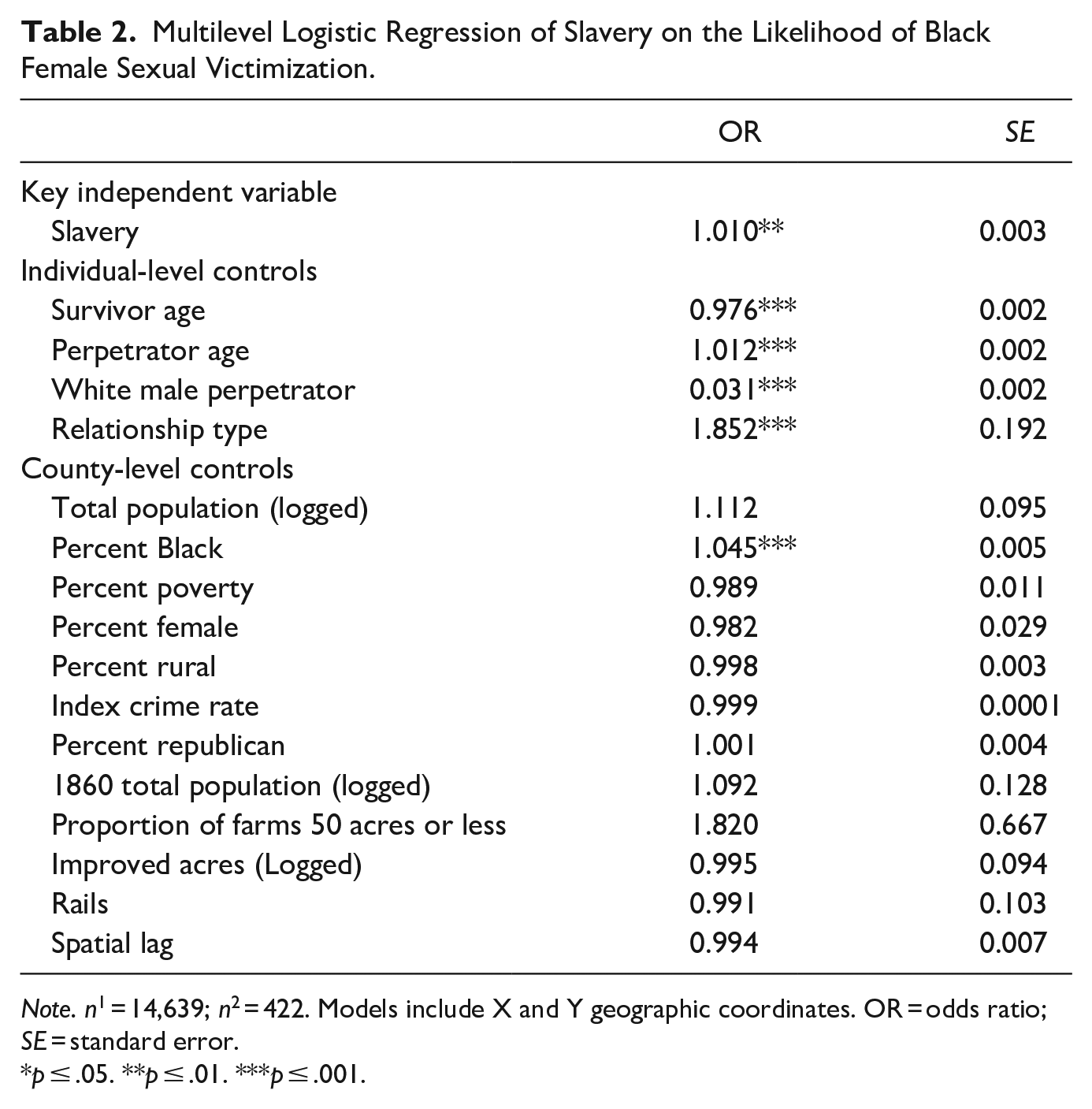
Table 2 illustrates the multilevel logistic regression effects of slavery on the likelihood of Black female sexual victimization. Before turning to the substantive findings of the current undertaking, several control variables warrant further attention. As it pertains to age, the current analyses reveal that both age of the survivor and perpetrator are significantly associated with Black female sexual victimization. Particularly, as Black females get older, they are significantly less likely to be sexual victimized (odds ratio [OR] = 0.976). Conversely, Black females are more like to be sexually victimized by older perpetrators (OR = 1.012). Moreover, Black females are significantly less likely to be sexually victimized by White males (OR = 0.031). This is consistent with research that has suggested that intraracial crime is more prevalent that interracial crime (see Becker, 2007; Hipp et al., 2011; Parker & McCall, 1999; Stotzer, 2014). In line with prior research that suggest survivors of sexual assault are more likely to know their abusers, the analysis reveals that Black females are significantly more likely to know their perpetrator (OR = 1.852). As it pertains to the contextual-level variables, the analyses reveal that Black females are significantly more likely to experience sexual victimization in counties that have larger Black populations (OR = 1.045). This finding is consistent with the racial threat perspective that suggests that there will be intensified social control in areas where the increasing Black population represents a threat to the White population (see Blalock, 1967; Jacobs et al., 2005; Kent & Jacobs, 2005; Parker et al., 2005; Ousey & Lee, 2008).
Multilevel Logistic Regression of Slavery on the Likelihood of Black Female Sexual Victimization.
Note. n1 = 14,639; n2 = 422. Models include X and Y geographic coordinates. OR = odds ratio; SE = standard error.
p ≤ .05. **p ≤ .01. ***p ≤ .001.
With regard to the substantive topic of the current research, Table 2 demonstrates that slavery is significantly associated with increases in the likelihood of Black female sexual victimization (OR = 1.009). In other words, Black females were significantly more likely to experience sexual victimization in counties that had larger percentages of enslaved people in 1860 than White females. This finding suggests that the effects of slavery continue to be woven into the fabric of America even though the institution was abolished over 150 years ago. More specifically, the results from this study suggest that the brutalization of Black women during slavery may, at least partially, explain patterns of Black female sexual victimization contemporarily. Slavery created an environment where Black women experienced high rates of sexual victimization. In the absence of slavery, the disregard for black bodies did not dissipate. Instead, the culture of sexually victimized Black women created by slavery continues to be pervasive in places where slavery was more prevalent.
Some research has disaggregated sexual victimization by type, suggesting that the predictors of one type of sexual victimization may not lend themselves to others. As such, the current study accounts for potential differences across sexual victimization offenses by running separate analyses to test the effects of slavery on rape 7 and fondling. As demonstrated in Table A1 in the Appendix, the analysis reveals that Black females are significantly more likely to experience rape (OR = 1.010) and fondling (OR = 1.011) than White females in places that had larger enslaved populations in 1860. The results of the control variables are in line with the findings presented in Table 1.
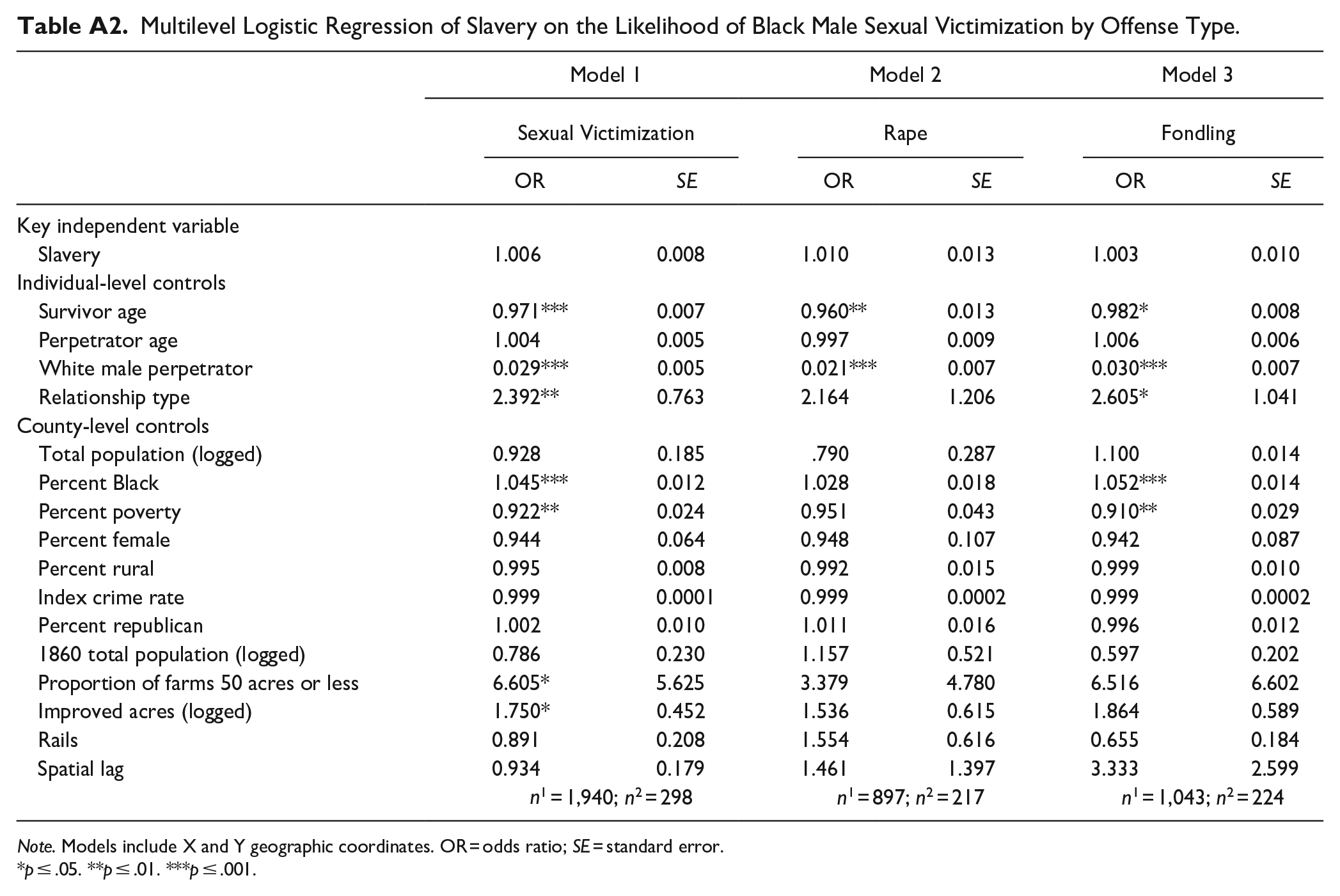
Certainly, Black males have historical traumas that are related to slavery, which may also include sexual victimization. To fully understand whether the effects of slavery on sexual victimization are peculiar to Black females and not all Black people, I ran supplementary analyses to explore whether slavery is consequential for Black male sexual victimization (1 = Black male sexual victimization, 0 = White male sexual victimization). Table A2 in the Appendix reveals that slavery is not significantly associated with the likelihood of sexual victimization of Black males. The findings here suggest that while slavery certainly has a devastating impact on the Black families, Black men, and African American culture, some experiences, like sexual victimization, may be more consequential for Black females. The absence of a relationship here suggests that slavery negatively impacted Black females in a way that it did not Black males.
Discussion and Conclusions
In the antebellum United States, both enslaved men and women were considered “chattel” (King, 2014). This designation left those enslaved without legal rights to their person, including protection from sexual violence. This was especially consequential for enslaved females as rape was historically “raced” and “gendered” (King, 2014). Having rape defined by race and gender assumed that rape could only be the sexual victimization of White females by Black males and Black females by White males. The race and gender differences in the definitions of rape also meant that the legal ramification varied based on the race of the victim and perpetrator (King, 2014). It was commonplace for Black men to be punished, legally and extra-legally, for abusing White women (Kemble, 1984; Sommerville, 1995). Perpetrators of Black sexual assault, regardless of race, often went unpunished because Black females were assumed to be promiscuous and consented to illicit sex (Kemble, 1984; Sommerville, 1995). In addition to their victimization during slavery, there is much evidence that suggest that there was sexual violence against Black females during the Civil War and post-emancipation period (King, 2014). In fact, Black women were more vulnerable to rape during the Civil War because “hostile white civilians who resented the social, economic, and political changes brought by war used rape as an instrument of terror to regain or solidify power and privileges lost as a result of slavery” (King, 2014, p. 184). Writings such as, “Us Colored Women Had to Go Through a Plenty” and Incidents in the Life of a Slave Girl, discuss the “wrongs and sufferings and mortifications” of Black females during slavery that made their experiences “peculiarly their own” (Jacobs, 2009; Jennings, 1990; King, 2014).
In modern times, women continue to experience alarming rates of sexual victimization. Despite the historical accounts of the sexual victimization of Black women during slavery and beyond, limited research has empirically explored the relationship between slavery and the contemporary sexual victimization of Black women. The current study endeavors to fill this void by exploring whether slavery is consequential for the contemporary instances of Black female sexual victimization. The current study reveals that slavery is significantly associated with an increase in the likelihood of sexual victimization of Black women, suggesting that the legacy of slavery continues to be consequential for contemporary outcomes, including the sexual exploitation of Black women. Taken together, this research advances the literature in several notable ways. It highlights a correlate that has been understudied in the sexual victimization literature—slavery. This line of research is important because it illuminates how slavery may have been particularly consequential for Black women and how the peculiar effects of slavery for women may manifest themselves contemporarily. To my knowledge, little research has examined the ways that the effects of slavery persist for Black women. Current research is not gendered, suggesting that the effects of slavery exist regardless of gender. While this research does not detract from the powerful findings that suggest that the effects of slavery are everlasting for all Black people, research should recognize that there may be unique experiences that differ by gender. Here, I argue that the sexual brutalization of Black women during slavery is consequential for how we disregard Black women’s bodies contemporarily.
Moreover, research exploring the effects of race on sexual victimization has also been rather limited. Research exploring the correlates of sexual victimization has often grouped women as a collective, often failing to make racial distinctions. This is a missed opportunity to identify factors that may be unique to one group of women when compared to another. Accounting for racial differences in explaining sexual victimization will better position policymakers and healthcare providers to identify and treat survivors. The current research further illuminates racial differences in sexual victimization. Additionally, there has been a paucity of research in the sexual victimization literature that has explored both the individual- and contextual-level factors associated with sexual victimization. In addition to supporting much of the research exploring the individual factors associated with sexual victimization, the current study adds to a gap in the literature by further exploring the contextual factors associated with sexual victimization.
Despite these contributions, the current study is not without limitations. The research should be the first step of many to further develop the relationship between the abuse of women to their historical treatment. Future research should further contextualize the relationship between slavery and sexual victimization by exploring mediating and moderating processes. In addition, some scholars have criticized literature that examine the contemporaneous effects of slavery, arguing that slavery may be a proxy for other forms of racism. Albeit a racist institution, I contend that slavery created an environment that made it socially and legally acceptable to decimate Blackness through capturing, enslaving, stealing, exploiting, and raping Black people. Slavery, then, was the impetus for which we can understand the continued mistreatment of Black people and the development of racist policy, aimed at continuing the devaluation of Black people. In addition, this current study is a cross-sectional analysis. Through longitudinal analyses, future research should explore whether this relationship exists over time. Next, the effects found here may be conservative given the underreporting of sexual violence (Decker et al., 2019; Richie & Eife, 2021). Given the limitations of official data, future research should consider using victimization surveys to explore this relationship.
Finally, there are several policy implications. First, policymakers should consider the effects of limiting the scope of history and race within the academic setting. Including curricula that accurately capture American history has the potential to lay the foundations of social justice. In addition, legislation should account for the racial nature of sexual victimization, especially in places characterized by slavery. Specifically, more resources should be devoted to victim advocates in places with a greater historical connection to slavery. In doing so, anti-rape organizations should hire cuturally competent staff and provide them with opportunities for job advancement (Calderon, 2004; West, 2012). These service providers should become more familiar with American history, to include slavery; and, instead of using them as a basis for stereotypes, use them as an impetus for help (see West, 2012). Finally, healthcare professionals and criminal justice actors should have ongoing racial bias and sensitivity training to be able to better address and provide resources for survivors of sexual victimization.
Footnotes
Appendix
Multilevel Logistic Regression of Slavery on the Likelihood of Black Male Sexual Victimization by Offense Type.
| Model 1 | Model 2 | Model 3 | ||||
|---|---|---|---|---|---|---|
| Sexual Victimization | Rape | Fondling | ||||
| OR | SE | OR | SE | OR | SE | |
| Key independent variable | ||||||
| Slavery | 1.006 | 0.008 | 1.010 | 0.013 | 1.003 | 0.010 |
| Individual-level controls | ||||||
| Survivor age | 0.971*** | 0.007 | 0.960** | 0.013 | 0.982* | 0.008 |
| Perpetrator age | 1.004 | 0.005 | 0.997 | 0.009 | 1.006 | 0.006 |
| White male perpetrator | 0.029*** | 0.005 | 0.021*** | 0.007 | 0.030*** | 0.007 |
| Relationship type | 2.392** | 0.763 | 2.164 | 1.206 | 2.605* | 1.041 |
| County-level controls | ||||||
| Total population (logged) | 0.928 | 0.185 | .790 | 0.287 | 1.100 | 0.014 |
| Percent Black | 1.045*** | 0.012 | 1.028 | 0.018 | 1.052*** | 0.014 |
| Percent poverty | 0.922** | 0.024 | 0.951 | 0.043 | 0.910** | 0.029 |
| Percent female | 0.944 | 0.064 | 0.948 | 0.107 | 0.942 | 0.087 |
| Percent rural | 0.995 | 0.008 | 0.992 | 0.015 | 0.999 | 0.010 |
| Index crime rate | 0.999 | 0.0001 | 0.999 | 0.0002 | 0.999 | 0.0002 |
| Percent republican | 1.002 | 0.010 | 1.011 | 0.016 | 0.996 | 0.012 |
| 1860 total population (logged) | 0.786 | 0.230 | 1.157 | 0.521 | 0.597 | 0.202 |
| Proportion of farms 50 acres or less | 6.605* | 5.625 | 3.379 | 4.780 | 6.516 | 6.602 |
| Improved acres (logged) | 1.750* | 0.452 | 1.536 | 0.615 | 1.864 | 0.589 |
| Rails | 0.891 | 0.208 | 1.554 | 0.616 | 0.655 | 0.184 |
| Spatial lag | 0.934 | 0.179 | 1.461 | 1.397 | 3.333 | 2.599 |
| n1 = 1,940; n2 = 298 | n1 = 897; n2 = 217 | n1 = 1,043; n2 = 224 | ||||
Note. Models include X and Y geographic coordinates. OR = odds ratio; SE = standard error.
p ≤ .05. **p ≤ .01. ***p ≤ .001.
Declaration of Conflicting Interests
The author declared no potential conflicts of interests with respect to the authorship and/or publication of this article.
Funding
The author received no financial support for the research and/or authorship of this article.
