



Abstract
To elucidate potential economic pathways that may improve violence prevention among Black youth and young adults, we estimated the association of state minimum wage and annual firearm mortalities from 2000 to 2020 among Black individuals aged 10 to 34 using data from the National Vital Statistics System. Two-way fixed effects models were used to analyze the relationship between state minimum wage and overall firearm deaths, as well as firearm deaths by category, including homicide and suicide. Additionally, models were stratified by age group. We found that a $1 increase in state minimum wage was associated with a 5% decrease (RR = 0.95, 95% CI [0.92, 0.98]) in overall, annual firearm mortality and a 6% decrease (RR = 0.94 [0.91, 0.98]) in annual homicides caused by firearms, adjusted for covariates and state and year fixed effects. Our findings in overall and homicide mortalities held true across all age groups. For the association between minimum wage and suicide among Black youth and young adults, the results were roughly null overall (RR = 0.99 [0.96, 1.02]). These estimates, however, were not robust to additional analyses examining the plausibility of the parallel trends assumption. Re-estimation of models including 1- and 2-year leads and lags suggest that changes in firearm mortality preceded changes in the minimum wage. Thus, the decrease in firearm deaths is likely due to a myriad of socioeconomic shifts that coincide with, but were not directly caused by, minimum wage increases. This research emphasizes the importance of further evaluating the complex relationship between economic policies and firearm violence and prevention.
Introduction
In the United States, firearm violence is a persistent, pervasive public health concern. In 2022 alone, 48,204 deaths were caused by firearms (CDC, n.d.; Goldstick et al., 2019; Kaufman et al., 2021; Kegler et al., 2022; Wen & Goodwin, 2016). Notably, Black youth and young adults are disproportionately affected by firearm-related injury and death compared to their peers (Kegler et al., 2023; Lawrence et al., 2023; Mariño-Ramírez et al., 2022). Individuals living in poverty are particularly susceptible to firearm violence, as firearm events are concentrated in urban, economically disadvantaged areas, and increased income inequality is strongly associated with higher rates of firearm-related violence (Abaza et al., 2020; Agoubi et al., 2024; Rowhani-Rahbar et al., 2022; Spitzer et al., 2023). These structural conditions often intersect with racial inequities, compounding mortality risk for Black communities (Gong, 2025; Mode et al., 2016). Exploring structural solutions to the significant health disparities experienced by Black youth imperative.
In extant literature, there are mixed findings about the potential of increased state minimum wage as a primary prevention strategy to reduce violence. One study found that during income shocks, states with a higher minimum wage experienced a reduction in overall crime rates and more substantial effects among young workers (Yang, 2020). Another study found consistent protective associations between increased minimum wage and firearm deaths by age, race, and gender (Merrill-Francis et al., 2024). However, the impact of minimum wage on youth violence remains debated with some literature suggesting that youth violence actually increases when the minimum wage increases because of lost youth employment opportunities (Beauchamp & Chan, 2014), and one study found no preventive effect among Black youth (Woods-Jaeger et al., 2024). Given mixed results to date, our goal was to conduct a rigorous quasiexperiment to examine the effects of minimum wage specifically on firearm deaths among Black youth. We test the prevention hypothesis that increases to minimum wage will reduce firearm deaths among Black youth and young adults. Secondly, we explore potential differential prevention effects by age.
Methods
We estimated the association of state minimum wage and annual firearm mortalities among Black youth and young adults (aged 10–34 years), both overall and by age, using a series of two-way fixed effects (TWFE) models.
Minimum Wage
Minimum wage data was compiled through 2015 in partnership with Temple University Center for Public Health Research (Komro et al., 2016). Updated data from 2016 through 2020 was compiled using information available on the effective dates of minimum wage changes from states’ department of labor. These data were further validated against pre-existing year-level data compiled by the University of Kentucky’s Center for Poverty Research (UKCPR National Welfare Data, 1980–2022, 2024). For analyses, we utilized the minimum wage, adjusted to 2020 dollars, for the month of January for each state-year of data.
Firearms Mortality
We obtained mortality outcomes from the National Vital Statistics System (NVSS), which provides complete census mortality data, and restricted them to those aged 10–34 and identified as Black. Deaths related to firearms were identified using the following ICD-10 codes listed as the cause of death: W32–W34 (accidental discharge of firearm), X72–X74 (intentional self-harm by firearm), X93–X95 (assault by firearm), or Y22–Y24 (firearm discharge, undetermined intent). Due to changes in race reporting, bridged race was unavailable after 2020, so we restricted the years of data from 2000 to 2020 (Heron, 2021). For firearm mortalities, we calculated an overall rate, which included the four discharge intentions, accidental discharge of firearm, intentional self-harm by firearm or suicide, assault by firearm or homicide, and firearm discharge with undetermined intent or unknown, as well as specific rates for suicide and homicide. Because the impact of economic policies may vary by developmental period (Ash et al., 2023), we calculated rates of firearm mortalities for all Black individuals aged 10–34 years, as well as rates stratified by age groups: 10- to 18-year-olds, 19- to 25-year-olds, and 26- to 34-year-olds.
Covariates
National Welfare Data from the University of Kentucky Center for Poverty Research were used for annual, state-specific economic covariates (UKCPR National Welfare Data, 1980–2022, 2024). These state economic covariates include: unemployment rate measured as a percentage of the labor force; gross domestic product (in millions); poverty rate (percent); and maximum monthly Aid to Families with Dependent Children/Temporary Assistance for Needy Families and Food Stamp benefit for a 3-person family. Additionally, we utilized the Traveler’s Guide to the Firearms Laws of the 50 States, an annual report that includes a permissiveness scale for each state’s firearm laws, as a proxy for state firearm policy and ownership (Das et al., 2021; Kappas, 2022). American Community Survey (ACS) 1-year estimates were used to estimate annual, state population estimates of Black youth and young adults (American Community Survey (ACS) Public Use Microdata Sample (PUMS), 2000–2022).
Statistical Analysis
Poisson models with standard errors clustered at the state level were used to evaluate the impact of state-level minimum wage on firearm mortality among Black youth and young adults. The annual state population of Black individuals aged 10–34 years was used as the offset for models estimating the impact of the policy for all Black youth and young adults; when models were stratified by age group, we used the annual state population for Black individuals restricted to the corresponding age group. We estimated the impact of state minimum wage on firearm deaths, overall and by discharge intent, among Black youth and young adults, overall and stratified by age group. State fixed effects accounted for differences between states that affect firearm mortality, and year fixed effects accounted for changes over time in firearm mortality that are common across states. We further adjusted for residual confounding by including the state-level policy and economic covariates. To assess the plausibility of the parallel trends assumption inherent in our TWFE models, we estimated additional models including minimum wage 1- and 2-year leads and lags. At the reviewer's request, models also estimated the associations for White decedents. Results were similar to those for Black decedents and not discussed further (Tables S2–S4). Additional sensitivity analyses restricting the youth to those of working age, 14- to 18-year-olds, found similar results to the 10- to 18-year-old group, and are not discussed further. The threshold for statistical significance was set at .05. All analyses were conducted using SAS version 9.4.
Results
From 2000 to 2020, a one-dollar increase in state minimum wage was associated with a 5% decrease in total firearms mortality (RR = 0.95, 95% CI [0.92, 0.98]) and a 6% decrease in annual firearms deaths classified as homicide (RR = 0.94 [0.91, 0.98]), after adjusting for covariates and state and year fixed effects (Table 1). The estimated association between minimum wage and suicides among Black youth was compatible with no effect (RR = 0.99 [0.96, 1.02]). When stratified by age groups, similar patterns were observed for the association between minimum wage and firearms deaths. Across all age groups, a dollar increase in the minimum wage was associated with approximately a 5% decrease in total firearm-related mortality and homicides, while the association between minimum wage and firearm suicides was comparable with no effect (Table 2).
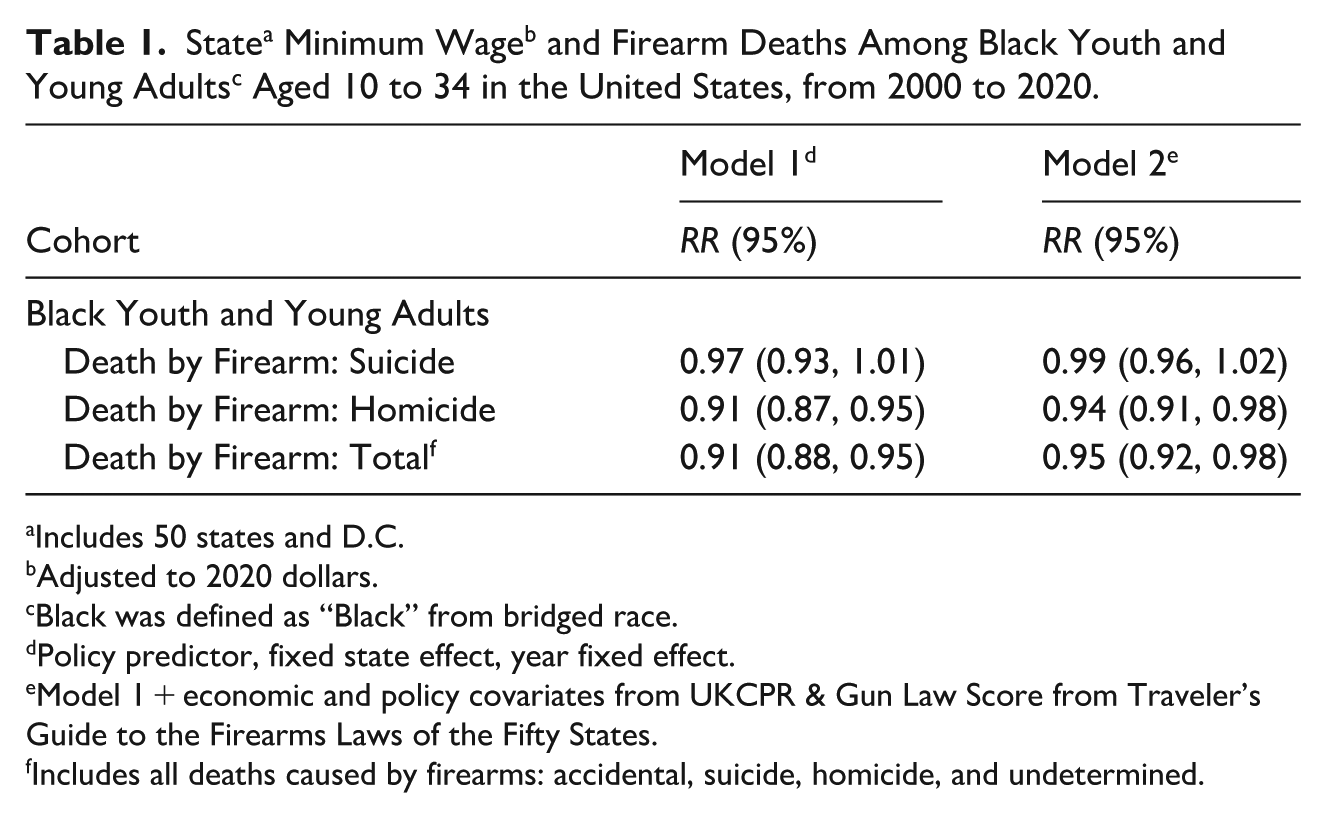
Includes 50 states and D.C.
Adjusted to 2020 dollars.
Black was defined as “Black” from bridged race.
Policy predictor, fixed state effect, year fixed effect.
Model 1 + economic and policy covariates from UKCPR & Gun Law Score from Traveler’s Guide to the Firearms Laws of the Fifty States.
Includes all deaths caused by firearms: accidental, suicide, homicide, and undetermined.
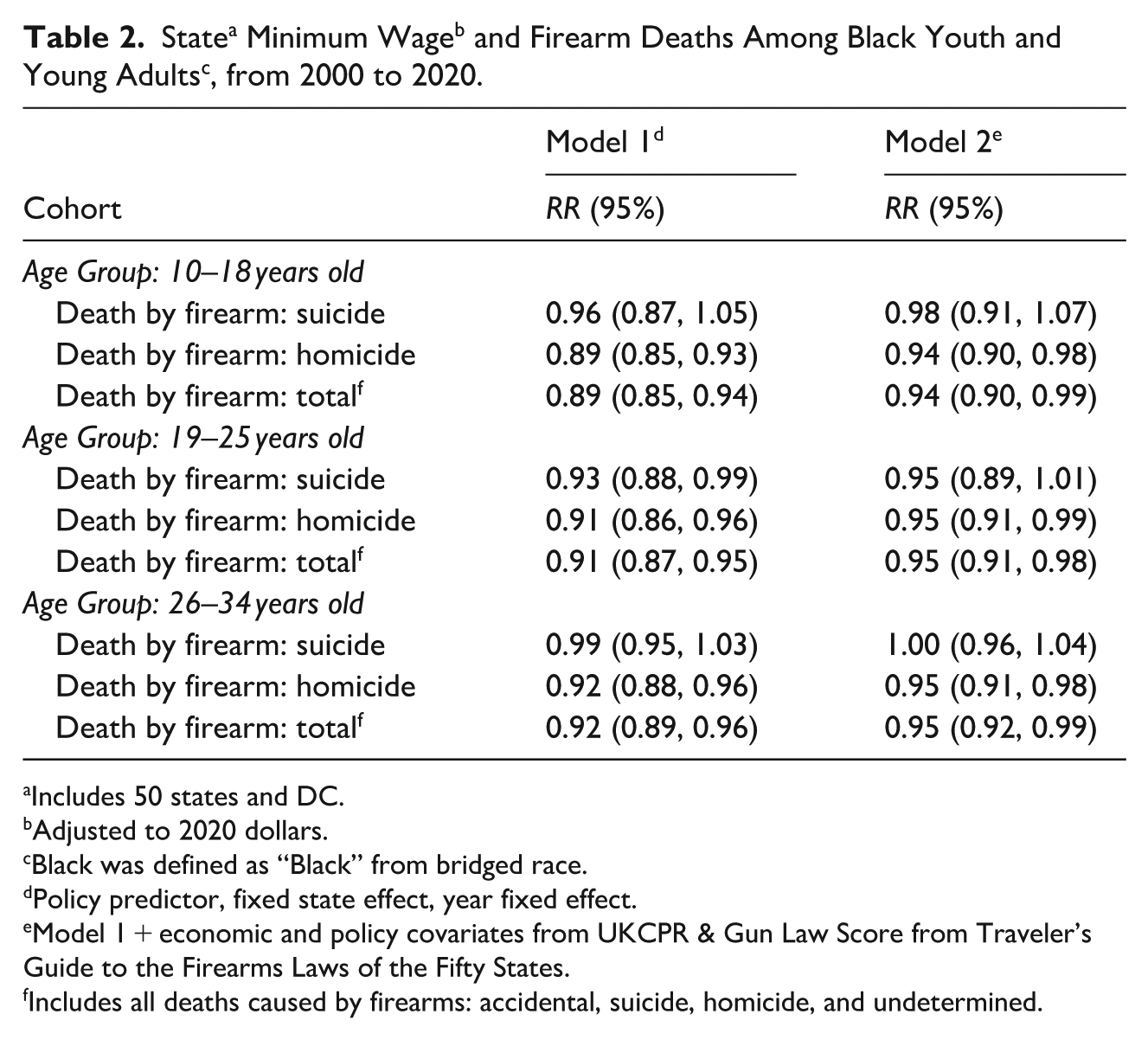
Includes 50 states and DC.
Adjusted to 2020 dollars.
Black was defined as “Black” from bridged race.
Policy predictor, fixed state effect, year fixed effect.
Model 1 + economic and policy covariates from UKCPR & Gun Law Score from Traveler’s Guide to the Firearms Laws of the Fifty States.
Includes all deaths caused by firearms: accidental, suicide, homicide, and undetermined.
However, these estimates were not robust to additional analyses examining the plausibility of the parallel trends assumption. When re-estimating models examining the association between state minimum wage and total firearms mortality, including 1- and 2-year leads and lags, the association between minimum wage and firearms deaths was driven largely by the minimum wage leads, and not contemporaneous or lagged minimum wage variables (Table 3). In other words, estimates indicate that changes in firearm mortality preceded changes in the minimum wage. This pattern of results is indicative of a non-causal association in our prior TWFE models due to violations in the models’ identifying assumptions. Similar patterns were observed for firearm homicides.
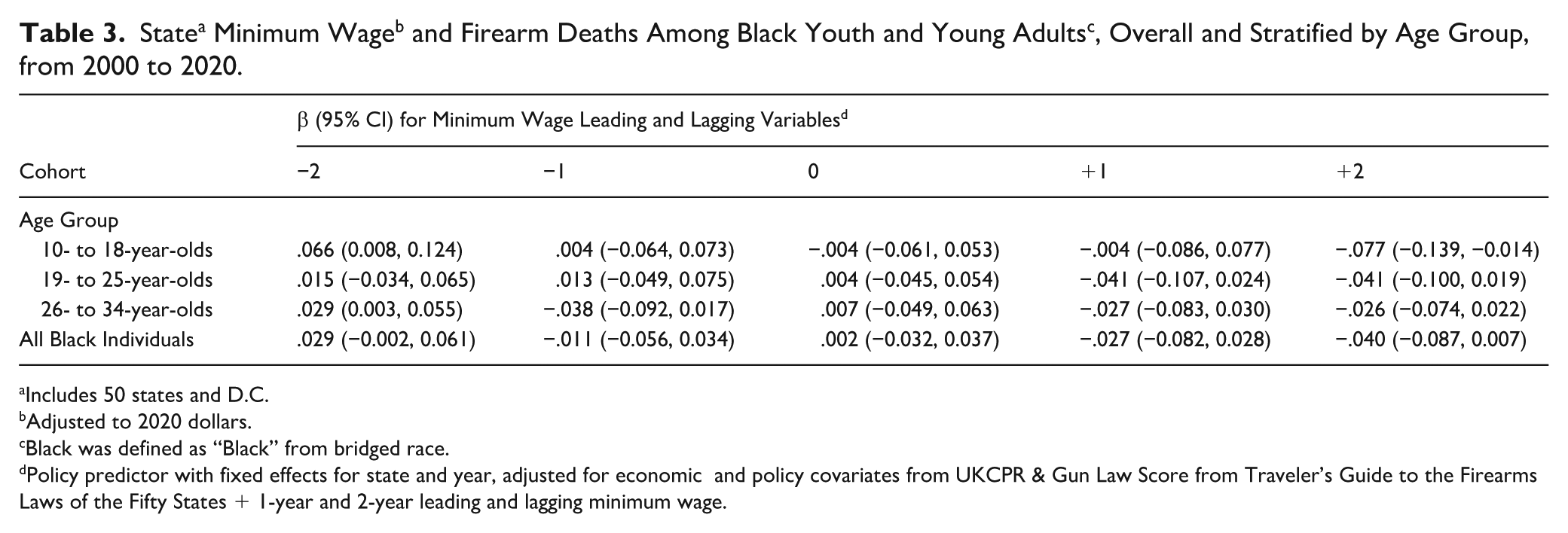
Includes 50 states and D.C.
Adjusted to 2020 dollars.
Black was defined as “Black” from bridged race.
Policy predictor with fixed effects for state and year, adjusted for economic and policy covariates from UKCPR & Gun Law Score from Traveler’s Guide to the Firearms Laws of the Fifty States + 1-year and 2-year leading and lagging minimum wage.
Discussion
This study examined the association between state minimum wage policies and firearm mortality among Black youth and young adults aged 10–34 years from 2000 to 2020, using TWFE models to leverage variation in state minimum wage laws across time. Initial analyses suggest that state minimum wage increases are associated with reduced firearm mortality among Black youth and young adults aged 10–34 years. However, subsequent robustness tests did not support this conclusion, as adding 1- and 2-year lags and leads resulted in associations that were most apparent in the policy leads and little association in contemporaneous or lagged policy indicators. Thus, the decrease in firearms deaths was not directly caused by minimum wage increases, but rather residual confounding, such as broader socioeconomic shifts.
Our findings contrast with those found by (Merrill-Francis et al., 2024), who found that an increase in a state’s minimum wage was associated with a decrease in firearms deaths among Black decedents, due to two key differences. First, they calculate a different relative metric of the minimum wage, expressed as a function of the state’s prevailing minimum wage and median household income, while we examine explicit changes in the state law. Second, Merrill-Francis et al. did not conduct the additional sensitivity analyses examining the plausibility of the TWFE models identifying assumptions, which is likely the key difference between our findings.
Our study has several strengths worth highlighting. Our TWFE models leverage natural variation in state minimum wage policies over time, providing a quasi-experimental approach to estimating policy effects. We use models that include lags and leads to test the robustness of our identifying assumptions. The use of complete mortality data from the NVSS ensures comprehensive capture of all firearm deaths. Lastly, our analyses account for a range of state-level economic conditions and policies that might confound the relationship between minimum wage and firearm mortality. There are also limitations that deserve mentioning. First, our measure of state minimum wage does not account for variations in the cost of living across states, which may influence the practical value of minimum wage increases. Second, we are only able to use state minimum wages in our models, ignoring within-state variation in the minimum wage. Third, while we adjusted for other economic factors, economic policies, and a state’s firearms environment, additional unmeasured confounders may exist.
In conclusion, while our initial analyses suggested associations between state minimum wage increases and reduced firearm mortality among Black youth and young adults, our sensitivity analyses highlight methodological challenges in establishing causality. Consistent with prior work showing diminishing returns for minimum wage increases among Black youth (Assari, 2018), our results show that minimum wage in isolation may not be sufficient to avert violent outcomes.
Supplemental Material
sj-docx-1-jiv-10.1177_08862605261451865 – Supplemental material for State-Level Minimum Wage and Firearm Deaths Among Black Youth and Young Adults in the United States, 2000 to 2020
Supplemental material, sj-docx-1-jiv-10.1177_08862605261451865 for State-Level Minimum Wage and Firearm Deaths Among Black Youth and Young Adults in the United States, 2000 to 2020 by Courtney Hoge, Tasfia Jahangir, Ebony Johnson, Imani Belton, Kelli Komro, Briana Woods-Jaeger and Melvin Livingston in Journal of Interpersonal Violence
Supplemental Material
sj-docx-2-jiv-10.1177_08862605261451865 – Supplemental material for State-Level Minimum Wage and Firearm Deaths Among Black Youth and Young Adults in the United States, 2000 to 2020
Supplemental material, sj-docx-2-jiv-10.1177_08862605261451865 for State-Level Minimum Wage and Firearm Deaths Among Black Youth and Young Adults in the United States, 2000 to 2020 by Courtney Hoge, Tasfia Jahangir, Ebony Johnson, Imani Belton, Kelli Komro, Briana Woods-Jaeger and Melvin Livingston in Journal of Interpersonal Violence
Supplemental Material
sj-docx-3-jiv-10.1177_08862605261451865 – Supplemental material for State-Level Minimum Wage and Firearm Deaths Among Black Youth and Young Adults in the United States, 2000 to 2020
Supplemental material, sj-docx-3-jiv-10.1177_08862605261451865 for State-Level Minimum Wage and Firearm Deaths Among Black Youth and Young Adults in the United States, 2000 to 2020 by Courtney Hoge, Tasfia Jahangir, Ebony Johnson, Imani Belton, Kelli Komro, Briana Woods-Jaeger and Melvin Livingston in Journal of Interpersonal Violence
Supplemental Material
sj-docx-4-jiv-10.1177_08862605261451865 – Supplemental material for State-Level Minimum Wage and Firearm Deaths Among Black Youth and Young Adults in the United States, 2000 to 2020
Supplemental material, sj-docx-4-jiv-10.1177_08862605261451865 for State-Level Minimum Wage and Firearm Deaths Among Black Youth and Young Adults in the United States, 2000 to 2020 by Courtney Hoge, Tasfia Jahangir, Ebony Johnson, Imani Belton, Kelli Komro, Briana Woods-Jaeger and Melvin Livingston in Journal of Interpersonal Violence
Supplemental Material
sj-pdf-5-jiv-10.1177_08862605261451865 – Supplemental material for State-Level Minimum Wage and Firearm Deaths Among Black Youth and Young Adults in the United States, 2000 to 2020
Supplemental material, sj-pdf-5-jiv-10.1177_08862605261451865 for State-Level Minimum Wage and Firearm Deaths Among Black Youth and Young Adults in the United States, 2000 to 2020 by Courtney Hoge, Tasfia Jahangir, Ebony Johnson, Imani Belton, Kelli Komro, Briana Woods-Jaeger and Melvin Livingston in Journal of Interpersonal Violence
Footnotes

Ethical Considerations
The Emory University Institutional Review Board approved the research reported in this manuscript (STUDY00006896) as non-human subjects research.
Funding
The authors disclosed receipt of the following financial support for the research and/or authorship of this article: Supported by the National Center for Injury Prevention and Control under grant R01CE003604.
Declaration of Conflicting Interests
The authors declared no potential conflicts of interest with respect to the authorship and/or publication of this article.
Data Availability Statement
Minimum wage data are available through Dataverse, Emory University’s open data repository. Mortality data are restricted and cannot be shared.
Supplemental Material
Supplemental material for this article is available online.
Author Biographies
References
Supplementary Material
Please find the following supplemental material available below.
For Open Access articles published under a Creative Commons License, all supplemental material carries the same license as the article it is associated with.
For non-Open Access articles published, all supplemental material carries a non-exclusive license, and permission requests for re-use of supplemental material or any part of supplemental material shall be sent directly to the copyright owner as specified in the copyright notice associated with the article.
