



Abstract
Reducing lethal violence against women requires comprehensive measures addressing individual, social, economic, cultural, and situational factors. Regarding situational factors, access to weapons—and firearm access in particular—has received notable research attention. However, most study comes from the United States of America, and findings may not apply elsewhere. The current study examines whether changing gun laws in Australia affected female firearm homicide victimization. Female firearm homicide victimization may have been affected; however, no significant impacts were found for male firearm homicide victimization. Findings suggest there may be value in preventing legal access to firearms by persons who have a history of intimate partner violence, although considerable further study is required.
Lethal violence against women accounted for approximately 20% of the estimated 437,000 homicide deaths worldwide in 2012 (United Nations Office on Drugs and Crime [UNODC], 2014), and reducing levels of lethal violence against women represents an ongoing concern for practitioners and policymakers in the fields of health, justice, and social and economic policy. Among female homicide victims, a majority (approximately two thirds) are killed by a current or former intimate partner (UNODC, 2014), making the reduction of intimate partner homicide (IPH) a key priority for addressing lethal violence against women more broadly. IPH has an estimated median prevalence of approximately 13% of homicides globally (World Health Organization, 2013), with the dramatic overrepresentation of female IPH victims making this form of violence an unquestionably gendered crime (for pioneering works, see Daly & Chesney-Lind, 1988; Dobash & Dobash, 1979; Pence & Paymar, 1993). Developing strategies to prevent lethal violence against women remains a challenge across nations, and calls for a comprehensive set of measures addressing a wide range of individual, social, economic, cultural, and situational factors (Wilkinson & Hamerschlag, 2005).
In terms of situational factors surrounding lethal violence against women, the availability of weapons—and the impacts of restricting the availability of facilitators of lethal violence—has received considerable attention. Access to firearms, in particular, has been given notable research consideration in the context of violence against women (e.g., DeJong, Pizarro, & McGarrell, 2011; Vittes & Sorenson, 2006, 2008; Vittes, Webster, Frattaroli, Claire, & Wintemute, 2013; Zeoli & Bonomi, 2015; Zeoli & Webster, 2010). As a result of the epidemiological focus of many studies, useful information is available about general patterns and trends in female firearm homicide victimization.
Far less is known about whether legislative measures concerning firearm access affect female firearm homicide victimization, and about the extent to which legislation may affect victimization rates. There remain gaps in knowledge about which types of legislative intervention may be effective in addressing female firearm homicide victimization, whether there are specific features or elements of legislation that may be most useful in assisting to reduce victimization, and how and why various different measures may (or may not) be effective. In addition, little research consideration has been given to questions such as whether factors like enforcement of laws—rather than legislation itself—may play a crucial role in protecting women from firearm homicide victimization.
Current Knowledge About Potentially Effective Legislative Interventions
In terms of formally evaluating the effects of firearm legislation on female firearm homicide victimization in particular, rather than firearm homicide victimization in general, existing research has examined a range of different legislative approaches. In the interests of brevity, a detailed review is not presented in this article; however, for additional information, the reader is referred to Frattaroli and Vernick (2006), Vigdor and Mercy (2006), and Webster and Wintemute (2015). Briefly, though, relevant legislative approaches fall into two dominant groups: laws to limit firearms access by persons who commit acts of domestic and family violence, using mechanisms such as linking apprehended violence or restraining orders with firearm prohibition orders and mandatory surrender of firearms (e.g., Bridges, Tatum, & Kunselman, 2008; Dugan, 2003; Raissian, 2016; Vigdor & Mercy, 2006; Vittes et al., 2013; Zeoli & Webster, 2010), and laws to limit firearm access by persons with general “disqualifying” offenses, such as violent misdemeanors (including but not limited to domestic and family violence), using measures such as background checks and purchase prohibition orders (e.g., Wright & Wintemute, 2010; Wright, Wintemute, & Rivara, 1999).
Although some inconsistent findings have emerged between the different studies, with a range of methodological challenges presenting themselves, several publications offer suggestive evidence that “firearm prohibition” orders for high-risk individuals, such as those under domestic violence restraining orders, are associated with lower levels of violence (for reviews, see Vigdor & Mercy, 2006; Webster & Wintemute, 2015). Such findings imply that certain legislative measures, if and when properly implemented and enforced (Webster et al., 2010), may offer promise for reducing female firearm homicide victimization rates.
Conceptual Framework
It is important to acknowledge that the legislative approaches outlined above draw on a body of theoretical and empirical knowledge about female homicide victimization, which primarily concerns IPH victimization. First, as Vigdor and Mercy (2006) pointed out, making it illegal for perpetrators of domestic and family violence to possess firearms (and attaching sanctions to possession) may increase the “costs” of perpetrating those acts of violence, potentially leading to a reduction in violence. Second, as a number of scholars have demonstrated, a key risk factor associated with IPH is that of past violence within a relationship (e.g., Campbell et al., 2003; Dawson, 2005; Dobash, Dobash, Cavanagh, & Medina-Ariza, 2007). It has also been found that in the context of intimate partner violence, access to lethal means may increase the risk of lethal violence occurring (e.g., Campbell et al., 2003; although also see Folkes, Hilton, & Harris, 2013). From a conceptual perspective, then, it would be expected that measures aimed at reducing the ability of perpetrators of domestic and family violence to access lethal means would translate to reductions in lethal violence using those particular means. Although it may be tempting to extend this expectation to include a reduction in lethal violence overall, rather than lethal violence using specific means such as firearms, the possibility of “method substitution” remains a largely unresolved question.
Gaps in Knowledge
Although there are some exceptions (e.g., Langmann, 2012), the vast majority of published literature examining female firearm homicide victimization comes from the United States. Given that country’s unique approach to firearms ownership and management, findings from the United States about firearms and IPH may not be representative of other countries’ experiences. This represents a clear gap in knowledge. It is, therefore, valuable to take a more international perspective on firearms in the context of lethal violence against women, and consider other countries’ experiences with legislative interventions aimed at restricting firearms access.
Australia particularly lends itself to the evaluation of the impact of legislative change on female firearm homicide rates. That country’s laws underwent a number of changes following the 1996 National Firearms Agreement (NFA), through which Australia’s federated states and territories agreed to implement a uniform set of firearms management principles. The legislative changes were introduced uniformly in all Australian jurisdictions during the same time period (1996-1997), rather than “staggered” over time or implemented at different times in different jurisdictions. Also, Australia’s relative geographical isolation and level of border control suggest that factors which may act as policy and/or evaluation confounds in other nations—such as cross-border transfer of firearms from states (or countries) with less restrictive jurisdictions—are far less likely to apply (Baker & McPhedran, 2007). This means that the Australian situation may reasonably be conceived of as a comparatively “pure” indicator of legislative impacts, relative to what may emerge in other countries.
Although a selection of studies to date have considered firearm homicide in Australia, with a consistent finding of no significant impact of the laws on firearm homicide rates (McPhedran, 2016), no research to date has undertaken gender-disaggregated analysis. However, consistent with observations made in other nations, Australian firearm homicide is a gendered crime—in the sense that the majority of victims are male (around 80%; see Bryant & Cussen, 2015; Chan & Payne, 2013; Dearden & Jones, 2008; Virueda & Payne, 2010). It is therefore possible that there may have been different effects of the legislative changes on male versus female firearm homicide victimization rates, but that these effects may not be apparent from an overall analysis of firearm homicide rates (which will tend to reflect patterns of male homicide victimization, given the high percentage of males in overall firearm homicide statistics). Consequently, it is desirable to examine firearm homicide in Australia by gender, to illuminate any differential impacts of legislation on males and female victimization, and assist in understanding whether any specific aspects of legislation may be beneficial in protecting women.
Australian Legislative Rationale
Australia’s 1996 firearm law reforms were introduced in reaction to a public mass shooting in which 35 people were killed. However, the purpose of the changes was described in the much broader context of improving overall community safety. For example, the then-Prime Minister of Australia stated that the scheme’s intent was to “. . . reduce the number of guns in the community and make Australia a safer place to live” (Howard, 1996), while the then-Attorney-General of Australia proposed that the laws offered “. . . the real chance of a safer festive season and New Year” (Williams, 1996).
It is important to note that lethal violence against women was not explicitly recognized within the general policy discourse that occurred at the time, the measures were not framed in that context, and there were no accompanying strategies rolled out during the scheme’s implementation to indicate that attempting to address lethal violence against women was a specific policy objective (e.g., there were no information campaigns about firearms and violence against women). This may seem unusual from an international perspective, given the existence of long-standing strategies to reduce gendered violence in countries, such as the United States, and the common practice of framing policy reforms against those strategies.
From an Australian perspective, though, the absence of mention of violence against women as a goal of firearm legislative change is likely to reflect the historical absence of clear, national strategies directed at reducing violence against women specifically. For instance, it was not until the mid-2000s that coordinated and funded national efforts to address violence against women, including public information campaigns and education, were supported by all jurisdictions’ governments and implemented around Australia. From the perspective of the current research, this is a positive feature because it reduces the extent to which external confounds, such as national violence prevention strategies specifically aimed at gendered violence, would be expected to influence observed homicide rates.
Australian Legislative Overview and Hypothesized Effects of Legislative Intervention
The 1996 NFA contained 11 major principles under which different individual elements were grouped. Box 1 contains more detailed information.
Outline of Legislative Principles Adopted in Australia Post-1996.

Various components of the legislative changes implemented in Australia may have a strongly “gendered” effect; that is, they may be more likely to affect female victimization than male victimization. In light of the conceptual framework around intimate partner violence and firearms as well as findings from earlier international research, discussed above, strengthening provisions around domestic violence and firearms possession would be expected to be particularly likely to affect female firearm homicide victimization in Australia. The Australian provisions draw on evidence from psychological and criminological literature, which suggest that past behavior is a useful predictor of future behavior. The legislative framework also has foundation in observations that a history of nonlethal partner violence perpetration is the most commonly found background factor associated with the commission of lethal partner violence (e.g., Campbell, Glass, Sharps, Laughon, & Bloom, 2007; Campbell et al., 2003).
Although not all female homicide victimization in Australia relates to incidents between intimate partners, lethal violence against women by a current or former intimate partner, nevertheless, represents a sizable proportion of all lethal violence against females in Australia. Although the actual number of female homicide victims fluctuates from year to year, a consistent feature is the overrepresentation of IPHs—typically, IPHs account for close to two thirds of all female victim homicides (Bryant & Cussen, 2015; Chan & Payne, 2013; Dearden & Jones, 2008; Virueda & Payne, 2010).
From this, it would be anticipated that measures which specifically consider limiting access to firearms in the context of intimate partner violence, if effective, would be likely to have a discernible impact on female firearm homicide victimization overall. In contrast, it would be expected that other measures—such as restrictions on the types of firearms that may be owned and/or the reasons for which they may be owned—would equally affect male and female homicide victimization rates, as there is no particularly gendered element to such laws. It is therefore reasonable to hypothesize that both female and male firearm homicide victimization rates in Australia would undergo significant declines post-1996, but that additional effects of the laws on female victimization may be apparent, relative to male victimization, due to the “gendered” element of some components of the changes.
Aims of the Current Study
Although a number of studies have examined the impacts of Australia’s changing legislation on firearm homicide at the aggregate level, to date there has been no research into whether the policy changes may have affected differently on males and females. The current study uses two different statistical methods to examine whether there is empirical evidence linking changed gun laws in Australia with changes in homicide victimization for males and females. The objective of this work is to begin to fill existing gaps in knowledge about the impacts of firearm legislative reform on female homicide victimization, in particular, to inform future policy development.
Method
Publicly available data were obtained from the Australian Bureau of Statistics (ABS) for assault-related deaths by firearm (i.e., homicides) and also for population by year and sex. Although those data are now routinely presented by cause of death (coded following International Classification of Diseases conventions) and sex, that form of reporting was only relatively recently introduced (in the mid-1990s). Earlier data were typically either disaggregated by sex, or by method, but not by both. To overcome this difficulty, information about the percentage of male victim firearm-related homicides (which was provided for the years 1980-1995) was used to calculate the number of deaths by sex, for earlier years of data. Given that count data were derived, rather than directly provided by the ABS, appropriate caveats should be applied. The resulting dataset spanned the period 1980-2013. The number of deaths was converted to a rate per 100,000 population, by sex, using population data.
Analytic Approach—Conceptual Overview and Tests Used
There are two complementary ways in which potential impacts of the legislative intervention can be studied. The first is to set 1996 as a predetermined “breakpoint” in the time series, and to compare pre- and post-1996 homicide victimization rates. This approach, although useful, is somewhat limited in that it may not detect “lags” in policy impacts (e.g., a policy may take some years to have a discernible effect). In other words, this approach assumes that the point in time when a policy was implemented will correspond with when the effects of that policy become apparent—an assumption that cannot necessarily be assumed to be correct (Lee & Suardi, 2010). To address this issue, it is desirable to incorporate tests that do not assume that a policy impact will necessarily correspond with the point in time when that policy was introduced, but which instead detect any significant changes in, for example, trends in homicide rates, regardless of when those changes may occur.
Taking into account the value of using more than one test, and following earlier studies, two different analytic approaches were used: Autoregressive Integrated Moving Average (ARIMA) modeling and Zivot–Andrews (ZA) structural breakpoint tests. These methods have been used on similar time series data (Baker & McPhedran, 2007; Langmann, 2012; Lee & Suardi, 2010), including to specifically test the impacts of legislative change on female firearm homicide victimization (McPhedran & Mauser, 2013). Best-fit ARIMA models were selected from examination of Akaike Information Criteria (AIC) and Bayesian Information Criteria (BIC), in conjunction with model fit statistics, and with the stipulations that all resulting predictions be positive values and that the model be both stable and invertible. Models were applied to the time series to 1996, switching to dynamic (out of sample) predictions from 1997 (inclusive) to 2013. The ARIMA model allows future values of the time series to be estimated by a linear combination of past values and a series of errors, and uses a maximum likelihood fit of the specified ARIMA model to the time series. This provided the opportunity to describe and predict the evolution of the time series to the year 2013. Predicted and actual rates of homicide were compared for each post-1996 time series, using t tests. The ARIMA method used in the present article sets a defined breakpoint in the data, corresponding with the implementation of the NFA in 1996.
In contrast, ZA tests do not presuppose a break in the data. Rather, this method detects the presence of a breakpoint in the data at any point in time rather than assuming the presence of a breakpoint at a “known” point (Zivot & Andrews, 1992). This enables the present study to detect any impacts that may have occurred in the years immediately following the NFA (thus taking into account possible lag in policy impacts), as well as any changes that may have occurred at other times, unrelated to any likely impacts of firearms legislation. As noted by McPhedran and Mauser (2013), in addition to identifying an endogenous structural break, the ZA test overcomes the difficulty identified by Perron (1989) that in failing to account for a structural break, conventional unit root tests (such as the Augmented Dickey–Fuller [ADF] test) may lead to the incorrect conclusion that the data contain a unit root, when the series is instead stationary around a structural break in the intercept (or “level” of a time series) and/or trend (commonly referred to as slope, or “rate of growth” of a time series). In instances where breaks in trends were detected by ZA tests, further examination of trends pre- and post-breakpoint was undertaken, using simple linear models, to provide indicative statistics about the relative slopes of the pre- and post-breakpoint trends.
Results
Figure 1 shows rates of firearm homicide victimization in Australia, for males and females, over time. Firearm homicide rates, although low even before the passage of the 1996 changes, have consistently been higher for males than females.
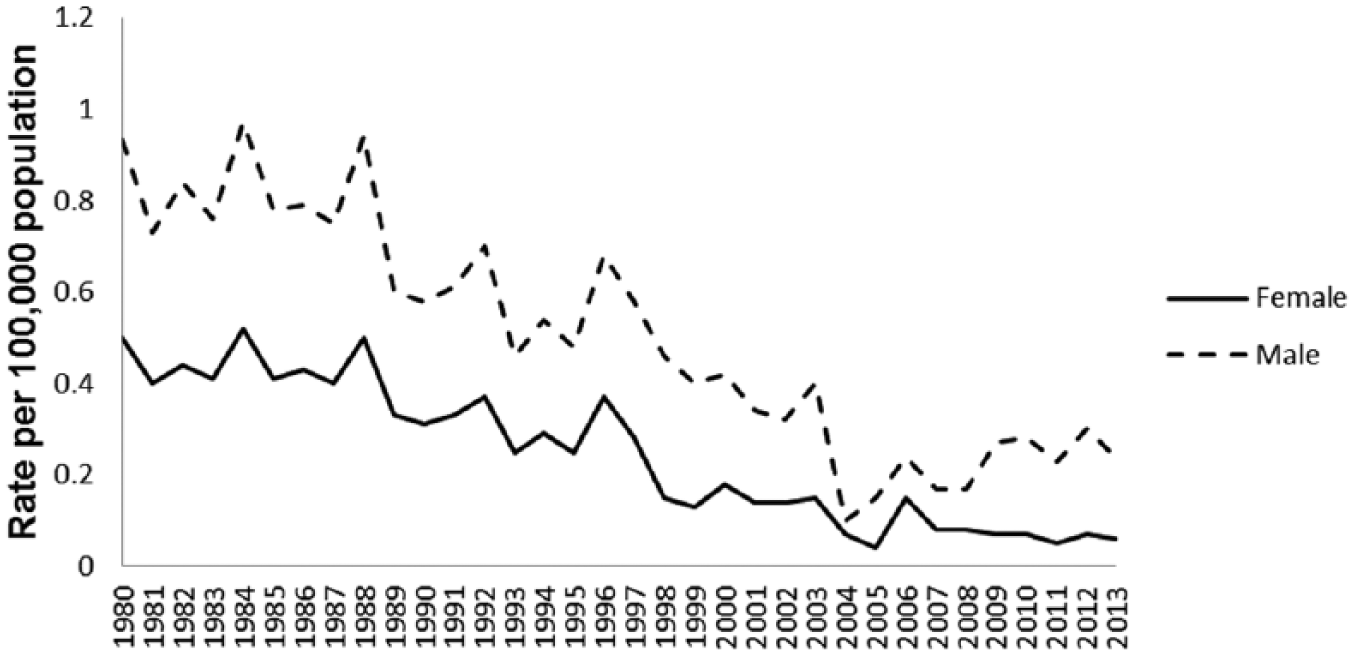
Rates of firearm homicide by sex, 1980-2013.
ARIMA Modeling
The observed rate of firearm homicide among males post-1996 did not differ significantly from the predicted rate (M predicted = 0.32, M observed = 0.30; t = 0.91, p = .38), model parameters AR(1),I(1),MA(1). These results imply that the preexisting downward trend in male victimization for firearm homicides was not affected by the legislative changes; if there had been an impact, then predicted rates would be expected to be significantly higher than actual rates.
In contrast, predicted and observed rates of firearm homicide for females, after 1996, differed significantly (M predicted = 0.18, M observed = 0.11; t = 5.99, p < .01; model parameters AR(2), I(1), MA(1). These results suggest that, when 1996 is used as a predetermined breakpoint in the time series for female firearm homicide rates, female firearm homicide rates after that point were lower than what would have been expected, based on forecasts using the time series pre-1996.
ZA Tests
Table 1 summarizes ZA test results for male and female firearm homicide time series, indicating years in which a significant breakpoint was found, as well as the t value and level of statistical significance corresponding with those breakpoints. For males, significant breaks were found in the firearm homicide time series during the years 2004 (trend and intercept) and 2008 (trend only and intercept only), neither of which correspond with the implementation of the 1996 legislative changes; indeed, visual inspection of Figure 1 indicates that the breaks denote upward shifts in rates, rather than declines, which suggests that the results are not indicative of any lagged impact of the legislative reforms. This was verified during regression modeling of the trends in pre- and post-breakpoint data. For the 2004 trend component of the trend and intercept break, the pre-break yearly trend beta coefficient was estimated at −0.89, while the post-2004 trend was estimated at 0.66—denoting the emergence of an upward rate of growth in male firearm homicide victimization after previous years of declines, along with an increase in absolute victimization levels. For the 2008 trend only break, the pre-break beta coefficient was estimated at −0.93, while the post-break beta coefficient was −0.19, suggesting a slowing of the overall long-term declines.
ZA Test Results for Structural Breakpoints.

For female firearm homicide, significant breaks were found for the years 1998 (intercept only, and trend and intercept) and 2006 (trend only), suggesting a possible one-off impact (or “shock”) of the NFA on absolute levels of female firearm homicide victimization (the intercept only break), as well as a change in the slope of the series (the trend and intercept break). The results also indicate an additional change in rate of growth at 2006 (the trend only break). For the trend component of the trend and intercept 1998 break, the pre-break yearly trend beta coefficient was estimated at −0.80, while the post-break beta coefficient was −0.72, suggesting that although the level of female firearm homicide victimization decreased post-1998, the trend component of that decline slowed somewhat, relative to the pre-1998 rate of decline. Regarding the trend only break at 2006, the pre-break beta coefficient was estimated at −0.92, while the post-break beta coefficient was estimated at −0.73, again suggesting a slowing of the overall long-term rate of decline.
Discussion
The present study suggests that the level of female firearm homicide victimization may have been affected by Australia’s legislative changes concerning firearms management, with different statistical tests pointing to a change in death rates shortly after the new laws were implemented. As noted in the introduction to this article, it is reasonable to expect that the type of changes most likely to affect female firearm homicide victimization are those that take into account the “gendered” nature of lethal violence against women, and which are strongly directed toward preventing legal access to firearms among persons who have a history of intimate partner violence. The current results are consistent with, and extend, international findings that background checks for license applicants and firearm prohibitions for domestic violence perpetrators may be associated with a decline in female firearm homicide victimization overall and female intimate partner firearm homicide victimization (McPhedran & Mauser, 2013; Vigdor & Mercy, 2006; Webster & Wintemute, 2015). Although the study was unable to consider female IPH victimization specifically, the consistent overrepresentation of IPH victims among female homicide victims overall makes this a reasonable inference to draw in the Australian context.
To appreciate the nuances of the 1996 reforms and illuminate specific pathways through which aspects of these changes may have affected female firearm homicide victimization, it is important to contrast the reforms with the pre-1996 legislation that already existed in Australian jurisdictions. It would be quite incorrect to assume that before 1996, there were no or very few controls over lawful firearms access in Australia. Licenses had been a requirement for firearms ownership since the late 1970s (earlier, in some jurisdictions), and by the early 1990s, all Australian states and territories had in place a number of elements that persist in legislation to the present day.
For example, before 1996, all jurisdictions had laws restricting firearm access to adults who had demonstrated “safety knowledge,” “safety training,” or “safety awareness,” and who were “suitable” or “fit and proper” persons to possess firearms (this included recognition, in some jurisdictions, that a person who had been convicted of a domestic violence offense or who was subject to a domestic violence/apprehended violence/restraining order was not a “suitable” or “fit and proper” person). All jurisdictions required firearms to be subject to “safe storage,” “secure storage,” or “kept in a place of safety,” and had in place waiting periods (of more than 21 days, and in most jurisdictions more than 28 days) which had to be served before a firearms license was issued. Although the exact wording used in legislation differed between jurisdictions, the principles articulated were consistent.
It is reasonable to say that the NFA brought about some considerable administrative changes. However, in many respects, those changes simply meant that the language of existing laws became more uniform and detailed; indeed, many elements of the NFA largely restated existing legislation, but with the addition of greater detail. This occurred, for example, by stipulating various types of offenses that would disqualify a person from holding a firearms license and expressly including domestic and family violence in that list (thus strengthening the existing, but somewhat vaguely articulated, pre-1996 legislative requirement around Australia that license applicants/holders be “fit and proper” persons), using wording that made provisions such as background checks a mandatory, rather than discretionary, part of the licensing process, and by clearly stipulating a considerable range of different grounds for license refusal/cancelation.
Importantly, the way in which the latter principle was reflected in post-1996 legislation around Australia differed from the pre-1996 situation in many jurisdictions, in that although the minimum standard for refusal/cancelation of licenses referred to convictions as one reason for refusal/cancelation, jurisdictions went beyond that standard such that a conviction was not necessarily required in order for police to refuse or cancel a license. This practice recognizes that there can be a wide range of different legal outcomes—such as an individual being found guilty of a violent offense, but not having a conviction recorded—that may have equally important implications for practical risk assessment.
Also, states and territories implemented various provisions requiring automatic suspension/cancelation of a license if a person was no longer deemed “fit and proper” to have that license; the practical effect of this, in the context of violence against women, is that any person who had previously been violent toward an intimate partner, or who became violent, would not be granted legal access to firearms. Again, this reflects a change from discretionary measures that may be taken, to a requirement that certain mandatory actions must be taken, in regard to firearms access by persons who have engaged in violent behavior.
Collectively, these subtle but important contrasts between key elements of Australia’s pre- and post-1996 legislation suggest that a crucial factor which may explain the post-1996 change in female firearm homicide victimization may have been the introduction of more clarity within laws concerning firearms and domestic violence, coupled with less leeway for the use of police discretion in matters such as background checks and license refusal/cancelation. It is reasonable to expect that these changes would have led to more stringent and uniform enforcement of provisions relating to license refusal/cancelation in the context of domestic and family violence offending. This would be consistent with U.S.-based observations made by Webster and others (2010), about the crucial role of enforcement and how variable enforcement of laws can relate to variations in the observed efficacy of measures designed to reduce firearm violence against women. Regrettably, no Australian data exist to allow empirical evaluation of this possibility.
The substantial range of different behaviors which serve to limit legal access to firearms by unsuitable or high-risk persons draws attention to “asymmetry” in the present results. Specifically, female firearm homicide victimization appears to have been significantly affected by the legislative changes, whereas no evidence emerged to suggest that male firearm homicide victimization had been affected. Although this study specifically sought to assess female victimization, it is a notable finding that male firearm homicide victimization was not significantly affected by the legislative changes. Given that males consistently constitute the majority of firearm homicides in Australia—representing more than 80% of firearm homicide victims each year (Bryant & Cussen, 2015; Chan & Payne, 2013; Dearden & Jones, 2008; Virueda & Payne, 2010)—this is an important result.
The reasons for this finding are somewhat unclear. Noting the wide range of violent and other behaviors which disqualify persons from holding a firearms license, it would be expected that male victimization rates, not just female victimization rates, should also have been affected by provisions designed to prevent unsuitable persons accessing firearms (or, indeed, by any or all of the other changes that were made post-1996). It is possible, though, that whereas the legislative changes may have broadly restricted the ability of unsuitable or high-risk persons to lawfully access firearms, this may not have materially affected the ability of those persons to illicitly access firearms.
There is a body of literature documenting the consistent prevalence of illegally owned firearms used in homicides in Australia, with the majority of firearm homicide offenders unlicensed (e.g., Chan & Payne, 2013; Davies & Mouzos, 2007; Mouzos, 2005). This provides a plausible explanation for why male firearm homicide victimization rates do not appear to have declined significantly after the reforms; those reforms emphasized legal, rather than illegal, access to firearms. However, if ongoing illegal firearm access provides insight into the absence of significant change in male firearm homicide victimization rates post-1996, then the question remains, why did female firearm homicide victimization rates show notable change post-1996? Even if the legislative changes ensured unfit individuals could not legally access firearms, it is reasonable to suggest that potential female victim homicide offenders could have illegally accessed firearms, just as male victim offenders appear to have done.
An explanation that allows for observations about male and female firearm homicide victimization to be reconciled with data concerning the high percentage of homicides involving illegal firearm access is that different offender “types” may be involved in male firearm homicide victimization, relative to female victimization. It has been found, for example, that among intimate partner violence offenders, some are violent only toward intimate partners, whereas others are generally violent/antisocial across all aspects of their lives rather than exclusively within intimate relationships (Holtzworth-Munroe & Stuart, 1994). Potentially, offenders who display violence toward intimate partners exclusively, and who do not engage in other violent/criminal behaviors, may be less likely/able to source illegal firearms than offenders who are generally violent/antisocial, for whom violence toward women is just one part of a wide spectrum of violent and other criminal behaviors. If so, then it would be expected that reducing the ability to access firearms of individuals who are violent toward intimate partners exclusively would influence female firearm homicide victimization rates.
Although breakdowns for the licensing status of offenders are typically not given for each category of relationship between offender and victim (e.g., intimates, acquaintances, strangers), it is logical to infer—from the overall patterns of firearm homicide and licensing status noted above—that most firearms used to kill women in Australia are not lawfully owned. This is consistent with the possibility that restricting legal firearm access by unfit persons will not prevent all unsuitable individuals from illegally accessing firearms, with individual offender characteristics and behaviors potentially playing a role in whether or not they illegally access firearms. Assessing firearm homicide offender typologies, and how those may relate to victim gender and the victim–offender relationship, is clearly a very fruitful direction for future research.
The issue of illicit firearms access also represents a challenge for future policy design. The role of illicitly held firearms in female firearm homicide victimization may flag the need to better identify individuals who have illicit access to firearms, and who also engage in violent behaviors toward a partner (as well as, quite potentially, toward others). To facilitate this, there may exist a role for programs designed not only to encourage women to report a partner’s illicit firearms access but also to ensure that those women are appropriately supported and protected from any harm as a result of their disclosure. Noting there are limitations in existing protections given to women who experience intimate partner violence, this represents a considerable difficulty for policy development and implementation.
This also raises questions about what type of policy measures may be most effective for reducing levels of male firearm homicide victimization. Although international meta-analytic research into this question flags the value of measures such as comprehensive, collaborative, community-based strategies specifically focusing on high-risk areas and individuals (e.g., Hahn et al., 2005; Makarios & Pratt, 2012), to date there has been no Australian research undertaken on this topic. Indeed, it appears from review of both academic literature and government agency reports that Australian efforts to reduce firearm homicide have focused strongly on legislative measures alone, rather than adopting a multifaceted approach.
The present study, although providing novel information about female firearm homicide victimization in Australia, contains a selection of limitations. The number of female firearm homicide victims in Australia has typically been low, even in the earlier years of the dataset, decreasing to fewer than 10 victims per year in the later years of data. As such, appropriate interpretive caution should be applied to the results, as the statistical findings of interest may have arisen as a consequence of the low sample size. Also, as noted above, even though a case can be made for drawing inferences about the possible impacts of particular legislative measures on intimate partner firearm homicide—based on the overall rates of female firearm homicide—it would be highly desirable to examine intimate partner firearm homicide victimization in its own right to better test these inferences. Regrettably, those data were not available; this point is expanded below.
Noting the findings of Langmann (2012), it would also be prudent to take into account external socioeconomic and structural factors, which may independently influence firearm homicide victimization, as controlling for such factors may mitigate effects observed in the present study. Although it was not the purpose of the present study to consider nonfirearm female homicide victimization, it would be extremely valuable to examine those data in future studies, to address the possibility that declines in female firearm homicide victimization may have been accompanied by increases in female homicide victimization from other methods (i.e., possible substitution of other methods). It is vital to acknowledge that factors other than legislative change may have influenced the changes in observed firearm homicide victimization rates. For example, evidence suggesting a change in trend for female homicide victimization was detected in 2006, which did not coincide with any significant epoch of legislative reform. The potential role of national violence prevention strategies and other policy interventions in influencing female homicide victimization rates in general, irrespective of method, should be examined in future work.
Finally, and perhaps most importantly, a recurrent difficulty, and a notable constraint on the study overall, is the absence of long-term, detailed, gender-disaggregated information about matters such as the exact nature of the relationship between offender and victim (whether they were intimate partners, friends, acquaintances, or strangers), the gender of offenders in relation to victims (e.g., how many males were killed by other males), the type of firearm used (e.g., were the firearms commonly used in pre-1996 homicides the same type prohibited by the 1996 legislative changes), whether offenders held a firearms license (noting that licenses were already required for lawful firearms access pre-1996), and whether the legal status of firearms varied depending on the type of relationship between offender and victim (e.g., were intimate partner violence offenders more or less likely to hold a firearms license than offenders who killed a friend or acquaintance, and did this vary pre- and post-1996). The generally poor level of detail contained in Australian data holdings around firearm homicide victimization, and pre-1996 data in particular, raises the frustrating prospect that these important questions may never be able to be fully tested—or, indeed, tested at all.
Overall, the present article adds to the relatively limited international body of literature evaluating firearms legislation and female firearm homicide victimization. Findings are suggestive of a “one-off” impact of legislative change on absolute levels of female firearm homicide victimization, supporting the hypothesis that there may be value in preventing legal access to firearms among persons who have a history of intimate partner violence, or who are otherwise deemed not “fit and proper” persons to access firearms. There may also be a role for policies encouraging and supporting women who disclose a partner’s illicit access to firearms. Although it is a concerning finding that no impacts emerged for male homicide victimization, with ongoing illegal firearms access by high-risk persons providing a possible explanation for this result, the study nevertheless offers new insights into associations between restricting legal firearms access and lethal firearm violence. Importantly, the study begins to fill gaps in international knowledge about firearm violence prevention, and implies that measures which specifically seek to prevent high-risk individuals from accessing firearms may be of assistance in reducing lethal firearm violence against women.
Footnotes
Declaration of Conflicting Interests
The author(s) declared the following potential conflicts of interest with respect to the research, authorship, and/or publication of this article: Samara McPhedran does not work for, consult to, own shares in or receive funding from any company or organization that would benefit from this article. She has been appointed to a number of firearms advisory panels and committees, most recently as a member of the Queensland Ministerial Advisory Panel on Firearms, and as a previous member of the Commonwealth Firearms Advisory Council. She does not receive any financial remuneration for these activities. She holds memberships with, and volunteers for, a range of not-for-profit firearm-related organizations and women’s advocacy groups. She is not a member of any political party.
Funding
The author(s) received no financial support for the research, authorship, and/or publication of this article.