



Abstract
Sales force compensation is influenced by various factors of development and change occurring at the individual, product, organizational and environmental levels. Companies that adapt to changing circumstances are likely to be more successful. The sales compensation strategy should be realigned according to changes in those factors. When they are viewed from the life cycle perspective, it gives rise to career life cycle of sales employees, product life cycle, organizational life cycle and business life cycle. Compensation practices are being increasingly planned and managed in response to changing circumstances. Whereas in the past researchers focused almost exclusively on how changes in compensation practices affect employee performance or satisfaction, researchers are now beginnings to ask how organizational as well as environmental conditions shape compensation practices. This article discusses several factors affecting the design of sales compensation systems and proposes a life cycle and a business value–added framework for strategic compensation planning.
Keywords
Introduction
The sales force normally knows business clients better than other employees and brings back much-needed information about the customers, markets and competitors. Every year firms invest significant resources in supporting their sales force. For the typical company, the compensation of its sales force is its biggest marketing expenditure. A well-designed sales compensation plan can substantially increase overall performance and revenue. The type and nature of the specific compensation plan used with the sales force not only influences performance but can also influence profitability.
Expenditures for sales force compensation represent a large portion of many sales organizations’ operating expenses, typically in the range of 10% to 22% of sales and sometimes as high as 50%. 1 To improve profitability, the company should assess the role of its sales force and overall compensation costs. An important issue in those analyses is the mix of pay—the proportion of pay that is fixed (i.e., base pay) versus variable pay.
Sales compensation plans varies widely from one company to another. Those that adapt to changing circumstances are likely to be more successful. Thus, the sales compensation strategy should be adjusted according to key micro and macro factors at the level of the individual, the product or the category, the company as well as the business environment. When these factors are viewed from a life cycle perspective, it helps in understanding the relevance of the career life cycle of sales employees, the product life cycle, the organizational life cycle and the business life cycle.
Fixed Pay and Variable Pay: The Key Components of Compensation Strategy
A well-designed compensation strategy can have a major influence on a company’s performance. The performance of the sales force is affected not only by factors specific to the individuals, such as their skill and aptitude, but also by the reward system. Companies should invest the time and effort to design the reward system most appropriate for their sales force.
More and more, sales organizations are relying on the sales force for executing activities and processes that improve overall company performance. In that context, it is fully appropriate to view employee rewards as an important investment rather than what is often the largest expense of the sales organization. Apart from a recruitment strategy, the sales compensation plan should be viewed as a fundamental sales management tool to aid in achieving desired results. Sales compensation plans are one of the most effective tools to ensure that sales performance is consistent with corporate goals. When the plans are not aligned with the corporate strategy, salespeople often focus on their own priorities to the company’s disadvantage.
Compensation is the most important reward used to motivate salespeople. A properly designed and deployed sales compensation plan should drive superior performance, thereby achieving and even surpassing sales targets without exceeding the compensation budget.
As HR specialists strive to increase their contribution, they need to identify effective ways to motivate and reward employees, with the goal of increasing their performance. Pay is a powerful communicator between the company and its employees, reinforcing the importance of goals and priorities across all levels. To be successful, companies must make employees partners in that success, with rewards that reflect their contribution. The significance of a strategically aligned compensation plan is summarized in Table 1.
The Strategic Compensation Plan.

Monetary rewards include base pay compensation (or fixed pay) and incentive compensation (or variable pay). Nonmonetary rewards include fringe benefits, both legally required and discretionary, along with promotions, training/development opportunities and paid time off. Base pay is a noncontingent reward, with only the possibility of annual increases tied to individual performance. The level takes into account the market and is generally based on the company’s pay philosophy.
A variable pay plan with payouts linked to company, group and/or individual results is a much more powerful motivator. Variable pay, in the form of incentives, bonuses or commissions, is a one-time earning that must be re-earned each performance period. It can be short term or long term, with short-term rewards focused on performance over a period of 1 year or less and long-term rewards based on performance over a period longer than 1 year.
If a portion of employee pay is tied to firm performance, labor costs will be lower when its ability to pay is reduced and higher when the firm is more successful. The compensation package, including benefits, usually represents a large portion of a firm’s total costs, ranging from 20% to as high as 60% or more. Its ability to adjust its cost structure is important to continued financial success. Shifting compensation from fixed to variable makes it easier to manage costs. 2
Research Review
A two-stage discussion is adopted in this article. The first stage involves the identification of various factors affecting sales force compensation along with an assessment of each from the perspective of life cycle theory. In the second stage, the discussion focuses on how the planning for sales compensation plans should be modified to reflect the impact of the factors and on the development of a business value–added framework for better sales performance.
A Life Cycle Framework
Compensation practices are increasingly treated by employers as dependent rather than independent variables. That is to say, in the past the focus was almost exclusively on how changes in compensation practices affect employee performance or satisfaction. Now plan designers are beginning to ask how organizational factors as well as environmental conditions shape compensation practices. The design of a sales compensation plan should take into account a complex set of organization and business factors. This article looks specifically at how the plan design should be modified to reflect changes in the environment affecting the sales function and proposes a life cycle framework to guide the planning.
The life cycle perspective is one of the most widely used concepts in the change management literature. The effectiveness of a sales compensation plan is influenced by several factors, each following a cyclical pattern, including the following: individual career, product, organizational and business/economic environment (as shown in Figure 1).

Sales force compensation: A life cycle framework.
As shown in Figure 1, the design of a sales force compensation plan should take into consideration several life cycle factors. Here, sales force compensation is the dependent variable whereas life cycle factors are independent variables.

A Business Value–Added Framework
When employees working in customer-facing departments possess requisite knowledge and skills and are motivated, they can create, communicate and deliver superior customer value. To illustrate the ways in which the organizational strategy can generate business success, a value-added framework is developed, as shown in Figure 2. In this framework, the several life cycle factors act as independent variables whereas the several sales performance drivers, for example, selling role, selling skills, sales force motivation and selling resources, are dependent variables. As shown in Figure 2, the sales performance drivers are independent variables affecting sales compensation, which is in turn a dependent variable and creates added value for the salespeople as well as the company. The goal should be to rebalance fixed pay and variable pay after taking into account the sales performance drivers to enhance overall performance.

Strategic sales compensation: A business value–added framework.
Implications for Sales Compensation
An effective sales compensation plan results in a win–win situation for both the sales force and the company and provides the opportunity to directly link individual performance to a positive impact on the firm’s success by the following ways:
Enhancing and supporting the company’s marketing and selling plans
Communicating expectations of sales performance
Influencing the efforts and behaviors of the sales force by rewarding individuals based on performance outcomes
Contributing to the culture of the company
That makes it important to design the sales compensation plan to reflect the key factors affecting the motivation and performance of salespeople. As discussed previously, the following are major life cycle factors should be considered in redesigning a sales compensation plan.
Career life cycle (CLC)
Product life cycle (PLC)
Organizational life cycle (OLC)
Business life cycle (BLC)
Career Life Cycle
The concept of PLC is fundamental in product management, from the introduction of new products to the phasing out of obsolescent ones. An equivalent continuum that ranges from the recruitment of a new sales employee to his termination suggests the appropriateness of the sales employee’s CLC in sales compensation practices. The failure rate of both products and sales employee is high, and each can fail at any stage in its life cycle. Unlike a product, however, a sales employee is not tied to a single firm; he or she can be terminated or voluntarily resign; he or she can become tired, bored, disgruntled, disabled or deceased at the peak of productivity. 3
As individual motivation is an important antecedent to performance, 4 it needs to be managed carefully across the different stages of the career cycle. A salesperson’s career passes through four stages, defined loosely by age—preparation (ages 20-30), development (ages 31-45), maturity (ages 45-60) and decline (beyond 60)—which produces a performance pattern similar to a product cycle curve. Their motivation and personal circumstances also loosely follow a cyclical pattern that reflects their time with the current employer. Hence, the mix of individuals with their changing individual circumstances makes managing the sales force effectively a challenge as each is at a different point in his or her CLC. 5
CLC: Characteristics of Different Stages
An individual’s career moves through different stages of life cycle over time (usually as one ages), similar to the biological model of growth, development and decay. Each career stage is associated with different developmental tasks, concerns, needs, values and activities. Each sales employee goes through a CLC, as illustrated with the four stages explained in Figure 3.

A typical career life cycle (CLC).
Preparation or exploration stage
At this initial career stage, the salesperson is concerned with finding a suitable occupation and employer in which he or she can be successful and grow as an individual. This period is characterized by self-discovery and establishing a professional self-image. It’s realized as one develops competence in one’s position, along with acceptance by one’s peers as a contributing member of the company. 6
Establishment or development stage
At this intermediate stage, a commitment is made to a specific occupational field and job path as individuals focus on stabilizing their work life and seek security. Challenges include balancing the demands of career and family, and needs include achievement, esteem, autonomy and personal development. It is essentially a time of establishing stability in one’s career, often in conjunction with other life commitments (e.g., marriage, family, house etc.). The rate of career and job changes typically decrease significantly from the earlier stage of exploration. 7
Maturity or maintenance stage
At this stage, sales employees attempt to maintain what has already been achieved during their career and sustain their performance at recent levels. For most employees, it is a time of holding their own and maintaining what has already been achieved. The rate of career changes decreases, accompanied by a reduced desire for and interest in competition. At this stage, sales employees experience a variety of physiological changes associated with aging. Major challenges include maintaining motivation and facing concerns about aging.
Decline or disengagement stage
This stage witnesses a shift from engagement to retirement. Challenges include establishing a stronger self-identity outside of work and maintaining an acceptable performance level and eventually the transition from full-time work to a less active, final phase of life (although many continue working part-time). Unlike the career concerns in earlier stages, performance during the disengagement stage is likely to decline because the individual is no longer interested in maintaining his or her professional position.
Compensation Strategy Across CLC
The design of a compensation system for sales employees should take into consideration the stages of the CLC, as shown in Figure 4. Sales employees in the exploration stage can generally be motivated by a higher proportion of variable pay. In the development stage, the typical salesperson can be motivated by a higher proportion of fixed pay as he or she looks for stability and security.

Compensation strategy across career life cycle (CLC).
To sustain motivation and productivity during the maturity stage, the proportion of fixed pay is best reduced and variable pay increased; it should offset or counteract the common emphasis on the status quo. In the final, declining stage of the CLC, variable pay plays an important role, along with performance-based nonmonetary rewards to recognize employees’ status and achievements. The purpose is to shift the focus in order to sustain commitment and motivation.
Managerial Implications
The CLC framework elaborates many concerns specific to each of the four stages of the life cycle along important dimensions such as age, motivation, selling skills and role perception. This understanding has important implications for effectively managing sales force compensation to keep it relevant to a salesperson’s career stage.
Product Life Cycle
The concept of PLC has been developed to explain changes taking place in the sales of a product over time. Every product passes through a series of stages, with the sum of the stages described as the PLC. It can be a valid framework for assessing competitive dynamics, planning a firm’s marketing strategy as well as the sales force compensation strategy. The point of a product in the PLC takes into consideration market penetration, growth rates, number of competitors and the nature of competition. 8
The compensation system should be designed to reinforce the overall strategy of the company and should be guided by the stages in the PLC. By synchronizing compensation plans with the PLC stages, a firm can curtail overly generous sales payment practices. Fluctuations in sales growth, profit margin, asset turnover and return on net assets are normal outcome of the various stages of the PLC. 9
PLC: Characteristics of Different Stages
The PLC is a useful managerial tool that helps in the development of effective strategies related to various management functions as a product moves from one stage to the next. 10 A company should review and update its sales management practices and the compensation strategy relative to the PLC. Identifying the current stage helps determine the sales compensation strategy that is likely to be most effective in achieving organizational goals. Every product passes through the PLC (shown in Figure 5) along with four stages as explained below.

A typical product life cycle (PLC).
Introduction stage
This is the first stage when a new product is introduced into the market and is laden with unknowns, uncertainties and frequently inexplicable risks. Generally, demand has to be created and developed in the introduction stage unless a ready market exists for the producer’s products or a competitor’s product. During the introduction stage, the marketing effort is focused on identifying market needs and creating widespread awareness. In this stage, the number of competitors is still minimal as entry barriers are usually high.
Growth stage
Typically, the growth stage is characterized by substantial profits and a rapid expansion in overall market sales as well as increasing competition. Naturally a company tries to stay in the growth phase as long as possible. It is a time when per-unit costs for a product is dramatically reduced through the economies of scale and learning curve, along with justification for increased capital investments and higher fixed costs. 11
Maturity stage
During the maturity stage, products are commodity-like in nature, and as products mature, buying patterns change and the responsibilities of marketers also change. In this stage, the market acts more like an oligopoly. With a saturated market, any increase in the company’s sales must come at the expense of competitors. Firms appeal to the consumer on the basis of price, marginal product differences or both. 12 In the maturity stage, competition will trigger price reductions and/or increased promotional expenditures. Cost reduction is needed in this stage as competitors start lowering their prices and introducing improved versions of the product. Profit margins are diminished because of a variety of forces acting in the environment, for example, intensified competition, falling product prices caused by market saturation and minimal market growth. 13
Decline stage
The decline stage is characterized by rapidly declining profit, excess capacity and minimal promotional support. The product begins to lose consumer appeal and sales drift downward. The market is shrinking, and firms will either look for ways to rejuvenate the products (in effect, postponing decline) or exit the market.
Compensation Strategy Across the PLC
Marketing decisions by producers can be categorized as pull or push strategy. 14 The pull strategy (e.g., advertising, coupons etc.) can influence the retailer’s decisions on the regular price, feature advertising, display and price cut for the brand, whereas a push strategy (e.g., the wholesale price, trade promotions and sales force efforts) will also influence the retailer’s decisions. The pull strategy is aimed at communicating directly to the end consumers to induce them to seek the brand, whereas the push strategy is based on offering incentives to the trade partners or channel intermediaries, such as retailers, to sell the brand aggressively. 15
During the introduction stage, the major objective of a marketing strategy is to increase the product trial rate and distribution of the product. To accomplish that, the focus will be more on advertising and promotional coupons (pull strategy). To make the product available in distribution channels, some kind of incentive scheme could also be introduced (push strategy). However, during this stage, it would be difficult to be successful without adequate pull promotions. Rarely does a firm use a push or a pull strategy exclusively. Instead, the mix of push/pull strategy will emphasize one of these strategies.
During growth and maturity stages, the major focus will be on sales force efforts and creation of extensive distribution channels (push strategy). In the growth stage, advertising is focused on building brand loyalty while it is focused on product differentiation during the maturity stage (pull strategy). When products are facing the challenge in the maturity stage of product commoditization, the sales force may increasingly provide a critical source of competitive differentiation. 16
In the decline stage, the survival of the brand often becomes more important, with a key objective of maintaining product distribution. Distribution channels are not at all enthusiastic about handling products with declining demand and typically are reluctant to promote them. Because of this unfavorable reality, the company emphasizes pull promotion strategy during the decline stage.
During the growth and maturity stages, when emphasis is on a push strategy, a higher proportion of fixed pay is recommended, whereas during the introduction and decline stages, when emphasis is on a pull strategy, the recommendation is to maintain a higher proportion of variable pay, as shown in the matrix of Figure 6.

Compensation strategy across product life cycle (PLC).
There is evidence to show that the form of compensation should change to fit the stage in the PLC. 17 For example, when a product is at the introduction stage, the company needs to spend heavily on advertising and promotion to create product awareness. Hence, it faces strong cash demands to finance product awareness campaigns. Accordingly, in this stage, companies rely more on variable pay rather than higher base pay to conserve cash for future growth.
During the growth and maturity stages, a higher proportion of fixed pay in the compensation plan will help the company in magnifying operating income sharply during the period of higher revenue growth. During the decline stage, when product uncertainty is high, sales volume and revenue decline along with profitability. Companies in this stage focus on cost control, and a reduction in fixed costs can be important. For that reason, lower base pay with higher variable pay is advocated. Thus, understanding the PLC can provide some key insights for HR specialists to anticipate when the company needs to change the compensation plan.
Managerial Implications
The PLC is an important concept that is linked to company performance and accordingly provides a framework to help HR specialists effectively manage compensation. Companies should review and update their sales force compensation strategy consistent with the PLC. Sales revenue and operating income can be expected to change at each stage. Restructuring fixed and variable pay according to the different stages will help the company maintain an optimal compensation strategy and sustain product success. The PLC concept can be a valuable framework for planning and managing the sales compensation system.
The Organization Life Cycle
Although companies devote considerable time and effort to managing their sales forces, few focus much on how sale force compensation needs to change over the firm’s life cycle. A single sales compensation plan is not likely to be effective at all stages of a company’s life cycle. As a company grows and develops, its policies, practices and systems need to change. By understanding how the OLC changes over times, it provides insight to how its HR management practices should change.
OLC: Characteristics of Different Stages
A number of researchers have proposed that companies progress through various stages in a life cycle as they grow and develop from birth to death. 18 The concept of OLC was developed to explain changes taking place in a company over time. The stage in the life cycle is likely to be a key determinant of the optimal compensation strategy and influence their effectiveness in achieving organizational goals. 19 There are typically four basic stages in the OLC: start-up, growth, maturity and decline, as illustrated in Figure 7. Once the stage in the life cycle is identified, appropriate HR management strategies can be developed.

A typical organization life cycle (OLC).
Start-up stage
The first stage of the life cycle, the start-up or inception stage, occurs when the company begins its operation with a few products. This stage, also known as the birth stage, shows a small, young organization trying to establish a niche for itself, typically with little or no formal systems.
Growth stage
The second stage of the life cycle, known as the growth stage, is characterized by a rapidly growing organization, expanding its niche in the market. By this stage, the company has achieved a degree of success and is actively involved in exploiting expansion opportunities.
Maturity stage
The maturity stage is the relatively flat period in the life cycle that follows the rapid growth period. An organization at the maturity stage is experiencing slower but more consistent growth; however, products and services start to lose their advantage, competition intensifies and profit margins erode.
Decline stage
During this stage, the company begins to stagnate as markets dry up and product demand decreases. The decline stage results either in the company’s death or in a new life by triggering a renewal stage with new or different products or services.
Compensation Strategy Across OLC
From anthropology studies, we know that all organisms must evolve through time and adapt to their environment. Companies need to adjust their operating strategies, policies and systems to fit with the changed external and internal environment. If they adapt to changing circumstances, they are likely to be more successful. As an organization moves through the life cycle, it should modify its strategies and systems. 20
During the start-up stage, a company has narrow product lines, with a focus in a small number of markets. As it grows, their early expansion is likely to be rapid as it adds customers and new products and enters new markets. That requires their sales force to call on prospects in a broader set of markets and territories. In this stage, the company is distinguished by more formalized systems with functional specialization and departmentalization. To operate effectively, they need practices and systems to coordinate the work performed across different units and levels. Over time, as the product line and customer base expands, the salespeople naturally become more specialized.
Research has shown that organizational attributes change and that different management practices are needed at each stage. Compensation systems should in turn be adjusted to support the changing strategies and systems. The sales compensation system that works during the growth stage is different from what works when the business is declining. Characteristics of sales jobs also vary depending on the stages of the OLC, and accordingly the mix of pay also needs to change as shown in Figure 8.

Compensation strategy across organization life cycle (OLC).
As repeat sales become a larger proportion of overall sales, customers will require service and support, adding to the workloads of salespeople. During the maturity stage, when the company’s focus is serving existing sales accounts and retaining market share, the salesperson’s role is more of a specialized one. 21 The time a salesperson needs to service his or her accounts also need to be reflected in the way they are compensated. Higher base pay reduces the pressure to generate new business and provide the service desired by existing customers. Customer satisfaction generally increases intrinsic work motivation.
Companies at the early stages of their life cycle face strong cash demands to finance expansion and capital expenditures and hence rely more on variable pay in lieu of higher base pay to conserve cash. Attracting highly skilled individuals becomes a high priority in the growth stage. In this phase, it is no longer sufficient to maintain a sales force of generalists who sell the entire product line to all markets. Salespeople need to master multiple products, markets and selling tasks at this stage. They may need to introduce specialists and adopt team-based selling techniques, making coordination and collaboration vital. Hence, it is important that sales employees receive higher base pay during the growth and maturity stages to recognize and reward multidimensional skills, as shown in Figure 8.
During the growth and maturity stages, a higher proportion of fixed pay in the compensation system will help the company magnify operating income during these periods of higher revenue growth. The sales force compensation system that works during the decline stage is different from what works when the business is steady. During the decline stage, when product and market uncertainties are high, sales revenue and sales volume turn down; free cash flow and profitability also decline. During this stage, companies focus on survival, and a reduction in sales force costs can contribute to that. Hence, lower base pay is recommended.
Research evidence confirms that the form of compensation changes to fit the life cycle stage. 22 Thus, the OLC can provide key insights for HR specialists to foresee when their firm is most likely to need to change its sales incentive plan. The OLC stages require decisive action from top management to transition successfully from one stage to another. The manner in which the company addresses these critical issues can play a key role in its success or failure in making the transition. 23
Managerial Implications
Sales organizations must review and update sales force compensation strategies based on the OLC stages. Realigning fixed and variable pay according to the different stages will help in designing an optimal compensation strategy. The OLC is integral to every company’s existence, and coping with it effectively is also a part of an effective HR strategy. During the different stages of the OLC, sales revenue, business risk and free cash flow change considerably. The HR office needs to monitor the work of the sales organization and identify the life cycle stages and the reasons prompting the transition from one stage to another and then proactively manage compensation in order to build and sustain competitive advantage.
Business Life Cycle
The rebalancing of fixed and variable pay offers HR managers the flexibility to deal with market variability and economic changes referred to as the BLC. Such rebalancing can be an effective strategy to accommodate and compensate for changing financial times as well as the varying selling role of salespeople during the different BLC stages: recovery, growth, recession and slump. The BLC reflects the volatility in GDP (gross domestic product) and refers to the period of expansions and contractions in the level of economic activity around its long-term growth trend. 24
BLC: Characteristics of Different Stages
Figure 9 illustrates the four distinct stages of the BLC: the “growth” stage as the economy expands; when the expansion stops and “recession” starts, GDP begins to decline; the fall of GDP accelerates during the “slump” and finally another a new turning point marks the end of the contraction and the beginning of a “recovery” or upturn in which the economy once again expands.

A typical business life cycle (BLC).
Recovery stage
As consumer confidence grows, leading to increased borrowing and spending during the recovery stage, firms increase output and build up stock levels. Sales begin to increase.
Growth stage
In the growth stage, the firm seeks to build brand preference and increase market share. The main strategy in the growth stage of business cycle is to penetrate deeper into existing segments and develop new ones in order to accelerate growth rates.
Recession stage
In the recession stage, the growth in sales diminishes. The primary objective at this point is to defend market share while maintaining profit levels. Firms mainly focus on efficiently serving and retaining existing customers.
Slump stage
During this stage of the business cycle, companies emphasize cost reduction and efficiency improvement, protect critical customer relationships and exit unprofitable segments.
Each stage of the BLC, shown as a classical sine wave in Figure 9, presents firms with challenges and opportunities particular to that stage. Business life cycles occur for every company, and coping effectively is essential to the managerial decision-making process. It is necessary to first understand the BLC and then proactively manage activities during the cycle for competitive advantage. Fluctuations in sales growth and profit margins are normal outcomes of the BLC as both business decisions and consumer buying patterns differ at each stage.
Compensation Strategy Across the Business Life Cycle
Business cycle stages are likely to be a key determinant of compensation strategies and their effectiveness in achieving organizational goals. The understanding of BLC can be used as a framework for sales force management and compensation strategy. An effective sales compensation plan is not only about making the right decisions but also about making timely decisions.
As all companies are affected by the BLC, it is important to carefully manage compensation expenses according to different stages. The design of an appropriate compensation system—fixed versus variable pay—should begin with a thorough understanding of the implications of the several stages. Analyzing the business life cycle provides a framework for determining the appropriate mix between base pay and variable pay.
One of the key challenges for HR specialists is determining how to minimize the impact of a downturn in the business cycle by changing the pay mix. The focus should be on managing the compensation strategy dynamically and fine-tuning it for different stages of BLC. The sales organization should seek to optimize overall costs by rebalancing fixed and variable costs to follow changes in the business cycle.
The sales force compensation system that works during the recovery and growth stage of the BLC when the business is expanding is quite different from what works well when the business is declining and passing through recession or slump periods. In the recovery stage, financial returns improve and business success and customer demand appear more ensured. In the growth stage, the product market becomes more certain and financial returns improve. Hence, during the expansion phase when sales volumes are predictable, companies should consider changing the pay system to more base pay and less variable pay. During the expansion phase (recovery and growth), salespeople prefer a high level of base pay, as shown in Figure 10.
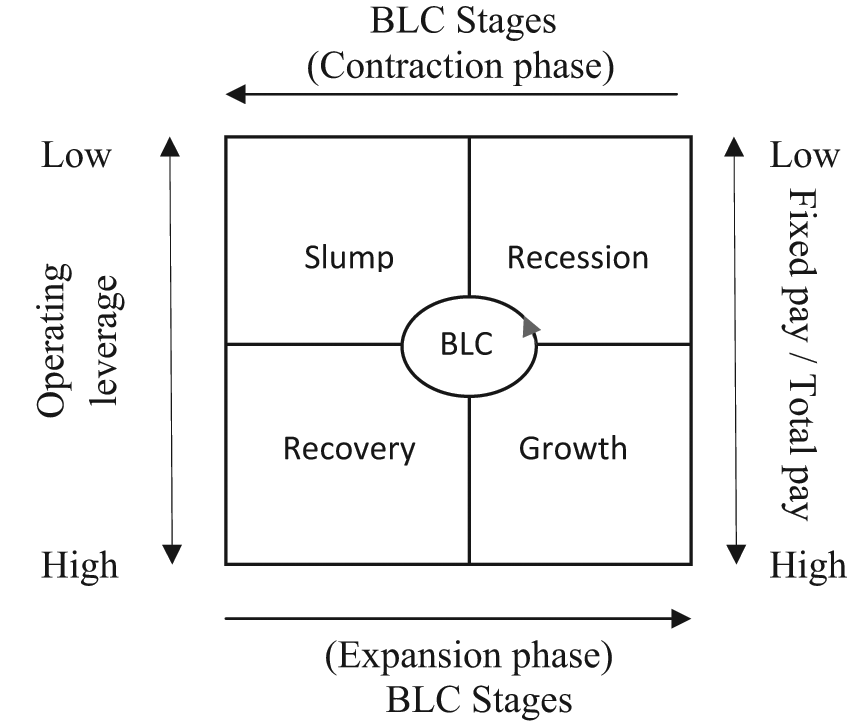
Compensation strategy across business life cycle (BLC).
During an expansion, sales compensation should have a higher proportion of fixed pay and lower commission or variable pay. Then, the minute business picks up, the existing sales force can do considerably more without increasing selling costs. Profit margins expand, and earnings rise faster than revenues. As variable costs will be low, the contribution margin (selling price minus variable cost) will be high. High contribution margins, when combined with high fixed-period costs, mean a hefty operating loss when volumes are low and mean large and increasing profits once cash flow breakeven volumes are exceeded. Hence, during the period of the expansion phase, high base pay is preferable.
During a period of demand uncertainty, such as in a contraction phase, financial returns decline and business success and customer demand drops. That should prompt the transition to a pay system of less base pay and more variable pay, as shown in Figure 10.
Operating leverage generally refers to the company’s incurrence of fixed operating costs and is determined by the cost system (higher fixed costs relative to sales increases operating leverage). A company’s ability to weather fluctuating business cycles stems from effective use of an appropriate level of leverage through realigning fixed and variable costs. Operating leverage is a key variable affecting business performance during the different stages of the BLC. Operating leverage is enlarged when a BLC is just bottoming out, as fixed costs with increased sales represent a decreasing percentage of sales. However, when the business cycle is peaking, fixed costs carry a substantial risk.
During the contraction phase (recession and slump), companies prefer a lower base pay. Because most sales compensation includes a higher proportion of variable pay, it represents a high percentage of the total. When variable costs are high, the contribution margin will be lower. Low contribution margins, when combined with low fixed costs, mean less risk of operating losses when volumes are low and increasing profits once cash flow breakeven volumes are reached and exceeded. Hence, during a period of the contraction stage of the BLC, low base pay is normally advantageous.
The companies that fail to update their sales compensation policies to reflect the BLC may be overpaying their salespeople during good economic times or overreacting to tough economic times. The BLC represents an opportunity to design the compensation strategy based on sales efforts and market dynamics. Sales organizations that change their sales force pay system to correspond loosely to the different stages a business goes through are more likely to be successful.
Managerial Implications
Companies cannot of course offer sales employees complete insulation from the vagaries of the BLC. They should design a pay system that responds to the different stages of the BLC in order to maximize productivity and manage costs. During the expansion phase, a higher proportion of target pay is kept fixed, whereas during the contraction phase, it is better to keep it variable. Balancing of fixed and variable costs provides higher operating leverage during expansion and lower operating leverage during a contraction. Experience, however, demonstrates over and over again that it is very hard to shed fixed costs as fast as sales revenues decline.
During good economic times, if the proportion of fixed pay is increased in the pay mix, it will help in capitalizing on the benefits of high operating leverage. During weak economic times, if the proportion of variable pay component is increased, it will help cut employment costs and also operating leverage. The company’s ability to weather the fluctuations of the BLC stems from effective management of the pay mix. Reducing employee fixed costs avoids the situation of a large-scale retrenchment. These accrued cost savings can then be redirected to keep the firm afloat until business conditions improve. Low operating leverage reduces the variability of profits during periods of disappointing sales.
With increasing competition, globalization and changes in the business environment, companies need to be more responsive and dynamic in planning their compensation strategy. Rebalancing fixed and variable pay provides the flexibility in sales force compensation to cope better with the vagaries of the business cycle. By synchronizing the sales compensation strategy with the BLC, management can curtail overly generous sales payment practices during good economic times. Synchronization can also help avoid overreaction during tough economic times.
Conclusion
An effective compensation strategy focuses on providing a pay mix with a high-enough fixed pay to attract the best sales talent and adequate variable pay to motivate them. Each element of the compensation system encourages certain behaviors and discourages others. Base salary or fixed pay encourages loyalty, steadiness and attention to service; however, it also discourages individual initiative. When the sales representative plays a major role in generating sales, incentive-based compensation is the answer to motivate the salesperson to expend additional efforts. At the same time, a straight commission plan encourages the quickest, easiest task with short-term focus but discourages strategic behavior that has a longer term payoff.
Employee performance is affected not only by factors specific to the individual, such as skill and aptitude, but also by other factors such as the company culture and performance-based reward systems. The key to motivating people lies in how the company’s incentives and pay system relate to their individual goals. There are many micro and macro factors affecting the design of the sales compensation system, such as the CLC of salespeople, the PLC, the OLC and the BLC. Based on the cycle considerations, sales organizations can design an optimal compensation system by rebalancing fixed and variable pay. As explained within the value-added framework, an effective compensation strategy enhances the performance of the sales force as well as the overall performance of the company.
Footnotes
Declaration of Conflicting Interests
The author(s) declared no potential conflicts of interest with respect to the research, authorship, and/or publication of this article.
Funding
The author(s) received no financial support for the research, authorship, and/or publication of this article.