



Abstract
A company and the configuration of its sales force have to evolve as the company goes through the stages of its life cycle. Sales force configuration involves decisions that reflect sales strategy, sales force structure and sales force size. Specifically, it focuses on how the sales personnel apportion their efforts among different products, customers, geography and selling activities (sales strategy); the differing roles that internal sales force and external selling partners should play (sales force structure) and the sales force capacity to effectively serve the customers (sales force size). Sales force configuration management is critical because it determines how quickly a company can adjust its sales forces in response to market opportunities, while balancing compensation costs and profitability. This article discusses how sales force configuration variables change across the life cycle and identifies best-case scenario for optimal performance.
Keywords
To succeed in a business world shaped by uncertain demand and rapid market changes, sales organizations must be able to adapt quickly as the life span of products unfolds and market conditions change. Sales organization needs to change as products and markets evolve and the organization itself evolves. A company moves from one stage to another because the fit with its environment is so inadequate that the organization’s efficiency and/or effectiveness are seriously impaired if it does not change. 1 Frequently, sales organizations are far too rigid to adapt to a changing environment. The effective and dynamic management of sales force configuration is seen as a key enabler of this flexibility. Sales force configuration calls decisions from the perspectives of sales strategy, sales force structure and sales force size.
Sales organizations are likely to have different configuration needs during different stages of their life span. Hence, they require a different mix of sales force resources and management practices to achieve optimal sales performance at the lowest payroll cost. Sales organizations must coordinate sales force configuration variables such as sales strategy, sales structure and sales force size and also establish synergy among them. Such strategically tuned sales force configuration works well at different stages of the organization life span. Organizations that manage the sales force configuration dynamically generate more sales revenue, reduce sales force compensation cost and realize greater profits than those that do not. The sales force compensation plan cannot be static; it changes along the life span of the organizations. Sales force compensation is influenced by various combinations of sales force configurations.
Sales Force Configuration: Key Variables
The sales force configuration in terms of sales strategy, sales structure and sales force size (Figure 1) changes throughout the life span of the organization and its products and has a significant impact on sales force compensation costs, and hence on profitability.

Sales force configuration (SFC): Key variables.
The life span of an organization can be divided into four stages of business life cycle: start-up, growth, maturity and decline. Life cycle stages are defined as a unique configuration of variables related to organization context, strategy and structure. 2 The configuration of the sales force needs to change to follow the life span of the company in order to fully exploit salient features of each life cycle stage. The key variables of sales force configuration are explained below.
Sales Strategy
The sales strategy during the different stages of business life cycle needs to match its general selling situation with a selling philosophy and a specific sales approach. It is also important to ensure the timely allocation of resources in order to deliver customized or unique solutions that meet the customers’ needs. As sales strategies evolve, the emphasis of a company’s attention on critical issues such as resource allocation, sales force structure and sales force size evolves as well throughout the life cycle. Sales strategy decisions must be responsive to the organization’s overall business strategy. For each stage of the business life cycle, an appropriate sales strategy is required. Sales strategy is defined as the set of strategic decisions that determine where the sales force will focus its attention, along with the role of the sales force in creating customer value.
The sales strategy during each stage of the business life cycle defines the role that the sales force will play in connecting with customers. The sales role includes what sales personnel do to whom, how, and how much to know and how the sales force makes a difference in overall sales and profitability of the organization. Once this role is defined, decisions about sales force structure and its size can be made. The successful sales strategy delivers the right products and services to the right customers through efficient, yet effective sales processes. The effective sales process includes all of the activities required to sell, deliver and service the organization’s products.
Sales Force Structure
The sales force structure follows the strategy. A detailed assessment of the sales force structure will need to be done periodically during each stage in the life span of the organization. A sales strategy determines the structure of the sales function as changes are required for the existing sales force so that representatives and support staff are capable of executing the sales strategy at each stage. Sales organizations need to spend a significant amount of time in evaluating and reconfiguring the sales force structure to ensure that it supports sales strategies and strategic goals. Often, this involves finding the right balance between specialized and generalized sales roles in the sales force structure. Organizations need to determine whether deployment of specialized sales force costs more than the resulting benefits in terms of sales and margins. 3
Sales Force Size
The sales force is a sales (and revenue) generator as well as a cost generator, influencing not only the cost of the sales force but also the variable expenses associated with sales volume. The size of the sales force needs to change as the company progresses through its life span. The sales force size affects customers, salespeople and the overall sales organization. If the sales force is too small, it cannot serve the needs of customers effectively, becoming overstretched, and the company will miss key sales opportunities. However, if the sales force is too large, it can become an annoyance to customers; salespeople may not be challenged, payroll costs of maintaining the sales force will be too high and productivity of the organization will be low. 4
The size of sales force affects morale, compensation methods used by sales organization, and ultimately overall sales force effectiveness. A sales force that is of the right size will be challenged but not overworked, connect with customers effectively, maintain reasonable sales compensation costs and generate strong sales and desired profitability. Unlike advertising and sales promotions budgets, which can be altered by organizations from time to time, any change in the size of the sales force requires meticulous planning. The sales force represents a long-term investment for the organization and cannot be upsized and downsized as quickly as variable resources. It takes a longer time for the organization to hire and train good salespeople, and it also takes time for salespeople to build relationships with customers.
Managing Compensation: Sales Force Configuration Across the Business Cycle
To succeed in the long term, sales organizations must reevaluate their sales force configuration across the business life cycle and change their sales strategy, sales force structure and sales force size accordingly. Sales force configuration decisions are important, as the consequences of mistakes are likely to affect the organization not just in current year but for many years to come. Sales force configuration is related to sales strategy and architecture, compensation management, distribution channels, deployment and territory management. No matter how well an organization hires and trains the sales force, at each stage of the product life cycle, an inefficient sales force configuration will prevent sales forces from reaching full productivity. The management of the sales force configuration is a key set of decisions that, if correct, can act as a catalyst in synergizing the efforts of a sales force, leading to many positive outcomes for the organization in terms of increased revenue, reduced compensation cost and enhanced profitability.
In the start-up stage of business life cycle, there is lot of uncertainty and higher business risk. Hence, sales organizations should keep low operating leverage. 5 Operating leverage is the extent to which fixed costs are prominent in a firm’s operations. As shown in the matrix of Figure 2, deployment of reps will decrease operating leverage, as reps work on a commission-only basis.
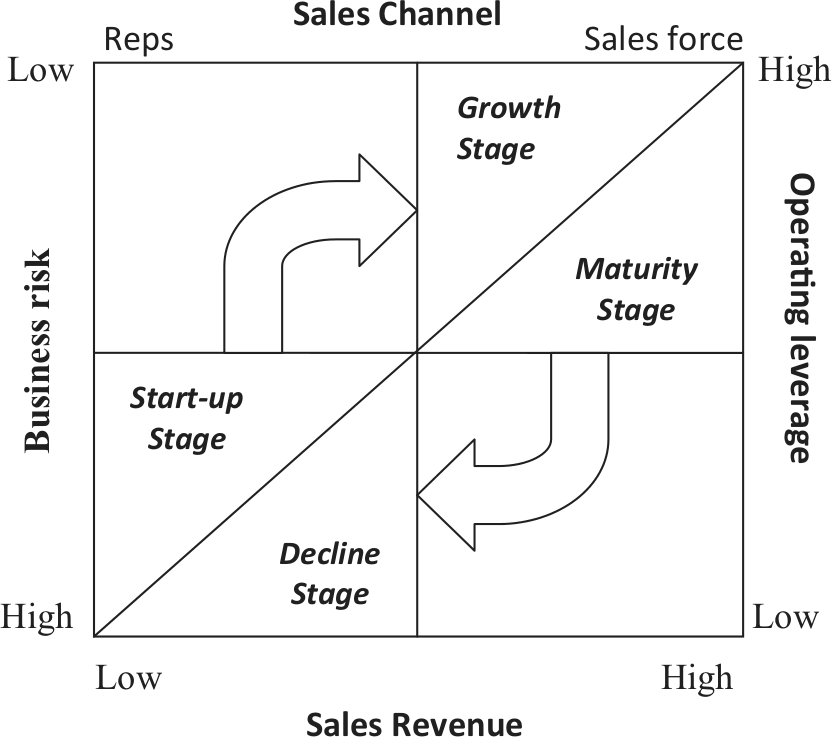
Sales force structure and business risk across business life cycle.
Accordingly, reps are preferred in start-up and decline stages whereas direct sales forces are preferred in growth and maturity stages of the life cycle (Figure 2).
A direct sales force generates a higher return on investment (ROI) in the growth and maturity stages compared to start-up and decline stages (Figure 3). 6
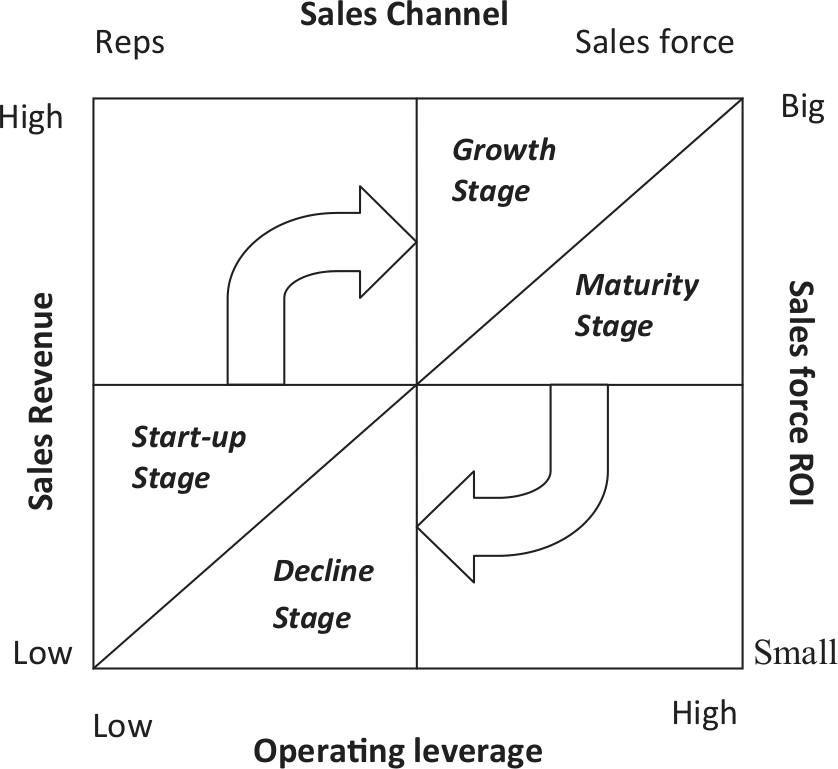
Sales force size and return on investment across business life cycle.
Sales compensation costs depend on sales strategy, sales force structure and sales force sizing. Hence, sales force configuration directly influences sales force compensation costs, as explained below with an illustration.
Illustration
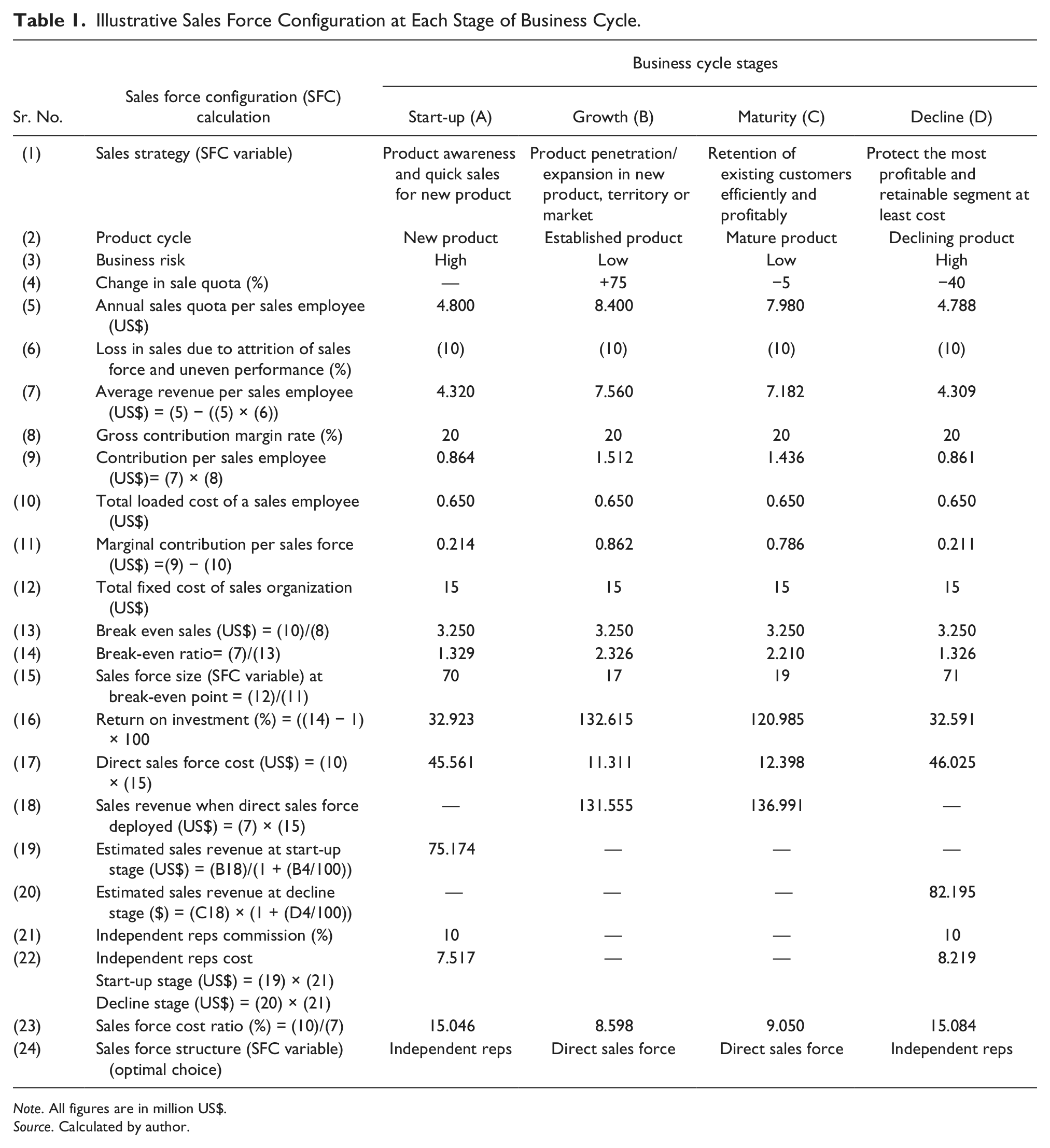
During the start-up stage of the business cycle, when a new sales organization is conservative about selling a totally new product in a new market, it is estimated that a fully effective sales force produces about $4.8 million in revenue per year. Based on marginal contribution analysis as calculated in the Table 1, the hypothetical company would conclude that it needs 70 salespeople and the corresponding ROI will be low (33%). Here, the sales organization in the start-up stage would be swamped if all 70 salespeople were hired at the outset, when the product awareness is low, the sales organization experiences negative cash flow, and revenues come in slowly. As cash flow is strained during the start-up stage, excessive sales force capacity will send the organization further into the red and disappoint investors. Hence, in this stage of the business cycle, reps are the preferred option. Similarly, during the decline stage, product demand is diminishing and cash flow is drying out. In this stage also, reps are a better choice compared to direct sales force (Table 1).
Illustrative Sales Force Configuration at Each Stage of Business Cycle.
Note. All figures are in million US$.
Source. Calculated by author.
However, during the growth stage of business cycle, when a sales organization is aggressive about selling an already established product, standard quota of the sales force increases by 75%. That enhances the marginal expected contribution per salesperson to $1.512 million and 17 salespeople are required and corresponding ROI will be high (133 %). Similarly, during the maturity stage of the business when organization is defending its market share, the sales quota of sales personnel decreases by 5%. Hence, the marginal expected contribution per salesperson decreases to $1.436 million and 19 salespeople are required (ROI = 121%). Hence, in this stage direct sales forces are preferred, compared to reps.
During the decline stage when a company is focused on retaining its profitable customers, the sales quota decreases by 40%. Hence, marginal expected contribution per salesperson decreases to $0.861 million, and accordingly 71 salespeople are required and corresponding ROI will be low (33%). Hence, in this stage also direct sales forces are preferred, compared to reps.
Sales Force Configuration at Start-Up Stage: Managerial Implications
A successful new product launch during the start-up stage always requires a considerable selling effort and usually demands a sizable investment in selling resources. The key features of the sales force configuration variables at this stage are explained below.
Sales Strategy
The sales strategy is focused on creating product awareness and generating quick uptake in high-potential market segments that are responsive to selling efforts and are likely to become early adopters of the new product. Start-up companies have limited funds available to invest in attracting good salespeople as they face strong cash demands to finance the expansion. Thus, they will have trouble finding and selecting adequate and suitable employees because prospective employees do not view the company as viable or legitimate.
In this stage, the sales organization needs to determine the type of sales distribution channels. Hence, the first configuration decision that a sales organization needs to make is if the business should build its own selling organization to promote its products (sell directly) or if it should sell using partners (sell indirectly). In this stage, outsourcing is the preferred option for a sales organization. By outsourcing sales activities, the organization uses external resources to limit its risk exposure (Table 1). Sales employees who contract their services are called independent reps, whereas those who are employed directly by the organization are often called in-house or direct sales force. During the start-up stage, strategic planning also explores whether there is a plan upfront for the transition of customer relationships from the reps to the direct sales force over time. Without such a strategic plan, sales organization can get tied into adverse long-term relationships with reps or indirect channel partners.
Sales Force Structure
In this stage, the primary responsibility of the salesperson is to overcome initial customer resistance to the new product, with the focus on communicating product performance. When product demand is uncertain, employing a direct sales force is a risk. Hence, deployment of reps can help sales organizations better manage the business risk. If reps do not perform as expected, since their compensation is in the form of commission, the risks are minimal. In this stage, projections of profitability are low and liquidity positions are strained. Hence, by engaging reps organizations can obtain a trained sales force immediately and with virtually no fixed cost.
During the start-up stage, reps are likely to be more effective than direct sales force as they are skilled and experienced and create synergy for customers as they offer multiple product lines. Reps visit a wide range of customers to get them more interested in the product and are responsible for looking at the early adopters, as they may be willing to pay a higher price. Reps can afford to call on small accounts because they have multiple lines, thereby absorbing high travel time between different accounts. Reps have established contacts and relationships with potential customers and are less expensive to sales organizations relative to direct sales force (Table 1).
Start-up sales organizations can enter markets rapidly by working with reps who have sales expertise along with influence over sales channels. Reps have experience that the start-up organization cannot replicate quickly or inexpensively, such as established customer relationships or product/market expertise. Hence, deployment of reps also helps the start-up organization learn about the market in order to build its own direct sales force successfully in the future.
Sales Force Size
The next step in the sales force configuration is to determine the sales force size by using limited resources of sales organizations as effectively as possible. The start-up stage occurs when a new sales organization launches its first product or when an existing organization launches a new division. Start-up companies are challenged to grow the business, yet often have limited resources, face considerable uncertainty about the product demand and are more cost focused. Hence, in this stage, sales outsourcing is the preferred option for a new organization as use of external resources limits its fixed costs as well as risk exposure. As the size of direct sales force would be higher and their inexperience in the market makes them less productive in this stage, reps are preferred by most sales organizations (Table 1).
However, a start-up division of an existing organization can benefit from the resources of the larger organization of which they are a part and therefore often have access to more monetary resources and greater sales expertise. Hence, divisions of larger companies may be able to afford to deploy direct sales personnel. However, they will need to learn a process in order to sell the products efficiently. They will need to move through the sales learning curve. The learning curve for a new product launch into a new market is much longer than one for introducing a variant of an existing product into an established market.
As the sales learning curve involves all customer-facing parts of the organization, it influences sales yield, defined as the average annual sales revenue per fully trained and effective sales employee. The sales yield measures the progress of the sales organization along the sales learning curve over time. The longer the sales learning curve, the greater the revenue gap—that is, it takes longer for sales yield to reach targeted quota levels. The more an organization learns about its product, market and sales process, the more efficient it becomes at selling and the higher the sales yield. Typically, sales yield for a new product starts out slowly during start-up stage, accelerates during growth stage and then flattens out as the product matures, in a classic S-shaped curve. When the start-up division of an existing organization launches a new product and the sales yield is low, it is better not to immediately ramp up direct sales force size to acquire customers as quickly as possible (Figure 4).
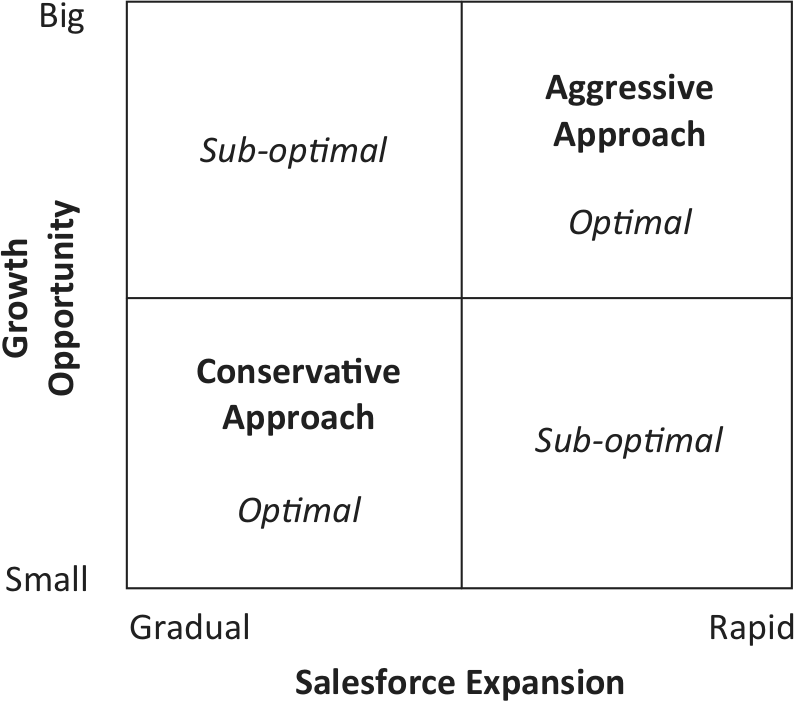
Growth opportunity and sales force expansion.
Typically, in this stage, few customers will be willing to consider buying the product, and those that do will require significant incentives. Hence, the sales force will not generate enough revenue to cover their total costs due to lower sales yields. Hiring a full sales capacity too rapidly during the start-up stage just triggers a resource crunch, and the organization fails to meet revenue and profit expectations.
Sales Force Configuration at Growth Stage: Managerial Implications
During the growth stage, the sales personnel have to call on prospects in a broader set of markets as their product portfolio expands. Hence, in this stage the size of the sales force remains a highly prominent issue. The key features of the configuration of the sales force at this stage are described below.
Sales Strategy
Sales strategies change throughout the life cycle of a sales organization. As a product takes off and the sales organization enters the growth stage, sales strategies evolve to emphasize increased penetration of initial market segments and expansion into new products, territories and markets. In the growth stage, when sales volume reaches the point where the cost of relying on direct salespeople is less than the cost of reps, direct sales force is preferred (Table 1).
Sales Force Structure
The sales force structure that works during the growth stage is different from what works during the start-up stage. When products become established in the market, repeat sales become a larger proportion of overall sales and customers require and expect service and support, which adds to the sales force’s workloads. As such, the combined selling and supporting tasks grow beyond the salespeople’s capacity to satisfy all the demands; when pressured they are likely to drop the customers, products and selling activities that are most difficult to manage. Unfortunately, what they drop may be lucrative or strategic opportunities for the business.
At this point, companies need to set up specialized sales forces to master specific products, markets and selling tasks. 7 Specialist sales forces are typically more effective and are initially deployed to drive revenue during the growth phase. In this stage, as a sales organization’s product portfolio grows bigger and more complex, or if the customers are numerous and from different industries, a specialized sales force is the usual choice. In fact, the broader the product portfolio and the greater the number of markets in which the customers operate, the greater is the need of the sales organization for specialization. Such need can be met by a sales force of generalists supported by product sales specialists, for instance, or by separate specialty forces dedicated to a single product, market, territory or customer segment. 8
The sales force need to master multiple products, markets and selling tasks at this stage. Some specialist sales teams focus on products, others on markets and still others on customer segments. Sales forces can also specialize in certain activities: Some salespeople concentrate on acquiring customers and others on servicing existing customers. Every kind of specialization has benefits and costs. For instance, specialization by markets reduces salespeople’s focus on products, whereas product or activity specialization can force customers to deal with multiple salespeople. Many sales organizations therefore create hybrid structures that include a mix of generalists as well as market, product and activity specialists as specialist sales force are more expensive in terms of compensation costs.
Sales Force Size
It may be beneficial for a sales organization to spend aggressively on the high-elasticity marketing variable such as sales force early in the growth stage to build high market share, to maintain market dominance and to secure long-term payoff. According to research published by the management consulting firm ZS Associates, the sales force size that maximizes companies’ 3-year profits is 18% larger, on average, than the size that maximizes 1-year profits. 7
In the growth stage, companies use direct sales forces with great effectiveness as they are most effective at selling compatible products to one market. Early in the growth stage, when uncertainty is low and the product has achieved traction and gained acceptance in the market, salespeople can be hired as rapidly as the sales organization’s financial constraints will allow. Sales come in relatively easily in the growth stage, and salespeople are motivated and full of optimism (Table 1). Hence, during the period of rapid growth, an aggressive approach is optimal. The organization should ramp up its sales force as early as possible to maximize profitability.
Aggressive investment in enhancing sales force size during the growth stage enables companies to capitalize on early opportunities, forestall competitors and build a strong base of loyal customers and increase sales and profits quickly (Figure 5). Smart sales organizations increase sales force investment as early success signals emerge.
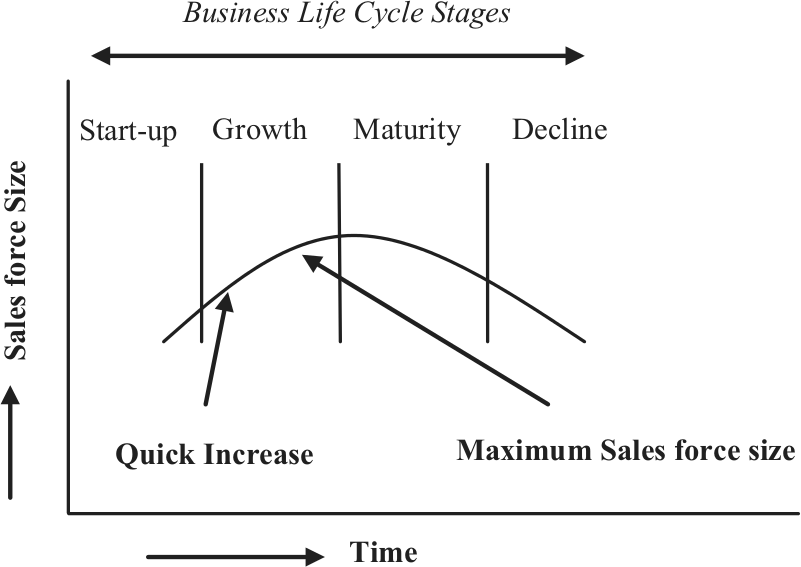
Impact of aggressive sales force sizing during growth stage.
Having a sales force of the right size is critical for organizations in the growth stage. However, many organizations are too conservative in increasing their sales force size even when clear success signals emerge. They increase sales force size gradually and continue to under staff in this stage, and as a result, they are unable to capitalize on all the market opportunities that exist. This type of sizing error is also referred to as undersizing error (Figure 6).

Sales force sizing: Undersizing versus oversizing errors.
An “earn your way” staffing strategy (i.e., start with small sales force size and add head count only after the company has generated the money to pay for them) seems extremely logical, but it often results in missed opportunities for sales and organization growth. In these organizations, the largest sales force size is reached in the mature stage and not in the growth stage as optimally desired (Figure 7).
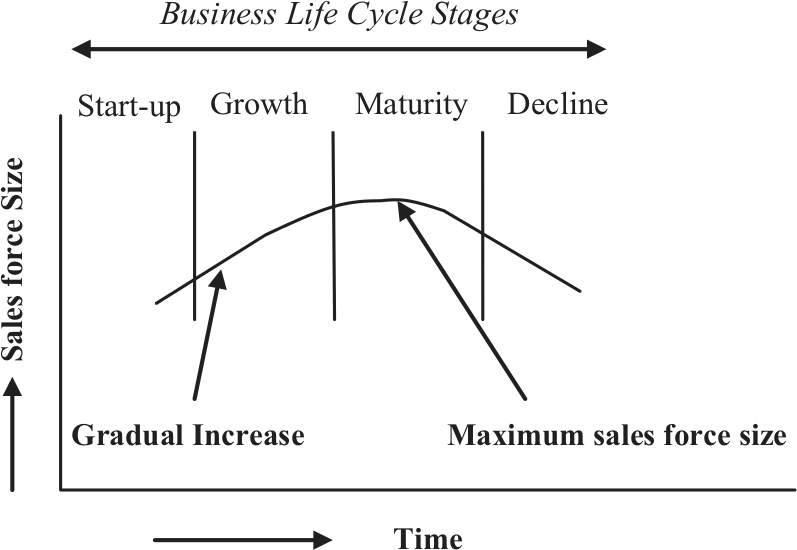
Impact of conservative sales force sizing during growth stage.
Increasing the size of the sales force has short-term and long-term consequences. One danger in keeping sales force size small during the growth stage to increase short-term profit is that the organization may lose strength, preventing it from rebounding when growth is assured or better market conditions prevail. Sales organizations typically view the consequences of hiring too many salespeople as being more serious than those of hiring too few. If they hire too many salespeople and the sales forecast is not realized, then at some point they must take the unpleasant step of reducing the size of the sales force by layoff and downsizing, thereby lowering morale of sales force. It also shatters the confidence of investor community as they view such steps as loss of market share. If, on the other hand, they hire too few salespeople, the investor community rarely recognizes their failure to make the most of a significant sales opportunity.
To figure out exactly how many salespersons to hire, the basic approach for calculating the number of salespeople needed to reach the point of profit maximization, is adding salespersons till marginal cost exceeds marginal revenue. Such a top-down approach calculates the contribution and cost associated with adding each sales employee and then adds sales employees until the increased contribution equals to the incremental cost. As shown in Figure 8, optimal sales force size occurs when the incremental return from additional sales force effort on all products and markets equals the incremental cost of the sales force effort. This incremental approach states that a new salesperson should be added until the gross profit on new business is equal to the cost of deploying another salesperson.
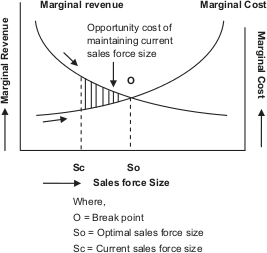
Optimal sales force sizing: A marginal cost approach.
There is a point at the peak of the profit curve where sales force size is maximizing profits. As shown in Figure 9, sales organization’s profit will be maximum at optimal sales force size (So). This is the point where the marginal or incremental contribution of the last salesperson added equals the marginal cost of that salesperson.
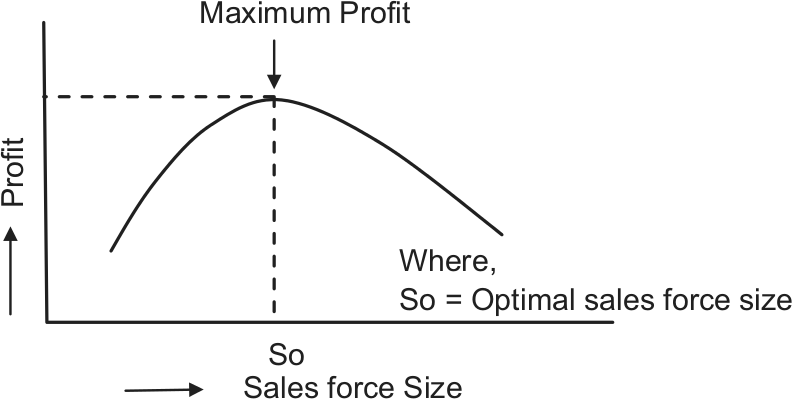
Profit maximization and optimal sales force sizing.
Sales force Configuration at Maturity Stage: Managerial Implications
Throughout the maturity stage, the emphasis of sales force configuration is on enhancing effectiveness and efficiency, mainly through sales force structure. Key features of various sales force configuration variables at this stage are described below.
Sales Strategy
As growth slows and the organization enters the maturity stage of the life cycle, sales strategies focus on retention of existing customers and emphasize continued effective coverage of market segments developed during the growth stage but with added emphasis on serving these segments efficiently and profitably.
Sales Force Structure
During growth stage, many companies adopt the “generalists-supported-by-specialists” model for their sales force as they broaden their product portfolios. However, in the maturity stage, the use of product specialists poses coordination problems for many companies. The use of specialists can also confuse customers as they must deal with several salespeople. Hence, in this stage the emphasis shifts to making sales forces more effective by reducing the number of specialists, by appointing account managers for the largest accounts and through better allocation of the sales force. The role of key account managers becomes significant as they are focused on specific accounts of customers and handle all of the sales negotiations for those particular customers. They can manage complex relationships on multiple levels. Account managers coordinate the sales effort and bring in product specialists when customers need expertise. The appointment of account managers boosts customer satisfaction, reduces selling as well as compensation costs and also increase revenues. Hence, attention to the allocation of sales efforts to improve the quality of the sales efforts contributes to profitability better than does an increase the quantity of sales contacts.
Sales Force Size
A study conducted by ZS Associates shows that companies in the mature stage boosted their gross margins by 4.5% when they downsized their sales forces and allocated resources better. 7 Hence, sales force resizing is an effective strategy in this stage to enhance financial returns.
Typically, in this stage, there is less focus on increasing the size of the sales force. However, there are situations in which modest upsizing is appropriate. This happens especially if the organizations were conservative in building their sales force during the growth stage. In this scenario, with an increase in break-even ratio of sales employee, corresponding ROI will also increase. To bring back ROI to the acceptable limit for optimal sales force size, companies require some increase in the size of the sales force, reaching a peak in the maturity stage and not in the growth stage, as shown earlier in Figure 7.
At the same time, some companies may need to downsize as markets become increasingly competitive and pressure to deliver profitable sales intensifies. During the maturity stage, sales growth also flattens, thereby reducing break-even ratio of sales employees (Table 1). A lower break-even ratio corresponds to lower ROI. For that reason, sales organizations increase their ROI by modestly decreasing the size of the sales force and by allocating sales resources more effectively. 6 Such sales organizations may have aggressively added staff as part of their strategy, reaching the peak sale force size during growth stage itself as optimally desired (Figure 5).
Sales Force Configuration at Decline Stage: Managerial Implications
As a business moves from maturity into the decline stage, sales fall off considerably, making a downsizing of the sales force inevitable. Improving efficiency is a primary focus in this stage as product portfolio of sales force has decreased considerably. Key features of selected sales force configuration variables at this stage are described below.
Sales Strategy
In this stage, sales strategies take on an even stronger efficiency, cost control focus compared to the maturity stage, as the organization aims to protect the most profitable and retainable customers while exiting unprofitable customer relationships. During this turbulent period, companies need a low-cost, flexible sales force that can adapt and resize accordingly (Table 1). Companies focus on improving the efficiency of their sales force and explore lower cost selling channels.
Sales Force Structure
In comparison to a generalist sales force, specialist sales personnel are more costly and involve larger staff. Hence, when sales decline, companies shift their sales force structure by moving from a specialized to generalist sales force. To preserve profitability, companies shift back to reps or selling partners to cover some market segments at a lower cost (Table 1).
Sales Force Size
During this stage, organizations reduce the size of their direct sales force and also take advantage of the decline to lay off poor performers, so that the overall sales force that emerges from decline is stronger and better positioned to exploit new market opportunities. To decide how quickly organizations should reduce head count at this stage, they must assess the market opportunities that remain and the risks of different downsizing strategies, such as the choice between a gradual or rapid contraction strategy. A gradual sales force reduction works well when the market is disappearing at a modest rate, but it is a poor strategy when the market opportunity and sales are declining quickly.
When the decline in sales is small, many organizations use a conservative approach, reducing their sales force gradually (Figure 10), as they remain optimistic that the decline will soon reverse soon. However, when a reversal does not happen, the high cost of the retained sales force will hasten the company’s unprofitability. Also, the gradual downsizing of a sales force results in significant, frequent disruption of customer relationships as contacts change; for that reason, a gradual strategy is not a good or the best alternative when the decline in market demand is severe.

Sales decline versus sales force reduction.
Similarly, when the sales are in steep decline, an aggressive approach is required in sales force reduction by contracting sales force rapidly (Figure 10). In this strategy of rapid contraction, the remaining sales force will realize that they have some kind of job security; customers will have greater confidence as sales contacts are not frequently changed and the organization will become more focused and responsive. However, the risk with a rapid reduction strategy is that if the market decline turns out to be less severe than expected, more salespeople will lose their jobs than necessary. If there is a lot of market uncertainty about the rate at which the market demand is declining, organizations should consider downsizing the sales force in small but discrete steps.
Conclusion
The organization and the configuration of its sales force have to evolve as the sales organizations goes through the stages of business cycle—start-up, growth, maturity and decline—if they want to continue maximizing customer share and profitability while minimizing compensation costs of their salespeople. Specifically, sales organizations must consider and modify three components of sales force configuration over time: (a) how the salespeople apportion their efforts among different products, customers, geography and selling activities (sales strategy); (b) the differing roles that internal and external selling partners should play (sales force structure) and (c) the capacity of the sales force to effectively serve the customers (sales force size). These key drivers are critical for the sales organization because they determine how quickly sales forces are able to respond to market opportunities, influence salespeople’s performance and affect sales organization’s revenues, compensation costs and profitability.
Footnotes
Declaration of Conflicting Interests
The author(s) declared no potential conflicts of interest with respect to the research, authorship, and/or publication of this article.
Funding
The author(s) received no financial support for the research, authorship, and/or publication of this article.