



Abstract
The design of salesforce control and compensation system is crucial in salesforce management as it plays an important role in influencing ethics of salespeople. The performance of a sales organization is positively influenced by ethical behavior of sales people. To understand this relationship, this research applies game theory in the areas of salesforce control and compensation system. Research considers multiple equilibria in the game to identify optimal payoff and finds that a sales organization is better off with outcome control when sales people behave honestly as it has the highest payoff among all other possibilities. The propensity for sales people to make unethical choices can be reduced by designing an appropriate salesforce control system and a relevant compensation plan. Ethical behavior in sales organization can also be influenced by various organizational drivers such as ethical climate, code of ethics, hiring, selection and training process and ethical leadership. By such organizational influences, if a salesperson is motivated to act ethically by putting high efforts for building long term customer relationships, trust and loyalty, it results into a win-win situation for both sales people and the organization. Research has developed various models and payoff matrices to validate application of game theory in the field of salesforce compensation.
Introduction
The salesforce is the engine that drives revenue of organizations and also represents a significant investment for most organizations. In current era of intense competition, management of the salesforce is becoming an increasingly complex and challenging task for sales organizations. Given that many businesses spend more on their salesforce than they do on any other marketing activity, improving the performance of the salesforce is of paramount importance. Yet managing the salesforce is often an overlooked area in management research. In this research, game theory is introduced in order to provide an idea of how it can be useful in an important area of salesforce management. Research also focuses on salespersons’ outlook to ethics and applies the game-theoretic framework to understand and integrate key organizational influences on ethical decision making.
Benefits of Effective Salesforce Management
The measurement of salesperson performance remains a fundamental issue in salesforce management. It is because of the need for information related to sales outcome for effective salesforce control to support decisions on remuneration, promotion or termination of salespersons.
It also provides some basis to facilitate decision making to improve salesperson performance and enhance sales organization effectiveness. A sales employee’s performance can be measured in two dimensions: behaviors (inputs) and outcomes (outputs).
Behavior performance consists of the behaviors employed by salespeople in meeting their job responsibilities as salespeople have more control over their activities and strategies than the outcomes of these actions. It is concerned with the various skills and activities (such as adaptive selling, teamwork, sales presentations, sales planning and sales support activities aimed to attract, keep or retain customers) that are important to salespeople for fulfilling the responsibilities of the sales job. Behavioral measures of performance consist of monitoring sales process activities aimed to attract or retain customers. Behavioral measures attempt to control the process of selling (as opposed to just the outcomes) and to reward effort as well as results.
However, outcome performance relates to the sales results directly attributed to the salesperson. Hence, as sales managers provide little monitoring and direction to salespeople, they are left alone to achieve results in their own way using their own strategies. Outcome performance uses objective measures of results, such as number of products sold or sales volume, sales income and retained profits, rather than measures of salesperson behaviors, to evaluate and compensate the salesperson. 1
Salespeople face an unusually high number of ethical conflicts because their positions provide the opportunity for ethics to be compromised. They must deal with the stress of being primarily responsible for generating their organization’s revenues, which at times can be very stressful; they work in relatively unsupervised settings and they are often evaluated on short-term objectives, 2 which can expose them to greater ethical pressures than many other jobs. Hence, salespeople are most likely to find themselves in ethical dilemmas. 3 One study of sales and marketing executives reported that almost 50% of the respondents suspected that their salespeople have lied on a sales call and almost 75% believed that the drive to achieve sales goals encourages salespeople to lose focus on customer needs. 4
The performance of a sales organization is positively influenced by ethical behavior of salespeople. Ethical sales behavior can play a vital role in forming, maintaining and sustaining long-term relationships with customers, enhancing customer retention and determining financial performance. 5 The lure of easy commission results in bad ethical decisions by salespeople and results in significant penalties to the organization. Prudential Insurance Company of America had to take a $2.6 billion charge against earnings to pay policyholders damages after the company allowed their salespeople to use deceptive sales practices that encouraged customers to trade in old life insurance policies for new ones. 6
Salesforce Control System: Behavior Versus Outcome Control
The purpose of a control system is to guarantee that the organization achieves its objectives while also ensuring that its members behave in the appropriate way. A salesforce control system as an antecedent of compensation can be defined as a set of procedures that a sales organization uses to monitor, direct, evaluate and compensate its salespeople in the performance of their tasks and responsibilities in order to achieve the sales organization’s objectives. 7 To do it, a sales organization can opt for two very different, diametrically opposed but complementary systems to carry out control tasks: outcome-based control and behavior-based control. 8
In relying on behavior control, sales organizations may dictate how salespeople make sales (new accounts or repeat business due to higher customer satisfaction), implying that their job is not only about meeting sales quota but also about the ways to achieve it. Behavior control is facilitated by monitoring as there is high level of managerial intervention and deployment of subjective measures of inputs. Under a behavior system, salespeople have higher levels of intrinsic motivation and are expected to perform as the sales manager requires, providing for long-term success of the organization and are more committed to serve the organization. Their sales techniques are more open and customer-oriented, using product knowledge and expertise. The behavior system is both objective and subjective, is based on the sales managers’ perceptions of their salesforce, evaluates the salesforce in light of the selling process and compensates salespeople with higher proportions of fixed pay in the compensation structure.
Outcome control is influenced by an incentive plan design as there is little monitoring and managerial direction for the activities of salespeople. Outcome control rewards salespeople for what they produce, thus encouraging them to do whatever it takes to achieve sales target. Outcome controls focus on immediate or short-term end results such as sales volume, revenue or quota attainment for monitoring and evaluating sales performance. The outcome system is more objective and evaluates the salesforce in light of results and compensates salespeople with higher proportions of incentive compensation (variable pay). However, incentives can have undesired consequences particularly when it comes to ethical behavior by salespeople as it encourages activity quantity at the expense of quality of sales activity. Outcome controls may lead to undesirable salesperson behaviors, such as prioritizing sales over customer service. Furthermore, the salesperson may be disinclined to take part in nonselling tasks. Hence, an outcome system does not always reflect effort, superior customer service or long-term relationship building.
The salesforce control system used for salespeople significantly influence salesforce behavior and activities and has significant effects on salesperson performance, sales organization effectiveness and compensation system used by sales organizations. Failure to match the right control system with the sales organization’s internal as well as external environment’s unique context may lead to organizational decline in the long run.
Game Theory Model: Basic Concepts
Game theory is the study of interactions among players whose payoffs depend on one another’s choice and who takes interdependence into account when trying to maximize their respective payoffs. 9 Hence, it is concerned with how individuals or players make individual decisions when they are aware that their final actions or outcomes affect each other and when each individual takes this into consideration. A formal game theory model consists of the following elements: a set of players, a set of actions and strategies for each player, a description of the order of play and the information available to any player at any point in the game, the outcome that results from every possible sequence of actions by players, a ranking of each outcome to every player (the player’s payoffs) and a solution (or equilibrium) concept. 10 Table 1 defines the basic features of game theory.
Basic Game Theory Concepts.

Source. Table developed by the author.
In the game theory model, players are decision-making entities. Each player has clear preferences and acts to maximize his or her utility (utility maximization and rationality) and also knows the other’s utilities and preferences (common knowledge). All strategic players are assumed to be rational and self-interested. Generally, this means that players want to get as much (satisfaction, happiness, money) for themselves as possible (self-interested) and are quite smart in figuring out how best to accomplish this aim (rational) despite the complexity of the game.
A strategy is a complete set of instructions or directions that tells a player what actions to pick in every conceivable situation regardless of whether or not that situation will be reached. Strategies are of different types: pure strategy and mixed strategy. A pure strategy is a detailed action plan that tells the player of the game about what action to take under every contingency and provides a complete blueprint of how a player will play a game. A mixed strategy tells the player of the game how to choose randomly between different actions and consists of a wide range of probability distribution over the full set of pure strategies. In this article, the game theory model is considered from the pure strategy perspective only. The outcome of the game theory model that results from every possible sequence of actions by players is described in terms of payoff. The outcomes for each player depend on the choices made by other players.
Each player receives a payoff in each outcome. In every set of the game it is important to predict the strategies that will be chosen by the players of the game. The methodology used for predicting strategy choices by the players of the game is called the solution or equilibrium. An equilibrium, in general, is a strategy combination (a set of strategy choices by each player) consisting of a best strategy for each of the players in the game. The equilibrium concept is a rule that defines what is meant by the best. The most practical and widely accepted equilibrium concept is the “Nash equilibrium.” A strategy combination is a “Nash equilibrium” if, given the other players’ strategy choices in that set of game, every player is choosing his best response (the choice of strategy that maximizes his payoff). 11
The following are major uses of game theory in management research 12 :
Explanation: When the situation involves interaction of decision makers with different aims, game theory provides the key to understanding the situation and explains why it happened.
Prediction: When looking ahead to situations where multiple decisions makers will interact strategically, researchers can use game theory to foresee what actions they will take and what outcomes will result.
Prescription: Game theory can help participants in the future interaction, and tell which strategies are likely to yield good results and which ones are liable to lead to disaster.
Salesforce Control: A Game Theory Model Perspective
The following assumptions are made in game theory model of salesforce control.
Assumptions
In the simplest format, the game consists of two players, the sales organization and one salesperson.
The sales organization can choose to control the salesperson with outcome control (with variable compensation, i.e., straight commission) or behavior control (with fixed compensation, i.e., salary).
The sales organization makes a decision about the types of incentives to offer its salesperson based on outcome or behavior control.
A salesperson, after seeing the type of salesforce control system, chooses unethical (short term) or ethical (long term) behavior. A salesperson’s action is not observable for the sales organization.
Once the salesforce control system is decided by the sales organization, the salesperson can choose either to represent the product honestly or dishonestly (i.e., ethically or unethically).
The aforementioned restrictive assumptions are considered in order to present a clear picture of decision choices and final outcomes of the game. There are key considerations for the selection of behavior control versus outcome control by sales organizations. 13 A sales organization begins the game by making a decision regarding the salesforce control system. This is described by the choice between the “behavior” branch and the “outcome” branch emanating from the sales organization’s decision node, as explained in Figure 1.
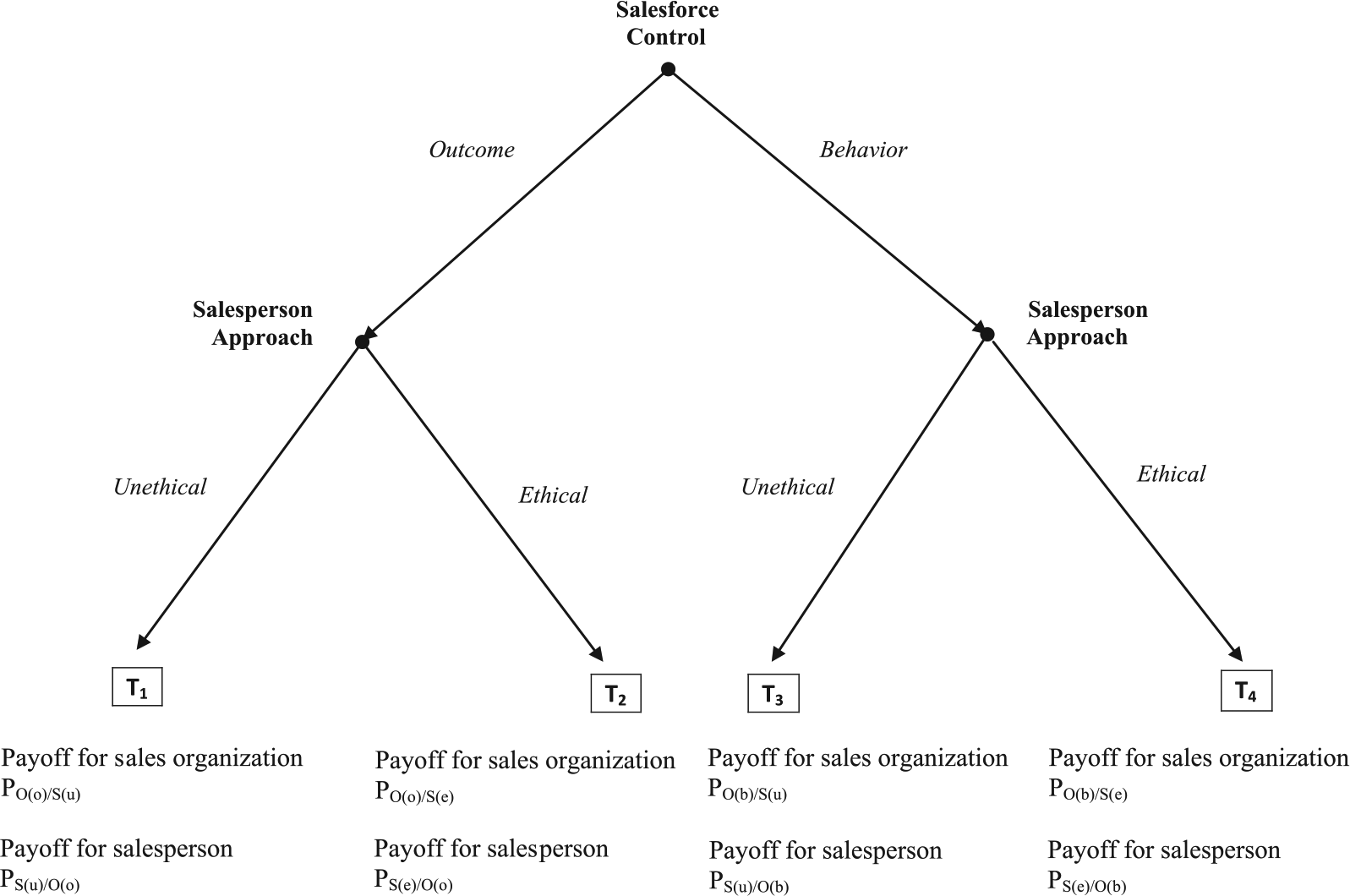
Decision tree and payoff for a sales organization and its salesperson.
This places a salesperson at one of two decision nodes, where he makes a decision to be ethical (honest) or unethical (dishonest). Definitions of ethical behavior versus unethical behavior are based on the degree to which a proposed act is perceived as right versus wrong, good versus evil, fair versus unfair or just versus unjust. 14 Ethical behaviors of salespeople denote behaviors on the part of the salespeople that promote the welfare of customers.
Ethical sales behavior can be defined as fair and honest actions that enable salespersons to foster long-term relationships with customers based on customer satisfaction and trust. 15 Ethical sales behavior does not seem to translate into short-term sales performance. Examples of ethical sales behavior include selling products that meet customers’ needs, providing true information about the products in terms of its benefits or availability and implementing low-pressure selling techniques. Salespeople who behave in an ethical manner are honest in their communications, sell only those products and services they believe will benefit the customer, promise only what can be delivered and treat customer information in a confidential manner.
Conversely, unethical sales behaviors can be defined as any short-run conduct that enables the salesperson to gain at the expense of the customer. Examples of such activities include lying (or exaggerating) about the benefits of a product/service, about product availability or about the competition; selling products/services that people do not need; giving answers when the answer is not really known and implementing manipulative influence tactics or high-pressure selling techniques. In short, it includes dishonesty, deception, manipulation, high-pressure selling techniques and bribes while interacting with customers. Salespeople may also behave unethically in their relationship with their employers in terms of misuse of company resources and misrepresentation or cheating on sales reports.
The terminal nodes (T1, T2, T3 and T4) indicate the point where the game ends. It ends with one of four possible outcomes. The payoff from each outcome to the organization is described by PO, and the payoff from each outcome to the salesperson is described by PS. The subscripts in parenthesis indicate the actions chosen (i.e., behavior or outcome control by sales organization and ethical or unethical approach by salesperson) by each player, which lead us to each outcome. The value after slash in the subscripts indicates payoff of the other player influencing the overall payoff. The payoffs with all possible outcomes are given below:
Payoff for organization with outcome control when salesperson acts ethically = PO(o)/S(e)
Payoff for organization with behavior control when salesperson acts ethically = PO(b)/S(e)
Payoff for organization with outcome control when salesperson acts unethically = PO(o)/S(u)
Payoff for organization with behavior control when salesperson acts unethically = PO(b)/S(u)
Payoff for salesperson with ethical behavior when organization chooses outcome control = S(e)/O(o)
Payoff for salesperson with ethical behavior when organization choose behavior control = PS(e)/O(b)
Payoff for salesperson with unethical behavior when organization choose outcome control = PS(u)/O(o)
Payoff for salesperson with unethical behavior when organization choose behavior control = PS(u)/O(b)
Principal-Agent Model or Agency Model
A principal-agent problem arises when one economic agent—the agent—takes an action that affects another economic agent—the principal. Agency theory predicts that, depending on the nature of the principal–agent relationship (outcome-based or behavior-based control), the type of contract between a salesperson (agent) and a sales organization (principal) will align the two parties’ interests.
Agency theory efficiently addresses the two basic problems of agency, namely, moral hazard and adverse selection. A moral hazard arises when a salesperson (i.e., an agent) can take certain actions that will affect both parties to the transaction but that the other party (i.e., an organization) cannot monitor or strictly enforce, which encourages undesirable behavior by the salesperson. Major causes of the moral hazard problem are the following: the principal cannot observe the agent’s action (hidden action) and problem arises after the contract. Agency models of salesperson behavior have assumed that owners cannot observe sales effort. 16 The problem of adverse selection arises if information relevant to the transaction is known to one party but is unknown to the other party. The objective of agency theory is to enhance efficiency and make the goals of the principal and agent congruent. Agency theory examines the tradeoffs necessary to reach efficient solutions between the costs of monitoring the agent’s behavior (to resolve adverse selection) and the optimal output (to resolve moral hazard) under conditions of information asymmetry. 17
A Static or Sequential Move Game of Salesforce Control
This article describes a sequential move game with three cases of preference ranking along with a repeated game model. 18 The sales organization’s preference ranking for outcomes are the same in each of the three cases. In each case, the assumption is made that the greatest payoff to the sales organization comes when outcome control is used and the salesperson chooses to be honest. This assumption is motivated in large part by the literature indicating that salespersons respond to incentives provided by commission-based compensation plans of the outcome control system. 19 It is because outcome control attracts and retains high-performing sales employees who are willing to share risks and rewards of the business as pay relates directly to performance and results achieved by salespeople. It encourages innovation and creativity and provides a direct monetary incentive to maximize sales revenue when impact of selling efforts on sales is high. In outcome control, incentives affect outcome or results by influencing salespeople’s motivation and hence it leads primarily to sales activity quantity. As salespeople use their own methods to achieve sales targets, these methods also provide a major individual motivation in that nonperformers receive no compensation.
Ethical sales behavior is fair and honest actions that enable the salesperson to foster long-term relationships with customers based on customer satisfaction, trust and loyalty. Honest actions such as low-pressure selling techniques, fairness, responsible acts and forbearance from opportunism increase customer trust in the salesperson. The ethical behavior of salespeople is especially important in today’s sales environment of increased customer awareness, demanding customers, shortened product life cycle and stiff competition. Some sales organizations are using ethics as a key selling point because more and more customers consider a sales organization’s ethical reputation when making purchasing decisions. As such the ethical behavior of a salesperson leads to repeat purchases. Hence, the ethical behavior of a sales employee enhances payoff for the sales organization and plays a significant role in determining an organization’s financial performance, long-term viability and competitive advantage in the marketplace. Thus, payoff for organization (PO(o)/S(e)) is highest with outcome control and when salespeople act ethically.
Behavior control attracts underachievers, results in high achievers subsidizing low achievers and hence reduces individual initiative, innovation and morale of sales employees. It tends to cause the salesforce to “underachieve” relative to the sales potential in their territories and hence increases fixed costs of the sales organization as compensation costs do not vary even during lower output. Hence, payoff for a sales organization is lower in behavior control than in outcome control. Ethics is a key driver of a sales organization’s success because it affects the organization’s capability to build strong relationships with customers and develop a positive work environment for sales employees. Hence, payoff for sales organization (PO(b)/S(e)) will be second highest with behavior control and when salespeople act ethically.
Behavior control by a sales organization is still preferred over outcome control when salespeople act unethically as it is difficult to detect unethical behavior in outcome control. In behavior control, sales managers are well informed about activities (i.e., inputs) of salespeople. Hence, the opportunities for unethical behavior decrease in a behavior control system, as the risk of detection and punishment of unethical actions is much higher compared to the outcome-based system. As behavior control does not provide financial incentive for the sales employee to put in extra effort, it also limits damage to the sales organization with unethical behavior of the sales employee. Hence, it gives the third highest payoff (PO(b)/S(u)) for the sales organization.
The least preferred outcome for a sales organization is dishonest behavior by a sales employee under outcome control (with straight commission) as it has the lowest payoff (PO(o)/S(u)). When salespeople derive a larger fraction of compensation based on sales commissions, they are more prone to engage in unethical sales practices as they focus on short-term goals. 20 A person who behaves unethically and is rewarded, in this case by economic means, is more likely to continue to behave unethically. 21 This is reflected in the higher income made by the salesperson and the potential loss of repeat purchases and long-term relations from the sales organization’s point of view. Outcome-based control systems are based on measurement of actual sales output and are likely to send the wrong signal to the salesperson to “do no matter what to get the sale.” Thus, outcome-based control systems can motivate salespeople to meet the sales quota even if it requires engaging in unethical sales activities.
All these assumptions can be written formally as follows:

In each case described below, the salesperson prefers to be unethical (dishonest) when the sales organization has outcome control and uses commission as compensation. This reflects the belief that unethical behavior increases when outcome control (with commission) is used. It is also assumed that the salesperson prefers to be ethical (honest) when outcome control is used over any outcome (such as ethical or unethical behavior) when behavior control is used. This reflects the increases in repeat purchases, despite the lower chance of making initial sales.
These assumptions can be written formally as follows:

and

In the cases described below, initial assumptions regarding salespersons’ preferences for two outcomes resulting from behavior control are changed.
Case 1
Assume the following outcomes for the game:

and

Given the sales organization chooses outcome control, the salesperson prefers to be unethical (dishonest), because

In behavior control, the sales manager monitors behavior (methods or process) used to achieve results such as closing ability, services performance, calls made, number of active accounts and sales strategies, more than outcomes as salespeople are accountable for their behavior. Performance of salespeople is evaluated subjectively based on many criteria. Hence, honest behavior is preferred to dishonesty by salespeople if the salesforce control is behavior and the sales organization compensates the salesperson with a straight salary. Given the sales organization chooses behavior control, the salesperson chooses to be ethical because

In a behavior-based control system, sales organizations specify desired activities and behavior rather than settling for sales outputs. As such, sales organizations are well informed about activities, behaviors and inputs of salespeople. Therefore, the risk of detection and punishment of unethical behavior is much higher in such systems. Hence, salespeople operating under behavior-based control systems are more likely to behave ethically as it has higher payoff compared to unethical behavior. Finally, the sales organization chooses behavior control, because

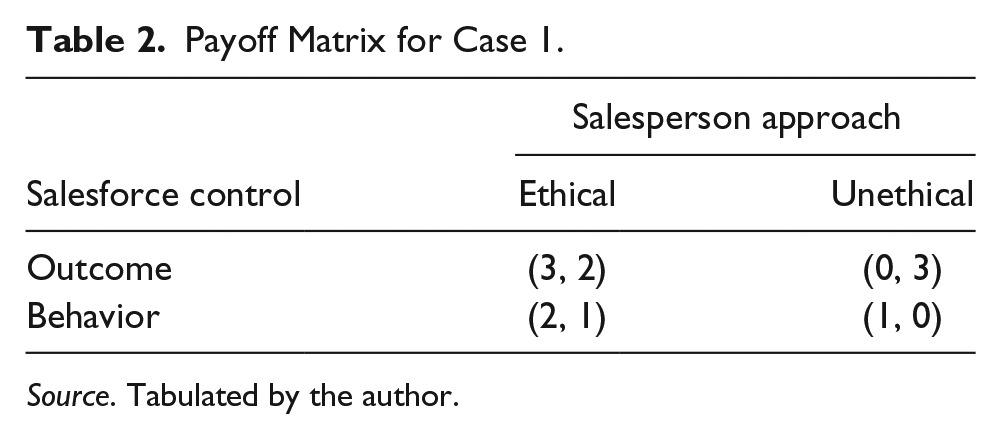
The outcome is that the sales organization receives its second highest payoff while the salesperson receives his third highest payoff. The sales organization’s equilibrium strategy is behavior control. The salesperson’s equilibrium strategy is to choose ethical if the sales organization chooses behavior control and to choose unethical if the sales organization chooses outcome control. The payoff matrix for this case is given in Table 2.
Payoff Matrix for Case 1.
Source. Tabulated by the author.
This result is interesting because, under the aforementioned assumptions regarding preferences, both the sales organization and the salesperson would prefer the outcome where the sales organization chooses outcome control and salesperson chooses honesty to the outcomes of the equilibrium strategies. In this case, the sales organization would receive its highest payoff and the salesperson would receive his second highest payoff. If another strategy combination can make one better off without making the other worse off, then the equilibrium strategy combination is said to be inefficient. In each of the next two cases, the equilibrium outcome is also inefficient. The problem is that, given his or her preferences, the salesperson cannot commit to being honest. Once the sales organization chooses outcome control, the salesperson is better off by choosing to be dishonest.
Case 2
Assume

and

This does not change the choice of the sales organization. However, the salesperson is indifferent between being honest and dishonest when behavior control is used by the sales organization. Each choice is part of either one of two equilibrium strategy combinations. The outcome may provide the sales organization with its second-highest or third-highest payoff. The payoff matrix for this case is given in Table 3.
Payoff Matrix for Case 2.

Source. Tabulated by the author.
As in Case 1, each equilibrium is inefficient. Both the sales organization and the salesperson can be better off if the salesperson can credibly commit to being honest under commission. This situation is interesting because it may provide a role for codes of conduct/ethics as well as building an ethical climate in the sales organization. The sales organization would like the indifferent salesperson to choose to be honest because it increases its payoff via long-term and repeated sales, that is,

To motivate honesty by the salesperson, the sales organization may introduce a code of conduct or ethics code. One interpretation of the code is that it changes the salesperson’s payoff ranking to bring it back to

Such an ethics code provides a guide to the salesperson about which choice should be made when indifferent toward ethics.
Case 3
Assume the following scenario:

and

In this case, the salesperson will always choose to be dishonest, regardless of the sales organization’s choice of salesforce control system, because

and

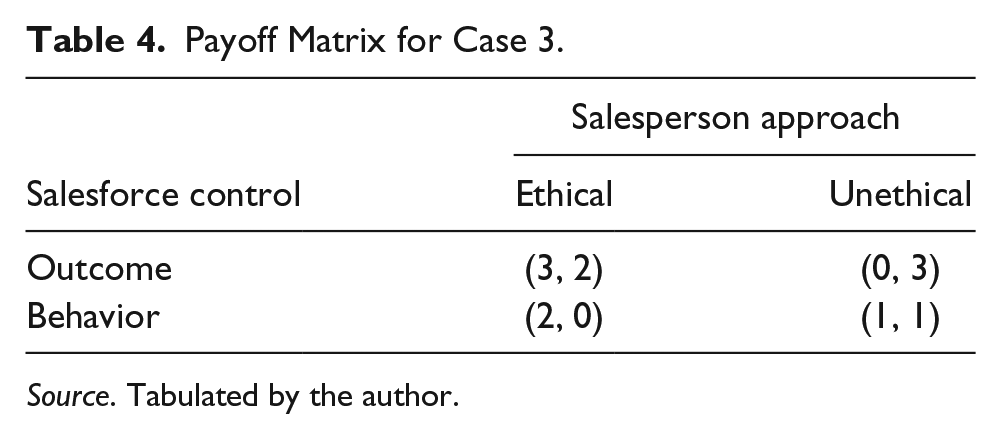
The salesperson prefers unethical behavior despite the choice of salesforce control. The result is that the sales organization receives its third-best payoff and the salesperson receives his or her third-best payoff. The payoff matrix for this case is given in Table 4. This is quite interesting because there seems to be no way to motivate honest behavior on the part of the salesperson and to reach the mutually best outcome.
Payoff Matrix for Case 3.
Source. Tabulated by the author.
Analysis of the Static or Sequential Move Game of Salesforce Control
The game theory model for salesforce control allows for other broad factors, such as personal ethics and organizational influence, that is, organizational climate and culture, to affect the decision making of the salesperson. The salesforce control system and subsequently compensation of salespeople is an important component of organizational strategy and is influenced by organization culture, training and leadership. For instance, the acceptance and internalization of corporate norms and reflections of personal ethics and values may influence a salesperson’s predisposition to being honest, which could result in different payoff rankings and equilibria. For example, if

The salesperson will never be dishonest regardless of the choice of salesforce control schemes. Ethics requires an individual to behave according to the rules of a moral philosophy with an emphasis on the determination of right and wrong acts. Sales behavior can be ethical or unethical based on the degree to which a proposed act is perceived as right or wrong, fair or unfair, just or unjust. Because different individuals have different personal ethics, a sales manager should acquire as much knowledge about the salespeople as possible before deciding on a salesforce control plan. This also emphasizes the importance of recruiting and selection activities for a sales manager in a sales organization.
A Dynamic or Repeated-Game Model of Salesforce Control
Dynamic (repeated) game theory can enhance our understanding of these important ethics issues in the salesforce control system. A repeated game involves the same “one-shot” game being repeatedly played, by the same players. It is assumed that the repetition of the same game never ends and players rank the outcomes in each period as they do in Case 3, that is,

and

Although each case results in inefficient choices, in Case 3 the salesperson prefers to be dishonest despite the choice of the salesforce control system. An important consequence of the repeated game is that many more strategies become available to each player and these strategies are more complex. For instance, the sales organization may choose to alternate between outcome control and behavior control in each period.
In a strategy called “unrelenting strategy,” the sales organization chooses an outcome control in the first period and continues to have outcome control unless the salesperson became dishonest, in which case the sales organization may adopt behavior control forever. The repetition of the game allows the sales organization to observe previous behaviors of the salesperson. In each period the game is played, the previous behavior of the salesperson can be inferred by the sales organization from its own choices regarding salesforce control and historical payoffs in preceding periods. Even if the payoffs in each period were to depend on a random external variable as well as the actual choices, by observing the behavior of the salesperson over many periods, the sales organization can be more confident that low payoffs are the result of dishonest sales practices and not the random variable. If certain that the salesperson has used unethical practices in the past, the sales organization “punishes” the salesperson by reverting to behavior control forever when the unrelenting strategy is used.
Given the sales organization chooses the “unrelenting strategy,” the salesperson should not choose a strategy that calls for being dishonest in any period. The salesperson is tempted to be dishonest in each period, because it increases his payoff (PS(u)/O(o) > PS(e)/O(o)). Resisting this temptation makes sense because doing otherwise would result in loss (PS(e)/O(o) > PS(u)/O(b)) in each period forever as the reversion to behavior control generates the same outcome in each period as in the one-shot sequential-move game.
One strategy that the salesperson can employ is simply to be ethical in each period. Let us call this strategy the “ethical strategy.” While introducing this new strategy the preferences of the salesperson are not changed. Given the “ethical strategy” by the salesperson, the sales organization chooses the “unrelenting strategy,” since the sales organization’s highest payoff is obtained in each period forever. Hence, the “unrelenting strategy” by the sales organization and the “ethical strategy” by the salesperson form an equilibrium strategy combination and results in efficient choices of outcome control and honesty (i.e., ethical behavior) in each period. This is without even the threat of firing the salesperson for dishonest behavior and without motivating a change in salesperson preferences. That is, efficient choices may arise without explicit mechanisms that rectify unethical behavior. In the “one-shot” sequential-move game this outcome was not possible in any of the three cases.
Analysis of the Dynamic or Repeated-Game Model of Salesforce Control
There are many equilibria in the repeated game. For example, if the sales organization chooses behavior control in each period (a naive strategy), the salesperson’s best choice is to be dishonest in each period (an opportunistic strategy), because

Also, given that the salesperson is unethical (dishonest) in each period, the sales organization’s best choice is to adopt behavior control, because

These strategies are thus part of another equilibrium. The outcome in this equilibrium is no better than it was in the simple “one-shot” game. In fact, the existence of multiple equilibria is realities in sales organizations as it provides reason to believe that different sales organizations will have different ethical climates and organizational cultures. Factors such as organization culture, codes of conduct, credibility in commitment and ethical leadership may influence players to choose one equilibrium strategy over another.
Salesforce Control System, Ethical Behavior and Valuation of Sales Organization
If a salesperson working in outcome control (with “commission”-only basis) takes a short-term view of sales by putting low efforts and working dishonestly or unethically and focuses only on immediate gain (i.e., commission), he or she will solely be guided by quick sales and will not be interested in building long-term customer relationship, customer trust and loyalty. When employees perceive that unethical behavior is accepted and promoted, they are more likely to engage in questionable activities. In that situation the value of a sales organization decreases as future cash flow and profitability decline because of lack of repeat sales and decline in customer trust and loyalty and deteriorating customer relationship. This situation is represented by Quadrant 3 and Quadrant 4 in the matrix in Figure 2. Quadrant 4 represents worst outcome for a sales organization as unethical behavior by a sales employee in outcome control leads to lowest payoff for the sales organization.

Salesforce control system, ethical behavior and valuation of a sales organization.
Customer trust in the salesperson can be earned by the honest actions of sales employees as well as low-pressure selling techniques. Customer trust leads to higher customer satisfaction and loyalty; hence, it is a significant determinant of future purchase intentions. If a sales employee is motivated to act honestly, work hard and focus on building long-term customer relationships and loyalty, the value of the business will increase because of higher future cash flow and profitability resulting from repeat purchases from satisfied customers. 22 This situation is represented by Quadrant 1 and Quadrant 2 in the matrix in Figure 2. These quadrants reflect ethical behavior of sales employees characterized by high level of efforts for long-term relationship and goals for sustainable gains, high customer trust and loyalty and subsequently higher valuation of the organization. Quadrant 1 represents the best outcome for the sales organization as ethical behavior by a sales employee in outcome control (characterized by higher proportion of variable pay in pay mix) leads to the highest payoff for the sales organization.
Ethical Behavior in Sales Organization: Major Drivers
The drivers of ethical behavior can be divided into formal and informal controls. Both formal controls (enforcement of ethical codes and punishment for ethical violations) as well as informal controls (internalization of codes of ethics and ethical climate) are vital to controlling the ethical behavior of sales employees. Formal controls set the rules or standards for ethical conduct and the boundaries for what is considered acceptable behavior, while informal controls bring the formal controls to a personal and individual level where sales employees monitor and regulate their ethical behavior.
The propensity for an employee to make unethical choices can be reduced by designing an appropriate salesforce control system and relevant compensation plan that rewards ethical behavior and punishes unethical behavior. As discussed earlier with the game theory approach, a salesforce control system plays an important role in influencing the ethics of salespeople. The other major drivers of ethical behavior in a sales organization are developing and implementing a code of ethics, reinforcing ethical behavior through an ethical climate, providing ethical leadership and developing effective hiring and training process. These drivers are shown in Figure 3 and are explained below.

Ethical behavior in sales organization: Major drivers.
Ethical Climate
Organizational climate refers to shared employee perceptions regarding policies, procedures, norms and values and to the behaviors that are supported, rewarded and expected by organizations. 23 The ethical behavior of employees is largely influenced by the organizational climate. An organization’s overall culture establishes ideals that guide a wide range of behaviors for members of the organization, while its ethical climate focuses specifically on issues of right and wrong. Ethical climate reflects the prevailing perceptions of typical organizational practices and procedures and is the organization’s character, conscience and mutually accepted expectations of conduct. 24
Ethical climate is a significant element of organizational culture because it can reduce ethical conflict, dilemma or stress faced by sales employees and lower the propensity of sales employees to make unethical decisions while increasing their job satisfaction and positive customer reactions. When customers believe that a salesperson works for an organization with a high ethical climate, they are likely to see the salesperson as ethical and credible. 25 In an ethical climate of sales organization, salespeople believe certain behaviors, such as customer satisfaction, trust and loyalty, are a worthwhile long-term investment even if immediate outcomes are relatively undesirable. They are willing to make short-term sacrifices to reap desired long-term future outcomes.
Organizations can diminish the opportunity for employees to engage in unethical behavior and create a strong ethical climate by developing, communicating and enforcing a code of ethics; punishing unethical behavior and limiting rewards for unethical behavior. 26
Code of Ethics
A code of ethics is important to an organization because it demonstrates an organization’s commitment to ethics; helps employees recognize the existence of moral issues and provides clear-cut guidelines about the organization’s expectations of ethical decisions and behaviors. The presence and enforcement of codes of ethics are crucial for reinforcing ethical behavior of sales employees. 27 A code of ethics is a formal and distinct management-initiated control that sets standards or expectations regarding both preferred and problematic behaviors and represents an organization’s consensus, or norms, regarding its ethical behavior. Ethical codes, along with other measures, positively influence the ethical climate within an organization, especially when they are effectively enforced. As such, establishing an enforceable code of ethics is the number one step in building an ethical climate.
The existence of codes of ethics that formalize a sales organization’s ethical value positively influences a salesperson’s perceptions of his or her organization’s ethical values. Research on 67 code studies found that codes positively affected behavior in many organizations. 28 Ethics codes also express the organization’s desire to prevent questionable conduct of employees and reward their moral actions. Since sales organization culture represents a set of implicit contracts, it may be difficult to change. This may help explain why written codes are often used as a driver for initiating change in culture.
Although ethical codes are important, they may not be sufficient to ensure ethical behavior as the organization must also consider situational factors that may influence behavior. 29 Creating a code will not ensure that ethical behavior will occur by itself; ethics, the code and ethical decision making must be infused into the organization and not ordered from the top down. 30 Forced code compliance does not work because codes communicated downward by senior management to employees are seen as edicts.
Culture and cooperation, not mandatory compliance, create the climate where codes become effective. 31 Ethical codes are most effective when employees internalize them through an experiential learning process where their behavior is modified by taking on norms or rules as their own. Organization culture is a more effective mechanism for controlling and managing employee behavior than organizational rules and regulations. 32 Suppose the organizational culture reflects a commitment to customer satisfaction and if salespeople are influenced by such ethical climate, they may be more likely to choose to be ethical in their relationships with customers. Desired culture must be communicated and reinforced. This can be accomplished in a variety of ways, including selective hiring of new sales employees, sales employee orientations, sensitivity training or through top management’s actions in the form of ethical leadership.
Recruitment and Training
Recruitment, selection and hiring with ethics focus imply that a sales organization is picking the “right kind” of individuals—those who have values and beliefs consistent with the organization or who can be taught the organization’s values. Training can be used to reinforce salespeople’s positive attitudes toward ethical values and prepare salespeople to behave more ethically. Training also provides salespeople with necessary knowledge to enable them to distinguish ethical from unethical practices. A sales manager can present salespeople with various different ethical scenarios and ask how they would respond to each and then provide inputs about how the sales organization wishes such situations be handled. A well-defined ethics training program in the organization could assist in the learning process as it would shape, reflect and formalize the organization culture.
Ethical Leadership
Managers play a very important role in setting the ethical climate in their organizations. 33 Ethical decision making must permeate the sales organization to enhance the ethical behavior of salespeople. This may mean that the sales manager should provide ethical leadership. Hence, a sales manager serves as a role model for ethical behavior in the organization and influences the ethical behavior of salespeople by virtue of what he or she says and what he or she does.
Managerial Implications
The role of organizational influences on ethical decision making is very significant. For example, organization climate and culture, type of salesforce control and compensation plan, code of ethics, effective hiring and training and top management values are major influences on the ethical decision-making process. The code of ethics and training in ethics provide a powerful mechanism to the sales organization for communicating the ethical expectations of the organization to salespeople. By such organizational influences, if a salesperson is motivated to act ethically or honestly by putting high efforts for building long-term customer relationships, trust and loyalty, it results in a win-win situation for both.
As explained earlier, there are multiple equilibria in game theory outcome, one where the salesperson chooses to be ethical in each period, the other where the salesperson chooses to be unethical in each period. All these outcomes or actions are the product of experience, can be learned and help sales organizations and salespeople coordinate in a better way on one equilibrium strategy combination for salesforce control as well as compensation plan over another.
Conclusion
The purpose of this research is to outline the contributions that game theory can make to our understanding of the salesforce control system and ethics issues. This article has outlined different types of salesforce control offered by sales organizations and the possible outcomes in terms of payoff for sales organizations as well as sales employees. As per game theory, a sales organization is better off with outcome control when salespeople behave honestly as it has the highest payoff among all other possibilities. Therefore, sales organizations can gain competitive advantages with outcome-based salesforce control by focusing on instilling and embodying ethical values throughout the organization and creating an environment where the potential for unethical behavior is low. Ethical behavior in a sales organization can be influenced by various organizational drivers such as types of salesforce control and compensation plan, ethical climate, code of ethics, hiring, selection and training process and ethical leadership.
Footnotes
Declaration of Conflicting Interests
The author declared no potential conflicts of interest with respect to the research, authorship, and/or publication of this article.
Funding
The author received no financial support for the research, authorship, and/or publication of this article.