



Abstract
Salesforce motivation is important for the success of the organization. Unless and until the salesforce is motivated, the organization will not be able to prosper. There are various factors that are responsible for salesforce motivation. It has been found that out of these many factors, the impact of salesforce control system and salesforce compensation plans is inevitable. Therefore, this study makes an attempt to analyze the impact of these two factors on salesforce motivation by following a review of selected studies from the year 1977 to 2014. Till now, none of the previous studies have analyzed the impact of these two factors on motivation. The review of studies reveals that salesforce control systems and compensation plans should be taken into consideration when motivation of salespeople is talked about as they have an impact on intrinsic as well as extrinsic motivation of salespeople. Based on the findings of the review, a framework is designed and implications and directions for future research are stated.
Introduction
A motivated salesforce is a boon for sales organizations. Salesforce motivation has been found to have an impact on salesforce performance and salesforce characteristics, which ultimately results in sales organization effectiveness. Salesforce is the linking pin between the customers and the organization. Therefore, if the interaction of the salesforce with customers is good, the organization can earn more profit.
As we notice, the selling environment has become more competitive and organizations are trying to gain competitive edge over its competitors. In such a scenario it is important for the organization to focus on its salesforce because the competitive advantage provided by the salesforce is long-lasting. The single most important factor having an impact on salesforce is motivation.
As motivation is so important, it is important for organizations to shift their attention to those factors that have an impact on salesforce motivation. If we go back to the literature on salesforce motivation, we will find that there are a lot of factors having an impact on salesforce motivation, such as salesforce personality, their characteristics and so on. But these factors cannot be controlled by the organization. In such a situation, the understanding of what and how managerial actions may affect salesforce motivation is important (Miao & Evans, 2014).
It has been found out that the most important factors that have an impact on salesforce motivation and that can be controlled by the organization are salesforce control system and salesforce compensation plans. There has not been a single study that has studied the impact of these two factors on salesforce motivation. Therefore, this study attempts to explore the impact of salesforce control system and salesforce compensation plans on salesforce motivation. The study first defines salesforce control systems, salesforce compensation plans and salesforce motivation. Then it describes the methodology used for review. Third, it reviews the studies exploring the impact of salesforce control system and compensation plans on salesforce motivation. Then it presents the findings and conclusion of the study along with a research framework. Finally, it states the implications of the study and future research directions.
Salesforce Control System
“One of the widely studied managerial means to shaping and influencing salesperson motivation is the sales control systems” (Anderson and Oliver, 1987). Salesforce control system is an organization’s set of procedures for monitoring, directing, evaluating and compensating its employees (Anderson & Oliver, 1987). There are two broad categories of salesforce control system: behavior-based and outcome-based salesforce control systems.
Behavior-Based Salesforce Control Systems
These are characterized by more monitoring of salespeople by management, more managerial direction to direct salespeople and use of subjective and more complex methods based on salespersons’ aptitude and product knowledge, their number of calls and their sales strategies to evaluate and compensate the salesforce (Anderson & Oliver, 1987). In behavior-based control system, managers know what they want salespeople to do. So they monitor their work in order to ensure that the salesforce behaves accordingly. Salespeople are given a fixed amount of salary. The firm bears the risk. Salespeople in this system are evaluated not on the basis of their achievement but on the number of factors that may result in performance.
Outcome-Based Salesforce Control Systems
These are characterized by less monitoring of salespeople by management, less managerial direction to direct salespeople and use of objective measures of outcomes to evaluate the salesforce (Anderson & Oliver, 1987). In outcome-based control systems, salespeople are left alone to achieve results in their own way using their own strategies. Salespeople are held accountable for their results and not for how they achieve the results. Under such a system, a salesperson is responsible for his or her performance but is free to select the method of achievement.
Activity Control and Capability Control
Behavior-based control has been divided into activity and capability controls by several studies (Challagalla & Shervani, 1996). In activity control, salespeople perform certain selling activities and are rewarded based on the performance of these activities. In capability control, the focus is on salesforce skills and abilities. Salespeople are monitored and rewarded by sales managers on the basis of their skills and abilities. As studies have shown different effects of activity control and capability control, these should be treated as separate constructs (Miao & Evans, 2012).
Salesforce Compensation Plans
Designing salesforce compensation plans is an important task as it helps in motivating employees and ensuring long-term profitability of the company (Coughlan & Sen, 1989). Pharmaceuticals, retail and business-to-business organizations rely excessively on personal selling. In such organizations, compensation plays an important role in affecting salesforce motivation. As the pay given to the employees forms the largest component of selling budget, management is concerned about the design of compensation plans and the return on these expenditures (Brown, Evans, Mantrala, & Challagalla, 2005). Compensation plan used by the organization affects the motivation of salespeople, which ultimately has an impact on organizational performance.
Types of Compensation Plans
Different kinds of compensation plans are used by the sales organizations. The three major types of compensation plans are as follows:
Straight salary: Salespeople in this type of compensation plan are given a fixed amount of salary. Straight salary compensation is used by the organization in usually two types of situations: (1) when it is difficult to measure the impact of salespeople on the results attained by them and (2) when the organization wants salespeople to focus on long-term objectives. It is often used in industries where the selling process is complex, team effort is involved (Basu, Lal, Srinivasan, & Staelin, 1985) and salespeople are risk-aversive.
Straight commission: In such type of compensation plan, salespeople are given commission based on their performance in terms of sales volume and profitability of sales. This type of compensation is used in those industries where there is a direct link between sales performance and financial rewards and the focus is on short-term goals. Commissions motivate salespeople to put in more effort and earn more incentives. The major disadvantage of straight commission is that it discourages salespeople to take on those activities that are not linked to the commission but are very crucial for effective organizational functioning. Therefore salespeople who are paid commission will perform low on nonselling activities. Commissions are usually preferred by salespeople who are not risk-averse.
Combination plans: Literature over the years has indicated that combination plan is one of the most commonly used salesforce compensation plans. In a combination plan, salespeople are given a base salary and some incentives in the form of commissions or bonuses. Salary provides a sense of security to salespeople, and commissions provide motivation to generate sales. The major problem in administering these plans is deciding on the combination of salary and incentives (Basu et al., 1985).
Compensation and Salesforce Motivation
Salesforce compensation is an important factor that has an impact on salesforce motivation. According to Walker, Churchill, and Ford (1977), in the marketing and sales management literature, one of the most important predictors of salesforce is financial compensation and incentives. A person working under compensation plan will feel that if he improves his performance related to total sales volume (or selling performance) then he can earn more. A person working under salary plan will feel that if she improves her nonselling performance (related to new account generation, performance of administrative duties etc.), then she has a chance of increase in pay.
Self-determination theory explains the effect of extrinsic rewards on intrinsic motivation. This theory asserts that human behavior is driven by the need to feel competent and autonomous. Different forms of feedback that a person receives in terms of verbal appreciation and financial rewards are interpreted by him or her in terms of fulfillment of competence and autonomy needs. Therefore receiving a financial incentive/bonus can inform a salesperson’s self-awareness of his or her level of competence or autonomy.
Motivation
Motivation is a psychological state that initiates and guides a person’s behavior or conscious choices (Brown & Peterson, 1994). The two types of motivation are intrinsic motivation and extrinsic motivation.
Intrinsic Motivation
Intrinsic motivation orientation is an individual’s preference for rewards that provide a sense of accomplishment, self-actualization and self-worth. Examples of such rewards are leadership opportunities and fulfilling work assignments (Walker et al., 1977). Salespeople who have high intrinsic motivation are likely to provide expected customer service and deliver high-quality customer presentations. Intrinsically motivated salespeople find their job rewarding and enjoyable, and they like to engage in selling behaviors that benefit the customers. Their focus is on building long-term relationships with the customers. They like their customers to be satisfied. Salesforce intrinsic motivation is important to sales organizations because of its impact on the selling effectiveness and well-being of salespeople (Ryan & Deci, 2000).
Extrinsic Motivation
Extrinsic motivation is the extent to which salespeople treat work as a means for obtaining external rewards such as money, recognition and promotion (Mallin, Asree, Koh, & Hu, 2010). An extrinsically motivated salesperson will focus on selling areas that produce tangible rewards, such as compensation, incentives and recognition.
Cognitive and Affective Dimensions of Intrinsic and Extrinsic Motivation
Previous research shows that intrinsic and extrinsic motivation have two different dimensions—cognitive and affective—that produce different impacts (Amabile, Hill, Hennessey, & Tighe, 1994). The cognitive and affective dimensions of intrinsic motivation are challenge seeking and task enjoyment, respectively. Extrinsic motivation includes compensation seeking (cognitive dimension) and recognition seeking (affective dimension). Miao, Evans, and Zou (2007) explored the effect of salesforce control systems on the affective as well as cognitive dimensions of intrinsic and extrinsic motivation.
Methodology for Review
Taking into account the variables of salesforce control system, compensation plans and salesforce motivation, research articles from the following marketing and sales journals were considered for the review: Journal of Personality and Social Psychology, Journal of Marketing, Journal of Personal Selling and Sales Management, Industrial Marketing Management, International Marketing Review, International Business Review, Canadian Journal of Administrative Sciences, Marketing Intelligence and Planning, Marketing Science, Psychological Bulletin, Journal of Management and Marketing Research, Journal of Business Research, International Journal of Research in Marketing, Journal of Marketing Practice, Journal of Marketing Management, American Psychologist, European Journal of Business and Management and Journal of Marketing Research.
Review of Studies
Behavior-Based Salesforce Control System and Intrinsic Motivation
Research studies are discussed in this section to enhance the understanding of the relationship between behavior-based salesforce control systems and intrinsic motivation.
Cravens, Ingram, LaForge, and Young (1993) found that field sales management control is related to intrinsic motivation, but no relationship was found between compensation control and intrinsic motivation. Piercy, Cravens, and Morgan (1997) in their study in the United Kingdom found that more effective sales organizations using behavior-based salesforce control system have salespeople with high motivation.
In a study in Canada, Barker (1999) found that higher performing salespeople are related more with behavior-based salesforce control system than with outcome-based salesforce control system and that behavior-based control has a positive effect on salesforce intrinsic motivation. The study by Baldauf and Cravens (1999) showed that intrinsic motivation is an important characteristics of high-performance salespeople in organizations where a behavior-based control system is used.
The findings of the study by Barker (2001) suggest that salespeople in more effective organizations employing behavior-based control systems have high intrinsic motivation. Baldauf, Cravens, and Piercy (2001) and Baldauf, Cravens, and Grant (2002), in their study on sales managers in Austria and the United Kingdom, found that a behavior-based control system has a positive effect on intrinsic motivation. Brown et al. (2005) suggested that a positive relationship exists between motivation and monitoring and control by stating that clear performance feedback leads to motivation.
Miao et al. (2007) measured the impact of two components of behavior-based control—activity and capability—on the affective and cognitive dimensions of intrinsic motivation. They found that capability control has a positive influence on task enjoyment (an affective component of intrinsic motivation). This indicates a positive relationship between behavior-based control and intrinsic motivation. Miao et al. (2007) also found a positive impact of activity control on challenge seeking (cognitive component of intrinsic motivation).
The study by Theodosiou and Katsikea (2007) involving 210 exporters in the United Kingdom revealed that a behavior-based salesforce control system has a positive impact on export sales managers’ motivation and attitudes. On the other hand, Miao and Evans (2012) found no direct effects of activity control and capability control on intrinsic motivation.
Review of studies showed that a behavior-based salesforce control system is positively related to intrinsic motivation. This is because in behavior-based control systems, salespeople have financial security and are encouraged by the management to focus on behavior rather than results, which ultimately leads them to pursue intrinsic goals.
Behavior-Based Salesforce Control System and Extrinsic Motivation
Cravens et al. (1993) found that field sales manager control has a positive impact on recognition motivation. Oliver and Anderson (1994) found that behavior-based control systems are related to a lack of extrinsic motivation. The study by Baldauf and Cravens (1999) showed that recognition motivation is an important characteristic of high-performing salespeople in organizations employing behavior-based salesforce control systems. Baldauf et al. (2001) and Baldauf et al. (2002) found a positive relationship between behavior-based control and recognition motivation. Miao et al. (2007) found that capability control is positive related with compensation seeking (cognitive component of extrinsic motivation) and activity control is positively related with recognition seeking (affective component of extrinsic motivation). The study by Theodosiou and Katsikea (2007) also showed recognition motivation and behavior-based salesforce control system to be positively related.
Review of studies showed that a positive relationship exists between behavior-based control systems and recognition motivation, except the study by Oliver and Anderson (1994), which indicated a negative relationship.
Outcome-Based Salesforce Control System and Intrinsic Motivation
Miao and Evans (2012) found that outcome control has a positive effect on intrinsic motivation. This finding is contrary to Anderson and Oliver’s (1987) proposition, which stated that outcome control may decrease intrinsic motivation, depending on the nature (controlling or informational) of outcome feedback. According to cognitive evaluation theory, if outcome feedback helps salespeople in improving their competence and abilities, it can result in an increase in intrinsic motivation. But if salespeople think that outcome feedback is a part of control, intrinsic motivation will decrease (Deci & Ryan, 1985).
Outcome-Based Salesforce Control System and Extrinsic Motivation
Compensation seeking is likely to be related to outcome-based control systems. Miao et al. (2007) found that outcome control is not related to compensation seeking (cognitive dimension of extrinsic motivation), which is contrary to expectations. Mallin et al. (2010) found a positive impact of outcome-based control systems on extrinsic motivation.
Impact of Hybrid Control System on Salesforce Motivation
Several organizations use a combination of behavior-based and outcome-based salesforce control systems. Various studies have investigated the impact of hybrid control system on salesforce motivation. The studies by Mallin and Pullins (2009) and Oliver and Anderson (1995) found that a hybrid control system has more impact on salesforce intrinsic motivation as compared to behavior-based or outcome-based control.
Interactive Effects
Outcome and Capability Control
Miao and Evans (2012) found that capability control and outcome control combine positively to increase intrinsic motivation. Miao and Evans (2014) found that outcome control and capability control combine positively to increase task enjoyment and recognition seeking (affective components) but not challenge seeking and compensation seeking (cognitive components).
Outcome and Activity Control
Miao and Evans (2014) found that outcome control and activity control combine positively to increase compensation seeking (cognitive dimension of extrinsic motivation) but have a negative interactive effect on task enjoyment (affective dimension of intrinsic motivation). As outcome–activity control combination highlights the link between external locus of control and rewards, it can increase salespeople’s extrinsic motivation in seeking monetary compensation (Deci & Ryan, 1985).
Activity and Capability Control
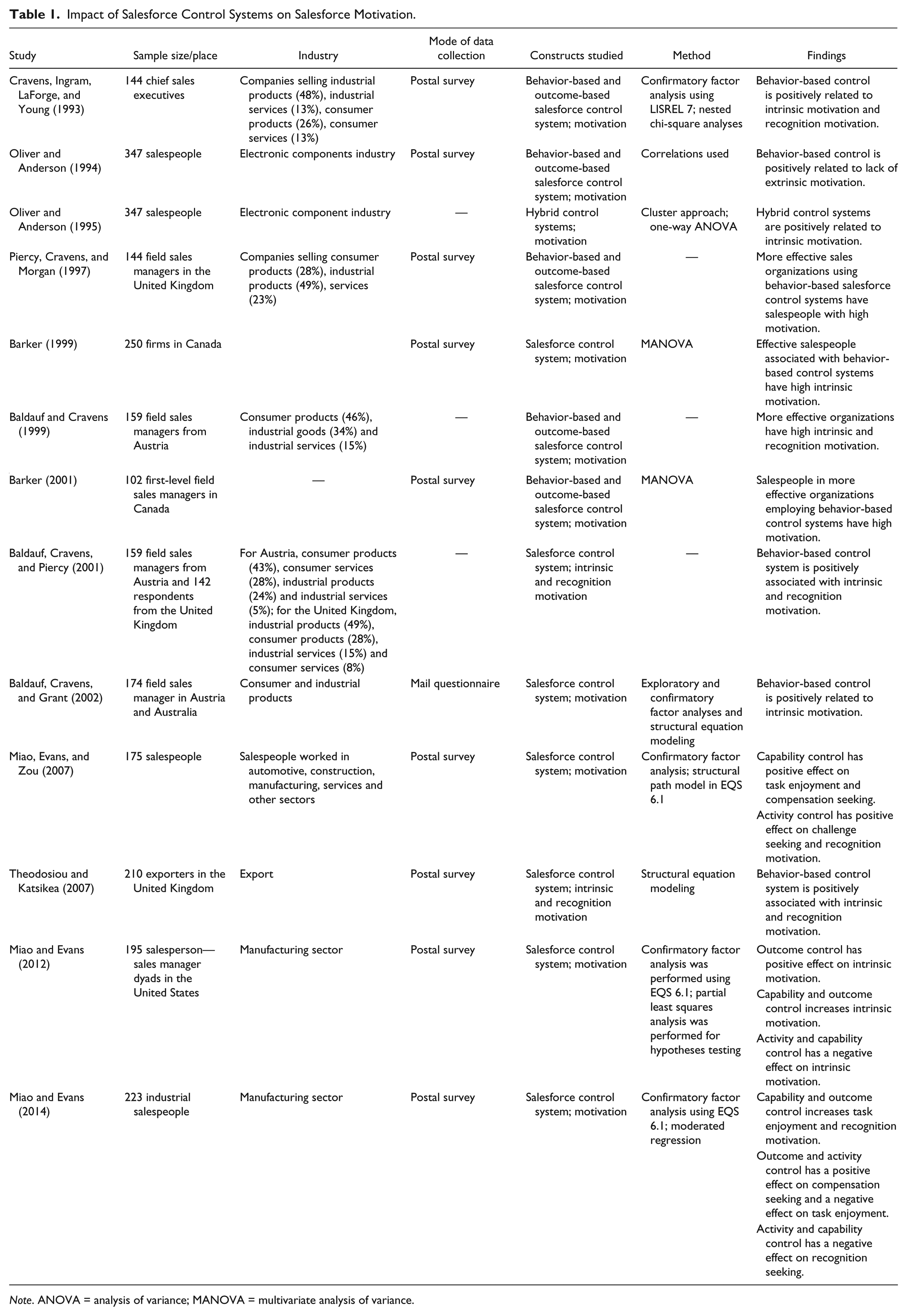
Miao and Evans (2012) found intrinsic motivation to be negatively related to activity–capability control combination. This may be because activity control restricts salespeople’s autonomy and hinders their ability to utilize new strategies, therefore reducing the positive impact of capability control on intrinsic motivation. Miao and Evans (2014) found that activity control and capability control together have a negative effect on recognition seeking (affective dimension of extrinsic motivation) but not on challenge seeking (cognitive dimension of intrinsic motivation; see Table 1 for review of studies showing impact of salesforce control systems on salesforce motivation).
Impact of Salesforce Control Systems on Salesforce Motivation.
Note. ANOVA = analysis of variance; MANOVA = multivariate analysis of variance.
Impact of Compensation Plans on Salesforce Motivation
To get better understanding of the impact of salesforce compensation plans on salesforce motivation, review of studies is presented in this section.
Walker et al. (1977) proposed that the type of compensation plan used by a firm is unrelated to the salesperson’s perceptions of the instrumentality of performance for attaining increases in nonfinancial rewards. Ingram and Bellenger (1983) studied the impact of compensation plans on a construct that is closely related to intrinsic motivation—accomplishment. They found that straight salary has a positive impact on a salesperson’s feelings of accomplishment.
In a study of 191 sales managers and 1,283 salespeople, Sujan (1986) examined the smarter and harder components of salesperson motivation from the perspective of attribution theory of motivation. Attribution theorists suggest that people are motivated not only to maximize their rewards but also to “attain a cognitive mastery of the causal structure of their environment” (Kelley, 1967, p. 193). They found that an orientation toward extrinsic rewards leads salespeople to attribute their failures to a lack of effort and that a tendency to attribute failures to insufficient effort motivates salespeople to work harder. An orientation toward intrinsic rewards leads salespeople to feel that their failures cannot be a result of poor strategies, and a tendency to attribute failures to poor strategies motivates salespeople to work smarter.
Hastings, Kiely, and Watkins (1988) examined the role of incentives in motivating salespeople in a U.K. life insurance company. They found that verbal rewards (positive feedback) have a positive effect on intrinsic motivation, while tangible rewards have a negative effect on intrinsic motivation for interesting tasks. Cravens et al. (1993) analyzed the impact of field sales management control and compensation control on salesforce intrinsic motivation. They found that field sales management control has a positive impact on intrinsic motivation and recognition motivation but not compensation control. They suggested that it will be a risky strategy if sales management uses heavy incentive plans to motivate salespeople.
Oliver and Anderson (1995) in their study of 347 sales representatives in electronic components industry found that combination plans lead to the highest level of intrinsic motivation.
Babakus, Cravens, Johnston, and Moncrief (1996) found no significant impact of compensation on salesforce intrinsic motivation. Their study also showed that compensation has an indirect impact on intrinsic motivation through perceived organizational support.
In a meta-analysis of 128 studies, Deci, Ryan, and Koestner (1999) found that tangible rewards including engagement-contingent, completion-contingent and performance-contingent rewards have a negative impact on intrinsic motivation. They found that verbal rewards (positive feedback) have a significant positive effect on intrinsic motivation.
The study on 19 sales managers by Pullins (2001) investigated the impact of compensation plan on salespersons’ intrinsic motivation. They found that commissions based on sales volume have a negative impact on salespeople’s intrinsic motivation. The study also revealed that salesforce motivation comes mostly from intrinsic rewards and the interesting and challenging nature of job.
Roman, Ruiz, and Munera (2005), in their study on salespeople in Spain, found that the method of compensation does not have an impact on intrinsic motivation. This finding is consistent with the previous research studies that found similar results (Cravens et al., 1993; Oliver & Anderson, 1994). Brown et al. (2005) in a selective review of studies revealed that clear performance feedback provided by management fosters salesforce motivation.
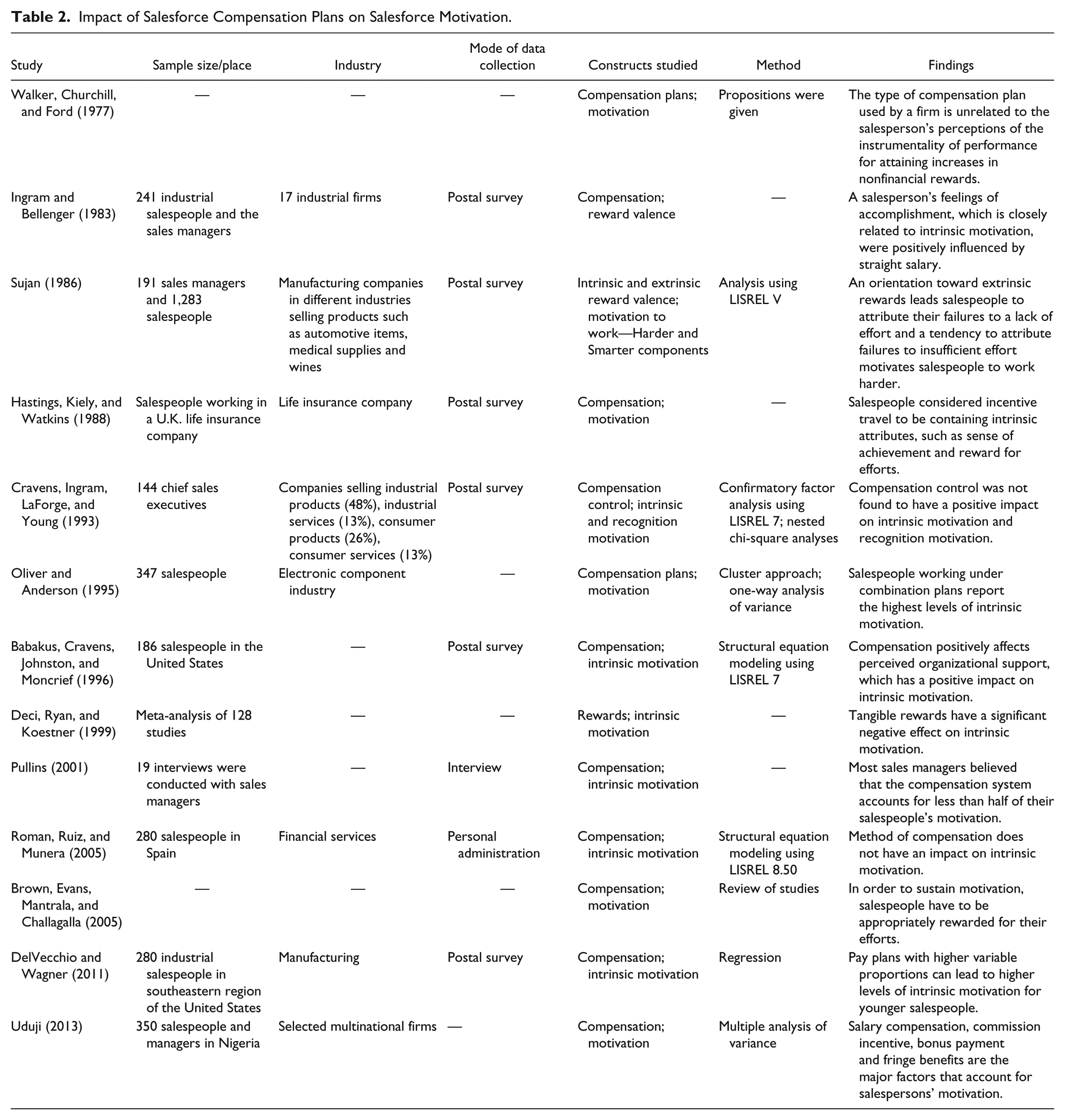
DelVecchio and Wagner (2011) found that compensation plans with higher variable proportions have a positive impact on intrinsic motivation of salespeople. Uduji (2013) found that the major factors that have an impact on salesforce motivation are as follows: salary compensation, commission incentive, bonus payment, fringe benefits, recognition awards for outstanding performance and opportunity for promotion and advancement. See Table 2 for review of studies showing impact of salesforce compensation plans on salesforce motivation.
Impact of Salesforce Compensation Plans on Salesforce Motivation.
Conclusion
The review of studies showed that behavior-based control system is positively related to intrinsic motivation (Baldauf et al., 2002; Barker, 1999). Outcome control has also been found to have a positive effect on intrinsic motivation (Miao & Evans, 2012). Behavior-based control system is positively related to extrinsic motivation (Miao et al., 2007) and intrinsic and recognition motivation (Baldauf et al., 2001; Cravens et al., 1993). On the basis of review it can be asserted that the salesforce control systems are multidimensional in nature and have a different influence on salesforce cognitive and affective dimensions of intrinsic and extrinsic motivation (Fatima and Azam, 2016).
Talking about the impact of salesforce compensation plans on salesforce motivation, the review of studies revealed that straight salary has a positive impact on intrinsic motivation (Walker et al., 1977) while commissions based on sales volume have a negative impact on salespeople’s intrinsic motivation (Pullins, 2001). Studies also revealed that combination compensation plans have the strongest positive effect on intrinsic motivation (Oliver & Anderson, 1995). In some cases the compensation plan was found to have an indirect impact on intrinsic motivation (Babakus et al., 1996). Bonus payment, fringe benefits, recognition awards for outstanding performance and opportunity for promotion and advancement are the major factors affecting salespersons’ motivation (Uduji, 2013). Two studies found that method of compensation does not have an impact on intrinsic motivation. (Babakus et al., 1996; Roman et al., 2005)
Figure 1 shows the relationships among salesforce control systems, compensation plans and salesforce motivation.
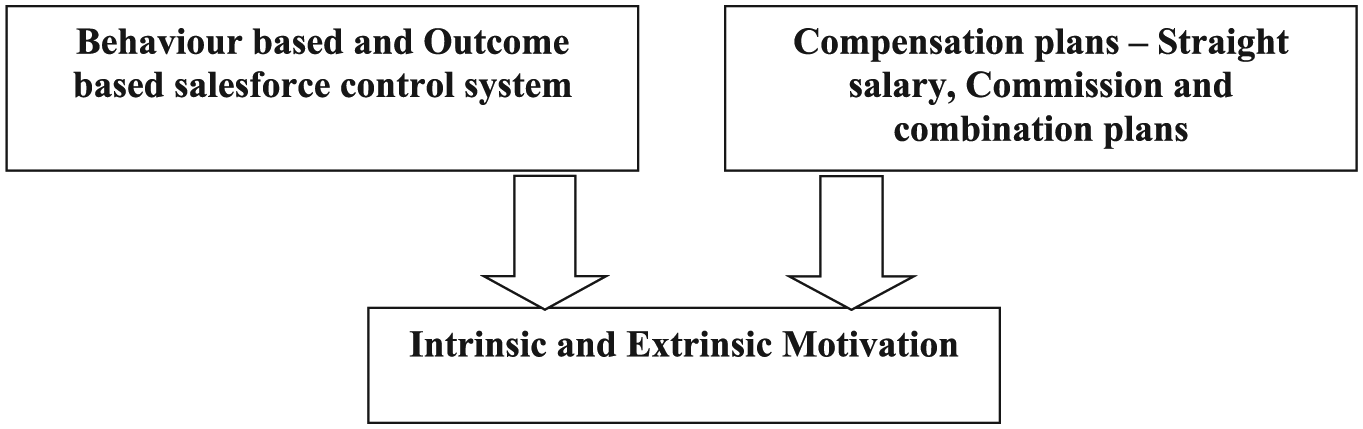
Relationships among salesforce control systems, compensation plans and salesforce motivation.
Implications
This finding of the study highlights the fact that salesforce control systems and salesforce compensation plans should be considered when salesperson motivation is studied. This study has important implication for sales organizations because it reveals that salesforce control systems and compensation plans play an important role in influencing salesforce motivation. Salesforce control systems have been found to have an impact on cognitive and affective dimensions of intrinsic and extrinsic motivation. Salesforce motivation is important for organizations as it has a direct impact on salesforce behaviors and sales performance, which ultimately leads to sales organization effectiveness (Fatima, 2016).
As far as the implications for researchers is concerned, this study will help researchers in understanding the role of two most important organizational variables in affecting salesforce motivation.
Future Research Directions
This study analyzed the impact of salesforce control systems and compensation plans on salesforce motivation taking a review-based approach. The research in future should try to fill in the gaps that were observed while doing the review of previous studies on salesforce control systems and salesforce compensation plans. The most important observation was that no study was found that analyzed the impact of compensation plans on affective and cognitive components of intrinsic and extrinsic motivation. Therefore, researchers should analyze the impact of compensation plans on affective and cognitive components of intrinsic and extrinsic motivation.
Footnotes
Declaration of Conflicting Interests
The author declared no potential conflicts of interest with respect to the research, authorship, and/or publication of this article.
Funding
The author received no financial support for the research, authorship, and/or publication of this article.