




Abstract
Compensation consultants often advise private companies to use equity incentives to attract and/or retain employees. This practice has become common during recent periods of labor shortages and low unemployment rates. This discussion summarizes what compensation consultants need to know about taxation and security valuation issues related to private company equity incentive compensation programs.
Keywords
Introduction
Compensation consultants often advise private companies (and particularly early-stage companies) to use equity incentives to attract and/or retain talented employees. This employee compensation practice has become particularly common during the recent periods of labor shortages and low unemployment rates. However, equity incentive compensation plans have income tax consequences—both to the employee recipient and to the employer company. This discussion summarizes what compensation consultants need to know about the taxation issues and the security valuation issues related to private company equity incentive compensation programs.
With labor shortages currently affecting many industries and with a low national unemployment rate, many private company owners are considering some form of equity compensation incentives to attract and retain high quality employees. For years, compensation consultants have advised private company owners to develop and implement equity incentive compensation plans for senior executives and for other key employees. In the current economic environment, many private company owners are expanding those equity incentive plans to include all management levels and, in certain cases, some of their rank-and-file employees, as well.
For our purposes, the term private company includes a corporation (both C corporation and S corporation), a limited liability company (“LLC”), or a partnership. Also, equity incentive compensation plans include stock (or LLC unit) awards, stock (or LLC unit) options, and partnership profits interests. With regard to the grant of equity incentives, we will consider what compensation consultants need to know about the uncertainties related to the fair market value valuation of private company equity interests. In particular, we will consider the uncertainty related to the valuation of early-stage company equity interests.
We will summarize both the taxation aspects and the valuation aspects of implementing an equity incentive compensation plan at a private company. This summary assumes that the compensation consultant is proposing such a plan is to assist the private company owner to attract and retain the best employees. Accordingly, this discussion is not intended to provide legal, accounting, or taxation advice.
While relevant to all private companies (including closely held private companies), this discussion is particularly relevant to early-stage and development-stage private companies (including start-up companies). In a competitive labor market, smaller, more thinly capitalized companies may face a greater need to use equity incentives to attract and retain high-quality employees. And, newer, smaller, and more thinly capitalized companies may experience more valuation uncertainty with regard to both the grant and the taxation of their equity incentives.
Company owners and their compensation consultants often do not consider all of the taxation aspects of implementing an equity incentive compensation plan. The company owner’s decision to implement such a compensation program may have to be made quickly in order to hire or retain a key employee. The taxation considerations of an employment offer that includes equity incentives may be an afterthought. In addition, the professional valuation of the equity instruments included in the newly created plan may also be an afterthought. The retention of an independent valuation analyst (“analyst”) may occur after the equity incentives have been offered—and accepted. In addition to the compensation consultants, these analysts may not be familiar with all of the taxation consequences related to the grant of equity incentive awards.
The implementation of an equity incentive plan has taxation consequences to both the employee recipient and to the private company. And, these taxation considerations may be particularly material to an early-stage company. Many of these taxation considerations relate directly to the valuation of the equity instruments included in the compensation plan. And, typically, there is a greater level of uncertainty in the valuation of an early-stage private company than there is in the valuation of a larger, established, better-capitalized private company.
We will summarize the least that company owners and their compensation consultants need to know about the implementation of an equity incentive compensation plan. While compensation plans can include many types of equity and synthetic equity instruments, the scope of this summary is limited to stock awards, stock options, and partnership profits interests.
Uncertainty in the Early-Stage Company Valuations
There is some uncertainty with regard to the fair market value valuation of any private company business enterprise. There is greater uncertainty with regard to the valuation of the nonmarketable, noncontrolling equity instruments of a private company. There is greater uncertainty still with regard to the valuation of the nonmarketable, noncontrolling equity instruments of an early-stage or development-stage private company.
This uncertainty is often defined as the probability that the estimated fair market value of the equity will turn out to be different than the actual fair market value of the equity. The estimated fair market value is the amount concluded in an independent valuation analysis prepared by a valuation specialist. In contrast, the actual fair market value is the price that is actually paid in an arm’s-length transaction between a willing buyer and a willing seller. The probability that the estimated value is different than the actual value is sometimes referred to as valuation risk. Valuation risk is typically considered to be the risk that the independent valuation conclusion will understate or overstate the actual transaction price of a private company equity interest.
Private company owners and their compensation consultants should understand that there is some uncertainty—or valuation risk—in every security valuation that is prepared for equity incentive plan purposes. There is greater uncertainty—or valuation risk—in every early-stage company security valuation that is prepared for equity incentive plan purposes.
In all private company valuations, analysts exercise professional judgment in the selection and application of the generally accepted business valuation approaches. Analysts exercise professional judgment in the selection and application of the individual business valuation methods applied within each generally accepted valuation approach. Analysts exercise professional judgment in the selection and application of the specific valuation procedures within each business valuation method. And, analysts apply professional judgment in the selection and application of the quantitative valuation variables (i.e., the actual numbers) that are considered in the selected valuation procedures.
When the private employer company is in the early or development stages, these professional valuation judgments are often more difficult to make and more different to support. Often, the analyst’s valuation judgments regarding the early-stage company may be difficult to support as a result of data constraints. The employer company may not have a long history of financial results of operations. The historical financial results of operations may look materially different year to year—as the employer company matures. The subject company may not have audited financial statements. The historical financial statements may be influenced by the company’s change in accounting policies over time. The historical financial statements may be influenced by the company’s debt/equity recapitalizations. The company may have not yet achieved a stabilized (also called normalized) level of operating income. This lack of stabilized income may limit the analyst’s ability to apply the direct capitalization method to the employer company’s security valuation.
In addition, the early-stage company may not have prospective financial statements—that is, financial projections. If the employer does have financial projections, then the analyst may not be able to assess whether those prospective financial statements are credible. That is, the analyst may not be able to perform the typical due diligence procedures with regard to those financial projections. For example, due to the employer company’s limited operating history, the analyst may not be able to compare previous period financial projections to previous period actual results of operations. Such a comparison often allows the analyst to assess the company management’s ability to develop reliable financial projections. This lack of reliable financial projections may limit the analyst’s ability to apply the discounted cash flow method to the employer company’s security valuation.
Another valuation data constraint may involve transactional data that would allow the analyst to apply market approach security valuation methods. For example, there may not be any publicly traded companies that are sufficiently comparable to the subject early-stage company to provide meaningful valuation guidance. In that case, the analyst may not be able to apply the guideline publicly traded company valuation method. Likewise, there may not be any completed merger and acquisition transactions that are sufficiently comparable to the subject early-stage employer company to provide meaningful valuation guidance. In that case, the analyst may not be able to apply the guideline merged and acquired company (or guideline transaction) valuation method.
The above-listed data constraints may impact the analyst’s judgments with respect to the employer company’s security valuation. There may also be data constraints that impact the analyst’s valuation of the options to buy the private company securities. Many stock option valuation methods involve analyses that are typically called option pricing models. These options pricing models incorporate valuation variables that may also be influenced by the analyst’s judgment. Many option pricing models include consideration of the expected future variability in the employer company stock value. And, many option pricing models include consideration of the expected future growth rate (or rate of appreciation) in the employer company stock value. However, the analyst may not have adequate data with regard to historical company stock value variability or historical company stock value growth rates. Such data constraints may cause uncertainty in the analyst’s stock option valuation analyses and conclusions.
Stock Awards and Valuation
Internal Revenue Code Section 83 provides the income recognition rules for an employee’s receipt of stock or LLC units (collectively referred to here as “stock”) with respect to that employee’s performance of services. Section 83(a) provides that the employee’s receipt of such stock is taxable income to the extent that the fair market value of the stock exceeds the price (if any) paid for the stock. The fair market value of the stock is measured at the time that the stock award vests.
Section 83(b) allows the employee to make an election. That election allows the employee to recognize taxable income on the stock grant date, regardless of when the stock award ultimately vests. The amount of the taxable income equals the excess of the fair market value of the stock over the price (if any) paid for the stock. When the employee makes the Section 83(b) election, the stock’s fair market value should be estimated without regard to any award restrictions that will lapse in the future. The stock award vests when all of the requirements for an employee to receive the stock are satisfied. The most typical vesting requirement is an agreed-upon number of years of employment.
Whether Section 83(a) or 83(b) applies, the amount by which the stock’s fair market value exceeds the amount (if any) paid for the stock represents taxable income to the employee and an income tax deduction to the employer company.
If the stock subject to grant is undervalued, then there may be a potential tax liability to the employee. That is, the Internal Revenue Service (the “Service”) may claim that the stock’s actual fair market value is greater than the amount that was reported by the employee. The Service may also claim that the employee underreported his or her taxable income. In addition, if the stock is undervalued, then the employer company will not benefit from the income tax deduction associated with that value understatement.
If the stock subject to the grant is overvalued, then the employee will recognize more taxable income than the Service would have required. In addition, the Service may disallow the employer company’s income tax deduction for the alleged stock value overstatement.
Stock Options and Valuation
Of course, private company stock options are typically subject to greater valuation risk than are private company stock awards. This is because, often, there is more analyst judgment involved in the valuation of the stock options than there is in the valuation of the company stock.
Nonqualified stock options are more typically granted in private companies (particularly in early-stage companies) than are incentive stock options. This is because nonqualified stock options are generally subject to fewer taxation requirements and restrictions than are incentive stock options.
Unless certain requirements are met, nonqualified stock options will fall within the Section 409A requirements. The most relevant Section 409A-related taxation requirement is the following: “the exercise price may never be less than the fair market value of the underlying stock. . . on the date the option is granted.” This fair market value requirement is provided in Regulation 1.409A-1(b)5(k)(A)(1). Section 409A provides for a 20% additional tax (plus interest) on the amounts to which it is applied. Therefore, employee recipients (and their tax advisers) want to make sure that any stock options are issued with a strike price (or exercise price) at or above the fair market value of the employer company’s stock.
In the Sutardja decision, 1 the Service applied the provisions of Section 409A to discontinued stock options. The Service claimed that the employee’s exercise of the employer company’s stock option was from a nonqualified deferred compensation plan under Section 409A(d). Dr. Sehat Sutardja and his wife Weili Dei were employed by his company, Marvell Technology Group Limited. Dr. Sutardja exercised a stock option that was granted by Marvell. Upon audit, the Service applied the additional 20% tax provided by Section 409A(a)(1)(B)(i)(II).
At trial before the Court of Federal Claims, both the taxpayer, Dr. Sutardja, and the Service agreed that the stock option did have a readily determinable fair market value as of the grant date. Based on that agreement, Dr. Sutardja could not convince the court that the nonqualified stock option was not issued at a strike price below fair market value.
Partnership Profits Interests and Valuation
Many employer companies operate as either a C corporation or an S corporation. In recent years, many early-stage companies have elected the LLC form of organization. These LLCs typically elect to be taxed as partnerships. Currently, the Biden administration has proposed the return of higher federal income tax rates for C corporations. In the event that such a fiscal policy initiative can make its way through Congress and be passed into law, the LLC organization structure may become even more popular—particularly for start-up companies.
As with early-stage corporations, compensation consultants advise early-stage LLCs to use equity incentive plans to attract and retain talented employees. For LLCs (taxed as partnerships), one possible compensation alternative is the profits interests. In such a compensation arrangement, the employee becomes a partner of the company—but a partner who can only share in the future appreciation of the company. Revenue Procedures 2001-43 and 93–27 provide safe harbor provisions under which the Service will treat the employee’s receipt of a partnership profits interest as a nontaxable event.
In Revenue Procedure 93–27, the Service defined a partnership profits interest as any “partnership interest other than a capital interest.” At its grant date, a partnership capital interest “would give the holder a share if the proceeds of the partnership’s assets were sold at fair market value.” Therefore, the fair market value valuation of the profits interest is an important taxation consideration.
The safe harbor provisions in the above-mentioned revenue procedures only apply in instances that the Service considers to be a true profits interest. The question of what provisions qualify as a true partnership profits interest has been litigated. See, for example, Crescent Holdings, LLC. 2 If the partnership interest is issued “in the money,” then the Service may recast the profits interest as a capital interest. The grant of a capital interest would be considered taxable compensation to the employee on the grant date. In other words, the Service will treat the grant of a capital interest just like the grant of a stock (or an LLC unit) award. A security is considered to be “in the money” if the purchase price for the security (say the option price) is less than the fair market value of the security (say when the option was granted).
Such a Service challenge to a partnership profits interest is particularly important to an employee who has made the Section 83(b) election. In that situation, if the Service recasts the profits interest as a capital interest, then the employee will have to recognize taxable income in an amount equal to the fair market value of the (recast) capital interest on the grant date.
Valuation Challenges
When company owners implement any of the above-mentioned equity incentive programs, both tax counsel and compensation advisers recommend that the company retain specialists to estimate the fair market value of the employer company and of the company equity interests. These specialists prepare such fair market value security valuations as of a specifically identified valuation date. That date is typically the equity incentive grant date. Such security valuations are typically prepared by analysts with specialized valuation credentials. And, such security valuations are typically developed in compliance with generally accepted valuation professional standards.
Nonetheless, as discussed above, such security valuations are influenced by the individual analyst’s professional judgment. And, such analyst judgment is influenced by the company, industry, economic, and capital market information that is known or knowable to the analyst as of the specified valuation date. When the Service reviews the company’s equity incentive compensation program years after the fact, the Service has the benefit of hindsight. Particularly for an early-stage employer company, the actual company results, competitive conditions, and economic trends may turn out differently from what was projected by the company management or by the valuation analyst.
This so-called hindsight advantage often affects the Service’s challenge of security valuations prepared for income tax, estate tax, or gift tax purposes. In the Estate of Jung, 3 the Tax Court opined that “if a prospective…buyer and seller were likely to have foreseen [a future sale], and the other activities leading to the liquidation, then those later-occurring events could affect what a willing buyer would pay and what a willing seller would demand as of [the valuation date].” In other words, the courts sometimes agree that the Service can consider certain post-valuation-date events to assess the credibility of an independent valuation analysis. The question is typically disputed about whether such post-valuation-date events were actually known—or could have been knowable—as of the specific valuation date.
The possibility of this hindsight lookback on the part of the Service may influence how the employer company approaches the valuation of the equity ownership interest. Company owners are typically advised not to undervalue the equity incentive award if there may be a near-term stock sale, company sale, or company capitalization event that will provide the Service with post-valuation-date security pricing benchmarks.
Of course, for private companies, valuation uncertainty—or valuation risk—cannot be eliminated entirely. This conclusion is particularly true in the case of an early-stage or development-stage employer company. As discussed above, such security valuations—however professionally prepared—are often influenced by the limited availability of both historical data and prospective data. Of course, the company owner’s reliance on a professional analyst’s independent valuation helps both the company and the employee to comply with various Section 409A safe harbors. And, such reliance—and such safe harbors—shift the burden of proof on any equity incentive valuation challenge from the taxpayer to the Service. With a professionally supported equity interest valuations in place, the company owner can more confidentially use the equity incentive compensation plan to attract and retain talented employees.
Making the Section 83(b) Election
The Section 83(b) election is an employee election, not an employer company election. First, the employee receives from the employer company one of the equity incentives described above. Second, the employee makes the Section 83(b) election. This election allows the employee to recognize the income tax consequences of the equity incentive at the time of the incentive grant—rather than at the time that the equity incentive is vested. Presumably, for a successful employer company with an appreciating equity value, the amount of compensation income that the employee will have to recognize is much lower on the current grant date than it will be on the future vesting date.
More generous private companies may pay for a tax adviser (or some other expert) to advise the employee recipient regarding the decision to make the Section 83(b) election. The principal purpose of implementing an equity incentive compensation plan is to attract and retain talented employees. The company owner wants to keep the company’s best employees happy. Company employees who are faced with unfavorable or unexpected income tax consequences—or who missed an opportunity to enjoy a favorable income tax treatment—generally will not be happy employees.
The Alves Decision
The Tax Court’s decision in Alves 4 illustrates the negative consequences of an employee not making a timely Section 83(b) election with regard to an equity incentive award. In this case, the taxpayer was an employee of an early-stage private company, General Digital Corporation. The employee was granted the right to buy the company common stock at 10 cents per share, the fair market value of the stock at the time of the grant. Employee Alves purchased the company stock for a price equal to its fair market value. In fact, upon audit, the Service never challenged the fair market value pricing determination.
The tax issue in the case was that the employee still owned the stock at the end of the vesting period, and the private company stock had appreciated materially between the grant date and the vesting date. In the year of the vesting date, Mr. Alves did not report that appreciation as compensation income on his personal income tax return.
The Service audited Mr. Alves. The Service issued an adjustment and assessed additional tax on the amount of the stock value appreciation between the purchase date and the vesting date. Again, employee Alves had paid an undisputed fair market value price for the new corporation’s stock on the grant date. But, Mr. Alves did not make the Section 83(b) election. Therefore, the Service claimed that the stock value appreciation was ordinary income to the employee under Section 83(a).
Alves brought suit in the Tax Court. Based on these facts, the Tax Court agreed with the Service. In its decision, the Tax Court stated, “it is unfortunate that the petitioner did not elect the provisions of Section 83(b).” However, the court upheld the Service’s position.
Alves appealed to the U.S. Court of Appeals. In its decision in Alves 5 the Ninth Circuit upheld the Tax Court’s decision. The Appeals Court also noted how unfortunate this result was for the taxpayer employee. The Appeals Court stated, “the tax laws often make an affirmative election necessary. Section 83(b) is but one example of a provision requiring taxpayers to act or suffer less attractive tax consequences.” While the Ninth Circuit recognized how inequitable this result may seem to Mr. Alves, this court also upheld the Service’s position.
In the Alves matter, if the employee had simply made the Section 83(b) election, he would have escaped the taxation on ordinary income related to the General Digital Corporation stock appreciation between the purchase date and the vesting date. In addition, in this case, there would have been no tax cost to Alves to make the Section 83(b) election. That is because, at the time of the early-stage company stock purchase, the “excess” of the stock’s fair market value over the stock’s purchase price was zero. This is because Lawrence Alves had paid the full fair market value for the General Digital Corporation stock.
Other Section 83(b) Election Issues
It is noteworthy that making the Section 83(b) election also starts the statutory clock running with regard to any Service challenge to the equity incentive transaction. That is, the tax year in which the employee makes the election starts the statutory limit on the amount of time during which the Service can challenge the valuation of the equity incentive award. Both grants and awards subject to vesting provide the Service with several opportunities to challenge the valuation of the equity incentive. The Service can challenge the initial equity valuation and any subsequent equity valuations during the various vesting dates. Therefore, it may be in the employee’s interest to make an election that begins to limit the time period during which the Service can challenge the equity valuations.
Employee recipients (and employer companies) should be aware that there is some financial risk to making the Section 83(b) election. The risk is that the employee may ultimately forfeit the equity incentive award or grant after the election is made. Employees (and employers) should realize that the employer company shares (or the LLC units) typically are not legally vested when the election is made. Those shares (or units) typically can be forfeited if the employee leaves the employer company for any reason before the vesting occurs.
Section 83(b)(1) states the following: “if such election is made…and if such property is subsequently forfeited, no deduction shall be allowed in respect of such forfeiture.” That is, if the employee leaves the employer company and forfeits the equity incentive, the employee will not get a tax deduction for the grant date income that was previously recognized when the Section 83(b) election was made.
Employees (and employers) should note that forfeiting the equity incentive stock (or units) has a different income tax consequence than does disposing of (say, in a liquidation) the stock (or units). In a disposal (say, a liquidation) scenario, the employee will have a tax basis in the stock (or the units) that are being disposed. This tax basis was created when the employee made the Section 83(b) election and recognized taxable income at that time. If the liquidation proceeds (if any) are less than the employee’s basis in the shares or units, then the employee can claim a capital loss on the disposal of the equity interest.
The point is that there are both risks and rewards to the employee recipient who makes the Section 83(b) election. The previous paragraphs illustrated some of the risks. However, employee recipients (and employer companies) should recognize that the rewards of the election generally outweigh the risks of the election. If the employer company is successful, then the employee could expect that the stock (or units) will appreciate over time. And, the employee would expect to ultimately sell the stock (or units)—whether back to the employer company or to another buyer—at a price much higher than the price the employee originally paid for the equity interest. If the employee had made a valid Section 83(b) election, then all of that appreciation will be taxed as a long-term capital gain—rather than as ordinary income.
Summary and Conclusion
Company owners (whether of early-stage companies or seasoned companies) are often in competition to attract and retain talented employees. This statement is particularly true when the national (or the industry) unemployment rate is at a historically low level. In addition, this statement is particularly true when the most talented employees believe that it may be a good time to jump ship and find (what they perceive to be) a better opportunity. Early-stage and development-stage companies may find it more difficult to recruit the most talented employees. Rightly or wrongly, such employees may perceive more risk and less opportunities associated with smaller employer companies.
In order to incentivize and retain high quality employees (and, particularly, key position employees), many compensation consultants advise private companies to offer a variety of equity incentive compensation programs. This article considered stock grants, stock options, and partnership profits interests as three typical examples of such compensation programs. These three types of equity incentive programs are fairly typical in early-stage and development-stage companies. Employees in such companies often believe that they deserve such equity incentives. Such employees often remind the company owners that “they came in on the ground floor” and that “they helped the company to achieve its success.” In such situations, these employees sometimes believe that they have earned a share of the company’s value appreciation.
In addition to compensation consultants, company owners should consult with tax advisers and valuation specialists before implementing an equity incentive compensation program. Such programs create income tax consequences to both the employee recipients and the employer company. And, both compensation consultants and valuation specialists should be aware of such consequences and should be aware of how the fair market value security valuations may affect those consequences.
In particular, all parties to the equity incentive program should be aware of the uncertainty associated with the valuation of employer company securities—and particularly early-stage employer company securities. And, all parties should understand that the Service is less subject to this so-called valuation risk when it challenges these employer company security valuations. That is because the Service may be applying hindsight when it reviews such compensation transactions years after the grant date or the vesting date.
This employer company valuation risk and uncertainty may be summarized in the following table. In this table, we note that the assessment of the company and security valuation risk is qualitative and not quantitative. That is, there is not a specific qualitative relationship between the various levels of valuation risk assessment.
Employer Company and Employer Company Securities
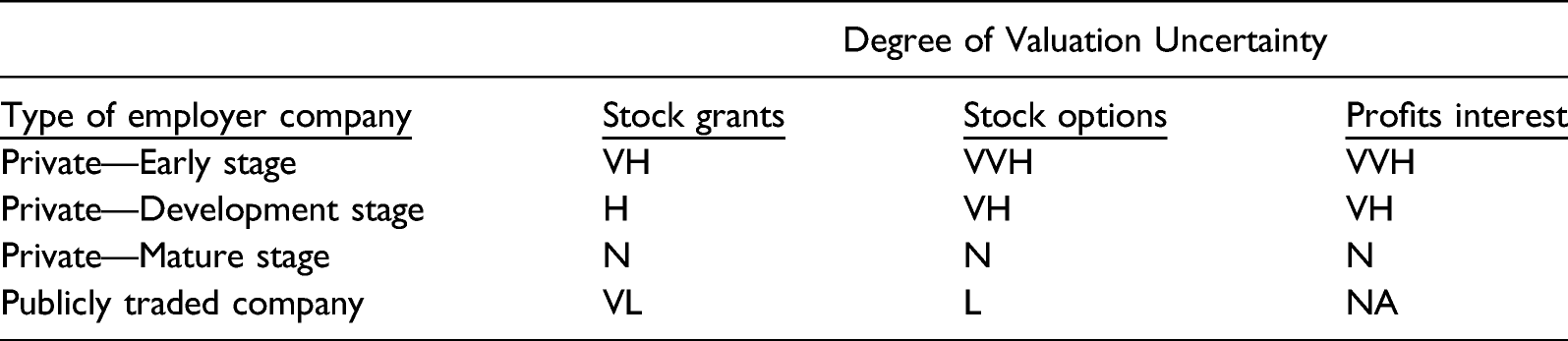
Key: VVH – very, very high level of valuation uncertainty; VH – very high level of valuation uncertainty; H – high level of valuation uncertainty; N – nominal level of valuation uncertainty; L – low level of valuation uncertainty; VL – very low level of valuation uncertainty; NA – generally not applicable
Company owners and their compensation consultants should consider all of the taxation consequences of implementing an equity incentive program. And, company owners and their compensation consultants should also consider the practical consequences of implementing such a program. For example, if the company employee does not have the available liquidity to exercise a stock option or to pay the income tax on a stock award, then such a program could prove to be an employee disincentive rather than an employee incentive.
Finally, both employees and employers should consider the costs and the benefits of all of the tax elections—and other tax strategies—related to the equity incentive compensation awards.
The opinions and materials contained herein do not necessarily reflect the opinions and beliefs of the author’s employer. In authoring this article, neither the author nor Willamette Management Associates, a Citizens Company, is undertaking to provide any legal, accounting or tax advice in connection with this discussion. Any party receiving this discussion must rely on its own legal counsel, accountants, and other similar expert advisors for legal, accounting, tax, and other similar advice relating to the subject matter.
Footnotes
Declaration Of Conflicting Interests
The author(s) declared no potential conflicts of interest with respect to the research, authorship, and/or publication of this article.
Funding
The author(s) received no financial support for the research, authorship, and/or publication of this article.
