



Abstract
The research explores older women's clothing fit and style concerns and their attitudes toward 3D body scanning. A film of the 3D body scanning process was developed as an information source and shown to groups of older women prior to collecting survey and focus group data in 10 different community centers and living facilities in four Midwestern U.S. states. Clothing fit was the most important consideration to participants in making apparel purchasing decisions. Participants addressed the difficulty in finding clothing that fits their body shapes and styles that are appropriate for the aging body. Participants' preferences for using 3D body scanning in the future were also examined. Focus group participants expressed greatest willingness to use 3D body scanning for pattern development services. Future research needs to address older consumer acceptance of emerging technology applications for clothing customization and selection.
In 2010, older persons 65 and over in the United States constituted approximately 13% of the total population (U.S. Bureau of the Census, 2010). Projections for the older population in 2050 are more than double, as the older population is expected to grow from 40.2 to 88.5 million and will make up nearly 20.2% of the total U.S. population (U.S. Bureau of the Census, 2010). As of 2011, the first wave of the 76 million baby boomers, the generation born between 1946 and 1964, will turn 65 (U.S. Bureau of the Census, 2005).
The apparel industry tends to design clothing for younger consumers and overlook consumers who are over 65 years old (Alexander, Connell, & Presley, 2005; Thomas & Peters, 2009). Because the older segment of the population is increasing proportionately at a greater rate than other segments of the population, attention to their clothing needs and preferences makes sense from both marketing and human issues perspective. The older segment of the population controls a major portion of the nation’s wealth and has a large disposable income (Bureau of Labor Statistics, 2011), making them a viable market as they age. In previous research, older consumers complained about their dissatisfaction with apparel fit and style offerings in the market (Howarton & Lee, 2010; Twigg, 2007). The present study provides a check on whether older consumers still have fit and style complaints and whether they are interested in new technologies that could help satisfy their apparel needs more adequately.
Although most clothing designers are aware that there is a growing segment of older consumers in current society, a need still exists within the industry to fully understand the physical, social, and psychological changes inherent in the aging process. Older consumers, particularly women, have for several decades reported complaints about the difficulty of finding well-fitting, comfortable clothing in stores (e.g., Ashdown & Na, 2008; Birtwistle & Tsim, 2005; Howarton & Lee, 2010; Joung & Miller, 2006; Lee, 2005; Twigg, 2007). Salusso, Borkoski, Reich, and Goldsberry (2006) stated that this age group was not well represented in the U.S. sizing system database from the 1940s or in any contemporary studies. Ready-to-wear fit problems in the areas of the shoulders, back, waist, bust, arms, and abdomen have been commonly noted by older women (Shim & Bickle, 1993). Changes in body shape during the aging process, such as changes in height and proportion, are common (Campbell & Horne, 2001; Salusso, Borkoski, Reich, & Goldsberry, 2006). Campbell and Horne (2001) described that “shorter stature, thickened waist, protruding abdomen, flattened buttocks, and a forward tilt of the head and shoulders” (p. 196) are common characteristics of the figure shape of older women. Good clothing fit is vital to an individual’s psychological and social well-being (Ashdown & O’Connell, 2006; Chun, 2007; Lee, 2005; Lee & Sontag, 2010; Twigg, 2007), but finding well-fitting clothing can still be challenging for older women.
Because the U.S. clothing sizing system was based on a study from the 1940s which does not accommodate the diversity of human shapes that currently exist in the United States, many fit problems have been increasing among consumers (Ashdown & Dunne, 2006; Simmons, Istook, & Devarajan, 2004). Limited research has been conducted on factors associated with older individuals' changes in body shape, apparel fit, and comfort. In 1994, the release of the American society for testing and materials D5586 standard tables of body measurements for women aged 55 and over (all figure types) marked the first step toward solving apparel fit problems for older women; however, few researchers and industry professionals have experimented with incorporating the measurements into garments for women in the older age group (Schofield, Ashdown, Hethorn, LaBat, & Salusso, 2006). Some firms are incorporating information from more recent national body scan studies, but dimensions of the older consumer are not usually incorporated purposefully into new sizing systems.
Previous research and design experts have used traditional measuring equipment (i.e., tape measures) to assess apparel fit. Current technology, particularly the three-dimensional (3D) body scanner, has the ability to obtain 3D data of the surface of the human body, providing valuable information to improve garment fit (Apeagyei & Otieno, 2007; Ashdown & Dunne, 2006; Ashdown & Na, 2008; Connell et al., 2003; Daanen & Hong, 2008; Loker, Ashdown, & Schoenfelder, 2005; Petrova & Ashdown, 2008; Simmons et al., 2004).
Full body 3D scanning captures 3D data in about 12–15 s, creating a computer image in less than 1.5 min (Ashdown, Loker, Schoenfelder, & Lyman-Clarke, 2004; Ashdown, Slocum, & Lee, 2005; Bye & Labat, 2005). Body scanning technology is beginning to have many significant uses in the apparel industry that will benefit consumers, such as developing custom fit apparel, selecting the best-fitting brand and size of ready-to-wear clothing, and providing virtual try-on of garments sold over the Internet (Cho, 2007; Fiore, 2008; Kim, 2009; Kim & Forsythe, 2008; Senanayake & Little, 2010; Wang, Lu, Chen, Geng, & Deng, 2011).
The SizeUSA and Civilian American and European Surface Anthropometry Resource (CAESAR) studies using 3D body scanning technology were the first major undertakings to gather information on women’s body dimensions since the 1940s (Ashdown, Loker, & Schoenfelder, 2005). New sizing systems for mass customization and tools for analyzing body scanning data have been developed on the premise that customization must start from a garment pattern that is correctly shaped for each customer (Loker, 2007). Several apparel companies, such as Brooks Brothers and Lori Coulter, have produced custom-made garments using measurements taken from 3D body scanners and have begun to realize the value of visual analysis of 3D scans in analysis of body types and sizing systems. Companies such as Jockey International, JCPenney, and Sears partnered with [TC]2 on the SizeUSA project, an anthropometric study. These companies have worked with data from 3D body scans to improve the fit of their products (Chensvold, 2007; Davis & Munro, 2008; 2 ). Body scan data of target customers can help companies to visualize their customer’s body proportions and body shapes more clearly and give valuable information for revising their sizing systems. However, little effort has been given to incorporate these data for an older consumer market, except to a limited extent in active wear, intimates, plus-size garments, and menswear (Brock, Ulrich, & Connell, 2010; Bye & Hakala, 2005; Connell et al., 2008; Shin & Istook, 2007).
Body scanning technology also could be used to assist consumers during style selection. When body scan data can be entered into codesign and virtual try-on systems, the consumer will be able to see how a garment fits the body proportionately and, to some degree, how the style looks on his or her own body (Kim, 2009; Loker, Ashdown, Cowie, & Schoenfelder, 2004a). In previous research, older consumers were dissatisfied with ready-to-wear apparel fit and were concerned that various components of styles were too youthful (Ashdown & Na, 2008; Howarton & Lee, 2010; Salusso et al., 2006).
An understanding of older individuals' willingness to try 3D body scanning is necessary before the apparel industry will be willing to adopt this new technology for the older consumer market. Several studies have been conducted on interest in 3D body scanning but focused primarily on convenience samples of consumers younger than 60 (Fiore, Lee, & Kunz, 2003; Lee, Kunz, Fiore, & Campbell, 2002; McKinnon & Istook, 1999). Loker, Cowie, Ashdown, and Lewis (2004b) found that 88% of 203 women between ages 35 and 54 expressed comfort with the body scanning process and were interested in being scanned again. However, 45% of the participants expressed less comfort with viewing their scans on a computer screen, and 62% were not comfortable showing their scan to family and friends.
Research Objectives
The purpose of this study is (a) to identify clothing fit and style concerns among women aged 60 and over and (b) to examine their willingness to use the 3D body scanning technology as an approach to improve clothing fit, to improve success in style selection, and for other potential commercial applications of this technology. The research questions that frame this exploratory study are What are the major clothing fit issues and general clothing concerns among older women? Are older women willing to participate in the body scanning process? If so, how much time and money are they willing to invest in the body scan process? In what types of 3D body scan applications are older women more interested?
This study is exploratory and inductive, examining attitudes about a new technology in a population group that may have limited knowledge about a technological advancement pertinent to the apparel industry. Previous research and theoretical frameworks guided inclusion of wide-ranging concepts and perspectives during interpretation of data. Lamb and Kallal’s (1992) conceptual framework for apparel design was utilized when analyzing older women’s clothing concerns in considering the functional (i.e., fit, mobility, comfort, and protection), expressive (i.e., values, roles, status, and self-esteem), and aesthetic (i.e., art elements, design principles, and body/garment relationships) needs and motives for dress that may form the basis for older women’s attitudes toward 3D body scanning. This framework can be adopted and used to interpret individuals' design preference criteria across various age groups.
Moschis' (1996) market segmentation model of older consumers was also utilized in considering personal and lifestyle characteristics that may shape attitudes toward use of technology for consumer activities. Moschis found that health status and socializing (outgoing vs. reclusive) behaviors were key determinants of consumer behavior among older population segments. The technology acceptance model by Davis, Bagozzi, and Warshaw (1989) indicated a further array of variables to consider, such as previous experience with, perceived ease of use of, and perceived usefulness of computer technology. These frameworks were not employed for a priori hypothesis testing among variables. Our approach is inductive, using previous research findings and existing theoretical concepts and models to assist in interpretation of patterns that emerged in the data (Corbin & Strauss, 2008).
For this study, we have the challenge of studying individuals from at least three generations who have widely varied experience with, perceived need for, and overall limited understanding of an emergent technology that may soon impact the retail industry and consumer access to goods and services. We take an exploratory mixed methods approach that is designed to uncover variables and concepts that will help shape further research as body scanning technology and its applications advance tremendously and as a new generation explodes in numbers in the older consumer age range we are studying.
Method
A combination of quantitative (questionnaire) and qualitative (focus group interview) approaches was applied as part of this mixed-methods study. The triangulation of data facilitated the exploratory approach. Small groups of participants were first instructed to view a 3-min video-clip explaining the body scanning process and potential use of this technology before administering the survey questionnaire. Each scenario of 3D body scanning applications was presented and clearly explained before initiating the focus group interview. Interview moderators also provided some possible examples of each scenario application verbally. After completing a questionnaire measuring participants' attitudes and feelings about body scanning, a focus group discussion about the potential uses of body scans ensued.
Population and Sample
Older women 60 years of age were recruited from a convenience sample of 10 different community centers and independent and assisted living facilities in four Midwestern U.S. states. The facilities were located in a large urban area, mid-sized cities, and small towns. Women who were younger than 60 years of age or living in an institutional setting such as a nursing home were not included in this study. A total of 84 older women participated in this study. Participant’s ages ranged from 62 to 97 with a mean of 81.4 years. The largest percentage of participants was aged 85 and older (38.1%), followed by 75–84 (36.9%) and less than 75 (22.6%). European Americans comprised 86.9% of participants. Asian American and Hispanic or Latino American made up 2.4% and 3.6% of participants, respectively. The remaining 7% of participants did not indicate their ethnicity. African Americans were not represented in the sample but were not intentionally excluded. The education level of the sample was relatively high; 38% had college degrees, 34.5% were high school graduates, and over 25% had graduate degrees. The overrepresentation of higher education achievement may reflect that half of the facilities in which data were collected were in cities where large state universities are located. Thus, the findings of this study are limited because the sample is not representative of the U.S. older population.
Informative 3D Body Scanning Film
A 3-min film about the 3D body scanning process was developed with the assistance of information technology services. The film was designed to provide basic information about 3D body scanning technology. Three older women with different body shapes and ethnicities (i.e., European American, African American, and Asian American) were recruited to volunteer as body scan models. The participants were filmed separately during the scanning process using a [TC]2 NX-16 white-light 3D body scanner. Each model wore a close fitting Lycra scan suit in the film. The entire body scanning process was videotaped and explained in the film via professional narration.
Quantitative Instrument
Four items assessing comfort with the 3D body scanning process were adopted from Loker et al. (2004b): (a) how comfortable are you to be scanned, (b) how comfortable is it for you to view your scan on the computer screen, (c) how comfortable are you showing your scanned image to family or friends, and (d) are you comfortable to attend the scanning process in the future if available. These items were rated on a 5-point Likert-type scale, ranging from “1” as Very Uncomfortable, “3” as Neutral, to “5” as Very Comfortable.
Items measuring personal investment of time and money were also adopted and modified from Loker et al. (2004b). Participants were asked about (a) the amount they were willing to pay for one body scan, (b) the extra amount they were willing to pay for custom fitted garments on the basis of scan data, (c) the time participants were willing to travel to be scanned, and (d) the time they were willing to wait for a garment customized via scan data. Items measuring demographics as well as self-reported height and weight were adopted and modified from Lee (2005) and Kim (2008).
Data Collection Procedure
The researchers worked with 11 supervisors/activity directors to set up visitation announcements, dates, times, and meeting areas. Data were collected at 10 facilities because of a cancellation at one facility. The focus groups ranged in size from 5 to 17 participants.
Each focus group session was audio-recorded. After the completion of each focus group interview, $10 was offered to each participant as a thank-you gift. The entire process took an average of 90 min, ranging from 60 to 120 min, depending on the number of participants in each facility and the time individuals took to complete the questionnaire.
After viewing the film as a group, participants completed the questionnaire individually. Participants were then asked to discuss as a group questions asked by the focus group moderator about major concerns when purchasing clothing, specific fit problems when shopping for clothing, and alterations done to their clothing.
Finally, scenarios about potential applications of body scanning were presented to participants who, in open group format, discussed their interest in and willingness to make use of the varied applications. The scenarios were developed by Loker, Ashdown, Cowie, and Schoenfelder (2004a) to describe seven different potential commercial applications of 3D body scan data: virtual try on, size prediction, custom fit, personal shopper, codesign, pattern development, and research. For this study, the focus group moderator presented, one at a time, PowerPoint descriptions of possible usages of 3D body scan data with full verbal explanation of each scenario. The moderator then engaged the participants in discussion and asked them to express their interest in the application. Rather than obtaining quantitative measures of the level of their interest, the qualitative approach was taken to assure that participants understood the scenarios which related to use of scan information for seven potential commercial applications.
Data Analysis
Quantitative analysis
The statistical package for the social sciences 17.0 was used to examine frequency distributions, means, and correlations. The 4 items of comfort with the 3D body scanning process were factor analyzed using principle component factor analysis with varimax rotation. One factor resulted, explaining 64% of the variance. Cronbach’s α was .84. Body mass index (BMI) scores based on each participant’s height and weight were also calculated to examine correlations with the 4 items of 3D body scan comfort level.
Qualitative analysis
Major themes across responses from focus group interviews were identified through constant comparison analysis (Corbin & Strauss, 2008). The data were examined line by line. Each time a passage of text was coded, it was also compared with all passages which were already coded into the same theme. After establishing a coding guide, two trained judges independently coded the interview data, and a third researcher audited the findings. All of the interview transcripts were coded by each judge, and differences in coding were negotiated by the two judges. Intercoder reliability of 94.5% was achieved.
Results and Discussion
Findings are organized by research objectives. Quotes are identified by facility ([F1], [F2], etc.) rather than by individuals, because which individual was talking is not always clear on the audio tapes.
Research Objective 1: Clothing Fit and General Concerns
What are your major concerns when you purchase your own clothing?
Participants were concerned about how clothing fits on the body, whether the clothing is easy to care for, and whether the price is too high. Clothing fit, a functional, expressive, and aesthetic aspect of clothing (cf. Lamb & Kallal, 1992), was the most important consideration noted by participants in making apparel purchasing decisions. As found previously (Ashdown & Na, 2008; Lee, 2005; Schofield et al., 2006; Shim & Bickle, 1993), participants expressed that it is difficult to find the right size of clothing.
In addition to fit problems, participants were concerned about their appearance and wanted to hide or minimize some signs of aging. Many women expressed that they would like to cover their arms and neck to hide wrinkles. They were more likely to wear long and three fourth length sleeves and were more likely to avoid low-cut necklines. For example: I like 3\4 -length sleeves because my arms are no longer beautiful. And I hate to wear long sleeves all the time. And, the short sleeves don’t do me any favors. So, something that’s kind of cupped and youthful looking yet covers your arms. T-shirts that kind of come down on the elbow [F10]. Low necks … I don’t. I’m kind of boney. I can’t have low necks [F2].
I have a hard time finding clothes that are appropriate for the mature woman. I don’t want to look like an old lady [F7].
… they always think that anybody who is over 50 loves huge flashy prints and these insane colors, and I said I don't want to look like a rock-star but then again, I don't want to look like Eleanor Roosevelt, you know. And there currently isn’t anything in between [F10].
No matter how old we are, we still want to look attractive [F6].
What specific fit problems do you often have when shopping for clothing?
Two major fit concerns were (a) lack of a standardized sizing system in the current apparel industry (i.e., inconsistency of clothing sizes across and within different brands) and (b) lack of attention by industry to body shape changes during the aging process. The majority of participants discussed difficulty in finding well-fitting garments because each company does not use a consistent standardized sizing system. For example: For the same brand you have to try it even if it’s the same size [F2].
If I get it to fit my lower portion, then the shoulders would be too broad [F8]. If you fit in the hip, you do not fit in the waist. If you fit in the waist, you do not fit in the hip [F1].
My waist. It doesn’t fit the way it used to [F7]. … the amount between the bust and the hips shortened. Nothing fits afterwards [F1]. I’ve noticed on my mother-in-law. She’s shrinking a little, so when she buys a jacket now it looks like it hangs longer and longer down her legs, you know. The jacket used to be styled right below her rear end, but now it looks like it hangs almost to her knees because she’s shorter… [F5].
Do you ever get alterations done to your clothing?
Consistent with Howarton and Lee’s (2010) results, participants often reported that they alter purchased garments to compensate for changes in body shape: I can’t make sure I am getting the right thing. I usually buy bigger and I tailor myself … I make everything…it is difficult to buy the right size [F10].
I shorten pants all the time, and I used to be considered very tall. Of course, I have lost some height, but it feels like I can’t find a pair of slacks that is right for me [F7].
Research Objective 2: Interest and Comfort With the Scanning Process
In the questionnaire, participants were asked to answer 4 items about their perceptions of the process. Approximately 64% of participants were comfortable or very comfortable to be scanned (M = 3.83). More than 63% of the women felt comfortable or very comfortable in viewing their scans on a computer screen (M = 3.79); whereas only about 38% felt comfortable or very comfortable in showing their scanned image to their family or friends (M = 3.13). The majority of participants (60%) felt comfortable or very comfortable in participating in the 3D body scanning process in the future (M = 3.66).
Characteristics of willing 3D body scan participants
The women who were interested in 3D body scanning had personal characteristics different from characteristics of the women who were not willing to participate in 3D body scanning. Approximately 74% of participants less than 75 years old were comfortable to very comfortable with the 3D body scanning process, while only 50% of the women aged 75 years and over were comfortable with the 3D body scanning process. With increasing age, women’s comfort in participating in 3D body scanning decreased. A number of the oldest participants suggested during focus groups that they might not be alive or would be too old to make use of it when body scanning became more commercially available.
Correlation analyses were conducted among demographic variables and the four perceptions of 3D body scanning items related to the level of comfort with (a) being scanned, (b) viewing the scanned image on the computer screen, (c) showing the scanned image to family or friends, and (d) attending the scanning process in the future. Despite the frequency distributions and qualitative comments indicating age differences in comfort with body scanning, no significant correlations were found between age and any of the four 3D scan-related items. However, BMI was negatively correlated with participants' comfort to share their scan image with family or friends, r = −.287, p < .05. This indicates that the women who proportionately weigh more were more uncomfortable about letting others see their scan images. No significant correlations were found between education level and any of the four 3D scan items.
All of the 4 items about comfort with the 3D body scanning process were significantly intercorrelated. Participants more comfortable with the scanning process were also more comfortable (a) in viewing their scan images on the computer screen, (b) in showing their scan image to family or friends, and (c) in attending the scanning process in the future, r = .766, p < .01, .524, p < .01. and 709, p < .01, respectively.
Time and money issues
Approximately 31% of participants were willing to pay more than $21 dollars for one scan (see Table 1 ). When asked to estimate how much extra they would be willing to spend for a $50 garment that was customized using scan data, approximately 42% of participants indicated a willingness to pay up to $15 or less. When asked about a garment that was normally priced at $150, 33.4% of participants were willing to pay up to $15, whereas 38.2% were willing to pay $16 and more. In terms of the travel time to obtain 3D body scanning, it was found that the preferable travel time was less than 30 min.
Personal Investment of Money to Use Three-Dimensional (3D) Body Scanning Technology
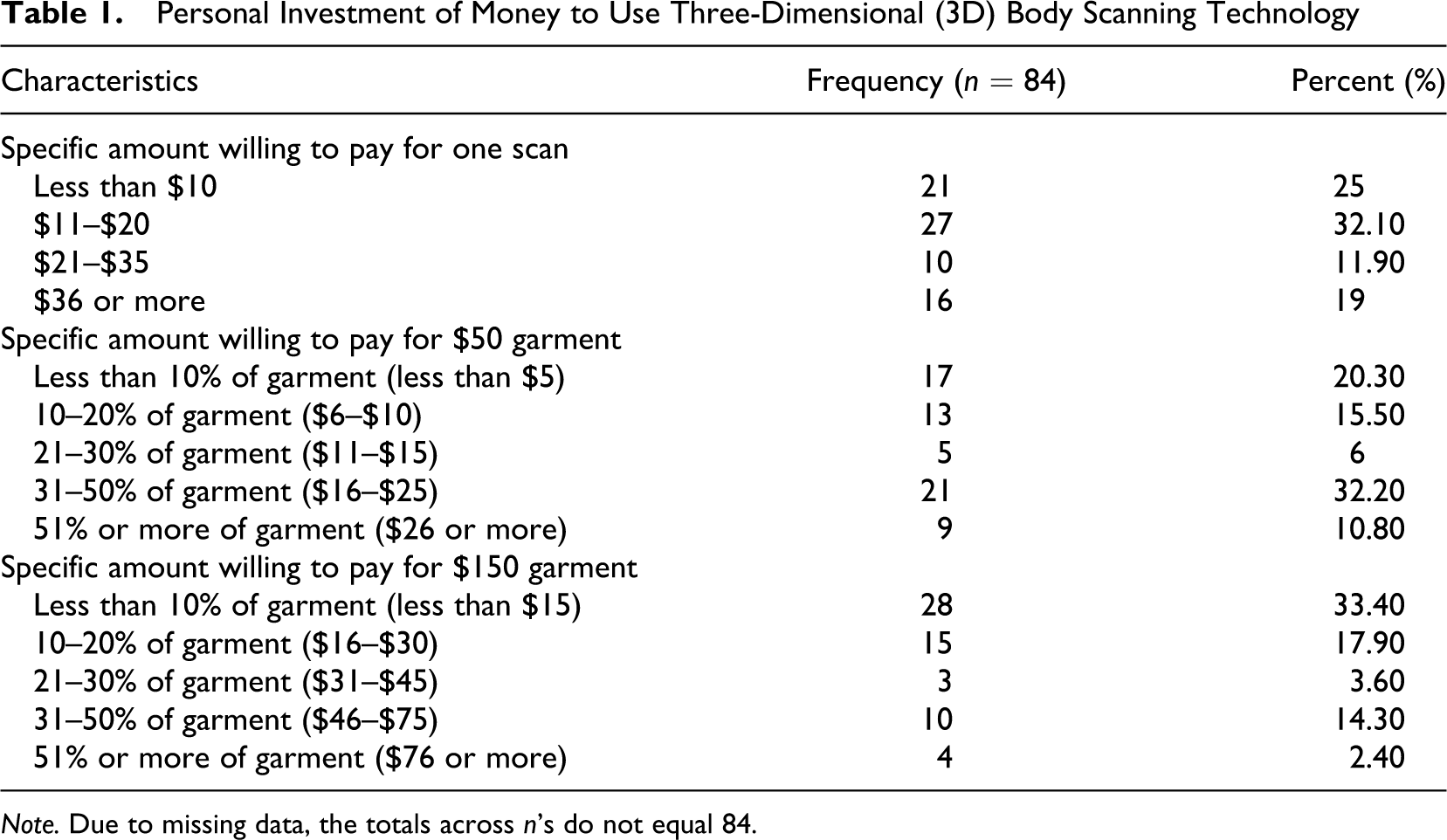
Note. Due to missing data, the totals across n’s do not equal 84.
Correlations were examined between demographic variables and the time and money items. The amount that participants were willing to pay for one scan had positive correlation (r = .316, p < .01) with age and a negative correlation (r = −.287, p < .05) with increased education level. Participants with a high school education were willing to pay more for a body scan than those with a college education or higher. Older and less-educated women were willing to pay more for scans, possibly because of less knowledge about scanning and the assumption that the process would be expensive. More-educated individuals may know that technology applications tend to reduce in price over time, and therefore may not be willing to leap ahead and pay high prices. Further research is needed to understand these low but significant correlations.
Education had a positive correlation with travel time, indicating greater willingness to travel farther for shopping in general (r = .245, p < .05). In addition, younger women in the sample were willing to wait longer for delivery of a garment made using 3D scan information (r = −.324, p < .01).
Research Objective 3: Commercial Applications of 3D Body Scanning for Older Women
Preference for using 3D body scan data in the future was examined for seven different scenarios of commercial application. Comments about the applications are presented in the order of importance to interview participants.
Custom pattern development. Participants were most enthusiastic about use of 3D body scans for pattern alterations, particularly among the women who sewed. The participants were interested that clothing fit could be improved by developing custom patterns using 3D body scan measurements. Sewers had high interest to resolve issues of clothing fit. Many participants were familiar with sewing and recognized the potential for home-sewn garments to fit better if altered with scan data.
I did take a class in adult education on designing my own slack pattern, and I used it for several years, and they fit. Using this service [body scan], … you can just lay the pattern out, cut them out, sew them together, put them on, and they will fit [F6].
The price wouldn’t matter so much then if you knew it was going to fit. [F8] It would save an enormous amount of time. [F7]
Size prediction
Size prediction is an online service that identifies the specific brand and size within the brand that should fit each individual best. Such a service could steer consumers to brands that might give greatest satisfaction with fit. Participants expressed that size prediction might be one of the more useful commercial options for 3D body scan information. Most participants presented a positive attitude about size prediction, even though they thought that younger people might be more interested in this service; participants thought that computer technology usage is more common among the young. For example: If I were 20 or 30 years younger, I might seriously look at body scanning, but at my age right now and the lifestyle that I live, I don’t see that for me it would be all that useful. [F6]
… rather than having to go in the store and try on three or four different sizes to figure out which one, you could go and just tell them or just go in and pull off the rack. [F5]
Codesign mass customization
Codesign is an online service that allows customers to be involved in the process of designing their own unique garments. On a codesign website customers use their body scan information to see how a set of options such as style, fit, color, and fabric features would look on their own body; then the codesign customers are able to choose and order the features they prefer to develop a unique garment.
Participants expressed a positive attitude toward codesign. One participant recalled her past experience which was similar to the codesign process but without the possibility of seeing the garment on the self before ordering or making it: Well, I grew up, my mother made my clothes. … and I always loved to pick patterns, pickthe fabrics, …. [F2]
It would make shopping much easier instead of going from a store to a store. [F4]
The women who were most interested in this service assumed that they would use it for purchasing special clothes: I would have it maybe on a special occasion but not for a run of the mill outfit. [F10]
… sounds like a lot of work and sounds fun … but it’s not easy. [F7]
Virtual try-on
A virtual try-on service allows the consumer to dress the personal 3D scanned image on a computer screen to see how a style looks on one’s body. Because an individual is using his or her own body scan data, the image is formed from personal measurements to give a more accurate representation of how clothes appear on one’s body. Some participants were interested in the possibility of using this service: Absolutely! … because you can see it from all angles and that would help …. [F7]
That is not so bad. That sounds probably something I might do. But, I can’t say that for Sure … I think young people might be excited as a way not to leave the house. [F3]
Custom fit
Customers may be interested in custom fit services because the garment is made specifically to their measurements, guaranteeing the best fit of clothing on their body. This possible application allows a retailer to either mail a garment to the customers or inform them that it is ready to be picked up at the store after the garment is custom-fit based on scan data. Participants presented responses similar to their evaluations of the size prediction option. Some of them were interested in custom fit service for a nice suit, blazer, jackets, sweaters, or dress: No, not for average t-shirt, but for a nice suit, a nice pantsuit, something like that, but not just for the regular everyday clothes. [F8]
Personal shopper services
Using 3D body scan information, a personal shopper service alerts the client to choices that might be of interest, advises on styles that look good on the individual, and keeps a record of previous purchases. In general, participants thought that the personal shopper option was a very useful service. One woman said: I’d love to have someone come up and say this is what you ought to consider. I think that would be nice. [F7]
My daughter will buy for me … like personal shopper … They always fit and I always like them. [F3]
Research use
Older women’s attitudes toward using their 3D scan information for future research was also explored. No participant expressed any objection toward using their 3D scan data for research purposes, assuming that the research would help consumers in the future.
In summary, across the different commercial applications of 3D body scan information, pattern development service was the most desirable among the women who participated in this study. Size prediction and codesign options were next in preference. Although participants were interested in various types of applications, they addressed their concerns about the cost of body scanning and the price of garments that were made or selected using 3D scan data. They also questioned whether it is easy to find a scanning location, whether this service is currently available in the apparel industry, how often they would need to rescan their body when their body shape changes, and whether they need to pay extra each time they rescan.
The technology acceptance model (Davis, Bagozzi, & Warshaw, 1989) explains the impact of accessibility, ease of use, and cost/resource factors on responses. Many participants agreed that younger consumers might be more interested in and excited by the commercial applications of 3D scan data, but that this technology would not be useful to them so late in life. Health condition may influence interest in level of 3D body scanning for any application (Moschis, 1996). For example, one focus group was conducted in a facility oriented to higher levels of assisted living care. These participants were less convinced of the applicability of body scanning to their needs.
Conclusion and Implications
The results of this study indicate that older women have clothing concerns relating to many different aspects of their clothing—functional, expressive, and aesthetic. Participants addressed that it is difficult to find clothing that fits their aging bodies. Two major concerns related to fit were (a) no standardized sizing system in the current apparel industry (i.e., inconsistency of clothing sizes across different and within brands) and (b) lack of industry attention to body shape changes among older consumers. The majority of participants expressed difficulty in finding well-fitting garments because each company does not use a consistent standardized sizing system. Other fit concerns related to subjective matters of body shape changes during aging. Participants felt that retailers and apparel manufacturers are not attending to their aging/changing body proportions.
Participants' interest in using 3D body scanning in the future was examined for seven different scenarios. The focus group participants expressed overall positive attitudes toward 3D body scanning and expressed some willingness to use 3D body scanning. In particular, pattern development was the most valuable way of using this technology to women who sewed. Potential uses of 3D body scanning for size prediction and codesign options were next of interest. Participants also expressed concerns about costs of a body scan and the need to repeat the scan as the body changed. A number of the oldest participants expressed that this technology would not be useful to them so late in life. Individuals with differing levels of physical ability may have different interest levels in use of 3D body scanning in resolving clothing fit concerns. Further research on this topic is needed to compare groups of older individuals who are in higher levels of assisted living care and nursing facilities. Such trends would be consistent with Moschis (1996) findings that all older consumers do not fit in the same lifestyle and market segment profiles.
No clear correlation of age and comfort with body scanning was found; however, frequency distributions and qualitative comments did indicate possible patterns of less comfort and interest among older individuals. Similarly, education level (i.e., high school, college education, or higher) was not related to scanning comfort in quantitative correlations but varied across facilities with different socioeconomic levels among residents. Although a clear measure of socioeconomic status was not employed (education is a component of status level), in two independent living facilities with greater concentrations of upper middle-income residents, participants expressed more enthusiasm for all of the body scanning applications. Qualitative responses may be indicating relationships that are not significant or are weak in the quantitative analyses. Additional research is needed to clarify these anomalies. Larger and more representative samples may facilitate more complex analyses to examine differences in quantitative and qualitative findings. Age (both chronological and perceived), generational life experiences, education level, income, and socioeconomic status all may play a significant role in shaping older consumer responses to emerging technological applications in shopping technology. Our exploratory, multimethod findings are a clear signal for future research directions.
Body scan technology application will continue to evolve as costs in scanner technology decrease. This will make scanners more affordable to manufacturers and retailers and more familiar to consumers. Older consumers aged 60 and over who are more interested in commercial applications of body scanning will be differentiated by their personal characteristics and shopping behaviors. Younger women in the focus groups, ranging from approximately 62–75 years, tended to be more favorable toward body scanning applications. As they continue to age, the baby boom generation is likely to have different characteristics from generations that are older than 67 today, because they are more familiar with computer technologies and online shopping and are a generation that strongly values product variety, aesthetics, and customization (Weigelt & Boehman, 2009). The technology acceptance model (Davis et al., 1989) predicts that greater computer experience and perceptions that body scanning is useful (for achieving better fit and aesthetic options) will increase adoption of the new technology.
Further research is recommended using real modules of 3D body scanning applications rather than examining the preference for using 3D body scanning technology based on hypothetical discussion of scenarios. Likewise, research needs to be conducted on consumer reactions to commercial applications of 3D body scan data. Consumers from varied populations with different age groups, ethnicities, geographic locations, and cultures need to be studied. However, greater consumer interface with body scanning and its practical applications is required before consumer responses can be adequately assessed. The film produced as part of this study was helpful, but more information resources should be developed. Real participation in the scanning process, as well as actual experience with applications, might change older women’s preferences for various commercial applications of 3D body scan data.
In addition, in-depth examinations of relationships between clothing fit and style concerns and various commercial applications of 3D scan data are needed. The apparel industry will benefit from paying attention to these matters when developing product lines. As customization services become more available, consumer demand for improved fit and styles that suit their aging bodies is likely to expand exponentially.
Generalization of the present findings is limited by the use of a convenience sample of older women with skewed representation in age and ethnicity categories. Further research is recommended on a random sample from a more representative population of older consumers. Due to the focus on women in this study, gender differences could not be analyzed. Studies of men’s attitudes to body scanning are certainly warranted.
Footnotes
Declaration of Conflicting Interests
The authors declared no potential conflicts of interest with respect to the research, authorship, and/or publication of this article.
Funding
The authors disclosed receipt of the financial support for the research, authorship, and/or publication of this article from the College of Human Sciences 2008-2009 Seed Grant for Junior Faculty at Iowa State University.