




Abstract
In order to more deeply engage students in understanding and applying concepts in a fashion history course, the traditional lecture-style course that relied primarily on unit exams for assessment was re-designed to use the Team-Based Learning (TBL) approach. Team-Based Learning is a decades-old teaching strategy that combines individual student work (primarily out-of-class) with heterogeneous student team assignments (all in-class). This study investigated the impact of TBL in the re-designed fashion history class on students' learning. Under the TBL model, students completed text readings, study guides, and two projects individually outside of class. Assignments completed regularly in class as teams included quizzes and activities that applied content prepared prior to class. Student response to the new strategy was largely positive, and findings suggested that TBL was an effective method for teaching this fashion history course. Implications of the new strategy and its applications are included.
University courses addressing changing fashions over time have become a mainstay of many apparel programs. While course titles may include terms such as history of fashion, dress, or costume, they typically share a common goal of educating students about how and why aspects of dress have changed over tens, hundreds, and even thousands of years. For the purposes of this study, the title “fashion history” will be used to refer to courses of this nature.
Fashion history courses have traditionally been taught as lecture-based courses with regular formative assessments and periodic applied individual student projects (Johnson, Yurchisin, & Bean, 2003). Under this model, students spend the majority of class time taking notes while viewing images of artwork or garments, or in some cases, extant garments themselves. A test comprised of objective questions is given to assess a student’s ability to identify fashion history terms and concepts following each chapter or unit. Potential challenges with this model are a lack of student motivation for the subject matter, lowered retention of key concepts, and limited understanding of how fashion history is applicable outside of a classroom (Marcketti, 2011). Recent research has highlighted the benefits of cooperative learning approaches to instruction in the undergraduate apparel classroom (Carpenter & Fairhurst, 2005; Farr, Ownbey, Branson, Cao, & Starr, 2005; Gam & Banning, 2011; Kimmons & Spruiell, 2005). While research has suggested numerous ways in which to teach courses in the apparel, merchandising, and design areas more effectively, none has specifically investigated the role that team-based learning (TBL) might play in teaching fashion history. Providing students the opportunity to experience the real-world applications for fashion history course content can increase student engagement and contribute to higher performance in class. The purpose of this study was to investigate the impact of TBL on students’ learning in a fashion history course.
Review of Literature
Teaching Strategies in Fashion History
Since the study of historic costume was proposed over a century ago to improve the creativity of aspiring American dressmakers (Fales, 1911), ways to teach the content have changed little for decades. A primary challenge for early instructors was “no agreed upon curriculum and no methodology” (Cumming, 2004, p. 31). While availability of quality resources dedicated to the study of dress increased, including contributions from teachers such as Lester (1925) and costume historians such as Davenport (1948), and later, Arnold (1973), ways to teach the discipline remained lecture based.
More recent pedagogy acknowledges a need for fashion history instructors to improve their instructional strategies. Paoletti (1984) suggested that instructors make regular connections from the past to the future in fashion history courses, highlighting that career paths ranging from apparel designers to retail store buyers make use of such knowledge on a regular basis. Paoletti wove this as a theme throughout her own fashion history course and ended the semester with a student-centered project that challenged teams of students to predict future trends.
Jasper and Roach-Higgins (1987) encouraged instructors to make use of available technologies in showing garment images to students, but also cautioned against the temptation to turn class periods into slide shows that challenged students’ memories of endless costume terms. Instead, Jasper and Roach-Higgins supported an approach to teaching fashion history that included a global perspective and an emphasis on analyzing fashion changes within theoretical contexts. A related example of inventive technology use in fashion history class was emphasized in Frey and Farrell-Beck’s (1995) study. The hypermedia and videodisc program employed in their study allowed an aspect of self-directed learning as they gave students the opportunity to select the format of visual images, such as line drawings and photographs, which would be most helpful to them when reviewing each fashion history time period.
Furthering Frey and Farrell-Beck’s (1995) use of student-directed learning, Marcketti (2011) detailed research-based teaching strategies for fashion history that shift the focus from instructor to students. Student-focused strategies suggested by Marcketti included the active learning use of constructive controversies, web-based discussion assignments, artifact analysis, annotated citations and discussions, and student choice projects. Most students rated their satisfaction level of the new course projects as high and supported their ratings with favorable comments. Students were particularly enthusiastic about the discussions with classmates, which allowed them to share their knowledge with others and thus increased their class involvement. Marcketti concluded that active learning strategies and hands-on opportunities proved to be innovative, effective teaching strategies for a fashion history class that also enhanced students’ professional and personal development.
Pairing active learning with artifacts can also enhance the teaching of fashion history. Marcketti, Fitzpatrick, Keist, and Kadolph (2011) encouraged the use of university museum collections as resources for fashion history classes and cited two examples of how collections have been effectively used as one tool to enhance student learning and interest in fashion history course content. Students conducted material culture studies with items in one collection, while with another collection, students volunteered work hours to provide care for garments that had been studied in class. These hands-on experiences helped students to view historic garments as personal connections to the past that made classroom learning more meaningful.
Saiki, Nam, and Beck (2012) documented an alternate way to use a historic costume collection in their research, which focused on a student-directed learning approach to develop an exhibition website for a collection. Students were grouped into teams representing curatorial, technology, education, display, and promotion aspects of museum exhibitions. The teams worked together over a 5-week period to create an online exhibition that educated viewers on a selected period of fashion history. Results of this team project indicated that the website was well received by the public and dramatically increased community access to the collection. Likewise, students gained organizational and time management skills through the teams while learning in depth about an area of fashion history.
Gam and Banning (2012) explained how collaboration between instructors of fashion history and apparel design enhanced the learning in a fashion history course. Students learned from the apparel design instructor how historical fashions could be used as objects of inspiration. Students’ learning was assessed through a team-based project that required them to design a contemporary garment that was inspired by fashions of the 1840s. Benefits of the collaborative approach included increases in student creativity, awareness of the connection between historic dress and design development, and motivation to utilize learned techniques.
Cooperative Learning Strategies in Apparel and Textiles Courses
Research supports the use of cooperative learning strategies in the apparel and textiles classroom. Cooperative learning strategies could be any activity that requires students to work as part of teams or groups at some point throughout the course, from period-long brainstorming sessions to semester-long projects. The most common collaborative teaching approach has been problem-based learning (PBL), used in teaching merchandising (Carpenter & Fairhurst, 2005), textiles (Farr et al., 2005), sustainable apparel design (Gam & Banning, 2011), and a capstone course comprised of merchandising, interior design, and graphic design majors (Kimmons & Spruiell, 2005).
Under PBL, teaching is student focused rather than instructor focused. Instructors serve as facilitators for students through the process of solving a real-world problem encountered in industry, but allow the students to take the lead and arrive at an appropriate solution or conclusion. PBL has been described as “a good fit in apparel design and merchandising coursework since the methodology is very ‘hands-on’” (Gam & Banning, 2011, p. 203), and it reflects relevant industry approaches to problem solving (Gam & Banning, 2011). Outcomes of PBL in apparel and textiles classes include increased student engagement and understanding of the subject (Farr et al., 2005), increased ability to solve problems (Carpenter & Fairhurst, 2005; Gam & Banning, 2011), and increased skills in personal relations and communication (Carpenter & Fairhurst, 2005; Kimmons & Spruiell, 2005).
Despite many strengths of PBL, limitations of the strategy are documented as well. Carpenter and Fairhurst (2005) felt that smaller class sizes were more appropriate for implementing PBL and noted that students in their study seemed to have difficulty adjusting to the active learning style. Challenges in assessing individual students’ contributions within team assignments and the significant amount of preparation time required by faculty to implement PBL were limitations expressed by Kimmons and Spruiell (2005).
Collaborative learning also can be realized in a virtual rather than a traditional classroom environment. Karpova, Jacobs, Lee, and Andrew (2011) implemented an international collaborative team-based project with students from three different universities in an effort to prepare students for the globalized apparel industry. All work for the project regarding international issues in the apparel and textiles industry was completed online by the multinational teams. Qualitative feedback about the experience revealed that students gained cross-cultural communication skills and improved decision-making skills. In addition, the “virtual collaboration experience resulted in increased student adaptability and flexibility required for the fast paced, ever changing and highly competitive global industry” (p. 309).
TBL
TBL, a type of cooperative learning, is a teaching strategy originally developed to increase student accountability and engagement in large college-level management classes with an average enrollment of 120 students per section (Michaelsen, Knight, & Fink, 2002). The method combines work that students complete outside of class on their own with in-class assignments completed as a part of heterogeneous instructor-formed teams that work together throughout the semester. While PBL and other forms of cooperative learning also use teams, TBL is unique in that the permanent student teams are an integral aspect of the course design, which has heavy emphasis on problem solving and cooperation during rather than outside of class and throughout the term. Other forms of cooperative learning typically do not require students to read course material outside of class and have quizzes used for accountability and assessment in class.
A typical unit taught within the TBL framework lasts between three and five class periods in a 16-week term. Prior to class, students are assigned work that might include chapter readings from textbooks, review questions or study guides, and other background preparation for the topic to be explored, analyzed, and synthesized in class. When students come to class at the beginning of a new unit, they take a short, formative assessment on the homework they were assigned. The quiz is first taken individually in order to ensure personal accountability for the content studied. Immediately after all individual quizzes are taken, students collaboratively take the same quiz again with their teammates. In the second iteration, team members discuss questions and mediate disagreements over correct answers while arriving at choices on which members can agree. When each team has completed its quiz, the instructor reviews correct responses, answers any questions, and explains content that was misunderstood or unclear in the homework. If necessary, a short lecture addressing key components of the unit or activity to come may be presented as well. Once the instructor is confident that the content has been adequately learned, the following one to three class periods can be spent applying the content in a real-world activity that uses the knowledge students have attained.
Knight (2002) reported previous researchers’ findings on the advantages of TBL in increasing student learning by offering the opportunity to practice communication and collaboration skills that have been emphasized in many work environments (Goodson, 2002; Lightner, Bober, & Willi, 2007), contributing to a more dynamic classroom experience (Goodson, 2002), and helping to reduce student attrition in courses throughout a semester (Kreie, Headrick, & Steiner, 2007). Analyzing 10 different TBL studies with classes ranging from freshman to graduate level, Knight concluded that in each case student learning increased as a result of TBL because of course content repetition and the application of information through activities during class time.
Goodson (2002) experimented with TBL as a teaching strategy to support the learning of nontraditional and underprepared students; she found that TBL helped all learners by improving collaborative efforts and promoting an atmosphere of active learning that motivated class attendance. Kreie, Headrick, and Steiner (2007) noted the increased retention of freshmen in TBL compared to traditional environments. At the graduate level, Lightner, Bober, and Willi (2007) attributed TBL’s positive results with accounting students to their liking teamwork, which increased their engagement in learning. Seeking to promote real-world problem solving and active learning, they found students to be willing “to work through differences of opinion, language barriers, and cultural misunderstandings” (p. 13) and motivated by the dynamics of teaming, including the varied roles, allocation of responsibilities, and conversations.
Some researchers have noted potential disadvantages. Goodson (2002) found that the time required to restructure a course to TBL compared to that needed to develop a new course. Kreie et al. (2007) and Su (2007) identified various frustrations with and drawbacks to teamwork environments. The former reported that fostering positive teamwork in class was challenging and that the “approach did not significantly increase the amount of time that instructors had to devote to the course” (p. 55). Su studied students according to grade point average and perceptions of team members and course importance. Those individuals with a medium level of ability most preferred TBL, but those with a low level least preferred it. Findings from the interaction effect between individual ability and favorable team members indicated that individual interest or benefits may affect student preference toward TBL and that perception of course importance was positively correlated with students’ contributions in TBL activities.
Procedure
Course coverage spanned the years 5,000 B.C. to 1900 A.D. and focused primarily on dress worn in Europe and the United States. Tortora and Eubank’s (2010) Survey of Historic Costume was the assigned textbook. The course was required for Department of Family and Consumer Sciences apparel design students, but could be taken as an elective by others. Teaching was patterned after Michaelsen, Knight, and Fink’s (2002) model of TBL. On the first day of class, random, heterogeneous teams were formed based on “course-relevant student characteristics” (Sweet & Michaelson, 2007) that included major, time in the program, and experience in other history-related courses. Such criteria helped students to connect previous experience with course expectations and demonstrated that a balance of skills in each team was beneficial (Lightner et al., 2007). Students lined up across the front of the room when a characteristic they represented was announced, such as “sophomore,” “merchandising major,” or “completed the Fashion History II course.” After all students had lined up, they counted off one through three, four, or five, depending on how many teams were being formed that semester. Student complaints about group formation were nonexistent probably because they witnessed the formation of each team and saw the characteristics on which teams were formed. Students worked in these teams throughout the entire semester.
The time periods covered in the course were divided into seven units that were consistent with those identified by Tortora and Eubank (2010). An additional final unit focused on preservation and research of historic apparel and textiles. Assigned readings from the textbook were required to be completed outside of class time prior to the beginning of each unit. Optional study guides and supplemental images to support the learning of each unit were available to students as they completed the required readings. Each unit lasted approximately three 75-min class periods. Each unit’s first class period was spent on individual and group quizzes, followed by time for student questions. An abbreviated lecture lasting from 15 to 30 min concluded the period and provided an opportunity for the instructor to review and emphasize significant aspects of the time period. Content typically included an explanation of quiz questions that students had answered incorrectly, as well as additional visual examples of vocabulary, influences, and historic context related to the period studied. Teams completed assigned projects for the following one to two class periods, depending on the scope of the objectives. Unit projects (see Table 1) were designed to apply relevant content from the time period through tasks that could be completed in 75–150 min of class time. These were written to allow students to apply and practice skills they had learned in previous program coursework. Each project was written as a case study for a particular job within the apparel industry, so that students could identify the connection between what they were learning and practice potential ways in which it could be applied postgraduation.
Team-Based Learning Activities by Time Period.
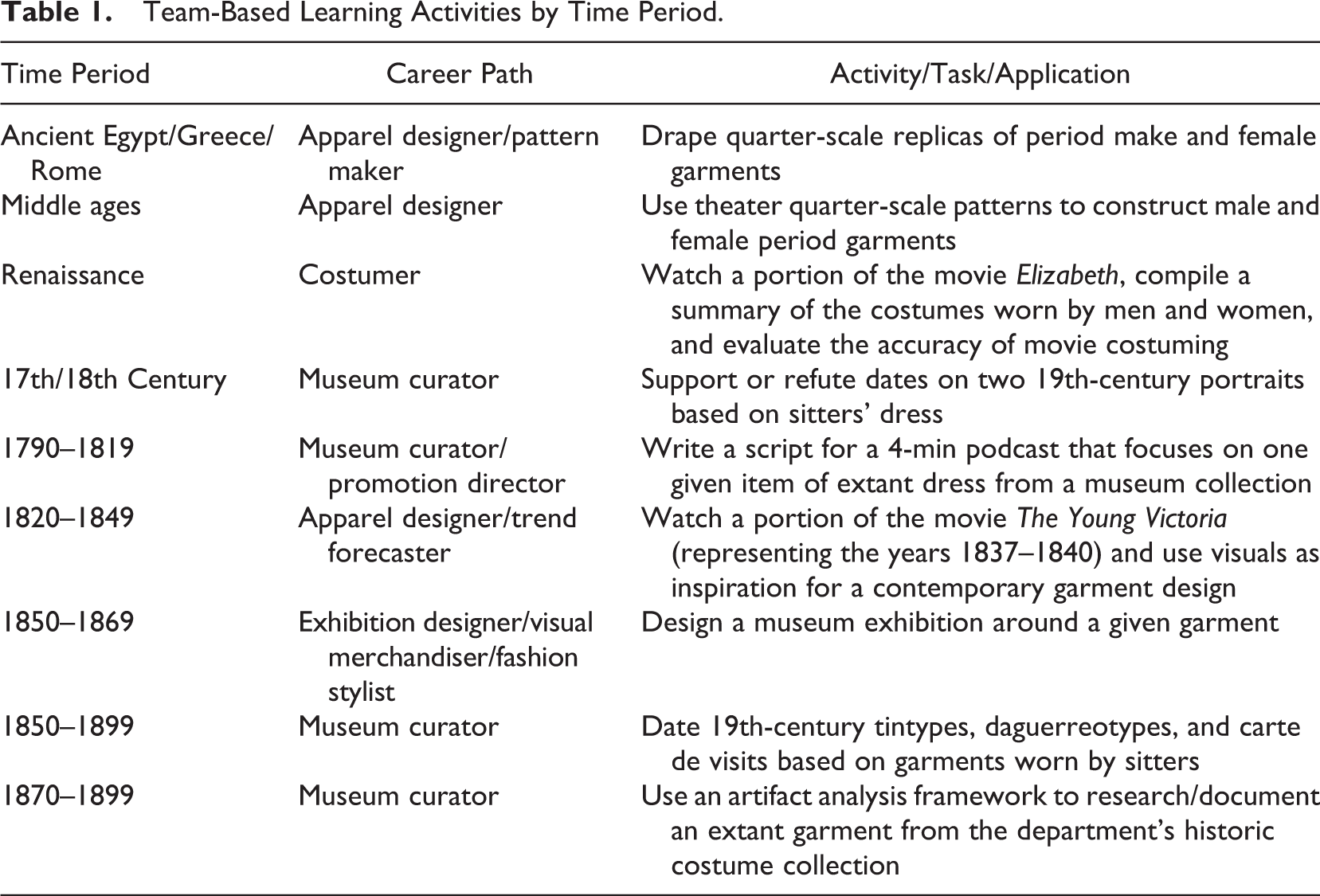
All teams completed the same project, and each team had the freedom to divide tasks among team members according to strengths and weaknesses of each member. For example, when hand sewing was required, students who could sew took the lead in that aspect of the project. Likewise, when illustrating or sketching was necessary for other projects, students talented in those areas volunteered to complete those aspects. In activities that required writing or researching as the main skills, team members typically split the work evenly and proofed the overall product as a team. Team members within each team earned the same grade for each project.
Multiple modes of accountability were used throughout the semester for team and individual assessments. In addition to individual quiz grades, students worked alone on two projects completed outside class time. The individual projects required students to locate and compare and contrast current fashions with past fashions, an activity unique from others completed in class. Twice during each semester, team members evaluated one another and allocated points to each member according to their preparation, contributions, level of respect, and flexibility during team activities. These two scores served as participation assessments for each student and gave the instructor insight into the effectiveness of each team. Most point reductions were due to team members being unprepared for in-class quizzes and activities. Other complaints over team members were rare, perhaps because all work took place during class, and the instructor regularly communicated with teams during activities. Potential problem situations were identified early, so that solutions could be implemented before serious issues eroded team cohesion. Finally, students took a comprehensive final exam that challenged students to recall and analyze course content.
Assessment
To assess the effectiveness of the TBL style of instruction and to document student feedback, a questionnaire was developed and administered to students. Data were collected at the end of the course for three consecutive fall semesters. Due to limited student enrollment each semester, collecting data for multiple years increased the validity and reliability of results. A total of 30 students participated.
The instrument included Likert-type questions, as well as open-ended questions to survey student attitudes regarding the class. Goodson’s (2002) Likert-style questions provided a model for the development of questions to measure students’ perceptions of the TBL process. Students could circle a number between 1 and 7 that best described their opinion toward each question. For all questions, 1 indicated the most negative opinion (e.g., few advantages, not stressful, terrible), while 7 indicated the most positive (e.g., more advantages, extremely stressful, and excellent).
The objective of Goodson’s (2002) questions was to measure students’ perceptions of the TBL process, rather than the impact on learning. Open-ended questions were included in the present study to help document students’ perceived learning through TBL. Students were asked to name class assignments that contributed to their understanding of fashion history, explain how they felt TBL might benefit their future career, and share any comments they had regarding the use of TBL in comparison to a traditional lecture approach.
Results
Students’ mean scores and standard deviations for the 10 Likert-type questions are reported in Table 2. Results for the 10 questions indicated that students had positive opinions of TBL, with the exception of opinions toward individual quizzes (M = 3.23, SD = 1.41). This result suggested that students favored group quizzes more than individual quizzes. The items that generated the most favorable responses included, “Do you find that a team learning strategy has more or fewer advantages than a lecture-based strategy?” (M = 5.60); “How would you rate your experience in this class?” (M = 5.60); and “How satisfied were you with the amount of learning you gained in this class?” (M = 5.57). These results indicated very positive overall perceptions of TBL.
Responses of Fashion History Students to Team-Based Learning.
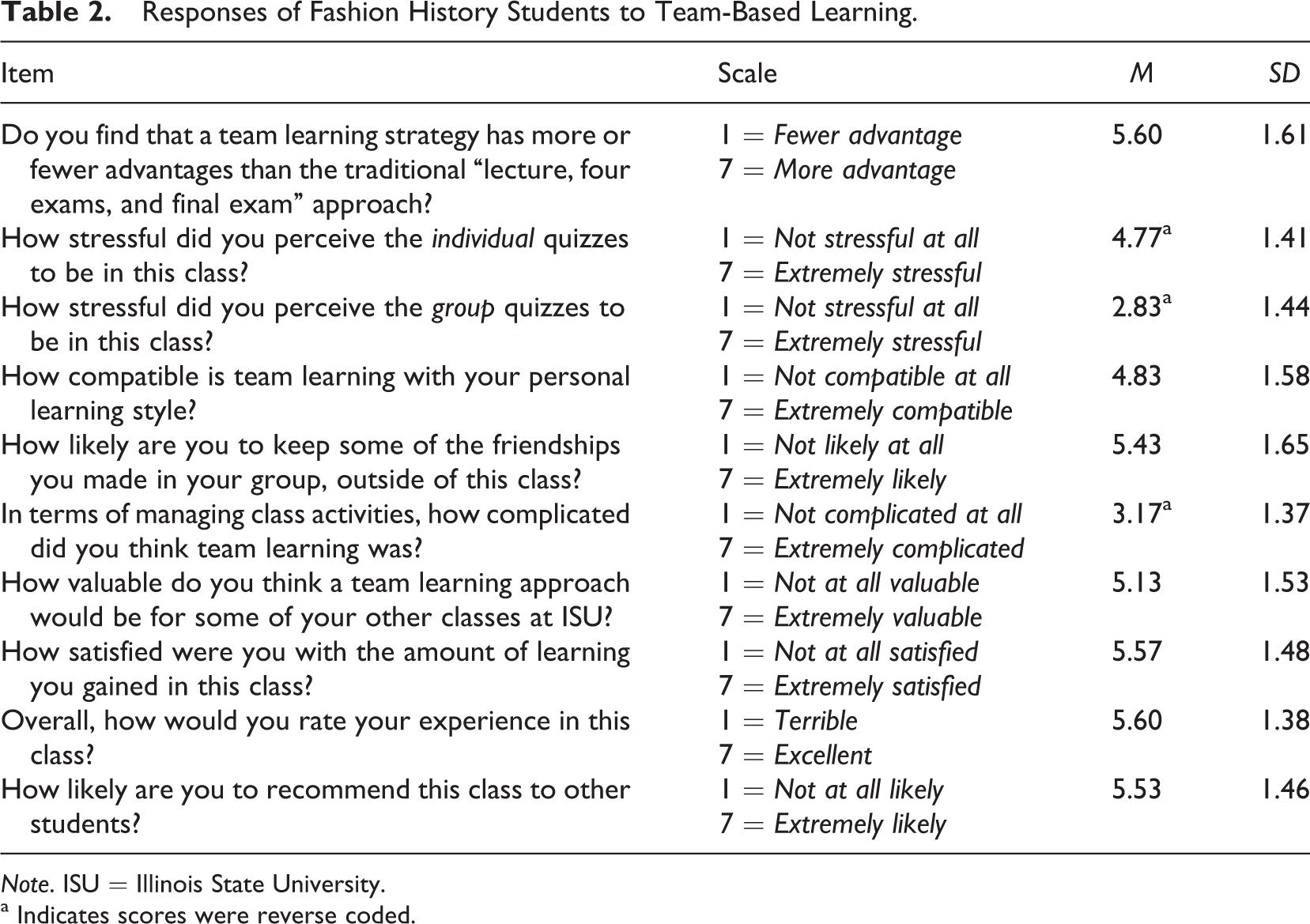
Note. ISU = Illinois State University.
a Indicates scores were reverse coded.
In the first open-ended question, students were asked to name which TBL unit activities were most valuable to their understanding of fashion history. Most students listed at least four activities, although select students indicated as few as one or as many as all nine. Among nine activities, the top three identified were the Renaissance period’s movie costuming critique of Elizabeth (Kapur, 1998), the historic inspiration project for the period 1820–1859 completed in conjunction with the movie The Young Victoria (Vallée, 2009), and the material culture study of garments from the time period 1870–1900.
In addition to listing the activities that were most valuable, students were asked to explain why they made each choice. Students valued the movie critique of Elizabeth (Kapur, 1998) because the motion picture provided a better visual understanding of historic dress. One student commented, “movies are more relatable,” while another student noted that the movie “helped me to better understand and differentiate whether or not the dress was true to the period.” The design inspiration activity that used scenes from The Young Victoria (Vallée, 2009) as a resource was a popular student choice because the hands-on learning inspired creativity. One student expressed, “The hands-on activities where I can make something or research then create a project helped me to learn more about the era.” Students indicated that they learned a lot from the material culture study project with extant 19th-century garments from the department’s Lois Jett Historic Costume Collection because they “were able to see an actual historical garment.” Other explanations for choosing that activity included, “I loved getting to see all the construction up close” and “I liked the activities that allowed us to get hands-on experience with garments.”
Two students said that all nine activities helped them better understand fashion history. These students added comments such as, “I feel I gained and attained information from these activities because they were all different” and “All the activities were valuable to my understanding of fashion history because it gave me a better understanding and knowledge of the different dress in a time period and why we dress the way we do.”
A second open-ended question asked students to explain how they felt participation in TBL influenced preparation for their future career. Students agreed that TBL will help, “because many careers are team-based,” and “I feel working in teams now sets a good foundation.” Students further explained that the team environment helped them “be more comfortable expressing my ideas and opinions in a group setting and learning to work with others,” “listen better,” “respect others’ opinions and trust their answers,” and “understand how to handle situations and talk through areas where members of the team don’t all necessarily agree.”
Students explained how TBL influenced their ability to work with other people in a team environment in a third open-ended question. Students responded that TBL taught them skills in compromise, patience, responsibility, and learning how to work with different types of people. One student said, “The ability to compromise and use each other’s strengths when assigning the jobs helped to discover the group’s skills and abilities.” Another student remarked, “Everyone brought different values and strengths and points of view to the group, and I think it helped to keep me responsible and helped me learn how to better communicate and hold others accountable for their work as well.” Some students indicated that they did not like learning and working as a group because they preferred working individually, but they acknowledged the importance of TBL.
In a final question, students provided additional comments about using the TBL method rather than the traditional lecture-based method. Most students indicated they preferred TBL rather than traditional method. One student said, “I liked this method because I was able to compare my ideas with others and could talk through material for a better understanding,” while another stated, “I really enjoyed this method and believe I will retain so much more about historic dress in the future.” Several students wrote that they enjoyed applying the information they learned through activities rather than only taking lecture notes and recommended continuing to use TBL in the future. Acknowledged one student, “I feel the team-based learning method works for this class, but it is more difficult than other courses because it is an unfamiliar way of learning.” A final student concluded, “I recommend it [TBL]. It is a better foreshadowing of the future. The class time and continued work with a team are more indicative of a work setting.”
Not all students, however, expressed satisfaction with the TBL style of learning. Students who said they preferred the traditional lecture-based approach noted that TBL did not fit their style of learning and that they performed much better in a lecture setting. “I prefer traditional lectures, even though the activities were fun and interesting,” explained one student. Another student simply stated, “I am not comfortable with this [TBL] learning style.”
Discussion and Conclusion
Findings indicated that most students enjoyed the hands-on approach of the activities and valued working as part of a team throughout the semester. Main reasons students cited for preferring activities were that the activity aided visual understanding of the content studied and helped them think or be creative. Students’ comments on their experience with TBL indicated that their communication skills improved as a result of TBL and that they gained from working with other students in the team environment. These student reactions are consistent with findings of Knight (2002), Goodson (2002), and Lightner et al. (2007). Overall, most students who participated in TBL preferred it over a traditional lecture-based approach to the course, believing that TBL was more advantageous to learning. This conclusion mirrors Goodson’s results and lends support for the assertion that TBL is a beneficial teaching strategy.
A few students expressed negative attitudes toward TBL. This finding is consistent with Goodson (2002), who noted negative views from students when TBL was not a fit for their preferred learning style. It is possible that students who prefer a lecture approach to courses may have an auditory or verbal learning style rather than visual or kinesthetic. In a hypermedia study, Frey and Farrell-Beck (1995) indicated that when making choices of supplemental content, students with strong analytical skills tended to choose text over images more than did those with weak analytical skills. Thus, a student’s areas of strength or challenge may influence how they prefer to learn in class. It is also possible that students who prefer lecture-based approaches may be learners who have less experience working as part of a team. Lightner et al. (2007) concluded in their study that, “dysfunctional teams tend to be populated by students who lack group experience or have not mastered the proficiencies that characterized a team player” (p. 14). With a predominance of high-stakes testing throughout the secondary education system, it is also possible that some students have become accustomed to objective tests as an assessment method and may struggle with the transition to a skill-based assessment system.
Instructor observations throughout this study showed that, compared with the lecture-style approach, students’ classroom attendance dramatically improved under the TBL approach, as did academic performance and attitudes regarding the course. Kreie et al. (2007) found a correlation between improved class attendance and TBL that they hypothesized related to a higher motivation to attend class.
Student grades in the fashion history course were slightly higher under the TBL model than they were before the TBL model was implemented, which could relate to a higher retention of course content during assessment (Kreie et al., 2007) or an overall increase in engagement in course material (Goodson, 2002; Lightner et al., 2007). Higher grades could also be related to the fact that students experienced higher levels of learning, according to the Revised Bloom’s Taxonomy of Educational Objectives (Anderson & Krathwohl, 2001). Because in TBL students regularly experienced the upper four levels of the taxonomy by applying, analyzing, evaluating, and even creating during class activities, their understanding of course content was strengthened. The result was often enhanced academic performance on assignments throughout class. This is a significant contribution of TBL because the traditional lecture approach may rehearse only the lowest two levels of the Revised Bloom’s Taxonomy, remembering and understanding, particularly if objective exams are the only assessment tool utilized.
The change in student attitudes toward the fashion history course at the center of the present study is even believed to have contributed to a rise in course enrollment. After TBL was implemented, an increased number of apparel merchandising majors took the course. Apparel merchandising students took it as an elective course, as it was not a requirement for their major.
Training apparel majors for future industry jobs requires honing skills such as communication, collaboration, and problem solving (Bye, 2010; Karpova, Jacobs, Lee, & Andrew, 2011). Sibley and Parmelee (2008) specified TBL as an ideal method for teaching these skills toward professionalism. The overall benefits observed under the TBL model support its continued use for this course, as well as potential adoption in undergraduate apparel courses in other universities.
Fashion history instructors at other universities could adapt TBL to fit their student demographics, class size, student skill sets, and course format. For example, while the TBL method was shown to be as successful for instructors teaching large classes and with much more diverse populations, success was also found in the sample used in the present study with small classes of primarily Caucasian, traditional college-aged female students. TBL was developed to teach classes with an average enrollment of 120 students per section (Michaelsen et al., 2002). Since its inception in the 1970s, TBL has been used as an effective teaching method with populations in the Czech Republic (Popovský, 2002), a mix of international students from different cultures (Cragin, 2002), and with nontraditional students (Goodson, 2002). Because of the small number of students in each class participating in the surveys for this present study, identifying information such as ethnicity, age, and transfer status were not collected. Instructor observations noted, however, that TBL appeared to give all students increased voice in the classroom. From African American and Hispanic to nontraditional and transfer students, TBL both provided smaller settings in which to get to know other students in a less threatening environment and afforded regular opportunities to demonstrate skills that helped the team. Future researchers with larger and more diverse student enrollments could collect this information to compare TBL experiences between students of different ethnicities, ages, and length of time in the program.
Because projects completed by students in the present study were designed to utilize skills they had gained in previous classes, it is possible that instructors at other universities wishing to try TBL would need to design projects to appropriately address the skill sets of their own population of students. Tasks designed for students in this study utilized apparel design-focused skills such as construction, fashion illustration, and draping, in addition to broader apparel skills such as research, visual display, and promotion skills because students had typically taken those courses prior to enrolling in this fashion history course. The strength of TBL is its flexibility around each group of students with which an instructor works.
The fact that TBL has been successfully utilized in online courses (Freeman, 2002; Palsolé & Awalt, 2008) suggests that courses taught in other settings and within different term lengths could experience optimal outcomes with TBL. For courses that meet in 50-min rather than 75-min blocks of time, activities could be spread over more class periods. For courses that meet more frequently in a shorter number of weeks, such as is common in summer sessions, activities could be shortened or lengthened accordingly. Planning appropriate activities within the available time frame can be accomplished once learning objectives for each unit have been identified.
One limitation to TBL during the study reported here was that students tended to only have hands-on practice with a portion of any one time period studied during class time. While breadth of fashion history was addressed through required readings outside of class, depth during class was reserved for a very select portion of a period. This fact could lead students to an unbalanced understanding of fashion history content that could prove problematic as they work to apply the knowledge in future courses or in their future career. Sibley and Parmelee (2008) addressed this challenge by stating that it is not possible in any course to cover all material, regardless of the teaching strategy used. Thus, methods such as TBL, which have been shown to increase student motivation and strengthen professionalism skills while still attaining the instructional objectives for the course, may be viewed as preferable to alternate ways of teaching course content that have fewer benefits.
A second limitation was the small set of students who participated in and evaluated the TBL process. Class sizes in this particular fashion history course typically range from 10 to 20 students per year, whereas similar courses at other universities can exceed 100 students per term or semester. Due to ethical issues such as informed consent and privacy, the survey evaluating the TBL experience was distributed at the end of each semester, outside of class time. Students were strongly encouraged to participate and provide feedback but could not be required to complete the survey. Future studies could provide students with a link to an online survey, which might result in a higher response rate than distributing and collecting hard copy surveys.
Future studies should continue to explore the possible benefits of TBL in apparel and textile classrooms. Professors of fashion history courses with a larger number of students could try TBL to better understand its benefits and limitations in different class settings. Other research projects could include identifying activities that most effectively help students learn and apply specific fashion history concepts. Student growth in teamwork skills could be measured with pretest and posttests prior to beginning TBL and at a term’s end to determine the effectiveness of TBL as a workplace skill-building tool. This study utilized scales from Goodson’s (2002) study, and questions were valuable for evaluating students’ responses to TBL strategies. Further development in scales to include assessing students’ learning experiences with group projects and assignments is recommended.
TBL has applications to many other areas of apparel and textiles. It could be adopted in apparel design courses that focus on apparel product development because many apparel design functions in industry are completed in a team environment. Case studies involving problem solving and critical thinking could be used as TBL activities in textiles, advanced merchandising, and apparel promotion courses. Encouraging expanded TBL approaches to teaching has the capacity to enhance the learning experiences of students in apparel and textiles courses.
Footnotes
Declaration of Conflicting Interests
The authors declared no potential conflicts of interest with respect to the research, authorship, and/or publication of this article.
Funding
The authors received no financial support for the research, authorship, and/or publication of this article.