



Abstract
Students often identify research methods classes as one of the most difficult and intimidating classes of their academic career. The objectives of this study were twofold. The first was to ascertain whether the use of group-centered, collaborative learning would improve student mastery of material compared to traditional, lecture-based classes. The second objective was to examine a possible differential impact of collaborative learning by race. The study measured students’ mastery of basic concepts in research methods as well as their application of the material to novel situations by comparing their competence at the beginning to their performance on the same measures at the midterm and final exams. Findings highlight the importance of examining race as a factor in the study of the effectiveness of collaborative learning and, more specifically, point to a need to further test the hypothesis that collaborative learning pedagogy techniques can ameliorate race-based achievement gaps in student performance.
Collaborative learning in higher education broadly refers to practices in which students work in small groups on a collective task aimed at achieving specific educational goals (Cohen 1994; Hoffman 2014). More than simply giving a few group assignments here and there throughout the semester, collaborative learning practices require a central focus on group work such that students become active rather than passive learners (Sweet and Michaelsen 2012). Although some time in the classroom is spent covering content, the vast majority is used for team assignments designed to give students the opportunity to use course concepts to solve problems and engage with material in a practical way (Heyborne and Perrett 2016; Hrynchak and Batty 2012). As such, a class that utilizes a collaborative learning style is often called a “flipped class” because the instructor moves “the typical ‘transmission of knowledge’ component of a class (i.e., lecture) to outside of the classroom and [moves] the ‘application of knowledge’ (i.e., homework) into the classroom” (Wilson 2013:194). Described as a method of instruction in which a teacher becomes more of a guide rather than a performer on stage, team-based learning (TBL) is a quintessential example of collaborative learning pedagogy (Michaelsen, Knight, and Fink 2004; Sweet and Michaelsen 2012).
In this article, we compare learning outcomes of students in collaborative learning–style classes (i.e., classes that had permanent teams of students who worked on numerous application activities) with those of students in traditional lecture classes (i.e., classes without such permanent teams). Although we have yet to collect data from classes that fully meet the criteria to be considered TBL classes, we feel it is important to briefly outline the mechanics of TBL because it is a key example of collaborative learning. The typical TBL class format requires that an instructor carefully assign students into teams in the first week, considering the prior knowledge and skills students bring to the class, with the goal to distribute students’ assets and challenges evenly across these teams (for more information, see Michaelsen et al. 2004). Compared to collaborative learning styles more generally, TBL has a specific course structure that requires more intense use of small groups (i.e., teams) such that students work together with the same team members throughout the semester (Fink 2004).
TBL instructors divide the course into major units, or modules, and each module guides students through three phases of learning: (1) outside preparation by students, (2) individual and group readiness assurance, and (3) application. The preparation phase takes place outside the classroom, where students prepare for class by reading course material or viewing videos or prerecorded lectures. In this phase, students learn the basic knowledge individually to prepare for application with their team in class. The next phase, the readiness assurance process (RAP), happens at the start of class, when each student takes an individual readiness assurance test on the key ideas from the assignments for the day. Then, in small groups, students complete the same test, called team readiness assurance test (tRAT), and come to consensus on team answers. In tRAT, students often use scratch-off cards called immediate feedback assessment technique, which gives them instant feedback whether they have chosen a correct answer or not. In this way, students continue discussing with their team members until they find the correct answers collaboratively. After the tRAT, an instructor invites questions from the students regarding the test questions and holds a brief lecture to recap the basic knowledge students must have acquired by then. This process allows the instructor to evaluate the team responses and group members on their ability to make evidence-based arguments. After the brief lecture and clarification on any misperceptions identified in the RAP, students are then prepared to participate in phase 3, the application process. Here, students work together with their team in numerous applied activities designed to reinforce key concepts. In each activity, students engage in group interaction and discussion first and then report to the entire class about their results (Michaelsen et al. 2004). Ideally, students achieve what Bloom (1956) describes as lower-level learning (i.e., recognize and comprehend course ideas) during phases 1 and 2, while phase 3 helps to develop higher-level learning (i.e., application, analysis, synthesis, and evaluation).
Through both student self-assessment and in-structor observations, students in collaborative learning classes tend to be more engaged and excited about the subject (Chung et al. 2009; Hoffman 2014) and appreciate the “real-world” applications they learn through the group exercises (Pedersen 2010; Ramnanan and Pound 2017). Compared with students in traditional lecture classes, Huggins and Stamatel (2015) found that students doing group work (more specifically, TBL classes) were more likely to report improvement in creative thinking skills and oral communication as well as improved rapport with their peers and instructors. In a comprehensive analysis of the TBL literature, Haidet, Kubitz, and McCormack (2014) outline substantial evidence that TBL improves educational outcomes in terms of knowledge acquisition, participation and engagement, and team performance. Specifically, researchers report collaborative learning environments increase student preparation and engagement with class material (Balan, Clark, and Restall 2015; Carmichael 2009; Hoffman 2014), encourage development of self-efficacy and self-directed learning (Chyr et al. 2017), enhance accountability (Stein, Colyer, and Manning 2016), and improve learning outcomes, such as performance on standardized exams and quizzes (Chung et al. 2009; Heyborne and Perrett 2016; Monson 2017).
Despite research on the effectiveness of collaborative learning and the popularity of styles such as TBL in other higher education fields, such as health care (Hrynchak and Batty 2012), collaborative learning has not yet been widely adopted in sociology. Within sociology programs, students describe their research methods class as one of the most difficult and anxiety-producing classes in their academic career (Macheski et al. 2008; Mahler 2012; Wilson 2013). Yet, graduates with bachelor’s degrees in sociology report higher job satisfaction when they embark on a career path that requires research skills (Senter, Spalter-Roth, and Van Vooren 2015; Spalter-Roth et al. 2013). Therefore, finding techniques that improve students’ understanding of research methods is important not only for the sake of their grade in the class but for their long-term success and career satisfaction. The leading goal of this project was to compare the use of collaborative learning with traditional, lecture-based class in terms of student learning outcomes, with a focus on evaluating any possible differential impact of collaborative learning by race.
Race-Based Achievement Gap and Collaborative Learning
Though social scientists consistently note the existence and persistence of race-based achievement gaps in several educational outcomes, from grade point averages (GPAs) to standardized tests and graduation rates (Dunham and Wilson 2007; Farley 2003; Green 2001; Haycock 2001; Hunn 2014; Jeynes 2011), there is some disagreement about the underlying causes and, hence, suggestions about how to bridge these gaps. Researchers focusing on the intersecting effects of economic inequality and race, for example, argue the gap would naturally close by providing schools and families with the economic resources they need (Harvey 2008; Rothstein 2004). Other social scientists point out that any attempt to alleviate the achievement gap must also consider cultural factors, such as Ogbu’s (1993) assertion that American culture alienates children of color by avowing education as a “white domain,” leading minority children to interpret school rules and practices as “acting white” and thus not acceptable to them. In addition, minority students on white college campuses face isolation, lack of support, and discrimination by students, staff, and professors (Farley 2003).
Researchers also reference the psychological process known as “stereotype threat” to help explain performance gaps in higher education (Aronson, Fried, and Good 2001; Davis, Aronson, and Salinas 2006; Steele 1997; Steele and Aronson 1995). Essentially this research demonstrates how negative stereotypes attached to a group can influence a person’s performance in academic endeavors as a result of concerns by the individual about the stereotype (Steele and Aronson 1995). For example, research suggests that female students are especially vulnerable to the effects of stereotype threat in mathematics-based classes due to increased anxiety caused by negative gender stereotypes that subsequently negatively affect their ability to master skills (Macheski et al. 2008; Rydell, Rydell, and Boucher 2010; Salikutluk and Heyne 2017; Stoet and Geary 2012). Research on stereotype threat attests to the substantial influence that even subtle sexism or racism can have on academic performance irrespective of the cultural intensity of stereotype or the student belief in the stereotype.
Since the establishment of stereotype threat in social psychology over two decades ago, research on uncovering ways to mitigate the effects of these threats on academic achievement has flourished (Keller and Dauenheimer 2012; Pennington et al. 2016; Wolfe and Spencer 1996). For example, Aronson et al. (2001) found that by manipulating student thinking about intelligence itself, they could reduce the effects of stereotype threat on African American students. Recent evidence suggests working in small groups can be effective in reducing the threat that negative stereotypes can have on student performance by allowing students to display their abilities and thus challenge negative stereotypes (Grover, Ito, and Park 2017). Furthermore, Ganguly, Faulkner, and Sendelbach (2019) found that racial diversity within the group increases group success, and the more diverse the group, the more likely group members are to attribute success to this diversity. Scholarship on stereotype threat demonstrates important connections between student self-efficacy and academic success; low self-efficacy has psychological consequences (e.g., motivation, threat, and curiosity) as well as behavioral outcomes (e.g., amount of time and effort spent for studying the materials), which, in turn, negatively impacts student success. Moreover, research shows, in order to build confidence and improve self-efficacy, individuals need multiple opportunities to demonstrate their ability through an accumulation of successful experiences (Gecas and Schwalbe 1983).
In theory, a collaborative learning environment gives students more opportunities to interact with their peers than in traditional, lecture-style classes through working on practical application activities, which builds the confidence needed to combat stereotype threats and redefine their self-efficacy associated with the class. In TBL classes, for example, by working on applied problems together with other members, students are regularly given opportunities to demonstrate the stereotypes as wrong over the course of semester-long interactions, potentially improving the psychological and behavioral outcomes for students. While fear of group evaluation certainly fuels stereotype threat (Keller and Dauenheimer 2012), demonstration of mastery within small groups lessens the impact of the threat (Gecas and Schwalbe 1983). Thus, in theory, collaborative learning classes have the potential to increase students’ comfort level, negating negative definitions (i.e., stereotype threat) students may have for their own ability (i.e., self-efficacy in the class), which would also result in higher performance in this type of class compared with a traditional lecture class.
Although some researchers have considered the ways in which student learning styles and pedagogical techniques might influence achievement gaps (Banks and Banks 2004; Bensimon and Malcom-Piqueux 2012; Hettler 2015), the research on exactly how minority students respond to various collaborative learning classroom environments is not completely clear. Petrilli (2013), for example, warns that collaborative learning pedagogical approaches have the potential to widen achievement gaps, as some minority groups may enter college with fewer skills needed to succeed in collaborative learning environments. To counter this concern, Saleh, Lazonder, and Jong’s (2007) study on engaging students with lower skill sets through structured, collaborative learning groups found that collaborative learning increased engagement by lower-skilled individuals. Other studies suggest that collaborative learning pedagogical approaches have the potential to narrow the achievement gap, as minority students (as well as low-income and first-generation students) either perform similarly to, or outperform, their counterparts in these environments (Eddy and Hogan 2014; Hettler 2015). For example, Macke et al. (2019) found the grades and GPAs of black students in TBL to be statistically comparable to those of white students, although it is important to note that black students were given statistically lower scores on their peer evaluations, suggesting the persistence of racial bias and negative stereotypes among group members. In contrast, Ganguly et al. (2019) found that group diversity increased success for all students and that students were aware of the importance of the diverse perspectives within the group.
Considering limited, and somewhat conflicting, evidence in the literature regarding how minority students respond to collaborative learning environments, we certainly need more research on the experience of minority students in collaborative classroom environments. Thus, in addition to exploring the efficacy of collaborative learning environments relative to traditional, lecture-based classes, we found evaluating any potential differential impacts of race on student learning outcomes especially compelling.
Hypotheses
Methods
Study Design
This study utilized a quasi-experimental design where data collected in four lecture-based research method classes, consisting of approximately 19 students in each class (N = 76), were compared with data collected in three collaborative learning classes with approximately 17 students in each class (N = 51) between fall 2016 and fall 2018 at California State University, Sacramento. Four of the lecture sections were taught by the same instructor (one of the coauthors), while the three collaborative learning classes were all taught by another of the coauthors, with both instructors having had at least six years of experience regularly teaching research methods courses. Due to the registration process inherent in higher education, we were not able to randomize students into the comparison groups (lecture based vs. collaborative learning); however, potential selection effects are somewhat mitigated by the fact that students had no advanced indication of how the sections would be structured when they enrolled in the classes. We have no reason to suspect any more gossip than is typical of college students about the instructors, teaching styles, and course expectations that could influence selection. Moreover, potential selection effects are also mitigated somewhat in our case due to particularly high demand for this course such that sections typically fill within hours of general student access to registration, leaving students to organize their other classes around the time frame of whatever section they can secure for this required class.
The traditional lecture classes relied almost exclusively on in-class lectures that tended to be regularly interactive in terms of engaging in class discussion through the frequent posing of questions to the class. The course work for the lecture classes could also be considered traditional, with student evaluation based primarily on in-class examinations and a final research paper requiring a literature review and the analysis of secondary data. Collaborative learning classes had instructor-assigned permanent teams that worked together on numerous application activities throughout the semester. The application activities followed the recommended practices in TBL (for more information, see Sibley and Spiridonoff 2014) whereby the instructor assigned the same question or problem to all teams, requiring each team to develop a specific response or solution within a given time frame. Teams then shared with the entire class their solution along with a justification as to their position detailing the advantages of their response or solution compared with alternatives. These application activities helped students think about the topic in real-world situations and learn that there are various ways to solve a given problem that offer certain advantages and disadvantages that should be considered before choosing a research plan.
In both types of research methods classes, students took an in-class test during the first week consisting of 21 questions (13 multiple choice, seven short answer, and one essay). 1 Instructors told students this pretest would not be part of their grade but rather be used only to estimate what students already know at the beginning of the semester. Then, students answered the same questions, which were embedded in their midterm and final exams. Students were never shown the results of the pretest they took during the first week; thus they were not likely to remember which questions on the midterm or final were ones they had seen prior, lowering the chance of testing effects.
This study was approved by the authors’ university institutional review board (IRB). In accordance with our IRB agreement, students were given the option not to participate and have their data excluded from the study even though they were still required to answer the questions as a part of their course grade. None chose to opt out and all 127 students filled out a questionnaire at the end of the semester that contained questions measuring basic sociodemographic information, including race, gender, parental education, and employment status. Student names were deidentified from their questionnaire, as were their pretest and posttest answers by graduate students. Open-ended questions were blindly evaluated and scored by three separate researchers using the same grading rubric. Over the five semesters that the courses were offered, the instructors made no alterations to the questions used to evaluate student learning outcomes and were also careful to make no meaningful alterations to the material covered throughout each semester.
Measures
Dependent variables
Three dependent variables measure student learning outcomes derived from questions designed to reflect each level of Bloom’s (1956) taxonomy. One variable reflects indexed answers to 13 multiple-choice questions (labeled fixed-choice posttest), another variable reflects indexed answers to eight open-ended questions (labeled essay posttest), and a third combines answers to both types into a single measure (labeled overall posttest). Exemplifying relatively lower levels of Bloom’s taxonomy, the 13 fixed-choice questions ask students to demonstrate that they can remember, define, and understand basic facts and concepts. For example, one question asks students to read about different research projects and choose the one that is an example of applied research. In another example, students are given a scenario to read: Do women watch more hours of TV per day than men? The local television station conducted a study of TV viewers in its region to test the hypothesis. A list of all residential customers who subscribed to cable TV was obtained from the cable company. The list had 20,000 households as subscribers. Since the TV station wanted to have 500 respondents, every 40th household was sampled from the subscriber list. An interviewer visited each household and conducted the survey with a randomly chosen member of the household regarding viewing habits.
After reading this scenario, students are asked a series of multiple-choice questions where they must discern and identify concepts such as the independent and dependent variables, sampling method and frame, and unit of analysis. The 13 multiple-choice questions were scored as either 0 for an incorrect answer or 1 for a correct answer. As such, the fixed-choice variable ranged from 0 (poor performance) to 13 (higher performance), with raw scores converted into proportion of correct answers.
Utilizing relatively higher levels of Bloom’s (1956) taxonomy, the essay questions task students with applying the information they know to new situations, drawing connections, differentiating among ideas, and creating or designing a new or original work that exemplifies a concept. The following short-answer question is an example of this type: “Suppose that you are interested in an effect of social class on attitudes toward undocumented immigrants. How would you operationalize these variables in the study?” Another question of this type asks students to describe how they would conduct a multistage sample of high school students in California or trace how they would study the benefits of faculty–student relationships starting with their research question through their data analysis. These eight short-answer and essay questions were scored on a scale from 0 (incorrect) to 3 (correct) and were summed together into an index measure of essay outcomes. Thus, student scores on the essay questions ranged from 0 (poor performance) to 24 (higher performance), with raw scores converted into a proportion of correct answers.
Independent variables
Teaching method was identified by whether students were enrolled in a collaborative learning class or a traditional lecture class. Race was measured by four dummy variables: African American, Asian/Pacific Islander, Latinx, and multiracial compared against the reference group of white.
Control variables
Although measured as an open-ended question, all students self-identified their gender as female or male. Employment status was measured as less than 20 hours worked per week or full-time employed for those working more than 20 hours per week. We asked students to identify each of their parents’ educational attainment and recoded that information to divide students by those for whom neither parent has a college degree (meaning a first-generation college student) versus those students who have at least one parent with a college degree. The test scores measured during the first week of the semester (the pretest scores) were used as control variables to hold the preexisted knowledge and skill differences constant. The questions that made up the pretest were identical to the posttest questions described already.
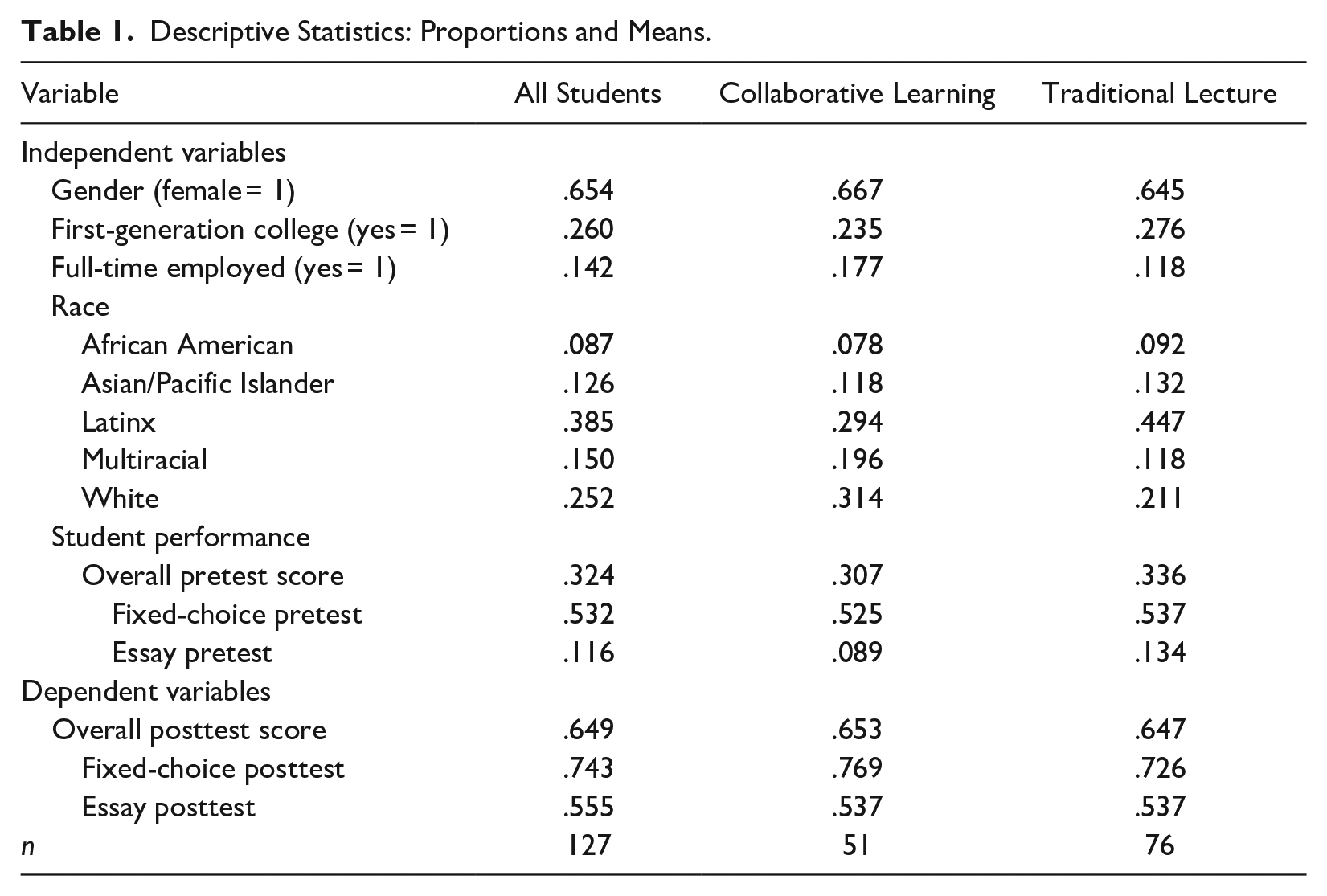
Table 1 presents descriptive statistics for each variable, outlining the participants’ demographic characteristics and performance on learning outcomes split by classroom type (collaborative learning and lecture). Over half of the students (65 percent) self-identified female, 26 percent were first-generation college students, and 14 percent reported to have full-time employment. Regarding race, about nine percent of the sample self-identified as African Americans, 13 percent as Asian/Pacific Islander, 39 percent as Latinx, 15 percent as multiracial, and 25 percent as white. As expected, students in both class types demonstrated considerable improvement in their responses from pretest to posttest scores. The fixed-choice pretest scores were 53.2 percent correct on average but improved to 74.3 percent in the posttest. The essay pretest scores averaged only 11.6 percent correct but improved to 55.5 percent correct in the posttest measure.
Descriptive Statistics: Proportions and Means.
Results
Hypothesis 1 proposed that student knowledge would improve more in collaborative learning classes compared with traditional classes. An intuitive starting point for testing this hypothesis is to measure improvement by the difference between pre- and posttest scores and compare the mean differences between the collaborative and traditional learning classes. Subtracting the overall posttest score from overall pretest score in Table 1 reveals a mean score improvement of 34.6 percentage points for the collaborative learning class and 31.1 percentage points for the traditional class; however, this 3.5 percentage point difference between these groups is not statistically significant (t = 1.170, p = .254). This relationship remains essentially unchanged even when we examine the fixed-choice scores separately from the essay scores. Splitting the overall posttest scores to compare the fixed-choice and essay scores separately, we see a similar pattern. Although the gap in mean percentage point improvement widens when looking just at fixed-choice scores (24.4 percent for collaborative vs. 18.9 for traditional lecture), the 5.5 percentage point difference is statistically insignificant (t = 1.379, p = .170). Last, the improvement gap in the essay-only scores was the smallest (44.8 vs. 43.3), with a 1.5 percentage point difference that is also statistically insignificant (t = .409, p = .683).
Individual student characteristics that differed between the collaborative and traditional classes could cloud an analysis that simply compares class averages. Thus, while the independent-samples t tests reported earlier comparing the difference in score improvements do not support Hypothesis 1, we were also interested in including control variables we considered important for isolating the impact of collaborative learning. In addition, while there is an intuitive clarity to comparing overall score improvements between classes, such a measure has its flaws. Specifically, the relationship between the value of a starting pretest score and score improvement is likely uneven across pretest scores, and consequently, we believe it is better to compare posttest scores directly and include pretest scores as a control variable in a regression model. Table 2 presents three regression models where the leftmost column regresses on overall posttest score to explain a student’s overall knowledge at the end of the course, while the other two columns isolate the effects of the independent variables on fixed-choice questions separately from the essay questions. Given that all the control variables (except the pretest variable) are dichotomized, the unstandardized betas represent the predicted difference in posttest score relative to the reference group after controlling for all the other variables. All the race variables are negative, reflecting the gap between students of color and white students in our classrooms, with African American and Latinx students faring the worst even after accounting for the other control variables, such as their initial pretest scores. African Americans and Latinx students are predicted to fare 12.8 and 10.8 percentage points worse respectively on the posttest relative to white students (the racial reference group). These are the only two statistically significant findings in the model.
Ordinary Least Squares Regression Models Examining the Effects of Collaborative Learning on Posttest Scores.
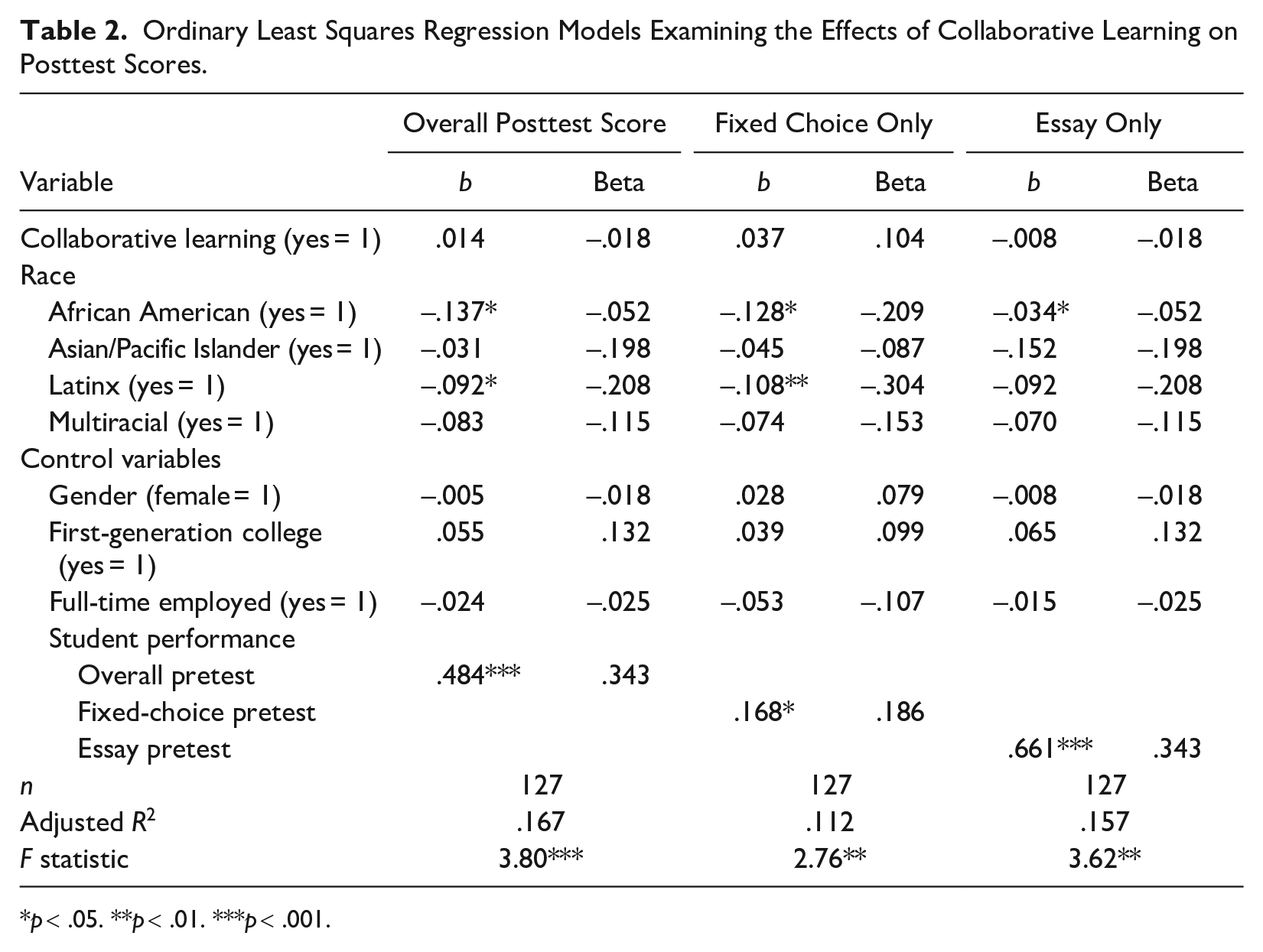
p < .05. **p < .01. ***p < .001.
The models outlined in Table 2 estimate collaborative learning increases posttest scores by 3.7 percentage points; however, this estimate is not statistically significant. Because there is a chance that collaborative learning could have a different impact when it comes to knowledge measured by fixed-choice questions (designed to measure the lower portion of Bloom’s [1956] taxonomy) compared to essay questions (designed to measure the higher levels of learning defined by Bloom’s [1956] taxonomy), we ran regressions on these measures separately. The middle and rightmost columns of Table 2 show the results of regressions on fixed-choice posttest questions and essay posttest questions, respectively. Analysis of these regression models do not lead to any novel conclusions, as both models essentially display the same patterns found in the overall posttest model. For example, all minority variables remain negative in both analyses, and similar to the findings outlined in the combined posttest model, African American and Latinx are the only statistically significant variables for the fixed-choice model, while only African American is statistically significant in the essay model. Most pertinent to the analysis of our first hypothesis, the collaborative learning coefficients for both the fixed-choice and essay posttest models were statistically insignificant and even smaller than what was found for the overall posttest model. Thus, we found no support for our first hypothesis that students’ knowledge and skills in collaborative-learning research methods classes will improve more than those of students in lecture-based research methods classes.
Table 3 presents the results of the analysis that tests our second hypothesis, which posits that race-based achievement gaps will persist in traditional learning classes, but they will not for collaborative learning classes. To examine this proposal, Table 3 splits student data into two columns to compare the differences in overall posttest learning outcomes between the collaborative and traditional lecture classes. The most notable finding in the traditional lecture class model concerns the African American students, who performed substantially worse than their white counterparts, with predicted posttest scores 22 percentage points lower. As suggested by our second hypothesis, this statistically significant finding is not replicated in the collaborative learning class, where African American students’ predicted scores were virtually equal to those of their white counterparts. No other race variable was found statistically significant in either class type. Thus, the ordinary least squares regression results in Table 3 show some support for our second hypothesis regarding the relationship between race and achievement gaps in collaborative learning versus traditional lecture classes. Specifically, we see race-based achievement gaps for African Americans in lecture-based classes but not, as far as we were able to detect statistically, in the collaborative learning classes.
Ordinary Least Squares Regression Models Predicting Posttest Scores: Subsample Analyses by Teaching Method.
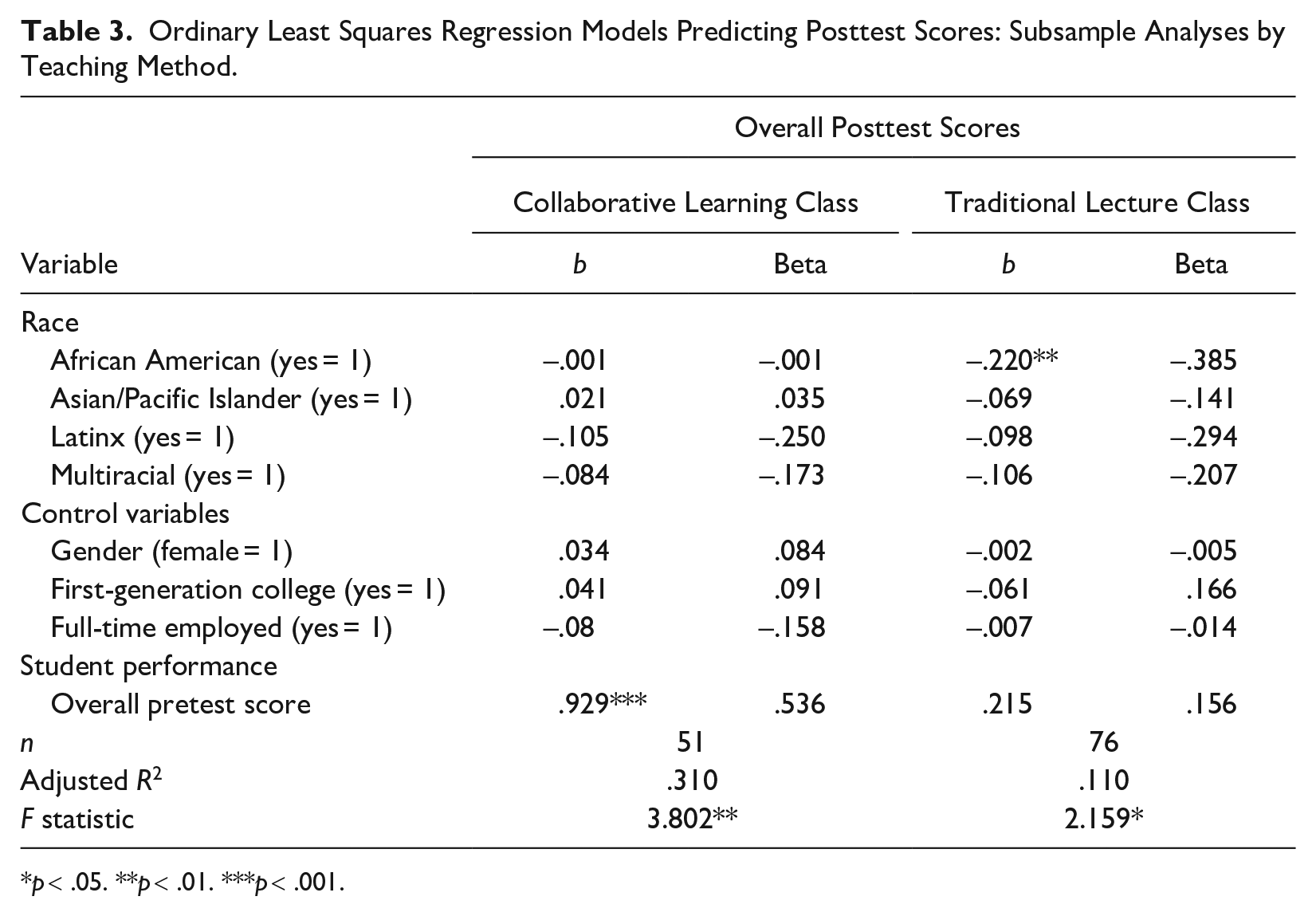
p < .05. **p < .01. ***p < .001.
Discussion
Although we did not see differences in student performance in sociology research methods classes when comparing lecture and collaborative learning pedagogy styles, we did see a race-based achievement gap in the lecture-style classes that was not present in the collaborative learning classes. While finding no statistically significant race-based achievement gap in the collaborative learning classes is interesting at both lower and higher levels of Bloom’s (1956) taxonomy, a lack of statistical significance does not necessarily mean that those differences were not there; they simply were not detected. Obviously, our quasi-experimental design represents a limited, modest effort toward understanding how we might ameliorate race-based achievement gaps in college classrooms; however, our results certainly suggest further research is warranted to test the hypothesis that collaborative learning pedagogy techniques have potential to help close race-based achievement gaps in student performance in higher education.
Our research design has limitations that are especially important to discuss as they point to possible improvements for future research. First, as is common in university studies, students self-select into the classes, so we are not able to discount the possibility that students could have chosen the classes with prior knowledge of the likely structure of the class from fellow students or, potentially, the professor and/or time classes were offered. Second, our skill assessment tests may have had too few questions to adequately capture nuances of differences between the two classes in terms of the learning goals we wanted to measure. Although longer instruments would be more time-consuming to collect and code, having multiple questions per concept could allow a measure reliability as well as improve validity in measurement. That includes a more robust evaluation concerning the success of students with different levels of engagement, as defined through Bloom’s (1956) taxonomy. Third, the collaborative and traditional courses were largely taught by two different instructors; thus future research that is able to compare the same instructors in both type of classes would help to separate out any possible “instructor effects” on learning outcomes from the effects of the type of pedagogy utilized. Finally, it is worth reiterating that this study collected data in collaborative learning classroom environments (i.e., classes with permanent teams) rather than TBL classes. Although implementing permanent teams and having students work on application activities is one aspect of TBL, the instructor’s classes could not be classified as TBL classes during the period these data were collected.
Despite the limitations of our research, the knowledge gained from this project adds to the body of literature examining the efficacy of collaborative learning and, we hope, encourages sociologists to continue examining and documenting the implications of incorporating teams in teaching research methods in their classes. Compared to the plethora of studies examining collaborative learning pedagogy in health science (Carmichael 2009; Heyborne and Perrett 2016) or business classes (Espey 2018; Hettler 2015), literature reviews of the topic reveal far fewer studies in social science classrooms (Haidet et al. 2014) and sociology classes more specifically (e.g., Huggins and Stamatel 2015; Pedersen 2010; Sweet and Michaelsen 2012). Given that methodology is foundational in the curriculum of the discipline, our research has important implications for sociology instructors seeking to improve the training of our majors.
More broadly, our findings highlight the importance of examining race as a factor in the study of the effectiveness of collaborative learning pedagogy. In our exploration of the literature on collaborative learning and TBL, we found surprisingly few studies that primarily examine, or simply report on, the impact of race, a topic of natural interest to sociology and especially relevant in our case due to the racial diversity of our students. Because the evidence on the relationship between collaborative learning and race is particularly limited in the literature, we hope our study sparks additional sociological research that seeks to better understand the potential effects of incorporating collaborative learning pedagogy techniques in higher education classrooms. Moreover, perhaps what may work on large, racially diverse campuses may not work the same in other universities, further reason more studies are needed that examine the relationship between race and collaborative learning practices on a variety of college campuses.
Our research suggests there may be good reason to pay attention to the racial diversification of groups as an additional control variable in large-scale quantitative studies of collaborative learning and TBL. For example, Hunn (2014:307) warns students of color attending primarily white institutions may “find themselves in a racially underrepresented group learning environment, isolated by [w]hite students who are not yet comfortable or receptive to ethnic diversity, alienated from the group process in that their ideas/suggestions/input is minimized or ignored, and are evaluated lower by peers.” Finding black students perceived less favorably by their group members, Macke et al. (2019:82) cautions “instructors at PWIs [primarily white institutions] who are implementing TBL are urged to be mindful of such factors as disengagement of [b]lack students in TBL group work due to feelings of isolation, differing cultural/social expectations, and institutional racism, racial stereotyping, and implicit racial bias.” Specifically, we believe it important to evaluate how stereotype threat may be influencing student engagement, as opposed to skill preparation, as a differential impact on learning. We also see a need to qualitatively explore the experience of minority students in collaborative classrooms and how that experience may differ significantly depending on the racial makeup of the campus.
Last, in addition to research needed to establish if collaborative learning can be a tool to reduce the achievement gap for some groups, further research is necessary to understand the mechanisms through which collaborative learning practices reduce this gap. For example, one pathway to explain why group work could improve exam outcomes in a research methods course may be that group work gives students an opportunity to work through and practice solving a particular methodological problem, thus improving their performance when asked to do similar tasks on an exam. Collaborative learning could also have the effect of reducing anxiety to a level that enables students to learn more effectively in research methods classes. Similarly, as we outline in the literature review, learning outcomes for some groups may improve by the reduction of the effects of stereotype threat. Research that directly measures stereotype threat and anxiety is necessary to explore our speculation that these threats to student success can be ameliorated by collaborative learning strategies and to uncover the mechanisms through which this happens in collaborative learning environments.
Footnotes
Acknowledgements
We would like to thank the editor, four anonymous reviewers, and Justin Morris for their thoughtful evaluation of our work and their valuable suggestions that helped us improve the manuscript.
Editor’s Note
Reviewers for this manuscript were, in alphabetical order, Shannon N. Davis, Danielle Kane, William Lovekamp, and Nicole Willms.
Funding
The author(s) disclosed receipt of the following financial support for the research, authorship, and/or publication of this article: This research received grant funding through a Research and Creative Activity Award and a Pedagogy Enhancement Award from Sacramento State University.
