



Abstract
With global recession and growing international competition among brands, cross-border acquisitions (CBAs) are increasing in the luxury industry. Since country-of-origin (COO) plays a large role in a luxury brand’s image, a CBA that changes the nationality of the company owning the luxury brand and modifies consumer COO knowledge can influence consumer brand perception. This study explores the influence of a luxury brand’s CBA on perceived brand value and the moderation effect of brand loyalty. In the case of a CBA by a company associated with a superior country image, only perceptions of low-loyalty consumers are affected positively by the CBA information. In the case of a CBA by a company associated with an inferior country image, only perceptions of high-loyalty consumers are affected negatively by the CBA information. The result of this study provides a deep understanding of how consumer brand perception is influenced by the changes of brand-country association.
With the globalization of the business environment, international competition among brands and cross-border acquisition (CBA) is increasing in the global market. In particular, an ongoing global recession has brought about mergers and acquisitions (M&A) in the luxury goods industry. Most recently, the number of CBAs of European luxury brands by Asian companies has been increasing. For example, in 2011, the Korean sportswear company EXR Korea took over the French luxury brand Castelbajac (Wendlandt & Denis, 2011), and Cheil Industries Inc., the Korean conglomerate Samsung’s fashion and textile affiliate, acquired the Italian luxury brand Colombo Via Della Spiga (“Samsung looks,” 2012). In 2012, the Hong Kong-based multinational company Fung Brands Ltd. acquired an 80% stake in the French luxury brand Sonia Rykiel (Wendlandt, 2012), and the British luxury brand Aquascutum was also acquired by YGM trading in Hong Kong (“Aquascutum sold,” 2012). Since Asian companies are less competitive in the luxury goods industry, buying European luxury brands that are rich in heritage can be a shortcut to successful entry into the luxury goods industry without having to build a luxury brand, which could take many years.
In the case of CBAs of luxury brands by Asian companies, however, one may ask whether the luxury brand equity that has been built up over a long period will be well maintained by the Asian companies. Country image has a substantial impact on consumer brand perception (Pappu, Quester, & Cooksey, 2006), and with regard to luxury brands, country of origin (COO) plays a large role in brand image (Aiello, Donvito, Godey, Pederzoli, & Wiedmann, 2009). Therefore, a CBA that changes the nationality of the company owning the luxury brand and modifies consumer COO knowledge can influence consumer brand perception. If new COO knowledge influences brand perception negatively, acquirer companies may have difficulty managing brand equity, which differentiates consumers’ perceptional responses to the brand (Keller, 1993). This study explores the influence of a luxury brand’s CBA on consumer brand perception in the context of country image research.
Through various media outlets and marketing communication channels, consumers are frequently exposed to M&A information. Because M&As have a significant influence on the share prices of public companies, these companies must make a public announcement regarding M&As in accordance with the relevant legal regulations. Many people, including investors, are interested in M&As (i.e., M&As are important issues that are actively reported by the media). Specifically, recent CBAs of luxury brands have frequently been played up by various media. Sometimes, acquirer companies also inform consumers of their acquisitions of luxury brands actively. Therefore, consumers have knowledge of the luxury brands’ CBAs to which a great deal of media attention is given, and consumer brand perceptions are influenced by the CBA information.
Although a considerable amount of research has been devoted to demonstrating the effect of country image (Han, 1989; Li, Murray, & Scott, 2000; Nagashima, 1970; Samiee, 1994), it remains unclear how CBAs that result in changes in brand–country association influence consumer behavior. Although there are numerous studies that coextensively compare an association between a specific product/brand and a country with other associations consisting of the same product/brand and different countries, the impact of a new brand–country association replacing a prior association has received little attention.
Therefore, this study constitutes a foundational investigation in terms of CBAs in the area of country image research. Although CBAs have been studied by many researchers from the perspective of firms (Shimizu, Hitt, Vaidyanath, & Pisano, 2004), consumer research that tests the impact of CBAs on consumer behavior is very limited. Considering the growing importance of CBAs in the luxury market, this study provides a deep understanding of how consumer brand perception changes in the case of a CBA of a luxury brand.
Literature Review and Hypotheses
The Effects of Country Image and CBA
Country image, which refers to consumers’ overall perception of a country (Han, 1989; Martin & Eroglu, 1993; Nagashima, 1970), is one of the most popular subjects in international business. After Schooler’s (1965) first attempt to illustrate the effect of country image on consumer behavior, numerous researchers have studied country image using various terms, such as country image, country of origin, and country of manufacturer. Most of the early studies tried to determine how the image of a country in which products are made influences consumer behavior. Early studies examined the causal relationship between country image and product evaluations (Hampton, 1977; Nagashima, 1970). Through empirical experiments manipulating country image cues by “made in X” labels, many researchers have succeeded in demonstrating that consumer product evaluations are varied according to the image of a manufacturer’s country (Han & Terpstra, 1988; Nagashima, 1970). Because of global sourcing and multinational companies, a product can have multiple associations involving more than one country. Some researchers have also shown effects of multiple-country images, such as images of the countries responsible for sourcing, assembling, and designing a product (Ahmed & d’Astous, 1995; Chao, 1993; Ha-Brookshire, 2012; Li et al., 2000). A country image associated with a brand affects the perception of that brand (Shimp, Samiee, & Madden, 1993; Zeugner-Roth, Diamantopoulos, & Montesinos, 2008). For instance, Zeugner-Roth, Diamantopoulos, and Montesinos (2008) define country brand equity as the value added brought forth by the association of a product or brand with a country, and they empirically show its impact on consumer preference.
A CBA involving an acquirer firm and a target firm whose headquarters are located in different home countries is a popular strategy for a firm’s strategic expansion (Shimizu et al., 2004). CBAs have important implications in country image research because they change the country–brand association. If a brand is acquired by a company in another country, the nationality of the company owning the brand changes, and a new association between the brand and the country in which the acquirer company is located is formed. Thus, with respect to the country image effect, the new country image associated with an acquirer company replaces the home country image and has an impact on brand perception. Lee and Lee (2011) used the real case of Lenovo’s (China) acquisition of IBM’s PC division (USA) to demonstrate that, after acquisition, the attitude toward the acquirer’s country has both direct and indirect effects on purchase intentions toward the acquired firm’s products. Although the context is different, research on cross-border brand alliance, which is formed to strengthen brand image (Bluemelhuber, Carter, & Lambe, 2007), aids understanding of the influence of a CBA on consumer brand perception. Although a CBA is done for strategic portfolio diversification (Shimizu et al., 2004), both cross-border brand alliances and CBAs induce changes in the country–brand association. Bluemelhuber, Carter, and Lambe (2007) describe COO fit as the consumer’s perception of the overall compatibility of the two countries involved in the brand alliance; the authors find that a good COO fit has a positive impact on consumer attitudes toward cross-border brand alliance. Lee, Lee, and Lee (2013) also demonstrate that cross-border brand alliance creates positive synergistic effects when both countries’ images are favorable. Thus, one can infer that, when a CBA occurs, not only the image of the home country but also the image of the acquirer’s country can influence consumer brand perception.
Perceived Value of a Luxury Brand and CBA
Perceived value refers to a consumer’s overall assessment of utility based on perceptions regarding what is received and what is given (Zeithaml, 1988). Marketing researchers pay great attention to perceived value of a brand because consumer brand choice largely depends on how much the consumers value the brand (Dew & Kwon, 2010; Sheth, Newman, & Gross, 1991; Sweeney & Soutar, 2001). Perceived brand value is relatively more critical for luxury brands because consumers purchase luxury brands when they perceive sufficient value that compensates for higher price (Tynan, McKechnie, & Chhuon, 2010). The higher brand value differentiated from other brands is one of the luxury brands’ key characteristics (Fionda & Moore, 2009), and consumers purchase a luxury product because it represents their value (Vigneron & Johnson, 2004).
Images generated from an association between a luxury brand and its home country is one of the important factors that influence perceived value of the luxury brand (Kapferer & Bastien, 2012). The majority of luxury brands have geographical origins in, and long histories related to, European countries (Brun & Castelli, 2013). The majority of craftspeople who have expertise in luxury products also reside in Europe. Accordingly, a luxury brand’s European home country symbolizes the luxury brand’s heritage, which is built with brand history in a specific country over time (Aaker, 1991; Fionda & Moore, 2009). A luxury brand’s European home country works as a metaphor for authenticity, and the home country–brand association positively influences consumers’ perception toward the luxury brand’s value (Brun & Castelli, 2013; Kapferer, 1997).
The competitiveness of European countries in the luxury fashion industry (Caniato, Caridi, Castelli, & Golini, 2011) is another reason that the home country–brand association has a positive impact on perceived value of a luxury brand. Because perceived strengths of a country in a specific industry have a positive impact on the perceived value of a brand that belongs to the same industry (Pappu et al., 2006; Roth & Romeo, 1992), an association of a luxury brand with its home country that is competitive in the luxury fashion industry positively influences consumer perceptions of brand value.
For these reasons, luxury brands have strong associations with their European home countries. Accordingly, an image of a luxury brand’s European home country contributes to luxury brand equity and influences consumers’ perceptions of the luxury brand. The results of previous studies (Aiello et al., 2009; Godey et al., 2012) that COO information is considered relatively important when consumers purchase luxury goods imply that consumers have a strong association between a luxury brand and its home country.
Therefore, a CBA of a luxury brand can have unexpected effects on the perceived value of the luxury brand. Particularly, if the image of the acquirer’s country is inferior to that of the home country, the CBA can negatively influence consumers’ perceptions of the luxury brand’s value, and thus the CBA can be detrimental to the luxury brand. If the acquirer’s country is less competitive than the home country in the luxury industry, consumers will have difficulty connecting the brand with the acquirer’s country and may think of the CBA as a degradation of the luxury brand’s heritage, one of the core attributes of a luxury brand (Fionda & Moore, 2009). On the other hand, if the image of the acquirer’s country is superior to that of the home country and is well matched to the luxury brand, a CBA may positively influence the perceived value of the luxury brand. This study aims to examine the impact of a luxury brand’s CBA on its perceived brand value.
Moderation Effects of Brand Loyalty
According to balance theory (Heider, 1958), which illustrates people’s attitudinal changes, people tend to maintain a psychologically balanced state. Because an imbalanced state produces tension, people change their attitudes to create a balanced state. Such a state exists when the relations among entities fit together harmoniously (Dalakas & Levin, 2005). If the result of multiplying all affect valences (positive or negative) of all the relations is positive, there exists a balanced state (Dean, 2002). For example, in the case of three entities, a balanced state exists if all three relations are positive or if two are negative and one is positive. If a person has a positive attitude toward an object (one side of the triangle) and the object’s relationship with the other object (the second side of the triangle) is negative, it induces the person to have a negative attitude toward the other object (the third side of the triangle) to avoid an imbalanced state. If both an attitude of a person toward an object and a relationship between the object and the other object are positive, the person’s attitude toward the other object will also be positive. When applying balance theory to CBA, one can predict that after acquisition, brand perception will be influenced by consumers’ perception of the acquirer company’s country. When a CBA occurs, a brand makes a new relationship with an acquirer’s country, and thus a consumer’s attitude toward the brand will be changed according to her or his attitude toward the new country. For example, if the new country’s image is superior to the home country’s image, consumers will have favorable attitudes toward the new country. Accordingly, if a consumer has an unfavorable attitude toward a brand before the CBA, her or his brand attitude will be affected favorably to restore balance. On the other hand, if a consumer has a favorable attitude toward the brand before the CBA, there will be no change in her or his brand attitude because her or his preexisting favorable brand attitude and her or his favorable attitude toward the new country are well balanced. According to the same reasoning, when a consumer’s attitude toward the new country are unfavorable because the new country’s image is inferior to that of the home country, the consumer’s preexisting positive attitude toward the brand will be changed unfavorably, while a preexisting negative attitude will be unchanged.
The degree of brand loyalty, which refers to a deeply held commitment to rebuy or repatronize a preferred product or service consistently in the future (Oliver, 1999), can be an indicator of a preexisting brand attitude. Brand loyalty includes cognitive, affective, and conative aspects and is formed through an attitude development structure (Dick & Basu, 1994; Oliver, 1999). Hence, high-loyalty consumers are assumed to have favorable attitudes toward the brand, while low-loyalty consumers are assumed to have unfavorable brand attitudes. Therefore, brand loyalty, which represents preexisting brand attitude, will moderate the effect of an acquirer’s country image. Changes in consumers’ attitudes toward a brand by an acquirer’s country image will be different depending on the degree of brand loyalty.
Drawing on balance theory and previous studies on COO and brand loyalty, we formulate our research hypotheses. When a CBA occurs, consumer brand perception will vary depending on the consumers’ perceptions of the acquirer’s country and on the degree of their brand loyalty. The perceived value of the luxury brand will vary according to the acquirer’s country image, and brand loyalty will moderate the impact of the acquirer’s country image. If the country image associated with an acquirer company is superior to the image of the home country, a consumer whose brand loyalty is high will not change her or his brand perception based on CBA information, because favorable attitude toward the acquirer’s country and preexisting positive attitude toward the brand are well balanced. On the other hand, if a consumer’s brand loyalty is low, she or he will experience tension induced by the imbalanced state between the positive perception of the acquirer’s country and her or his preexisting negative brand attitude. Thus, her or his brand perception will be changed positively by a CBA in which the acquirer company is associated with a superior country image.
The same reasoning, applied to acquirer companies with country images inferior to that of the home country, predicts that a consumer’s brand perception will not be changed by the CBA information if her or his brand loyalty is low but will be negatively affected if brand loyalty is high.
Method
An experimental study was conducted using an online survey to test our research hypotheses. A two (country image associated with the acquirer company: superior vs. inferior) by two (brand value: pre vs. post) mixed design was employed. Country image associated with the acquirer company in a CBA was manipulated as a between-subject factor. Perceived brand value was a within-subject factor and was measured twice, once before and once after presentation of the CBA information. Two different news stories about the CBA were developed as stimuli.
Pretests
Two pretests were conducted to select a luxury brand and two countries in which the acquirer company is located for fictitious CBA news stories. To select a brand that is perceived as a luxury brand and whose home country is well known to consumers, we conducted the first pretest. Thirty-one graduate students in Korea were asked to list three countries in any order that they think have many luxury brands. Then they were asked to list two luxury brands that belong to each country. The United States, Japan, and European countries such as France, Germany, Italy, Spain, and the United Kingdom were listed. Among these, Italy (n = 31) and France (n = 31) were the countries listed most frequently. Considering the plausibility of the experiment, Italian brands were more appropriate than French brands because there were actually many luxury brands in Italy that had recently been acquired by foreign countries. The respondents listed the following Italian brands: Armani, Bottega Veneta, Dolce & Gabbana, Etro, Ferragamo, Fendi, Gucci, Moschino, Missoni, Prada, Tod’s, and Valentino. Among the listed Italian brands, the brands that had already been acquired or stated as potential targets in recent news articles were eliminated to control other factors that were not addressed in this study. Finally, the Italian luxury brand Tod’s was selected. The second pretest was employed to select two countries. This pretest surveyed 31 graduate students who had not participated in the first pretest. We assessed the country images of France and China as our potential new acquirer company’s countries, using 14 items (Martin & Eroglu, 1993) on a 7-point Likert-type scale (1 = strongly disagree, 7 = strongly agree). France was assessed as a country with a superior image because it was listed by many respondents on the first pretest and has been mentioned in many country image studies as a country with a positive image (Kim & Chung, 1997; Roth & Romeo, 1992). China was assessed as a country with an inferior image because although China is becoming a major buyer in the luxury market, its country image is still low. As a comparison, Italy’s image was also measured. France’s averaged mean score across the 14 items was the highest (4.70), followed by Italy (3.78) and then China (2.15). Paired sample t-tests revealed that France has a superior country image compared with Italy (4.70 vs. 3.78; t = 7.43, p < .001) and that China has an inferior country image compared with Italy (2.15 vs. 3.78; t = 11.616, p < .001). On the basis of these results, we developed two fictitious news stories. One story claimed that a French company had acquired Tod’s, while the other story stated that a Chinese company had acquired Tod’s.
Participants
An online survey was conducted by e-mail using the panel of a Korean survey company, Macromillembrain. The respondents received movie tickets for participating in the online survey. For external validity, data were collected from actual consumers of luxury brands, who were identified with screening questions. We asked whether they had purchased or been given luxury brand goods in the last 3 years, and product types that they have were also checked. We excluded respondents who reported having only cosmetics because they do not represent typical consumers of luxury brands: most of luxury brands’ main products are fashion items such as clothes, shoes, and bags. After exclusion of incomplete surveys, 394 surveys were used for final analysis. The characteristics of the sample are presented in Table 1. Because we divided participants into three groups depending on the types of stimuli presented in the second online survey (superior country group, inferior country group, and control group), we conducted a cross tabs analysis using chi-square tests to ensure sample homogeneity among the three groups. Sample homogeneity was achieved in demographic characteristics including experiences of Tod’s (see Table 1). Among the respondents who answered that they already knew Tod’s before participating in our experiment, 71.2% had the correct COO knowledge that Tod’s is an Italian brand. That is a relatively high level, considering previous research (Samiee, Shimp, & Sharma, 2005). The high level of COO knowledge accuracy of our sample implies that our sample consisted of actual luxury brand consumers because consumers are more sensitive to COO information when they purchase luxury products (Godey et al., 2012).
Sample Group Characteristics.
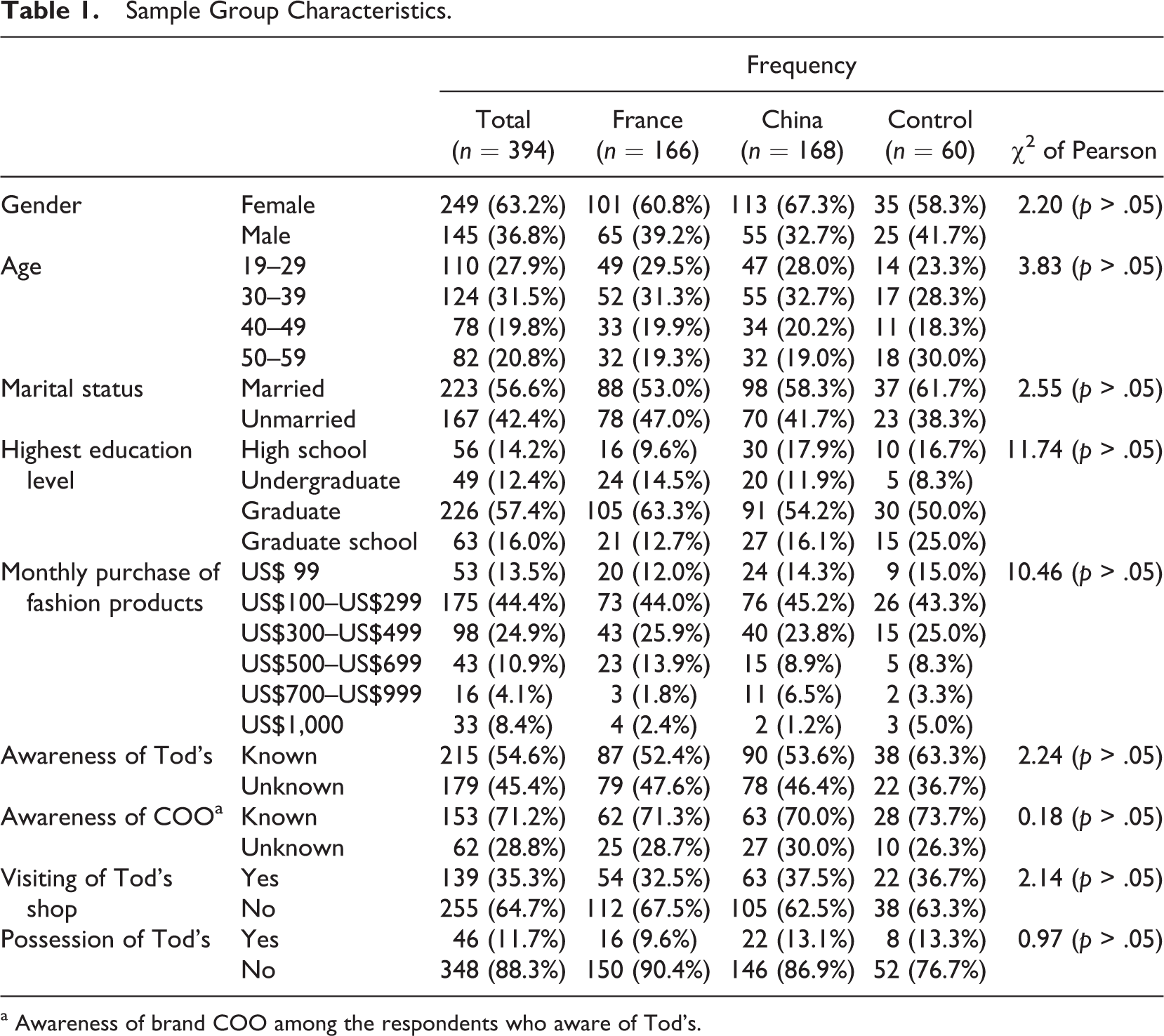
a Awareness of brand COO among the respondents who aware of Tod’s.
Procedure
The online survey was administered twice with a 1-week interval between administrations. Because the purpose of our experiment was to test the change in consumers’ perceived brand value resulting from the CBA information, perceived brand value was measured twice, once before and once after the CBA information was presented. The 1-week time interval was included to reduce any carryover effects of the within-subject design (Afsarinejad & Hedayat, 2002). The first online survey (Pre; n = 394) began with a brief description of Tod’s, including its home country information. After reading the description, the subjects answered questions designed to measure brand loyalty and perceived brand value. Italy’s country image was also measured as a manipulation check. Demographic questions were included at the end of the survey. One week later, in the second online survey (Post; n = 394), subjects read fictitious news about the CBA of Tod’s by a foreign company and then answered the questions regarding perceived brand value again. For the superior country group (n = 166), a French company was presented as the acquirer company; for the inferior country group (n = 168), a Chinese company was presented. As a manipulation check for superior and inferior countries, country images of France or China, respectively, were measured in each group. The subjects in the control group (n = 60) also answered questions regarding perceived brand value again. The fictitious news about the CBA, however, was not included in the second survey for the control group. Finally, after receiving notification that the news story was fictitious, the subjects were dismissed.
Measures
In the main study, country image was measured with 14 items (Cronbach’s α = .91) from Martin and Eroglu’s (1993) country image scale on an 11-point Likert-type scale (1 = strongly disagree, 11 = strongly agree). To measure brand loyalty, 6 items (Cronbach’s α = .94) were developed based on the loyalty scale of Russell-Bennett, McColl-Kennedy, and Coote (2007). The scales of Russell-Bennett et al. were modified from semantic differential scales to 7-point Likert-type scales (1 = strongly disagree, 7 = strongly agree) for consistency of the measurements. Brand value was measured using 19 items from Sweeney and Soutar’s (2001) brand value scale on a 7-point Likert-type scale (1 = strongly disagree, 7 = strongly agree). A confirmatory factor analysis was conducted on the four value dimensions (quality, social, emotional, and price value) using the data from the first and second surveys. The model fits were acceptable overall (the first, χ2 = 473.90, degrees of freedom [df] = 146, p < .001, comparative fit index [CFI] = 0.96, relative fit index [RFI] = 0.93, normative fit index [NFI] = 0.94, Tucker–Lewis index [TLI] = 0.95, root mean square error of approximation [RMSEA] = 0.08; the second, χ2 = 494.75, df = 146, p < .001, CFI = 0.96, RFI = 0.93, NFI = 0.94, TLI = 0.95, RMSEA = 0.08). The results satisfied the goodness of model fit criteria of Hair, Black, Babin, Anderson, and Tatham (2010). All items in the model were significant (p < .001), and all factor loadings were greater than 0.75. The reliability of each latent factor was established by confirming that all Cronbach’s αs were greater than .89.
Results
Manipulation Check
To test the validity of our manipulations regarding superior and inferior country images, we compared the country image of Italy with that of France and China, respectively. The responses to the 14 items on the country image scale were averaged. Prior to pairwise comparisons of country images, we tested the homogeneity of country image perceptions toward Italy among the three groups. A one-way analysis of variance (ANOVA) showed consistency among the three groups with respect to Italy’s image (control group = 7.83; France group = 7.53; China group = 7.54, F = 1.55, p > .05). Paired samples t-tests for each treatment group were then conducted. The result of the t-test for the superior group supported the assumption that the image of France (7.96) is significantly higher than that of Italy (t = 5.07, p < .001). The result of the t-test on the inferior group also supported the assumption that the image of China (4.43) is significantly lower than that of Italy (t = −19.95, p < .001). The results of the t-tests showed a successful manipulation of country images.
For testing the validity of the main effect of the CBA information, we compared the pre- and post-CBA perceived brand values for the control group (n = 60) through a paired samples t-test. No significant difference is expected for the control group because they did not receive CBA information in the second survey. Consistent with our conjecture, there was no significant difference (quality, t = 1.83, p > .05; price, t = 1.50, p > .05; social, t = 1.70, p > .05; and emotional, t = 1.26, p > .05). This result ensured that the changes in perceived brand value for the treatment groups were not due to a maturation effect (Fraenkel & Wallen, 2011) induced by the 1-week time interval. Because the results confirmed a successful treatment design, we no longer discuss the result of the control group.
Superior Image of an Acquirer Company’s Country and Changes in Brand Value Perception
Before hypotheses testing, the subjects were divided into a high-loyalty group (n = 176, mean = 4.34) and a low-loyalty group (n = 158, mean = 2.42) using the mean score of 3.43, as measured on the brand loyalty scale. The result of an independent t-test showed a significant difference in brand loyalty (t = 24.28, p < .001). We first tested the moderating effect of brand loyalty because Hypotheses 1 and 2 are based on the prediction that brand loyalty will moderate the influence of the superior country image associated with an acquirer company on consumers’ perceived brand value. The moderating effect can be represented as an interaction between a focused independent variable and a factor that specifies the appropriate conditions for its operation (Baron & Kenny, 1986). Thus, we tested the interaction between times (pre–post) that is an independent variable and brand loyalty that specifies the appropriate conditions using repeated measures ANOVA. The results of the analysis on the interaction showed that brand loyalty toward Tod’s has a moderating effect on perceived brand value. All of the interaction effects (Times × Brand Loyalty) were significant (quality, F = 4.16, p < .05; price, F = 10.50, p < .001; social, F = 3.84, p < .05; and emotional, F = 12.75, p < .001).
For individual examination of Hypotheses 1 and 2, we conducted a series of paired samples t-tests. The findings showed that when Tod’s was acquired by a French company, there was no significant difference in perceived brand value for consumers of high loyalty (quality, t = −1.76, p > .05; price, t = −0.39, p > .05; social, t = 0.82, p > .05; and emotional, t = −1.50, p > .05). Therefore, Hypothesis 1 is supported (see Table 2 and Figure 1). For consumers of low loyalty, when Tod’s was acquired by a French company, post-CBA perceived brand value was generally higher than the pre-CBA perceived brand value (see Table 2 and Figure 1). Furthermore, there was a significant difference between the pre- and post-CBA perceived brand values with respect to price value (t = 3.66, p < .001), social value (t = 2.75, p < .01), and emotional value (t = 3.03, p < .01). With respect to quality value, a small (t = 1.21, p > .05) but insignificant increase was found. Therefore, Hypothesis 2 is partially supported. We deem that the insignificant difference between pre-CBA quality value and post-CBA quality value is due to low-loyalty consumers’ high pre-CBA perceived quality value. Low-loyalty consumers’ perceptions of pre-CBA quality value toward Tod’s (4.72) were relatively higher than their other value perceptions toward Tod’s (pre-social = 3.51, pre-emotional = 4.13, and pre-price = 3.67). This means that although low-loyalty consumers do not value Tod’s as highly as high-loyalty consumers do, they believe that Tod’s represents high quality. Because they had already held high perceptions of quality value, their post-CBA quality value could not increase like other values, and the influence of France’s favorable image would have decreased to an insignificant level. Previous studies on luxury consumption find that consumers consider function and quality to be important in luxury consumption (Wiedmann, Hennigs, & Siebels, 2009) and expect luxury products to be usable and of good quality (Vigneron & Johnson, 2004). The low-loyalty consumers’ high perceptions of quality of Tod’s are consistent with these previous studies.
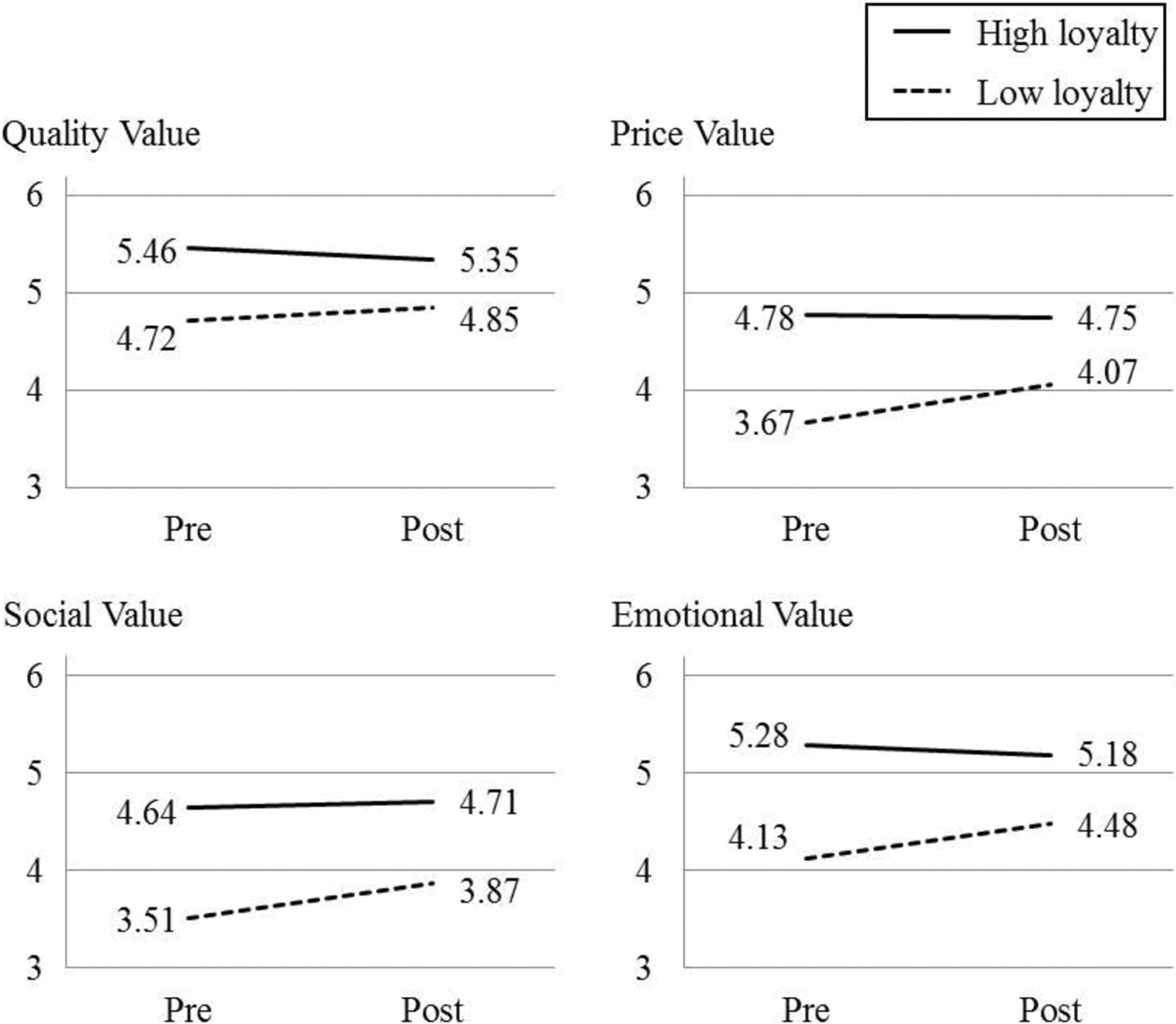
Changes in perceived brand value in cross-border acquisition by a French company.
Results of Paired Samples t-Test on Hypotheses 1 and 2.
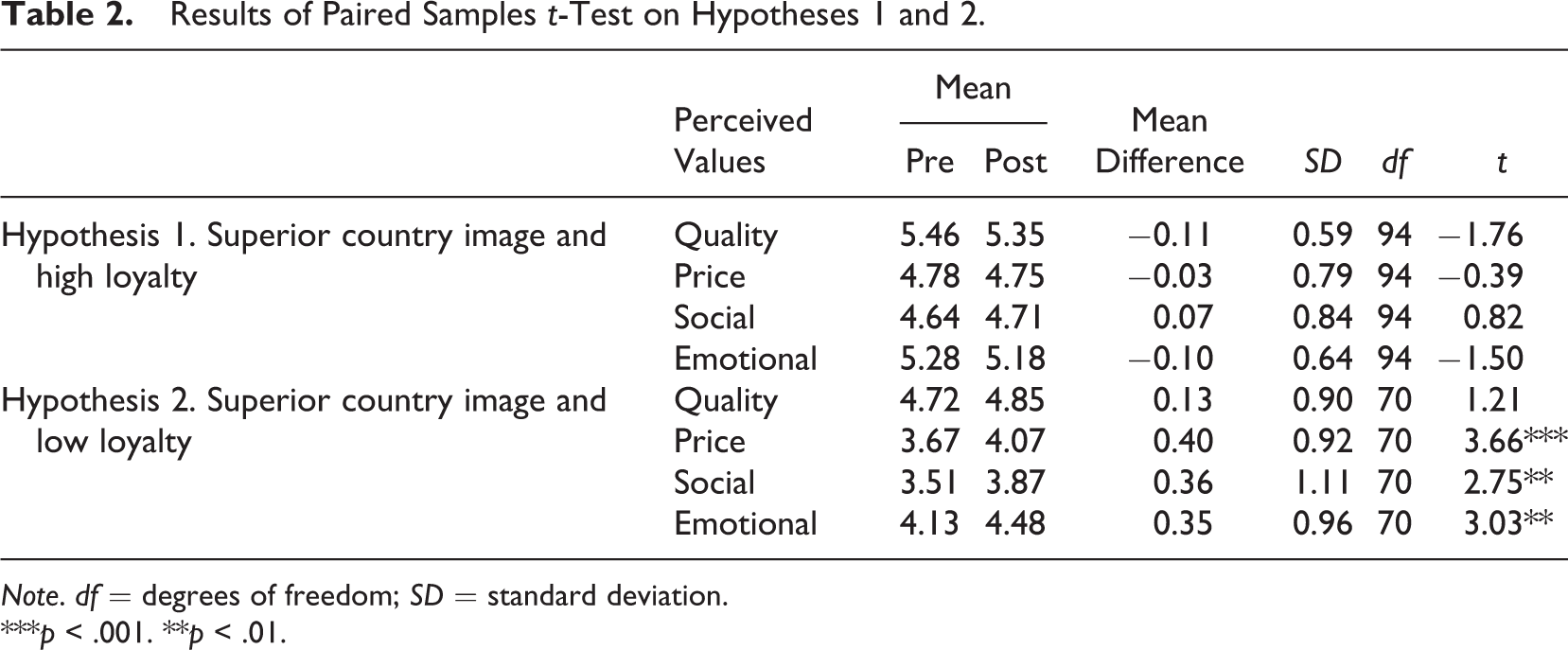
Note. df = degrees of freedom; SD = standard deviation.
***p < .001. **p < .01.
The results of the repeated measures ANOVA and the paired samples t-tests indicate that, in the event of a CBA by a company located in a country with a superior image, only consumers who have low brand loyalty experience an imbalanced state between their attitudes toward the acquirer’s country and their attitudes toward the brand. To reduce this cognitive dissonance, low-loyalty consumers’ perceived brand value increases according to their positive perceptions of the acquirer’s country.
Inferior Image of an Acquirer Company’s Country and Changes in Brand Value Perception
Hypotheses 3 and 4 are based on the prediction that brand loyalty will moderate the influence of the inferior country image associated with an acquirer company on consumers’ perceived brand value. Thus, we tested the moderating effect of brand loyalty using repeated measures ANOVA. Most of the interaction effects between times (pre–post) and brand loyalty on perceived brand value were significant (price, F = 13.33, p < .001; social, F = 7.71, p < .01; and emotional, F = 5.87, p < .05). Although the moderating effect on quality value was not significant (F = 3.48, p = .06), it was very close to the significance criterion.
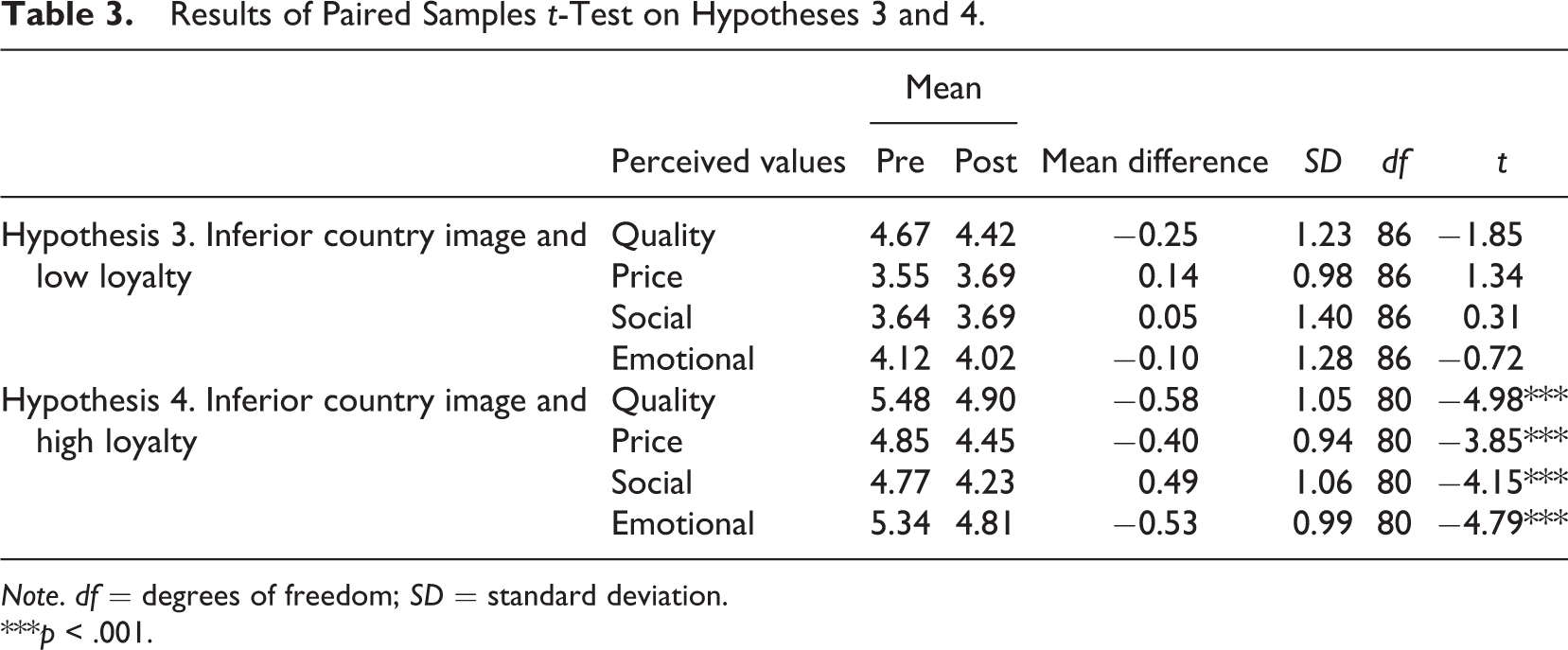
To test the hypotheses related to inferior country image, paired samples t-tests were employed. The results showed that when Tod’s was acquired by a Chinese company, there was no significant difference in perceived brand value among consumers of low loyalty (quality, t = −1.85, p > .05; price, t = 1.34, p > .05; social, t = 0.31, p > .05; and emotional, t = −0.72, p > .05). Low-loyalty consumers’ perceived brand value was not changed by the Chinese company’s CBA information (see Table 3 and Figure 2). Therefore, Hypothesis 3 is supported. For consumers of high loyalty, post-CBA perceived brand values were lower than pre-CBA perceived brand values when Tod’s was acquired by a Chinese company (see Table 3 and Figure 2). In all of the value dimensions, there were significant differences between pre- and post-CBA perceived brand values (quality, t = −4.98, p < .001; price, t = −3.85, p < .001; social, t = −4.15, p < .001; and emotional, t = −4.79, p < .001). Therefore, Hypothesis 4 is supported.
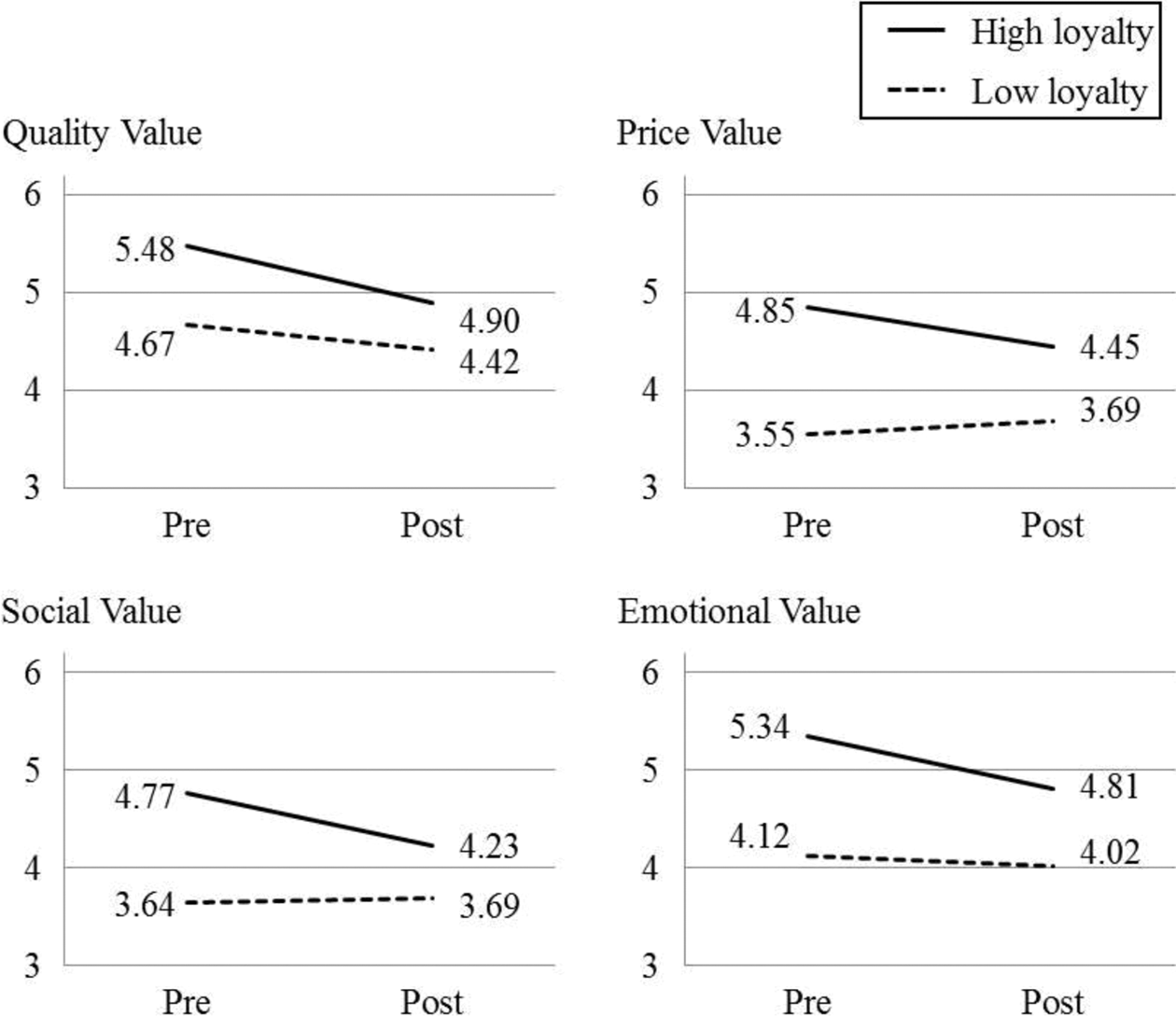
Changes in perceived brand value in cross-border acquisition by a Chinese company.
Results of Paired Samples t-Test on Hypotheses 3 and 4.
Note. df = degrees of freedom; SD = standard deviation.
***p < .001.
These results show that in the case of a CBA by a company associated with an inferior country image, only perceptions of high-loyalty consumers are affected negatively by the CBA information. High-loyalty consumers experience an imbalanced state between their negative attitudes toward the acquirer’s country and their positive attitudes toward the brand. To reduce their cognitive dissonance, high-loyalty consumers’ perceived brand value decreases according to their negative perceptions of the acquirer’s country.
Discussion and Implications
In this study, the influence of the CBA of a luxury brand on consumer brand perception was investigated, and it was successfully demonstrated that the image of the acquirer company’s country has an effect on consumers’ perceived brand value. The theoretical contributions of this article are as follows: (1) COO research is extended by examining the influence of a CBA, which has received minimal attention in COO research. We showed that the image of a brand owner’s country, like the image of a manufacturing country or a designing country, has an effect on consumer brand perception. By demonstrating the importance of the new brand–country association replacing the prior one, a more comprehensive and integrated understanding of COO effects has been developed. (2) Applying balance theory, this article revealed the psychological mechanism of the country image effect and identified brand loyalty as a moderator. When brand loyalty and the image of the acquirer’s country are not compatible, the image of the acquirer’s country influences perceived brand value. Through this research, we can understand the detailed and sophisticated mechanism of COO effects. (3) CBA research, previously studied primarily from the perspective of firms, is extended. By examining a CBA from the perspective of consumers, this study enriches CBA studies and provides a deeper understanding of effects on consumer brand perception of a luxury brand’s CBA. According to the literature, the failures of CBAs are largely the result of paying excessive premiums or encountering unfavorable problems associated with post-acquisition integration (Shimizu et al., 2004). Our study provides an additional new explanation for the failure of CBAs from the perspective of consumers: the possible degradation of brand value resulting from an inferior or negative image of an acquirer company’s country.
We believe this article is timely and appropriate because Asian companies are extending their business through CBAs. Although the pace of luxury fashion brands’ CBAs is brisk, little is known about consumers’ responses to those CBAs. The results of our study imply that consumers are apt to be very sensitive to the CBA of a luxury brand. If an image of an acquirer’s country is unfavorable or inferior to that of the home country, the consumers may accept the CBA as evidence that the luxury brand is suffering managerial problems. High-loyalty consumers tend to be disappointed by the CBA information and may lose allegiance to the brand. Even consumers who have low levels of brand knowledge can be negatively affected by the CBA. Perceived brand value of Tod’s also decreased among survey participants who did not know Tod’s before participating in our experiment, when they learned that Tod’s was acquired by a company with an inferior country image. This finding is important because these participants represent potential consumers of the new markets. Asian companies that have acquired a European luxury brand are extending their business by opening new stores of the luxury brand in Asia. Consumers in those markets who are new to the luxury brand are critical target consumers. The acquirer may expect that the consumers in the new market will welcome an opening of a new luxury brand near them. However, our research implies that those consumers might be disappointed and unwilling to pay for the luxury brand if they find out that the brand was turned over to the new company with an inferior country image and is no longer managed by the company that had successfully preserved the heritage of that brand.
Our results imply that consumers consider CBAs negative events when the acquirer company is located in a country with an inferior image. Thus, a CBA can fail unless a prudent counterstrategy is deployed. Our findings suggest that post-acquisition strategies should be adopted to maintain luxury brand equity and to prevent consumer backlash. First, the companies considering CBAs to enter the luxury goods industry must take their country image into account and incorporate it into the postacquisition strategy. If the acquirer company’s country image is inferior, consumers in mature markets may resist the CBA. In this case, the acquirer companies should minimize the exposure of their acquisition information. On the other hand, if the acquirer company’s country image is superior, the acquirer company can highlight the heritage of the luxury brand as well as information regarding the acquirer company in the new market. For example, for new market consumers, LVMH’s acquisition of Italian luxury brands can create a synergistic effect with France’s image, which has strong associations with luxury products. Second, in all markets, the acquirer companies have to convince consumers that their acquisition of the luxury brand will not affect product quality because the issue of foremost importance is to build consumer trust. Postponement of drastic management policy can be helpful. The entire replacement of the management team can cause consumers concern. Through active communication, the acquirer company must reassure consumers that the core traditional policies, including the manufacturing system by local craftspeople, will be maintained. Last but not the least, the acquirer company should show its belief in brand philosophy by emphasizing that their acquisition is not motivated solely by the wish to take over sales of the luxury brand but also by appreciation of the tradition and heritage of that brand. Disclosure of concrete activities to preserve and enhance the luxury brand’s heritage and authenticity would be helpful.
The following few points may enrich this line of study in the future. First, further research might address whether the effect of CBAs on consumers’ perceived brand value diminishes over time. Second, the results of this study may not directly apply to all brands because the strength of the country image effect may differ according to types of products and brands. A future study, therefore, could investigate the effect of CBAs on consumer brand value perception of non-luxury brands. Third, the degree of CBA, such as simple financial acquisition versus acquisition including change of management or relocation of the production facility, may also mediate brand value perception.
Footnotes
Declaration of Conflicting Interests
The author(s) declared no potential conflicts of interest with respect to the research, authorship, and/or publication of this article.
Funding
The author(s) received no financial support for the research, authorship, and/or publication of this article.