



Abstract
Global clothing production has given rise to fast fashion strategies adopted by the majority of fashion retailers. However, there is a production network located in London, one of the most expensive areas in the world. The Savile Row tailors using craft techniques slow by nature have never outsourced production to remain competitive. In line with the resource-based view, the relational view, and global production networks theories, the authors devise a conceptual framework as they seek to explore how competitiveness can be achieved within a slow production network. A single case study of London’s Savile Row tailoring operations is adopted. This self-reliant network has managed to acquire capabilities and specialized knowledge and transform them into core competences, thus generating competitiveness. The perennial values of this slow craft and its recent international revival secure the tailors’ longevity.
Outsourcing clothing production has become a common practice among industrialized countries. To achieve cost reduction, the majority of firms have relocated production to countries with lower labor costs as investments tend to be directed toward the branding and retailing side of the business. This separation of production and consumption has suggested that retailers and branded manufacturers (RBMs) could operate without factories, thus reducing clothing production in most industrialized regions. Moreover, RBMs have arranged production in dispersed localities through the formation of production networks where they act as the central controllers of their supply chain, directing manufacturers on what products to manufacture and in which countries or regions. Power asymmetries accrue from this system of production, as manufacturers in developing countries are usually compliant with their buyers. Survival among clothing manufacturers relies heavily on seasonal orders, usually via arms’ length transactions (Coe, Dicken, & Hess, 2008; Gereffi & Lee, 2012).
The above global production arrangements have served as the platform for the quick response production and the fast fashion consumption models. This aggressive business model corresponds to the lowest possible labor costs and conditions, usually overlooking the quality of manufacture, and most importantly disregarding environmental considerations, since speed is imperative, to the detriment of all other variables in the retail equation (Cline, 2013).
Against this background, there are a number of strategies proposed as the antidote to fast fashion. One is the deceleration of fashion consumption related to the slow fashion movement, as well as the associated sustainable practices in manufacturing through “slower” production methods (and in some cases, the reintroduction of craft techniques; Fletcher, 2010; Sennett, 2008). Another one pertains to the reshoring of production among countries in the industrialized blocs where labor conditions can be monitored and quality can be maintained (Groom & Powley, 2014).
Within the clothing industry is an example of a production network inside industrialized nations that has not relocated production in order to remain competitive. The Savile Row tailors, a British institution, have assembled a number of unique resources in a dense network of relations located in central London. This feat has been largely accomplished by using the technique of hand tailoring, which is by nature a slow craft. This contrasts with the relentless pace of cutthroat competition advocated by business analysts as is done with the fast fashion business model. Savile Row is a destination street in central London’s Royal Borough of the City of Westminster. The street became the epicenter of men’s tailoring businesses in the middle of the 19th century as textile merchants sought to sell tailored clothing to the British gentry. They organized tailoring activities centered on the street and surrounding areas. Savile Row and its adjacent alleys have been associated with outstanding bespoke services for nearly 200 years, as the tailors are the inventors of the suit and the so-called London cut. The Savile Row tailors, as all tailors in the area are known in the trade, are renowned as the bespoke tailoring authority in the country and are also well respected across the tailoring world. In the City of Westminster, there are a total of 116 tailoring businesses, ranging from the legendary tailor houses to small sole trader tailor workshops in a variety of business sizes. Savile Row and its surrounding areas are protected by the City of Westminster. The city’s policy explicitly states that Savile Row is home to a historic concentration of bespoke tailoring businesses with the street name itself acting as a recognized international brand (Westminster City Council, 2015). Nearly 70% of the suits, furnishings, and accessories output are directed for export, as the majority of customers are of international origin and their word of mouth generates goodwill disseminated to the four corners of the world (Foulkes, 2015; Mellery-Pratt, 2014). Nevertheless, it must be noted that in the 1980s, due to the proliferation of designer ready-to-wear, the Savile Row’s tailoring tradition nearly became extinct as it was neither appreciated nor utilized by the younger generation. Currently, Savile Row is enjoying a renaissance. Contemporary men are far more interested in how they look and spend more time and money in their requests for sartorial advantage.
Despite a relatively large body of research addressing sustainability and fast fashion within the outsourced manufacturing sector of the clothing industry (Cline, 2013; Fletcher, 2010), there is little evidence regarding the issue of competitiveness and how this can be achieved by slower production in the regions where high labor salaries are an issue.
The authors attempt to explore how the Savile Row tailors have managed to survive and simultaneously how they have maintained their competitiveness for nearly 200 years. They propose a conceptual framework of slow clothing production, drawing from the resource-based view theory and the relational production networks. The Savile Row’s tailoring production network serves as a single case study to empirically examine how competitiveness may be achieved within a slow production ecosystem.
Literature Review
The Relational View of the Firm and Network Resources
The relational view of a firm derives from the resource-based view theory, which posits that a single company comprises a specific set of critical tangible and intangible resources. These critical resources deployed by the firm constitute possible sources of competitive advantage (Barney, 1999; Dyer & Singh, 1998). The relational view claims that the company can be viewed as a nexus of relations where it may extend its boundaries and form relationships with other network members by accessing network resources. Interdependencies are fundamental as they have to be ordered by agreements (Coe et al., 2008). Competitive advantage can accrue within a network of interfirm collaborations (Barney, 1999; Gulati, Nohria, & Zaheer, 2000). The synergies created by collaborations when companies combine and reconfigure resources to generate specialized capabilities can form a powerful blend of core competencies, which correspond with organizational routines (Hamel & Prahalad, 1994). Capabilities are generated through these routines, which can lead to knowledge. Knowledge, which resides within individuals in the firm, is capable of strengthening further the capabilities of the firm. When the company extends to collaborations, capabilities transform into specialized knowledge, which can lead to possible sources of competitive advantage (Grant, 1996).
Global Production Networks (GPNs)
The concept of GPNs explains the internal workings of a network. The relational governance of the network is characterized by mutual trust and social rapport, critical for a network’s coordination (Coe et al., 2008; Gereffi & Lee, 2012). Coe, Dicken, and Hess (2008) argue that GPNs exist in the transnational space where actors engage and shape the geographies of political, cultural, and social conditions as well as the transformation processes of production. GPNs integrate all sets of mediators and links involved in a profound relational mode. The net-chain configuration prevails within the GPN concept. This consists of sets of networks in horizontal and vertical configurations. Horizontal networks refer to the relations among actors on the same layer of transactions, such as states, trade agreements, and civic society associations deriving from nongovernmental organizations. Vertical networks refer to the commercial relations among firms on different layers in the production and distribution sequence.
The interdependent nature of networks is important as it impacts governance and power factors within the network. Network theorists introduce the concept of central controllers who have developed abilities for the effective coordination and organization of production activities in a network among suppliers. Central controllers are capable of obtaining and commanding critical resources in any given network, which helps them to form a structured hierarchy around suppliers (Gulati et al., 2000; Shih & Agrafiotis, 2015). Power asymmetries in GPNs as in all bargaining situations do exist, but these are configured differently as it is not always the bigger player who wields power in relation to the weaker one. It must also be noted that GPNs refer to production coordination arranged in networks of variable sizes. These may range from a local network that produces specialized products to networks that span countries, regions, and even continents (Coe et al., 2008).
In relational networks, collective trust deriving from interdependence prevails, as territorial proximity, the reputation of manufacturers, and social coherence are crucial factors within the network. Continuity of collaborations in adverse market conditions, mutual commitment, and dependencies strengthen the relations among participants because they all acknowledge that benefits will be fairly distributed (Lee & Cavusgil, 2006). In the next section, the authors discuss slow production and its association with craft practices, which are inherent in the slow relational networks.
The Slowness Ideology and Craft Revival
Craft as in artisanal production can be viewed as an alternative to the ubiquitous fast fashion/quick response business model. It is by no means an antiquated practice as currently there is a global reversal to craft and its idiosyncratic qualities (Sennett, 2008). Cosmopolitan and knowledgeable customers are tired of seeing the uniformity of the same brands lining shopping malls worldwide and have developed a new interest in the handcrafted object (Salter, 2016). Thus, discerning customers seek to understand the full context of why an object is special and perhaps meet the crafters themselves to observe their skills and experience removed from branding and mere connotations of an opaque notion of “luxury” (Kapferer, 2012; Salter, 2016).
The term craft derives from the word handicraft, which implies that a crafter produces an object by hand. Even machines in craft production are employed in the service of the crafter. Craft can be defined as the design and manufacture of an object by the same person who exercises full control over all processes (Campbell, 2005). Thus, the crafter imbues the manufactured objects with his or her personality and also with the crafter’s creative, expressive, and authentic values.
In the luxury industry, there is a broad consensus among designers and company executives who believe that the sector must return to its perennial values of handcrafted objects (Kapferer, 2012). They have set their sights on the classic luxury values, those of neoclassic styles that date more slowly, durability in construction methods, and superlative craftsmanship. Europe perhaps leads the way in this recent craft revival as apprentices flourish in various sectors of luxury ranging from watchmaking to handmade lace and bespoke suits. Kapferer (2012) argues that in a true luxury company, management should not outsource production by seeking lower costs, as the country of origin plays a fundamental role by bringing to the fore the national culture and psyche. True luxury objects are the finest products a country can produce, a principle that corresponds to the ethical reasoning of production retention within national borders and is also acknowledged by potential customers worldwide.
Artisanal manufacturing is a slow process that is time-consuming, as the quality of a handcrafted object cannot entirely be affected by time restrictions (Sennett, 2008). This slow element of craftsmanship relates to the slow movement philosophy (Fletcher, 2010; Honore, 2004). Slowness has more to do with a mental disposition—that of being unhurried, reflective, calm, patient, and valuing quality—as opposed to quantity (Honore, 2004).
Fletcher (2010) relates the slow philosophy to textiles and fashion, as she stresses that the fashion industry needs to shift its mind-set from the fast and disposable fashion to a model conducive to biophysical parameters. Jung and Jin (2016) observe that a sector of consumers in the United States are likely to engage in slow fashion and are willing to pay more for it. Slow fashion can also be a viable business model. A number of fundamental slow fashion precepts are briefly discussed below (Fletcher, 2010). Firstly, the customer becomes coproducer as he or she participates in the production process. The customer coproducer is also conditioned to elect quality over quantity in the sense of a more responsible consumption pattern. Secondly, companies within the slow fashion mind-set engage in fair practices toward workers across the supply chain, thus improving their livelihoods. Thirdly, companies’ managers become more resourceful in utilizing alternative ways of preserving natural resources. They use mostly local materials and labor instead of sourcing from thousands of miles away from their base. Fourthly, they care about the preservation of local traditional skills. Fifthly, companies’ aesthetic considerations take a more neoclassic approach to design, which, combined with quality of manufacture, is certainly more durable, thus guaranteeing that garments can be worn over much longer periods of time. Finally, financial viability is secured since companies can charge more for their clothing and accessories, and customers are willing to pay more because they know these fashion products are made in a fair practice ecosystem.
Research Method
In this article, the authors attempt to explore how the clothing industry and its production arrangements in a particular local network can remain competitive in global terms. The authors adopt the philosophical view of interpretivism inherent in the logic of interpretation and observation in order to understand the context of the world. This approach is integral to the qualitative research tradition and is focused on the contexts of how humans live and work, which helps researchers understand the cultural and historical backgrounds of people in specific situations. Moreover, the researchers’ own setting can configure their interpretation because they position themselves in the situational investigation. Both authors’ working experiences in Savile Row’s tailoring establishments were very helpful as the experiences enabled them to comprehend and analyze appropriately the subject matter. Therefore, the researchers’ intent is to interpret a pattern of meanings configured by the actors who shape the research content (Creswell, 2009).
Qualitative research methods were employed in this research, as the authors aim to explain the subjective processes and meanings of how individuals or groups take action or cope in a particular social situation, based on the social construction of reality (Creswell, 2009). Qualitative methods are more appropriate for this study because the inherent social context of the tailoring network and its interpretation are difficult to quantify. The Savile Row’s tailoring network was selected by the authors for a number of reasons. Firstly, the longevity of the tailors’ network combined with its global reputation indicates its sustainability. Secondly, the competitiveness in the textiles and clothing sectors relying on competition and fast fashion models may need to be modified where other more cooperative forces come to the fore. Slow fashion can be seen as part of sustainable development in relation to craft practices in local production networks as a viable production alternative. Moreover, the perceptions on the authentic side of the luxury market seem to be currently shifting toward handcrafted objects as apprenticeships flourish in the sector (Barton, 2011). A holistic single case study approach was used by the authors, so they could explicitly explore the tailors’ activities, capabilities, and resources inherent in the production network (Yin, 2009). This may provide an in-depth understanding of how sustainable competitiveness can be achieved in the assumed intricate functions of simultaneous cooperation and competition in the tailoring network.
Interviews, a qualitative method, were used as the primary data collection method to represent rich, in-depth, and relevant information for the study. Interviews allow researchers to explore and capture the insights of the research through the interviewees’ explanations (Yin, 2009). Unscripted questions with a flexible approach were also used in follow-up interview sessions, allowing interviewers to capture relevant details within a situation comfortable for the interviewees (Oppenheim, 1992). Examples included the question, “How is trust important between you, a master tailor, and your tailor partners?” and the answer, “I trust all the tailors that I work with because after all these years, they understand my cutting style. We don’t negotiate prices (laughs). We are more like friends than business partners.” Additionally, the question, “How do you view a bespoke suit?” was answered in the following ways: “What we make here is true luxury because it is unique, handcrafted, and of outstanding quality” and “Our suits have nothing to do with fashion and designer gear.” The authors conducted 15 semistructured in-depth interviews with tailors ranging from independent master and alteration tailors to sole reader tailors in order to understand the pertinent activities taking place in the tailoring network. The interviews conducted during the summer (June–August) of 2015 were transcribed and then sent back to the interviewees for clarification. This can enhance the reliability of this study.
Data analysis, according to Yin (2009), includes data examination, categorization, and tabulation. It must be noted that qualitative data analysis relies heavily on the researchers’ knowledge and understanding to interpret, analyze, and categorize the data in order to make a logical assumption about the corresponding linkages between the collected data and its interpretation into the study’s topic. Nevertheless, in order to avoid bias, the researchers triangulated data not only from interviews but also from their personal observations and secondary sources such as trade documents and current affairs articles in the newspapers. In the next section, the authors discuss the tailoring techniques together with the production practices of the network, which are instrumental to competitiveness.
Case Study: Savile Row’s Production Network and the Tailoring Craft
Savile Row is a lot more than a street where bespoke tailoring production takes place. The name, which acts as a brand, is synonymous with superior craftsmanship, elegance, and unique personal services; it is renowned internationally (Foulkes, 2015). This connects to the new notion of handcrafted luxury, which applies to more than expensive branded clothing (Eisenhammer, 2013). In Savile Row, tailoring is personal, since a suit is made to an individual’s style and measurements and not to the average body figuration, which is the case with made to measure, where generic pattern blocks are modified to fit individual measurements. This personalization process is also observed when the master tailor typically introduces the customer to the tailors who actually make the suit and also safeguard patterns and measurements for future orders. A handmade suit in a decent cloth is not subject to fashion’s frivolities as it can withstand the test of time by serving its wearer for years if not generations. Additionally, cloth inlays are left when cutting, allowing for future alterations (as the authors observed with a cutter and a Savile Row alteration tailor). Most of the Savile Row establishments make use of cloth sourced mainly from British mills, and in some cases, they may even source wool from local farmers and finishing fabrics from local organizations (Belcher, 2013; Conti, 2010).
Production in Savile Row is organized in a dense network and is divided into two main types. The first type pertains to the famous tailoring houses, which employ a wider range of staff including a number of master tailors. These staff, namely tailors, are trained to carry out the complete tailoring process on a division of labor basis under the corporate workshop. The bigger tailoring houses have established retail stores where they offer made-to-measure services, with suits made in the factories outside Savile Row in addition to merchandise assortments such as belts, ties, and knitwear. The second type of the bespoke production arrangement pertains to small workshops comprised of a handful of tailors who receive work from master tailors employed by the established houses. This occurs because master tailors and the tailoring staff in the corporate workshops are usually overwhelmed with backlog orders. In the second type, there are also independent master tailors who do not necessarily engage with retail operations but keep a small showroom for customers in the back streets of Savile Row. Moreover, there are sole trader tailors who work by taking orders from independent master tailors who only engage in measuring and cutting but do not assemble garments. Within the network, all master tailors cooperate with specialized alteration tailors who are very skillful in garment modifications following instructions from the master tailors after fittings (Figure 1).
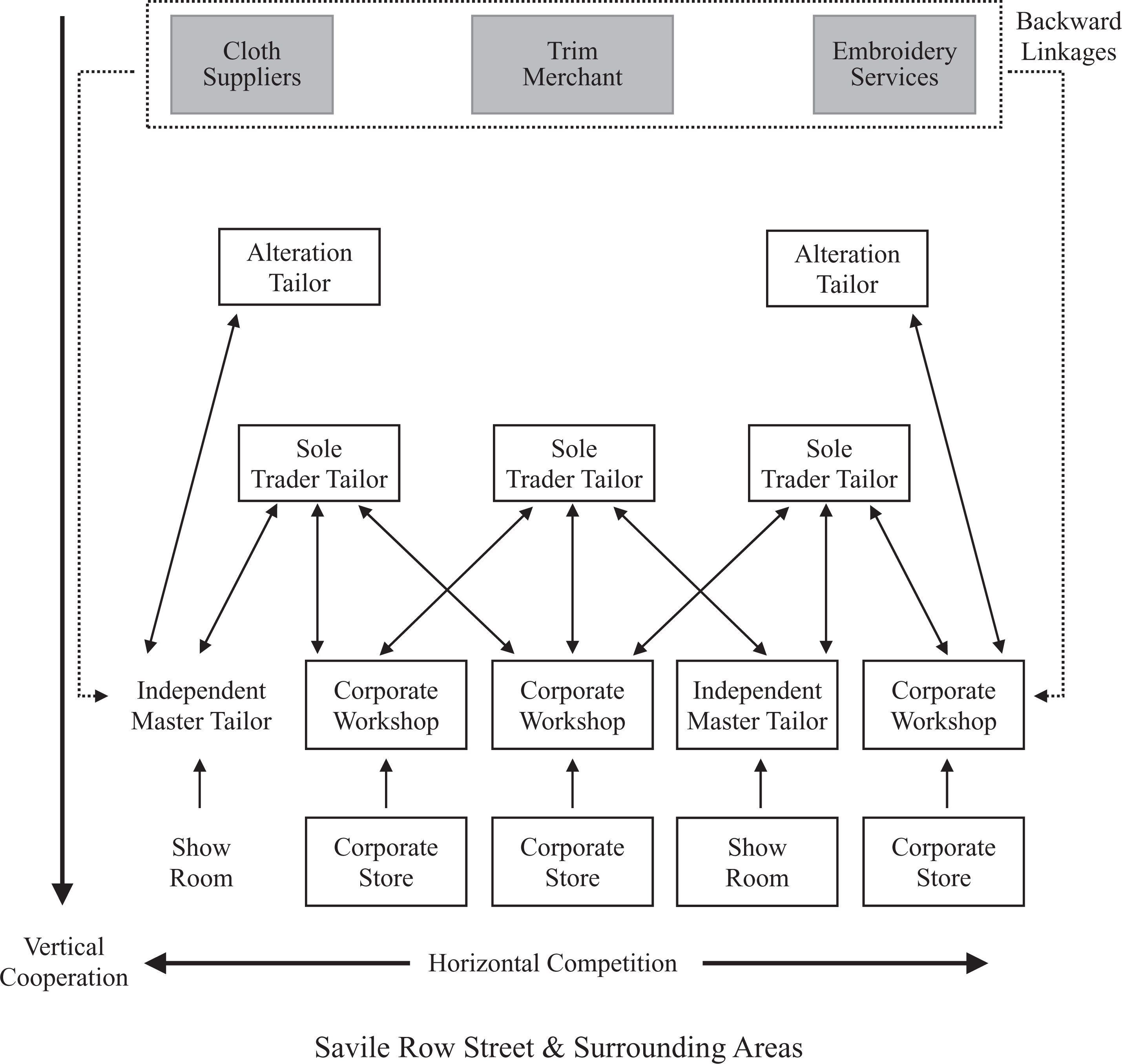
The mechanics of Savile Row’s production network.
The master tailor, either cooperate or independent, takes the measurements from the customer and relays this information to an apprentice who writes down the measurements in a specific order in a ledger. The master tailor, with the fabric consultant, discusses with a customer his or her choice of design features, cloth, linings, and buttons. The master tailor then cuts a paper pattern and passes it to a striker who cuts the cloth along the lines of the pattern.
The cut pieces are bundled up and handed over to a tailor (sole trader) who will assemble the whole suit by himself; in bigger tailoring establishments, each tailor specializes in a few different assembly operations. The perfect suit fit requires three or four fittings at different stages of the construction, and the whole process requires approximately 55 hr of manual labor to complete. The network is also connected to a number of backward linkages such as cloth merchants, who can supply cloth within 1 or 2 days as most tailors make use of British mills and trim merchants, who supply among other things threads, canvases, linings, and buttons. Corporate employees in embroidery and also embroidery sole traders provide services such as monogramming, regimental badges, and formal military uniforms. It must be noted that all the above supporting services are within walking distance of any tailoring workshop, either corporate or sole traders. Sometimes the master tailors employ a “runner” who will run all the errands like taking a jacket after fitting to an alteration tailor or buy trims.
Trust permeates the network. There are no formal contracts for any transactions, as master tailors and sole traders show great respect for each other’s work. They understand that they need each other and view their partnership as being of an equal standing.
Physical proximity and cooperation are crucial to all production stages in the network. There is a strong feeling of community among tailors, since a spirit of solidarity has been cultivated for decades in the area. This has also built a healthy local economy based on egalitarian principles and a strong collective understanding that financial rewards will be fairly distributed (Barton, 2011). All tailoring houses and independent master tailors compete on the commercial side of the business for customers; however, cooperation is also observed, since the overwhelming majority of sole trader tailors work simultaneously for two or three independent master tailors or tailoring houses. Master tailors may also send a customer to a fellow master tailor if they believe that a customer’s wishes do not fit with their particular style.
Finally, it must be noted that some of the tailoring establishments have extended their operations by incorporating specialized made-to-measure services and related accessories, have branched out to international markets by organizing trunk shows and opening stores, and also have started to advertise. As with any business, the scale of operations is a fundamental prerequisite for growth and survival. However, in a cottage industry like Savile Row, economies of scale are nearly nonexistent no matter how much the business grows its productivity, as human hands have a limited speed capacity (Foulkes, 2015). Therefore, branding and expansion to off-the-peg ranges and accessories are considered a wise growth strategy by the bigger tailoring firms (Mellery-Pratt, 2014). This connects to similar diversification strategies implemented in the past by famous French fashion houses such as Chanel and Hermès (Conti, 2010).
Discussion and Findings
The Co-Opetition Strategy in the Production Network
Resources in the net-chain configuration of tailors’ network lead to competitive advantage, which is also acknowledged by London’s local authorities since the area is protected under the council’s special policies. All tailors make use of the inherent resources in the area (Dyer & Singh, 1998). These include a pool of knowledgeable labor, from master tailors and tailors to alteration tailors, finishers, and the backward linkages of cloth merchants and trim suppliers. Interfirm collaborations seem to be the norm in the community as all members acknowledge that interdependences are vital for survival (Coe et al., 2008). These synergistic forces seem to generate specialized capabilities that in turn form core competences (Hamel & Prahalad, 1994). Core competences include all sorts of tailoring craft techniques applied in Savile Row, where each tailoring house and master tailor possess a unique style of cutting, while simultaneously corresponding to the London cut which is universally appreciated. All this specialized knowledge reinforces all tailoring firms and sole traders operating in the network, leading to a set of resources leading to the sources of competitive advantage (Barney, 1999).
In terms of production and consumption, the case study concurs with the literature which advocates that networks are relational (Coe et al., 2008). More specifically, the net-chain configuration of GPNs is shown in its horizontal and vertical dimensions. In the horizontal dimension, Savile Row is one of London’s special policy areas as the council safeguards Savile Row’s integrity because bespoke tailoring is considered a part of the capital’s creative industries. The central London location is instrumental to production as well as consumption of these highly specialized products and services. The vertical dimension of the net chain is represented in all commercial transactions among all tailoring operations in the area, which is relational as all tailors cooperate in the completion of orders.
An interesting characteristic of the network that was revealed through this study is that competition occurs on the retail side of tailoring houses and independent master tailors, while there is cooperation in all manufacturing operations. Competition is not aggressive but rather moderate because all tailoring businesses acknowledge that survival depends on the collective effort of all participants to grow the market, thus enhancing the reputation of the network. Simultaneously, cooperation prevails in all operations because tailoring houses and independent master tailors act as buyers to sole trader supplier tailors and cloth/trim merchants, as these operate on the supply side of the network.
This confirms the co-opetition business strategy (Brandenburger & Nalebuff, 1996), in which firms collaborate to develop the market and afterward compete. Rewards accrue from the fact that cooperating firms mutually agree to augment the market and capture more value, instead of competing individually in a smaller market. Co-opetition in this view reduces risks and costs because allies with different resources and capabilities share information and build new products/services. Thus, the motive is collaboration among competitors as this can improve products/services, in turn increasing opportunities for relational rents (Dyer & Singh, 1998; Ritala, 2012).
Ritala (2012) argues that co-opetition occurs in knowledge-intensive industries where there are considerable capital outflows for research and development, but is a less successful strategy among manufacturing firms, which are less knowledge intensive. However, the above contradicts this study, as in the less knowledge-intensive manufacturing network of Savile Row, co-opetition is a well-established practice within all tailoring firms, sole traders, and cloth and trim suppliers who have simultaneously cooperated and competed for decades.
Network theorists argue that power asymmetries exist in networks, as central controllers command critical resources because this helps them build a structured hierarchy around suppliers (Gereffi & Lee, 2012; Shih & Agrafiotis, 2015). However, Savile Row is a flatter, self-organized production network where all participant firms, including sole traders, coordinate all tailoring operations with minimal formal control. All actors acknowledge where they stand in the network and demonstrate respect for each other. Bigger establishments and reputable cutters coordinate workflows in the network but do not command resources by making “weaker” suppliers (sole trader tailors) docile. Moreover, there is no evidence in the Savile Row network that the weaker suppliers compete for resources or positioning, as everybody is treated equally (Coe et al., 2008).
The Network’s Principles That Lead to Competiveness
There are fundamental principles permeating the tailoring network. Trust and fairness are two of them. Tailors and master tailors not only respect each other’s work but also trust each other’s skills and capabilities to carry out production in a timely manner. Trust is demonstrated by the fact that formal contracts are redundant in these relationships. Moreover, fairness prevails in the network, as everybody acknowledges that financial benefits will be distributed accordingly; all participants know the prices that master tailors and tailoring houses charge their customers. This concurs with the literature that mutual commitments, social coherence, and dependencies strengthen the network (Lee & Cavusgil, 2006).
Slow production is another crucial principle that can be related to the eternal values of craft practices exercised by the tailors. The recent revival of craft practices around the world seems to apply to Savile Row because younger generations of discerning customers have discovered the “mystique” of a handmade suit. Moreover, Savile Row customers are not interested much in the vague notion of luxury as experienced in branded expensive clothing, which can be found in every upmarket high street worldwide. Instead, they look for unique features that differentiate the suit from the ordinary and also to experience the craft involved in the making of the garments. This new ethos toward craft consumption connects to the slow element in production, as hand tailoring is by nature a slow process (Fletcher, 2010). Customers engage in the design process as they express their desires to the master tailor. They are also involved in the production process by meeting with the tailors responsible for the making of their suits. Savile Row customers prefer to avoid the ephemeral nature of fashion, as for them, the inherent values of craftsmanship reside in superior quality. This fact connects to the timelessness element, as master tailors adopt neoclassical designs for their cutting and material selection because these do not easily date. Timelessness is synonymous with durability, as superior quality translates not only to materials and trims but also to cutting and hand-stitching techniques. The definition of craft expressed by Campbell (2005) is problematic, as in the Savile Row case, it is not the same person who designs and makes the garment but there is still a clear division among master tailors, tailors, and alteration tailors. It is the specialized knowledge available among participants in the network that gives Savile Row its unique characteristics. Moreover, all tailoring houses source materials from local cloth mills and trims from local merchants and manufacturers, thus helping to retain jobs in the supply chain and preserving a healthy local economy. This connects to the luxury strategy (Kapferer, 2012) that authentic luxury production should never relocate to cheaper locations because provenance is crucial for any true luxury item.
According to Knoben (2011), a network can provide firms with resources, which can lead to competitive advantage. Thus, the bigger tailoring houses in Savile Row employ a couple of apprentices per year, which means that they want to preserve traditional skills. Knowledge in this regard is transferable as it is not particularly an element of rivalry in the network. Moreover, locational advantage also corresponds to selective distribution, as Savile Row’s bespoke tailoring services are only provided by the tailors located in the street and surrounding areas and nowhere else in the world. Trunk shows and shops offering ready-to-wear clothing in other countries and cities reinforce the mystique of the houses and the street.
Lastly, the higher prices for suits charged by the tailors reflect all the abovementioned qualities and represent outstanding value. Customers acknowledge that superior craftsmanship does not come cheap, and this is also demonstrated by the fact that some customers save money in order to have a suit made in Savile Row.
Based on the discussion, the authors present a conceptual framework of a slow relational production network in the clothing industry where co-opetition combined with craft practices can lead to competitiveness. This is demonstrated in the Figure 2.
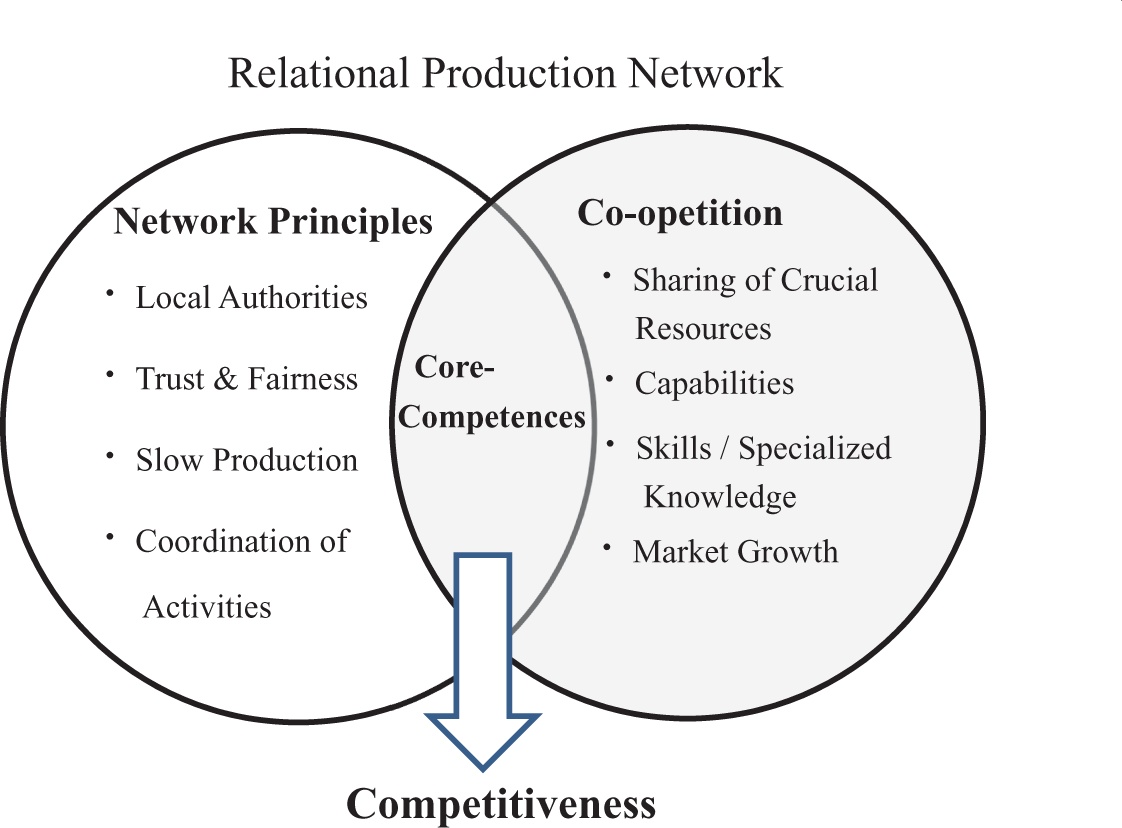
The conceptual framework of the relational production network of Savile Row.
Conclusions
The authors identify that within a slow production network, interdependences, co-opetition, trust, and fairness may lead all participant firms to achieve competitiveness.
The theoretical framework of the resource-based view, the relational view of the firm, and production networks explain how slow production in a self-organized, flatter network of clothing firms can be competitive. The core competencies, namely, capabilities, specialized knowledge, trust, fairness, and slow production craft practices, form the crucial competitive parameters in the production network. That is, superior craftsmanship situated in a specific area has developed through the progress of time into a unique tailoring style for two major reasons. It differentiates members of the network from competing substitutes as the tailors pool a set of resources in the area. Moreover, by attracting new apprentices who want to learn from some of the best practitioners in the world, the tailors’ network secures its longevity.
The authors recommend that a number of specialized clothing firms irrespective of size may wish to organize in a slow production network. Power asymmetries are largely redundant since all network members demonstrate deference for each other’s capabilities and specialized knowledge. Central controllers do exist, but their role extends to coordination without capturing vital resources, making weaker participants docile.
Therefore, slow localization economies do not rely on the relocation of production in search for lower costs. Instead, they remain in the locality and strive to make the specific region renowned for its products and services. This can benefit all members in the network, hence the inclusion by local authorities of Savile Row as part of London’s creative industries. It must be noted that the localization frame of mind should not be viewed through the lens of a pre-Industrial-Age utopia, as competition and cooperation happen simultaneously in the co-opetition business model.
Timelessness, outstanding quality, and durability as values crucial to the slow fashion mind-set are well represented in Savile Row operations. Despite the high prices for bespoke suits, the tailors directed their comments to the exorbitant prices charged for designer wear, which do not represent real value in terms of craftsmanship. It is also revealed in this study that the tailoring craft revival has attracted both local and mostly international customers to Savile Row, thus supporting the locality of the production network and reinforcing the idea that superior production methods should never relocate as they represent the “made in England” provenance of the garments.
The authors from an academic perspective propose a conceptual framework to demonstrate empirically that within the relational network of a localized economy, net-chain resources prevail in their vertical (commercial transactions) and also horizontal (the role of local authorities) configurations. Moreover, co-opetition administered in a healthy manner without firms aggressively competing for critical resources and positioning can positively impact growth in the local economy of Savile Row. Participants have made the street synonymous with an international luxury brand, and this in our view is the most critical resource, as all members through the development of crucial core competencies can reap significant benefits in the long term (see Figure 2).
Research limitations lie in the fact that there was reliance on a single case study in a very specific location and within a specific clothing market, namely, handmade menswear. This may limit the generality of the proposed conceptual framework of slow relational production networks. Nevertheless, to the authors’ best knowledge, European production networks can thrive by serving these market segments, as provenance and authenticity represent a “hard” currency especially in international markets. Future research can be directed toward other parts of the creative industries and in other localities and countries, in order to examine if the proposed framework can be a viable alternative in terms of slow production and competitiveness.
Footnotes
Acknowledgments
We thank all the participants from the Savile Row tailors who provided insights, knowledge, and expertise that greatly assisted this research.
Declaration of Conflicting Interests
The author(s) declared no potential conflicts of interest with respect to the research, authorship, and/or publication of this article.
Funding
The author(s) disclosed receipt of the following financial support for the research, authorship, and/or publication of this article: This research was partially supported by Hsuan Chunag University and the Ministry of Science and Technology in Taiwan.