




Abstract
Women’s support garments including corsets and brassieres have been intimately tied to health and a woman’s outward appearance. Manufacturers strongly urged stout women to wear corsets well into the 1930s when many women had already discontinued their use. Stout women often had different requirements in regard to comfort and fit for their clothing and support garments. Stout women were an important consumer group in the first half of the century (1891–1956), though little research has been conducted. The purpose of this study was to better understand, through patent research, the ways in which inventors sought to solve clothing ills for the stout woman. To explore this topic, a content analysis approach was utilized using patents found through Google Patents. Patents for stout women focused on supporting and improving the body through corsets, brassieres, menstrual products, support devices, and combinations of corset and brassieres.
Women wear support garments under their clothing to provide support and shape to the body. Rigid materials like steel and boning can add shape to otherwise flat parts of the body or cinch the body if it is deemed “too large” or unflattering. Historically, garments only looked “correct” if they were properly fitted to the undergarments and not to the body. Support garments provided the foundation to which the outfit was displayed and built upon. Without support garments, clothing in the 19th and first half of the 20th centuries would not fit the natural body. Support garments have included corsets, brassieres, combination of corsets and brassieres, and other devices such as garter belts and stomach cinchers. The researchers in the present study focused on utility patents for women’s support garments specifically designed for the stout woman. Support garments were especially important to stout women because their bodies did not fit into the ideal silhouette of the time period studied and thus provided both physical support and created the perception of a more slender body.
Stout women have represented a modest to substantial portion of the population within the 19th and 20th centuries, with potential discretionary income to spend on fashion goods (Keist, 2018). Businesses and manufacturers would miss out on increased profit by ignoring these women. By the mid-1910s, 12.7% of the total U.S. population was overweight; by the 1970s, over 30% of women had a body mass index over 30; and today, over 60% of women are considered overweight or obese (Cutler, Glaeser, & Shapiro, 2003; Keist & Marcketti, 2013; National Institute of Diabetes and Digestive and Kidney Diseases, 2018). This group has often faced personal and societal discrimination, as well as being marginalized by researchers who continue to focus on the slim ideal.
Stout women’s clothing emerged almost simultaneously with clothing intended for the “slender-” or “average”-sized women. With the beginnings of the ready-to-wear industry, manufacturers like Lane Bryant quickly saw the need for clothing that did not fit a standard or “perfectly” proportioned body (Keist, 2017). During the advent of the ready-to-wear industry, clothing sizes for women were organized primarily by bust size. A 38-in bust or larger was considered stout at this time; anything smaller was designed for the “slender” or “average” female consumer (Stearns, 1997). Lane Bryant sold clothing up to a 60-in bust. Albert Malsin, Lane Bryant’s husband and designer for the company, identified three basic body shapes for stout women: a “perfect proportioned” stout woman who grew at the same rate along the bust, waist, and hips; the flat-busted and large-hipped woman society would call a pear shape today; and the full-busted but normal-hipped woman society would call an apple shape (Keist, 2017).
In this article, the researchers utilized patents as their primary source material to explore how patentees created potential solutions to the problems of underclothing and support garments worn by stout women. By utilizing patents, the researchers gained a viewpoint different from what traditional sources such as popular press, fashion magazines, and newspapers would provide. Apparel designers and manufacturers have had tenuous success utilizing copyright, trademark, and trade dress laws to protect their products (Marcketti & Parsons, 2006). Patents have been a part of American history since nearly the birth of the nation. According to Abraham Lincoln, the American patent system added “the fuel of self-interest to the fire of genius” (Gotshal & Lief, 1945, p. 7). Inventors designed patents, once approved by the U.S. Patent and Trademark Office (USPTO), to exclude others from making, using, selling, or importing the invention for a term of 20 years from the date of issuance (Hoke, 2003).
Method
The researchers used Google Patents to access utility patents approved by the USPTO for stout women’s apparel and garments. It is important to single out products identified to aid the stout woman as opposed to looking at inventions for women in general. Stout women have different garment fit needs than women of average size; as such, inventors had an opportunity to provide innovative solutions to these challenges. Many of the utility patents were improvements on existing products and not new inventions. Google Patents is an extensive database of viewable and easily searchable patents, which aided in the feasibility of this study. As of the date of this publication, Google Patents currently has over 87 million patent publications (Google Patents, 2018). Although there are many benefits, one limitation of using Google Patents includes the potential of missing patents designed for a stout woman, which have yet to be uploaded. To confirm that the patents in Google Patents were representative of all patents issued, the researchers picked 15 patents from the print version of the Official Gazette—the official journal of the USPTO—and matched these to the Google Patents results.
The researchers used a content analysis approach to analyze utility patents targeted at stout women. Researchers use content analysis as a way to quantify patterns in sources. This method is useful when sources are plentiful (as in patents), the primary source is in the form of documents, and the researcher is looking for implicit meanings. One key factor of content analysis is that it lends itself to a systematic and objective approach (Paoletti, 1982). For coding purposes, the researcher “must choose whether to study words, paragraphs, themes, or other units into which communication can be divided” (Paoletti, 1982, p. 14). For this research project, the researchers recorded the title of the patent, author, date, type of patent, description, and stated improvement for each patent. The title of the patent given by the patent author proved the most helpful for coding purposes; if the author labeled it as a corset, the researchers coded it as a corset. When the title was not as transparent, such as “chafing shield” or “hose supporter,” the researchers created a sixth category of “support devices.” This category was a catchall for patents related to dressing but did not properly fit into the other categories as they supported the act of dressing.
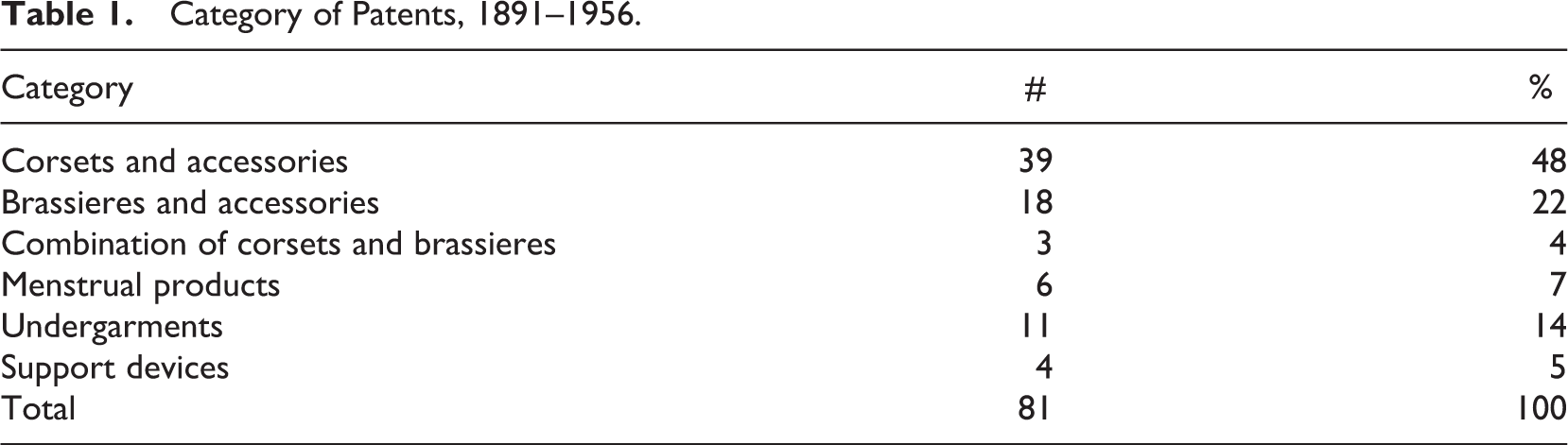
The six categories of inventions in the present study included corsets and accessories, brassieres and accessories, combination of corsets and brassieres, menstrual products, undergarments, and support devices (Table 1). Corsets and accessories included any type of support garment or attachment in which the purpose was to confine and support the bust, waist, and hips. Brassieres and accessories included any type of support garment or attachment in which the purpose was to confine and support the bust area only. Combination of corsets and brassieres included any garment in which a corset and brassiere was combined into one garment. Menstrual products included any product in which the purpose was to support bandages or protect the wearer from spotting on her outer garment. Undergarments were usually looser-fitting garments worn under the top layer of clothing but without the supporting characteristics of corsets and brassieres. Inventors defined support devices to include a variety of products in which the product accompanied a garment or aided in dressing but did not fit into the other categories. The placement of single items into group of categories is important to better understand what types of products the patentees invented, to identify common themes in inventions, and to better understand the problem and proposed solution of clothing design for stout women.
Category of Patents, 1891–1956.
The researchers focused on the time period from 1891 to 1956 to gain increased knowledge of the real and the perceived clothing-related challenges of this important consumer group. When searching for the term “stout woman,” 1891 was the first and 1956 the last appearance of this phrase in the patents available through Google Patents at the time of data collection. The term “stout” was the most commonly used phrase for plus-sized women during this period, and it was the only term used for systematic searching, allowing for consistency in the data collection process (Keist & Marcketti, 2013). Terms for women larger than “average” or “slender” styles are numerous, and there is no common term during any decade. For example, the word “stout” fell out of favor in the 1930s and was replaced by terms such as “women’s,” “full figure,” and “plus-size” (Lane Bryant, 1930). “Plus-size” would not be the preferred term until the 1980s (Google Ngram Viewer, 2018).
The researchers identified 81 patents specially targeted to stout women; the majority of patentees were women (i.e., 52 of 81 or 64%). Women inventors, especially if stout themselves, would have had a better understanding of the problems faced by stout women than thin women or men would. Nine of the 81 patentees stated representation by a company. These nine included: A. J. Lecoutre, who designed for the Royal Worcester Corset Company; Thomas Bowers, who designed for the Gilbert Manufacturing Company; Alfred Abt, who designed his corset for Warner Brothers Company (also known as Warnaco); Ellen Decker and Arthur Scott, who designed for Julius Kayser & Company; Isidor Roth, who designed his brassiere for the Benjamin & Jones Company (also known as Bien Jolie); Clayton Whitney, who designed his corset for the Royal Worcester Corset Company; August Jurgensen, who designed for the International Cellucotton Products Company; Edward Sutter, who designed for Beau-T-Form Foundations, Inc.; and Morris Scheinberg, who designed for Sturm & Scheinberg, Inc. The Royal Worcester Company and Warnaco were large and influential companies. Stout corsets made by these companies could have increased sales by catering to the stout woman’s unique fitting needs. It is not clear if the remaining 72 patentees were affiliated with companies. For example, Mary Phelps Jacobs patented, manufactured, and sold her “backless brassiere” to friends and neighbors. The brassiere design was later sold and designed by the Warner Brothers Corset Company (Macdonald, 1992).
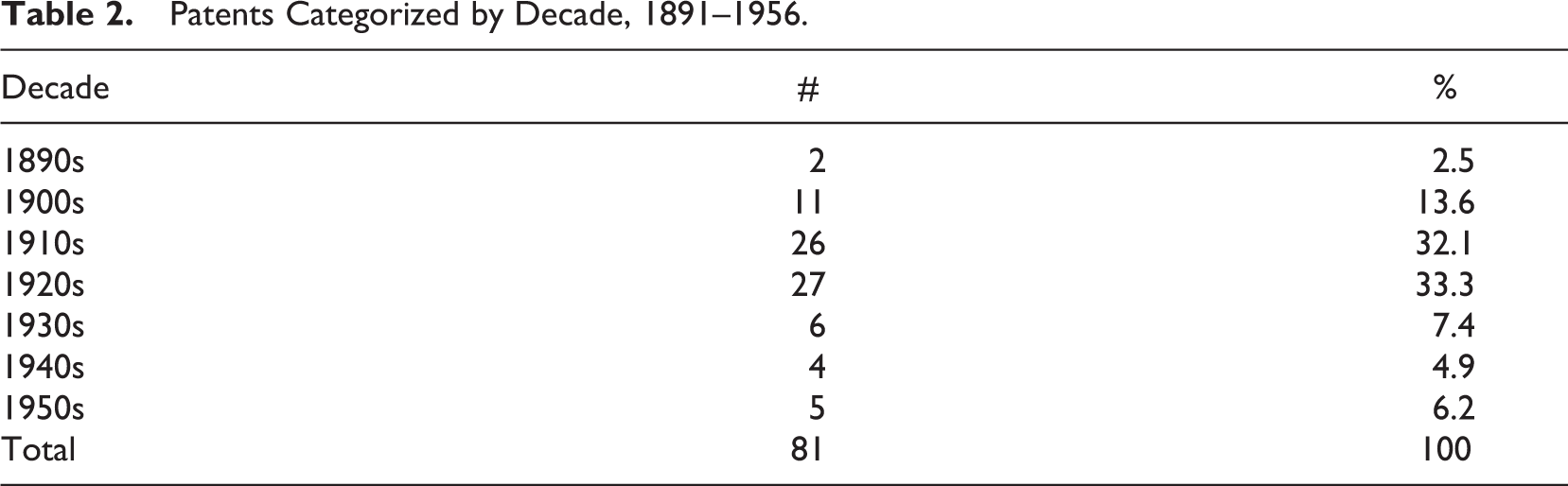
The majority of patents were awarded in the 1910s and 1920s, or 65% of the total number of issued patents (Table 2). The increase in patents during this time was most likely related to the fashion change from more mature to slender. During the 1890s, the hourglass silhouette (with its narrow waist) was popular, while during the Edwardian period, the S-bend (with its distorting mono-bosom) was considered fashionable; these styles may have been more accommodating to the plus-sized woman. During the 1910s and 1920s, slim styles with a straight-cut and tubular silhouette were preferred. By the 1930s, the youthful look of the 1920s had disappeared as an increasingly curvilinear look was favored. The late 1940s to 1950s had a greater diversity of styles, including sportswear, shirtwaist dresses, and suits, which allowed for more leeway in pressures to conform the flesh to a slim ideal. It is to be noted that Christian Dior’s New Look of 1947 reintroduced the narrow waist, which required women of all shapes and sizes to don girdles to control waistlines.
Patents Categorized by Decade, 1891–1956.
Results and Discussion
Patented Garments
Corsets and accessories
The majority of undergarments patented for stout women from 1891 to 1956 fit into the corset and accessories categories. 1 For over 400 years, inventors designed corsets to provide shape, structure, and support to the body (and to outer garments), serving as orthopedic devices and more recently for fashionable dress (Tortora & Marcketti, 2015). It is no surprise that many of the patentees tried to improve this garment when it was intended to do so much to the wearer’s body. Manufacturers, patentees, and advice columnists all strongly encouraged, if not demanded, that stout women wear a corset at all times. This advice contradicted advice for slender women, as most abandoned the corset by the 1920s for brassieres and girdles. The purpose of the girdle was not to slim the figure but to keep the smooth line of an already slender figure (Keist, 2018).
Corsets differed from girdles in that they had boning and rigid steel and attempted to mold the body to a smaller size and appropriate silhouette desired for the time period studied in this paper. Edith Gardner in Good Housekeeping reported that stout women had difficulty corseting themselves properly around their busts, diaphragms, and hips, depending on which part of the figure was emphasized at the time (Gardner, 1924). Patentees saw this difficulty and tried to remedy the problems through their corset designs. All of the inventors of corsets stated their inventions were unique from other products available in the marketplace in that they were designed to provide support; create the illusion of slimness; be comfortable, simple in construction, and easy to put on and take off; and not “ride up” the wearer’s body when sitting or stooping for the stout woman’s distinct body shape (Benjamin, 1924; Harris, 1910; Hensley, 1912; Scott, 1942).
Inventors of corsets patented for the stout woman’s form during 1891–1956 promised to create an illusion of slimness for the wearer (Benjamin, 1924; Bodensiek, 1909b; D. Kops, 1906, 1921b; Spanel, 1944). Already by the first part of the 20th century and into later decades, women strived for a slender silhouette in order to be fashionable. Companies such as Lane Bryant and others advertised the slenderizing effects of their garments and urged their customers to appear slender (Keist & Marcketti, 2013). Corsets aided the appearance of slimness and were viewed as a must for the stout. Patented corset designs in the 1900s and early 1910s tried to produce the flat-fronted style popular with empire-waisted garments. The empire style created a tubular silhouette, which emphasized long, lean lines that looked best smooth and unbroken. However, a stout body and this silhouette are incongruent. Patentees attempted to create corsets and attachments to smooth out the natural (and fashionably unattractive) curves of the stout body (Bodensiek, 1909b; Kops, 1906). For example, the “Abdominal Adjuster, Reducer, Supporter, and Retainer,” patented in 1910, “simply” attached to the bottom of an existing corset to cover a stout woman’s lower stomach not normally covered by popular corset styles at the time. This invention attempted to cover and blend excess fat from distorting the smooth, long, and lean lines of empire-waisted dresses deemed fashionable at the time. According to the inventor, it fits “perfectly and acts similar to a person holding the abdomen with both hands to adjust it to its proper position” (Harris, 1910, p. 3). Excess fat does not magically disappear when covered, and one can only imagine the discomfort and trouble this device would create when the wearer was seated. This need to produce a smooth line that is not only a historical problem. Spanx, Inc., founded in 2000, sells millions of dollars of foundation garments intended to smooth the silhouette and slim the figure (Spanx, 2018).
Patent authors noticed that many of the “average” size corsets did not fit stout women’s bodies properly; when such corsets were worn, stout women’s extra flesh and fat would spill over and under the corset, causing unsightly ridging above and below the corset line (Brundidge, 1926; Dubner, 1938; Hensley, 1912; Kops, 1921a). This phenomenon is natural when wearing a corset, and the tighter the lacing, the more the flesh and fat is displaced. This creates unattractive bulges and deforms the shape of the body. Another solution to this problem was not a new corset design, but rather making sure the corset was properly worn, was the correct size and style for the figure, and that the woman’s posture was correct. Miss White, President of the Dressmakers’ Protective Association, stated that the problem was not the corset, but how women were wearing them. She suggested that a woman who weighed 300 to 400 pounds would look slimmer only if properly corseted and dressed without the aid of additional corset modifications or devices. Her advice was that to look good while corseted, all women needed to re-lace their corsets every day and not fall victim to laziness (“How to Put on Corsets,” 1903).
As the wearer sat or moved throughout the day, corsets would often ride up on the body, becoming displaced and no longer providing the desired shape. Inventors of corset patents worked to alleviate this problem with added fabric panels at the top or bottom of the corset or through extra straps or stays that would provide additional support. These added panels and fabric would cover the additional flesh and try to keep the corset in place. To illustrate, Alverda Hensely created a corset attachment in 1912 that included a semicircular piece of fabric attached to the front top of the corset to reduce and support the bust, as well as prevent “the unsightly and embarrassing projection…beyond the upper edge of the corset” (Hensley, 1912, p. 2). As corsets constrict the middle of the body, the excess flesh is often pushed up toward the arms, creating an unnatural bulge. Kops (1921a) drafted his corset to cover and suppress this bulge but then did not state where the bulge would move next. Benjamin (1924) included straps at the shoulders to prevent rolls of flesh from bulging out of the top with her corset.
In addition to the general displacement of an incorrectly fitting corset displacing flesh and fat, corsets shifted out of place when a stout woman sat down. For instance, a stout woman’s extra weight around her hips and buttocks area would displace the corset and force it upward (Harris, 1910; Kops, 1912a; Kops, 1912b; Shultz, 1924). This problem would be hard to correct unless an author designed a corset to buckle or snap under the crotch to hold it in place. None of the corset patents the present researchers observed includes this additional piece, and so it is unknown if designing a piece to hold the corset in place would be a successful solution to this problem. Heinzen designed an athletic corset in 1922 to allow for freedom of movement when a woman bent over, was seated, walked, danced, skated, or played tennis. Based on the patent illustrations, the side bust closure, front and back boning, and side lacing would prove to be uncomfortable and still make it difficult to move “athletically” (Heinzen, 1922).
Some corsets were designed to give the illusion of weight loss (and often stated actual weight loss) through cinching in of the flesh or through gentle compression. Several inventors stated that stout women needed only to wear their newly designed corset and not change or modify their diet or add exercise for actual weight loss (Howell, 1917; Roussin, 1920). Amber Benjamin’s corset design, issued in 1924, applied pressure upon the areas of the body with extra fat tissue, including the bust and under the arm. Benjamin (1924) stated that “an object is to provide a means whereby reduction of adipose tissue may be affected by applying a gentle and not uncomfortable pressure upon the parts where such tissue has accumulated and is likely to accumulate,” rendering the excess fat obsolete (p. 3). These claims would be appealing to stout women, as encouraged weight loss was prevalent in fashion magazines. Magazines like Vogue endorsed weight loss to fit in fashionable dress instead of promoting stoutwear retailers or featuring stout styles in their editorials (Keist, 2018).
D. Kops’s (1910) apparel corset of 1910 had a “holding-in function” that reduced the figure by preventing any “abnormal abdominal prominence” (Figure 1). A search of The New York Times yielded a Kops Brothers Manufacturers Company advertisement from 1911 that featured similar, yet not identical, corset designs. The advertised Kops Brothers’ “Nemo” brand corset featured a similar triangular design on the front of the corset and extra panels that wrapped around the woman’s abdomen to create a “holding-in function” for a flat-front effect (“Epoch-making invention,” 1911). Within the advertisement, the Kops Brothers Manufacturers extolled the virtues of their invention, “Lastikops Webbing,” and urged dealers to “not palm off a ‘just as good’ corset for the sake of making a larger profit” (p. 73). In this corset advertisement, Kops Brothers Manufacturers stated that the corset was trademarked but did not mention if it was patented. Further investigation did not yield any patents for the special webbing or Nemo corsets specifically, but in 1922 Kops filed a patent that related to previous Nemo Marvelace corsets already on file in the early 1920s (Kops, 1922). Shortly before Daniel Kops’s death in 1923, his son Waldemar filed a patent for a brassiere as assignor to Nemo Circlet Company (W. Kops, 1925; “Obituary,” 1923). In 1912, D. Kops (1912a, 1912b) patented a corset that provided a self-reducing benefit with the additional plus of remolding, confining, and reducing the upper portion of the thigh.
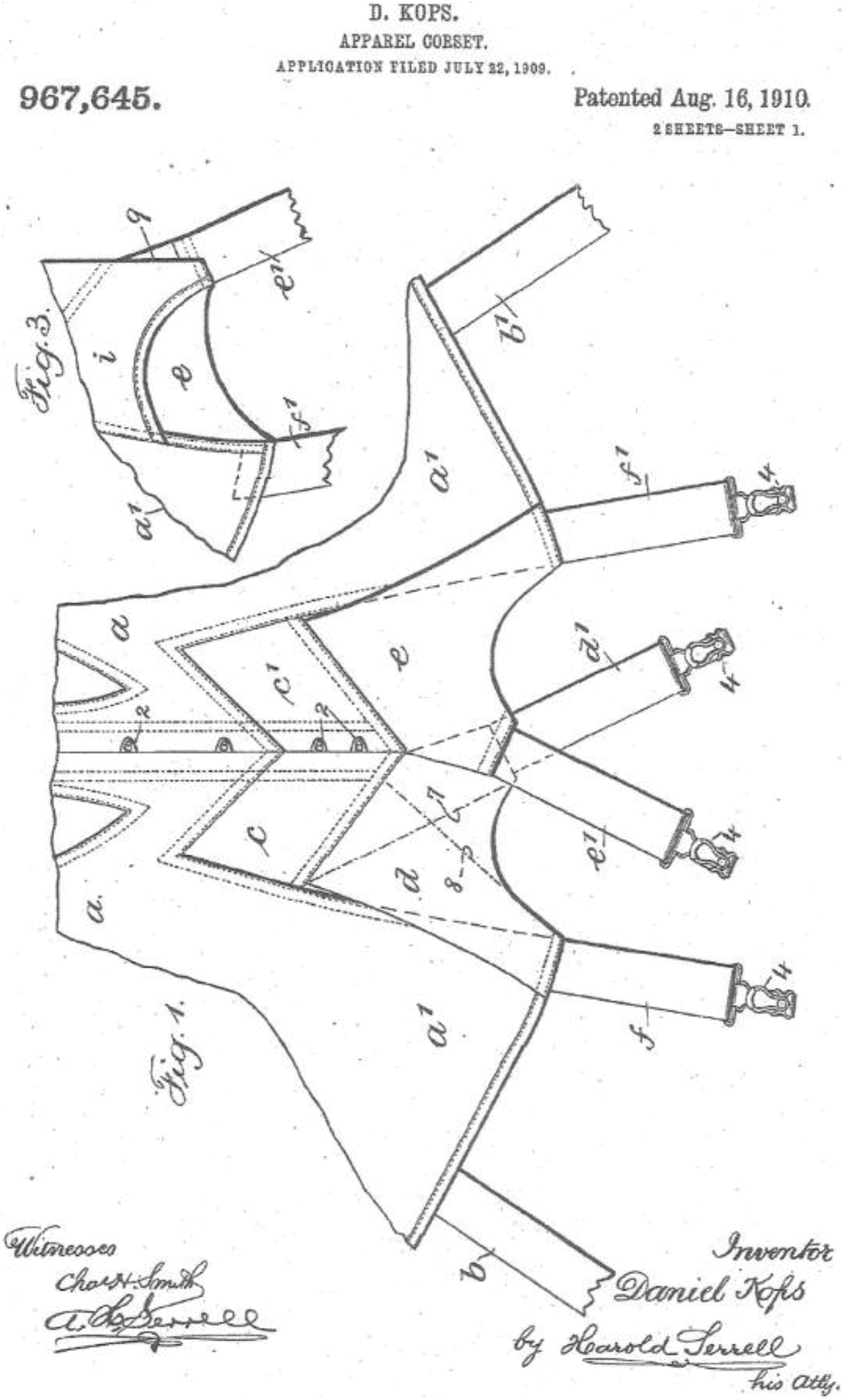
Patent for an “apparel corset” specially designed for the plus-sized woman with godets for extra movement. D. Kops, Patent No. 967,645, 1910.
One can imagine that a corset might not be the most comfortable of undergarments, but comfort was a stated benefit of the corsets patented (Abt, 1915; Brundidge, 1926; Harmon, 1891; Pickens, 1937). Corsets could be uncomfortable because perspiration would cause chafing and irritation. One corset designer stated that his new corset supported and reduced the abdomen and also eliminated any discomfort “such as the torture of scalding in summer and chafing in winter” by absorbing perspiration or “other moisture cast off by the wearer” (Howell, 1917, p. 3). Waunetta Pickens designed a corset stay and corset closure in the 1930s, which were designed to attach to a woman’s existing corset and provide more comfortable fit and more ease of movement for the stout woman (Pickens, 1937). Based on corset designs of the time, many authors realized that wearing a corset for stout women had its issues. They wanted to help the stout woman, but based on these designs, these corsets might “fix” one problem area only to create a different issue somewhere else on the body.
Even into the 1940s, when most women abandoned corsets, at least one inventor saw the need for improvements on this device for stout women. Scott (1942) patented a corset designed to produce a smooth silhouette by providing a front double closure to securely hold extra flesh in place. The inventors of all of these new corset designs promised the excess flesh and bulging would be eliminated, but none stated what to do when the excess flesh appeared elsewhere. However, these inventors only moved the “problem” to somewhere else and didn’t account for this shifting excess bulge.
Brassieres and accessories
Brassieres and accessories were the second-most patented undergarment for stout women. Bust supporters (patented as early as 1863) provide support for women’s breasts and back (Farrell-Beck, Poresky, Paff, & Moon, 1998). Designed for different purposes, brassieres can restrict the breasts’ movement during physical activity, enhance the breasts’ size and shape, facilitate nursing of infants, or support prosthetics after breast removal due to surgery. Brassiere inventions were stated to be cool to the wearer, comfortable, and easy to take on and off (Alberts, 1938; Anderson, 1956; Oppenheimer, 1920; Panes, 1921). Anderson’s (1956) improvement on brassiere straps aided the stout woman who “experience[d] considerable discomfort due to the tension in the straps as they pass over the high point or ridge of the wearer’s shoulder” by adding a wider strap with more cushion (p. 2). This wider strap increased the surface area of the strap, which would redistribute the pressure needed to fully support the bust (Anderson, 1956). This design feature is still used in the plus-sized bra industry to add comfort and support.
Patented brassiere designs in the early 1900s through the 1930s attempted to conceal extra rolls of flesh and reduce the bust. In the 1920s, flatter chests, waists, and hips in women were considered ideal and more fashionable; therefore, creating restrictions in brassieres to adhere to the societal preference of smaller bust lines deemed necessary in this fashion age (Bodensiek, 1909a; Clark, 1916; Cornell, 1907; Feldman, 1913; Moore, 1936). Mary Clark developed a bust-confining and -reducing garment that covered and confined the superfluous fat that hung over the stout woman’s corset. It was important to her that the extra fat was covered when a thin blouse was worn and that it would be an improvement to the figure (Clark, 1916). Moore (1936) claimed great results from use of her brassiere design, such as the reduction in bust size appearance. Specifically, Moore designed this brassiere to restore sagging busts to their original youthfulness, firmness, and resiliency (Figure 2). By removing the weight and pressure of large, sagging busts from the diaphragm, and drawing the breasts apart and backward toward the armpit, Moore was able to promote deeper breathing and prevent irritation from chafing, rubbing, and similar causes.
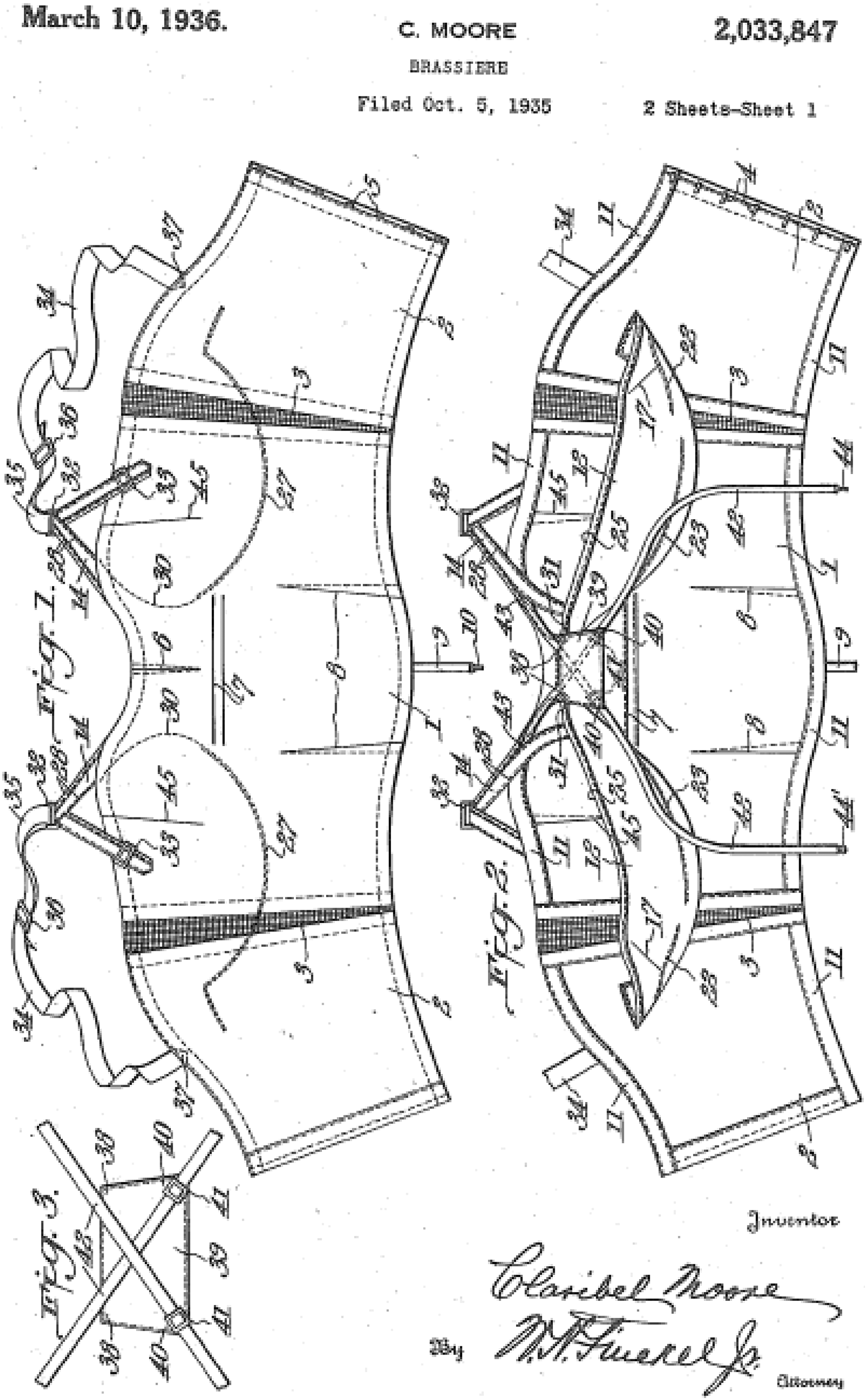
Patent for a “brassiere” for the plus-sized woman, with many stated benefits. C. Moore, Patent No. 2,033,847, 1936.
Miller (1920) stated in 1920 that “one of the defects of ordinary garments of this class is that they tend to ride up from the waistline, not only causing discomfort, but robbing them of their function of supporting the figure” (p. 2). Miller created her invention to not only support the figure but also permit ease of movement and freedom of the body and arms. Miller also designed her brassiere to prevent the garment from riding up during movement and exercise. Godchaux (1922) suggested other brassieres forced the bust out of a natural position, which would make the wearer uncomfortable. She stressed with her invention that the stout woman could wear any style of dress including low-neck dresses and evening dresses.
Similar to corset improvements, inventors crafted brassieres to prevent excess flesh from bulging out of the top or the bottom of the brassiere’s edge. Isidor Roth stated that his brassiere design did not move out of proper placement when the wearer bent over. Roth (1922) designed his brassiere to support the wearer’s diaphragm, which tended to bulge unattractively “outwardly over the top edge of the modern low bust corsets” (p. 3). Roth worked for the Benjamin & Jones Company in New Jersey. They sold the Bien Jolie brassiere, which was mass produced in high quantity and fixed sizes. They sold their products through catalogs, corset departments, and specialty stores, usually to an older clientele. Roth’s construction was intended to provide an unwrinkled and smooth line to the outer garment for an attractive appearance. Smith (1922) designed an adjustable bust-confining garment that prevented excess shoulder flesh from protruding over the back of the corset while still firmly holding the bust. Zwiebelson’s (1924) brassiere design “constitute[d] an appliance for promoting the proper distribution of the fat roll of the upper abdomen and which tends to further distribute the same below the breast and flare of the ribs” (p. 2). The design also stayed in place with movement and allowed for comfortable breathing. Support for large chests, common on stout women, is a necessity to ease back pain and be more comfortable.
Menstrual products
The menstrual products patented from 1891 to 1956 often included elements specific to stout women’s clothing dilemmas. For instance, menstrual products included an antichafing and menstrual garment, along with a garment protector (Dudley, 1918; Jurgensen, 1936; McPherson & Grundy, 1912; Sutter, 1951; Tacon, 1918; Whitlock, 1925). Authors invented products to prevent menstrual leakage, protect a woman’s garments during her menstrual cycle, and prevent chafing on the inner thigh area. Stout women’s large legs produced friction while walking, often causing painful sores and chafing.
The anti-chafing and menstrual garment (McPherson & Grundy, 1912) was a pair of drawers with an attached shield that prevented staining and chafing. The combining garment protector was waterproof and designed to prevent the skirt from clinging to a woman’s backside, preventing undue embarrassment (Tacon, 1918). Dudley (1918) and Jurgensen (1936) invented menstrual products to prevent leakage and be discreet enough to not be noticed. These characteristics were of the utmost importance. These inventions were designed in a time before Always and Kotex created maxi pads with plastic backings and wings to control and maintain menstrual blood. Always once offered pads for women who wore size “14+” and currently has a size chart to determine correct pad size. Always suggests only two of the five sizes for plus-sized women (Always, 2019).
Undergarments
Undergarments were placed in a different category from corsets and brassieres in that they were soft in nature and not worn to constrict the body (Decker & Scott, 1918; Geldowsky, 1892; Kelly, 1923; Shelton, 1950; Wheeler, 1907). Similar to corsets and brassieres, undergarments were considered to be comfortable and produce a tidy appearance. A larger body needed extra room in undergarments for freedom and ease of movement. The improvement in stockings was another undergarment design that led to enhancements in the stout woman’s appearance. With shortened skirts and more leg exposure in the 1920s, stout women complained that their large legs and ankles were “ungainly” in appearance (Wolff, 1929). The inventors designed an optical illusion “whereby the wearer’s leg slenderized” to “conform more nearly to a generally accepted standard of leg beauty” (Wolff, 1929, p. 2). Wolff’s intention was to create an optical illusion to slenderize the leg. A similar product was manufactured and sold by the Kayser Company five years before Wolff’s patented stockings (“Wear, Wear, Wear,” 1924). Wolff (1929) stated in his patent that he was “aware no attempt has heretofore been made of according such treatment to a stocking as will have the effect of slenderizing the appearance of the leg upon which it is worn” (p. 2). No reports of a lawsuit could be found.
Support devices
The researchers considered four anomalous patents without easily identified categories. This resulted in a catchall category of “support devices.” This included a stand-alone chafing shield, hose supporter, detachable shield for foundation garments, and shoulder hose supporter. These devices attempted to aid the dressing of stout women but did not make an overall contribution. Blanche Hall invented chafing shields in 1910, which proved to be comical (Figure 3). Hall’s chafing shield was a leather harness that wrapped around a woman’s waist and upper thighs. The leather straps contained six pockets with talcum powder. When the woman walked, the movement would distribute the powder to the interior portions of the thighs to prevent chafing. Hall (1910) claimed that the chafing shields were efficient to use, durable, easy to wear, and of simple construction. The patent, however, did not mention what happened to the excess powder that fell out of the bottom of the skirt while the woman walked.
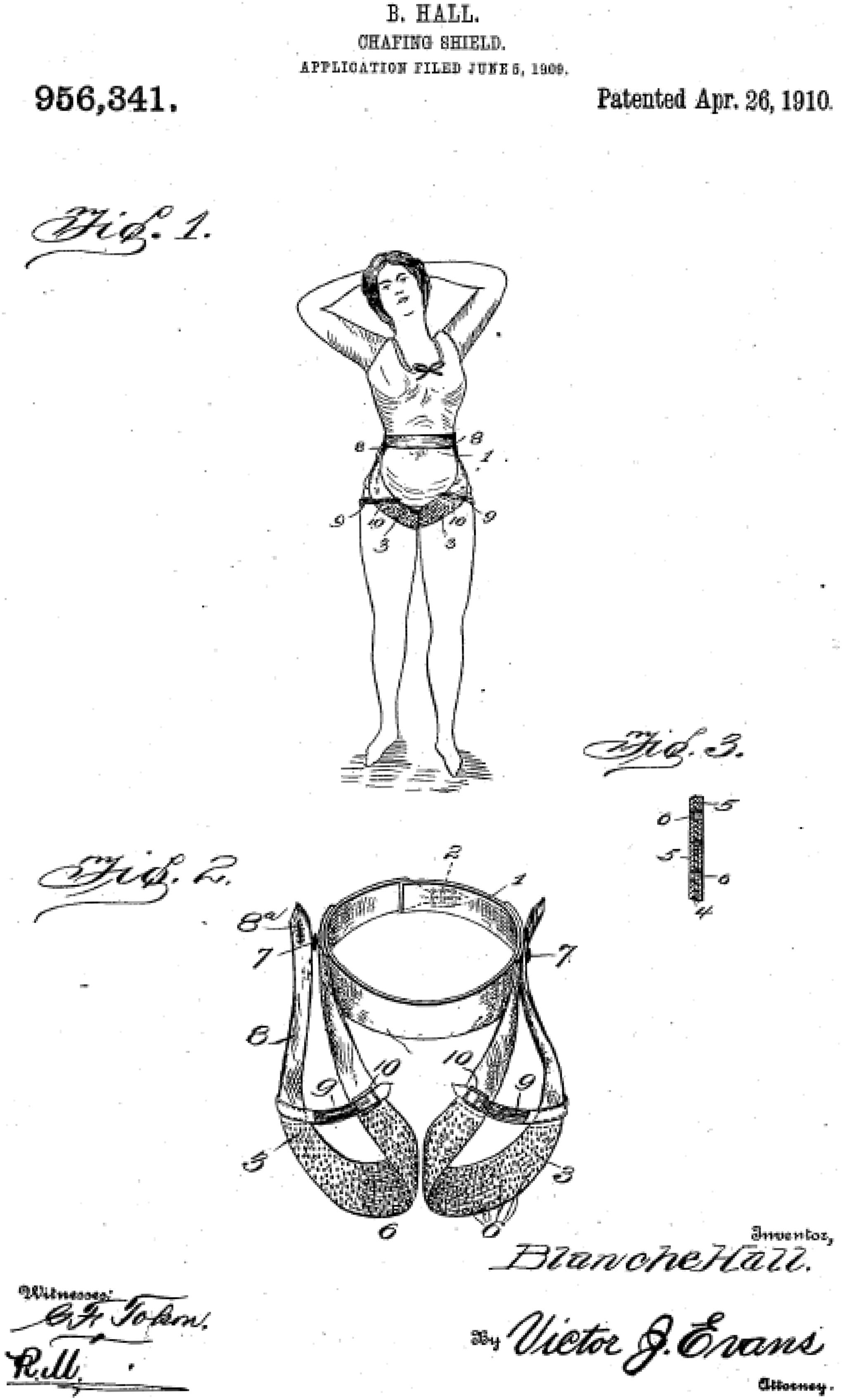
Patent for “chafing shields” to prevent chafing between the legs for the plus-sized woman. B. Hall, Patent no. 956,341, 1910.
Conclusions
Patents provide a historical viewpoint that the popular and fashion press do not. Products designed and patented from 1891 to 1956 were created to (theoretically, at least) improve upon the stout woman’s life. Both men and women patented corsets, brassieres, menstrual products, undergarments, support devices, and combination of corsets and brassieres. While fitting into the slim ideal was the norm of the patents, they were also designed to provide solutions to functional problems, including ill fit and discomfort. The lack of research and the lack of fashionable clothing for stout women both historically and contemporarily speak volumes in terms of society’s views on the attractiveness of the fat body. Without suitable ready-to-wear clothing, the patentees sought solutions to the problems of plus-size clientele in categories including corsets and accessories, brassieres and accessories, combination of corsets and brassieres, menstrual products, undergarments, and support devices. While we have expanded the literature exploring clothing designed for the plus-size consumer, there is great need to expand this research to include different periods, cultures, and perspectives. For example, studying different decades in American history, as well as different geographical locations, would expand our understanding of the needs of the plus-size consumer. Additionally, we focused on the female plus-size consumer. Plus-size males, as well as plus-size transgender individuals, warrant additional research into their clothing needs. Future researchers could explore differences between the inventions for the plus-size market and similar support garment patents for the “average”-sized women to better understand similarities and differences in fit, construction, and comfort needs. Researchers could also explore if patented products were actually created to know if these garments were indeed marketed and sold. A limitation to this study is that by the 1930s, the term “stout” was falling out of favor and replaced by other terminology. By including additional search terms, more patents might have appeared for analysis in this study. Additionally, this research focused on patents and patentees in the United States.
Footnotes
Declaration of Conflicting Interests
The author(s) declared no potential conflicts of interest with respect to the research, authorship, and/or publication of this article.
Funding
The author(s) received no financial support for the research, authorship, and/or publication of this article.