




Abstract
Close to 30% of garments bought online are returned, often due to issues of fit. These issues often relate to size selection, which is challenging without physically trying on a garment. Alternative methods need to be explored to select the best size in lieu of physically trying apparel on. To address this issue, we compare the size selections based on primary measurements and size charts, virtual garments, and real garments. A cross-sectional quantitative survey was carried out in an experimental setting. The participants (36, predominantly White females, aged 21–56) made size selections and evaluations based on virtual and real blouses and trousers. Selecting the size based on virtual garments is more accurate than size selection based on primary measurements and size charts, scoring 57% and 42%, respectively. Further research should be used to improve the virtual fitting room, with benefits such as fewer returns and more satisfied customers.
To ensure the selection of the best fitting size, customers feel that they have to physically try on many sizes (Daanen & Ter Haar, 2013; Kasambala, Kempen, & Pandarum, 2016). This poses a problem when it comes to Internet shopping, where physically trying on the desired garments is not possible (Daanen & Ter Haar, 2013; Kim & LaBat, 2013a). Close to 30% of the garment purchases made online are returned (Dennis, 2018; Interactive Media in Retail Group, 2014; Textiles Intelligence, 2018). Reasons for the returns are often fit- and size-related (Interactive Media in Retail Group, 2014; Textiles Intelligence, 2018) and may stem from the challenge of communicating specific fit information accurately to customers (Kartsounis, Magnenat-Thalmann, & Rodrian, 2003).
The most traditional way to select a size, without trying a garment on, is to use vertical and girth body measurements (Winks, 1997); these body measurements are compared to a size chart provided by the apparel retailer. Customers do not believe that such measurements correspond to size marking, however, nor do they believe that the recommended size will fit them (Kasambala et al., 2016). This might be one reason for the large return rate for garments. Alternative methods of size selection (without physically trying clothes on) are therefore needed; one such method may be virtual try-on of clothing through the use of a simulated, three-dimensional avatar.
Companies can use virtual garments to market physical garments to customers and to help achieve a better fit during the product development process. Researchers and fit experts have started to explore the fidelity of the virtual garment (Lee & Park, 2017; Song & Ashdown, 2015). Kim and LaBat (2013b) compared the evaluation of virtual and real garments involving test persons. Researchers using virtual garments in their studies have reported contradictory results. They thus noted the need for further software development and more research in relation to virtual garments, such as how to communicate the effect and amount of garment ease (Ancutiene, 2014), and the interaction between the garment and the avatar (Volino, Cordier, & Magnenat-Thalmann, 2005).
The purpose of this study was to answer the call for further research and thus to explore the use of virtual garments with a focus on size selection and fit evaluation based on both virtual and physical garments. The virtual garments were visualized in two formats, solid and transparent; the latter helps in visualizing the amount of ease in the garment and its relationship to the avatar. The long-term goal to which this study contributes is the realization of more reliable tools and methods for the selection of size, in lieu of physically trying on a garment. This should benefit Internet shoppers, brands, and the environment by fewer returns and more satisfied customers.
Literature Review
Individual Preference of Garment Fit
The comfort of a garment is important to customers, and perceptions of comfort are individual and may vary (Goldman, 2005), which makes it difficult to study and quantify (Slater, 1986). Fit is one of the many factors affecting the comfort of a garment. Garment fit is influenced by fashion, social, and cultural norms (Petrova & Ashdown, 2012), as well as by individual preferences (Alexander, Connell, & Presley, 2005; Ashdown & O’Connell, 2006; Bye, LaBat, & Delong, 2006; Kohn & Ashdown, 1998). Garment fit is defined as the balance between the garment and the silhouette of the body (Ashdown & O’Connell, 2006; Brown & Rice, 2014; Erwin, 1974; Song & Ashdown, 2010).
The difference between the body and the garment is quantified as the garment’s ease. There are two types of ease: functional or fit ease, which is related to the movement of the body and aesthetic or style ease, which is connected to the design of the garment (Ashdown & DeLong, 1995; Beazley, 1999). This combination of functional and aesthetic ease contributes to an appropriate fit; the amount of ease relates to individual preferences (Ancutiene, 2014; Ashdown & DeLong, 1995; DeLong, Ashdown, Butterfield, & Turnbladh, 1993; Lin & Wang, 2016). Given that ease and fit are related to individual preferences, the aim in the current study was to include this individual element when asking wearers to make their size selection and fit evaluation based on virtual and real garments.
Selection of Size
A sizing system is one way for a brand to communicate garment size to the consumer. The system should be consistent (LaBat, 2007) and indicate which size fits the consumer well (Ashdown & O’Connell, 2006). The traditional means of size selection uses vertical and girth body dimensions (Winks, 1997). Usually, the primary body measurements used are bust and hip girth for women and chest and waist girth for men (International Organization for Standards, 2017); however, researchers have indicated that customers do not think measurements correspond to specific indicated sizes nor do they trust that a size will accurately fit them (Kasambala et al., 2016). Gribbin (2014) noted that the measurements for a particular size vary between brands. This variation can stem from so-called vanity sizes, where a brand decreases their size marking but retains the volume of the garment (Gribbin, 2014), giving the customer the satisfaction of fitting into a smaller size (Alexander et al., 2005); however, inconsistent size systems make it difficult for customers to find their size.
Brands can use algorithms and databases to recommend an appropriate size. They ask for the customer’s self-reported measurements and data as input (Daanen & Byvoet, 2011; Gribbin, 2014). Software application companies provide brands with plug-ins for customer size recommendations, such as Fitizzy.com, Fitanalytics.com, and Virtusize.com. Other solutions include visual features that make it possible to view a body approximation of the customer trying on different sizes, such as Metail.com, Trimirror.com, and Benefitbyclo.com.
Researchers have tested whether it is possible for customers to select the best fitting size on the basis of virtual garments (Kim & LaBat, 2013b). Regardless of the size selection method, the goal is always to find the size that makes the customer feel satisfied. Gribbin (2014) argued that the only true judge concerning the fit and comfort of a garment is the customer; therefore, all attempts to select a size on behalf of the customer involve the uncertainty of the customer’s agreement. Given the uncertainty of making size recommendations on behalf of the customer, we aim to compare size recommendations based on the body measurements and size charts, with customer size selections based on virtual garments seen on an individual’s personal avatar.
Virtual Garments
Virtual garments are created in the apparel industry for product development and marketing and can also be used for the fit assessments of a garment. If a fit assessment is required, the garment has to be presented on an avatar approximating the customer’s body. The avatar can be created based on the individual’s body measurements or by using a 3-D body scanner to create a replica of the body (Gribbin, 2014; Kim & LaBat, 2013a; Lim & Istook, 2011; Stjepanovič, Pilar, Rudolf, & Jevšnik, 2012). The type of avatar used in a simulation affects the final virtual garment, and researchers have shown that 3-D body-scanned avatars provide a more realistic virtual garment compared to parametric avatars (Jevsnik, Pilar, Stjepanovic, & Rudolf, 2012; Kim & LaBat, 2013a; Lim & Istook, 2011). Researchers have also indicated that a dynamic avatar that moves would help to better evaluate strain, ease, and fabric characteristics (Ancutiene, 2014).
Researchers have previously discussed techniques for virtual apparel fitting. Huang, Mok, Kwok, and Au (2012) worked from 3-D to 2-D with simple, basic garments, where the simulated 3-D garment is flattened into a 2-D pattern. Another technique is to 3-D scan the garment (i.e., dressed on a body) and then analyze the visual correspondence with the real garment (Bye & McKinney, 2010; Song & Ashdown, 2010; Zhang, Zhang, & Xiao, 2011). Other researchers used 2-D patterns that were placed, curved, and simulated on an avatar and later evaluated against their similarities to a real garment (Kim & LaBat, 2013a, 2013b; Song & Ashdown, 2015) or virtual sizes were ranked and sorted according to size (Kim, 2016).
Garment simulation, from 2-D to 3-D, involves the use of dedicated software provided by computer-aided design software developers such as Assyst®, Browzwear®, Clo3D®, Gerber Technology®, Lectra®, and Optitex®. Researchers have used a variety of this software to investigate the mechanical properties of fabrics (Ancutiene, Strazdiene, & Lekeckas, 2014), grain line (Koo & Suh, 2009), wrinkles (Kang & Lee, 2010), and amount of ease (Lin & Wang, 2016). Researchers also report several challenges when using virtual techniques. The most frequent problem is related to the fabric, where its properties (Ancutiene & Sinkevičiūtė, 2011), structure, or wrinkles do not correspond to reality (Kim & LaBat, 2013a, 2013b; Song & Ashdown, 2015). Other challenges involve the communication of the amount of ease and its effect on the garment fit (Ancutiene, 2014) and the interaction between the garment and the body (Volino et al., 2005). We therefore aim to facilitate size selection and fit evaluation by using both solid and transparent virtual garments in this study, where the latter shows the garment’s relation to the avatar.
Virtual Versus Real Garments
Researchers have compared virtual and real garments in a number of ways. Kim and LaBat (2013b) studied the perception of virtual and real garments involving test persons. They made their size selection based on different sizes simulated on the test person’s own avatar; then, the real garment in the selected size was tried on. The participants tended to select a larger size than they normally wore; in other words, the virtual garment was perceived as being smaller than the real garment. Song and Ashdown (2015) used an expert panel to evaluate the fit and fidelity of the virtual garment. The panel based their responses on photographs of the participants wearing a real-sized garment and on illustrations of the corresponding virtual garment on the participants’ avatars. The fidelity was higher when the garment fit was good; however, when the fit was poor, the experts reported that the virtual garment was looser than the real garments (Song & Ashdown, 2015). Such findings were in contrast to those of Kim and LaBat’s (2013b) study. In another study, however, Kim (2016) showed that the respondents could successfully rank and sort a set of virtual-sized pants and detect differences down to ±0.5 in.
The researchers above reported contradictory results; when evaluating only the virtual garment (Kim, 2016), the consistency of the responses was better than when the evaluation was made between the virtual and real garments (Kim & LaBat, 2013b; Song & Ashdown, 2015), where part of the results contradicts each other. Even if the fidelity of the virtual garments was only moderately good and the technique involved challenges, virtual garments were better than photographs for demonstrating the garment fit (Kim & LaBat, 2013b; Kim & Forsythe, 2009; Shim & Lee, 2011). This highlights the call of previous researchers for further software development and research within the field.
Research Questions
Given the contradicting results when comparing virtual and real garments, more research is needed. We contribute with added knowledge regarding how virtual garments are perceived in relation to the size selection and fit evaluation of physical garments. The goal of this study was to compare size selections and fit evaluations based on primary body measurements and size charts, virtual garments, and real garments. The test person’s fit evaluations of virtual and real garments were compared. The following questions guided this research:
Method
Using quantitative research methods, we conducted a cross-sectional survey with quantitative questionnaires. The results are presented with descriptive statistics and frequencies. An overview of the study design is given in Figure 1. The design included two stages with the participants; between these two stages, the first set of primary data from the 3-D body scan was processed, and the garment simulation was executed on the individual avatar. The second stage was divided into two independent steps: (a) size selection and evaluation based on virtual garments and (b) size selection and evaluation based on trying on real garments.
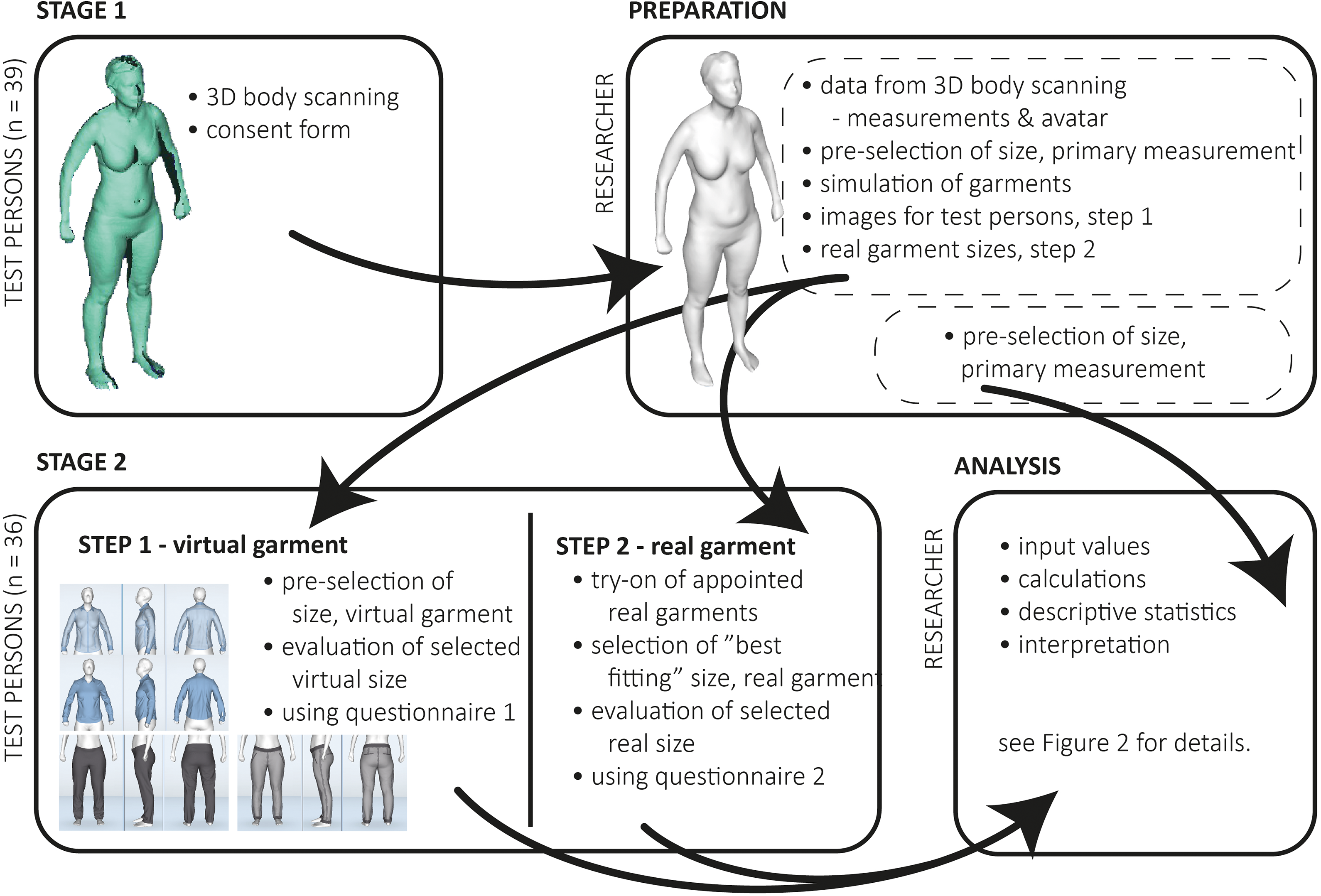
Overview of the research design, including the activities during the two stages and the contents of the preparations between the stages and the final analysis.
Participants
Sample sizes have varied in previous research, even when similar research designs, including virtual and real garments, were used: Four test persons evaluated strain and fit in a dress (Ancutiene, 2014), 37 individuals evaluated consumer perspectives by trying on trousers (Kim & LaBat, 2013a), and 61 test persons tried made-to-measure trousers, evaluated by experts (Song & Ashdown, 2015). In this study, a relatively small sample size was used due to the complex setup of using two types of garments.
A nonprobability sample was used for this study, and a combination of convenience and self-selection sampling was implemented. Test persons needed to be geographically close to the test site because of the two participation stages and because the 3-D body scanner was stationed at the university. University staff and students in Northern Europe and 124 women from a database of potential participants received information about the study. They were informed that the study needed women within a certain garment size, ranging from Swedish sizes 34 to 44 (Johansson, 1987) and that it consisted of (a) a 30-min appointment, including 3-D body scanning and (b) a 1-hr second appointment 2–3 weeks later, including trying on real garments. All participants signed a consent form and were informed about how to proceed if they wished to withdraw from the ongoing study or withdraw the data already contributed.
Our invitation to participate resulted in 42 women volunteers, 39 of whom were able to attend the first stage and 36 the second stage. They completed a questionnaire regarding trousers and shirt separately. A few of the responses were not completely filled in, and the final number of viable responses was 34 for the shirt and 33 for the trousers. A further reduction of data was necessary for the comparison of the evaluations. In order to compare the virtual and real garment evaluations, only the test persons who selected the same size (from the size range 34 to 44) in both virtual and real garment were included; this reduced the number of participants for evaluation analysis to 18 for the shirt and 19 for the trousers.
In total, 35 women produced viable data for the shirt and/or the trousers. They were between the ages of 21 and 56, M = 40.2 (11.9). One was an American native woman, 2 were Asian women, and 32 were White women. Body mass indexes (kg/m2; World Health Organization: Regional Office for Europe, 2019) were between 18.3 and 29.6, M = 22.9 (2.9).
Study Instruments
Various instruments and resources were needed to conduct this study, including a 3-D body scanner and accompanying software for measuring and creating avatars. A Seca scale (2–200 kg) was used for weight registration. Real garments to try on and software to create a virtual representation of the real garment were required. Two questionnaires were also used to collect the primary data.
Avatar
To obtain both the individual avatar and body measurements, we used Human Solution’s LS3 body scanner with their software, Anthroscan®, for measuring and extracting the avatar. The measurements were checked for correct placement on the 3-D body-scanned image and then exported for analysis outside the scan system. The surface of the 3-D scanned body was closed to create an avatar with a solid surface, appropriate for trying on garments. The avatars were exported to an object file format to enable import in the simulation software. The avatar was also saved as an image to allow the participants to see it before assessing the virtual garments on the same avatar.
Real and virtual garments
We decided to use a fitted, button-up shirt and trousers in the study because these types of garments follow the shape of the body and are therefore more fit demanding. The garments were obtained from a local manufacturer who provided both 2-D patterns and real garments for a semifitted, button-up blouse in 100% cotton and close-fitting trousers in 53% polyester, 43% wool, and 4% elastane. The size of the garments ranged from the Swedish sizes 34 to 44 (Johansson, 1987), with a basic size of 38. The company’s body measurements for a size 38 are chest 92 cm, waist 74 cm, and hip 99 cm. The primary body measurements used for size designation in this study were chest and hip (International Organization for Standards, 2017; Winks, 1997). The garment (shirt) chest measurement was 104 cm with an increment of 4 cm grading between sizes, and the garment (trousers) hip measurement was 104 cm with an average increment of 3.6 cm between the sizes. To ensure that the virtual and real garments had the same measurements, the physical garments and the 2-D patterns were verified against the garment measurement charts of the manufacturer. Where there were differences, they were modified so that both the 2-D patterns and real garments reflected each other’s measurements. Waist, hip, thigh, and inseam measurements were verified for the trousers; chest, waist, hip, bicep, across the shoulder, sleeve, and center back length measurements were verified for the shirt. To make sure that the size label of the garment did not influence the participants’ size selections and evaluations, all size labels were disguised and replaced with letters with no relation to sizing.
To prepare and create the garment simulation, we used Lectra’s software (V8R1), Modaris® 2D/3D. The researcher simulated the garments on the participants’ individual avatars. The recommended size, based on primary body measurements, was used as the starting point; thereafter, one size up and one size down were simulated to present the virtual garments in three sizes. Various software settings, such as mesh size, friction, and graphic card tuning, were the same for each size and individual. The mechanical properties for the virtual fabric were selected from the software’s database. First, a wide selection was made based on the real fabric’s composition. Next, the researchers simulated the selected fabrics from the database, finding the virtual fabric that was visually similar to the drape of the real fabric. The fabric of the garment was visualized in two formats, solid and transparent, to attempt to convey the amount of ease and the garment’s relationship to the body.
Questionnaire
Two sets of questionnaires were used to gather the participants’ size selections and fit evaluations. The first questionnaire was answered in relation to the virtual garments, alongside the printed images of the transparent and solid virtual garments in different sizes. The second questionnaire was answered while the different real garment sizes were being tried on. Each questionnaire had two parts: In the first part, the participants selected sizes, and in the second part, the selected sizes were evaluated for fit in different areas of the garment. We used multiple-choice questions including the terms “tight/low/short” and “loose/high/long,” similar to the terms used by Song and Ashdown (2015; e.g., much too tight, too tight, good, too loose, much too loose). The areas evaluated for the shirt were the circumference of the bust, waist, hip, bicep, placement of the waist, length of the center back, and the sleeve; the areas for the trousers were the circumference of the waist, hip, thigh, placement of the waist, crotch, and the inseam.
We wanted not only to evaluate the match (same evaluation) between the virtual and real garment but also to include how the virtual garment was perceived in relation to the real garment; for example, if the virtual garment was perceived as tighter/shorter or looser/longer than the real garment. We therefore used a 5-point Likert-type scale for each evaluation area on the garment. The options were as follows: much too tight/low/short (1), too tight/low/short (2), good fit (3), too loose/high/long (4), and much too loose/high/long (5); the value in parentheses refers to the assigned value for statistical analysis.
Data Collection Procedure
The primary data in this study were collected using a 3-D body scanner and the two printed questionnaires. The data collection points in the study design are shown in Figure 1.
Each stage was scheduled with each participant. The participants were not offered any incentive for participating; however, we arranged snacks during each stage, and after completing the two stages, they were given files including their avatar.
Stage 1
The participants were informed about the 3-D body-scanning process, our data storage procedure, and how they could withdraw from the current study or, in the future, ask us to erase their data. The participants provided personal demographic information such as sex, age, ethnicity, country of birth, and contact information. A few manual measurements were also taken as part of our in-house procedure for the 3-D body scanning. The participants were asked to undress and be 3-D body scanned in their underwear. They were 3-D body scanned in two standing poses. The first pose was with the arms slightly bent, the fists 15–20 cm away from the body, and the feet shoulder width apart, which follows Human Solution’s protocol for 3-D body scanning and ensures the correct extraction of measurements. The second 3-D body scan was more relaxed, with the arms and legs still placed apart from each other and the body but not as much; this pose captured a more relaxed 3-D body scan, better suited for creating an avatar to be used in garment simulation.
Preparation
The scan data were processed to prepare the material for Stage 2. The output from the 3-D body scanner was the measurements and an avatar. The primary body measurements of chest (shirt) and hip (trousers) were used to make the preselection of size according to the manufacturer’s measurements charts. The selected size was simulated on the individual’s avatar, one size up and one size down. Each virtual size was presented as six images: front, back, and left side views, all in both solid and transparent fabric (see illustration in Figure 1, Step 1). These images were presented on an A3 color printout, with one garment and one size per page. An image of the undressed avatar was also presented (see illustration in Figure 1, Preparation). To give the participants a point of reference for the design of the garments, images of an average avatar (size 38) dressed in the transparent and solid virtual garments were provided. The same sizes used in the simulation were also prepared for a real try-on; however, if all three sizes were not available for the real try-on (i.e., due to limited size range), then the sizes available were tried on. At least two sizes were tried on.
Stage 2
The participants were informed about the two independent steps during this stage and the structure of the questionnaires. In the first step, the participants preselected the best fitting size. This selection was based on the colored printouts of the solid and transparent virtual shirt and trousers. The different areas of the selected size were evaluated by the participants. This first step was completed and handed in before continuing to the next step. In the second step, we asked the participants to try on the real garments in the different sizes. When all real garments had been tried on, the participants selected the size that fitted the best (real selection of size). The participants dressed once more in the best fitting size and evaluated the different areas of this real garment.
Data Analysis Procedure
The collected data were treated and analyzed in different steps; an overview of the procedure is provided in Figure 2. Based on the input values, we calculated the difference between the preselection of size (i.e., based on the primary body measurements and virtual garments) and the real selection of size (i.e., the try-on of real garment) to identify whether the preselection of size was perceived as larger (>0), smaller (<0), or the same (=0) in relation to the real selection of size (Research Question 1). We also wanted to calculate the difference between the virtual and real evaluation areas of the garment to determine whether the virtual garments were perceived as tighter/lower/shorter (<0), looser/higher/longer (>0), or as the same (=0) in relation to the real garments (Research Question 2). We also wanted to see how the participants evaluated the fit of the real garment; thus, we present the mean values and the standard deviations of each evaluation area. The insight gained through this analysis was useful for highlighting differences between virtual and real garments to better understand consumer perceptions of virtual garments.
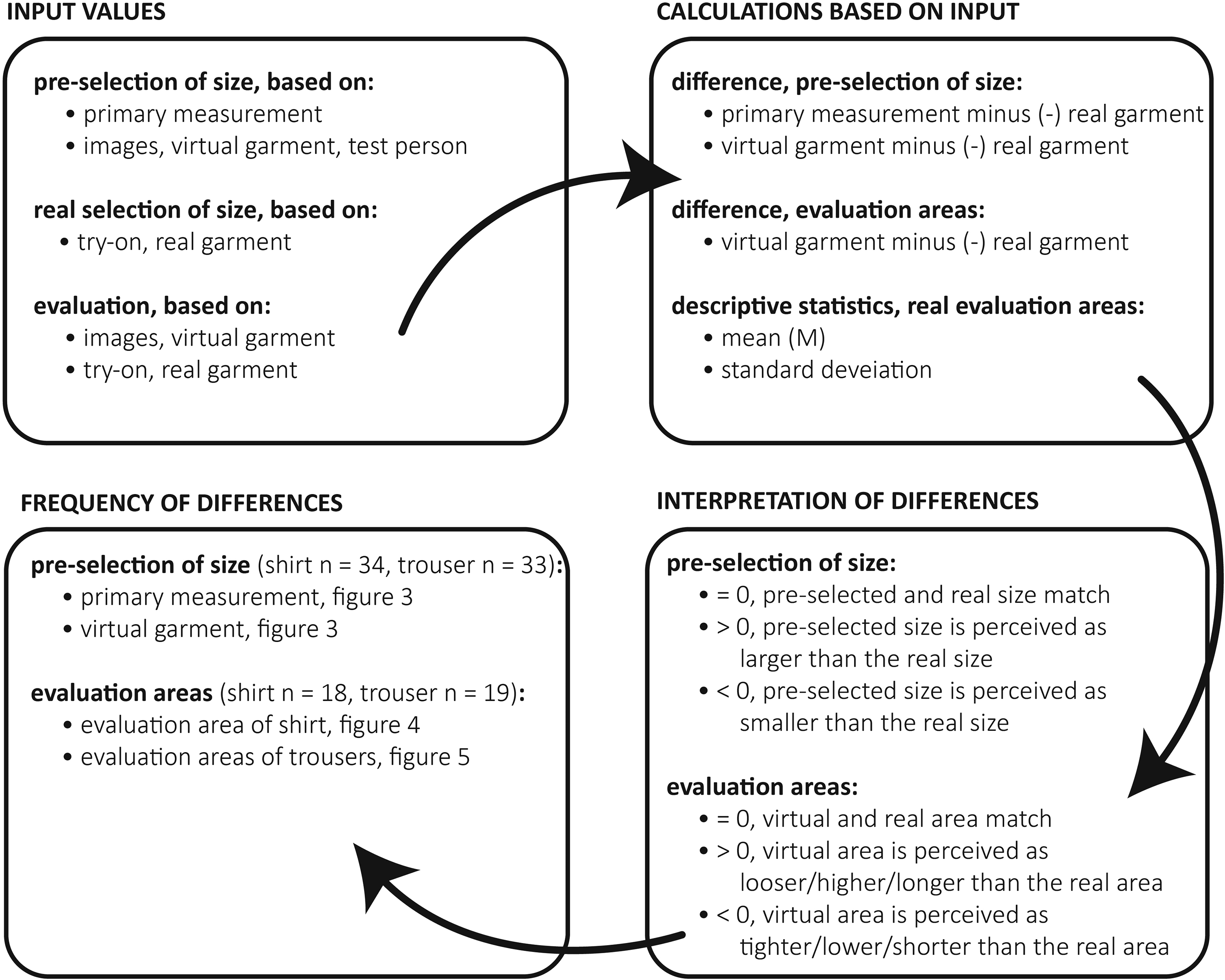
A detailed overview of the calculations and interpretations based on the primary data.
Results
Without physically trying on clothes, it is difficult to select the correct size; therefore, alternative methods need to be explored to select the best-fitting size in lieu of physically trying on a garment. In this study, we investigated how the preselection of size, based on primary body measurements in combination with size charts and virtual garments, was perceived in relation to the real selection of size, based on physically trying on clothes. We also assessed how the fit of virtual garments was perceived in relation to the fit of the real garments.
Size Selection
The goal of a preselection method is to be as accurate as possible in terms of the preselection of size matching the real selection of size. If there was no match between the preselection and real selection of size, then we studied how the preselected size was perceived in relation to the real size selection—whether the preselected size was larger or smaller in relation to the real selection of size. When analyzing the results, we therefore looked at the difference between the preselected size and the real selection of size (see Figure 2).
An overview of the findings is given in Figure 3. Preselection based on virtual garments tended to be more accurate—shirt 53% (n = 34) and trousers 61% (n = 33)—than the more traditional preselection method using primary body measurements and size charts. The preselection of size, based on the primary body measurements and size charts, tended to result in a larger size than desired by the participants—shirt 50% (n = 34) and trousers 55% (n = 33). This may indicate that the size chart of the garment does not fully match this group of individuals. If these garments were ordered online where they could not be tried on, the delivered garment would have been perceived as too large by some participants. Based on our findings so far, if it is not possible to physically try on a garment, then a virtual garment may be a useful tool for Internet shoppers, brands, and the environment, as a result of fewer returns and more satisfied customers.
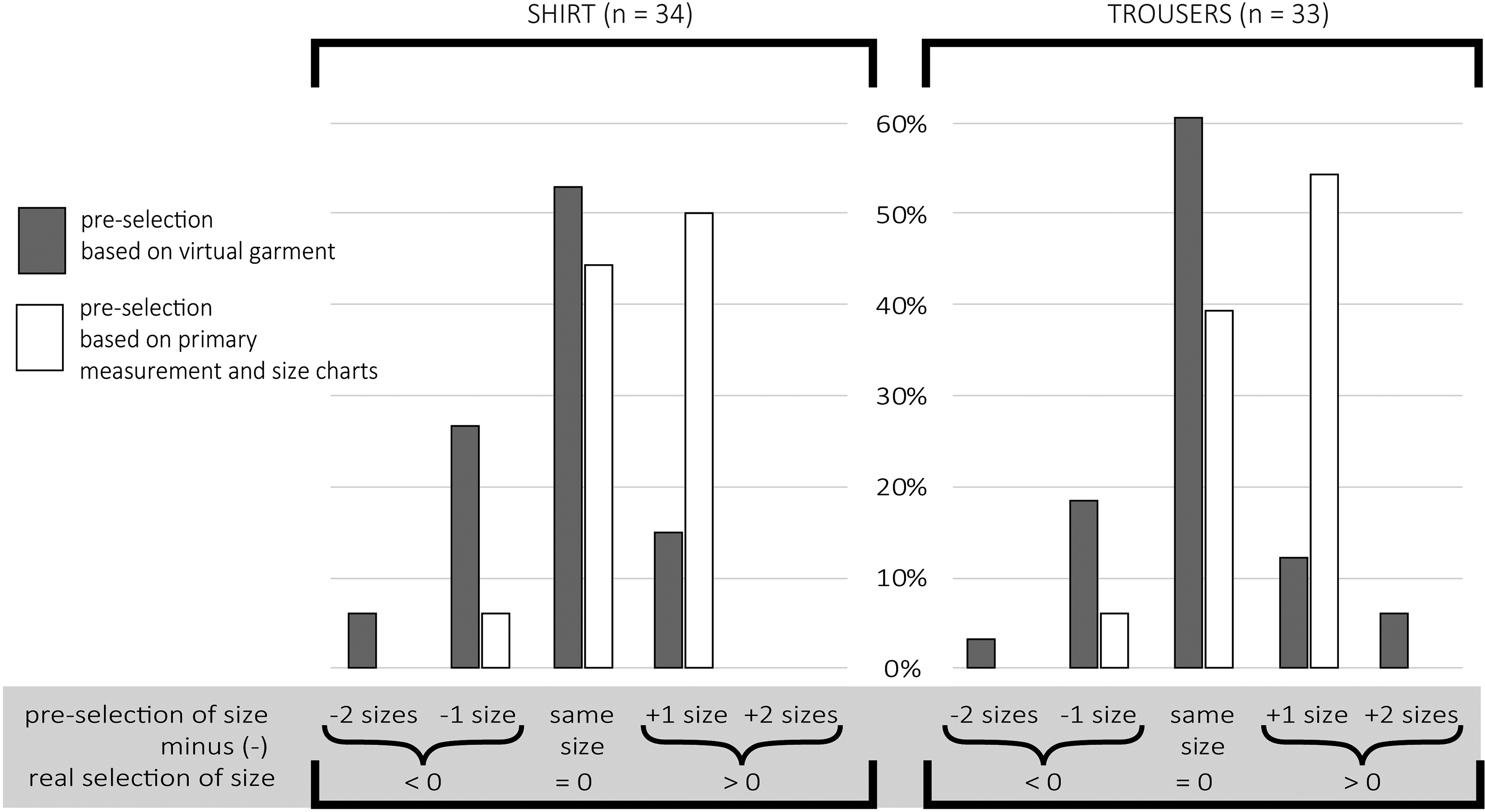
The difference between the preselected and real selected size. The preselection of size is based on the primary measurements as well as the virtual garments, and the real selection of size is based on trying on real garments.
Garment Evaluation
The most reliable evaluation of garment fit is made when a garment can be tried on; however, we wanted to study how fit evaluation based on virtual garments was perceived in relation to the real garment. As seen in Figure 2, the differences between the evaluation based on the virtual garment and the real garment were calculated to find out how the virtual garment was perceived: whether it was tighter/lower/shorter (<0), looser/higher/longer (>0), or the same (=0).
The participants evaluated different areas of the garments, as illustrated in Figures 4 and 5. Areas with a high percentage of matches (same evaluation) would be considered the most reliable areas when comparing how well the virtual evaluation matches the real evaluation. The areas with the highest reliability were chest and hip (the primary body measurements): 78% (n = 18) for the chest on the shirt and 89% (n = 19) for the hip on the trousers.

The differences between the evaluations based on virtual (VR) and real (RL) garments are illustrated for each area of the shirt. The average real evaluation scores (M) and the standard deviations are also reported. This analysis includes the data sets with the same size selected for the preselection and the real selection of size for the shirt (n = 18). Percentages may not total 100 due to rounding.

The differences between the evaluations based on virtual (VR) and real (RL) garments are illustrated for each area of the trousers. The average real evaluation scores (M) and the standard deviations are also reported. This analysis includes the data sets with the same size selected for the preselection and the real selection of size for the trousers (n = 19). Percentages may not total 100 due to rounding.
Apart from the matches, we could see that the virtual center back was perceived as being shorter than the real garment, while the length of the virtual sleeve was perceived as being longer; even the real sleeve was judged to be too long. The mean evaluation score for real sleeve length was M = 3.39 (0.70). The virtual waist area of the shirt was perceived as being tighter than on the real garment. The placement of the crotch was perceived as being baggier (i.e., further down) on the real garment. The virtual inseam of the trouser was perceived as longer than the real trouser, and the real evaluation indicated that the inseam was too short, M = 2.89 (0.66). The overall evaluation of the width measurements indicates that the virtual garment matched the real garment to some degree. Apart from the matches, it seemed that the virtual shirt was perceived as being smaller than the real garment. The width measurements of the virtual trousers do not indicate any particular tendency because the results were evenly distributed between too small and too large.
Discussion
We examined the differences between the preselections and real selections of sizes of a shirt and trousers in both virtual and physical trying-on sessions. We also studied how the virtual garments were perceived in relation to the real garments. It seems to be an advantage to use virtual garments as a tool for the size selection, specifically when trying on something physically is not possible; however, more research is needed to refine the method and potentially include more virtual tools to further increase the match between the preselection and real selection of size.
Size Selection
The more traditional preselection of sizes, based on the primary body measurements and size charts, mainly resulted in a selection of the same size or one size too big in relation to the real selection of size (see Figure 3). Although this could indicate vanity sizing (Alexander et al., 2005; Gribbin, 2014), the results are not clear enough to justify taking action and modifying the measurements of the size table. Variations in the results could also stem from the participants’ individual preferences of garment fit (Alexander et al., 2005; Ashdown & O’Connell, 2006; Bye et al., 2006; Kohn & Ashdown, 1998) and their individual preference of ease in a particular garment (Ancutiene, 2014; Ashdown & DeLong, 1995; DeLong et al., 1993; Lin & Wang, 2016). As previously shown by researchers, the customers thought it was difficult to find the correct size without trying on clothes, and they did not trust that a recommended size would fit them (Kasambala et al., 2016). Part of this distrust is also confounded by the fact that the sizes vary between brands (Gribbin, 2014), which makes it more difficult for a customer to easily find the best-fitting size.
An alternative method to preselecting size from a size chart and body measurements is to select sizes using virtual garments. On the basis of our data, we could see that the preselection of the sizes, based on the virtual shirt and trousers combined, gave a slightly better match (57%, n = 67) than the one based on body measurements and size charts (42%, n = 67). Such results occurred when simulating and presenting the virtual garments on the individual avatar based on the body scan. This increased the matches between preselection and real selection of size, which could be a result of participants including their preferences of garment fit and ease in the preselection based on virtual garments.
Garment Evaluation
By analyzing the perception of fit in the virtual garments, in relation to the real garments, we could identify areas that seemed to be easier to evaluate and the more difficult areas of the body to evaluate. The areas with the highest match (same evaluation) between the virtual and real evaluation were chest and hip measurements, with scores of 78% (n = 18) and 89% (n = 19), respectively. The average mean evaluation scores for these areas were both close to 3 (good fit = 3), shirt, M = 3.06 (0.42), and trousers, M = 3.00 (0.47). The high level of match and evaluation close to good fit suggests that the participants regard these areas as important when selecting the best-fitting size and can more easily understand fit in these areas of the body; other areas of the garment are secondary, and a compromised fit was somewhat accepted in these areas.
When evaluating the different areas of the virtual and real garments, the lowest scores were the inseam for the trousers, and the circumference of the waist and the bicep, as well as the length of the sleeve and the center back for the shirt. This might suggest that these areas were more difficult to evaluate when using the virtual garment provided in this study. The participants thought that the sleeve length of the real garment was too long, M = 3.39 (0.70), and 56% (n = 18) of the participants evaluated the virtual garment as even longer than the already-long sleeve of the real garment. Ancutiene (2014) suggests that a dynamic avatar that moves could facilitate the evaluation of virtual garments. The evaluation of the virtual and real garments in our study might have matched to a greater extent if the avatar could move, as the participants could have seen that some of the sleeve length, which looked bulky when standing still, was necessary when moving the arms. The same reasoning might be true for the inseam of the trousers, where the virtual garment was perceived as being longer than the real garment.
The trousers had a higher match (i.e., same size and evaluation) between the virtual and real garment than the shirt. The higher match for the trousers might be an effect of the fabric stretch, which in the garment increased the span of good fit. The same circumference of a garment can accommodate a wider range of body measurements, thanks to the flexibility inherent in the fabric stretch. In the simulation of the virtual trousers, a fabric with stretch was used; however, it was not investigated how the amount of stretch was conveyed and affected the size selection and evaluation done by the participants.
Contradicting Results
Other researchers have conducted garment fit evaluations, including for virtual garments, with a slightly different purpose and evaluation scale than those used in our study. When looking at the fit of trousers, Kim and LaBat (2013b) reported, based on interviews, that the virtual trousers were perceived as smaller than the real garment, and Song and Ashdown (2015) indicated the opposite, based on the circumference. In our study, we had a 72% (n = 19) match (same evaluation) between the virtual and real circumferences of trousers; however, when looking at evaluations of the other 28% (n = 19), we found they were evenly distributed between tighter and looser. Such differences between the studies might stem from different garment styles, fabrics, software, and settings related to the simulation of garments. No matter the garment style, fabric, or software used in the simulation, however, the customer should be able to trust that the virtual garment fit is reflective of the real garment.
Researchers have previously pointed out the challenges affecting virtual garments: fabric simulation (Ancutiene & Sinkevičiūtė, 2011; Kim & LaBat, 2013a, 2013b; Song & Ashdown, 2015), communication of ease (Ancutiene, 2014), and how the garment relates to the body (Volino et al., 2005). Further development is needed to optimize both the fidelity of the virtual garment and software development. More standardized methods for garment simulation are also needed, if possible.
Conclusions
The indication is that the preselection of size, based on virtual garments, exceeds the accuracy of size selections that are based on the more traditional primary body measurements: 57% (n = 67) and 42% (n = 67), respectively. This result was reached when the participants evaluated the virtual garment simulated on their individual avatar and the garment was presented with and without transparency. Size selection based on the size table using primary body measurement tends to appoint a larger size than desired by the participants.
The perception of the virtual garment, in relation to the real garment, varies between their specific areas. It is interesting to note that the areas related to primary body measurements (i.e., chest and hip) have the highest match (i.e., same evaluation) between virtual and real garments. Other areas with a lower match between virtual and real evaluations might give a more uncertain virtual evaluation: for trousers, the inseam, and for the shirt, circumference of the waist and bicep, and length of the sleeve and center back.
Our sample size is too small to show levels of significance or generalize the findings, but we can summarize that virtual garments are worth considering when it comes to the preselection of size and when physically trying on something is not possible. We have shown that the accuracy of size selection can increase with the help of virtual garments. The benefit for Internet shoppers, brands, and the environment are evident: fewer returns and hopefully more satisfied customers. Based on this and previous research, however, it is evident that future studies are needed to improve accuracy when using virtual garments. The software also has to develop further, as does our knowledge of which tools are best suited to improving the accuracy of size selection and fit evaluation. Future developments and studies identified in the current study include the need for dynamic and moving avatars and to research whether the use of movement increases accuracy in the fit evaluation.
Footnotes
Acknowledgments
The authors appreciate the collaboration and support from Newhouse Design and Västra Sveriges Tekoförenings stipendiefond both situated in Borås, Sweden, as well as Swedish Institute for Innovative Retailing, University of Borås.
Declaration of Conflicting Interests
The author(s) declared no potential conflicts of interest with respect to the research, authorship, and/or publication of this article.
Funding
The author(s) received no financial support for the research, authorship, and/or publication of this article.
