



Abstract
Illicit drug markets vary organizationally and operationally in terms of things like the product being bought and sold, the community and population being served, the people engaged in the business, and the extent to which the market has matured. In this paper we use data from a survey of 1,367 law enforcement agencies to examine the characteristics and dynamics of illicit retail methamphetamine markets in U.S. communities. We describe the characteristics of those markets and we distinguish different types of communities in terms of the characteristics of their local meth markets. Despite finding similarity in the organizational and operational characteristics of methamphetamine markets in the U.S., we found variability in terms of the source of production of meth for the local market (local labs and importing from Mexico and other U.S. states) and the extent to which local police consider meth to be a local problem.
Introduction
The illicit drug industry is part of the U.S. economy, and in many ways illicit drug markets are organized and operate like licit markets. The system by which illicit drugs are manufactured, distributed, and sold is a commercial enterprise based on a division of labor and driven by the forces of supply and demand (see Brownstein, 2000a; Caulkins & Reuter, 1998, 2004; Degenhardt, Reuter, Collins, & Hall, 2004; Everingham & Rydell, 1994; Johnson et al., 1985; Mieczkowski, 1992; Reuter, MacCoun, & Murphy, 1990; Rhodes, Langenbahn, Kling, & Scheiman, 1997; Skolnick, Correl, Navarro, & Rabb, 1990; Venkatesh, 2008; Venkatesh & Levitt, 2000; Waterston, 1993). However, illicit drug markets differ from legitimate markets in that market participants, consumers, and those engaged in the business, by definition, operate outside the purview of law. Operating outside of the legal realm, these markets are more prone to violence over disputes involving things like market share or product quality, and market participants face greater personal risk of arrest or even incarceration, loss of gain from their criminal activity, theft by competitors or others, deceptive collaborators, and injury or death from their market participation (Brownstein, 2000b; Caulkins & Reuter, 2004; Curtis et al., 1995; Fagan & Chin, 1990; Reuter et al., 1990; Sommers, Baskin, & Baskin-Sommers, 2006). In this article, we describe the organization and operation of markets for a particular illicit substance, methamphetamine, and discuss how those markets vary not only from licit markets in their communities but also from one another within the community.
Literature Review: Drug Market Variability
Although illicit retail drug markets are similar to each other in that they are economic markets operating outside the realm of legitimate commerce, research has shown that drug markets are neither all organized nor do they all operate in the same way. Indeed, Johnson, Hamid, and Sanabria (1992) studied crack markets and found that they were not particularly well-organized and lacked well-established routines, relationships, and territorial boundaries. Crack markets were found to have been more entrepreneurial and less like formal businesses than were traditional heroin or cocaine markets, facilitated by the fact that crack was easier to manufacture and package and as a market crack had higher volume sales and profit margins (see Belenko, 1990; Hughes, 1977; Inciardi, Lockwood, & Pottieger, 1993; Johnson et al., 1992; Office of the Attorney General, 1989; Reinarman & Levine, 1997). This has practical as well as theoretical implications because research has also shown that different forms of market organization and operation have different outcomes, particularly in terms of public health and safety (Brownstein & Taylor, 2007; Curtis et al., 1995; Harocopos & Hough, 2006; Kerr, Small, & Wood, 2005; May & Hough, 2004).
As commercial markets, illicit retail drug markets vary organizationally and operationally, for example, in terms of the nature and attributes of the product bought and sold, the characteristics of the community and population being served, the characteristics of those people engaged in the business, and the level of market maturity. From existing research, we know more about the markets for some drugs (e.g., heroin, marijuana, crack cocaine) than we do about the markets for others (e.g., methamphetamine). We also know more about the economic characteristics of markets than we do about the social activity and behavior of participants, and more about the international traffic in drugs than we do about their trade in local communities. Overall, we know more about drug use and abuse than we do about the dynamics of retail drug markets. This article seeks to fill this gap by examining the characteristics and dynamics of illicit retail drug markets, particularly methamphetamine markets, across U.S. communities. We use data from a survey of law enforcement agencies in the United States to distinguish illicit retail methamphetamine markets in terms of their organizational and operational characteristics. We view markets as commercial activity related to methamphetamine in terms of geographical and social locations within a community rather than the whole community (e.g., city, county) as a single market.
Much of the social scientific research on illicit drugs has focused on drug use, particularly as it relates to individual or community outcomes such as violence and disease (e.g., Anglin, Hser, & Chou, 1993; Brownstein, 2000b; Carpenter, Glassner, Johnson, & Loughlin, 1988; De La Rosa & Soriano, 1992; Dembo et al., 1987, 1990; Goldstein, 1985; Greenbaum, 1994; Jacques, 2010; Kuhns, 2000; MacCoun, Kilmer, & Reuter, 2003; McBride, VanderWaal, & Terry-McElrath, 2003; Miller, Gold, & Mahler, 1991; Roth, 1994; Spunt, Brownstein, Goldstein, Fendrich, & Liberty, 1995; Tinklenberg, Murphy, & Pfefferbaum, 1981; Waterston, 1993; White, 1990, 2004; Zahn & Bencivengo, 1974). Social scientific studies of that relationship often have explored the drug involvement of known violent offenders (e.g., Brownstein, Baxi, Goldstein, & Ryan, 1992; Fendrich, Mackesy-Amiti, Goldstein, Spunt, & Brownstein, 1995; Goldstein, Bellucci, Spunt, & Miller, 1991; Goldstein, Brownstein, Ryan, & Bellucci, 1989; Inciardi, Horowitz, & Pottieger, 1993; Lattimore, Trudeau, Riley, Leiter, & Edwards, 1997; Spunt et al., 1995) or the criminal activity of users generally but not necessarily their involvement in violence (Ball, Rosen, Flueck, & Nurco, 1982; Carpenter et al., 1988; Hunt, Lipton, & Spunt, 1984; Johnson et al., 1985; Nurco, Ball, Shaffer, & Hanlon, 1985; Shaffer, Nurco, Ball, & Kinlock, 1985). To a large extent, these studies have focused on heroin or crack, whereas only a few have examined the relationship between methamphetamine use and violence (King & Ellinwood, 1992; McKetin, McLaren, & Kelly, 2005; McKetin, McLaren, Riddell, & Robins, 2006; Office of Applied Studies, 2005; Smith, Galloway, & Seymour, 1997; Sommers et al., 2006), with some attention as well to methamphetamine use and HIV infection (Centers for Disease Control and Prevention, 2006). In addition, a few ethnographic studies have looked at small numbers of people known to have been involved with drugs and described other aspects of their lives (e.g., Bourgois, 1995; Jacobs, 1999; Williams, 1992).
Retail drug market studies have largely focused on the overall market economy (Reuter et al., 1990; Venkatesh, 2006, 2008; Venkatesh & Levitt, 2000), with a number of ethnographies of particular markets (e.g., Adler, 1993; Bourgois, 1995; Curtis et al., 1995; Hughes, 1977; Jacobs, 1999; Maher, 2000; Mieczkowski, 1990, 1992; Murphy, Sales, Duterte, & Jacinto, 2005; Venkatesh, 2008). However, as in the case of drug use, the scientific research in this area has focused largely on the relationship between illicit drug markets and community outcomes, such as violence and HIV (e.g., Altschuler & Brounstein, 1991; Berg & Rengifo, 2009; Bourgois, 1995; Brownstein, 1996; Brownstein et al., 1992; Dembo et al., 1990; Dembo, Hughes, Jackson, & Mieczkowski, 1993; Fagan, 1989; Fendrich et al., 1995; Goldstein et al., 1989, 1992, March; Heffernan, Martin, & Romano, 1982; Hughes, 1977; Jacques, 2010; Kingery, Pruitt, & Hurley, 1992; Lattimore et al., 1997; Li, Stanton, & Feigelman, 1999; Ousey & Lee, 2007; Saner, MacCoun, & Reuter, 1995; Scott & Wright, 2008; Zahn, 1980). Some attention during the later years of the 20th century was paid to market dynamics and the instability of local crack markets (Goldstein et al., 1989, 1992; Johnson et al., 1992; Lattimore et al., 1997). For our purpose, this literature suggests that illicit retail drug markets may vary both on the macro level of market structure and the micro level of participant relationships and interaction (Brownstein et al., 2000; Brownstein & Taylor, 2007; Goldstein et al., 1992; Lattimore et al., 1997; Taylor & Brownstein, 2003).
Markets have structure. Social structure refers to the institutionalized yet dynamic form of social relations (compare Gordon, 1964; Radcliffe-Brown, 1952; Weber, 1947). In this sense, the structural dynamics of drug markets operationally may be defined as forms of market organization. For example, whereas organized markets are more likely to adhere to established routines and relationships and to maintain order through a hierarchy of authority (Brownstein et al., 2000), in less organized markets, the lines of authority and territory are likely to be less clearly drawn (see Johnson et al., 1992).
Social interaction may be defined as an active and meaningful relationship between two or more people (compare Blumer, 1969; Mead, 1964). In that sense, the dynamics of a drug market also may be considered in terms of social interactions between and among drug market participants. For example, whereas less organized markets involve interaction among suppliers, distributors, and entrepreneurs who most often do not know one another (Brownstein & Taylor, 2007; Taylor & Brownstein, 2003), more organized markets involve role specialization, vertically integrated hierarchy and developed interpersonal relationships, and suppliers, distributors, entrepreneurs, and consumers tend to know each other.
Research also has shown that the nature and attributes of the product sold affects the organization and operation of drug markets. Although there are some similarities between crack and methamphetamine markets, there are also differences between patterns of buying and selling (Hunt, 2004; Hunt, Kuck, & Truitt, 2005; Taylor & Brownstein, 2003). For example, researchers have found that crack is “easy to manufacture, [can] be packaged in low-priced units for sale, and [has] high addiction potential” (Brownstein, 2000b, p. 44); so it is typically sold in open-air markets (Bourgois, 1995; Goldstein et al., 1989; Johnson et al., 1992; Venkatesh, 2008; Williams, 1992). By contrast, meth is less easily manufactured and is often sold from “a dealer’s home” (McKetin et al., 2005, p. 65). Methamphetamine buyers most often purchase product from known dealers. Yet retail sale of meth is similar to crack in that most meth producers sell within their local geographic area (Brownstein & Taylor, 2007; National Institute of Justice, 1999; Taylor & Brownstein, 2003). Unlike crack markets, however, methamphetamine markets appear to be less likely to be associated with major roadways (Eck, 1994), again suggesting that the drug is more likely sold through personal relationships rather than in open-air drug markets, implying an interactional measure of organization not found in crack markets. Clearly, much has yet to be learned about how these markets are organized and how they operate to better understand their origins and consequences in local communities.
For more than a decade, methamphetamine increasingly has been recognized as a serious drug problem in the United States. For example, the Federal Advisory Committee of the Methamphetamine Interagency Task Force (Federal Advisory Committee, 2000) noted at the start of the 21st century that methamphetamine use in recent years had increased dramatically, and its use had spread from the West to the Midwest and South. More recently, the National Drug Intelligence Center reported that after a period of increases from the 1990s through 2002, there is now an “increasing prevalence of high-purity methamphetamine throughout the country and through networks based in Mexico and Asia the markets in the United States have been sustained at the higher level” (2007, p. 19). In this article, we will demonstrate that individual methamphetamine markets within a single urban or rural area may differ from one another and that the mix of market types within an area is related to these changing patterns of meth use, distribution, and policy response in the United States and that the mix itself has a potential impact on the local community.
Method: A Survey of Law Enforcement Agencies
The overall aim of this article is to describe the organization and operation of local methamphetamine markets in cities and counties in the United States. To that end, we use an approach that integrates analyzes of relationships between variables and an examination of commonalities across a small number of cases (Ragin, 1994). Therefore, in selecting our sample we place the greatest emphasis on the inclusion of cases that maximize our ability to identify, describe, and analyze diversity across communities.
The data for this analysis were derived from a survey of 1,367 police agencies across the United States. The frame for the sample of agencies was developed from the National Public Safety Information Bureau’s 2007 National Directory of Law Enforcement Administrators (NDLEA) database, which is a comprehensive listing of law enforcement agencies across the country, including department/agency name, type, description, and relevant contact information. For our screening sample frame, we included data from four NDLEA segments: municipal police departments and independent city sheriffs, county police and sheriff’s departments, State Police/Highway Patrol Headquarters, and State Criminal Investigation Headquarters. In total, the frame contains 15,917 agencies. Agencies were assigned to strata based on whether they were in metropolitan, micropolitan, or rural counties (as defined by the U.S. Office of Management and Budget, OMB) and the Organized Crime Drug Enforcement Task Force (OCDETF) regions in which they were located.
Within each stratum, the allocated sample was selected systematically with probability proportional to the size of the agency, where size is measured as the number of municipal and county police officers/sheriffs per agency. A total of 4,389 law enforcement agencies were selected. Each received a seven-page questionnaire asking them about the extent of methamphetamine use and the existence of meth markets in their jurisdiction, the source of meth (e.g., local labs, importing) and where it is sold, whether it is related to local problems of public health or safety, and how the local markets are organized in terms of patterns of buying, selling, production, and use. The instrument was sent to each department with a cover letter from both National Opinion Research Center (NORC) at University of Chicago and the Police Executive Research Forum requesting that it be completed by a narcotics investigator or other designee who is “the most knowledgeable about meth and its impact on the agency and community.” Each agency was given the option to respond by mail, fax, or by web. To maximize our response rate using multisurvey modes, we implemented the survey using a modified Dillman (2007) approach, including a respondent-friendly questionnaire, up to five contacts with recipients of the survey, a brief prenotice letter sent a few days prior to the arrival of the questionnaire, a questionnaire mailing that includes a detailed cover letter, a thank you/reminder postcard, a replacement questionnaire, and a final contact by fax or telephone.
The sample agencies were selected primarily for screening purposes, that is, to identify jurisdictions where local law enforcement was cognizant of the extent to which methamphetamine was marketed and considered problematic in their community. Of these agencies, 1,367 covering all 50 states responded that they had some knowledge of and experience with methamphetamine use, distribution, and/or manufacture in their jurisdictions and that (at least to some degree) meth was considered to be a local concern. For analytic purposes, we utilized a formal cluster analysis technique to collapse the 1,367 jurisdictions into distinct clusters or types reflecting the mix of meth markets in the jurisdiction and related characteristics.
Participants in any social setting or activity construct an interpretation and understanding of that setting or activity in the context of their own experience and interests (Berger & Luckmann, 1966). In terms of illicit retail drug markets, individuals who participate in different social locations relative to the market have different social experience of the market and different interests in relation to it. There are the people who themselves are engaged in the activity and business of the local drug markets trying to transact business. There are people working in the local community drug prevention sector engaged in activities and programs intended to intervene when local people are being initiated into drug use and to address the problems of people progressing from drug abuse to dependence. People working in drug treatment area engage in activities and programs designed to care for people in need of care related to drug use and abuse disorders. These people all are social actors with a vested interest in the organization, operation, and outcomes of the local illicit retail drug markets.
Thus, although we recognize that respondents from police agencies are not the only source of information about illicit retail drug markets in their community, they are a source and in fact an important one. The police have the responsibility to maintain order and to prevent and investigate crime related to drug use and markets and therefore have a singular interest in knowing how those markets are organized and operate. That is, the police need to know about the markets because it is their responsibility to respond to them on behalf of their communities. So although their knowledge about drug markets may not be the only source of information about those markets and may not coincide precisely with those of other interested parties or researchers (see Ryan, Goldstein, Brownstein, & Bellucci, 1990), they are nonetheless a unique and valuable source of information about local methamphetamine markets. Notably, we could find no evidence of any other research that has studied the organization and operation of methamphetamine markets or any other illicit retail drug market from the perspective of the police on a national level.
Findings: Diversity of Local Methamphetamine Markets
As noted earlier, research has demonstrated that local retail illicit drug markets vary in how they are organized and how they operate. Johnson and his associates distinguished freelance entrepreneurial crack cocaine markets from more organized business-model heroin markets (Johnson et al., 1992). In their study of high-level cocaine and marijuana markets, Reuter and Haaga (1989) hypothesized a range of market types, from more informal networks of sellers and buyers for local distribution to more formal and enduring organizations with specialized workers more often engaged in higher level trafficking. Reuter and Haaga, for example, note in their report that they were able to reach conclusions about market organization despite limitations of their study that led them to suggest that their “observations fall somewhere between informed speculation and empirical findings” (1989, p. 54).
To date, this research has been less than definitive. Our study takes it a step further by collecting more detailed data on the organization and operation of a particular drug market (methamphetamine) from a broader sample of law enforcement agencies that regularly deal with these markets in all 50 states. We begin by describing the characteristics of the organization and operation of local meth markets in a given area based on the knowledge and understanding of local law enforcement responsible for preventing and investigating crimes of and related to local drug markets.
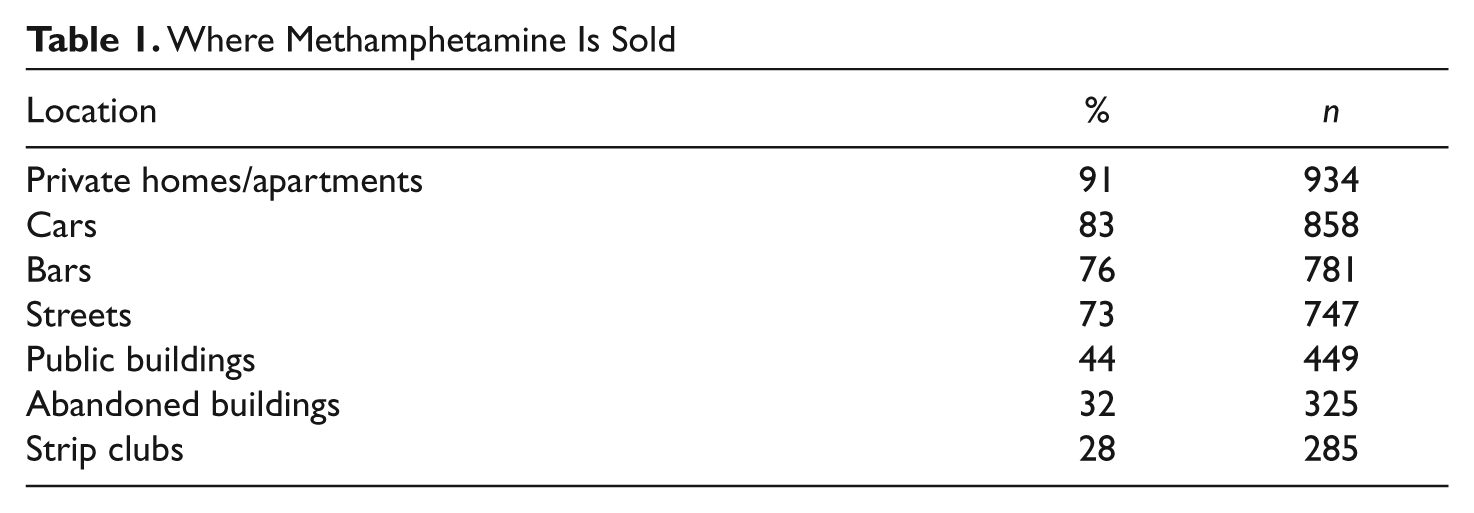
Law enforcement respondents were asked about the specific locations in their jurisdictions where the methamphetamine was sold. They reported (see Table 1) that meth sales most often took place in private homes or apartments, or in cars or bars. Much of the trade in crack cocaine takes place in open markets on street corners, where buyers can approach strangers as well as dealers they know (Fagan & Chin, 1990; Goldstein et al., 1989; Jacobs, 1999; Johnson et al., 1992; Pettiway, 1995; Taylor & Brownstein, 2003). A number of our police respondents also reported meth transactions taking place in their jurisdiction on the street (73%), but as we will see below, according to those respondents, even the meth transactions on the street were more likely to be among people who knew each other.
Where Methamphetamine Is Sold
In describing the dynamics of illicit retail methamphetamine markets, we focus on the organization and operation of the markets. Police agency respondents were asked based on their knowledge of how the local markets in their area were organized and how they operated in terms of buying, selling, production, and use. Relative to the organization of meth markets, respondents were asked questions about both the structural and interactional measures of market organization. As noted earlier, the structural characteristics are those that involve adherence to established routines and relationships and the maintenance order through a hierarchy of authority. The interactional characteristics are those that relate to the ordering of relations by role specialization, hierarchy, and established interpersonal relationships such that suppliers, distributors, entrepreneurs, and consumers would more often interact with people they know. Table 2 shows the responses of law enforcement office respondents to various questions about the structural and interactional characteristics of the meth markets in their local area.
Market Organization
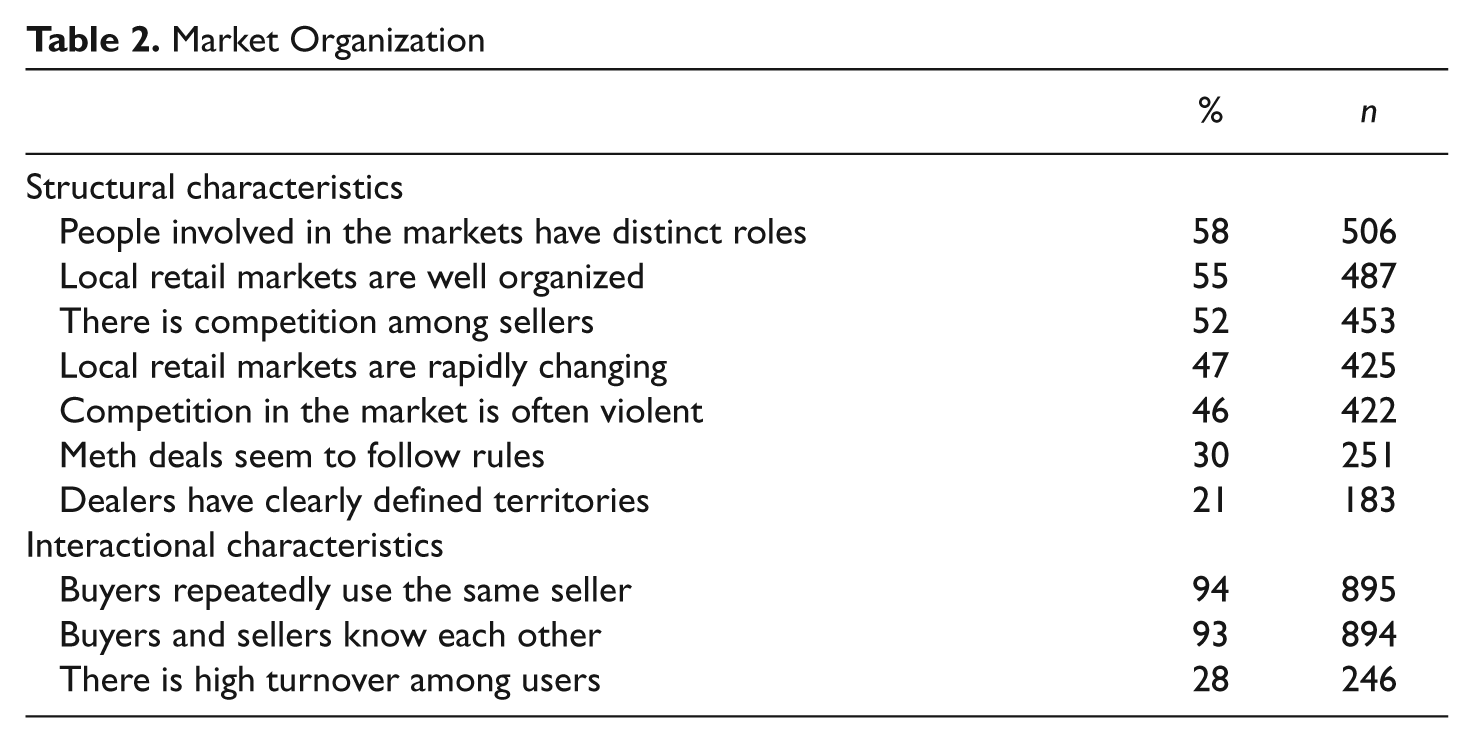
In terms of structural characteristics, about half of the respondents agreed that the illicit retail methamphetamine markets operating in their area were well organized having participants with distinct roles, although only 30% said that transactions or deals in the local markets seem to follow rules and only 21% said that dealers in their area seem to have clearly defined territories. Furthermore, about half the police respondents reported that the local markets did involve competition among sellers and that the characteristics of local markets changed rapidly. Notably, about 40% reported that the market competition could be violent.
In terms of the interactional characteristics of the organization of illicit retail meth markets, almost all police respondents said that in their jurisdiction the people who buy methamphetamine repeatedly are buying it from the same seller. Similarly, almost all of them said that local buyers and sellers are known to each other, and only slightly more than one quarter said that there is high turnover among meth users in their area.
To examine the operation of illicit methamphetamine markets, we asked our law enforcement respondents about the local patterns of meth buying, selling, production, and use. Table 3 shows the responses of the police respondents to particular questions about how people involved in the meth markets in their local communities buy, sell, produce, and use methamphetamine.
Market Operation
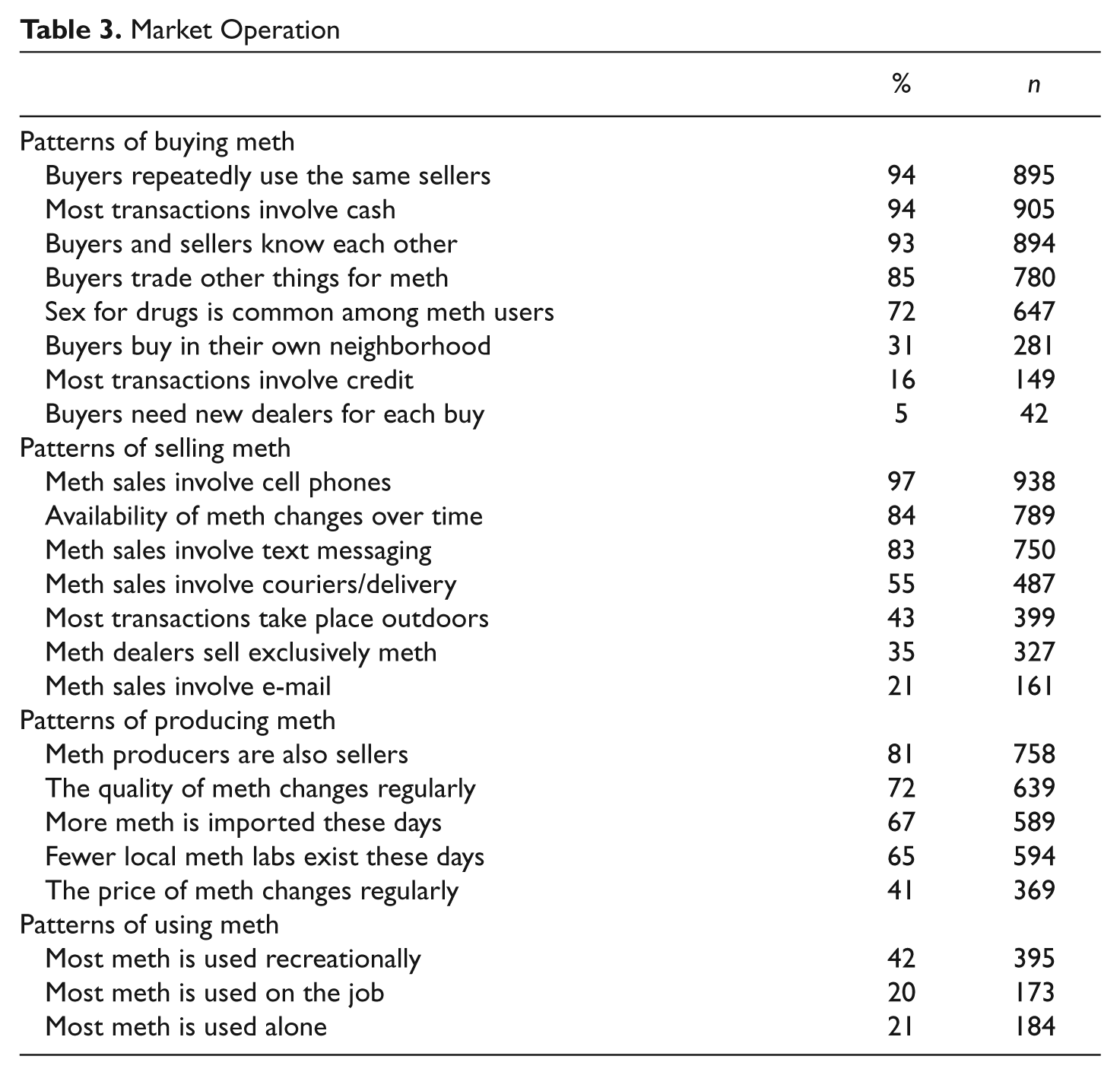
Respondents noted similarities and dissimilarities among the various market characteristics. Looking at the same questions as were asked about interactional organization, again we see that in almost all jurisdictions buyers and sellers know one another and deal with one another repeatedly. In very few places do buyers have to find a new dealer for each purchase. In addition, in almost all jurisdictions the police respondents said that meth is a cash business with a fair amount of trading (e.g., sex or precursor chemicals) for drugs. Only a few respondents reported credit being used to buy meth in their area. Cell phones are reportedly used almost everywhere to buy and sell meth, and text messaging is fairly common. In about half the jurisdictions, respondents reported that couriers or other forms of delivery are used for sales.
In terms of the use of methamphetamine, about 20% of local police respondents said that in their jurisdiction most meth is used by people on the job and most of it is used alone. Less than half of the respondents reported that local meth use in their area is largely recreational. In terms of the production of methamphetamine, there appears to be a bit more variability among jurisdictions. Police respondents in 81% of the areas said that the people who produce meth are also the people who sell. Interestingly, about two thirds of respondents said that in their area meth is imported, and about two thirds said that in their area meth is produced in local laboratories. So clearly there is overlap and some measure of dissimilarity among jurisdictions in the local mix of meth markets within the area.
In its National Drug Threat Assessment 2008, the National Drug Intelligence Center reported “significant changes” in the production and distribution of methamphetamine in the United States with imports replacing local home-cooked laboratories as the major source of supply since 2004 (2007, p. 19). Mexican and Asian drug trafficking organizations reportedly sustain methamphetamine markets in the United States by circumventing restrictions on the necessary precursor chemicals. In this survey, the law enforcement respondents were asked about how methamphetamine finds its way to their jurisdiction. Table 4 shows that about half of the law enforcement respondents in our sample said that local meth was imported (either from Mexico or from another country or state), and about two thirds said it came from local labs. These numbers are not mutually exclusive and demonstrate that jurisdictions with meth markets are likely to have more than one type of market based on the source of the drug.
Source of Local Methamphetamine
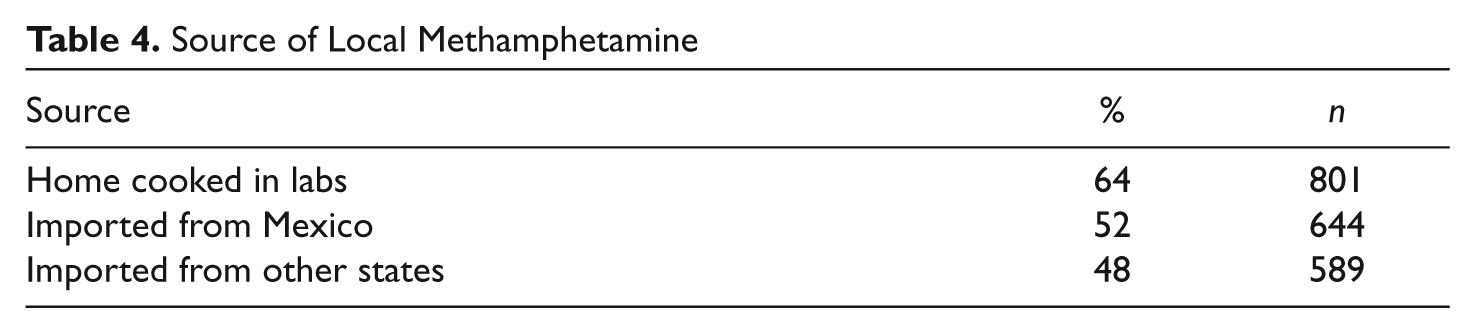
These numbers also show that despite restrictions on precursor chemicals in the United States, there are a considerable number of places where local law enforcement continues to observe methamphetamine being produced in local labs. It also shows that imports from Mexico are significant, but so are imports from other states. Police respondents were then asked what they knew about the maturity of local markets, specifically whether their areas included meth markets that were emerging, established, or declining. Any area could have more than one type. Table 5 shows differences in the source of methamphetamine given the maturity of the market. Notably, most of the meth arriving in areas with established markets is reported to be imported. Respondents in 69% of the jurisdictions with established meth markets reported that meth used locally is imported from Mexico, and 58% said it is imported from another state. This makes sense because the precursor restrictions were intended to make local production more difficult forcing local labs in older, more established markets to close, thereby resulting in supply being replaced by imports. However, those respondents who said there are declining meth markets in their areas reported in more than half of those areas that meth is still made in local labs. Even in those areas where they reported that there are established meth markets, more than one third still report local labs producing meth.
Source of Methamphetamine by Market Maturity

Obviously, the maturity of meth markets in an area does not alone explain where the local meth comes from or the mixture of local market types given the source of the meth. To better understand the mix of market types in an area relative to the source of meth as reported by police respondents, we conducted a cluster analysis to identify types of areas with different mixes of local meth markets. Cluster analysis is an exploratory data analysis tool that allows us to distinguish and classify (cluster) respondents into meaningful groups (Everitt, Landau, & Leese, 2001; Romesburg, 1990). For purposes of this analysis, we constructed a new variable that uniquely identified various combinations of three types of markets in an area based on the source of the drug (local production, imported from Mexico, other import). For purposes of distinguishing types of areas, we also included a measure of the extent to which local law enforcement respondents perceived there to be problems in their jurisdiction related to methamphetamine. Using this variable, we conducted our cluster analysis to distinguish the cities and counties in our sample in terms of the mix of types of local methamphetamine markets. This analysis allowed us to identify eight clusters or types of areas each with a distinctive composition of meth markets and one cluster with no reported local meth markets.
For our analysis of the 1,367 locations, we drew our clusters using a TwoStep SPSS function on responses related to the source of the methamphetamine and the perceived seriousness of the local meth problem. Table 6 shows the clusters by types of local markets and reported seriousness of the local meth problem. Of all the cities and counties in the sample, 21% of law enforcement agency respondents reported that they have no local methamphetamine markets and, naturally, that although meth may be of concern it is not a problem locally. Of the remaining cities or counties, 8% reported that meth in the area was mostly distributed through markets based on local production, 3% reported that most of the local markets depended on meth imported from Mexico, and 3% that most of the local meth was imported from somewhere other than Mexico, particularly from another state in the United States (where it might have been produced locally or originally imported from Mexico). The remainder reported a mix of local markets with more than one source of methamphetamine. Although the greatest proportion of cities or counties reported no local meth markets (21%), the next largest clusters included those places reporting a serious meth problem and a combination of local labs and imports from Mexico and from other states (19%), followed by those reporting a combination of local production and Mexican imports (16%).
Clusters of Cities and Counties by Types of Meth Markets

It is noteworthy that our cluster analysis divides the group of markets with all sources of methamphetamine (local lab production, meth imported from Mexico, and meth imported from somewhere other than Mexico) into two categories: (a) a category (n = 113) where local law enforcement respondents reported that despite having methamphetamine coming into the area from all sources the local problem with meth was nonetheless mild and (b) a category (n = 264) where local law enforcement respondents reported that with meth coming in from all sources the local meth problem was severe. Interestingly, in those 113 jurisdictions where the meth problem was considered mild despite meth coming from all sources, police reported that of all drug arrests they make about 8% are for meth. In comparison, in those 264 jurisdictions where meth came from all sources and the meth problem was considered serious, police reported that of all drug arrests they make about 31% are for meth.
Finally, it is important to note that different regions of the United States exhibit different combinations of market typologies. Historically, methamphetamine use has been observed to have been moving slowly from west to east (National Drug Intelligence Center, 2007; National Institute of Justice, 1999, 2003; Office of Applied Studies, 2005), and our analysis shows that the movement of meth use across the country is reflected in the maturity of local meth markets and the mix of markets in different parts of the country. For this purpose, we divided the areas in our sample into regions of the United States based on the OCDETF regions. In Figure 1 we see the distribution of the mix of different types of meth markets in different regions.

Distribution of market types across regions
Considering the distribution of market types across regions of the United States, the mixture of local meth markets in different regions reflects the historical spread of methamphetamine use across the country. In the western regions, where the widespread use of meth first emerged, jurisdictions were reported to be dominated by mixtures of local markets including combinations of local production and Mexican import markets. By contrast, in the northeastern and mid-Atlantic regions, where meth use came later, there were more jurisdictions with no meth markets reported. Half of the local police respondents in the mid-Atlantic and more than three fourths in the Northeast reported no meth markets in their area. In the Northeast, to the extent that local police did report there being meth markets, it appears that mostly they were local production markets. In the South, there were still a fair proportion of local police reporting no meth markets in their area, but in nearly half of the areas local police reported a mixture of local production and Mexican import markets, and about as many reported local production markets in their area as no meth markets. In about a third of all areas in our sample in the Great Lakes region, local police reported no local meth markets, but about one fourth reported local production markets and a similar number reported that their areas had a mixture of local production and Mexican import markets.
Discussion: Policy Implications and Future Research
It has long been recognized that illicit retail drug markets differ in terms of how they are organized and how they operate (Altschuler & Brounstein, 1991; Brownstein, 2000a; Brownstein, Crimmins, & Spunt, 2000; Brownstein & Taylor, 2007; Jacobs, 1999; Johnson et al., 1992; May & Hough, 2004; McKetin, et al., 2005; Reuter et al., 1990; Venkatesh & Levitt, 2000). They vary by type of drug being bought and sold, people involved, region of the country where they are located, location in a community, and so on (Dembo et al., 1993; Fagan, 1989; Hunt, 2004; Murphy et al., 2005; Taylor & Brownstein, 2003). In this article, we have described particular organizational and operational characteristics of methamphetamine markets.
In support of earlier research on methamphetamine markets, we found, in general, that meth is more likely sold through personal relationships than openly in public spaces and that compared to early crack markets, for example, meth markets tend to demonstrate a higher degree of structural organization. We found that, according to local police, buyers and sellers of methamphetamine typically know one another and repeatedly deal exclusively with one another. We also found that the trade in methamphetamine tends to be a cash business, rarely involving credit, though on occasion there may be some level of trade involved. According to our police respondents, cell phones are a common means of communication in meth markets, as is text messaging.
Although our research identified common characteristics of methamphetamine markets that distinguish them from other illicit drug markets, we also found considerable variation in the mix and characteristics of particular markets within the same city or county. We found that in those areas where the local meth markets are more likely to be well established the meth predominantly comes from imports, mostly from Mexico. In contrast, in those areas where the local meth markets are in decline the meth in the areas comes primarily from local lab production. Cities and counties predominantly supplied with meth from local labs compared to those predominantly supplied by imported meth appear to be more autonomous, in the sense that they are less dependent on outsiders for their product. Given such self-reliance and lack of dependence on imported meth to meet local demand, it is not surprising that in these places local police more often than not agree that the quality and price of meth remains consistent over time in the local area. Nor is it surprising that these places are often rural and that meth markets in these places have limited competition among dealers.
The importation of methamphetamine from Mexico or elsewhere requires some level of relationship between local dealers and outsiders. In that sense, the local meth markets in places with imported meth are more dependent on people who are not part of their community of friends and acquaintances. So theoretically there should be less uniformity of quality, quantity, and price over time. Local police respondents agreed that although some order is observed in the local markets dependent on imported product it is less likely in these places that local dealers have defined territories. Police in these places also agree that there is not an unusually high level of competition among dealers, but to the extent that there is competition it is more likely to be violent.
Cities and counties where local meth markets are supplied by both local production and imports vary greatly in terms of how the markets are organized and operate. In jurisdictions experiencing both local meth production and imported meth from Mexico, local police agree that the local meth markets are well organized. By contrast, in jurisdictions with local production and imports from places other than Mexico, this is not the case. However, police respondents agreed that quantity and quality, though not necessarily price, vary over time.
In cities and counties where methamphetamine is supplied to local markets from all sources (including local production and importation from Mexico and other places), it is more difficult to assess how the markets are organized or operate. This is not surprising given the combination of local and external forces on the market and the greater difficulty in trying to coordinate a response to multiple markets in a common location. To complicate things, in some of these places local police make most of their drug arrests for meth-related charges, thereby explicitly recognizing meth as a serious local problem, perhaps at the expense of their attention to other crime. In other places, police make fewer arrests for meth-related charges.
In summary, our study suggests that the organization, operation, and consequences of methamphetamine markets across the United States are best understood in terms of the source of the meth in the community, the region of the country where the markets are located, and the maturity of the local markets. We found that in areas where the markets are in decline and are based on local production in home-based labs the markets tend to be organized around personal relationships and operate as informal social networks. In contrast, in areas with more established markets that are based on imported meth, mostly imported from Mexico, the markets tend to be more formally organized in a structural sense and operate on more of a business model. The import markets are more often found in the Western United States and more often, according to reports of local law enforcement, have negative outcomes in terms of public health and safety. Our research suggests that at any given point in time the mix of methamphetamine markets in a particular area may be grouped into clusters or types that correlate strongly with the region where they are located and maturity of local markets. In terms of the outcomes of market organization and operation, considering things like market stability, price, purity, availability, competition, and violence, we found variability in the types of local problems as identified by local law enforcement relative to the mix of market types in an area. Areas where there were no identified local methamphetamine markets demonstrated the lowest level of such problems, and areas with a mixture of local production markets and markets based on imports from Mexico or from other places demonstrated the highest level, although not in all cases. Areas with only or predominantly local production or what could be called mom and pop labs tended to have comparatively fewer problems, and those based on Mexican imports (alone or with some mix of other state imports or local lab production) tended to experience even more challenging problems. To some extent, it appears that the shift toward import markets from local lab markets resulted from the introduction of laws limiting access to over-the-counter pseudoephedrine.
Our findings demonstrate the importance for policy and practice as well as for future research of understanding and responding to the mix of local meth markets particularly in terms of the source of the meth and where and by whom meth is sold in the local community. These findings can inform policy decisions about where to place resources to address problems related to local meth markets and future studies comparing illicit retail drug markets in different areas. They also can be used in future studies to help us to better understand how different market structures and dynamics are related to different outcomes. Understanding the variability among retail methamphetamine markets in different places is important because it opens the opportunity for substantively meaningful studies of the impact of the organization and operation of methamphetamine markets on public safety and public health in local communities. It also allows future research on different outcomes related to external events and policies, such as legislation limiting access to precursor chemicals or border control programs.
Footnotes
Acknowledgements
The authors thank Bethany Deeds of NIDA and Yonette Thomas, formerly of NIDA now at Howard University, for their encouragement and support.
The opinions and points of view of the authors are theirs alone and do not reflect or represent the position of NIDA, NORC at the University of Chicago, or the Police Executive Research Forum.
The author(s) declared that they had no conflicts of interest with respect to their authorship or the publication of this article.
The author(s) disclosed that they received the following support for their research and/or authorship of this article: This article was supported in part by a grant from the National Institute on Drug Abuse, The Dynamics of Methamphetamine Markets: A Systematic Approach to Process, Grant Number 1R21DA024391-01.