



Abstract
This article examines the public opinion of randomly selected Pennsylvanians on their support for racial profiling at airports. The 2009 Penn State Poll revealed that most Pennsylvanians felt that profiling was occurring at airports—but did not support the practice. Building on prior research, the research introduced three new measures into the area of public opinion on racial profiling. These included the role of perceived effectiveness, perceived discrimination, and ethical values in influencing public opinion on racial profiling. Respondents who felt racial profiling in airports was effective and was discriminatory were more likely to believe it was occurring. In terms of support for racial profiling, those who felt the practice was discriminatory and unethical were less likely to support it, whereas conversely, those who felt the practice was effective tended to support its use. We argue that the public needs to be better informed about the strategies that have been proven to be most effective in reducing the threat of terrorist attacks.
Introduction
Decades before the September 11, 2001 (hereafter 9/11) attacks, there were concerns about the safety at airports and on airplanes. Beginning in the 1930s, there have been hijackings of airplanes that were the result of personal greed and political strife (Trento & Trento, 2006). From the late 1960s to the early 1970s, there were more than 300 airliner hijackings. In response, the Federal Aviation Administration (FAA) studied the problem and crafted strategies to reduce the number of incidents (Fennello, 1971). At the time, the FAA believed that potential hijackers could be identified based on a list of personal attributes, or a hijacker profile, that indicated that the person in question was likely a terrorist (Baker, 2002). Those who fit the profile had their boarding passes marked and were later scrutinized more thoroughly. This ineffective strategy was abandoned in the mid-1970s in favor of the inspection of carry-on baggage, mandatory screening of all passengers, and the use of x-ray technology. This new strategy was much more effective and considerably reduced the number of hijackings.
Although the use of the hijacker profile was abandoned in the 1970s, the use of profiling made a comeback in the 1980s and 1990s—at the height of the war on drugs. This time race was included as part of the profile. Specifically, Blacks were racially profiled and targeted as suspected drug dealers on state and local highways. This produced scores of traffic stops that were nothing more than pretexts to search for drugs and the fruits from drug trafficking (Harris, 2002). Study after study emerged showing that racial profiling was occurring and that innocent Blacks were becoming enmeshed in this new policing strategy (del Carmen, 2008; Harris, 1999; Russell, 1998; Milovanovic & Russell, 2001; Withrow, 2006). African Americans, however, challenged the practice of racial profiling in court and won. Victories in state and federal class action suits produced data that illuminated the magnitude of the problem. These revelations led to the requirement that states record traffic stop and search data. Unfortunately, just as victims of racial profiling were securing victories in court, 9/11 occurred and brought with it a new era of racial profiling.
It is notable that prior to 9/11 there was concern about terrorists planting bombs on planes as occurred in the 1988 Pan Am Flight 103 tragedy. By 1996 there was increasing concern about this problem. As a result, the computer assisted passenger screening (CAPS) was developed by the FAA and first used in 1998. The intended use of CAPS was to collect specified data from all passengers to determine whether or not the passenger was a possible security risk (Baker, 2002). The program, however, quickly came under fire because of the alleged use of national origin as one primary criterion for singling out passengers for additional security screening. Among those who were increasingly caught in the net of the screenings were people of Arab descent. But, for the most part, prior to 9/11 Arab Americans were generally subsumed under the White racial category. Yet because of the background of the terrorists, immediately after the attacks, they became the focus of considerable racial animus and were targeted for violence, discrimination, defamation, and intolerance. Illustrative of this is the fact that, according to an analysis of major American newspaper stories in the 7 days following 9/11, there were 645 bias incidents and hate crimes directed at South Asians and Arabs (Cainkar, 2002; Mishra, 2001). The venomous attitudes directed at Arab Americans were further captured by public opinion polls in the aftermath of 9/11. Two Gallup polls conducted in the month of the attacks found “that a majority of Americans favored profiling of Arabs, including those who are American citizens, and subjecting them to special security checks before boarding planes” (Cainkar, 2002, p. 23).
Considering the results of this early public opinion research, we were curious about the current sentiment surrounding the use of racial profiling at airports. Our curiosity, however, was not solely centered on investigating whether there was support for the practice. We also wanted to explore why people do or do not support racial profiling at airports. In short, this research contributes to the existing body of public opinion research on profiling by trying to better understand the reason for one’s position on racial profiling. The next section reviews the public opinion research on racial profiling. After a brief overview of the general racial-profiling literature, the section focuses on the limited public opinion research on the use of profiling at airports.
Literature Review
There is a large body of public opinion research on racial profiling. This research is intimately tied to the long tradition of public opinion research on the criminal justice system. Early research in the area sought to determine why there were so many Blacks under the clutches of the law (Du Bois, 1904). But public opinion on the justice system over the last four decades has been dominated by studies on perceptions of the police (Bayley & Mendelson, 1969; President’s Commission, 1967). Prior to the recent move toward studying public opinion on racial profiling, researchers were enamored with identifying the most influential correlates of public opinion on the police. These studies also considered whether opinions varied by a host of factors—including race (see most recently, Gabbidon & Higgins, 2009). One consistent finding in the early 1970s (Bordua & Tift, 1971; Hindelang, 1974; Nathan, 1970; Reasons & Wirth, 1975) and in more recent scholarship (Gabbidon & Higgins, 2009; Payne & Gainey, 2007; Lai & Zhao, 2010) has been that Blacks are less likely than Whites to have favorable views of the police. In addition to the consistent findings regarding race, researchers have also noted that experiencing and witnessing police misconduct, marital status, political ideologies, gender, income, educational level, and employment status are also influential factors in public opinion on policing.
Public opinion research on racial profiling dates to the late 1990s when the Gallup Organization conducted a national poll on the topic. Ronald Weitzer and Stephen Tuch (2002) were among the first scholars to examine the nuances of the early Gallup poll. Not surprisingly, a detailed analysis of the poll results produced findings that were similar to the earlier public opinion research on general attitudes toward the police. Blacks were more likely than Whites to believe racial profiling is widespread and less likely than Whites to support it (Weitzer & Tuch, 2002, 2005, 2006). Though the views of Hispanics tend to rest somewhere in between Blacks and Whites, they still harbor concerns about racial profiling and are less likely than non-Hispanics to believe profiling is widespread and that they have encountered it (Reitzel & Piquero, 2006; Rice, Piquero, Reitzel, 2005; Reitzel, Rice, & Piquero, 2004).
This initial wave of public opinion research on racial profiling centered primarily on citizens’ views as they related to racially profiling Black (referred to as “Driving While Black”) and Hispanic (referred to as “Driving While Brown”) motorists to identify drug traffickers. Interestingly, as with the more traditional racial-profiling literature on traffic stops, much of the emerging literature on profiling at airports was found in the legal literature in which legal scholars debated the legality of the use of profiling to identify terrorists (for example, see Chandrasekhar, 2003; Gonzales, 2002; Lund, 2002; Macdonald, 2002). Remarkably, even in the wake of 9/11, very few criminologists conducted or analyzed existing polls related to the profiling of Arab Americans, Muslims, and people of Middle Eastern descent (Rice & Parkin, 2010). This is despite the fact that, as noted in the introduction, Arabs were clearly profiled (referred to as “Flying While Arab”) at airports because of their ethnic background (Harris, 2002; Onwudiwe, 2005).
There were a few exceptions to the general dearth of public opinion research on the use of racial profiling at airports. Fiala (2003) discussed poll results that revealed that four months after 9/11 “66 percent of Americans agreed that racial profiling of Middle Easterners is understandable, but you wish it didn’t happen” (p. 54). Surprisingly, in the same study, a large number of Blacks (59%) also expressed the same sentiment as Whites. Schildkraut (2002) also analyzed poll findings in the aftermath of 9/11 and found intense negative sentiments directed at Muslims and people of Arab descent. One poll conducted shortly after 9/11 found that 31% of Americans approved of the “hold[ing] of Arabs who are U.S. Citizens in camps until it can be determined whether they have links to terrorist organizations” (p. 525). This finding was eerily similar to the sentiment expressed by Americans toward Japanese Americans in Gallup and other polls conducted following the bombing on Pearl Harbor (Schildkraut, 2002).
Kazemi, del Carmen, Dobbs, and Whitehead (2008) conducted a mail survey of Muslims in the Fort Worth, Texas, area. The study examined their views on a host of topics related to their perceptions of the 9/11 attacks, perceptions of fairness in the United States, and numerous aspects of their perceptions of the War on Terror. The majority of the respondents reported that they did not support the 9/11 attacks and that the War on Terror was justified. But only approximately half the respondents felt the War on Terror was successful in identifying individuals and organizations that support terrorism. There was also a strong sentiment that the War on Terror placed them at risk because of their faith.
Gabbidon, Penn, Jordan, and Higgins (2009) conducted an analysis of a Gallup poll that explored the perceived prevalence and extent of support for racial profiling at airports. The national poll included an oversample of Blacks and Hispanics that allowed for analyses across race/ethnicity. The poll revealed that 60% of the respondents felt that profiling was widespread at airports and only 25% of the respondents supported the practice. More detailed analyses found that Blacks were more likely than Whites to believe that profiling at airports was widespread, whereas the perceptions of Whites and Hispanics did not significantly differ. The researchers also found that as age increased, the belief that profiling at airports decreased, and that liberal-leaning respondents were more likely than conservatives to believe that racial profiling at airports was widespread. Blacks and Hispanics were less likely than Whites to support racial profiling at airports, and other factors such as living in the suburbs, gender (being female), liberal orientation, and having children in school also decreased the likelihood of support for the practice.
Schildkraut (2009) tested several hypotheses comparing 9/11 profiling (targeting suspected terrorists) to more traditional racial profiling (the profiling of Blacks and Hispanics as drug dealers/traffickers). She hypothesized that there would be more support for 9/11 profiling than for traditional profiling and that there would be more support of profiling involving immigrants as opposed to U.S. citizens. Using the 2004 21st Century Americanism Survey that included oversamples of Blacks, Latinos, and Asians, Schildkraut was able to conduct a variety of between-race analyses. In support of her first hypothesis, she found that 77% of the respondents did not approve of traditional profiling, but only 66% did not approve of 9/11 profiling. In addition, her analysis of the data set found that “People are . . . more likely to approve of placing people who fit the 9/11 profile into camps than they are to approve of pulling over minority motorists” (Schildkraut, 2009, p. 68). The analyses by race revealed that Blacks were less supportive of traditional and 9/11 profiling than Whites, and Republicans were more supportive of all forms of profiling than those with liberal leanings. The analyses by race/ethnicity also revealed that “Black, Asian, and Latino respondents are less likely than White respondents to support allowing searches of people who look Middle Eastern” (Schildkraut, 2009, p. 74).
The existing public opinion research on racial profiling provides a nice transition to the current research. Clearly, much of the past research focused largely on traditional racial profiling and placed minimal emphasis on racial profiling at airports. And the research that does exist on perceptions regarding racial profiling at airports is limited. Our research expands the previous literature by focusing on three new potential explanatory variables related to citizens’ support or lack thereof for the use of profiling at airports. First, we examine whether the perception that profiling is discriminatory influences the perception that profiling exists and whether one supports it. In short, our general thinking here is that those who feel racial profiling at airports is discriminatory will be less likely to support the practice. Second, while there has been debate among scholars about the ethics involved in using racial profiling as a technique to identify criminals (Lever, 2007; Lund, 2002; Risse, 2007; Risse and Zeckhauser, 2004) and suspected terrorists at airports (O’ Malley, 2006), we consider whether the ordinary citizen’s ethical beliefs influence his or her support for profiling at airports. Most people have an ethical/moral compass that guides them. Hence, we believe that ethical beliefs will also influence perceptions related to profiling at airports. Finally, it is our belief that the perceived effectiveness of racial profiling will also influence views on the use of the practice at airports. More specifically, those respondents who perceive the practice as being effective will be more likely to support it. In addition to these new factors, following the related prior literature, we also consider whether race/ethnicity (Gabbidon et al., 2009; Rice et al., 2006), gender (Weitzer & Tuch, 2006), age (Higgins, Gabbidon, & Vito, 2010), educational level (Weitzer & Tuch, 2005), and income (Schuck, Rosenbaum, & Hawkins, 2008) also influence views on the topic.
Methods
Data
The data for this research were collected during the annual Penn State Poll conducted by the Center for Survey Research at Penn State Harrisburg. The center uses 30 trained professionals to conduct their interviews using the computer-assisted telephone interviewing (CATI) system. The 2009 poll was conducted between October 5, 2009 and November 4, 2009. In total, 852 randomly selected Pennsylvanians participated in the study. The survey cooperation rate was 74.1% as calculated using the American Association of Public Opinion Research’s Cooperation Rate 3 (COOP3) formula. Each interview lasted approximately 14 min.
Measures
For this study, we used two items as dependent measures. The first measure is as follows: “Do you believe racial profiling occurs in airports to identify terrorists?” The respondents used a dichotomous answer choice (0 = no and 1 = yes) to indicate their belief. The second measure is as follows: “Do you support racial profiling in airports?” The respondents were again presented with a dichotomous answer choice (0 = no and 1 = yes) to indicate their support. For this study, we used a number of items as independent measures. However, there were three measures that we created to discern the influence of ethics, discrimination, and effectiveness. To capture the role of ethics in perceptions regarding profiling at airports, we asked the respondents their level of agreement with the following statement: “Racial profiling in airports is not ethical.” The respondents indicated their response using a 4-point Likert-type scale (1 = strongly disagree, 2 = disagree, 3 = agree, 4 = strongly agree). The second measure represented a statement to determine how influential the perception that racial profiling was discriminatory influenced their views. Specifically, we asked for the respondents’ level of agreement with the statement: “Racial profiling in airports is a discriminatory practice.” The respondents indicated their agreement to this statement using a 4-point Likert-type scale (1 = strongly disagree, 2 = disagree, 3 = agree, 4 = strongly agree). As we also wanted to gauge how much perceived effectiveness influenced respondents’ support for profiling at airports, we asked the respondents: “How effective is racial profiling at airports in identifying terrorists?” The respondents indicated their belief of effectiveness of racial profiling using one of a 7-point response category that was anchored with 1 = not effective and 7 = completely effective.
Besides these measures, we also measured a standard set of demographic characteristics including age, race/ethnicity, income, educational level, and gender. The respondents selected their age from the following choices: 1 = 18-24, 2 = 25-34, 3 = 35-44, 4 = 45-54, 5 = 55-64, 6 = 65-74, and 7 = 75 years of age or older. Due to the lack of variation in race, we coded whether a respondent was White (1) and non-White (0). The respondents indicated their income using a 9-point measure as follows: 1 = below 10,000, 2 = 10,000-19,999, 3 = 20,000-39,999, 4 = 40,000-59,999, 5 = 60,000-74,999, 6 = 75,000-99,999, 7 = 100,000-124,999, 8 = 125,000-149,999, and 9 = 150,000 and above. Educational level was measured using the following 6-point measure: 1 = less than high school, 2 = high school diploma, 3 = some college, 4 = 2-year technical degree, 5-4 year college/graduate work, and 6 = graduate education. Respondents’ biological sex was coded as 1 = male and 0 = female.
Analysis Plan
The analysis plan takes place in a series of steps. The first step is a presentation of the descriptive statistics that will illuminate the distributions of the measures. The second step is a presentation of a series of logistic regression analyses. Two of the dependent measures use dichotomous responses. Because ordinary least squares (OLS) requires a continuous dependent measure (Bachman & Paternoster, 1998; Freund & Wilson, 1998), we used logistic regression (Long, 1997). With any form of regression, the independent measures should not share variance too highly. This is a condition referred to as multicollinearity (Freund & Wilson, 1998). To detect multicollinearity, we will use tolerance measure in OLS. Menard (2002) argued that tolerances could be used to examine multicollinearity among independent measures in logistic regression. Following Field (2003), tolerances that are below .20 will be considered multicollinearity.
Results
Step 1
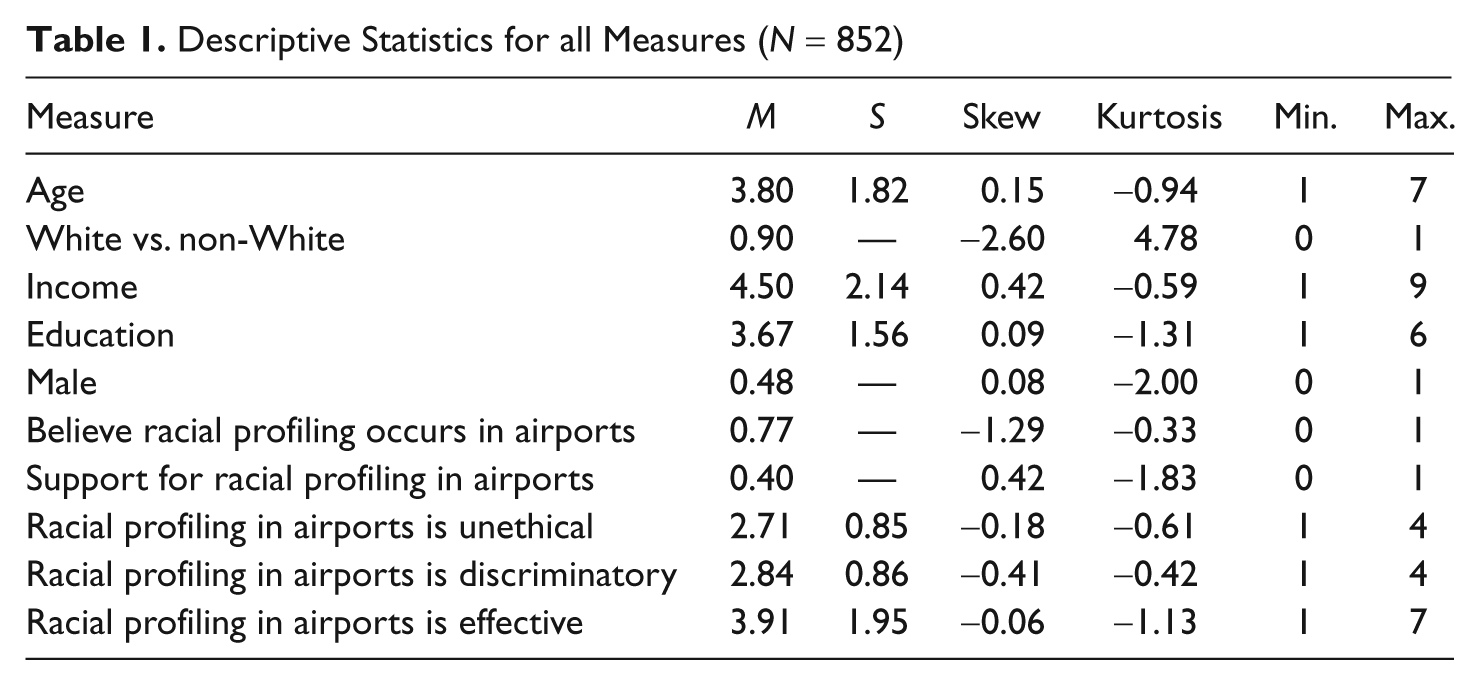
Table 1 presents the descriptive statistics for the sample (see appendix for the bivariate correlations of the measures). The average age for the respondents is 3.80 or 35 to 44. Hispanic respondents comprise 1% of the sample, and Black respondents make up 4% of the sample. The average income of the respondents in the sample is 4.50 or 40, 000 to 59,999. The average educational level of the respondents in the sample is 3.67 or some college. Male respondents make up 48% of the sample. Seventy-seven percent of the sample believes that racial profiling occurs at airports to identify terrorists. Forty percent of the respondents support the use of racial profiling at airports. A large percentage of the respondents agree with the view that racial profiling at airports is not ethical. Similarly, many of the respondents agree with the view that racial profiling occurring at airports is discriminatory. Finally, the majority of the respondents do not believe that racial profiling is an effective tool in identifying terrorists.
Descriptive Statistics for all Measures (N = 852)
Step 2
Table 2 presents the logistic regression analysis for the belief racial profiling occurs in airports. Two measures are statistically significant. First, as the individual’s perception that racial profiling is a discriminatory practice gets stronger, he or she is more likely to believe that racial profiling occurs in airports (b = 0.66, Exp(b) = 1.94). Second, as an individual’s perceptions that racial profiling is effective in identifying terrorists gets stronger, he or she is more likely to believe that racial profiling occurs in airports (b = 0.23, Exp(b) = 1.26). None of the tolerances are above the 0.20 threshold, suggesting that multicollinearity is a problem in this analysis.
Logistic Regression Analysis on the Belief That Racial Profiling Occurs in Airports (N = 852)
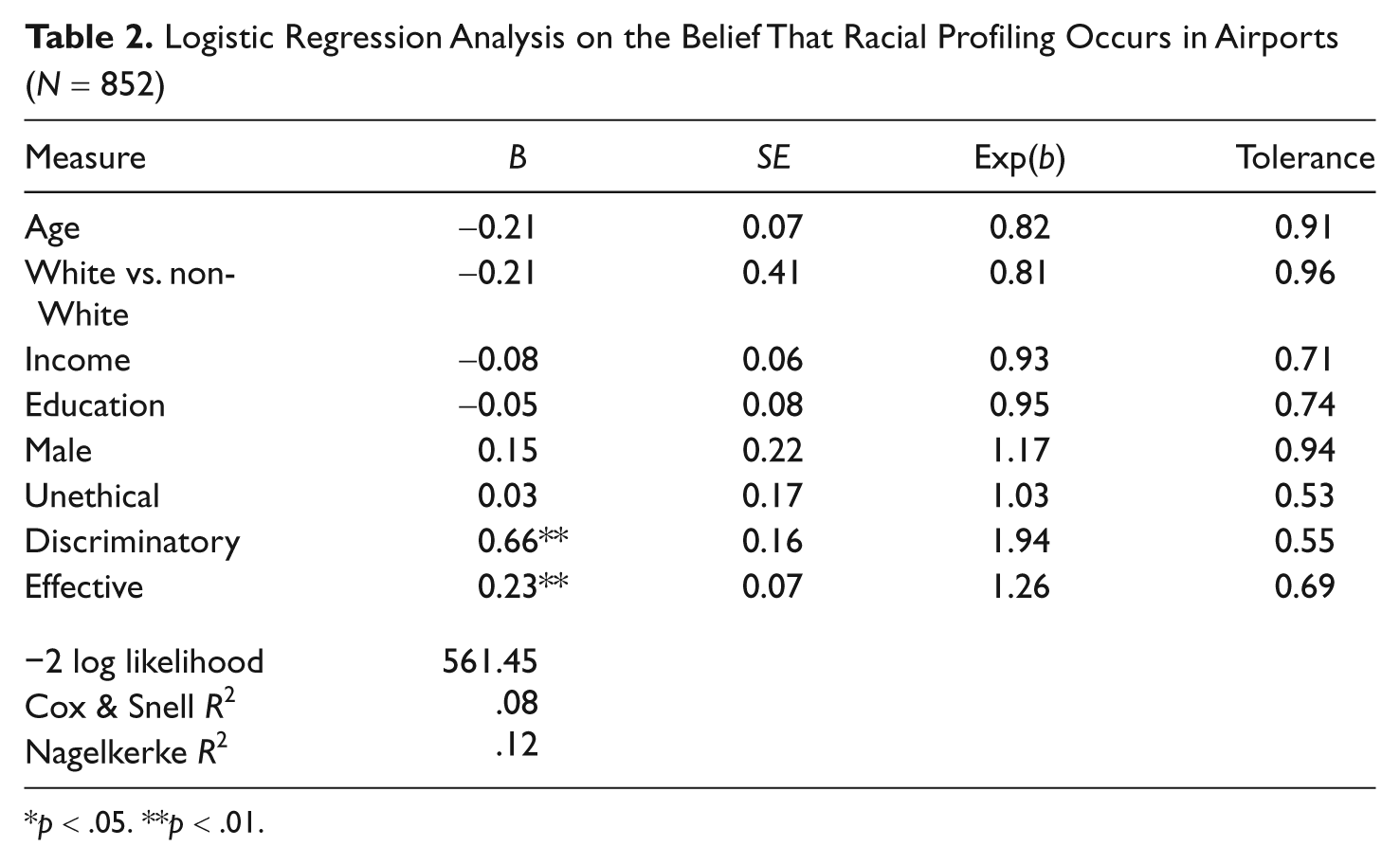
p < .05. **p < .01.
Table 3 presents the correlates of support for racial profiling in airports. As the individual’s perceptions that racial profiling in airports is not ethical gets stronger, he or she is less likely to support the practice (b = −1.25, Exp(b) = 0.29). As the individual’s perceptions that racial profiling in airports is a discriminatory practice gets stronger, he or she is less likely to support racial profiling in airports (b = −0.39, Exp(b) = 0.68). Finally, as an individual’s perceptions that racial profiling is effective in identifying terrorists gets stronger he or she is more likely to support its use in airports (b = 0.42, Exp(b) = 1.52). The tolerance levels are above 0.20, suggesting that multicollinearity is not a problem in this analysis. 1
Logistic Regression Analysis on Support for Racial Profiling in Airports (N = 852)
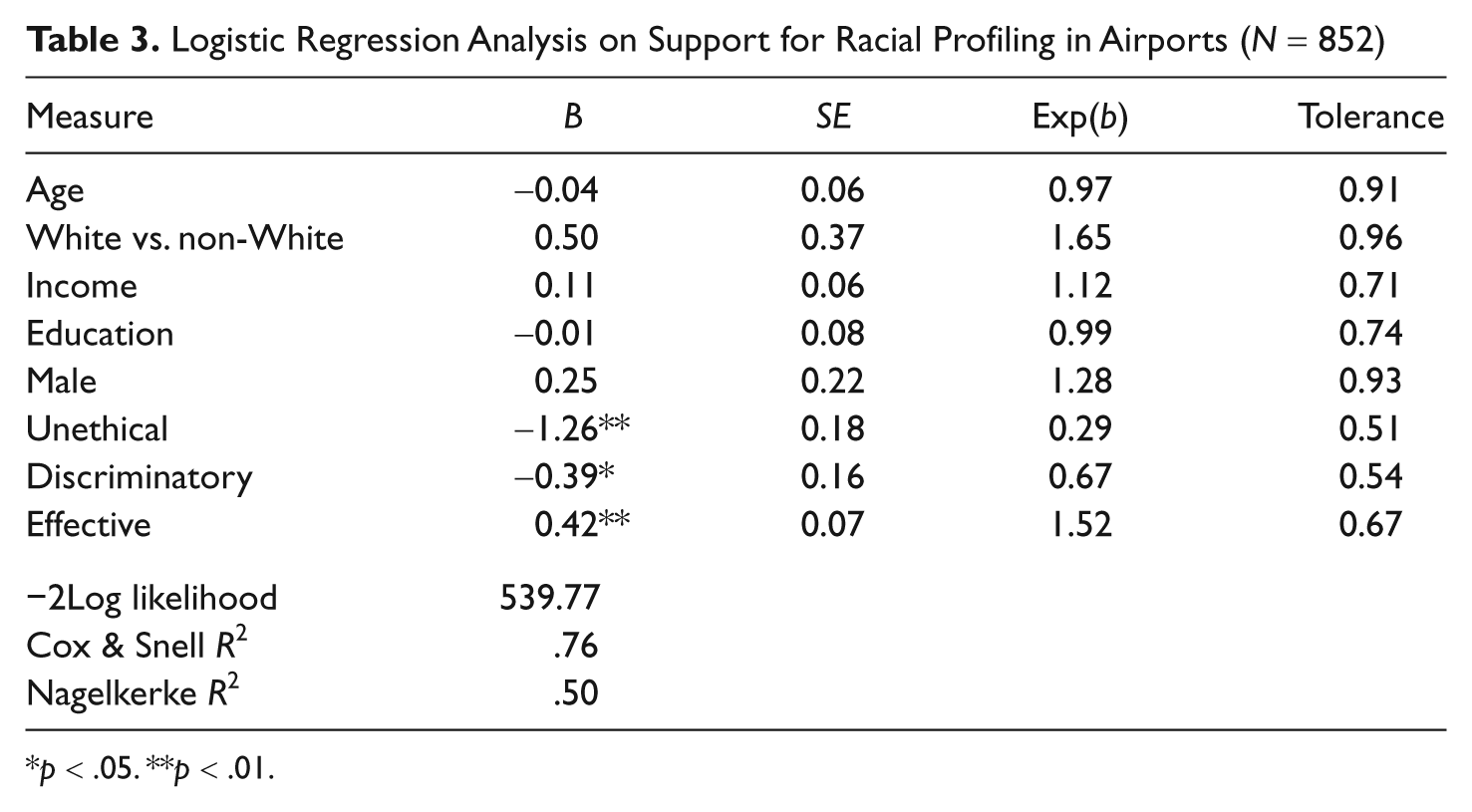
p < .05. **p < .01.
Discussion
We explored several new nuances related to public opinion on racial profiling at airports. First, however, we followed prior research by asking respondents whether they felt racial profiling was being used at airports to seek out terrorists. In alignment with past public opinion research on racial profiling, a large number of respondents believe the practice was being used (Higgins et al., 2009; Weitzer & Tuch, 2002). It is likely that given the media coverage of security incidents at airports in which there have been allegations of profiling, very few Americans—or in the case of this sample, Pennsylvanians—would not be aware of the existing allegations. We also asked whether the respondents supported racial profiling at airports and, again, the results mirrored that of previous polls in that only a small percentage of respondents expressed support (40%). It is notable that in a previous national poll only 25% of the respondents supported the practice (Gabbidon et al., 2009). It could be that as Pennsylvanians were directly impacted by the terrorist attacks with one of the hijacked airplanes having crashed in Shanksville, Pennsylvania, they more readily support the practice than those who reside in states that were not directly affected by the terrorist attacks.
Second, we explored whether respondents felt racial profiling at airports was discriminatory. There was a strong sentiment that the practice was discriminatory and the respondents who felt this way were more likely to believe this form of profiling occurs and less likely to support the practice. It is reasonable to expect that those who perceive racial profiling at airports as being discriminatory will not support the practice. These persons are likely citizens who have a strong sense of justice and perceive that discrimination—especially in light of the actions after 9/11—would exist at airports. Another factor we considered was ethical beliefs. Our suspicion that ethical beliefs would also influence support for racial profiling was confirmed; however, the belief that racial profiling occurs in airports was not influenced by ethical beliefs measure. Again, from our standpoint, it would be natural for those who are ethically against racial profiling to not support it. Ethical values typically guide one’s beliefs and, although we found the existence of some limited scholarly discussion in Canada about ethics and the use of profiling at airports (O’Malley, 2006), none of the existing discourse examines how public opinion is shaped by ethical values. This finding suggests that future researchers need to further explore the concept of ethics and create additional measures to capture one’s ethical beliefs.
Finally, the research sought to determine if the perceived effectiveness of profiling at airports influenced views on profiling at airports. Although the research revealed that less than 50% of the respondents supported racial profiling at airports, those who felt the practice was effective were more likely to support its usage. In addition, those respondents who felt that profiling was effective were also more likely to believe it was occurring at airports. It is very likely that as ordinary citizens do not know much about policing practices at airports, their views might be tempered by what they don’t see. For example, as there hasn’t been another major event that was a product of poor airport security, it is possible that respondents believe that racial profiling—along with additional security upgrades—has prevented further terrorist acts. This is also why the respondents who perceive the practice to be effective are also more likely to believe that racial profiling is occurring at airports. In short, if you believe that the practice works, you must believe that any reasonable security force (public or private) would be using the approach. The only problem with this thinking is that there is no scholarly evidence, to our knowledge, that supports that racial profiling is an effective strategy at airports. Unfortunately, in the absence of presenting respondents with evidence to contradict their beliefs, they will continue to harbor the belief that profiling is effective.
Even though the research revealed some exciting new insights on public opinion on racial profiling, there were several notable limitations. Most notably, the poll was restricted to Pennsylvania residents. It is possible that the results would have been different had the research been conducted in a different state or in another part of the country. In addition, it is possible that some of the views expressed by the respondents are temporal. That is, they might feel this way as there hasn’t been a terrorist attack on American soil since 9/11. It is possible that if there was such an incident, their views might have aligned with some of the findings from polls conducted shortly after 9/11. In short, without a longitudinal design, we are unsure how the respondents’ views would hold up over time. We were also restricted to the number of questions we could ask because of the cost of including questions on the poll. For example, we would have liked to have measured factors such as political beliefs that have been significant in similar polls. Furthermore, previous polls have oversampled racial and ethnic minorities, which has provided researchers with the opportunity to conduct comparative analyses by race/ethnicity. Our small sample of racial/ethnic minorities did not allow for split-sample analyses that have been extremely insightful in prior research. Another limitation of our research was that there was no measure related to victimization. In other words, there weren’t any measures on the survey to determine if the respondents’ views might have been influenced by actual or vicarious experiences with profiling at airports. 2 In general, we acknowledge that there is a dearth of research studies on racial-profiling victims (for a recent exception to this trend, see Glover, 2009). Despite these limitations, the Penn State Poll data yielded key findings that can be used as a springboard for future researchers.
Conclusion
This study explored some new measures for public opinion on racial profiling at airports. The infusion of measures for perceived discrimination, perceived effectiveness, and ethical considerations will, hopefully, spark new interest in the public opinion research in this area. It was promising that, based on the results related to discrimination and ethical values, Pennsylvanians have a strong sense that racial profiling is wrong. Moreover, there is also a strong sense that the approach is not effective. However, for the minority of respondents that supported the practice and also believed that it is effective, there needs to be an attempt to educate them as to what is and isn’t working regarding the war on terror because—to our knowledge—there is no existing scholarly evidence to support these views. In fact, decades of experiences and studies on the use of profiling at airports, during traffic stops, and in retail establishments have all shown the opposite: Racial profiling is not now—and never has been—an effective strategy (Dabney, Hollinger, Dugan, 2004; Harris, 2002; Leuprecht, Hataley, Moskalenko, & Mccauley, 2010).
To offset the misguided perceptions regarding the effectiveness of racial profiling, it is important that researchers continue to disseminate their research in venues that are read by the public. The recent focus on public criminology is of value here (Loader & Sparks, 2011; Rock, 2010; Uggen & Inderbitzin, 2010). Too often, researchers wait until the media contacts them to educate the public about the important findings in a particular area. We believe criminologists should be more proactive in presenting the results of their research through press releases and other media outlets to dispel myths that largely go unchallenged and, as a result, have the potential to create inequitable treatment that is sometimes based on race/ethnicity. Uggen and Inderbitzin (2010) speak to this general point, writing that “By bringing high-quality evidence to bear on hotly contested questions, public criminologists might play a key role in promoting sound policy and averting moral panics precipitated by extreme but rare cases” (p. 738).
In addition to criminologists, nonprofit organizations that have social justice-related missions (e.g., The Sentencing Project) should also be leaders in disseminating “facts from fiction” that will ideally lead to sound evidence-based policies. Here, too, criminologists have a wonderful opportunity to share the knowledge acquired through their scientific research with organizations that are well equipped to disseminate the results of important criminological work.
Footnotes
Appendix
Bivariate Correlations of the Measures
| Measure | 1 | 2 | 3 | 4 | 5 | 6 | 7 | 8 | 9 | 10 |
|---|---|---|---|---|---|---|---|---|---|---|
| 1. Age | 1.00 | |||||||||
| 2. White vs. non-White | 0.14* | 1.00 | ||||||||
| 3. Income | −0.18* | 0.18 | 1.00 | |||||||
| 4. Education | −0.10 | 0.08* | 0.46* | 1.00 | ||||||
| 5. Male | −0.07 | 0.09* | 0.15* | 0.03 | 1.00 | |||||
| 6. Belief | −0.14* | −0.03 | −0.03 | −0.06 | 0.01 | 1.00 | ||||
| 7. Support | 0.05 | 0.08* | 0.04 | 0.00 | 0.09 | 0.10 | 1.00 | |||
| 8. Effective | 0.17* | 0.04 | −0.08 | −0.10* | −0.04 | 0.09* | 0.46* | 1.00 | ||
| 9. Discrimination | −0.17* | −0.12* | 0.03 | 0.01 | −0.11* | −0.16* | −0.45* | −0.44* | 1.00 | |
| 10. Ethical | −0.12* | −0.12* | 0.02 | −0.02 | −0.10* | 0.10* | −0.55* | −0.52* | 0.64* | 1.00 |
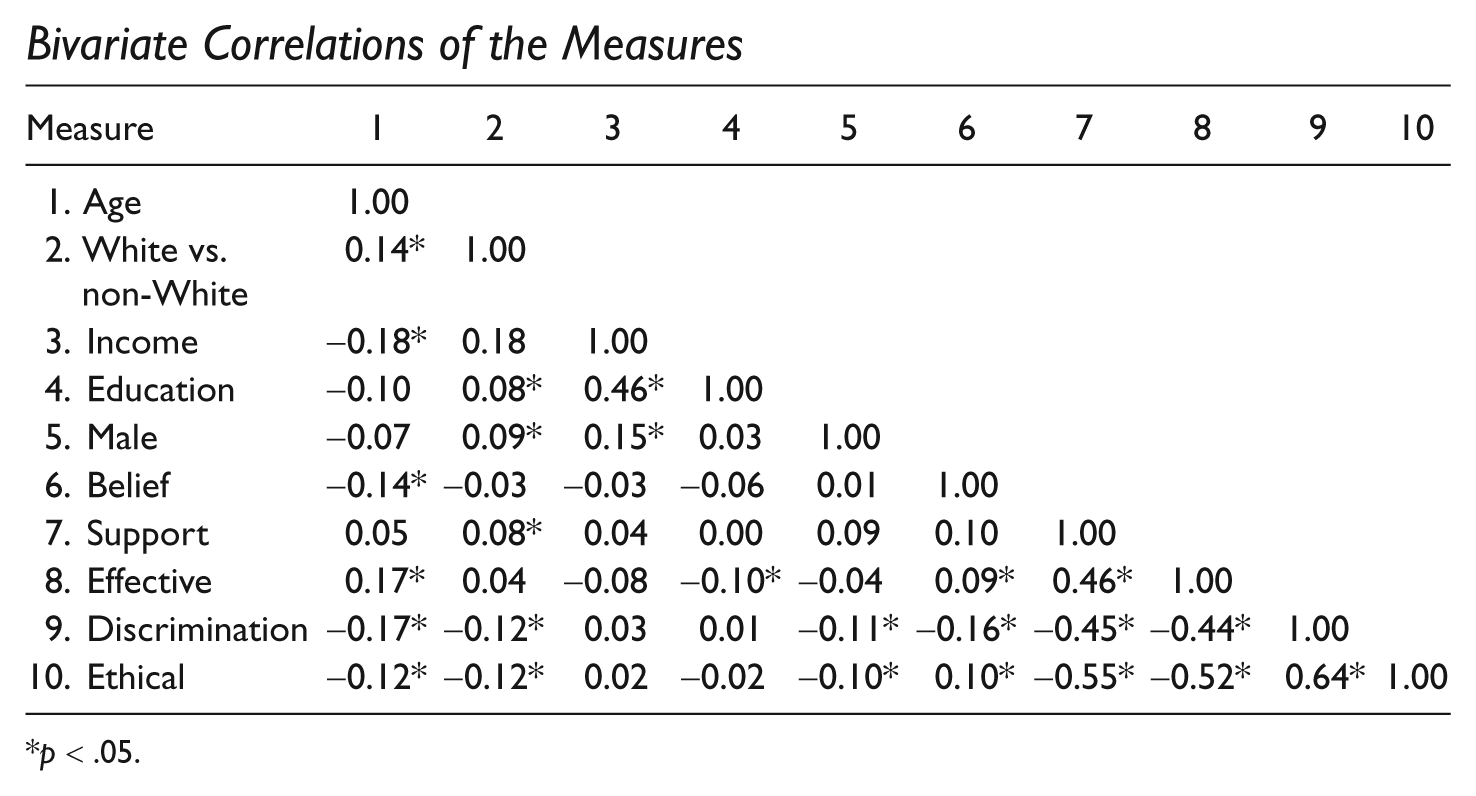
p < .05.
The author(s) declared no potential conflicts of interest with respect to the authorship and/or publication of this article.
The author(s) received no financial support for the research and/or authorship of this article.