



Abstract
Numerous policy issues surround the incarceration of religious extremists and individuals with terrorist ties. These inmates must be managed, prevented from precipitating security risks, and stopped from recruiting or encouraging others to commit terrorist acts. To systematically investigate the prevalence of these issues in U.S. prisons, we conducted a survey of wardens of state-level maximum security prisons in the United States. Results suggest that the majority of facilities currently have existing security threat groups (STGs) with extremist religious beliefs. Large majorities of wardens indicated shortages of religious service providers, with nearly all allowing volunteers to supplement existing religious services. A multinomial logistic regression model suggests that (in accordance with previous literature on gangs) wardens pursuing policies of isolating these prisoners believe these policies to be much more effective than other strategies, such as increased monitoring. Additionally, more frequent staff training relevant to managing these individuals is significantly related to wardens’ judgments that their policies are effective.
Introduction
When President Barack Obama took office in January of 2009, one of his first acts as President was to announce his intention to close the U.S. military detention facility at Guantanamo Bay, Cuba (Chaffee, 2009). At the time of the inauguration, approximately 200 prisoners reportedly remained detained in the facility as alleged members of al-Qaeda and other extremist organizations (Masters, 2011). The President and members of his administration have argued that the closure of Guantanamo Bay is essential because the detention facility diminishes the moral authority of the United States and has become “a rallying cry for terrorist recruitment” (Rhee, 2009, para.12-13; CNN, 2009). As a consequence of the President’s 2009 announcement, however, the public debate surrounding the fate of the Guantanamo Bay detainees intensified rather than abated, in large part because the plan to close the facility highlighted a number of intractable policy issues.
In addition to serious questions surrounding the circumstances under which particular detainees might be tried or eventually even released, the closure of Guantanamo Bay also heightened questions about the continuing detention of those who would remain in custody. Where would these detainees be relocated and under what conditions would they be held? One option considered by the Obama administration was the transfer of Guantanamo prisoners to an “underused” prison in a rural area of Illinois (USA Today, 2009, para.1). When this choice was met with strident objections from Illinois lawmakers and others citing concerns over risks to civilians in the area, another option was then proposed which involved a plan to move Guantanamo detainees to high security federal prisons, such as the “supermax” prison in Florence, Colorado (Johnson & Pincus, 2009; USA Today, 2009). This plan, too, was met with opposition from lawmakers and from many members of the public, despite the fact that existing prisoners with ties to terrorist organizations were already serving sentences at the Florence facility (Johnson & Pincus, 2009). In fact, polling data has routinely provided evidence that public perceptions represent a significant obstacle to efforts to close Guantanamo Bay, with polls suggesting that greater than 60% of Americans oppose the facility’s closure and even larger majorities oppose the relocation of these prisoners to U.S. soil (Harwood, 2011; Page, 2009; Steinhauser, 2010).
Ultimately, the controversy has proven so difficult to resolve that—after more than three years of the Presidents’ term of office—there still exists little consensus on the part of American political leaders regarding what is to be done with these individuals. Yet, even if the Guantanamo detainees are never moved to American soil, the need for correctional facilities in the United States to confront the potential problems inherent in incarcerating terrorists and religious extremists is still present. Indeed, as the post-9/11 period has progressed, a number of scholars and others have called our attention to the potential for prisoners already serving time in the United States to adopt extremist beliefs, to recruit and organize nonradicalized prisoners, and even to orchestrate “homegrown” terror plots (Hamm, 2007, 2009; Useem & Clayton, 2009).
For example, Hamm (2009) and others discuss at length the case of Jam’iyyat Ul-Islam Is-Saheed (the Assembly of Authentic Islam or “JIS”), the now-notorious group of prisoners from the California State Prison-Sacramento (“New Folsom Prison”) led by Kevin James. James, a former gang member, adopted and refined his religious beliefs while serving time in California correctional institutions (Hamm, 2007). In 2005, it was discovered that James and his adherents planned to attack numerous targets in the Los Angeles area, including synagogues, National Guard recruiting stations, and the Israeli Consulate (Hamm, 2007, p. 27). The plot was disrupted when one of his followers, Levar Washington, was paroled and eventually arrested for robbing US$252 from a gas station in an attempt to fund JIS activities (Hamm, 2007, 28). Hamm (2007, p. 4) argues that the JIS case “represents an international post-9/11 trend toward homegrown terrorist cells” and also “demonstrates that under certain conditions American correctional institutions are . . . vulnerable to prisoner radicalization and terrorist groups that infiltrate, recruit, and operate inside the walls.”
Despite the importance of these policy issues, a search of the research reveals surprisingly few empirical articles related to the topic. This is likely the consequence of difficulties in collecting and accessing data, obstacles that are also encountered by scholars attempting to conduct counterterrorism research more generally. Notably, a 2006 article by Kennedy, Lum & Sherley found only a very small number of empirical research articles examining counterterrorism interventions, despite healthy expenditures on antiterrorism efforts and a large number of scholars writing on these topics. With respect to policy questions about the detention of suspected terrorists or religious extremists, one resource at our disposal is the expertise of professionals in the corrections field. Thus, in this article, we conduct a national survey of wardens at maximum security state prisons in the United States, asking them to respond to a variety of questions about policy, training, and other issues related to the detention of radical or extremist individuals.
We believe that this survey will add to the literature in a number of ways. First, a survey is useful in that it provides a systematic, representative account of the concerns and recommendations of these professionals. Although the most infamous terrorists are in federal custody in the United States, many wardens at state-level facilities have also already encountered the challenges of detaining inmates with terrorist ties, those who hold religious extremist beliefs, or other radicalized individuals in their facilities. Additionally, the call for civilian prison staff at all levels to address these issues in their institutions is likely to grow, rather than diminish (Hamm, 2007, 2009; Useem & Clayton, 2009). Indeed, a number of specific concerns have been raised by researchers, government officials, and others regarding the extent to which American prisons are already confronting a growing problem related to extremist religious conversions, attempts to organize, and attempts to recruit prisoners to religious extremism and encourage terrorism. A survey can also test the extent to which there is existing evidence of these concerns in American correctional institutions. Currently, most of what is known about these issues has come from law enforcement sources; only a very few researchers have gathered primary data from the correctional system (Hamm, 2007, 2009; Useem & Clayton, 2009). However, before we turn to a discussion of the survey’s design and results, the next section situates this project further within existing research in the field.
Existing Research Related to IncarceratingTerrorists and Religious Extremists
Concerns about procedures for managing radicalized and terrorist prisoners are relevant not only to the Guantanamo Bay detainees and to specific facilities considered for their relocation, but also to other prison facilities in the United States and to additional prisoners. Indeed, even were we not to consider the potential problems inherent in detaining the specific individuals in Guantanamo Bay on U.S. soil, there are currently known individuals with terrorist ties serving time at all levels of the U.S. prison system (Hamm, 2007, 34, 106). These prisoners must also be managed and prevented from initiating attacks or precipitating other security risks.
A specific concern raised in the academic and policy literatures relates to the fear that inmates with extremist beliefs or terrorist ties will engage in attempts to recruit other nonradicalized inmates if they are permitted to interact with broader inmate populations (Hamm, 2007). Prior research has suggested that prisoners often become involved in religious groups for a number of benign reasons, such as to enhance their sense of belonging or to cope with difficult conditions in prison (Clear & Sumter, 2002; Hamm, 2007; Thomas & Zaitzow, 2004). Yet, some authors argue that the violent prison environment may also leave individuals seeking to join a radical group for protection or to gain status among the inmate population (Cilluffo et al., 2006).
The recruitment concern is potentially important not only because it might increase security risks inside of prison facilities, but also because recruits may decide to commit terrorist acts against the civilian population if they or any of their associates are released from prison (Hamm, 2007). The JIS case discussed in the previous section provides an example of this. Integral to the JIS plot was a new convert, named Levar Washington, who was paroled from New Folsom following his conversion (Hamm, 2007, pp. 47-49). At the direction of JIS’ still-incarcerated leader, Levar Washington recruited individuals with no criminal history from the civilian population outside of the prison to help with the plot (Hamm, 2007, p. 45). Additionally, after his parole, Washington used his former gang connections to secure firearms for the group (Hamm, 2007, p. 47).
The discovery of the JIS incident led to growing scholarly and government interest in the potential problem of prisoner recruitment to radicalization. Yet, as Hamm (2007, 2009) points out, this policy issue is particularly difficult because only one or a very small number of individuals out of the entirety of those incarcerated will ever pose a threat of this type. Additionally, it was precisely “because their numbers paled in comparison to other prison gangs, [that] JIS operated below the radar” (Hamm, 2007, p. 51). While large numbers of prisoners will undergo religious conversions and about 80% of these will convert to sects of Islam, (Ammar, Weaver, & Saxon, 2004; Spalek & Wilson, 2002; Zoll, 2005), most conversions will have little to do with terrorism (Hamm, 2007, 2009; Useem & Clayton, 2009).
Rather, social scientists studying the issue of inmate conversions have almost uniformly concluded that religious conversions to Islam are a positive force for transformation and rehabilitation in the lives of the great majority of converts (Ammar et al., 2004; Hamm, 2009; Spalek & El-Hassan, 2007). Thus, Hamm (2009) argues that commentators and policy makers too frequently draw unduly “alarmist” conclusions regarding the threat posed by conversions based on studies that are “devoid of social science methodologies . . . and . . . offer only scant evidence [about] the perceptions of wardens, guards, chaplains and gang intelligence officers” (p. 669). Indeed, efforts by the FBI to assess prisons in the United States for evidence of recruitment efforts on the JIS model have yielded no evidence of additional plots (Trout, 2007, as cited in Hamm, 2007). However, even those empirical researchers who find these threats to be exaggerated also assert that some possibility does exist for inmate recruitment to terrorism (albeit quite rare) and that corrections officials must remain vigilant (Hamm, 2007; Useem & Clayton, 2009).
Moreover, the potential for a recruitment threat originating from inside prisons is not the only type of recruitment concern raised in the literature. A second facet of this concern relates to extremist recruitment efforts targeting prisoners, but arising from outside of the facilities. Individuals who come into prisons to visit inmates may spread their ideas or may bring religious materials with them (Hamm, 2007, p. 106). There is also the potential for radical ideas to be spread via the telephone or by U.S. mail, even in letters originating from prisoners at other institutions (Hamm, 2007, p. 34). Some also have questioned whether radical groups may, in fact, be engaging in organized efforts to recruit prisoners to their beliefs through the [systematic] distribution of religious materials or even propaganda directly to prisoners (Baran, 2005, as cited in Hamm, 2007; Gartenstein-Ross, 2005). A number of authors have charged that Saudi Arabia has been involved in such efforts (Baran, 2005, as cited in Hamm, 2007; Gartenstein-Ross, 2005), though Hamm (2009) calls this particular threat “the myth of Wahhabi imperialism” (p. 680) and provides interview evidence suggesting that concerns related to outside recruitment are exaggerated (Hamm, 2007).
Generally, empirical researchers like Hamm have concluded that more pressing concerns may stem from structural issues inside U.S. prisons, such as overcrowding or a lack of rehabilitation efforts (Hamm, 2007; Useem & Clayton, 2009). Additionally, the limited availability of appropriate religious service providers may tie into the problem of radicalization and potential terrorist recruitment in prisons (Hamm, 2007, 2009). Through a methodology of detailed interviews with both prison chaplains and with prisoners, Hamm (2007) finds that prisons experiencing a shortage of these providers are more likely to allow inmates to fulfill this role. In New Folsom prison in 2007, for example, there was only one chaplain for every 2,000 inmates. . . . One part-time cleric was assigned to the Muslims; he was responsible for roughly 10 percent of the Islamic instruction. [In comparison, an inmate volunteer] and his team of inmate teachers were responsible for 90 percent of the instruction. (Hamm, 2009, p. 678).
Where shortages exist, a “charismatic” inmate may step in and act as an imam, but these inmate volunteers may hold much more extreme views than professional chaplains and may also use these positions of apparent authority to spread their beliefs (Hamm, 2007, p. 107). Rather than the more generalized recruitment concerns discussed above, the individualized recruitment of small numbers of inmates through ongoing, one-on-one efforts may be a more significant concern (Hamm, 2007, 2009).
When facing a shortage of religious service providers, another option is to allow volunteers from the community to enter prisons in order to fulfill this role. Many states have limited their prison chaplain programs due to a lack of resources and some states have moved to an entirely volunteer system (Hamm, 2007, p. 116). Yet, these volunteers may be difficult to control and are often not held to the same standards as paid chaplains (Hamm, 2009). For example, chaplains are required to have an accredited degree in a religious field, whereas volunteers may not be required to have the same level of formal education (Cilluffo et al., 2006). Volunteers are vetted with respect to criminal background and undergo a variety of searches and restrictions regarding what they may bring inside a prison (Hamm, 2007; Useem & Clayton, 2009). However, even with vetting, there are prisons where “little attention is paid to religious credentials” (Hamm, 2007, p. 98). Since the presence of outside volunteers has been suggested as a relevant factor, we examine reliance upon both paid and volunteer religious service providers in the survey discussed below.
Finally, in addition to the impact of shortages of religious service providers, we also broaden our inquiry further to investigate the types of existing policy and even staff training in place that are relevant to detentions of extremist inmates. For example, much of the research related to prison extremism has underscored the fact that American prisons are seeing a good deal of overlap between more traditional gangs and groups of religious extremists; in fact, extremist groups are routinely organized on the “gang model” (Cilluffo et al., 2006; Hamm, 2007, 2009). One inmate at Folsom explained, [p]eople are recruiting on the yard every day. It’s a ripe climate for terrorism. It’s scandalous. Everybody’s glorifying Osama bin Laden. But these Muslims come to Islam with the same gang mentality they had on the streets. Same red rags, same blue rags [symbols of the Crips and Bloods]. (Hamm, 2009, p. 674)
As a result, a number of insights may be drawn from the related literature on gangs in prisons.
Specifically, Fleisher and Decker (2001) note that a variety of efforts have been tried in prisons as a response to gang concerns, including segregation and isolation of gang members or leaders, lockdowns of institutions, and intercepting mail and other communications by known gang members. One of the most frequently used methods involves the isolation of inmates, often for 23 hours a day. A recent survey provides some empirical evidence related to the wardens’ perceptions of the effectiveness of these policies for managing gang members. Winterdyk and Ruddell (2010, p. 733) conducted a survey of 37 prisons and found that 75% of respondents indicated that segregation/isolation was “very effective.” In fact, more respondents rated isolation-type policies to be effective than for any other measure or policy examined (Winterdyk & Ruddell, 2010). We conduct a similar inquiry here regarding wardens’ perceptions of using isolation policies to manage religious extremist prisoners.
To further understand procedures already in place in these institutions, we also examine the availability and frequency of staff training related specifically to detecting or managing inmates who may pose a threat due to religious extremism. Though the issue of training has been raised in the literature (Hamm, 2007, 2009), little empirical work focused on training has been conducted to date. Based on findings from interview data, Hamm (2007) makes recommendations for “roll call” training involving “briefings on current gang recruiting activity and shifting power dynamics among prisoners” (p. 120). In order to further investigate the issue of training, respondents to this survey were asked about the frequency and types of training related to religious extremism that are given to staff. Respondents’ answers regarding training are discussed in further detail below and also incorporated into our regression model.
Data and Method
To explore these questions, surveys were sent to the wardens of all state-level prisons in the United States containing a maximum security unit in March 2011. All surveys were mailed along with consent forms via U.S. mail, but respondents were given the option of returning the survey in hard copy through a postage prepaid envelope or completing the survey online. The hard copy and online versions of the survey did not differ substantially in content or form. In the end, all but two respondents who completed the survey elected to do so in hard copy. Overall, a total of 49 surveys were returned (N = 49), reflecting a response rate of 19.1%, within the normal range for a mail survey (Kallis & Gigleriano, 1992; Kaplowitz, Hadlock, & Levine, 2004). Perhaps even more significantly, 31 out of the 50 states surveyed returned at least one completed response, reflecting a high degree of geographic representation and diversity (discussed in greater detail below).
The survey questions included a number of items about the policies in place for managing religious extremists and suspected terrorists in these facilities. Respondents were also asked about the types and frequency of training provided for staff. Additionally, questions were formulated to address and test specific other issues and concerns found within the literature, such as the concern that outside groups are using prisons for terrorist recruit or spreading extremist propaganda in prisons. Finally, the survey asked about prison characteristics, including demographic questions, such as the size of the prison, the type of prison (maximum security only or mixed levels of security), and the type of community in which the prison is located (urban, suburban, rural).
In the large majority of cases (75.5%), the respondents answering the survey identified themselves as wardens or superintendents of the institutions that they represented. However, in an additional 16.3% of cases, the wardens directed their assistants, prison chaplains, public information officers, or community resource managers to complete the survey on their behalf. In a number of cases where the wardens directed other individuals to complete the survey form, the wardens themselves also reviewed the responses and attached comments in some places where the survey items asked for the warden’s own judgment. In 6.1% of the cases, the survey respondent elected not to identify his or her position within the institution.
As mentioned above, a high level of variation is seen in the types of institutions that participated. In addition to the large number of facilities from different states that responded, the prisons were located in a wide variety of different types of communities, including large urban locales (14.6%), medium/small cities (25%), suburban communities (10.4%), and rural areas (43.8%). 4.2% of those responding did not elect to identify the types of communities in which their facilities were located. Likewise, the sample contains a good deal of variation in terms of prison population size, which ranged from a low of 99 inmates to a high of 5,000 inmates. Mean inmate population for the sample was 1,547 inmates.
Moreover, a comparison of our sample with data from the most recent Bureau of Justice Statistic’s Census of State and Federal Adult Correctional Facilities reveals striking similarities between our sample and the overall population of institutions. For example, in the BJS Census, the average number of inmates housed in state-level maximum security facilities in the United States was 1,423, a figure comparable to our mean of 1,547 (U.S. Department of Justice, 2005). Likewise, the bottom quartile of prisons found in our sample housed 850 inmates or less, while the comparable census quartile was comprised of prisons housing 809 prisoners or less (U.S. Department of Justice, 2005). Finally, the top quartile of institutions in the sample each housed greater than 2,000 inmates, while the top quartile of institutions in the census each housed greater than 1,795 inmates (U.S. Department of Justice, 2005).
Variables in the Regression Model
In addition to reporting the results of the survey items below, we use multinomial logistic regression to estimate a model of policy effectiveness using our survey data. During the survey, all wardens were first asked to specify the types of policies in place in their institutions for managing prison inmates who are members of security threat groups (STGs) or extremist/radical groups (the specific wording of this item is discussed in more detail below). Following this, wardens were also asked to assess the effectiveness of the measures taken in their facilities for managing inmates with extremist religious beliefs. For this question, the respondents answered on a 3-point scale by selecting “very effective” (n = 15), “somewhat effective” (n = 21) or “needs improvement” (n = 13). Since very limited research has been conducted on this topic to date, it was thought prudent to restrict the number of options on this response scale in order to increase the likelihood that responses would be substantively meaningful. The wardens’ responses to this survey item are utilized as the dependent variable in the regression model presented below.
Multinomial logistic regression is used in research designs where the goal is to predict membership in a specific category of a polychotomous dependent variable (in this case, those wardens who judged their policies to be most effective). As such, the regression model aims to uncover policy measures or facility characteristics which are associated with assessments of high policy effectiveness, while controlling for other factors that could influence these judgments. By revealing which characteristics are significantly associated with wardens’ judgments of policy effectiveness, this model allows us to take advantage of this group’s expertise regarding what they view to be best practices. One benefit of using multinomial logistic regression is that this technique involves separate comparisons for each category of the dependent variable as compared with a base category (Field, 2008). Thus, in the model presented below, two comparisons are presented, first a comparison between those wardens rating their policies as “very effective” with those answering “needs improvement” and then a comparison between wardens rating their policies as “somewhat effective” with those responding “needs improvement.” In situations where little previous research exists, this technique is useful because it doesn’t “force” the data found in different response categories of the dependent variable to fit within one singular comparison (Field, 2008). 1
Of course, since these questions ask about warden’s perceptions, a limitation of this study is that the perceptions of individuals can sometimes be incorrect. However, though this is always a concern in survey research, we believe that it is useful and appropriate to query this population about their perceptions of this problem, as these individuals have significant professional experience closely related to the questions at issue. As mentioned above, the major existing studies in this field rely primarily on detailed interviews and case studies, both of which are also based upon individuals’ perceptions. Though previous studies have provided exceedingly useful and detailed evidence (Hamm, 2007, 2009; Useem & Clayton, 2009), a survey is a valuable contribution because the methodology increases representativeness and also allows the respondents to answer under conditions of anonymity.
Independent Variables
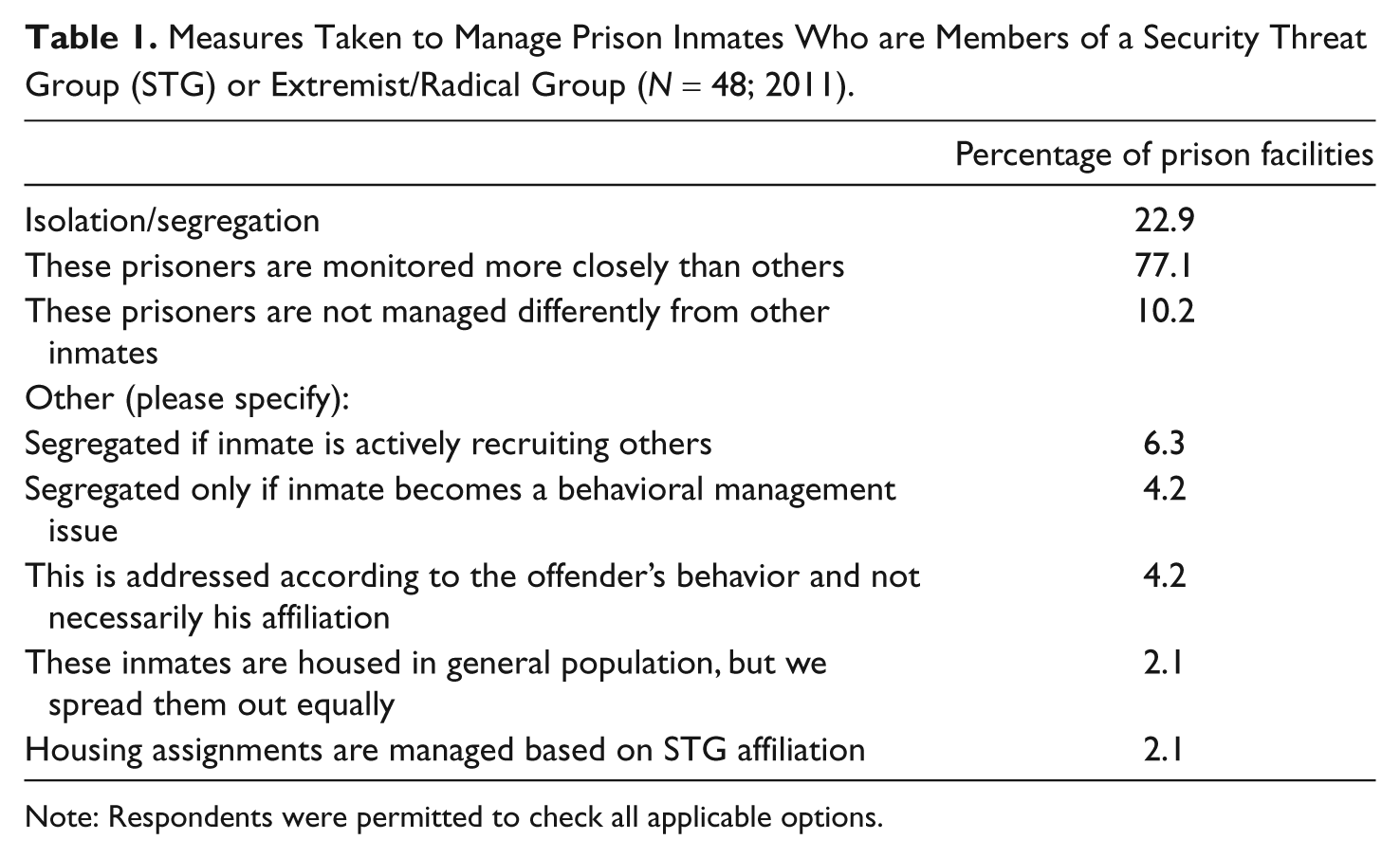
Independent variables incorporated into the model include two dummy variables connected to specific policies in place in these wardens’ facilities. In order to construct these variables, all wardens were asked about the measures taken in their facilities for managing prison inmates who are members of an STG or an extremist/radical group. Respondents were permitted to select either a specific policy from a list or to specify an individualized policy (listed in Table 1). To formulate the prespecified options, the authors consulted with an individual with lengthy professional experience in the corrections field and also examined the relevant literature. Overall, only 12.2% of wardens opted to describe a policy tailored to their specific institution rather than selecting a prelisted option, suggesting that the list is a reasonable representation of existing policies. Respondents were also permitted to check more than one option or to indicate that no existing policy was then in place specific to managing these prisoners. The next paragraph explains in detail how these options were treated in the construction of the two relevant independent variables.
Measures Taken to Manage Prison Inmates Who are Members of a Security Threat Group (STG) or Extremist/Radical Group (N = 48; 2011).
Note: Respondents were permitted to check all applicable options.
The first policy dummy, called “isolation policies,” pertains to prisons that have in place a policy of isolating or segregating extremist/radicalized inmates from the general prison population. All wardens who indicated that an isolation policy exists in their prisons were coded as 1 for the purposes of this variable, regardless of the other options selected. The percentages in Table 1 make clear that isolation policies are sometimes pursued in combination with other measures. The second policy-related dummy variable, called “monitoring-only policies,” was also constructed by using the data collected from the survey item described in the last paragraph. The “monitoring only” dummy pertains to those facilities opting to pursue only a policy of increased monitoring for these inmates (coded as 1). In total, about half of the sample fell into this group.
In addition to the independent variables relating to specific types of policies for managing these inmates, a measure of the frequency of staff training is also included. Respondents were asked to indicate whether or not their facilities offer training to staff “related specifically to managing routine interactions with inmates who hold extremist religious beliefs.” Answer choices for this question included: “Yes, as part of their initial training,” “Yes, staff receives this training annually,” or “No.” In this case, relatively few survey respondents selected the first option (reported in more detail below), so we found it was necessary to combine this category with another to avoid empty cells in the regression. One beneficial aspect of multinomial logistic regression is that the researcher may collapse response scale categories in this manner without fear of biasing the results (Field, 2008). Since we are most interested in the impact of consistent or repeated training, we have opted to include a dummy variable representing institutions with yearly training (coded as 1) as compared with all other facilities (coded as 0).
Finally, the regression also includes three control variables related to specific prison characteristics. Though this study is the first of its kind, we included these controls because it is logical to hypothesize that, for example, the overall frequency of security issues related to extremist/radicalized inmates would impact wardens’ views of the success of their policies and training for managing these inmates. As a result, we constructed an additional dummy variable representing those facilities (coded as 1) where wardens reported that safety or security issues arise relatively frequently (once a year or more) as the direct result of inmates holding extremist or radicalized beliefs. All other facilities were coded as 0. Similarly, included in the regression is a dummy variable representing all facilities that currently have STGs related to religious extremism designated in their facilities (coded as 1, all others = 0). Finally, a dummy variable called “dedicated maximum security facility” was added, representing all facilities containing only maximum security units (coded as 1), as opposed to those facilities containing mixed levels of security (coded as 0).
Results
The Prevalence of Extremism, Organization, and Recruitment
The survey results reveal that the spread of religious extremism and radicalization in prisons is not an insignificant concern among this sample of wardens. In fact, 60.4% of wardens surveyed indicated that security threat groups holding extremist religious beliefs have been designated in their facilities, while only 37.9% of respondents answered that such groups have not been designated in their facilities. Additionally, when asked whether or not these wardens see signs that extremist prisoners are engaging in efforts to organize themselves, either formally or informally, 39.6% of respondents answered that there are “some indications” of this, while an additional 6.5% of respondents indicated that they see “significant indications” of this concern within their facilities (Figure 1). In comparison, a full 50% of those surveyed answered that they have seen “no indications” of this concern in their facilities.
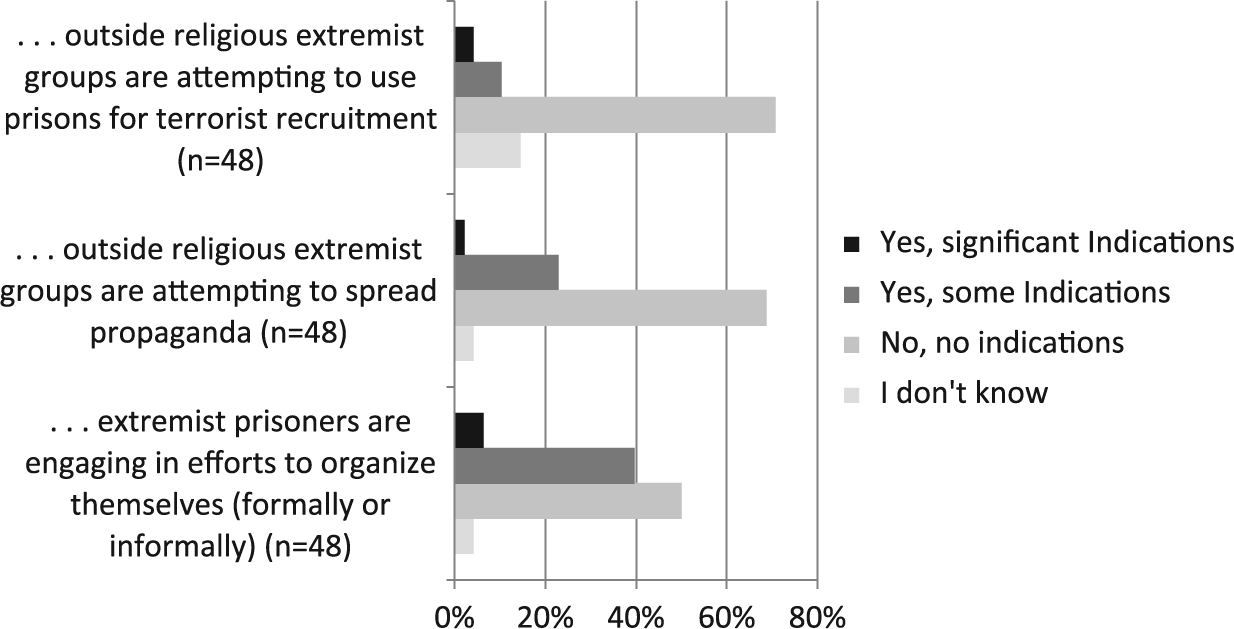
“Within your facility, do you see any indications that . . . ?” (2011).
The survey also included some additional items meant to explore the prevalence of other types of concerns raised in the literature. For example, some have suggested that outside religious extremist groups might attempt to utilize prison populations as a base for the recruitment of new members (Baran, 2005, as cited in Hamm, 2007; Gartenstein-Ross, 2005). 10.4% responded that there are “some indications” of this in their facilities and an additional 4.2% suggested that they see “significant indications” of this effort, for a total of 14.6% indicating that this is a concern at their facilities. Though a substantial majority of respondents (70.8%) indicated that this is not a concern, it is also important to note that a significant percentage of respondents selected the available “I don’t know” option (also 14.6%).
When asked about efforts by outside groups to spread propaganda within prisons, the numbers of wardens reporting signs of this concern increased somewhat in comparison to the last question, with 22.9% of respondents selecting “some indications” and an additional 2.1% selecting “significant indications” for a total of 25% of the sample. 68.8% of wardens reported no indications of this, while another 4.2% selected “I don’t know” and 2.1% left the question blank.
Evidence of a Potential Link BetweenShortages of Religious Service Providers and Extremism
In addition to the concerns discussed above, some have suggested a possible link between shortages of appropriate paid religious service providers and the spread of religious extremism in prisons (Hamm, 2007, 2009). Only 35.4% of the wardens in this sample reported having sufficient numbers of paid Muslim religious service providers, as compared with 41.7% for Catholicism, 58.3% for Protestantism, and only 25% for the Judaism (results not shown). In each case, however, an additional 12% to 14% of wardens opted not to answer this question. One reason that shortages might be concerning is that those facilities without sufficient numbers of religious service providers may have a tendency to allow volunteer religious service providers. Some worry that the presence of volunteers could encourage the spread of extremism or heighten other security risks, since volunteers may not be trained or vetted to the same extent as official chaplains.
In response to questions about the presence of these volunteers, only one warden indicated that his or her facility does not permit volunteers of this type. The remaining wardens were then asked to indicate the extent to which they were concerned about specific potential risks posed by these volunteers (Figure 2). For example, when asked if they were concerned that these volunteers don’t possess enough training, 10.4% of wardens responded that they were “very concerned,” while an additional 54.2% of the sample selected “somewhat concerned” in response to this item. In this case, only a minority of the sample (34.5%) responded that they were “not concerned” about a lack of training with respect to volunteer religious service providers in their facilities.
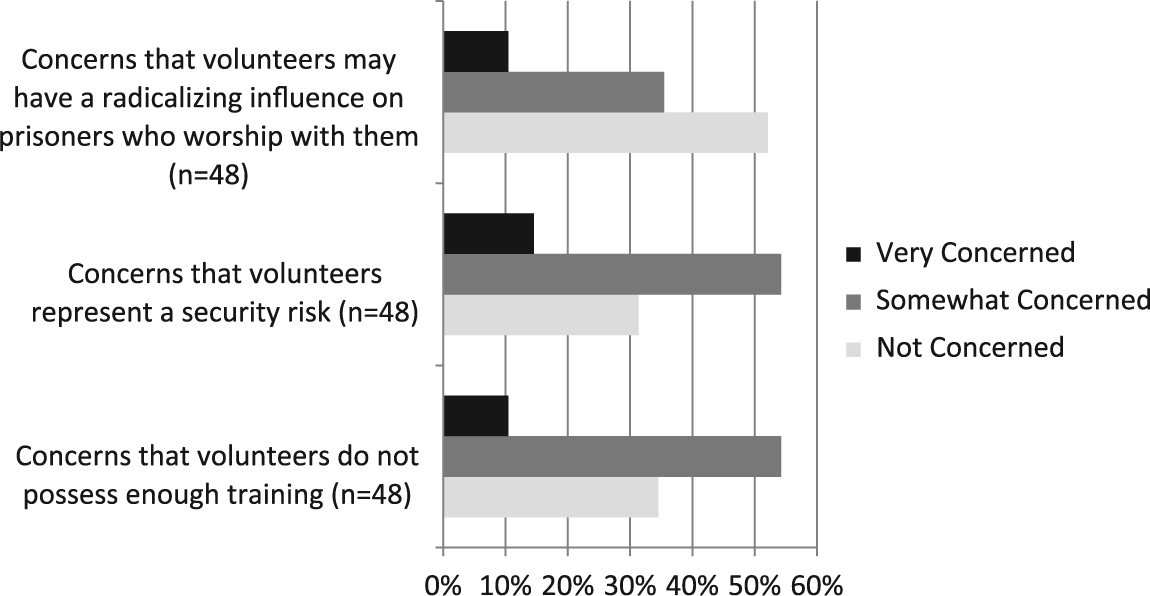
“If your facility permits volunteer religious service providers, how concerned are you about the following types of potential risks regarding these individuals?” (2011).
Similarly, respondents were also asked to rate their level of concern about these volunteers posing a security risk to their facilities (Figure 2). 14.6% selected “very concerned,” while a full additional 54.2% indicated that they were “somewhat concerned.” In this case, an even smaller minority (31.3% of the sample) indicated that a potential security risk involving these volunteers was not a concern. Finally, when asked about their level of concern that the volunteers may potentially have a radicalizing influence on the prisoners who worship with them, 10.4% selected “very concerned” and 35.4% selected “somewhat concerned.” In comparison, 52.1% of the sample did not think this potential radicalizing influence to be of concern.
Policies in Place for Managing ReligiousExtremist and Radicalized Prisoners
The survey also included a number of items about the policies in place for managing religious extremist prisoners, as well as the training routinely provided to staff. Table 1 (above) displays all responses to the question discussed in the methods section pertaining to the measures in place for managing prison inmates who are members of STGs or extremist/radical groups. 22.9% of respondents indicated that their facilities separate prisoners in STGs or extremist/radical groups from the general population. The remainder of the institutions surveyed opted to put in place other types of policies (Table 1). For example, the large majority of respondents (77.1%) indicated that their institutions monitor these individuals more closely (sometimes in combination with other types of policies). Nearly half of the wardens surveyed responded that their facilities have opted only for policies of monitoring these inmates more closely. 10.2% of the respondents indicated that no special measures are taken to manage these inmates any differently from others.
Figure 3 displays the answers to questions about the types of training that members of the staff in these facilities receive. Since few studies have concentrated on staff training related to religious extremism prior to this survey, we opted to use substantive, descriptive terms to frame the questions about staff training, as opposed to technical descriptors than might differ from one institution to another. Thus, we first asked respondents whether or not members of the “staff receive specific training regarding how to spot inmates who may pose a threat due to extremist religious beliefs.” The results reveal that a significant percentage of institutions provide annual training on this issue (41.7%), with an additional 37.5% reporting that their institutions provide staff with training of this type only at the time of their initial hire. Twenty-seven percent do not provide their staff with any training of this type. However, when asked about training for staff “related specifically to managing routine interactions with inmates who hold extremist religious beliefs,” the responses were markedly different. With respect to this type of training, the majority of the respondents’ facilities (64.6%) do not offer this. In comparison, 25% of respondents’ institutions offer annual training and an additional 16.7% offer this training only initially.
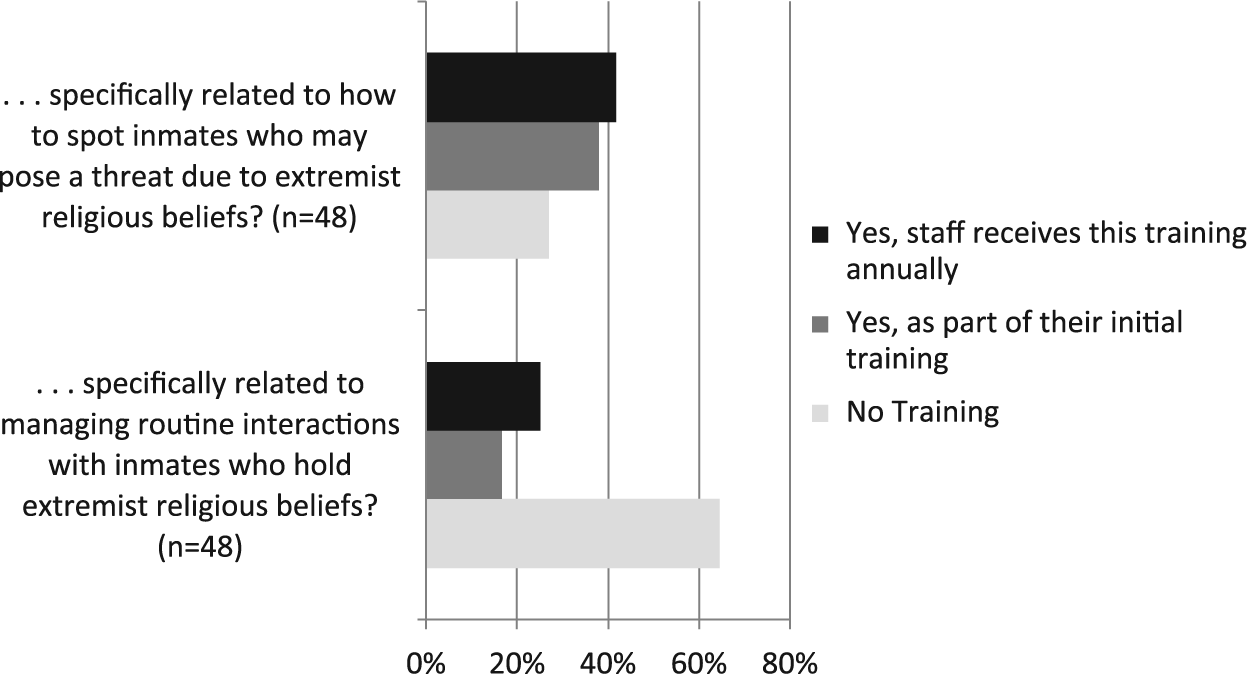
“Does the staff in your facility receive training . . . ?” (2011).
Overall, the majority of wardens responding to the survey indicated a belief that more training related to religious extremism would be beneficial, with 22.9% selecting “highly beneficial” and 62.5% believing additional training would be “somewhat beneficial” (results not shown). In fact, only 12.5% of the respondents thought that more training would not be a good use of staff time. However, further examination of the results reveals that none of the respondents who fell into this category indicated that their institutions provided yearly training of either type mentioned above. For this reason, it is unlikely that this response may be attributed to the wardens’ sense that routine, annual training related to religious extremism already occurs too frequently in these 12.5% of prisons. Only 2.1% of those participating opted not to respond to this survey item.
Factors Associated With Wardens’ Judgments of Successful Policies
Table 2 displays the results of the multinomial logistic regression model using data from the survey. The model reveals that a number of factors are significantly related to wardens’ appraisals of the effectiveness of their institutions’ policies for managing extremist/radicalized inmates. Both types of policies discussed above—isolation policies and policies involving increased monitoring alone—are significantly related to wardens’ judgments of policy effectiveness, yet with opposite effects. Wardens from facilities that isolate extremist and radicalized inmates were significantly more likely to view these policies as “very effective,” b = 4.960, Wald χ2(1) = 7.03, p < .01. In fact, the regression reveals that the odds of a warden from a facility with a policy of isolation judging this policy to be “very effective” were actually 142 times greater than the odds for wardens at other types of institutions.
Multinomial Logistic Regression Results, Factors Predicting Wardens’ Judgments of Policy Effectiveness (N = 49).
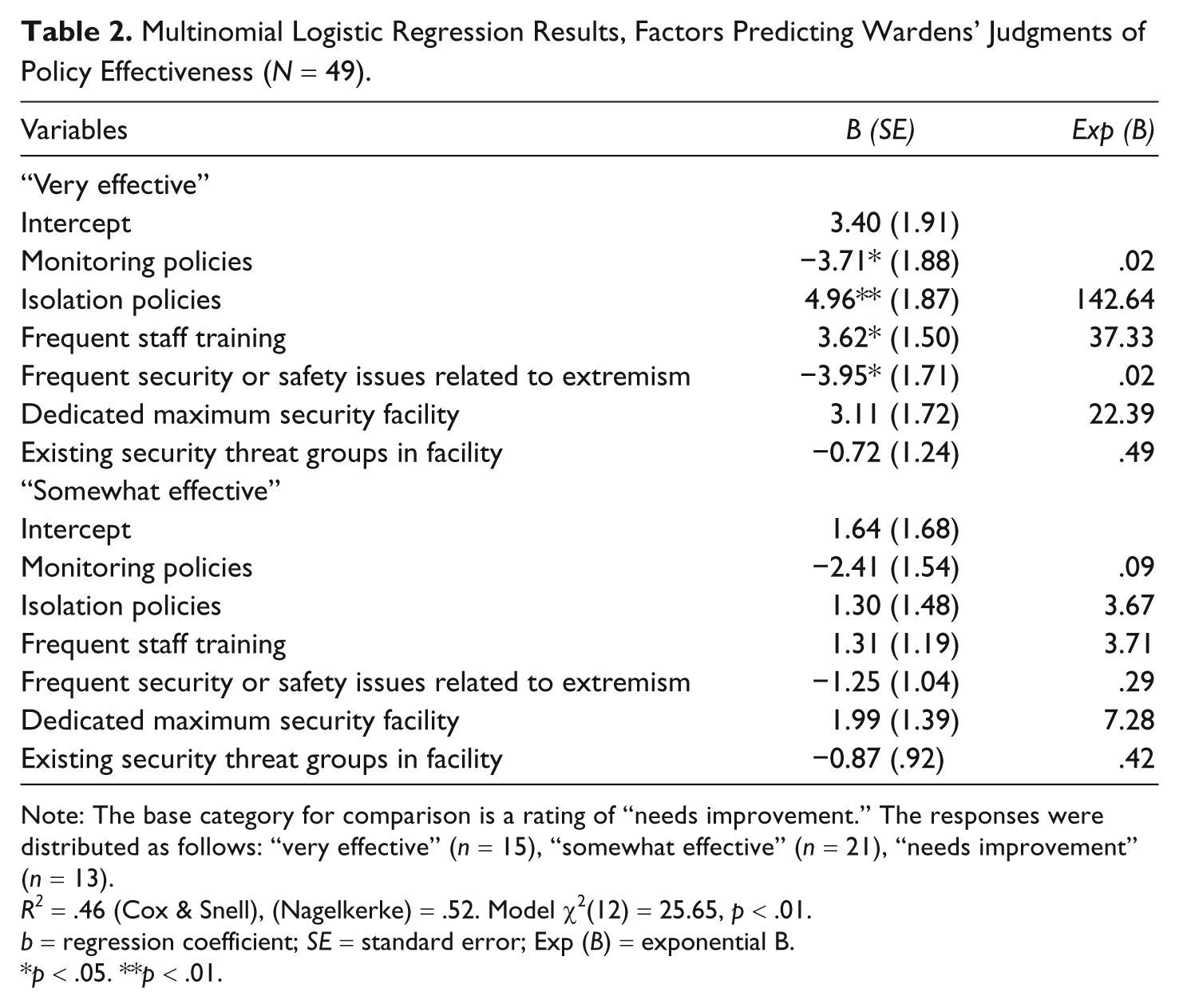
Note: The base category for comparison is a rating of “needs improvement.” The responses were distributed as follows: “very effective” (n = 15), “somewhat effective” (n = 21), “needs improvement” (n = 13).
R2 = .46 (Cox & Snell), (Nagelkerke) = .52. Model χ2(12) = 25.65, p < .01.
b = regression coefficient; SE = standard error; Exp (B) = exponential B.
p < .05. **p < .01.
Interestingly, the opposite relationship is found when one investigates the responses of wardens whose facilities have adopted policies involving only increased monitoring. When compared with other types of institutions, the wardens at institutions with “monitoring-only” policies in place were significantly less likely to judge their policies as “very effective,” b = −3.71, Wald χ2(1) = 3.92, p < .05. Rather, these wardens were much more likely to indicate that their policies “need improvement.” Specifically, the odds of wardens from institutions with monitoring-only policies selecting “needs improvement” were nearly 42 times greater than for the other wardens in the survey.
Moreover, the model reveals that the provision of more frequent staff training related specifically to managing interactions with extremist/radicalized inmates is also significantly associated with these professionals’ judgments of policy effectiveness. For example, those wardens at facilities with yearly training were much more likely to consider their policies to be “very effective,” as compared with other wardens, b = 3.62, Wald χ2(1) = 5.81, p < .05. In fact, the model reveals that wardens of facilities with yearly training were about 37 times more likely than others to judge their policies to be “very effective.”
Lastly, two of the control variables included in the model also yielded significant or near-significant coefficients. First, the distinction between facilities where extremism-related safety or security issues arise once a year or more and facilities with fewer of these issues is significant. Not surprisingly, the odds of wardens of facilities with more frequent safety or security issues judging their policies to be effective were almost 52 times less than for wardens at other facilities, b = −3.95, Wald χ2(1) = 5.33, p < .05. Very simply, the fewer issues arising related to these prisoners, the more likely it was that the wardens’ felt their policies to be effective. The type of facility at issue—either a “dedicated” maximum security facility or a facility containing units of multiple security levels—also very nearly yielded a significant result, b = 3.11, Wald χ2(1) = 3.26, p > .05. Though it cannot be said to produce a significant effect (p = .07), those wardens serving in “dedicated” institutions in this sample were more likely to rate their policies as “very effective” than others in the sample.
In comparison, the dummy variable denoting whether or not a facility contained currently-designated security threat groups related to religious extremism did not yield a significant result, b = −0.715, Wald χ2(1) = 0.33, p > .05. Moreover, an examination of the bottom half of Table 2 (or the half that compares those wardens who rated their policies as “somewhat effective” with respondents who answered “needs improvement”) does not reveal any significant results. One benefit of multinomial logistic regression is that the technique involves separate comparisons for different categories of the dependent variable (Field, 2008). This is particularly useful when conducting an analysis that is more exploratory in nature, since it does not “force” a particular segment of the data (in this case, the comparison between “somewhat effective” and “needs improvement”) to fit within a model with one set of coefficients that may not reflect all categories of the data well. Further discussion of this and the possible reasons for the outcome with respect to the second half of Table 2 will be reserved to the next section.
Discussion
A survey of professionals in the field is useful because it allows us to gauge the actual level of concern among practitioners regarding issues that have been raised in the empirical and nonempirical literatures. For example, the survey results provide a sense of the breadth of institutions currently grappling with these policy issues. In this case, the majority of institutions (60.4%) indicated that they have existing STGs that also hold extremist religious beliefs designated within their facilities. This finding suggests that many of the policy issues considered here are dispersed throughout the field, rather than confined to a specific small number of institutions.
Thus, we opted to introduce this article with a brief discussion of the most widely covered facet of the policy debate regarding terrorist and extremist prisoners—the case of the Guantanamo Bay, Cuba detainees. This discussion was not meant to suggest that all of the concerns surrounding these detainees are identical to those relating to extremist prisoners already in U.S. prisons. Rather, the goal was to draw a policy connection between this high profile debate and the experiences of corrections professionals working in U.S. institutions, many of whom already confront similar issues. Additionally, we suggest that there is utility in grounding discussions of closing Guantanamo Bay in research by scholars examining the incarcerations of religious extremists and recruitment to terrorism in American prisons. The study conducted here contributes to that line of research through the first survey of prison wardens related specifically to these topics.
It is important to note, however, that although these policy issues are relevant to large numbers of prisons, the survey results also provide support for the conclusions of previous researchers who have warned against the potential to be “too alarmist” regarding the scope of this threat (Hamm, 2009; Useem & Clayton, 2009). Specifically, in comparison with the 60.4% of institutions containing STGs with extremist religious views, a smaller percentage (39.6%) of wardens responded that there are “some indications” that members of these groups are attempting to organize either formally or informally. Moreover, an even smaller percentage (only 6.5%) of wardens in this sample indicated that they see “significant indications” that members of these groups are attempting to organize themselves. These results are not inconsistent with the conclusions drawn in existing interview-based studies. For example, Hamm (2007) argues that though there are large numbers of religious conversions in prison and extremist groups may view prisons as “fertile grounds for recruitment,” serious threats will likely come from many fewer sources (p. 28). Clearly, though, if threats can emanate from even a small number of institutions, these must be taken seriously. Continued research can provide more targeted information for responding to potential threats.
Previous empirical researchers have similarly suggested that the threat of outside recruitment appears to be exaggerated (Hamm, 2009). With respect to this conclusion, the results from our survey appear both partially consistent and partially inconsistent with existing research. On the one hand, some respondents (10.4%) reported indications of attempts at outside recruitment in their facilities and a small number (4.2%) even reported “significant indications.” However, a very high percentage (nearly 71%) also responded that they have seen no indications of this whatsoever. Moreover, when asked a follow-up question related to attempts to spread religious propaganda in their facilities, the results were quite similar with nearly 70% reporting no indications of this. Thus, the wardens’ responses seem to echo those researchers finding that an organized outside recruitment effort is not the most salient concern to these facilities compared with other concerns discussed on the survey. This result also appears consistent with Hamm’s (2007) argument that a JIS-type of threat involving individual recruiting by one charismatic inmate inside of a facility is of greater concern.
Also consistent with previous interview-based studies is the extent to which the survey supports researchers’ concerns over shortages of chaplains. Of particular interest, however, is the fact that the survey also provides specific evidence that wardens appear to be quite concerned about these same shortages. Only about one third of respondents to this survey indicated that their facilities have sufficient paid religious service providers for the Muslim inmates housed there. In comparison, shortages of Christian chaplains were slightly less severe, while shortages of professional Jewish religious service providers were actually the largest. In response to his own evidence of these shortages, Hamm (2009) criticizes the fact that too often “resources are expended in the search for [recruitment by] prison outsiders, [but] the root causes of radicalization—overcrowded maximum security prisons with few rehabilitation programs and a shortage of chaplains to provide religious guidance to spiritual searchers—are ignored” (p. 682). The survey results may provide some evidence about the impacts of ignoring these problems.
For example, nearly all facilities participating in the survey indicated that they permit volunteer religious service providers to enter prisons from the community in order to work with prisoners. Consistent with our results, Knox (2005) likewise finds that the great majority of prisons in the United States permit volunteers of this type. Additionally, Hamm (2007, p. 116) suggests that some state prison systems, such as those in Virginia and Colorado, have even moved to a system entirely comprised of volunteers. The survey items meant to gauge concerns about these volunteers reveal that between 10% and 15% of wardens have serious concerns about each potential issue related to volunteers that was discussed on the survey, including security concerns, concerns about the spread of extremism, and concerns about a lack of training. Furthermore, additional consideration of those wardens responding that they are “somewhat concerned” about these issues increases this figure by between 35% and 55% of respondents, depending upon the specific concern contemplated. Thus, significantly greater percentages of prison wardens expressed concerns about volunteer religious service providers than they did about the issues discussed in the last paragraph, such as organized outside recruiting or the dispersion of propaganda by outside groups.
From their interviews and the analysis of other data, Useem & Clayton (2009) conclude that prisoner radicalization is becoming less of a concern over time because prisons have been adept at responding to potential threats through policy. The survey results support this conclusion in the sense that nearly 80% of facilities report that they currently have staff training in place to deal with the detection of religious extremists who may pose a threat. There is much to be said for the fact that so many of these institutions are responding to this potential threat through training. Interestingly, however, greater numbers of wardens indicated that their existing training relates to the detection of extremists, rather than to the day-to-day management of religious extremist inmates. It is possible that this difference may be attributed to the fact that the threat of a terrorist act renders detection the highest priority, for detection is certainly necessary in order to protect civilian populations. We also know from the survey that most wardens (85%) believe that additional training in this area would be beneficial. To meet this need, Hamm (2007) argues for daily roll call training, covering such topics as “briefings on current gang recruiting activity and shifting power dynamics among prisoners” (p. 120). Not surprisingly, then, the regression model reveals that the existence of more frequent training in how to manage these inmates is significant in predicting wardens’ judgments of the effectiveness of their institutions’ policies.
Moreover, the model suggests the significance of additional factors to wardens’ appraisals of policy effectiveness. With respect to policies for managing inmates of this type, it is clear that many of these wardens believe that isolation policies represent the most effective approach for dealing with religious extremists. Interestingly, though, it is still a minority of institutions that have policies of isolation in place (22.9%). Previous work related to gangs has found a similar result regarding wardens’ high levels of support for isolation/segregation policies (Winterdyk & Ruddell, 2005). In fact, following a survey of similar design, Winterdyk and Ruddell (2005) report that 75% of their 37 respondents believed this strategy to be “very effective” for controlling gangs and that none of their respondents indicated isolation policies to be ineffective (p. 733).
Thus, the available empirical evidence suggests that the practitioner community is strongly in favor of isolationist policies. And, this support seems to echo the prevailing philosophy in the United States regarding inmates of this type (Neumann, 2010). Though the survey conducted here involves respondents from state-level facilities, there is also evidence of strong support for isolation behind the development of specialized Communication Management Units or “CMUs” within the federal prison system. CMUs have been established at the federal penitentiaries in Marion, Illinois and in Terre Haute, Indiana for the purpose of “fully segregating terrorist inmates” (Hamm, 2011, p. 8; Johnson & Williams, 2011). “By fully segregating these prisoners, the [Bureau of Prisons] claims that it can better concentrate its resources on language translation, content analysis of letters and phone calls, and intelligence sharing” (Hamm 2011, p. 9).
It is not surprising, then, that the wardens who participated in our survey reported dissatisfaction with monitoring-only policies. However, the extent to which these professionals seem wholly dissatisfied with policies involving increased monitoring is somewhat surprising. On average, wardens of institutions with monitoring-only policies rated the policies as even less effective than did wardens whose institutions had no specific policies related to the management of these prisoners. And, this finding is significant in a model controlling for the impact of institutional disparities in the frequency of security or safety issues related to these prisoners (also significant to judgments of policy effectiveness).
Interestingly, though the first half of the model contains a number of significant findings, the second portion of the model—that comparing judgments that policies are “somewhat effective” to responses of “needs improvement”—did not yield significant results. In surveys, however, individuals can sometimes use the midpoint of a survey scale (in this case, the judgment of “somewhat effective”) to indicate that they have mixed feelings about the policy or issue being examined. It is plausible that this occurred here, particularly since the effectiveness of various types of policies for managing religious extremist inmates is still an evolving issue in this field. These factors might make the relationships in this middle category less clear, also making it less likely to reveal a significant result.
Fortunately, the model used here accounts well for this issue, as this type of regression conducts separate comparisons for each distinct category of the dependent variable. Since research at this stage is primarily concerned with discerning factors that predict judgments of policy effectiveness (and the lack thereof), the failing of the second half of the model is likely not a significant issue. However, it does suggest that additional factors not yet accounted for in the literature may better capture the dynamics at work in this group of respondents. As additional research is conducted related to these issues, this should become clearer. Moreover, this interpretation of the results (that they are influenced by the evolving nature of the issues and the limited research thus far) is further supported by the relatively large numbers of respondents who opted to select the “midpoint” answer for a number of items across the survey.
Conclusion
The policy issues surrounding incarcerations and detentions of religious extremists and those with terrorist ties are significant. In fact, Hamm (2007) concludes that the potential for terrorist or extremist recruitment in prison is a problem unlike any other faced by correctional administrators today, or at any other time in history . . . because [it] operates in the deep underground of inmate subcultures, between the seams of prison gangs and extremist religions that inspire ideologies of intolerance, hatred, and violence. Even more importantly, it is a problem so atypical of everyday prison life that it defies prediction. (p. 11)
These characteristics also render this policy problem very difficult for researchers to attempt to study. Yet, one way to understand the possibility of a terror threat emanating from prisons is to ask those with the greatest expertise. Thus far, the empirical literature surrounding these questions has employed a similar methodology, making use of in-depth interviews with corrections administrators, chaplains, and prisoners themselves. These existing studies are exceedingly useful, but a survey provides a broader view of these issues over a large population that is also useful.
We know from the survey results presented above that these policy issues are considered significant by a large number of wardens and that a wide variety of institutions are grappling with these questions. However, we now also know that many more of these professionals consider certain concerns to be significant than others that have been raised in the literature. For example, the survey reveals that far greater numbers of wardens consider the problems of chaplain shortages and concerns about volunteer religious service providers to be significant than do the issues of outside recruitment and the spread of propaganda. These results underscore the importance of a number of policy recommendations, most notably increases in the numbers of trained religious service providers, a finding that echoes other research (Hamm, 2007). Since the findings also suggest that more frequent staff training related specifically to managing extremist inmates is significant to wardens’ judgments of policy effectiveness, this likewise represents a recommendation supported by this research.
Lastly, the survey also provides strong evidence that these wardens believe policies of isolation to be effective at much greater rates than other types of policies, including policies involving only increased monitoring. Yet, much more information is needed in this area. In the case of the federal CMU’s that embody this philosophy of “full isolation,” we know little of the conditions inside these facilities nor has academic research thus far been permitted on this topic (Hamm, 2011, p. 9). However, Hamm (2011) reports that “[c]ivil rights attorneys have filed lawsuits contending that CMU inmates are denied the right to review the evidence [against them] or to challenge that evidence” (p. 10). If these charges prove true, policy questions regarding the conditions of these inmates and protections afforded to them may once again be on a collision course with the principles of justice that many consider to be quintessentially American. If so, we are likely confronting a reinvigorated debate surrounding these policy issues, but this time centered on institutions standing firmly on United States soil.
Footnotes
Acknowledgements
The authors would like to thank Drs. Al Turner, David Weisburd, and Cynthia Lum, the students of the 2010-2011 Honors Seminar in Criminology, Law and Society, and the anonymous reviewers and editors for their assistance with this research.
Declaration of Conflicting Interests
The author(s) declared no potential conflicts of interest with respect to the research, authorship, and/or publication of this article.
Funding
The author(s) received no financial support for the research, authorship, and/or publication of this article.