




Abstract
Variation in Sex Offender Registration and Community Notification (SORCN) policies may suggest differences in public fears of sexual crimes as well as differences in state-level policy-making. This study explored the standardization of SORCN policies across a sample of five midwestern states. A thematic content analysis showed that states varied in how registrants were defined, what information was selected for public notification, and how sex offender laws are maintained. A typology of revisions emerged, which may inform our understanding about policy-making. Ultimately, existing research provides limited explanations for these results, serving as an impetus for future research on context and process of criminal justice policy change.
Keywords
Sexual victimization has long stimulated public fear (Jenkins, 1998). One way that legislators have responded to these fears has been to increase informal and formal monitoring of the sex offender population using Sex Offender Registration and Community Notification (SORCN; Sample & Kadleck, 2008). Although the public seems to generally support these laws (Anderson & Sample, 2008; Kernsmith, Craun, & Foster, 2009; Levenson, Brannon, Fortney, & Baker, 2007), existing research on SORCN policies suggests that the public is limited in their access to and understanding about sex offender registries (Anderson & Sample, 2008; Levenson et al., 2007; Phillips, 1998) and that raises concerns about the effectiveness of SORCN policies in reducing recidivism (e.g., Letourneau, Levenson, Bandyopadhyay, Sinha, & Armstrong, 2010; Tewksbury & Jennings, 2010). Nevertheless, these polices appear to be successful in assuaging public fears of sexual victimization (Sample, Evans, & Anderson, 2011), so it may not be surprising that SORCN laws are present in every state in the United States (Sample & Evans, 2009; Terry & Ackerman, 2009). Despite their prevalence across the nation, however, SORCN laws may still vary in their responses to sex offending, particularly with regard to the ways sex offenders are identified and monitored from one state to the next. If this were the case, it may suggest that public fears vary across states, at least to the degree that laws reflect public sentiment. Variation in the content of similar laws across states could serve as an indicator of variation in public sentiment and, therefore, influence the perception, utility, and effectiveness of laws across states that rely on citizen involvement to achieve their goals.
One may argue that policy differences may exist across states for many different criminal justice policies; however, based on the level of public concern, research attention, and media coverage noted in the previous paragraph, the stakes regarding public safety may be higher if sex offender policies vary across states. Among other things, variation in the methods by which the public identifies and monitors sex offenders may mean that offenders required to register in one state may not be required to register in another. Therefore, as the public travels from one state to another, perceived public safety may be affected by the variation in the types of offenders included in the registry, as well as the methods by which citizens may identify and monitor sex offenders.
Ultimately, this study attempted to identify whether SORCN policies varied across states over time. An exploratory, sequential mixed methodology research design was used to answer two research questions. First, does the content of SORCN policies vary across states over time? Although some research has explored the presence of variation in types of sex offender laws present across states (e.g., Mancini, Barnes, & Mears, 2011), many of these studies focused on variation in certain types of sex offender laws, such as civil commitment, with little focus on the ways in which content of these laws varies. Further, these studies focus on variation in sex offender policy across states, overlooking possible variation in these laws within states over time that may contribute to our knowledge of state-level criminal justice policy-making. Therefore, the current study will be the first to allow variation in the content of sex offender policy to emerge from the maintenance of statutes over time.
In addition, lawmakers periodically revise SORCN laws. Consequently, the amount of time between revisions may also vary between states. For this reason, the second question explored in this study was, “Do SORCN policies vary in the frequency by which they are revised across states and the type of revisions made?” Not only may the answers to these questions contribute to the growing literature on criminal justice policy-making, they may also indicate variation in opinion toward sex offender law, specifically, and sexual victimization more broadly.
Theories of the Policy Process
Policies rarely remain static over time (Baumgartner & Jones, 2009; Kingdon, 1995). Indeed, policies are constantly being reevaluated and rewritten, a part of what is commonly called the “policy process” (Lasswell, 1971; Smith & Larimer, 2009). Researchers have offered a variety of theoretical frameworks to explain policy change, which have been grown from investigations of policies ranging from nuclear power to child care (e.g., Baumgartner & Jones, 2009; Nelson, 1984). The theoretical frameworks reviewed below provide the basis for my research questions and were used to inform my understanding of the results in the current study.
Punctuated equilibrium theory (PET; Baumgartner & Jones, 2009) attempts to explain instability or change in the policy process over time. In the American political system, long periods of sustained stability in the policy process have been “punctuated” by periods of significant, rapid change. These punctuations shift the policy process from one period of stability to another, typically as a result of changes in definitions of social problems. Once a problem has been redefined and policy changes made to address it, a new political structure is established and the policy process returns to equilibrium. During stages of equilibrium, policy change occurs incrementally; that is, policy makers make slight adjustments to the existing policy as pressures to do so within the political environment arise (Lindblom, 1959, 1979; Wildavsky, 1964). For example, policy revisions during equilibrium may include changes in word choice or small alterations to keep up with technological advances. This period of stability continues until the next policy punctuation. It is this theory that suggests that sex offender registration and notification laws have not remained static since their original passage, and subsequent changes to the laws may create variation in their content across states.
In addition, multiple streams theory (MST; Kingdon, 1995) emphasizes three “streams” of influence (problems, policy, and politics) related to policy change that operate as separate, dynamic entities. When two or more of these streams converge, a “policy window” opens in which rapid policy change becomes possible. To create a favorable environment for implementation, policy entrepreneurs (i.e., policy actors who are promoting a particular policy option) must link their policy option to some significant social problem or political discourse, while the policy window remains open. Once this window closes, significant policy change is unlikely until streams converge again.
Although both PET and MST suggest that policy change is possible and acknowledge the complexity of such, they suffer from limited predictive power (Smith & Larimer, 2009). In the case of PET, scholars have conceded that policy researchers would have difficulty obtaining the information necessary to predict a punctuation (Baumgartner & Jones, 2009). MST also has problems with the operationalization necessary for statistical tests (Smith & Larimer, 2009). For example, it is difficult to clearly identify stream convergence without an operational definition for each stream. Another criticism of these theories pertains to their unit of analysis. Both PET and MST have focused most of their attention to changes in national policy, raising concerns about their application to state-level policy processes (Zahariadis, 2007). Despite these limitations, these theories provide a framework within which my inquiry and results can be understood.
Sex Offender Policy
Sex offenses have long been a concern to the American public (Jenkins, 1998). Concerns over rates of sexual victimization (e.g., Bonnar-Kidd, 2010), along with the damaging psychological and physical consequences to victims (e.g., Gidycz, Orchowski, King, & Rich, 2008; Sarin & Nolen-Hoeksema, 2010; Wilson, 2010), have spawned public demand for legislative action (e.g., Cohen & Jeglic, 2007; Petrunik, 2002). Legislators have responded to this demand (Jenkins, 1998; Sample & Kadleck, 2008), as evidenced by the passage of SORCN laws requiring offenders to provide up-to-date information to authorities regarding their residence, employment, and criminal history, all of which is currently released to the public (Bonnar-Kidd, 2010; Logan, 2008). Overall, the public generally supports these laws (Anderson & Sample, 2008; Kernsmith et al., 2009; Levenson et al., 2007).
Although SORCN laws currently exist in all 50 states (Sample & Evans, 2009; Terry & Ackerman, 2009), variation may still exist in the content of these policies, which could have implications on people’s perceptions of risks of sexual victimization across states. Specifically, if SORCN policies were passed with the goal of increasing public perceptions of safety (Sample et al., 2011; Sample & Kadleck, 2008), state-level variation in how residents identify and monitor sex offenders may affect public fears of sexual victimization.
Existing research on variation in SORCN laws is relatively limited (Adams, 1999, 2002; Baldau, 1999; Brewster, DeLong, & Moloney, 2012; Mancini et al., 2011). Many of these studies simply described the current practices of state sex offender registries with little analysis of variation in the content of their laws. For example, Brewster and her colleagues (2012) analyzed the content of state registry websites to assess variation in the websites used to disseminate information to the public. Similarly, the Bureau of Justice Statistics (BJS) has published several reports documenting the size and operation of state sex offender registries in every state (Adams, 1999, 2002; Baldau, 1999), but often data on each state’s registry were collected from surveys of the state agency responsible for its maintenance (Adams, 1999, 2002; Baldau, 1999). The data source for each of these studies excluded state statutes, which prohibits examination of the maintenance of sex offender laws, the types of revisions made to them, or how often they are revised. Mancini and colleagues (2011) assessed the variation in the number of different sex offender laws across states, along with differences in certain characteristics of these laws, based on the existing research on their effectiveness. Essentially, variation in SORCN laws in this study did not emerge from the data. Considering the limited extant research on variation in the content of SORCN laws, this approach, while appropriate methodologically, likely overlooked how and when revisions to sex offender laws occur. Further, each of these studies only assessed variation in current SORCN laws, possibly overlooking variation in these laws within states over time, which may contribute to our knowledge of state-level criminal justice policy-making. Therefore, the current study will be the first to allow findings regarding variation in the content of sex offender policy to emerge from the statutes themselves.
The current study, then, explores the standardization in the content of SORCN policies across a sample of five states. Specifically, the first research question addressed in the current study was, “Do SORCN policies vary in their content across states?” Further, variation in the content of SORCN policies is likely not static. Rather, it is widely recognized that revisions to original policies occur over time and may differ in their impact on society (e.g., Baumgartner & Jones, 2009; Smith & Larimer, 2009). Therefore, the second research question addressed in the current study was, “Do SORCN policies vary in the type and frequency of their revisions across states?” The second research question will be answered using findings from a thematic content analysis along with support from an unconditional multilevel model.
Currently, theoretical explanations for variation in the content of SORCN laws assume that such variation exists, which, until the current analysis, would be an untested assumption. Therefore, this study’s most important contribution to the field may be to empirically identify such variation, which could be used to launch studies into the factors that might predict variation.
Method
This study employed a sequential exploratory mixed method research design (Creswell, Clark, Gutmann, & Hanson, 2003). Specifically, my methodology was comprised of a two-stage process, beginning with a review of all five states’ statutes from which I qualitatively coded themes that emerged from the data (e.g., Corbin & Strauss, 1990, 1998) to determine variation in the content of sex offender laws over time. These data were also used to create a typology of legislative revisions. While collecting these data, I also noted the dates for policy changes, which I quantified to determine if there were significant differences across when states revise their sex offender laws.
Sampling
For this study, a legislative history of SORCN statutes was prepared for each state in a purposefully chosen sample of five midwestern states (Iowa, Nebraska, Kansas, Missouri, and Illinois). Legislative histories include information about the development of some piece of legislation from its origin to the present. Given the exploratory nature of this study, an in-depth examination of five states was preferred over a more cursory nationwide search resulting in only quantitative data. These specific states were selected purposefully based on their placement in the midwestern region of the United States. To the degree that states within the same region share cultural values, the states included in this study should be culturally similar. However, these states were also selected to represent differences in the concentration of urban centers within each state. Specifically, the number of metropolitan areas in the states selected in this sample ranged from 13 in Illinois to 4 in Nebraska (see Table 1 for information about the states using data from the most recent U.S. Decennial Census), 1 thereby allowing an examination of states that are statistically labeled as “rural” with those labeled as “urban.” Further, the statutes collected from these five states produced a large enough sample size to provide more than adequate data to obtain a qualitative saturation of information and statistical power for the purposes of analyzing differences in timing, according to generally accepted standards. Although the small sample of states was clearly a limitation, these states provided enough information to answer the exploratory research questions addressed in this study.
Descriptive Information About the Sample of States.

Note: MSAs = Metropolitan Statistical Areas in 2013; % with children = percentage of families taking care of own children; % poverty = percentage of families below the poverty line; party in power = political party in majority in State Congress in 2010; governor party = political party of governor in 2008; vote for president = vote in 2008 presidential election.
Nebraska’s legislature is nonpartisan, meaning that no statistics were provided regarding political party in the legislature or governorship.
SORCN statutes from each state were collected using a snowball sampling method. I began with a LexisNexis 2 keyword search of current SORCN statutes in each state and collected all statutes found in the “history” subsection of the current laws. All five states identified their SORCN policies using keywords that included some derivation of “registration” or “notification.” Sampling accuracy was verified by running the same keyword searches in each state’s legislative website. Electronic versions of any statutes that were not available for viewing online were requested from the state’s Supreme Court Library.
The total number of SORCN statutes from my sample of states was 94. The majority of statutes came from Illinois (n = 49), followed by Kansas (n = 15), Iowa (n = 11), Missouri (n = 10), and Nebraska (n = 9). Of the sample of 95 statutes, 82% (n = 78) were specific to the sex offender registry and 7% were specific to community notification statutes. The remaining 10 statutes included both registration and notification laws. The period within which all statutes were passed in this sample was 1986 through 2012.
Content in SORCN Policies
To begin qualitative coding, I read each statute reflectively with the goal of identifying broad categories to represent the ways in which SORCN statutes varied across and within states (i.e., open coding; Charmaz, 2006; Gibbs, 2007). To guide theme identification during open coding, I used my general knowledge of the existing literature on sex offender laws. Second, I reanalyzed the statutes to narrow these broad categories into more specific themes (i.e., axial coding).
One way that states may vary in the content of their SORCN laws could be in the definition of registry-worthy sex offenders (Jenkins, 1998; Sample & Kadleck, 2008), and definitions of registry-worthy sex offenders may vary based on the labels used to distinguish between types of sex offenders (i.e., sex offender or sexual predator; Sample, 2001). In addition to the generic “sex offender” label, distinctions have been made to identify especially dangerous offenders, such as “sexual predators” (Jenkins, 1998; Sample, 2001). Also, the manner in which SORCN policy distinguishes between sex offenders may indicate changes in issue definition, a concept important in existing theories of the policy process (e.g., Baumgartner & Jones, 2009; Best, 2008; Kingdon, 1995).
The inclusion of juveniles has gathered attention from numerous scholars and has appeared in the existing literature on sex offenders (e.g., Letourneau, Bandyopadhyay, Sinha, & Armstrong, 2009; Sample, 2001; Tewksbury, 2005; Vásquez, Maddan, & Walker, 2008), and was therefore coded when noticed. The explicit inclusion of juveniles in the sex offender registry as well as their definition of “juvenile” sex offenders was observed in the legislative histories of Missouri, Illinois, and Iowa (see the “Results” section for more details).
Further, each state’s definition of registry-worthy sex offenders also included a list of all registrable sex offenses. To more easily facilitate qualitative cross-state comparisons, offenses were distinguished by the victim type (i.e., offenses against adults, offenses against children) and the level of contact between offender and victim (Sample, 2001; Sample & Bray, 2006). Distinctions across sex offenders based on contact and victim characteristics have not only been common in the existing research on sex offenders (Looman & Abracen, 2010), but they have also factored into risk assessment tools validated for the purposes of predicting sexual recidivism (e.g., Static-99; Hanson & Thornton, 2000; Lussier, Deslauriers-Varin, & Râtel, 2010).
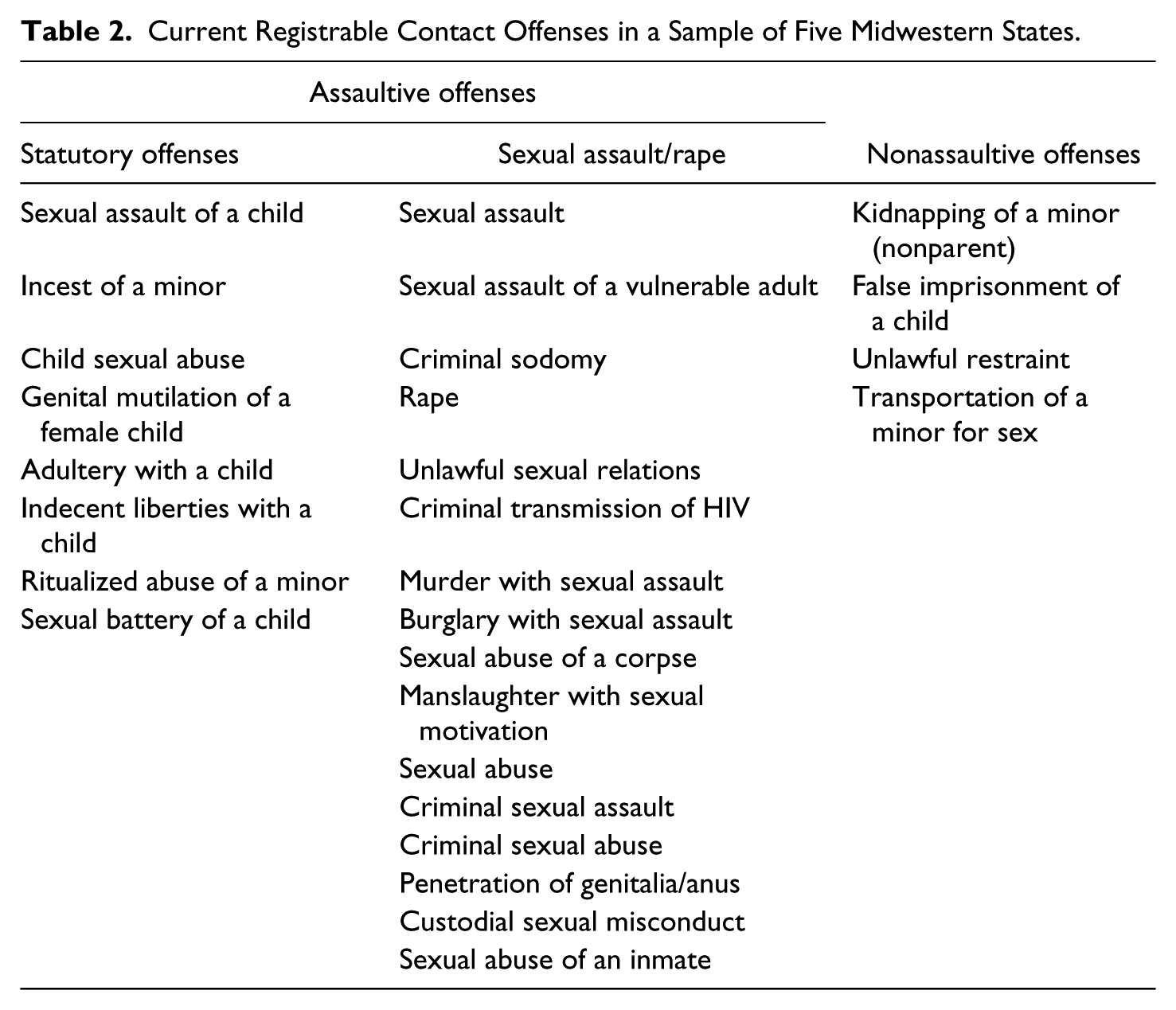
There were many different types of registrable offenses identified across the five states in my sample. Similar to previous research (e.g., Jenkins, 1998; Sample, 2001; Sample & Bray, 2006), two categories were initially identified as contact and noncontact crimes in open coding. Contact crimes included crimes requiring direct, physical contact between offenders and victims, such as sexual assault, rape, and human trafficking (see Table 2). On the other hand, noncontact crimes included all other offenses that did not require physical contact between offender and victim (e.g., possessing child pornography, stalking, and indecent exposure; see Table 3). Each state included contact and noncontact crimes in their list of registrable offenses.
Current Registrable Contact Offenses in a Sample of Five Midwestern States.
Current Registrable Noncontact Offenses in a Sample of Five Midwestern States.

In axial coding, these broader groups of offenses were separated into more specific categories. Contact crimes were further disaggregated into assaultive and nonassaultive crimes. Assaultive crimes included some element of aggression within the crime’s definition, such as child sexual abuse or criminal sodomy. Nonassaultive crimes consisted of all other contact crimes that did not require physical aggression in the definition of the crime. For example, many nonassaultive offenses included some unwanted restraint of the child. Many of these crimes required classification as sexually motivated to justify registration, but did not explicitly require sexual contact.
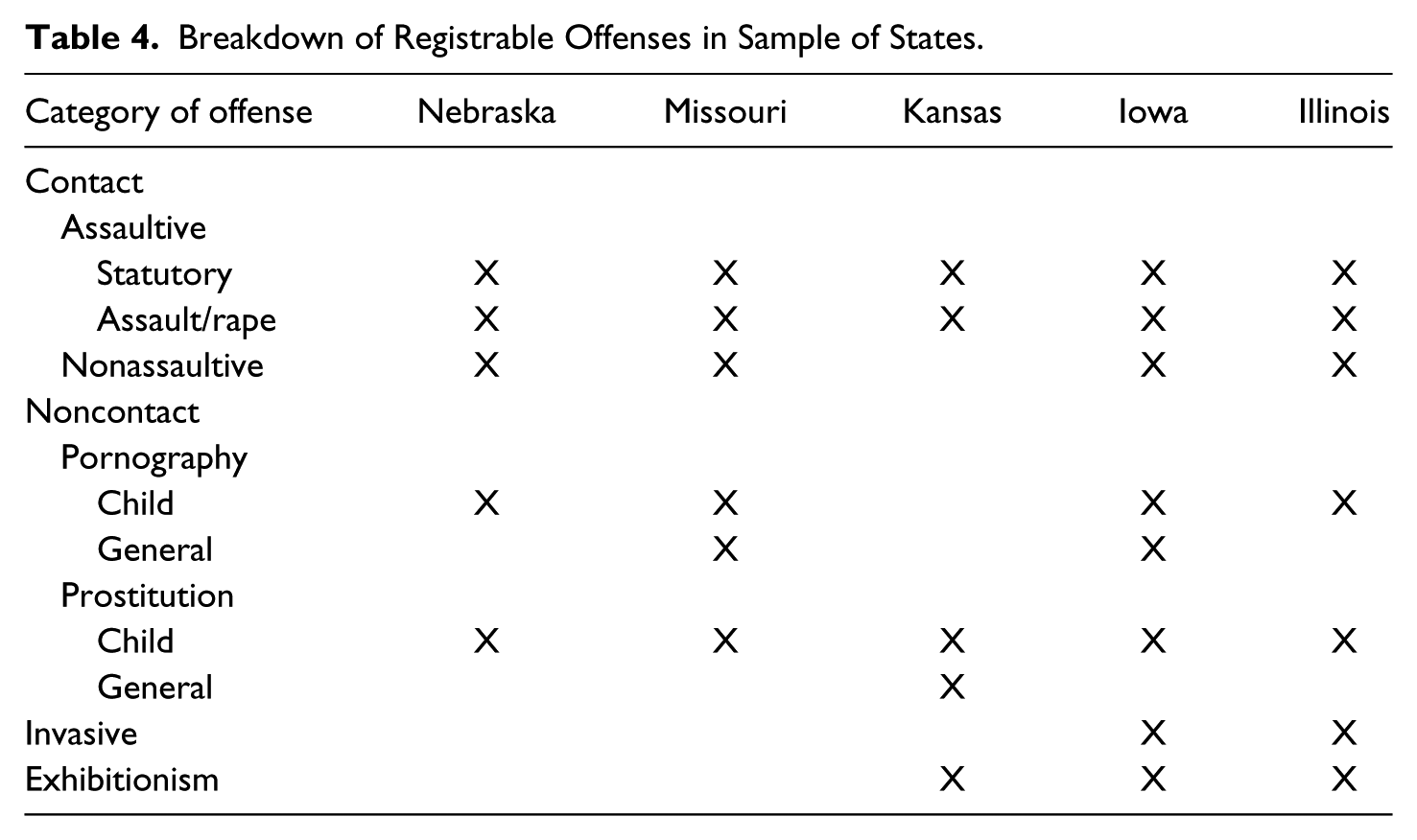
Noncontact crimes were separated into four categories: pornography, prostitution, invasive, and exhibitionism offenses. Pornography and prostitution categories were further distinguished as being specific to child victims (child pornography and child prostitution) or being more general in their definitions (general pornography and general prostitution). “Pornography” offenses included any offenses dealing with pornographic media or material defined by the state as obscene (e.g., promoting child pornography, furnishing sexual material to minors). “Prostitution” offenses covered crimes that pertained to selling, paying, or persuading another person to participate in a sex act (e.g., patronizing prostitution, debauching a minor). “Exhibitionism” involved crimes in which the offender exposed him- or herself to a victim without physical contact (e.g., indecent exposure, lewd and lascivious behavior). Finally, “Invasive” offenses were made up of all other offenses that do not include prostitution or pornography that invade upon the privacy of others (e.g., stalking, harassment with sexual motivation).
Finally, if the length of time offender information was included in public notification depended on some criteria, these criteria were noted and included in my analysis. Two types of criteria for the length of time on public notification were observed in the SORCN statutes in this sample. One type was the offender’s risk of sexual recidivism. For example, a risk-based system would assign lifetime registration and public notification to offenders who were determined to have a high risk of recidivism based on some risk assessment tool validated for sex offenders (e.g., the Static-99; Hanson & Thornton, 2000). The second type was an offense-based system in which length of time an offender is required to remain on the registry is predetermined by the offense of conviction (Sample & Evans, 2009).
Amount of Time between Policy Revisions
To determine the frequency with which laws are revised across states over time, I first noted the number of revisions by states and then coded the month and year of each statute’s passage during qualitative coding. Then, the difference in months between a statute and its most immediate predecessor was entered into an unconditional Hierarchical Linear Model (HLM 7; Raudenbush & Bryk, 2002). 3 More specifically, the number of months between revisions was nested within states (see Table 6 below for the formulas used in this analysis).
Since existing research has not yet established whether variation in the timing of SORCN exists, the current analysis was intended to simply determine whether or not variation was present, so no explanatory or control variables were included in this analysis. The timing in the passage of initial sex offender laws, and changes to them, could be indicative of variation and changes in public attention to sex offenders within and across states. An unconditional HLM allowed me to answer my second research question by providing the proportion of variability in the number of months between revisions within and across states. This analysis also provided a test of statistical significance for the proportion of variability in time between revisions across states, which is used to methodologically triangulate the qualitative findings regarding the frequency of SORCN policy revisions across states.
The decision to use an unconditional HLM was not only based on the ability to identify variation in timing, however. Since time was a factor in this analysis, the assumption of independence of errors required in ordinary least squares models made traditional regressive analysis inappropriate. Fortunately, HLM relaxes this assumption, allowing for the analysis of time variables. Therefore, an unconditional HLM was selected to assess the variation in the number of months between revisions across states.
Results
Variation in the Content of SORCN Laws
Dangerousness of sex offenders
One way in which states defined registered sex offenders was the distinction between sexual predators and sex offenders. Every state in this sample included definitions for both generic “sex offenders” and “sexual predators.” In each state, sexual predators were considered to be more dangerous than sex offenders. Variation existed across states, however, in the ways in which the “predator” label was applied. Although every state assigned the label of sexual predator based, at least in part, on the severity of the crime committed, three states also required a diagnosis of some “mental abnormality” (Missouri, Kansas, Iowa). Further, only Kansas included crimes committed against adults, such as rape and criminal sodomy, in their definition of sexual predators. This clearly suggests that in some states there is a perception that a mental defect is responsible for increasing the seriousness of sex offenses to predator states, which may imply a treatment-oriented response for these offenders. Conversely, states that define sex offenders without some diagnosis of mental defect may imply a less rehabilitative, more retributive response. Moreover, states varied regarding the predatory nature of sex offending, in that one finds that predators can “prey” on adults, whereas others suggest that predatory status is reserved for children. If states vary in their definitions of dangerousness in their SORCN laws, might they also differ in their definitions of sex offenders more generally?
Who can be a registrable sex offender?
Three states explicitly included juveniles in their sex offender registries (Iowa, Missouri, Illinois). Consequently, only adults were included in the sex offender registry in Nebraska and Kansas. This indicated variation in the definition of registry-worthy sex offenders based on an offender’s status as an adult. Further, in the three states that registered juvenile sex offenders, there was variation in the criteria to be considered a “juvenile” sex offender. For example, Missouri only included juveniles on their sex offender registry if the juvenile had been tried as an adult and the victim in the case was under 13 years. In contrast, Iowa required registration for any offender committing a registrable sex offense over the age of 14 years. These findings suggest that in some states, typical sex offenders for which the public should monitor were adults, whereas in other states, offenders demanding informal surveillance can be of a wider age range.
States also varied in their lists of registry-worthy offenses. All five states had assaultive contact crimes in their lists of registrable offenses. Further, all five states had registrable offenses representing both the statutory and sexual assault/rape subcategories of assaultive contact crimes. Two specific crimes, incest with a minor and kidnapping (nonparent with sexual motivation), were present on the list of registrable offenses for all five states, although the definition of a minor differed across states. Kansas was the only state without a nonassaultive contact crime.
The only category of noncontact offenses represented in all five states was child prostitution. States varied in their inclusion of other subcategories of noncontact crimes in their lists of registry-worthy offenses. For example, out of the states in this sample, Kansas was the not only state that lacked an offense linked to child pornography, but it was also the only state that had an offense related to nonjuvenile prostitution (patronizing prostitution). In addition, the only noncontact offenses meriting registration in Nebraska focused on child victims. Ultimately, states appeared to vary greatly in their selection of noncontact offenses requiring registration and notification (see Table 4). These results suggest that as citizens move from state to state, there may be little consistency in the types of noncontact sex offenders they should informally monitor. Moreover, the results may suggest that some noncontact offenses are not perceived as problems in some states but are in others. Based on the findings presented here, it seems clear that my sample of states differed in their definitions of sex offenders; however, states might also differ in the level to which the public is involved in monitoring these offenders (i.e., community notification).
Breakdown of Registrable Offenses in Sample of States.
Community notification requirements
Another source of variation in the content of SORCN statutes was present in how levels of public notification changed over time. At the time of this study, all states in this sample made information for all registered sex offenders public; however, this pattern was not always the case. Indeed, Nebraska and Iowa began with a risk-based approach to identifying which offenders’ information to publish. For example, original community notification laws in Nebraska varied the level of public access to offender information based on sexual recidivism risk assessment. Specifically, information about low risk offenders was only disseminated to law enforcement, while moderate risk offenders had their information publicized to schools and other child care centers as well as law enforcement. Finally, the general public was only provided with information for high-risk offenders. This method was used in Nebraska for 10 years until its revision to include all offenders in 2010. In contrast, Illinois adopted an offense-based notification system from the law’s inception. Therefore, although the methods for assigning time on the sex offender registry were very similar at the time of this study across states, these methods have varied over time, suggesting that states tailored their notification processes to their individual populations, likely based on public sentiment, advice of experts, or the simple adoption of other states’ policy with similar citizen populations.
In summary, there appears to be variation in the definitions of dangerousness and publicization of offender information across states. However, SORCN content may also vary in frequency of policy revisions as well as the types of revisions. Now I will present results to the second research question addressed in the current study, “Do SORCN policies vary in the frequency and type of revisions across states?”
Variation in the Frequency of SORCN Policy Change
Prior to discussing the statistical analysis of the variation in timing of SORCN policy revision, it seems appropriate to provide evidence of variation in the creation of SORCN policies across states. The year in which SORCN statutes were first adopted in our sample of states ranged over a span of 10 years between 1986 (Illinois) and 1996 (Nebraska). While no quantitative analysis was conducted to statistically test this variation, the large discrepancy in the adoption of SORCN statutes remains worth noting for future research.
The results of the unconditional HLM model indicated a significant proportion of variability in the months between revisions across states (p = .003; see Table 5). More specifically, 11% of the variation in the timing of revisions of SORCN statutes in this study (i.e., for all states) was attributed to between-state variation. 4 Conversely, 89% of the variation in timing of policy change in this analysis was attributed to variation within states. The statistically significant between-state variation in the time between revisions suggests that state-level factors, such as political ideology or economic structure (e.g., C. Brooks & Manza, 2007; Garland, 2001), have influence over the timing of revisions to SORCN laws. Therefore, this finding may provide scholars with justification for future research to include state-level factors in exploring explanations for differences in sex offender legislation across states.
HLM Model Testing Variation in Timing of SORCN Policies.

Model summary: Level 1 model: DIFFTIME ij = β0j + rij; Level 2 model: β0j = γ00 + u0j[]; mixed model: DIFFTIME ij = γ00 + u0j + rij.
Findings from the thematic content analysis may be used to elaborate upon the significant findings in my quantitative analysis (Creswell & Clark, 2011; Creswell et al., 2003). Some states passed many revisions of their SORCN statutes (Illinois, Kansas), while others passed fewer revisions (Nebraska, Iowa, Missouri). For example, Illinois passed a majority of the statutes in our entire sample. This was not simply due to their 7-year head start the state enjoyed. After its first revision in 1991 (P.A. 87-457), Illinois only had 4 separate years in which a new revision was not passed (1994, 1996, 2001, and 2003). Further, Illinois passed multiple revisions within the same year (e.g., 1993, 1995, etc.); in some cases, revisions occurred in Illinois in the same month, such as P.A. 91-221, P.A. 91-224, P.A. 91-357, and P.A. 91-394 in July of 2000. Other states, however, passed revisions less often. For example, Missouri only passed nine revisions over the 17-year life span of their registry. Unlike Illinois, Missouri never revised their SORCN statutes more than once a year. Along with the statistically significant variation in timing of revisions across states noted in the unconditional HLM above, it was apparent that some states have been more prolific in their policy change than others. The degree to which this variation results from new or ongoing sex crime panics in some states as opposed to others remains unknown.
Therefore, the combined results of the qualitative and quantitative analyses in this paper provide evidence for variation in the content of sex offender laws, and frequency of policy change across and within my sample of states. Considering these differences, however, one may wonder if all of these revisions were similar. That is, were there different types of SORCN policy changes in my sample of states?
Types of Revisions
While many of the findings presented above pertain to variation in the content and rate of revisions for SORCN law across states, variation in the content of SORCN laws within states was also observed in the different types of policy changes made over time. For example, in Iowa, Acts 1999 Chapter 23 indicated that registered offenders who committed a kidnapping or false imprisonment could only have their information on public notification sites if sexual abuse was involved in the crime. Several years later, Iowa passed Acts 2009 Chapter 119, which completely restructured SORCN to approach compliance with the Adam Walsh Act. Existing policy change theory indicates that revisions may differ in their scope and impact on existing law. For example, punctuated-equilibrium theory predicts that a policy’s timeline will consist mostly of small, incremental changes punctuated by sudden spikes of rapid policy change. Although existing research has acknowledged that revisions may be qualitatively different, an empirical typology of revisions, beyond incremental revisions and punctuations from punctuated-equilibrium theory, has remained relatively unexplored. Therefore, the typology of revisions described below emerged from the data, providing empirically developed categories.
A Typology of Revisions
This study’s qualitative content analysis produced a typology of revisions based on the degree to which the revision affected the distribution of resources in the operation of SORCN in that state, both for criminal justice agencies and for the registered sex offenders. Specifically, a continuum of revision types emerged from the data where each type of revision overlapped with other types lower on a hierarchy (see Table 6). For example, Iowa Acts 2009 Chapter 119 not only fit into the highest type (net-widening), but it also met the criteria for types lower on the hierarchy, such as procedural (e.g., registered offenders had to provide fingerprints) and definitional revisions (e.g., restructured and redefined the list of registrable offenses).
Distribution of Revision Types.

Note: As this typology pertains to revisions, statutes that created a state’s registration or community notification policy without altering an existing SORCN statute were not included in the typology. Therefore, marginal totals will not equal those reported for the original sample.
The first category in this typology is “tinkering” revisions. These revisions changed words without actually changing the meaning or scope of the content in the law. For example, P.A. 91-357 in Illinois simply inserted the word “and” in one sentence along with a comma. Also, Kansas Law 155-10 in 2010 added the word “human” to the existing offenses previously known as “trafficking.” In this case, the definition for trafficking did not change, only the name of the crime.
The next type of revision made changes that altered the meaning of the specific words or phrases in the content of the law, which I call “definitional” revisions. These revisions overlapped with tinkering revisions in that the changes focused on specific words or phrases; however, these revisions actually altered the meaning of the content of the law. One example is found in 2010 Laws 147-8 in Kansas, which added unlawful sexual relations with a minor to the list of sexually violent crimes used to identify especially dangerous offenders. Although the distinction made in this revision may lead to a difference in the way that affected offenders interact with the registry (along with the way criminal justice agents interact with these offenders), the revision itself did not change the operation of the registry outright, which would make it a procedural revision (see next paragraph). Another example of a definitional revision would be P.A. 87-457, which was passed in Illinois in 1991. This revision included tinkering in that some commas and short clauses were removed without affecting the meaning of the existing law; however, a clarification was made that criminal sexual abuse was only registrable if they were classified as felonies at the time of the crime.
The third type of revision on this hierarchy includes procedural revisions. These revisions altered the actions necessary to be compliant with SORCN policy for either criminal justice agencies or registered sex offenders. An example of a procedural revision for criminal justice agencies includes Missouri’s HB 424 from 1996, which placed responsibility for maintaining the sex offender registry with the Missouri State Patrol. Another example of a procedural revision that affected registered offenders was P.A. 97-565 in Illinois, which required all registered sex offenders to submit a DNA specimen for the registry. Neither of these revisions expanded the scope of their state’s sex offender registry; however, each of these revisions directly changed the operation of the registry, either for law enforcement or for the offenders.
The fourth and final type of revision observed in this analysis increased the purview of the registry, typically by adding offenses or requiring larger groups of offenders to register or for which the community should be notified. These revisions, which I will refer to as net-widening revisions, not only change the operation of their state’s registry, they expand the registry to include more offenders, requiring greater monetary and time resources. An example of a net-widening revision would be Nebraska’s LB 285, passed in May 2009. LB 285 changed Nebraska’s criterion for the length of time registry information was made available to the public from risk-based to the offense-based system described earlier in the paper. Further, this revision was applied retroactively, restricted offender interactions with children, shortened deadlines for registering, required in-person visits to verify information, and added another crime to the registry. Another example would be Iowa Acts 2009 Chapter 119. This statute revised Iowa’s SORCN policy to more closely resemble requirements put forth by the Adam Walsh Child Protection and Safety Act (AWA). In addition to clarifying definitions of registrable offenses and changes to information provided to law enforcement by registered offenders, registration was expanded to new crimes and applied retroactively to anyone who had committed registrable crimes.
Very few of the revisions included in this study were only tinkering revisions. Only three states had tinkering revisions in the history of their SORCN law, and only Illinois had more than one tinkering revision. It was also fairly rare for states to pass definitional revisions. Again, of the three states (Kansas, Iowa, and Illinois) that had definitional revisions in their legislative history, Illinois was the only state to include more than one of these revisions. Every state had procedural revisions in the history of their SORCN law, with Illinois representing a majority of such revisions. Finally, net-widening revisions were represented in each state’s SORCN legislative history (see Table 5).
It is important to note that, although revisions such as tinkering and definitional revisions may appear to have little impact on the implementation and operation of sex offender registration and notification, existing theories of policy change have considered such revisions to be important in the policy process (e.g., Baumgartner & Jones, 2009). Essentially, any changes made to existing policy, regardless of their anticipated impact, require time and resources from legislators. From this, we may infer that any changes made to existing policy must have been considered important, for some reason, by the legislators recommending them. Further, if the content of each revision is deemed to be important by legislators, the variation in the impact of revisions to SORCN statutes across states may provide insight into the variation in policy process for SORCN statutes across states. That is, some states may be more open to making small changes and clarifications in SORCN statutes, while other states only make revisions when some deficit in the operation of existing SORCN policy is brought to the attention of the legislators. Unfortunately, such an explanation based on the exploratory information in the current study will remain speculative, until future research can examine the policy process further.
Discussion
The current study has identified variation in the content of SORCN statutes across a purposive sample of five midwestern states. Specifically, distinctions between sex offenders and sexual predators, age criteria for sex offender registration, and each state’s list of registry-worthy offenses varied across states. These findings indicate that some offenders deemed to be dangerous enough to merit registration in some states (e.g., juveniles in Missouri, exhibitionism in Kansas) are not considered as dangerous in others (e.g., juveniles in Nebraska, exhibitionism in Missouri). Also, early methods by which public notification of sex offender information was decided differed across states. Indeed, Nebraska and Iowa used risk-based notification systems early in the history of their notification statutes, wherein only high-risk sex offenders were included in public notification. In addition, states varied significantly in the time between revisions, suggesting that some states may be more prolific in revising SORCN policies.
Interestingly, a typology of revisions emerged from the legislative histories of SORCN statutes within states. This typology provides evidence of within-state variation in the substantive contribution of revisions to SORCN statutes. Generally, this typology distinguished revisions based on their impact on the operation of the registry. Although many revisions altered the day-to-day operation of the registry and public notification sites (i.e., procedural revisions), other revisions seemed to be focused on tinkering with words and clarifying the existing language.
One possible explanation for these findings may be that variation in the content of SORCN policies across states was an artifact of variation in the quality and timing of policy change. If some states revised their SORCN policies more substantively and less often than others, it may be that these states varied in their content because they did not keep up with their more prolific state neighbors. However, it may also be that the variation in timing of SORCN revisions observed in this study reflected differences in the perceptions of policy change across these states. Indeed, states that frequently revised their SORCN laws may have been more inclined to experiment with new policy options. On the other hand, states that were less active in changing SORCN laws may have taken a more conservative approach, waiting to see how new policy options performed in other states before making changes to their own laws. Indeed, the more prolific states in my sample made revisions that consisted of grammatical clarifications (i.e., tinkering and definitional revisions) that would do little to alter the operation of the SORCN. The concentration of such revisions in the most active states may indicate that these states were situated within a political climate that was more accepting of revisions.
Another possible explanation for variation in the content of SORCN laws may come from the moral panic literature (Cohen, 2002). Using our understanding of moral panics, we may conclude that variation in the content of SORCN laws observed in this study arose from a similar variation in local and statewide perceptions of a larger sex crime problem, much of which would be attributed to mass media and political-cultural climate in each state. One limitation of this explanation, however, would be the assumption that news reporting will vary across this sample of states. Considering the geographic proximity of the states in this sample, it may be unreasonable to assume that high-profile sex crimes would not be disseminated across state lines. Indeed, even existing research has indicated that much of the media contribution to the current sex crime panic has been situated in nationwide media attention of high-profile sex crimes (Jenkins, 1998). Therefore, although the moral panic literature may provide possible explanations for this study’s findings, these explanations may be limited. Ultimately, future research will be required to better understand the relationship between variation in SORCN policy and moral panics.
Theories of policy change and the policy process discussed earlier in this paper could also provide possible explanations for the current study’s findings. For example, the findings in the current study regarding revisions that made relatively small changes to SORCN laws appear to fit into the concept of equilibrium as described by Punctuated-Equilibrium Theory (PET; Baumgartner & Jones, 2009), which suggests that incremental changes occur but policies remain reasonably stable until such time the problem they address has been redefined. Further, for many states, there appeared to be single, major revisions to SORCN policy (e.g., Nebraska’s LB 285) spread among a longer period of more minor revisions. Brief periods of rapid policy change, such as that observed for Nebraska’s LB 285, would be predicted in several theories of the policy process, including PET and the Multiple Streams Framework (Kingdon, 1995). It is possible all three streams in policy-making (problems, policy, and politics) converge in some states but not others, or converge at different rates or by varying degrees based on some broader state context.
As noted earlier, these theories have been criticized within the policy sciences for their lack of predictive power (de Leon, 1999; Smith & Larimer, 2009). Also, many of these theories have focused on explaining policy change at the national level and lack empirical tests for state-level variation (Zahariadis, 2007). Further, these theories may not be generalizable to criminal justice policy, especially considering the emotionally charged nature of such policies (Jenkins, 1998; Jenness & Broad, 1997; Karstedt, 2002; Scarborough, Like-Haislip, Novak, Lucas, & Alarid, 2010). Nonetheless, these theories can provide a starting point upon which new theory for criminal justice policy-making may be built in future research. Therefore, future research may attempt to assess the degree to which differences in SORCN policy, or criminal justice policy more broadly, fit within existing policy change frameworks.
One final explanation for the variation in both SORCN content and the frequency of revisions may come from the mechanisms by which SORCN policies spread from one state to another (i.e., policy diffusion; Rogers, 1995). One of the most common frameworks in policy diffusion has been the social learning perspective (S. M. Brooks, 2007; Gray, 1973; Heclo, 1977; Jordana & Levi-Faur, 2005; Karch, 2006, 2007; Meseguer, 2004; Walker, 1969; Weisburd, Mastrofski, McNally, Greenspan, & Willis, 2003; Wejnert, 2002). Within the social learning approach, policy innovations spread across locations once “adopters” (i.e., the jurisdiction considering adoption or revision of some innovation) have collected the information needed to reduce uncertainty about the innovation. Therefore, according to the social learning framework, the most influential factors early in the policy diffusion process are the sources of information used by policy makers (Rogers, 1995).
One of many sources of information used by policy makers may be the performance of some considered policy option in other states (Karch, 2007). Essentially, legislators in one state may prefer to observe the effectiveness and consequences of some policy option implemented in other states prior to implementing it in their own state. This perspective has been labeled “democratic laboratories” by several policy researchers (Karch, 2007). For example, Nebraska may not have language explicitly including juveniles in their sex offender registry because they are observing the cost-effectiveness of this policy in other states and consciously chosen not to adopt it. Therefore, mechanisms of policy diffusion should also be considered in future research on variation in SORCN law.
Conclusion
Criminal justice policies, such as SORCN laws, often represent legislative responses to public fear of crime. In particular, public fears of sexual victimization have been addressed, with some success, by increasing the monitoring of the sex offender population through the passage of SORCN laws (Sample et al., 2011; Sample & Kadleck, 2008). This study explored the ways by which SORCN laws varied across states. The differences in how residents became aware of and monitored sex offenders across states may suggest that public fears of sexual victimization also varied across states, if variation in laws is a function of public opinion. Further, variation in the operation of sex offender registries across states may mean that registered offenders who travel to other states for business or leisure must become familiar with the laws of their destination state or risk a registry violation, which can be a felony in some states.
Now that variation in the content of SORCN laws has been empirically observed, however, future research should begin to identify factors that contribute to this variation. Existing theories of policy change and the policy process may not be applicable to all types of policies (S. M. Brooks, 2007). Therefore, it is important to be cautious when applying these theories directly to criminal justice policies generally, especially considering the emotions and fear of crime typically at the heart of criminal justice policies (Cohen, 2002; Jenkins, 1998; Jenness & Broad, 1997; Karstedt, 2002; Scarborough et al., 2010).
In addition to its theoretical contributions to how we understand criminal justice policy change, however, it is also important to identify significant factors in the policy process for criminal justice policy as well as the settings in which policy is most likely to change. A better understanding of the policy process can facilitate our ability to anticipate rapid and, perhaps, hurried policy change, which may contribute to the passage of policy that is ineffective in addressing public fears and that distracts law enforcement from true threats to public safety.
Footnotes
Acknowledgements
The author would like to thank Drs. Amy Anderson, Samantha Clinkinbeard, and Lisa Sample for their advice and feedback regarding this work.
Declaration of Conflicting Interests
The author(s) declared no potential conflicts of interest with respect to the research, authorship, and/or publication of this article.
Funding
The author(s) disclosed receipt of the following financial support for the research, authorship, and/or publication of this article: The author wishes to thank the School of Criminology and Criminal Justice at the University of Nebraska at Omaha for funding my research efforts for this paper.