



Abstract
Mental health courts are relatively new to the scenes of therapeutic jurisprudence and problem-solving courts. Research is necessary to determine how to evaluate this unique subset of courts and their clients. This research uses a mixed methodology to develop grounded theories explaining the differences found in more successful courts whose jurisdiction saw a statistically significant decrease in crime rate after the mental health court was established and less successful courts that did not. Eleven Oklahoma-based mental health courts were researched. More successful courts prioritized intensive monitoring methods, multiple specially tailored treatment options, and additional program supports. More successful courts also used a diverse court team, emphasized proper program assessment, visibly divided compliant and noncompliant participants in court, and gave “tangible symbolic incentives.” The found successful theories were compared with the published Essential Elements of a Mental Health Court and Cesare Beccaria’s Essay on Crimes and Punishment for possible future validation efforts.
Keywords
The “revolving door” of justice in America leads to overfilled, underfunded, and overwhelmingly inefficient courtrooms, jails, and prisons. Judges must mechanically sift through a backlog of cases only to further burden the jail and prison systems with offenders who do not receive proper treatment in the prison system and repeatedly cycle through the justice process (Denckla & Berman, 2001). Initial attempts to reduce the overflowing system proved ineffective. The “tough on crime” solution, meant to deter people from committing crimes, offered limited chances before lifelong prison sentences and did not reduce the prison population as intended. The influx of offenders continues to weigh heavily on the judicial system, correctional facilities, and taxpayers. Changes need to be made to find a proper solution. One of the newest solutions is the use of therapeutic jurisprudence within problem-solving court programs. In this alternative court program, offenders receive treatment, not while in jail, but in a tiered-step prison diversion program led by a judge. The programs are comprised of a nonadversarial court team, treatment options, and supervision methods.
The first problem-solving court, a drug court program, began in Miami-Dade County, Florida, in 1989. Thanks to extensive research supporting the use of the drug courts, by June 30, 2013, there were more than 2,800 drug courts in operation in the United States (National Institute of Justice, 2013). The authors of The Ten Key Components of Drug Courts pinpointed essentials elements in which drug courts could adhere to in order to find reduced recidivism, decreased drug use, and cost-effective drug court planning. Research evaluating The Ten Key Components of Drug Courts supported the use of these particular elements (Carey, Mackin & Finigan, 2012; National Association of Drug Court Professionals [NADCP] & United States of America, 2013). Rapidly, the drug court model adapted to assist a variety of offenders. New courts like veterans treatment courts, family drug courts, driving while intoxicated courts (DWI), tribal healing to wellness courts, domestic violence courts, and many others began appearing across the United States and other countries. By forgoing harsh punishments and, instead, treating the underlying causes of offender criminality, these court programs focus on the use of therapeutic jurisprudence. Researchers struggle to keep pace with the rapid expansion of problem-solving courts.
The therapeutic movement birthed yet another problem-solving court: the mental health court. Initial findings are encouraging in terms of reduced recidivism, decreased drug use, and cost-effectiveness (Cross, 2011; Dirks-Linhorst & Linhorst, 2012; Moore & Hiday, 2006; Steadman, Redlich, Callahan, Robbins, & Vesselinov, 2011). Best practices for mental health court are most notably recognized in Improving Responses to People With Mental Illnesses: The Essential Elements of a Mental Health Court (Thompson, Osher, & Tomasini-Joshi, 2008). However, these courts have much further to evolve in terms of research and best practices due to their relative newness compared with other problem-solving courts and also because of the complicated nature of the mentally ill offender.
People coping with drug, alcohol, and mental health problems deal with their issues and addictions on a daily basis. However, offenders with mental illnesses differ from other offenders in drug courts or DWI courts because of the nature of mental illness. Although a negative drug or alcohol test indicates adherence to sobriety and court mandates, adherence to medication and therapy cannot produce a negative result on a mental health assessment. Mental illness is always present. So how can one determine the success of a mental health court? Currently, mental health court assessors evaluate these courts with the same methods used for drug courts and other problem-solving courts: length of abstinence from drugs and alcohol, recidivism rates, medication compliance, and improved cognitive functioning.
Community impact serves as another possible method for mental health court evaluation. This methodology emerges from two theories: (a) A small number of typically low-level, nonviolent offenders commit the majority of crimes, and (b) most offenders do not travel long distances to commit crimes, but instead, commit crimes relatively near their own homes (Greenwood, 1980; Van Koppen & De Keijser, 1997). This research theorizes that an effective mental health court will have an impact on the community served. If a small number of offenders commit the majority of crimes and do so close to home, a successful mental health court will reduce the jurisdictional crime rate by effectively reducing the criminal activity of mental health court clients.
A mixed-methods approach, utilizing both quantitative and qualitative methods, was used to test the theory on the community impact of mental health courts. Eleven of 13 mental health courts in Oklahoma served as participants in this research. First, the study examined jurisdictional crime rate before and after mental health court establishment to discern court success in terms of variance in crime rate. Next, the study sought to determine whether similarities and differences existed between the courts labeled as “more successful courts” and “less successful courts” based on the jurisdictional crime rate variance after program implementation. The researcher undertook an ethnographic process of court team interviews, historical document collection, and nonparticipant observation of staffing and court dockets to develop grounded theories that revealed similarities between more successful mental health courts.
The research did not start with testable hypotheses on what elements constituted program success. Instead, the data collection process allowed for development of grounded theories to provide support for successful elements of mental health courts. Cesare Beccaria’s Essay on Crimes and Punishments and the published Essential Elements of a Mental Health Court guided the data collection process (Beccaria, 1819; Thompson et al., 2008). The study aims to provide an additional method of mental health court evaluation, along with rational gathered through ethnographic research, to add to the currently underdeveloped body of mental health court research.
Literature Review
Therapeutic Jurisprudence
David B. Wexler and Bruce B Winick (1991) created the theoretical concept of therapeutic jurisprudence in the 1990s. The definition of therapeutic jurisprudence is the “study of the role of law as a therapeutic agent” (Winick, 1997). The concept works with the understanding that both laws and judges affect both therapeutic and antitherapeutic consequences on individuals with whom they interact. Therapeutic jurisprudence attempts to negate as many antitherapeutic interactions with the law as possible to promote mental health and psychological functioning. Therapeutic interactions with the law work to solve a variety of social problems like drug abuse, sex offenses, delinquency, and family violence (Winick, 1997).
Problem-Solving Courts
Problem-solving courts, also known as therapeutic courts or specialty courts, utilize the concept of therapeutic jurisprudence. Problem-solving courts divert offenders from traditional court processes and direct them toward treatment for the core causes of their criminal behavior (Ray, 2014). The over-arching term, problem-solving court, refers to nontraditional court programs with a judge-centered, nonadversarial process that includes treatment options, judicial monitoring, and collaboration between client and treatment team. Offenders in these courts are not subject to quick and mechanical judgments in “plea bargain mills,” but actually spend time with the judge. The judge and other court team members assess the offender to develop a therapeutic treatment model suited to individual offenders’ needs (Berman & Feinblatt, 2001). Problem-solving courts hope to both properly punish and effectively treat offenders for their crimes. Successful treatment ends the “revolving door” in which offenders continually cycle through the criminal justice process without proper treatment or punishment (Denckla & Berman, 2001). Although problem-solving courts treat a variety of issues and offenders, common elements exist within all problem-solving courts. These courts use enhanced information, community engagement, and collaboration among justice system actors. Problem-solving courts also offer individualized justice and a focus on offender accountability and outcomes (Porter, Rempel & Mansky, 2010).
Drug Courts
Drug courts appeared as the first of the problem-solving courts, beginning in Miami-Dade County, Florida, in 1989. By June 30, 2013, 2,800 drug courts were in operation across the United States (National Institute of Justice, 2013). Drug courts focus on treatment of drug-addicted individuals, typically arrested numerous times, for crimes perpetuated as a result of drug use. Despite differences, drug courts typically incorporate a tiered-step program led by a nonadversarial judge and court team. Members of the court team work together to find treatment options, therapy, and counseling, among other necessities, for their clients. The treatment program involves frequent drug testing, supervision methods, a graduated system of sanctions and incentives, and frequent court appearances.
Drug courts are the most researched and evaluated among the court programs. Many findings appear encouraging in terms of recidivism, drug use, and cost. Recent meta-analytic studies based on clients in drug courts indicated a reduction in arrests up to 14% (Mitchell, Wilson, Eggers, & MacKenzie, 2012; Shaffer, 2011; Wilson, 2006). In addition, a recent comparative study of drug courts by Rossman et al. (2012) shows 17% fewer positive saliva drug tests at 18 months than the comparison group. Also, drug courts prove cost-effective. The NADCP states that drug courts save US$3,000 to US$13,000 per client compared with regular judicial and incarceration costs (Aos et al., 2011; Marlowe, 2010).
Early participant-level research produced results depicting success in drug courts. Guided by the Bureau of Justice Assistance’s (BJA) Ten Key Components of Drug Courts developed in 1997, researchers then set out to determine which program implements provided the greatest effects on cost-effectiveness and recidivism rates. Over time, research acknowledged that adherence to these Ten Key Components was vital to drug court goal attainment. Drug courts’ failure to utilize the components was found to decrease both effectiveness for clients and cost-effectiveness up to half (Carey, Mackin, & Finigan, 2012; Downey & Roman, 2010; Gutierrez & Bourgon, 2012; NADCP & United States of America, 2013; Shaffer, 2011; Zweig, Lindquist, Downey, Roman, & Rossman, 2012).
Problem-Solving Courts Program Expansion and Research
Drug courts started the problem-solving court revolution, but, quickly, the drug court model expanded and adapted to assist other offender types. Veterans’ treatment courts help offenders with military experience deal with drug and alcohol dependence, traumatic brain injuries (TBIs), and mental health issues like posttraumatic stress disorder (PTSD). Outcome data on these courts show success in regard to decreases in recidivism and substance abuse (J. M. Cavanaugh, 2010; Hawkins, 2009). DWI courts assist offenders who chronically drive while under the influence of drugs and alcohol. With some varied results, studies on individual DWI courts show some reductions in recidivism rates and drug use (M. R. Cavanaugh & Franklin, 2012; Mitchell et al., 2012). Future research needs to determine the population best suited for success in DWI treatment courts (Bouffard & Richardson, 2007). Tribal courts assist Native American and Alaskan natives to work within their tribal communities to find solutions for offenders. Outcome data on tribal courts is extremely limited, but these courts collaborated to develop their own key components (BJA, 2003). Findings for domestic violence courts, which treat both victims and abusers in domestic violence situations, are mixed. Additional research is required for development and testing of key components (Jones & Gondolf, 2001; Petrucci, 2010; Snow, Sullivan, Swan, Tate, & Klein, 2006; Taylor, Davis & Maxwell, 2001). Each problem-solving court and its juvenile counterparts determine what elements make up their most successful courts. Developed key components or elements are held in high regard when research proves their relationship to reductions in recidivism, drug use, and program costs. State and federal government offers funding to problem-solving courts that adhere to research-proven key components. Research continues on various programs’ key elements to validate their existence and necessity for success (BJA, 2003; National Center for DWI Courts, 2006; National Council of Juvenile and Family Court Judges, 2003; Russell, 2013).
Mental Health Courts
Mental health courts are yet another problem-solving court recently created in response to the lack of treatment options for offenders with mental illnesses. The first mental health court began in 1997 in Broward County, Florida (Almquist & Dodd, 2009). Mental health courts help clients become stable through treatment, therapy, and medication compliance. The court also mandates clients with co-occurring drug, alcohol, and mental health issues to sobriety. Mental health courts assist clients with their sobriety through treatment and supervision methods. Like drug courts, the client/defendant typically progresses through a tiered-step program led by a judge and court team. Supervision and treatment team staff monitor clients and deliver graduated sanctions and incentives to compel compliance to program mandates.
Offenders with mental illness make for a complicated legal process. Mental health courts seek to provide a program able to teach culpability to offenders with mental illnesses. Legal framework in different mental health courts varies in regard to plea agreements and adjudication, among other legal aspects. Some courts are set up like specialized probation, alternative sentencing, or jail diversion programs. Mental health courts also vary court to court according to their scope, target population, and program structure. Different mental health programs allow entry to various offenders based on allowances for specific charges, diagnoses of the illness, and co-occurring conditions (Almquist et al., 2009; Berman & Feinblatt, 2001).
Participant-level research and outcome data on individual mental health courts indicated relative program success. Urban, suburban, and small multisite studies show reductions in violence, re-arrests, and recidivism (Dirks-Linhorst & Linhorst, 2012; Steadman et al., 2011). Graduates tended to spend fewer numbers of days in jail than those who receive treatment as usual (Moore & Hiday, 2006; Steadman et al., 2011). Finally, mental health court remedies prove more cost-effective over time than regular incarceration (Clark et al., 1998; Research and Development, 2007).
Published in 2008, Improving Responses to People With Mental Illnesses: The Essential Elements of a Mental Health Court delineates the 10 essential elements of mental health courts (see Figure 1). However, the document explicitly states that further research is required to verify the necessity of the established elements and to uncover initially missed elements. Future research should also associate each element to its contribution to improved client outcomes and cost-effectiveness (Thompson et al., 2008).

Essential elements of a mental health court.
Theoretical Framework
Research on mental health courts emerged, in part, from the notion that punishment is most effective when it adheres to Cesare Beccaria’s (1819) three principles of punishment: celerity, certainty, and severity. According to Beccaria, celerity and certainty are the two most pertinent principles of punishment and severity is the least important. Beccaria believed that humans make decisions based on hedonistic calculus. Beccaria believed that humans rationally determine which actions will suit their hedonistic needs. Proper punishment allows individuals to more often make rational choices to behave within society’s bounds. Celerity is important because the quicker a punishment is given after the crime, the more closely associated the two events become in the offender’s mind and the more likely the individual will make a rational choice not to commit the crime. Proper punishment must guarantee certainty. Individuals must know what constitutes a crime and what punishment the crime will incur. Severity not only is the least important principle of effective punishment, but also serves as the most difficult principle to adhere to properly. The difficulty arises in that punishment should closely fit the crime, but only be terrible enough to deter offenders in the future (Beccaria, 1819).
Before data collection began, I attempted to narrow the search for information by utilizing the theoretical framework provided by Beccaria and The Essential Elements of a Mental Health Court (furthermore known as “Essential Elements”). I theorized that more successful courts would adhere more closely to Beccaria’s celerity, certainty, and severity principles of punishment as well as to the Essential Elements than less successful courts and developed a rudimentary model associating the two aforementioned texts to guide the data collection process. This model (see Figure 2) served only as a starting point for guiding the data collection process. The model was modified as new ideas and concepts arose.
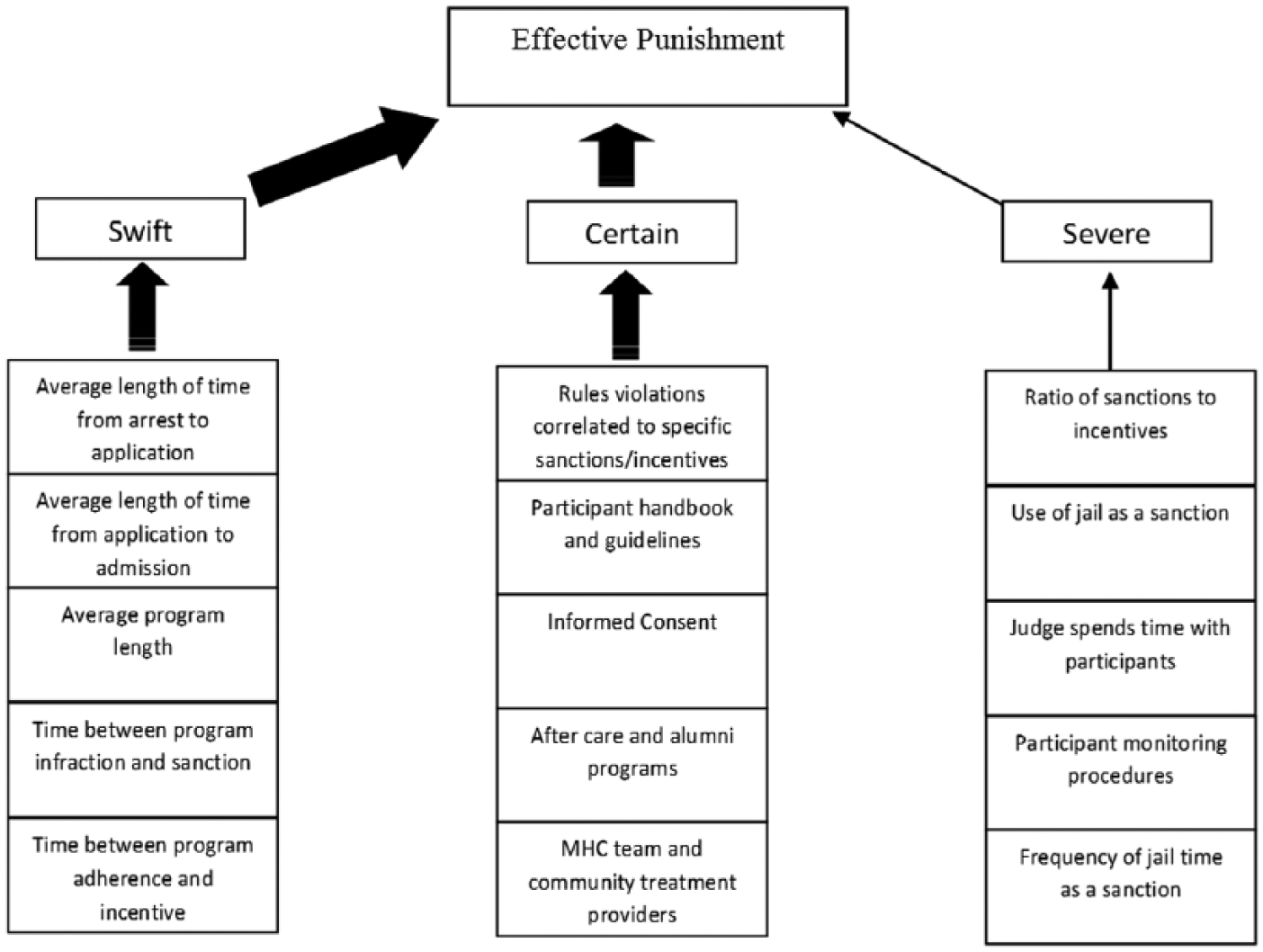
A structural/organizational model for data collection and analysis.
Method
The purpose of the study was to offer an additional perspective and potential evaluation method of mental health courts (Bullard, 2014). The research undertook a mixed-methods approach, utilizing both qualitative and quantitative methods to provide a deep understanding of mental health courts (Creswell, 2013). The research process included a statistical component to divide courts on level of success utilizing Uniform Crime Rate (UCR) data. The research included an ethnographic study of 11 mental health courts in Oklahoma through a collection of participant observations, interviews, and historical document analysis. The study did not begin with prior hypotheses; instead, the process of data collection allowed for development of grounded theories to provide rational for more success of some mental health courts over others based on the initial statistical findings. Each mental health court varied in caseload size from approximately 15 to 85 clients per year. The legal framework utilized in Oklahoma mental health courts currently varies in three forms: post-plea/pre-adjudication models, post-plea/post-sentence models, and pre-plea models. In all courts observed during research, mental health court clients received counsel. Judges also further questioned clients in open court to ensure that they understood their rights and knowingly and freely agreed to court-ordered treatment. In addition, judges and other court team members within the researched courts were eligible to attend specialty-court training conferences like those offered by The National Judicial College and NADCP. Any potentially identifiable information of clients or the specific court gathered during the research process remained in aggregate to protect individuals’ privacy and conform to Institutional Review Board requirements.
Statistical Analysis
To begin, each mental health court was phoned for permission for study inclusion, determination of jurisdiction, and year of program establishment. After the year of establishment and mental health court jurisdiction were determined, each jurisdiction’s statistics on UCR per 1,000 population were collected for the 3 years prior to each court’s mental health court program establishment and for the 3 years subsequent to the year of program establishment. The UCR crime rate per 1,000 statistics is calculated by year, adding all reported Part I and Part II offenses within a given county, dividing by the county population, and then multiplying the result by 1,000. The UCR data on the Oklahoma counties available through the Oklahoma State Bureau of Investigation (OSBI) includes information on forcible rape, robbery, felonious assault, breaking and entering, larceny, and motor vehicle theft, which are crimes used for determination of the UCR per 1,000 statistic. To delineate a more successful and less successful court, I compared each court’s jurisdictional crime rate for 3 years before the year of mental health court establishment with the 3 years subsequent using the analysis of variance (ANOVA) statistic. Courts whose jurisdiction(s) saw a statistically significant decrease in crime rate at the p < .1 level were considered “more successful courts.” Courts whose jurisdiction(s) saw either no statistically significant variance in crime rate or a statistically significant increase in crime rate at the p < .01 level were considered “less successful courts.” Any court whose jurisdiction spanned more than one county was considered a more successful court if one or more of the jurisdictions saw a statistically significant decrease in crime rate after the year of court establishment. UCR per 1,000 statistics were not combined in multi-county court jurisdictions to preserve the unique populous and resources within each county.
Statistical Findings
Using ANOVA, 4 of the 11 mental health courts included in the study were labeled more successful courts based on statistically significant decreases in jurisdictional crime rate after mental health court establishment (p < .01). Seven mental health court jurisdictions showed no statistically significant variance in crime rate or a significant increase in crime rate after year of mental health court establishment. These seven courts were labeled less successful courts.
Grounded Theory Development
After the UCR data provided the ability to label four courts as more successful courts and seven courts as less successful courts, I aimed to develop grounded theories that would provide insight into the differences between the two groups of courts. Grounded theory development starts with no initial hypotheses; instead, the gathered data develop a theoretical analysis fitting the data (Hesse-Biber, 2003). To develop grounded theories, I first collected ethnographic data to provide a “thick, rich description” on each of the 11 mental health courts (Geertz, 1973). I gathered information and field notes from nonparticipant observations of the mental health court dockets, staff meetings, historical document analysis, and in-depth interviews with pertinent court team members, which included the judge, program coordinator, bailiff, treatment staff, supervision staff, and others. Web page information, employee guides, participant handbooks, aggregate client outcome data, funding allotment information, and plea-in forms constituted useful historical documents for analysis.
Next, I began to code the ethnographic data on each court utilizing the constant comparative method with theoretical sampling. As initial codes in the court data began to appear frequently, the data collection process began to focus on development of categories. Analytic memos supplemented the data collection process and pinpointed potentially missing information. I then engaged in theoretical sampling when gaps in the data were found. To supplement the development of potential theories, I re-interviewed court team members about specific information. The cyclical process of coding, memo writing, and theoretical sampling continued until the data reached saturation, in which no new codes, categories, or theories emerged (Hesse-Biber, 2003).
Theoretical Findings
The constant comparison process coupled with theoretical sampling allowed grounded theories to develop from collected and analyzed data. The discovered grounded theories related to differences between the courts labeled as more successful and those labeled less successful. I then took the grounded theories and compared/organized them along with the Essential Elements of a Mental Health Court and Cesar Beccaria’s Essay on Crimes and Punishment (Beccaria, 1819; Thompson et al., 2008). Grounded theories that aligned with certain Essential Elements potentially validate the necessity of that particular Essential Element. Grounded theories that did not exactly align with a particular Essential Element require more analysis regarding its necessity or its need for inclusion as a future element of successful mental health courts. A rudimentary model used for data collection and organization utilizing The Essential Elements of a Mental Health Court and Cesar Beccaria’s Essay on Crimes and Punishment can be found in Figure 2.
Observations Related to Celerity
Diversity of court team members at staffing and court
A t test lacked statistically significant variance between more successful courts (n = 4, M = 12.75, SD = 5.91) and less successful courts (n = 7, M = 7.28, SD = 3.09) in regard to the number of court team members present for the viewed staffing and court dockets t(4) = 1.72, p = .16, p < .05). This is to say, there was not a significant difference between more successful courts and less successful courts in the number of team members who attended court and staffing meetings. Although many individuals were present at staffing and in court, in some less successful courts, the variety of individuals representing a certain background or position was generally less diverse.
When the t test was conducted again, this time using the number of positions represented at staffing, more successful courts (n = 4, M = 8.5, SD = 2.08) showed significantly more positions represented than less successful courts (n = 7, M = 4.71, SD = 1.50), t(5) = 3.20, p = .024, p < .05. This factor indicates that more successful courts include a number of court team members from a variety of positions in the staffing and court docket processes. Interviews with some more successful court team members revealed that those courts mandated that all court team employees attend staffing and dockets even if not directly involved with any clients/defendants on the upcoming docket. Court team members from diverse backgrounds at staffing and court dockets adhere to Essential Element 8, Court Team. Diversity of court team adheres to the celerity principle of punishment because informed court team members are continually up to date about their clients/defendants and are less likely to make a decision that contradicts a decision agreed on among the staff or in court, thereby saving valuable time. A large, diverse group of court team members can provide numerous insights and more efficiently divide the workload.
Rapid, proper program placement
In more successful courts, the court team collaborated to determine the best fit for clients. Often, mental health court teams worked with other available court dockets in their jurisdictions, that is, drug courts or veterans’ courts, to determine whether clients would be better suited for inclusion in another specialty court. More successful courts assessed clients for the correct program through use of both mental health and addiction assessment tools. The collaboration with other court teams acknowledged that more successful courts understand who they are looking for as program clients. This knowledge responds to Essential Element 2, Target Population.
Some less successful courts indicated that they let all clients funnel through the drug court program to “dry out,” or detoxify, from drugs and alcohol before attempting mental health assessments for program inclusion. Many individuals with mental illnesses also suffer from co-occurring substance abuse issues. Although this “funnel system” makes sense in theory, fundamental differences found in program perspective and implementation appeared to act as hindrances in clients’ future success within the mental health court program. The initial placement of offenders with mental illness into the mental health court program, despite co-occurring substance abuse and alcohol issues, shows a rapid connection of clients to needed treatment options. The rapid placement adheres most closely to Essential Element 3, Timely Participant Identification and Linkages to Services.
Time spent with judge
Another element frequently monitored in specialty court research is the amount of time clients spend with the judge during the court docket. In each of the 11 courts, I timed the interactions between each client and the judge. The results indicated no marked differences between the time, in seconds, that clients spent with the judge in more successful courts (n = 4, M = 96.75, SD = 35.3, and the time, in seconds, that clients spent with the judge in less successful courts (n = 7, M = 135, SD = 47.96), t(9) = 1.38, p = .17, p < .1, using a t test. This lack of any statistically significant difference implies that no specified amount of time that each client spent with the judge correlates to court success.
Although, therapeutic jurisprudence is extremely therapy and recovery-based, one must not forget that mental health court is still a form of punishment. Rapid access to proper punishment, that is, treatment in a specialty program, is related to more successful courts. Overwhelmingly, a diverse court team in attendance at court along with staffing and initial proper program assessment allowed clients rapid access to the treatment and program implements they need to succeed. Courts that collaborated well with other court dockets also increased the celerity of punishment in that clients received access to their specifically needed program treatment quickly.
Observations Related to Certainty
Network of supervision
One of the strongest differences noted between more successful courts and less successful courts correlates to Essential Element 9, Monitoring Adherence to Court Requirements. All more successful courts utilized probation officers on the court team, frequent home visits, ankle monitors, and frequent but random drug tests. All four more successful courts used fully commissioned probation officers who were present at court docket and staffing meetings. Only two of the seven less successful courts used probation staff, and only one of those courts mandated probation staff presence at every court docket. The probation staff in all courts assisted with home visits and drug testing. With additional home visits conducted by treatment team and program coordinators, clients could be certain that a home visit would occur and less certain of when that visit would actually take place.
Drug testing options were more widely available in more successful courts. More often, more successful courts tested new clients at least once a week, if not more. Multiple testing sites allowed for testing options on weekends and holidays. Court team members made sure to point out any days noted for probable drug use at staffing and drug tested clients relative to that probable date. More successful courts used ankle monitors to monitor difficult clients whereas less successful courts did not. Ankle monitors included global positioning system (GPS) trackers and/or alcohol monitors. Often, the probation staff in more successful courts was responsible for monitoring adherence to this supervision method. The monitoring methods previously mentioned also adhere to the celerity of punishment. The less time between noncompliant behavior and punishment, as well as compliant behavior and incentive, the more likely the client will be to associate good behavior to rewards and bad behavior to punishment. The overlapping duties for court team staff in home visits, drug testing, and compliance monitoring made for a network of certainty so no noncompliant or compliant behavior would go unnoticed.
Program adaptations
Another interesting difference between more successful courts and the less successful courts is the adaptation of program. Often, mental health court clients would grow fearful of program graduation. More successful courts frequently acknowledged this fear and adapted portions of the program to foster self-confidence. Program extension allowed for soon-to-be graduates not yet ready to leave the program to stay under program supervision. More successful courts tended to use program adaptations like mentor programs, alumni programs, or extension of the final program phase more often than less successful courts. Each of the 11 mental health court program encouraged clients to continue treatment with the treatment provider after program graduation. The treatment was most often through an outside treatment provider, not within the courthouse or mental health court program specifically. More successful courts tended to use final program phase extensions, alumni programs, or mentor programs within the actual court so that clients and program graduates could remain in contact with court personnel who reminded them of former program requirements. Mentor programs and alumni programs allowed advanced/graduated clients to share skills they learned with newer clients and discover more about themselves as well. Mentorships help the program by offering free services from the mentors who could also offer suggestions for program improvement. These free services relate to Essential Element 10, Sustainability.
Court requirement reminders
More successful courts also informed clients of weekly requirements during each court date. Court team members would give out information on the next upcoming court date, drug testing schedule, homework assignments, and other meeting times to clients in paper form each week in every program phase. This practice relates to Essential Element 4, Terms of Participation, and Essential Element 5, Informed Choice. Each week, the court team informed their clients of requirements so that clients could make the choice whetherto adhere to those requirements. The paper form of the requirements is helpful, especially to those not capable of remembering a variety of times and dates. The court team could be certain the client received the information.
Multiple treatment facility options
More successful courts used multiple treatment facilities, but only a few less successful courts regularly collaborated with more than one treatment facility unless necessary for tribal or veterans services. Whereas most courts offered essentially, the same treatment options, multiple sites for treatment allowed for extremely tailored treatment options for individual clients. For example, not all clients required Alcoholic Anonymous meetings. Whereas many clients needed drug therapy, some needed groups specially tailored for methamphetamine addiction. More successful courts were able to create extremely specialized classes and treatment options for individuals, an element correlated with Essential Element 6, Treatment Supports and Services. Less successful courts, without such specialized treatment options, more often used “blanket services” in which all clients went to the same classes and received similar treatment options.
Transportation provisions
Essential Element 6, Treatment Supports and Services, also correlates to more successful courts in that all four more successful courts provided transportation options for their clients. Three of the four more successful courts provide bus passes. The fourth court explained that most clients live within walking distance of the courthouse. Those not within walking distance are made aware of low-cost transportation services provided within the community. Only one of the less successful courts gave bus passes to all clients. All less successful courts indicated a desire for more transportation options to utilize in their communities.
Division of compliant and noncompliant clients/defendants in the courtroom
One of the most interesting differences noted between more and less successful courts was the division of compliant and noncompliant clients/defendants in the courtroom. In two more successful courts and one less successful court, the judge asked noncompliant clients to sit in a known separate location, like the jury box or front row of gallery seating, before the court docket began. One more successful court called attention to noncompliant clients by asking each, “Why are you in the jury box?” to which the client would respond publically about their misbehavior. The judge called up sanctioned clients during the hearing in a known portion of the docket. Most often, the judge mandated sanctioned clients to stay for the entirety of the docket to speak to the judge last. Compliant clients could leave the court docket early after the status hearing. Some more successful courts and one less successful court brought in snacks for “honor roll” clients and utilized a progress chart, or “honor roll board,” that notified clients before court that they were to be rewarded for good behaviors. These noticed practices adhere to certainty, because clients are not “left in the dark,” wondering whether they are to be punished or rewarded for recent behaviors. However, this practice does not appear to adhere to any one Essential Element.
Observations Related to Severity
Beccaria regards severity as the least important of the three principles of effective punishment. Interestingly, many of the program implements did not correlate with statistically significant differences between more and less successful courts. As stated before, Beccaria stated that punishments must closely correlate in severity to the intensity of the crime. He also stated that if a punishment for a crime is not sufficiently severe, it would not terrify or deter anyone from committing the crime. However, if the punishment for the crime is too severe, individuals will become numb to the punishment and eventually revolt against the punishers. Research states that graduated sanctions are an important aspect of drug courts. However, mental health court research is only beginning to try to understand what sanctions are needed as well as to what extent, and how each sanction should be graduated (Callahan, Steadman, Tillman, & Vesselinov, 2013; Fulkerson, Keena & O’Brien., 2013).
Ratio of sanctions to incentives
One failed theory concerning the division between more and less successful courts related to the difference between the courts’ ratio of sanctions to incentives. Clients receive rewards when compliant and receive additional program mandates or supervision methods when noncompliant. The Oklahoma Department of Mental Health and Human Services suggest that courts give clients incentives and sanctions on a four-to-one ratio, respectively. More successful courts differed vastly in their allocation of sanctions and incentives. Two more successful court programs stated they tend to give out more incentives, but the other two courts stated they tended to give out more sanctions. An unpaired t test indicated a lack of significant variance between the numerical ratio of sanctions to incentives in the more successful courts (n = 4, M = 3.36, SD = 1.92) and the less successful courts (n = 7, M = 6.39, SD = 5.19), t(8) = −1.39, p = .20, p < .05.
Severity of jail sanctions
A relationship was found to exist in more successful courts (n = 4, M = 6.25, SD = 2.5) versus less successful courts (n = 7, M = 21.86, SD = 10.59) in the length of maximum jail day sanctions given to noncompliant clients, t(7) = −3.72, p = .007, using a t test (p < .05). Simply stated, more successful courts averaged 15.61 fewer jail days than less successful courts for a typical maximum jail sentence during the court program. This found difference relates to Essential Element 9, Monitoring Adherence to Court Requirements and relates considerably to the severity of punishment. However, these results did not include outliers found during the research process. One court utilized a jail sanction in which the client was sent to jail for as many days as absent without leave (AWOL) during the program. Another court utilized a 90-day jail sentence for a client who committed a serious offense. Although not a typically utilized level of severe punishment in this court, special circumstances allowed for an exception.
Incentives
Another division between more and less successful courts related to incentives. Essential Element 9, Monitoring Aherence to Court Requirements, mentions the general use of incentives. However, more specifically, more successful courts gave out certificates of completion as incentives after each client moved up to the next level of the tiered-program structure. More successful courts also gave out certificates of recognition for various good behaviors or specific accomplishments during the entirety of the program. The teams worked together in staffing to pinpoint improvements that clients made and then gave the client a paper certificate acknowledging the improvement during the court docket in front of the other clients. Both more and less successful courts acknowledged trouble in affording tangible gifts like movie passes, clothing items, or gift certificates for clients. However, more successful courts more frequently gave out what I deem “tangible symbolic incentives,” which were personalized to the individuals and to the specific court program in which they participated. These rewards are inexpensive compared with other tangible rewards but contain sufficient symbolic significance to produce an emotional response or reminder of court requirements/accomplishments for the client. Tangible symbolic incentives most often came in the form of court coins and certificates of recognition. The relative inexpensive nature of tangible symbolic incentives adheres to Essential Element 10, Sustainability, but may have further significance as a successful program element not yet fully encapsulated by the published Essential Elements.
Conclusion
Marked differences exist between courts labeled as more successful courts and less successful courts, based on the variance in jurisdictional crime rates after mental health court establishment. More successful courts prioritized intensive monitoring methods, multiple specially tailored treatment options, and additional program adaptations. More successful courts also utilized a diverse court team, emphasized proper program assessment, visibly divided compliant and noncompliant clients/defendants in court, and gave out “tangible symbolic incentives.” The differences found through the ethnographic research support the use of mental health court evaluation using jurisdictional crime rates. Most, but not all, of the found theories relate to both Essential Elements of a Mental Health Court and Cesare Beccaria’s Essay on Crimes and Punishment (Beccaria, 1819; Thompson et al., 2008).
In particular, two grounded theories require further examination in future research endeavors. The division of compliant and noncompliant clients before court and within the court docket appears to adhere to the certainty principle of punishment, but uncertainty exists as to which Essential Element it relates. I also suggest a closer look into the use of “tangible symbolic incentives”/ personalized trinkets. Although the use of incentives relates to the severity of punishment as well as Essential Element 9, Monitoring Adherence to Court Requirements and Essential Element 10, Sustainability, I feel there is more to this practice than originally observed and deserves future study.
Figure 3 is an illustration of all found elements that strongly divide along lines made by the division between more and less successful courts based on jurisdictional crime rate. Figure 3 also relates each found theory of a successful mental health court to the related principle of effective punishment and relatable Essential Element of a Mental Health Court, if found. One will notice that found elements are very dissimilar to the ones proposed in Figure 2.

A structural/organizational model for grounded theories.
Limitations and Future Research
Scope of project and data availability limited this research. The use of UCR crime rate data is not without its flaws. Individuals do not report all crimes to police, not all crimes are reported to the UCR, and UCR reporting methods could have changed throughout the years of the data collected. In addition, although there are 13 mental health courts in operation in Oklahoma, 2 were not included in this study. These court programs could either not be contacted for study inclusion or felt that their clients’ anonymity could not be sufficiently protected. Much of the individual courts’ outcome data was not released due to the identifiable nature of client information within the documents. The interview process was not overtly structured, so content and depth of interviews varied. In addition, the time allotted for study completion did not allow for multiple viewings of all court staffing and dockets. Although quite a few theories were developed, perhaps additional understanding and insight could have been gleaned through more observations and a deeper initial understanding of the mental health court process.
Though the scope of the research was small, it does contain practical implications. The grounded theories found within the scope of this research of 11 Oklahoma-based mental health court programs provides a starting point for future research as well as a possible new method of determining success in mental health courts by use of jurisdictional crime rate. Future research will include a larger sample of mental health court programs from other states and countries, if possible. With a larger database of information, stringent statistical models can validate the successful theories of this research and identify potentially new Essential Elements not included in the originally published literature (Thompson et al., 2008).
Footnotes
Declaration of Conflicting Interests
The author(s) declared no potential conflicts of interest with respect to the research, authorship, and/or publication of this article.
Funding
The author(s) received no financial support for the research, authorship, and/or publication of this article.