



Abstract
Court systems have a unique and powerful impact on the lives of persons who enter into them. In recognition of some of the deleterious effects of traditional court models, scholars and practitioners advocate for alternative court processes, especially through the implementation of specialty courts. Family court is a type of specialized court, which handles legal disputes among family members. The stated mission of family courts reflects notions of therapeutic jurisprudence; however, scarce research examines if therapeutic jurisprudence is actually practiced in family court settings. Using 12 months of observational data of over 100 hearings, the present study assesses the extent to which principles of therapeutic jurisprudence are apparent in court proceedings. I find that although therapeutically just interactions are common in family court, some encounters remain antitherapeutic or damaging. The implication of family court’s current operation within the broader “justice” system is discussed.
Families are changing. Although cultural conceptions of men as breadwinners remain pervasive (Cherlin, 2000), over the last several decades women have entered the paid labor force at substantial numbers; state-sanctioned support for parenthood and child rearing have become more restrictive, and informal customs regarding relational dissolution and child rearing have transformed (Thistle, 2006). Court processes are also changing, and some argue that these variations are closely linked to new family and community realities, including escalating legal disputes among family members (Babb, 2008; Small & Kimbrough-Melton, 2002). Historically, courts have taken a hands-off approach when dealing with familial conflict, but recent years have seen an increased use of the judicial system to resolve domestic issues. Indeed, legal cases involving families make up a significant portion of jurisdiction caseloads, up to half of the docket in some states (Babb, 2008).
Research has long demonstrated that family disruption and conflict negatively influence behavioral and psychological functioning among involved adults (Bloom, Asher, & White, 1978; Webster-Stratton, 1989) and children (Ayoub, Deutsch, & Maraganore, 1999; Kelly & Emery, 2003; Yorgason et al., 2014). What is more, the adversarial proceedings associated with traditional court settings can escalate family conflict (e.g., Pruett & Jackson, 1999; Reihing, 1999). For example, Arendell (1995) found that some divorced men reportedly used or threatened to use violence against their partners partially because of their frustration with court proceedings. Relatedly, Sinclair (2000) revealed that women reported feeling revictimized and fearful when asked about their participation in adversarial court proceedings. Taken together, these studies suggest that traditional court proceedings may allow men an opportunity to instill fear and women an opportunity to feel unsafe, thus comporting with studies of women seeking protective orders from abusive partners (Ptacek, 1999). These findings also highlight the social-psychological strain associated with court processing of family-related matters, which are often unique in that parties maintain contact following the legal dispute. Such concerns, coupled with the increase in family-related litigation and changing expectations of families, have led to a significant growth in courts that specialize in family matters.
Family courts are one form of specialized court. Specialty courts were developed to address rising concerns about traditional courts’ emphasis on adversarial proceedings among specific populations. Since 1990, the growth of specialty courts has been tremendous. There are currently over 3,200 specialty courts operating in the United States (Nolan, 2011), with family courts operating in 38 states (Babb, 2008).
As discussed below, the official goals of specialized family courts reflect principles of therapeutic jurisprudence. Therapeutic jurisprudence advocates maximizing the potential for healing and minimizing the potential for damaging effects (Wexler, 1990). Proponents of therapeutic jurisprudence often cite therapeutically just encounters as containing three features: respectful interaction between legal actors and litigants, structuring processes to encourage statements of individual perspective and standpoint, and transparent judicial decision making (e.g., see Winick, 2002). 1 Using 12 months of observational data, the present article will discuss the extent to which therapeutically (un)just encounters occur in a unified family court. Specifically, it presents data focused on the legal procedures of and communications between legal actors (judges and attorneys) and litigants (plaintiffs and defendants) in a midsized family court in North Carolina. Family courts are described in the succeeding section. Next, the theoretical and empirical literature on therapeutic jurisprudence is reviewed. Following this, the methods of data collection are discussed, observed cases are summarized, and the results of the analysis are detailed.
Unified Family Courts as Specialty Courts
Specialty courts emerged from reform movements promoting court restructuring due to the damaging effects of the adversarial and/or fragmented practices in traditional courts. Reformation movements endorsing specialized courts contend that justice administration should include a holistic, therapeutic approach to resolving problems, which includes considering the litigants’ psychological health, behavioral functioning, and other “nonlegal” needs.
Babb (2008) argued that recent court reforms largely resulted from the complexity of family law cases; however, the modern specialty court movement is commonly associated with the development of drug court in 1989 (Goldkamp, 1999; Hora, 2002; Nolan, 2001; Wolf, 2000). Given its innovativeness and success, the drug court model was imitated in its general philosophy and structure, and specialty courts now exist to handle cases for a variety of specific populations. Indeed, several forms of specialized courts operate today, including mental health courts, veteran’s courts, teen courts, reentry courts, and family courts (see Berman & Feinblatt, 2001 for additional information on the breadth of specialty courts). 2
Family court models recognize familial conflict as a profoundly intimate and emotional experience and view legal cases as having widespread consequences. Although the Standard Family Court Act of 1959 called for the development of specialized family courts, the 1990s marked a time when legal scholars, practitioners, and advocates collectively called for court reform in family law (e.g., Babb, 1997; Higginbotham & Ross, 1993; King, 1993; Newmark, Harrell, & Salem, 1995). In response, the widespread establishment of unified family courts models was promoted (Babb, 1998). These models were expected to maintain comprehensive jurisdiction over various familial legal issues, employ motivated personnel who would encourage and coordinate necessary legal, social, and emotional services, and offer alternative dispute resolution relevant to each family’s legal and social problems (Town, 2001).
Today, unified family courts preside over various domestic disputes, including familial violence, juvenile neglect, divorce, equitable distribution, alimony and child support, and child visitation and custody. In most cases, judges and other court personnel have intricate knowledge and training in family law and an appreciation and understanding about social-psychological factors affecting families and children. Some argue, in fact, that family court personnel’s problem-solving responsibilities are much greater than other judicial personnel because the relationships and personal attachments of the parties are deeper and more emotional than other type of cases (Knowlton, 2015).
Therapeutic Jurisprudence
Therapeutic jurisprudence is a perspective that emphasizes law as a significant component of social life whereby the enactment of law produces therapeutic or antitherapeutic consequences through its influence on the social, emotional, and psychological health of the parties involved (Wexler, 1992, 2008; Winick &Wexler, 2003). Advocates of therapeutic jurisprudence recommend laws and policies that maximize the potential for healing and minimize damaging effects. It encourages law reform by promoting an interdisciplinary approach to legal scholarship and legal practice. Some scholars note difficulty in pinpointing an overarching definition of therapeutic jurisprudence, which is largely defined by its individualized emphasis (e.g., Wexler, 1996); however, literature commonly delineates three ways in which to encourage therapeutically just encounters (e.g., Winick, 2002). First, proponents note the importance of having respectful interaction between legal actors and litigants. Second, therapeutic jurisprudence is said to be present when the parties are stimulated to express and explain their standpoint. Finally, therapeutically just encounters involve transparency in judicial decisions.
David Wexler and Bruce Winick, who developed and popularized the notion of therapeutic jurisprudence, have promoted therapeutic jurisprudence as a framework for understanding the organization and successes of specialty courts. For example, Wexler (1999) argued that researchers interested in studying therapeutic jurisprudence must examine the actual practice of law. Winick (2002) further contended that therapeutic jurisprudence can help explain specialty court processes. He proposes that when used, it encourages successful outcomes in these courts.
While prior research suggests that mental health and drug courts often utilize components of therapeutic jurisprudence (e.g., Carey, Mackin, & Finigan, 2012; Cattaneo & Goodman, 2010; Rossman, Roman, & Zweig, 2011), sparse research investigates the presence of therapeutic jurisprudence in family court settings (for an exception, see Fay-Ramirez, 2015). The present analysis seeks to remedy this oversight.
Therapeutic Jurisprudence and Family Courts
The overarching aims of unified family courts reflect the philosophy of therapeutic jurisprudence. While each family court is tasked with developing its own mission statement, family court models generally purport to facilitate conflict resolution between family members in a just, timely, and competent manner by providing family members with full access to courteous, quality court and community services (Babb, 2008). This mission involves encouraging a nonadversarial resolution of family disputes using mediators, judges, and other decision makers who have specialized training in family law and knowledge about social-psychological factors affecting families and children.
Family courts are expected to act in ways that meet the best interests of the family. Family court models recognize that participation in litigation and adversarial dialogue damage familial relationships. As such, family courts promote “future-focused, problem-solving services,” which include encouraging families to arrange their own solutions where possible (Kourlis, Taylor, Schepard, & Pruett, 2013, p. 355). Although families may require the use of mediators, judges, and other courtroom personnel due to failed self-directed negotiations, family courts expect court personnel to make decisions based on the family’s complete history, including the potential interplay between disputing parties. Finally, judges and mediators are tasked with recommending and connecting parties to nonlegal services, such as parental development, counseling, or financial planning (Knowlton, 2015). In this way, the family court’s general purpose and organization compel using components of therapeutic jurisprudence to enhance its purpose and functioning (Babb, 2014).
The Current Study
Assuming that practices may not reflect idealized principles and stated missions, Wexler (1999) and Winick (1997) argued that therapeutic jurisprudence is best assessed by examining law in action. Indeed, studies find disjuncture between the specialty court ideals and actual practices (e.g., Feld, 1990; Miethe, Lu, & Reese, 2000; Ray & Dollar, 2013). Few studies have investigated whether family courts operate in therapeutically just ways. In fact, the existing literature on family courts largely emphasizes cases of domestic violence even though other familial issues, such as divorce and custody, are disruptive and can escalate into violent conflict. This project uses a civil family court as the research site for data collection. Through observing court procedures and interactions between the legal actors (judges, attorneys) and litigants (plaintiffs and defendants), this article examines the extent to which three commonly cited principles of therapeutic jurisprudence—respectful interaction, encouragement to express one’s standpoint, and judicial transparency—occur in family court proceedings.
The Court Setting
In 1994, the North Carolina Commission for the Future of Justice was established. For over 2 years, the commission met about once per month and in 1996 recommended implementation of unified family courts across the state. The commission members concluded that these specialized family courts should handle all intrafamilial disputes and suggested employing judges and other personnel with specialized training in family law and family-related psychosocial factors who would encourage timely, alternative dispute resolution and access to services (Medlin, 1996).
The court that is the subject of this research was established in 2008 and is located in a midsized county in North Carolina. North Carolina district courts presided over nearly 100,000 cases in 2013 and about 45% of those involved disputes between family members. In 2016, the court handled over 1,200 domestic cases.
The court is considered comprehensive, meaning that it holds subject jurisdiction over all family and juvenile cases. Judges are typically assigned to the court for 2 to 3 years. The judges and trial court administrator are required to attend trainings on substantive family law issues as well as topics related to sociology, child development, social work, and psychology of families. According to the court’s Best Practices and Guidelines (Unified Family Courts, 2009), at least 24 of the required biennial 30 hours of continuing judicial education (CJE) must be designed explicitly for family court with about 5 hours addressing substantive law, about 9 hours addressing leadership and team building, and approximately 10 hours in social, psychological, and developmental areas. In cases involving custody, the court offers parent education services prior to mediation. These courses inform parents about the psychological and emotional impact of custody disputes and/or divorce on children. Court personnel are also expected to be knowledgeable about the availability of local and statewide resources in case litigants need referrals for additional assistance.
Seeking to provide continuity, the court employs a “one judge, one family” method. The judge presiding over the initial scheduling conference is assigned the family and becomes the presiding judge on all subsequent matters involving the family. Extant research suggests that this model benefits families and courts through a familiarity and knowledge about the family members and their particular circumstances, which increase court efficiency and fairness in reaching a resolution (e.g., Babb, 2008; Summers & Shdaimah, 2013).
Case management practices involve the court early and often. The court holds weekly status hearings to ensure consistent case processing. At these status hearings, the presiding judge requests the status of each case. These status reports are brief but inclusive. If the judge deems that insufficient progress is being made on the case, he or she specifically and directly inquires about resolution. Because these status hearings are held weekly, the judge often recalls information from prior status updates and asks litigants or their legal counsel specific questions about case events.
The mission statement for this family court posits that the court should afford a fair process by which to resolve legal disputes in a context that both promotes the best interests of the family and helps families arrange their own solutions. In its Best Practices and Guidelines (Unified Family Courts, 2009) and other written goals, the court specifically promotes the following:
A nonadversarial environment where families are treated with respect and dignity so that the stress and chaos that family conflict brings can be minimized.
Encourage parties to represent themselves and to utilize alternative dispute resolution, such as mediation, to structure their own solutions so that any emotional damage stemming from adversarial confrontation is reduced, the rights of each individual family member is heard, and parties are empowered.
Provide special services and make decisions that support the best interests of the family. Appoint and hire judges, mediators, and case managers who have specialized training in family and juvenile law and knowledge about theories and practice of social work and psychology.
These goals significantly align with the three therapeutic jurisprudence components noted above. For example, the first goal highlights the court’s desire for respectful, nonadversarial interactions; the second goal arguably encourages self-expression of standpoint to ensure that each party’s position and perspective is heard; and the third goal likely results in transparent judicial decision making.
Data Collection
Because the goal of the project is to examine the presence (or lack) of therapeutically just interactions in family court, the project relies on collecting theoretically guided observational data. Observational research is used when the primary goal of research is to describe and explore an understanding of routine activities in their natural setting. In other words, this form of research methodology best answers questions of “what” and “how” as it provides a more holistic picture of multifaceted social processes as they unfold. Sometimes referred to as naturalistic inquiry, researchers attend and observe “in the field” to ensure that the persons and activities being studied are not deviating from their ordinary practices (Lincoln & Guba, 1985).
I employ a closed case study design. Generally speaking, case studies allow for an in-depth analysis of a phenomenon or certain processes in its real-life context. This deep focus is the primary advantage of the case study method (Gerring, 2004). While case studies may be understood as a comprehensive research strategy that examines a single or multiple unit(s), closed case studies systematically collect data from one case or unit. Thus, closed case studies are empirical inquiries that assess a single case to answer descriptive questions (see Yin, 2013). Such methodological approaches rely largely on the interpretation of language and other forms of communication. In the present analysis, I use a closed case study design of observational data to describe and assess if and how the organization of and routine interactions within a unified family court conform to a therapeutic jurisprudence framework.
The data are taken from 12 months of direct observation of family court proceedings. During this time, I observed 108 hearings, including eight trials, presided over by five judges. By maintaining a consistent presence in the court, my attendance became normative, thus minimizing any observational influence on data collection. 3 In addition, the extended time in the court ensured that observations were typical court procedures and behavioral patterns of legal actors and litigants. It also demonstrated a commitment to understanding the court and its procedures.
Although court proceedings are publicly open, I made connections with family court personnel prior to beginning data collection. Making this initial contact helped establish a degree of esteem and trust with court personnel. Because the present project explores a scarcely researched area, I did not rely on a structured observation guide. Rather, I conducted “unstructured” observations, which allow for a degree of focal flexibility and encourage attention to relevant issues as they unfold (Emerson, Fretz, & Shaw, 1995). Thus, even though my observations were guided by my interest in how therapeutic jurisprudence may be practiced in family court, I did not construct a checklist of expected actions or behaviors; I remained open to observing various interpersonal dynamics. All persons in the courtroom were methodically observed, but observations and field notes centered largely on the exchanges between judges, plaintiffs, defendants, and their respective attorneys.
I recorded relatively brief on-site field notes of “raw behavior” to maximize the capacity to watch and listen to interactions (see Lofland, 1971). Notes included data on verbal and gesturing expressions and reactions to provide meaning and insights about social relational contexts as they related to therapeutic jurisprudence principles during court proceedings (i.e., Emerson, 1988; Spradley, 1980). In addition to notes regarding the interactions between the court personnel and parties involved, I recorded pertinent case information, including the type of matter(s) being heard, the gender and number of parties involved, the presiding judge, and the presence of legal counsel. Following Lofland (1971; Lofland & Lofland, 1984), when I recorded verbatim quotes, I used double quotation marks in the field notes. I marked paraphrasing using single quotation marks. Notes capturing the general substance of interactions and communications were not punctuated. In line with the recommendations by the General Accounting Office (1990), I expanded jotted field notes to include greater detail once leaving the field. These more thorough notes were developed immediately following each court session while still at the courthouse, usually sitting in a car or conference room. Once leaving the field, I typed expanded field notes and added analytical reflections about the patterns and conceptual categories (i.e., Lofland, 1971). The typed notes are contained in a single electronic file, with each hearing separated by date and a case identification number, so the file was modified to add observational data from each court visit throughout the data collection process.
Once observational data were added to the master file, I read through the notes and reflections multiple times. The initial reading was done without an attempt to make additional notes but to gather a general sense of data collected. During the second reading, done immediately after the first, I made additional notes of observational patterns and divergences. The third and subsequent readings included a review of observational data in its entirety. This broader reading of the data encouraged attention to overarching issues over the course of data collection, including the identification of specific thematic encounters, patterns of consistencies across themes, and/or irregularities or unique points in the data.
I color coded the data file to categorize particular instances of thematic content. A color was assigned for each of the three therapeutic jurisprudence principles, and the typed document was highlighted to identify when particular themes occurred. I highlighted interactions suggesting therapeutic jurisprudence through respectful interaction in yellow, interactions indicating therapeutic jurisprudence through standpoint expression in green, and interactions evidencing therapeutic jurisprudence through transparent decision making in blue. I used red highlighting to designate antitherapeutic or damaging encounters. During the third or subsequent readings, I would highlight particular observations in orange if I interpreted them as potentially significant but not clearly relevant to therapeutic jurisprudence. In these instances, I returned to the data at a later time to reconsider if the observation was consistent with an existing theme. If it was, I highlighted it accordingly and made a marginal note regarding the recoding decision. If it was not, the note remained highlighted in orange, deeming it interactionally interesting but not directly relevant to the present research. 4 Once data collection concluded, I compiled all color coded instances of (anti)therapeutic jurisprudence into a spreadsheet, separated by theme to visually inspect the number of times each theme was present as well as the specific content of the interactions. The findings below report on this information.
Findings
General Case Descriptions
As indicated in the appendix, the majority of hearings (and all of the trials) I observed involved issues of custody and visitation, but cases of alimony, child support, equitable distribution, postseparation support, divorce, and other miscellaneous matters, which included motions to withdraw as counsel, motions related to rules of civil procedure, motions to obtain child protective records, and motions for civil contempt or enforcement, were also observed. Although the family court studied herein advocates a nonadversarial approach and encourages parties to handle their own cases, most cases involved attorney representation. In fact, only four of the cases involved pro se representation of both parties. The other 104 cases involved at least one of the parties being represented by a hired attorney. In the majority of these cases, both parties were legally represented in cases; however, some cases involved one party being legally represented and the other being self-represented.
Nearly every case involved a male and female spouse or parent. No cases involved “same-sex” couples and the substantial majority involved couples of the same (White) race. Only two cases involved interracial couples and only one case involved an African American family. Three cases involved parents and grandparents as opposing litigants in child custody conflicts. The initial complainant varied somewhat across sex-gender. Sixty-three cases were initiated by women plaintiffs, 42 cases were initiated by men plaintiffs, and three cases involved both men and women plaintiffs. These latter cases involved grandparent plaintiffs who were seeking custody of a child(ren) from biological parents.
The findings below are organized around the three criteria of therapeutic jurisprudence. Although the principles often overlap in practice, I present the findings separately to aid in clarity. 5 The findings conclude by discussing observations that appear to challenge the practice of therapeutic jurisprudence.
Respectful Interaction Between Legal Actors and Litigants
Court personnel commonly treated the parties with dignity and respect. For example, judges directly communicated with the litigants even when the parties are represented. In fact, two judges observed never concluded a hearing without asking the litigant directly if there were any questions that the judge could answer. When the litigant had questions, the judge would answer them, although the answers were sometimes brief and a simple restatement of earlier court exchanges. Still, by speaking directly to the parties, who may be unfamiliar with or intimidated by court proceedings, the judge actively involved the litigants in an interpersonal exchange.
Relatedly, judges commonly forego the use of formalities, including legal jargon, opting to use “natural” language. 6 Upon entering the courtroom, one judge greeted every person in the courtroom, including litigants, attending counsel, myself, and any others who were sitting in the public viewing area. The greetings were transitory but contextually relevant to the person to whom he spoke. For example, when seeing me in the courtroom, the judge would say “Hello, Dr. Dollar. I hope your research is going well.” Moving to the next person, who was a litigant, he said “Good morning [name], it’s good to see you again,” before responding to the representing attorney “[Attorney name], I hope you have some good news for me today.” This same judge closed nearly every hearing by making purposeful eye contact with each party and thanking them for their attendance. All judges used this colloquial manner when explaining the court’s mandates to the litigants. For example, after custody court orders were signed, one judge would routinely state the following and listen for affirmative answers, “I see that you have signed this document at the bottom. Do you understand that when I sign this document you are agreeing to let your child remain with [other party]?”
In establishing temporary custody and visitation agreements, which were common, I noted multiple judges engaging in the following routine questions: “Do you understand that this agreement is temporary, and you will have an opportunity to come back to the court on [date] to arrange a different custody arrangement?” Following, judges consistently asked each litigant to make a public declaration that he or she would comply with court order (i.e., “Do you both agree that you will follow the rules that we have agreed to today?” or “I need each of you to tell me that you know what you’ve signed here because this document is really important. Do you know what you’ve signed here and said you will do?”). In one instance, following a relatively argumentative hearing, the judge stated to the defendant, “I feel like I need to say this, but don’t read anything else into it. Do you know that failure to comply with this [points to the document] means that she [points to plaintiff] will win, really by default, because you will be incarcerated? And you can’t have custody if you’re wearing an orange jumpsuit.”
After the parties affirmed understanding, judges commonly followed with a statement of the consequences of not following the order. For example, two judges would regularly state, “Do each of you understand that after I sign this paper, if you don’t do what you say you will do, you could lose custody of your child?” This type of informal questioning acknowledges the consequences of legal documents, which are often lengthy and contain potentially confusing words. In this way, it conveys respect and arguably demonstrates a degree of sympathy to the litigants who may be unfamiliar with the legalese in these life-altering agreements. This style of informal communication is also likely to minimize confusion and the potential for noncompliance (Wexler & Winick, 1991).
Family court judges commonly used the litigants’ first and last name rather than the impersonal “plaintiff” and “defendant.” This type of naming was not only used when directly communicating with the parties but also when judges read court documents aloud. In other words, the judge spontaneously inserted the name of the litigant even if court documents noted them as “plaintiff” or “defendant.” Using the litigants’ names displays a degree of respect for a variety of reasons. It indicates the judge’s effort to honor the individual as a person and helps the individuals maintain their personal identity in what is often a difficult and perhaps hostile process. Because the court uses the “one judge, one family” rule, it is likely that the judge has some personal knowledge of the litigants, which could make the use of names even more salient (Braithwaite, 1989, 2004).
While direct verbal communication between the judge and litigants was commonplace, the judges also signified respect using nonverbal forms of communication. As mentioned above, one judge would thank parties for attending while making purposeful eye contact with each of them. All judges regularly displayed sensitivity toward family conflict using body language or gesturing to display that he or she was listening. For instance, although it is not uncommon for the judge to spend a large majority of time during hearings reviewing documents and writing with her or his head down, when a litigant spoke, the judge would regularly glance at the litigant and affirmatively nod her or his head. This form of gesturing suggests respect for the litigants and may also induce respect for the judge who is the primary representative of the court.
Finally, in nearly every trial, the litigants were not asked to sit in the witness stand while testifying. Instead, they sat at the counsel table (beside their lawyer if they were represented). Such positioning is notable for a few reasons. First, this spatial arrangement decreases adversarial overtones of the court proceeding. The testifying litigant is arguably in an emotionally safer position, not sitting alone alongside a robed judge facing the “opposing” litigant. It is likely, then, that this arrangement allows parties to feel more supported. Even if not represented, remaining at the counsel table means that the testifying litigant did not have to walk through the front of the courtroom while others remained seated. Thus, the witness may feel less separated or singled out. In addition, testifying at the counsel table indicates a court style that is unique to traditional court practices. Even for those litigants who have no experience in participating in other courts, it is likely that they would note this style of court behavior as different from that depicted in media accounts. 7
Allowing Parties to Express and Explain Their Standpoint
The family court consistently provided space for parties to express and explain their standpoint. Indeed, the data indicated that judges not only allowed, but encouraged, parties to express their standpoint. This encouragement took a variety of forms. In some cases, the judge solicited information about family history, including past patterns of parent-specific resource allocation, which often led to conversations about what social and financial support was needed to provide adequate means to parent. For example, in one hearing involving a dispute over the amount of child support payments, the judge asked the plaintiff to detail the monthly costs needed to support the child she shared with the defendant. While an itemized spreadsheet of monthly child-related costs was completed and contained in the case file, the judge informed the plaintiff that this was her opportunity to more fully explain the costs being claimed. Allowing the plaintiff to contextualize amount of child care costs, recreational costs, and school and clothing costs meant that she could explain how these costs were relevant to the plaintiff’s work schedule, the lack of nearby family to assist in child care, school-mandated clothing, and the vast income difference between the plaintiff and defendant. It also allowed her to voice how economic-based child support was handled throughout the marriage. Once the plaintiff finished speaking, the judge asked the defendant if he would like to respond. The defendant took a brief opportunity to speak about his willingness to assist in economic contributions to the child and did not contest any of the information detailed by the plaintiff though he asked for some reduction in payment. In this specific example, both parties were represented, yet the judge directly encouraged each party to express his or her standpoint even though the itemized financial information was already contained in the filed case documents. While explaining his decision, the judge reiterated the plaintiff’s testimony, arguing that the child support payment he was ordering would assist the child in being able to retain many of the routine activities that she had prior to the litigants’ marital separation. He also referred to the vast income difference identified by both litigants during their verbal testimony. In doing so, the judge addressed concerns about how court systems can protect relatively vulnerable parties (e.g., Garrison, 1994), and he also demonstrated listening and validation of the litigants’ standpoint. 8
One judge, who presided over the majority of cases, always asked litigants if they wanted to speak even if they were legally represented. If the litigant did speak, the judge would allow the litigant to speak without interruption; however, she rarely asked probing questions following the litigant’s statement. In fact, once the litigant finished his or her statement, the judge would normally give an affirmative gesture or verbal response, indicating that the information had been previously voiced but would thank the litigant for reminding her. Although the lack of further engagement could be perceived as dismissive, the acknowledgment of the information being previously detailed indicated that the judge was listening and had noted information that the litigant wanted to repeat or emphasize.
Litigants did not always demonstrate an interest in speaking even when judges would encourage them to do so. In cases where a litigant indicated that he or she had nothing further to add, the judges would often remind him or her that once they ruled, the case was going to be “done,” thus signaling that the litigant’s perspective would be considered. It was not uncommon after the judge made such a remark for the litigant to speak although it generally was a restatement of previous arguments.
To keep “a clean record” of each proceeding, one judge thoroughly restated the evidence presented and considered before ruling or taking the case under advisement even though this restatement often took 10 to 20 minutes. As a part of the judge’s reiteration, the case content and the litigants’ emotional responses to the content were read into the court record. For example, in one case involving a temporary custody dispute due to the incarceration of the defendant, the judge reiterated the evidence presented at the hearing before ruling. She stated, “I confirmed that the defendant has no attorney. She did ask about getting one, but I explained that this is not criminal court so there is no right to a court appointed attorney. The defendant expressed concern about what happens when the plaintiff gets custody, but we have all come to an agreement with the plaintiff’s attorney. They have agreed to try to arrange visitation with the kid until the defendant is released from incarceration, and I am ordering that agreement into effect.”
The judge then turned to the defendant and said, “Do you understand that? You’ll be able to see your kid while you are jailed when [plaintiff’s name] can get him there, but when you’re released, you’ll come back to this courtroom, and we’ll figure something else out?”
This review of testimony, which identified the defendant’s concern about legal representation and the temporary custody agreement, indicates careful listening and validation of the litigant’s perspective. Winick (2002) has identified the use of this type of empathic judicial response as important in therapeutic jurisprudence as it illustrates the judge’s attention to the party’s verbal and emotional displays. In fact, the defendant appeared to appreciate the judge’s attention as her physical posture and demeanor changed drastically following the judge’s reiteration. When the hearing first began, the defendant presented in a fixed upright stance, was decisively vocal and crying, often interrupting the judge and other parties. At the conclusion of the hearing, the defendant’s posture appeared more relaxed. She seated herself, and her crying had diminished although she remained teary.
Transparent Judicial Decision Making
As stated earlier, it is not uncommon for presiding judges to directly communicate with litigants even when they are represented. After asking litigants a direct question, judges often followed with “…and the reason I am asking you is [explanation of legal relevance].” This elaboration gives the litigants’ context about why certain issues are important and implies understanding that questions may seem overly personal or superfluous. It also indicates that the judge is willing to share information, which likely helps build some degree of trust. It is plausible that knowing why certain questions are asked allows litigants to comprehend how the judge came to her or his decisions.
Nontherapeutic Encounters
Despite the therapeutically just interactions described above, some instances of antitherapeutic or damaging encounter were observed. Some of these exchanges were due to revealing upsetting, personal information about the litigants and their relationships. Like traditional court, family court proceedings are open to the public, so litigants’ discussions of familial conflict and tension occur in open court. One of the most apparent instances of damaging interactions took place during a custody hearing involving a female defendant and male plaintiff where the plaintiff was requesting to spend more time with their children. During her testimony, the defendant’s attorney asked the defendant to disclose information about the plaintiff’s history of violence, requesting “some examples” of how this occurred. While the defendant recounted violent events, including a rape, by the plaintiff, the plaintiff began laughing. Although the judge told the plaintiff to “stay quiet,” the defendant began sobbing and had a difficult time continuing her account. Because hearings are often scheduled simultaneously or back-to-back, several persons were in the courtroom during this testimony. Thus, the defendant relived and verbally publicized this information in front of others who were unrelated to this particular legal matter. During this same hearing, the defendant’s attorney also revealed that the plaintiff had a history of substance abuse, had been diagnosed with severe mental health disorders, and was currently being investigated for child maltreatment; yet, the attorney did not provide any documentation of these actions.
Family court advocates for a nonadversarial approach, but I saw instances of adversarial practices, that is, litigants and/or their counsel presenting damning evidence about the other party. This approach seemed more common when both parties were represented by legal counsel, although, to be fair, most cases involved dual attorney representation (see the appendix). For example, in one case involving an alimony dispute, the plaintiff’s attorney submitted text messages sent by the defendant as evidence. Many of these messages contained aggressive, offensive language toward the plaintiff, but no claims of adultery were admitted as evidence (i.e., none were raised during the hearing or apparent in the text messages). The judge, however, implied such behavior when ruling and recounting testimony about the defendant’s increased alcohol consumption. Specifically, the judge said, “These messages seem to be occurring when [defendant’s name] was drinking alcohol and becoming involved in another relationship.” Although it is possible that the judge had some knowledge about an extramarital affair based on prior case information, no such evidence was presented at this hearing, and as this judge consistently and meticulously summarized all relevant case facts into the court record prior to ruling, it is conceivable that the judge erroneously linked the defendant’s drinking and texting behavior to the development of an adulterous relationship.
Another disturbing example involved litigants who were litigating a temporary custody arrangement. While the plaintiff was testifying, the defendant’s attorney began questioning the plaintiff, who was not a native English speaker, about his citizenship. This line of questioning began about 15 minutes into the plaintiff’s testimony and continued for more than 3 hours without the plaintiff getting a break even though two interpreters switched places multiple times to receive breaks. Through testimony, it was established that the plaintiff did not have a license to drive but had driven himself to the court. When the lunch break was impending, a uniformed officer arrived in the courtroom and the defendant’s attorney continued questioning the plaintiff about his citizenship and asked him about his driving without a license to and from the court house. Although the arrival of the officer during this line of questioning could have been coincidental, it was the only time during my observation that I noted a uniformed officer in the courtroom apart from the bailiff or an officer escorting a jailed litigant to a scheduled hearing. Moreover, given the lengthy line of questioning about the plaintiff’s legal residency, which was not directly related to arranging custody, I interpreted the questioning as adversarial, intimidating, and threatening.
In some ways, the structure and organization of the court hinders therapeutic jurisprudence. As mentioned earlier, the family court observed is a unified family court and therefore maintains subject jurisdiction for cases involving juvenile and family matters. Given this, litigants cannot opt out of the court. Winick (2002) argued that a core tenant of therapeutic jurisprudence is voluntary participation, so mandatory participation may be problematic, especially when legal disputes occur in families with a history of abuse or maltreatment. In addition, the court’s case management plan involves weekly status hearings. Each week parties or their counsel must present case status to the presiding judge at which time the judge assesses the progress of the case. This practice reflects the court’s intense concern for “timely” case resolution. In fact, the court tracks “success” by measuring the days between the initial filed complaint and final order (Unified Family Courts, 2009). These demanding case processing strategies coupled with the bureaucratic complexity of court proceedings (i.e., drafting and filing the required documents, appearing at weekly hearings, and otherwise navigating the court procedures) practically necessitate legal counsel to effectively meet the procedural mandates of the court. Nevertheless, as noted above, antitherapeutic encounters occurred more often in cases where both parties were represented by legal counsel. Fay-Ramirez (2015) similarly noted that family court’s therapeutic jurisprudence ideals are often complicated by their operation in the traditional court system. Echoing the observations presented here, Fay-Ramirez (2015) found that courtroom practices and court personnel’s beliefs are consistent with the principles of therapeutic jurisprudence, but the practical caseload pressures and demands can undermine the therapeutic approach. Others have concluded comparable results across various types of specialty courts (e.g., Miethe et al., 2000; Ray & Dollar, 2013).
Summary and Discussion
Law and legal actors can be agents of therapeutic change (Miller & Rollnick, 2002). Specialized courts favor an integrated approach that require courts and legal decision makers to address underlying conflictual issues by exploring the healing power of law. Family courts, one form of specialized court, view familial disputes as uniquely intimate events necessitating resolution and healing.
Advocates of therapeutic jurisprudence contend that therapeutically just encounters promote social and psychological welfare through the administration of justice (Wexler, 1990, 1999); The goal of this study was to evaluate the law’s performance with respect to therapeutic exchanges in a family court setting. An observational research approach was used to examine the extent to which family court legal procedures and interactions between legal decision makers and disputing parties reflect principles of therapeutic jurisprudence. The data indicate that the court commonly practices therapeutic jurisprudence. Still, some observations suggest instances that undermine a therapeutic approach.
I noted numerous instances of respectful communication between judges, attorneys, and litigants, an encouragement of parties to express and explain their personal standpoint, and transparency in judicial decision making. These core principles of therapeutic jurisprudence were revealed in various ways, but the informal or colloquial communications between judges and parties seem especially significant as it arguably promotes a space where open, productive dialogue and decisions can be made. Respectful communication has been commonly found across various forms of specialty courts (Berman & Feinblatt, 2001; Canada & Watson, 2013; Dollar & Ray, 2015; Huddleson & Marlowe, 2011; Wales, Hiday, & Ray, 2010) and is often used to explain positive outcomes (e.g., Goldkamp & Irons-Guynn, 2000; Poythress, Petrila, Christy, & Boothroyd, 2002; Rossman, Roman, & Zweig, 2011; Winick, 2002).
Despite the common presence of therapeutically just interactions, antitherapeutic encounters occurred. Some of these cases involved one party who was self-represented and the other with legal representation, but most involved cases where both parties were represented by legal counsel. This observation is consistent with prior research. For example, Schneider and Mills (2006) found that family lawyers were more adversarial than attorneys practicing in other areas of the law. Although it is possible that family law attorneys may incite adversarial processes, it is important to remember that the majority of the cases observed involved dual representation. As shown in the appendix, about 60% of the cases observed involved both parties having legal representation. As such, adversarial encounters may be more commonly observed in cases with dual representation because they are the most common arrangement in this sample. Although future research may wish to examine the relationship between legal representation and antitherapeutic encounters, the present study does not do so because damaging interactions were relatively rare. Of note, however, none occurred in cases involving dual self-representation (i.e., both parties being pro se). Yet, pro se representation may not be as harmonious as it is portrayed in the family court’s mission statement. Fieldstone (2014) concluded that self-represented parties may be ill-equipped to handle the rigors of a bureaucratic court system. Given the demanding administrative procedures discussed in the preceding section, this may explain the lack of pro se representation in this court. I return to this issue in the subsequent section.
Even with the knowledge gained by the present study, it is important to recognize some of its limitations. First, this article investigates a single court and prior research indicates significant variation in case load, case type, and litigants across family courts (e.g., Babb, 1997, 2008); As stated earlier, the court observed herein rarely, if ever, heard cases involving same-sex couples, non-White couples, and nonparental litigants. A court encountering more heterogeneous family structures may operate differently. Indeed, it is presumable that marginalized or “unconventional” families may encounter increased antitherapeutic exchanges because of their disenfranchisement. Past research, in fact, indicates that persons of color are less likely than Whites to involve courts in conflict resolution because of their historic experiences with legal discrimination (e.g., Singer, 2018). Nonetheless, legal scholars and practitioners argue that unified family courts, regardless of size, organization, and population served, should remain cognizant of their therapeutic potential (Winick, 1997) even as jurisdictional needs vary (Babb, 1998; Menkel-Meadow, 1996). As such, although the court under investigation in this study may not be analogous to all family courts, the data presented herein are relevant as it provides an empirical examination of how court practices may adhere to (anti)therapeutic principles (e.g., Wexler & Winick, 1991). Second, open court hearings are relatively rare. For example, it is estimated that only 5% to 20% of parents are actively engaged in custody litigation (Jaffe, 2014). When parties appear in front of a judge, it is likely due to the parties’ inability to come to a mutual, out-of-court agreement. Thus, these are likely the most contentious cases. While it could be argued that these cases are the ones in most need of therapeutic jurisprudence, potential selection bias is concerning. Finally, prior research supports that people are more likely to comply with court orders when orders are conveyed in a respectful manner (e.g., Canada & Watson, 2013; Gottfredson, Kearley, Najaka, & Rocha, 2007; Kopelovich, Yanos, Pratt, & Koerner, 2013). The present project does not examine the litigants’ perceptions of therapeutic jurisprudence nor does it investigate if therapeutically just encounters produce compliance with court mandates, but future studies should further examine the litigants’ perceptions of court encounters and determine if these perceptions influence compliance with family court orders.
Conclusion
The present study has several policy-relevant implications. I find ample evidence of therapeutic jurisprudence in family court interactions, especially as practiced through respectful communication and the encouragement to express one’s standpoint. Although I do not investigate if these practices influence litigant satisfaction or order compliance with the court process, prior studies suggest such links (e.g., Canada & Watson, 2013; Gottfredson et al., 2007; Gover, Brank, & MacDonald, 2007; Kopelovich et al., 2013). Given this evidence, therapeutic jurisprudence practices should be retained, but additional family court research will help gain more insight about these connections.
Notwithstanding the positive encounters mentioned above, it is important to remember that these courts operate in a wider system of “justice.” Because state-sanctioned law was historically developed to establish practices that reserve individual rights at times of conflict (Wexler, 1999; Wexler & Winick, 1991), our traditional legal system was largely built on principles that divide rather than reconcile and seek to find fault rather than heal. This historical foundation likely explains why traditional court proceedings can be injurious to the parties involved, especially in their capacity to escalate familial conflict (e.g., Arendell, 1995; Pruett & Jackson, 1999; Reihing, 1999; Sinclair, 2000).
Supporters of unified family courts call for an administration of justice that considers the unique emotive ties and interdependencies of family members (Babb, 2008, 2014; Small & Kimbrough-Melton, 2002). In doing so, these courts seek to advance the families’ well-being—as a unit. It should not be surprising, then, that tensions between the holistic, therapeutic approach said to guide family (and other specialty) courts and the adversarial approach underlying traditional legal practices arise. Reflecting these tensions, I find that therapeutic encounters are restricted by bureaucratic institutional operations. For instance, the court I observed abides by weekly status hearings and measures success by the number of days between initial complaint and final resolution, both of which may explain why the substantial majority of litigants employ legal representation. These case management strategies are likely the result of the family courts ties to conventional models of law. As previously argued by Baar and Solomon (2000), therapeutic courts may be unable to adhere to their mission and goals because of the bureaucratic complexity of the court system.
While I appreciate strategic case management as providing some form of bureaucratic accountability and/or operational competence, strict case processing guidelines are likely ineffective for resolving deep-seated familial conflicts. To this end, family courts may wish to distance their practices from those common in traditional courts of law. Although full disassociation may be immediately unrealistic, new family court procedures can be established. For instance, a more flexible and case-specific management strategy may benefit the parties of family legal matters. Family courts officially and practically encourage parties to structure their own solutions. Perhaps this plasticity, which focuses on the parties’ behavior, could be applied to the court’s behavior as well. Allowing a case administrator or judge to use family-specific information to inform case management would inspire a more comprehensive approach to reconciliation and healing.
These types of short-term operational changes could advance the goals of family courts; however, I submit that family (and other specialty) courts may be more effectual to its goals if they operated apart from traditional models. As stated earlier, remaining bound to traditional court models inevitably produces conflict, given specialty court’s divergent underpinning. Separating the two could allow for a degree of freedom to develop alternative dispute resolution practices that more centrally include “informal” social network ties (as opposed to conventionally trained legal personnel), which may establish a more generalized sense of support, safety, and resolution for those involved. Indeed, there is reason to suspect that nontraditional procedures are more restorative than more formalized ones (e.g., Latimer, Dowden, & Muise, 2004; Morris, 2002). In recognition of therapeutic jurisprudence principles, it would, of course, be crucial for the parties involved to select the forum of conflict resolution that best fits their needs.
To take this argument further, therapeutic encounters in dispute resolution may be more easily attained if such encounters were commonly exercised in our broader social world. Although it is admirable that therapeutic encounters are practiced in certain contexts, including specialty courts, confining these encounters to specific areas limits our full social and personal potential. Consider if we applied the fundamental principles of therapeutic encounters—respectful interaction, empowerment to express one’s standpoint, and honest discussions that transparently reveal the cognitive processes behind decision making—beyond specialized legal settings. When abstracted thusly, links between therapeutic encounters and social justice are revealed. Perhaps we could strive to create a social world, en masse, which structures relationships as sincerely prosocial. Critics may dismiss such an argument as overly optimistic, but I challenge us to try. Echoing others (e.g., Braithwaite, 2003; Fromm, 1955; Tannen, 1998; Wexler, 2000), I urge us to be open to developing, implementing, and investigating innovative and progressive practices rather than merely discarding them. In fact, acknowledging possibilities toward expressive existence is a fundamental basis of therapeutic ideals.
Footnotes
Appendix
Case Characteristics.
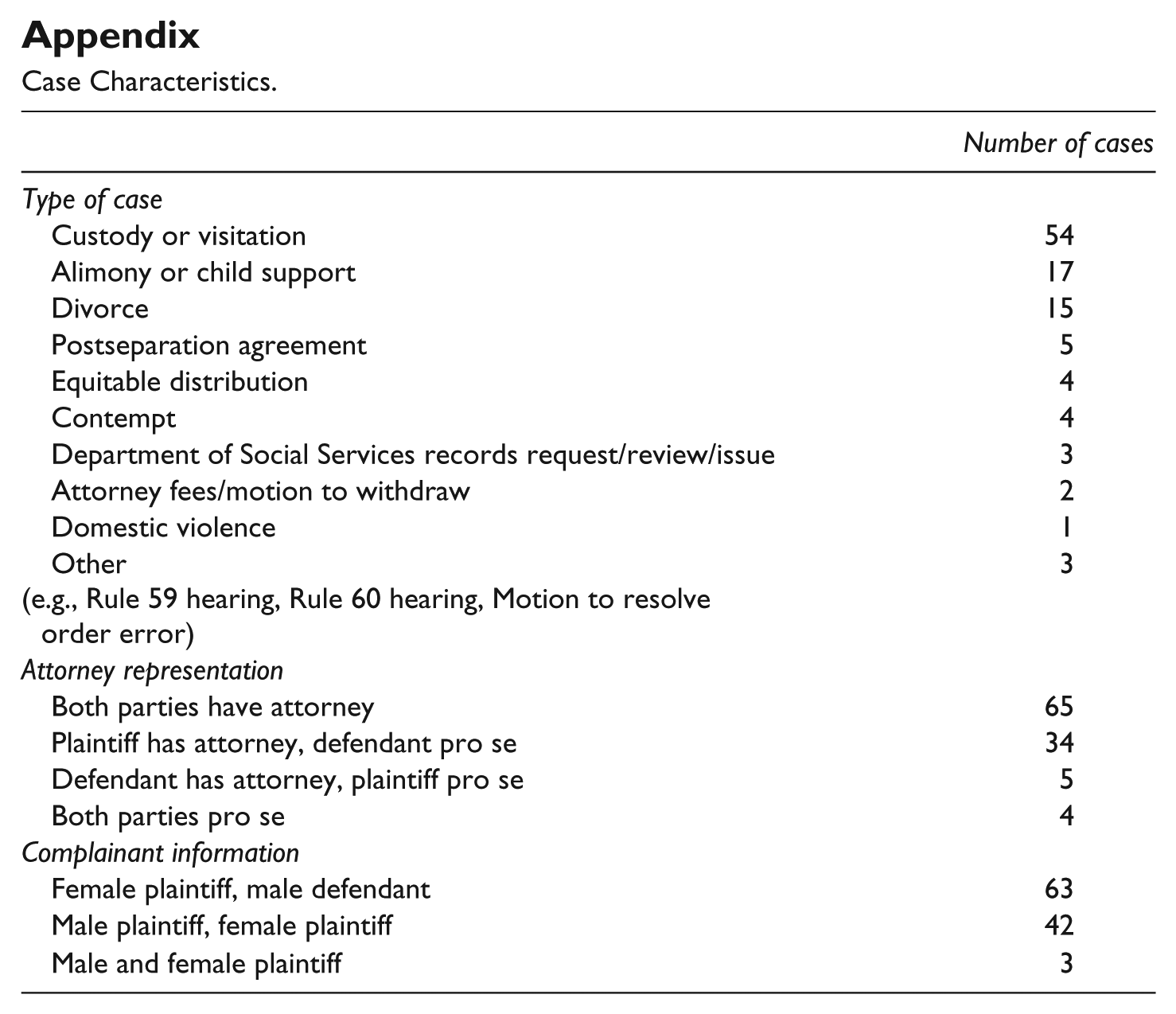
| Number of cases | |
|---|---|
| Type of case | |
| Custody or visitation | 54 |
| Alimony or child support | 17 |
| Divorce | 15 |
| Postseparation agreement | 5 |
| Equitable distribution | 4 |
| Contempt | 4 |
| Department of Social Services records request/review/issue | 3 |
| Attorney fees/motion to withdraw | 2 |
| Domestic violence | 1 |
| Other (e.g., Rule 59 hearing, Rule 60 hearing, Motion to resolve order error) |
3 |
| Attorney representation | |
| Both parties have attorney | 65 |
| Plaintiff has attorney, defendant pro se | 34 |
| Defendant has attorney, plaintiff pro se | 5 |
| Both parties pro se | 4 |
| Complainant information | |
| Female plaintiff, male defendant | 63 |
| Male plaintiff, female plaintiff | 42 |
| Male and female plaintiff | 3 |
Acknowledgements
The author would like to thank the court personnel and litigants for their participation in this study.
Declaration of Conflicting Interests
The author(s) declared no potential conflicts of interest with respect to the research, authorship, and/or publication of this article.
Funding
The author(s) disclosed receipt of the following financial support for the research, authorship, and/or publication of this article: This research was supported in part by a grant from the University of North Carolina at Greensboro.