



Abstract
Although there is some limited research on the effectiveness of the America’s Missing: Broadcast Emergency Response (AMBER) Alert system, to date, there has been no research specifically examining the viability of prospective AMBER Alert issuance criteria. Using data acquired from various media accounts of 446 AMBER Alerts issued in the United States and Canada, we examine how well “peripheral harm” (harm to someone other than the abducted child during the course of the abduction) predicts subsequent harm to the abducted child. Counterintuitively (from the perspective of AMBER Alert issuance decision making), peripheral harm or threat is negatively associated with harm to the victim in cases involving an AMBER Alert. Furthermore, this negative finding is spurious, and is primarily driven by the fact that, disproportionately, the abductors who commit “peripheral harm” in AMBER alert cases are parents and other family members of the child who are presumably unlikely to harm child relatives despite whatever violence they might commit (or threaten) against others. We discuss the implications for the use of peripheral harm as an AMBER Alert issuance criterion, the empirical evaluation of the system, and the public discourse surrounding the AMBER Alert system and its relationship to child protection in general.
Introduction
The America’s Missing: Broadcast Emergency Response (AMBER) Alert system originated in Texas after the brutal abduction and murder of 9-year-old Amber Hagerman by an unknown predator in 1996, in Arlington, Texas. Although the abduction was immediately observed and reported, authorities were unable to receive updated information of the location of either the perpetrator or the victim. The perception that quicker response might have saved Amber Hagerman’s life inspired the development of a system to disseminate information about kidnapped children and their abductors to media outlets and to the public (Griffin, Miller, Hoppe, Rebideaux, & Hammack, 2007). The AMBER Alert system became a nationwide network under the 2003 Federal Prosecutorial Remedies and Other Tools to end the Exploitation of Children Today (PROTECT) Act, and has been frequently lauded by practitioners and advocates for its ability to “save lives” (National Center for Missing and Exploited Children [NCMEC], 2013; U.S. Department of Justice [DOJ], 2007). However, extant research has questioned such claims. AMBER Alert successes are overwhelmingly not apparent “life-saving” rescues (Griffin, 2010), and the system arguably confronts inherent constraints to achieving such levels of success (Griffin & Miller, 2008).
Although there have been efforts to examine the overall effectiveness of the AMBER Alert system, to date, there has been no examination of the viability of AMBER Alert issuance criteria. Developed by the U.S. DOJ, which oversees the operation of AMBER Alert, the issuance criteria are part of an effort to rationalize the AMBER Alert issuance process and reserve the use of Alerts for the most compelling child abduction cases. Specifically, DOJ recommends Alerts be issued only when the following criteria are met: (a) Law enforcement officials have confirmed an abduction has occurred, (b) the child is likely in imminent danger, (c) descriptive information about the perpetrator and/or victim is available, (d) the victim is under 18 years old, and (e) information about the child has been entered in the National Crime Information Center (NCIC) system (NCMEC, 2012).
Of special relevance to this article is Criterion (b)—the “imminent danger” standard for issuing an Alert. Law enforcement officials are of course presented with a dilemma in determining whether a particular alleged abduction justifies the issuance of an AMBER Alert: How can “imminent danger” be determined? One clearly reasonable basis for issuance would be evidence the abductor is violent. Violence committed against the child at the moment of abduction would seem to clearly justify an AMBER Alert. However, violence against someone other than the child, such as a custodial parent or other guardian (“peripheral harm”—as we define it for this article) in concurrence with the kidnapping, would also seem to constitute a clear justification for issuance (see the example below). It stands to reason that an individual willing to threaten, harm, or kill a peripheral victim during the course of an abduction might be equally menacing to the kidnapped child.
However, practitioners and scholars to date have paid little attention to the viability of AMBER Alert issuance criteria and issuance decisions. It is usually not specified, for example, why a particular Alert was issued other than the abducted child was presumed to be in “imminent danger.” Nor has there been any scholarly examination of the viability of “threat” types as measures of actual threat to the abducted victim or as predictors of the likelihood of AMBER Alert “success.” In this article, we attempt to address this gap in research on the AMBER Alert system by simulating the use of “peripheral harm” or threat (harm or the threat thereof to someone other than the child during the course of the abduction) as an AMBER Alert issuance criterion. To give the reader a concrete example of what we mean by “peripheral harm” committed in a child abduction case involving an AMBER Alert, we have included an excerpt from a news story published online in March 2014, regarding just such a case:
Through the Texas Amber Alert Network, the Temple Police Department issued a child abduction alert for -------…… at about 11:15 a.m. Friday. According to NBC affiliate KCEN-TV in Temple, law enforcement believed the child was in grave or immediate danger due to a shooting that took place at about 6:30 a.m. KCEN reported the child’s father, Vincent Corson, Jr., was suspected of shooting his estranged wife and then disappearing with their child (Janda, 2014).
The balance of this case, including its resolution, will be discussed below, as it illustrates the larger argument of the article. The more immediate point is that it illustrates how an AMBER Alert can be issued in a case involving “peripheral harm”—that is, harm to someone other than the abducted child. In this particular instance, the injured victim was the child’s mother, and the violence inflicted on her, according to the news report, specically flagged the suspect as an imminent and potential threat to the child, enabling the case to meet the issuance criteria for an AMBER Alert.
Potential Limits to AMBER Alert Effectiveness and Implications for AMBER Alert Issuance Criteria
Available research on AMBER Alert to date suggests a number of related limitations to and qualifications of the system’s effectiveness (Griffin, Williams, Wooldredge, & Miller, 2015). First, AMBER Alerts are more likely to be “successful” when the abductor is a parent or other family member, and less so when she or he is a stranger or acquaintance (Griffin, 2010). Second, the principal determinant of AMBER Alert outcomes in general (whether the Alert has a direct effect or not) does not appear to be how rapidly Alerts are issued or recovery is achieved, but the identity and (presumed) intentions or capacities of the abductor (Griffin et al., 2007). Finally, issuing authorities are compelled to minimize the superfluous use of AMBER Alerts to avoid undermining public attention to them, but this can conflict with the presumptive need to issue Alerts rapidly—and avoid the risk of being second-guessed if the abduction ends tragically—to minimize response time as per the system’s design (Griffin & Miller, 2008).
This latter issue—the desire to prioritize AMBER Alerts for the most serious cases—is of special relevance to this article, because that consideration presumably forces issuing authorities to look for features of particular abduction cases, which would justify an Alert. The presence of “peripheral harm” (PH) would seem to render just such a justification. However, to date, there has been no specific examination of the viability of the various issuance criteria, such as the means by which a child is determined to be in “imminent danger.”
Thus, the present study tackles a very different research question from earlier examinations of AMBER Alert effectiveness: How harm or threat thereof to a peripheral victim is associated with (a) AMBER Alert outcomes in general, or (b) cases where AMBER Alerts were shown to be successful either through citizen assistance or the intimidation of the abductor by the Alert. This will allow for an assessment of the viability of PH as an AMBER Alert issuance criterion, and the potential implications for the prospect of rationalizing the AMBER Alert issuance process.
Clarifying the Scope and Limits of the Study
Unfortunately, when AMBER Alerts are issued, the specific reasons why the child is deemed to be in the “imminent danger,” which might justify the Alert, are rarely if ever stated by the issuing authorities. In fact, by definition, all children for whom an Alert is issued are at least supposed to be presumed by issuing authorities to be in some danger. Again, those exact threats are rarely if ever specified, so this study can only test the viability of threats known to the data coders. Furthermore, the analysis presented here requires the additional assumption that “peripheral harm” committed at the moment of the abduction is regarded by issuing authorities as indicating greater physical threat—all other things being equal—to the physical safety of the child—relative to most other plausible threats, such as a parent with “only” a drug addiction or mental health issue. Thus, we must hasten to emphasize that the analysis presented here must be regarded as a simulation of the use of “peripheral harm” as an issuance criterion, not an actual direct test of it, which is not possible with available data.
There are, however, two key considerations mitigating this concern. First, although the authors stipulate the possibility that the observed peripheral harm or peripheral harm and/or the threat of peripheral harm (PH/PHTPH) was not the reason for the issuance of a particular Alert, it stands to reason that Alerts would be more likely to be issued in these situations. Authorities assessing threats to abducted children are confronted with the murky business of attempting to predict human behavior, and if harm committed at the moment of the abduction does not routinely figure in this estimation, then it begs the question. Second, even if PH or threat was not the main reason why authorities chose to issue a particular Alert, the analysis is still valid as a test of how well PH performs as an issuance criterion. In sum, there is compelling reason to presume that PH is used as a determination of threat to the abducted child in AMBER Alert cases, and thus, this study is informative as to its potential utility as such.
Hypotheses
Prior research has consistently shown that parental and other familial abductors usually pose little threat to abducted children, and that strangers and acquaintances on average pose the greatest threat (Hanfland, Keppel, & Weis, 1997; Hegar & Greif, 1991). However, the premise of the AMBER Alert system is to rescue children from situations and abductors who are estimated by issuing authorities to pose some threat, whatever their relationship to the victim, and that perforce these estimations are presumed to have some validity. Thus, a control for the independent effect of relationship is logical, even if—again, assuming the AMBER Alert issuance process is amenable to rationalization—a familial abductor would be deemed more dangerous by virtue of committing or threatening PH. Available data also consistently show that most AMBER Alerts have no direct effect in bringing about the safe recovery of the abducted children (NCMEC, 2007, 2008, 2009, 2010, 2011, 2012, 2013). Thus, if PH/PHTPH are used as proxy measures of “imminent danger” to the child, then cases where PH/PHTPH exists should be associated with a greater occurrence of harm to the abducted child(ren) in the full pool of cases (see below). From this, a simple research hypothesis is suggested:
The data allow for another hypothesis test related to the possible effectiveness of the AMBER Alert system under the presumption that PH/PHTPH is indicative of some real threat to the child. Because the premise of AMBER Alert is to quickly and safely recover children from the worst prospective abductors, it stands to reason that within the pool of cases involving PH/PHTPH, the cases where there was some AMBER Alert effect will be less likely to involve victim harm than cases where there was no AMBER Alert effect, if, again, PH/PHTPH genuinely indicates threat to the abducted child. This suggests an ancillary but critical second hypothesis:
Method and Data
The data used here are derived from content analyses of news articles on AMBER Alerts issued in the United States and Canada. Using the primary search term AMBER Alert on Lexis-Nexis, volunteer student data gatherers searched through all the “hits” for individual months from September 2006 through June 2010 and identified relevant stories for 672 distinct AMBER Alert events. The first author supervised the thoroughness of this work to maximize sample size. Two data coders (the second and third authors) then entered the various numeric codes into an Excel spreadsheet that was later converted into an SPSS file for statistical analysis. Hoaxes, misunderstandings, and missing-data cases were eliminated, leaving a sample size of 446 cases. Forty-seven randomly selected cases were coded in common to develop a standard intercoder reliability rating. Of the original 672 cases coded, the second author coded Cases 1 through 199; the third author coded Cases 200 to 672. Each coder was required to copy and paste the exact verbiage from a newspaper or other account of the AMBER Alert case that justified each coding.1,2
Variables
Table 1 shows the descriptive statistics and coding framework used in this analysis. A number of variables were gathered as per available empirical understandings of AMBER Alert: Prior research suggests that the relationship of the abductor to the child is a key predictor of AMBER Alert outcomes (Griffin et al., 2007). 3 The Alert Effect indicates if, and in what manner, the Alert helped to recover the child. The Alert was deemed effective when there was evidence from the media accounts that a citizen’s tip led to the recovery of a child, or when the offender was apparently intimidated by the Alert into releasing the child. From an original set of coding protocols in which the media accounts reported apparent “threats,” such as murder or assault during the course of the abduction, the dummies of PH/PHTPH indicate violence inflicted or threats against an individual other than the child during the abduction. Where there was evidence of any harm or threat by the abductor during the abduction, the Target of the harm was also noted to allow for the creation of the dummies of PH and PH/TPH. The nature of any Child Harm, also derived from the media accounts, indicates whether the child suffered physical harm, sexual harm, or death.
Descriptive Statistics by Different Units of Analysis.
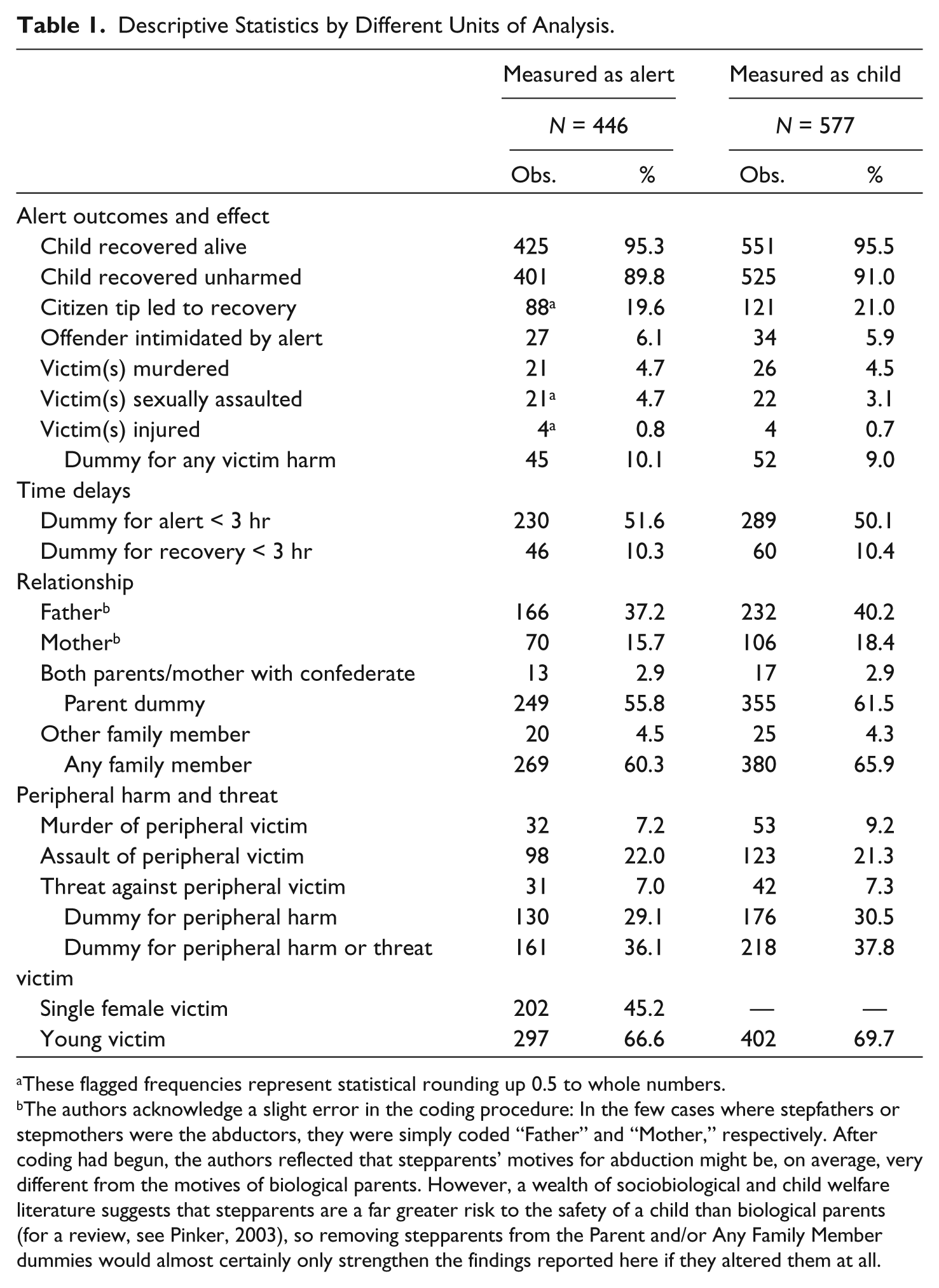
These flagged frequencies represent statistical rounding up 0.5 to whole numbers.
The authors acknowledge a slight error in the coding procedure: In the few cases where stepfathers or stepmothers were the abductors, they were simply coded “Father” and “Mother,” respectively. After coding had begun, the authors reflected that stepparents’ motives for abduction might be, on average, very different from the motives of biological parents. However, a wealth of sociobiological and child welfare literature suggests that stepparents are a far greater risk to the safety of a child than biological parents (for a review, see Pinker, 2003), so removing stepparents from the Parent and/or Any Family Member dummies would almost certainly only strengthen the findings reported here if they altered them at all.
Analysis Strategy and Dependent Variables
To shed light on the relative importance of PH/threat as a predictor of AMBER Alert outcomes, we conducted multivariate logistic regression analyses to predict two outcome variables. The first outcome variable was Victim Harm, regardless of whether an Alert had an effect. The second outcome variable was AMBER Alert success, or where the Alert had some effect as explained above. 4
Predictor Variables
The predictors used in the regression models are suggested both by the significant findings from the bivariate analyses and prior literature. Single female victims are disproportionately the targets of abduction-murder and/or sex crimes (Hanfland et al., 1997), and the sample includes a number of Alerts issued for girls who turned out to be victims of such crimes (which often, but not always, included murder). Whether the Alert was issued within 3 hr was included based on its significant inverse 0-order relationship with victim harm (described below). Similarly, the control for the presence of any child aged 5 or under follows the significant 0-order relationship and the recognition that the vast majority of very young children are abducted for reasons other than for the purpose of victimization. Controlling for type of relationship follows from both its significant positive zero-order relationship and prior literature indicating familial abductors—all other things being equal—do not typically pose an immediate threat to the abducted children. 5
The reader should be aware of two important features of the data. First, there are two sets of descriptive statistics reflecting two different units of analysis in the results shown in Table 1. In the first column, the unit of analysis is treated as the Alert outcome regardless of the number of children involved in the particular abduction. This reflects our belief that, as long as the outcome is the same for all the abducted children, a particular AMBER Alert should be treated a single event. 6 To provide readers the actual numbers of victims involved, the second column is included wherein each Alert outcome was weighted according to the number of children abducted in the particular Alert case. Thus, for example, while the first column shows that 425 Alerts ended with the recovery of the child(ren) alive, the second column shows that 551 total children were recovered alive in these Alert cases because some of the Alerts involved multiple abducted children.
A second important clarification is terminological but should be iterated. Positive Outcome merely refers to the fate of the child independent of any AMBER Alert effect, whereas AMBER Alert “Effect” (success), by contrast, is defined here as where (a) a citizen tip directly led to the recovery of the child, or (b) there was evidence the perpetrator was intimidated by the Alert into releasing the child or surrendering to authorities. Thus, there can be a Positive Outcome that does not necessarily involve an AMBER Alert Success.
Results
Univariate Descriptive Statistics
The information displayed in Table 1 is highly consistent with prior research. In almost 90% of the cases, the child was recovered safely unharmed (Positive Outcome). However, AMBER Alerts were a contributor to the return of the child(ren) in just less than 26% of all cases. This finding is consistent with previous research conducted by Griffin and colleagues (2007), which found AMBER Alert to be successful in recovering the child in approximately 32% of the cases, and the NCMEC studies, which found an average success rate of 22% (derived from NCMEC, 2007, 2008, 2009, 2010, 2011, 2012, 2013). 7
An observation highly relevant in interpreting the validity of “peripheral harm” as a proxy of “threat” to the child concerns the relationship of the offender to the victim. In just less than 53% of the cases, the child was abducted by a parent, and 61% of the cases involved a parent or other family member. The perpetrator was a stranger or acquaintance in 21% of the cases. This is again consistent with previous research reporting that the offender was a parent in 44% of the cases and either a stranger or an acquaintance in approximately 18% of the cases (Griffin et al., 2007).
Also important to note is that PH was evident in 130 (29.1%) of the Alerts used in this analysis. Of the cases involving PH, the peripheral victim was assaulted in 98 cases (75.0%) and murdered in 32 cases (24.6%). PHTPH was noted in 161 (36.1%) of the cases. In the overwhelming majority of PH/PHTPH cases, the target was a guardian—typically a parent or other relative of the abducted child—but in a few cases, the non-child targets were others, such as child welfare officials or babysitters.
Bivariate Analysis
The first statistical analyses were basic Pearson correlations to test for significant correlates of PH/PHTPH (See Table 2). The most important finding from this analysis is the correlation between PH/PHTPH and the eventual harm to the child. It turns out, in the full pool of AMBER Alert cases studied here, an abducted child is significantly less likely to be harmed prior to recovery when either PH (r = −.149; p < .01) or PHTPH (r = −.159; p < .01) is evident. This is contrary to the expectation that children abducted by violent offenders would be in greater, not less, danger. Thus, Hypothesis 1 is not only disconfirmed, but its opposite is suggested. In other words, PH/PHTPH is a significant proxy measure of less “threat” to the abducted child.
Zero Order and Multivariate Logistic Regression Models Predicting Victim Harm (N = 446).
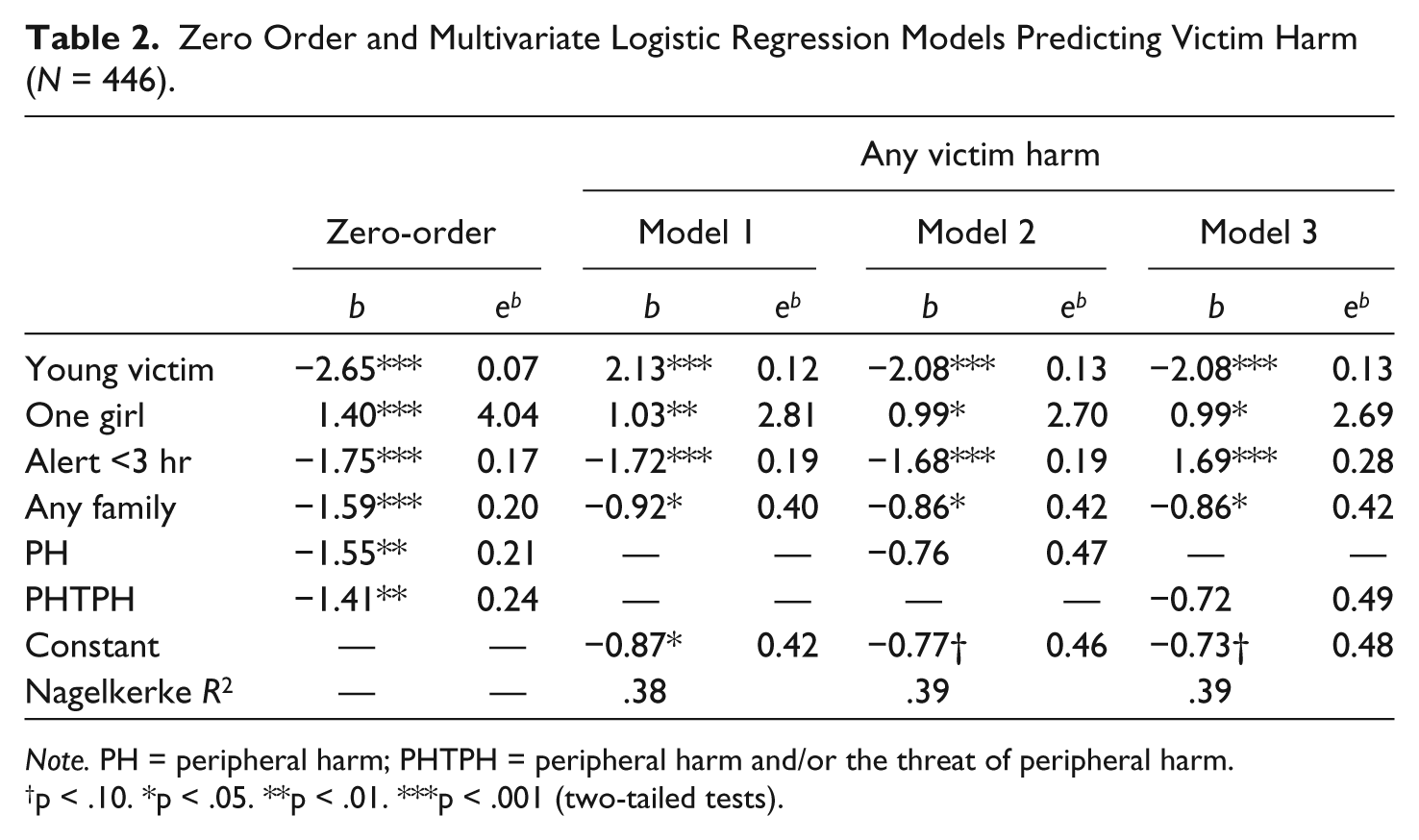
Note. PH = peripheral harm; PHTPH = peripheral harm and/or the threat of peripheral harm.
p < .10. *p < .05. **p < .01. ***p < .001 (two-tailed tests).
This naturally begs the question as to whether the Alerts are somehow more effective in those cases or perhaps the presence of PH/PHTPH creates a greater sense of urgency in law enforcement officials to issue the Alerts and/or resolve the cases themselves. And in fact, the data show that when PH or PHTPH are present, AMBER Alerts are more likely to be issued in less than 3 hrs (PH r = .118, p < .05; PHTPH r = .131, p < .01). Even more important, when the Alert is issued in less than 3 hr, victims are significantly less likely to be killed (r = −.166; p < .001) or in any way harmed (r = −.227; p < .001). This is important and at least consistent with prior research suggesting that rapid official response is crucial in the worst child abduction cases (Hanfland et al., 1997; Brown, Keppel, Weis, & Skeen, 2006).
However, it is possible these findings suggest something else. First, there was no relationship between PH/PHTPH and recovery time. 8 If more rigorous official response resulted from a greater sense of urgency inspired by the PH/PHTPH, one would expect it would manifest itself in more rapid recovery time, but in these data, it did not. It is thus more plausible that PH/PHTPH and rapid response are both associated with a case type that is more amenable to rapid issuance and effective (if not necessarily rapid) official investigation. Crucially, the bivariate analyses showed a strong correlation between PH/PHTPH and the relationship between offender and victim. The findings were very similar regardless of which combination of relationship to victim and PH/PHTPH dummies were used, so only a few will be reported here. For example, examination of the “Parent” dummy shows that a parent was the perpetrator of PH in 95 cases (r = .223; p < .001). Conversely, strangers and acquaintances were significantly less likely to be the perpetrators of PH (r = −.210; p < .001). These findings are consistent with prior research showing that abducting family members in AMBER Alert cases usually do not harm their children (Griffin et al., 2007). It also affirms the important (if not facially profound) insight that parents/family members are relatively more likely to use instrumental violence during the course of the abduction, and even if that violence is perceived by issuing authorities as indicative of threat to the child, it is not. In combination with the correlation between PH/PHTPH and rapid issuance, the association between PH/PHTPH and family members suggests that impulsive familial abductions readily draw rapid official response and successful official attention. 9
This speculation is bolstered in light of the significant negative relationship between Alert Delay less than 3 hr and the Alert having some effect (r = −.103; p < .05). When Alerts are issued within 3 hr, they are less likely to play a direct role in the recovery of the child. This initially counterintuitive finding merits discussion, especially in the context of the finding just noted that PH/PHTPH is associated with both rapid issuance and the relationship of the abductor to the abducted child. Rapidly issued Alerts are associated with case types more amenable to official response independent of the AMBER Alert, so the Alert, in essence, does not have a chance to be “successful” because normal police investigation is associated with relatively rapid official response and successful ultimate resolution of those cases independent of the Alert. In sum, there is no reason to believe that PH/PHTPH either (a) induces heightened official response in these AMBER Alert cases in general, or that (b) the Alerts are more “effective” in these cases.
To test Hypothesis 2, only the pool of cases involving PH/PHTPH was examined. Again, if PH/PHTPH is a valid measure of threat to the child for the purpose of determining whether to issue an AMBER Alert, and if AMBER Alerts are effective at rescuing children from harm, then PH/PHTPH cases in which there was no Alert effect should be more likely to involve harm to the abducted child. In fact, the hypothesis is not confirmed. In the cases that included PH (N = 130) or PHTPH (N = 161), there was no relationship between Alert Effect (Success) and whether the abducted victim suffered some harm (PH r = −.051, p = .56; PHTPH r = .005, p = .95). Thus, it can be concluded that PH/PHTPH is not a valid predictor of threat to the child regardless of whether AMBER Alerts have any effect. 10
Multivariate Analysis
At least from the perspective of rationalizing the AMBER Alert issuance process, it is conceptually bizarre to posit that the presence of PH is on its face a logical indicator of less threat to the child, in which authorities are attempting to reserve the Alerts for cases involving apparently threatening abductors. In fact, in our regression models (see Table 2), the various controls behaved exactly as expected, affirming the commonsense predictors of threat to abducted children. Very young kidnapped children and children kidnapped by family members were at relatively lesser risk of harm, while single female victims faced a higher risk of harm for the reasons explained above. Rapid issuance time remained a negative predictor of harm to the child (see “Discussion” section of this article). However, the key finding for our research question regards the effect of PH/PHTPH. Despite significant zero-order relationships with victim harm across all AMBER alert cases, these relationships were rendered nonsignificant when measures of the relationship of the abductor to the child were included in the multivariate models along with the other statistical controls. This again simply suggests familial abductors are more likely to commit PH but are less likely to pose an immediate threat to the children they abduct, and if in fact PH/PHTPH is routinely used as an AMBER Alert issuance criterion, it is suspect.
The reader will note that, as with the bivariate analyses, the issuance of an Alert within 3 hr is a significant predictor of a successful conclusion to the abduction. This again seemingly vindicates AMBER Alert advocates’ point that more rapid response can help reduce threats to abducted children, but it is highly qualified. This relationship holds for all AMBER Alert cases in the sample, not just the ones for which the Alert had some effect. One speculation, as noted above, is that rapid issuance is associated with a more easily resolved category of case, regardless of what an AMBER alert does or does not accomplish. It could also indicate a number of ways the AMBER Alert system might have evolved since its earlier implementation: (a) It has become more streamlined in its execution in resolvable cases, (b) it has indirectly influenced the culture of law enforcement to exercise greater diligence in child abduction cases, and (c) Amber Alerts might in fact be “effective” in that the system tangibly improves law enforcement response in child abduction cases through superior communication of better information, even if it is not routinely eliciting useful citizen tips or intimidating abductors. However, these important matters are for future research outside the scope of this article. 11
If we are to tie this discussion back to the negative relationship between PH/PHTPH and risk to abducted children in AMBER Alert cases, one can imagine the application of any number of criminological explanations of why parents and other family members would be willing to deliberately hurt someone else but not the abducted child. At an intuitive level, however, it should not surprise that most relatives of children do not want to hurt them, even if they are willing to hurt someone else to achieve the goal of possessing the child.
Resolution of the Real Life Example
We now return to the case mentioned above involving an AMBER Alert issued in Temple, Texas, in March 2014, where the mother of the abducted child was shot by the perpetrator during the abduction. The case provides a recent and illustrative example of the passions and motivations of familial abductors in PH cases. The perpetrator was in fact the noncustodial father, who defied a restraining order when entering his estranged wife’s home to take the child. He clearly had no sophisticated escape plan, as he was captured within hours through routine police pursuit and investigation, and the child was recovered unharmed. As with the majority of AMBER Alert cases, the AMBER Alert had no effect. The perpetrator was later visited in jail by local reporters, during which exchange, he said the following:
“I was just trying to spend some time with my son,” says -----------. “That seven hours that I did have with my son were essentially the happiest seven hours I’ve had in the last six months. I was just trying to spend some time with my son . . . I’m sorry. I didn’t, physically me, myself do this. You can look at me in my eyes and tell that I didn’t do this myself something happened. I don’t know what happened,” says --------. “I was told I shot my wife. I didn’t go to there to harm my wife. This is the love of my life. Still today, I love my wife.” (Gross, 2014)
The AMBER Alert in this case had no effect, but that it was issued at all reflects the central concern we have regarding its use as a perceived “remedy” to the problem of child abduction.
Implications
The findings presented here must be regarded as preliminary. Again, AMBER Alerts do not include the specific grounds for their issuance, and so additional research is needed to test the validity of PH/PHTPH as a predictor of threat to an abducted child in cases involving an AMBER Alert. Still, the negative correlation of “peripheral harm” with harm to an abducted child presents a quandary. Even if it could be assumed that public officials overseeing AMBER Alert are interested in statistical findings about the system and the presumption of “threat” to the child in cases involving PH/PHTPH, there is likely little inclination to withhold AMBER Alerts for violent abductors, whatever the targets of their violence. As noted above, public officials already confront an onerous dilemma when attempting to quickly determine whether a reported kidnapping merits an AMBER Alert, and they certainly cannot be blamed for assuming “peripheral harm” constitutes evidence of threat.
It must also be remembered that the inverse correlation between PH/PHTPH and victim harm is not perfect; there are cases where the abductor commits serious PH and harms the abducted child. 12 An official deciding whether to request an AMBER Alert in a case involving a murdered spouse and an abducted child is unlikely to care what the statistics say. As noted in prior research, officials have been subjected to withering criticism for not issuing Alerts in cases that initially did not appear to involve any threat but which ended in the serious harm or death of an abducted child (Griffin, 2010; Griffin & Wiecko, 2015). They are not likely to risk even more intense second guessing in cases involving what at least appear to be menacing abductors.
Future Research
Nonetheless, the findings provided in this study can make a meaningful contribution to both the manner in which AMBER Alerts are studied and the public discourse surrounding AMBER Alert, if not necessarily its implementation. The NCMEC releases annual reports on the performance of all AMBER Alerts issued in the United States the previous year, although to date, none of them includes information on the specific criteria used in issuing Alerts. This is because the determination of “threat” to the abducted child is left to issuing authorities; once it is presumed the child is in “imminent danger,” and the other issuance criteria are met, no further specification is required.
Thus, requiring public safety officials to note the specific reasons for the determination of threat to abductees in AMBER Alert cases and then developing categories for those justifications (e.g., “abductor has violent past,” “abductor harmed child during abduction,” “abductor is a known drug abuser,” and so forth) would enable researchers to examine how well such stated justifications perform as predictors of either actual threat posed to the victims or the likelihood of Alert “success.” This information could probably not be publicized because of the sensitivity public officials generally exercise in protecting the privacy of minors involved either as perpetrators or victims in criminal cases, but the data could still be useful to researchers at NCMEC attempting to analyze the AMBER Alert system and its effects.
Public Discourse
More important, the findings presented here could inform the discourse surrounding AMBER Alert. Ultimately, the finding that most violent child abductors present little threat to the children they abduct is only counterintuitive from the perspective of trying to rationalize the AMBER Alert issuance process. The failure of PH/PHTPH to perform as a proxy of threat to the abducted child is unsurprising to those who understand the dynamics of child abduction, but it is yet another piece of evidence highlighting AMBER Alert’s inherent limitations. Prior research on AMBER Alert has already identified the potential tension between the imperative for rapid response and careful verification of the issuance criteria, as well as the preeminent role of a perpetrator’s identity, and not recovery time, in determining outcomes in AMBER Alert cases. This study suggests an additional limitation of the system: Even what could be plausibly regarded as an indication of threat to the child is usually indicative of the opposite.
Thus, the most important public policy implication to emerge from these findings does not concern how the AMBER Alert system should be implemented, but how it should be interpreted. As noted in prior research, it is frequently suggested by AMBER Alert program advocates and practitioners that “hundreds of lives” have been saved by AMBER Alerts, but that these claims are very dubious and possibly self-defeating; inflated expectations of what the system can accomplish can cause public backlash and even litigation when AMBER Alert “fails” or is not rapidly deployed in cases ending tragically (Griffin, 2010; Griffin & Miller, 2008). The findings presented here are simply additional evidence that the AMBER Alert system’s original goals are unrealistic. Not only is the system of limited utility in saving children from threatening abductions, but it is also extremely difficult to gauge whether those abductions are even threatening enough to merit an AMBER Alert.
It could be the AMBER Alert system is a victim of the excellent intentions of its designers. Child abductions are inherently chaotic events, usually involving a jumble of passions, perceptions, acts of violence, facts, half-truths, and lies. The decision to issue an AMBER Alert must be made quickly with often poor and/or contradictory information about even basic facts such as whether an abduction even occurred and the identity of the perpetrator—let alone something as indiscernible as the perpetrator’s intentions or capacities. When an AMBER Alert is issued and the issuance criteria (such as evidence of threat) are considered by public safety officials, it represents an attempt to bring order to bear on an inherently fluid and unpredictable situation, and might thus be largely impeded from the start. If the presence of “peripheral harm” is in fact being used as an indicator of threat to the safety of the child in AMBER Alert abductions, it represents an attempt to plumb the indiscernible depths of perpetrator motive—which can hardly be known in the rapidly evolving circumstances of a child abduction.
The failure of “peripheral harm” to function as a positive predictor of “threat” to an abducted child is a microcosm of the broader dilemma confronting virtually every component of the justice system, including parole boards’ release decisions, judges’ sentences, prosecuting attorneys’ plea agreements, treatment experts’ assessments of successful “rehabilitation,” and patrol officers’ daily gauging of the level of threat posed when confronting wayward citizens. In short, it is the often lamented “prediction problem,” except with the AMBER Alert system, these predictions of risk have to be made even faster, with less information, and with potentially even more at stake. It is not that law enforcement officials are “irrational” in their management of the AMBER Alert issuance process, but that the process itself may be inherently resistant to rationalization.
Our findings also have wider implications regarding how threats to children are gauged and remedied. It is very likely an abductor willing to threaten, harm, or kill a peripheral victim poses a long-term threat to the welfare of the child, even if she or he does not pose an immediate threat in the short time frames typically involved in AMBER alert cases. However, that an AMBER alert was issued for the purpose of protecting an “endangered” child suggests that various other child protection institutions fell short in securing the child’s welfare in the first place, allowing the child to linger in the unstable and dysfunctional conditions that preceded the perceived need for an AMBER Alert, as is so often the case with familial abductions (Hegar & Grief, 1991). To wit, although child abductions resulting in serious harm or murder are extremely rare (Finkelhor, Hotaling, & Sedlak, 1992), abuse and neglect account for hundreds of child deaths annually in the United States (Palusci & Covington, 2014). The AMBER alert system represents a sincere, sensational, and, by its very nature, highly public ex post facto response to particular child abduction cases. However, by its design, it does nothing to address the principal and underlying threats to child safety and health. Our fear is that the attention paid, effort invested, and faith placed in AMBER Alert could be misguided if society becomes satisfied with the largely symbolic, minimally effective, and as suggested by this research, inherently unwieldy response to child safety it constitutes.
Thus, law enforcement officials, child protection authorities, and the public would all benefit from an increasingly realistic public discourse about AMBER Alert. Rather than lauding its “life-saving” abilities or its success as a thriving “partnership” between the public and law enforcement, we believe officials should downplay public expectations about the system and caution against over-optimism. Any given child abduction is an emotionally unstable and chaotic situation for which there is usually no simple solution such as an AMBER Alert or any clear means to evaluate its severity until after the fact. Perhaps it is time this possibly disheartening but realistic view, so clearly demonstrated in this and prior research, begins to reshape how AMBER Alert is publicly discussed and evaluated.
Footnotes
Declaration of Conflicting Interests
The author(s) declared no potential conflicts of interest with respect to the research, authorship, and/or publication of this article.
Funding
The author(s) received no financial support for the research, authorship, and/or publication of this article.