



Abstract
Prior research based on limited datasets has suggested AMBER Alerts do little to prevent harm to child abduction victims. However, to investigate the possibility of recent improvements in AMBER Alert performance, the authors examine a sample of 472 AMBER Alerts issued over a 3-year period from 2012 to 2015, using available media accounts to code for relevant case information. The findings are consistent with prior research questioning AMBER Alert effectiveness: The crucial variable predicting Alert outcomes is abductor relationship to the victim, not AMBER Alert “performance.” Furthermore, cases involving “successful” AMBER Alerts are comparable on measurable factors to AMBER Alert cases where the child was recovered safely but the Alert played no role, suggesting both categories of cases involved little real risk. Implications for interpreting the viability of the AMBER Alert concept, public discourse regarding its contribution to child safety, and larger implications for crime control policy are discussed.
Introduction
The AMBER Alert child recovery system was inspired by the abduction and murder of Amber Hagerman in Arlington, Texas, in 1996 (Griffin et al., 2007). Public dismay at the brutality of the murder and inability of law enforcement to appeal for public assistance in the search for the missing child inspired the creation of the first “Amber Plan” in Texas in 1996. The system was eventually expanded, federalized, and unified across the United States under the PROTECT Act of 2003, and at the time this article’s completion, the U.S. Department of Justice reports, “1064 children [have been] rescued specifically because of AMBER Alert [and] 92 children have been rescued because of Wireless Emergency Alerts.” (U.S. Department of Justice, Office of Justice Programs, 2021a, emphasis added). AMBER Alerts are issued when authorized law enforcement personnel, upon learning of a missing child case, assess the circumstances to determine if there is enough evidence of threat and useable information to issue an AMBER Alert to solicit the public’s assistance in searching for the child. AMBER Alerts can then be publicized through television, news websites, electronic road signs, radio announcements, and social media in an effort to elicit the public to quickly assist law enforcement (U.S. Department of Justice, Office of Justice Programs, 2021b).
Although AMBER Alert system operators, advocates, and members of the public have expressed enthusiasm for the system’s achievements, prior research has suggested these claims are exaggerated. The children recovered because of AMBER Alert are rarely “rescued” rapidly, which is a crucial consideration in light of research showing that most child abduction-murders end within hours of their initiation (see Brown et al., 2006). Furthermore, there are little evidence abductors in AMBER Alert “success” cases posed serious threats to the children recovered (see Griffin, 2010; Griffin et al., 2007, 2016). The crucial variable determining “safe recovery” in AMBER Alerts (what happens to the abducted children, which is not the same as whether the Alerts had any “effect”—a crucial distinction which will be revisited) appears to be the identity and apparent nature of the abductors and their likely intentions. AMBER Alert “failures,” however, were simply tragedies for which there was likely no possible intervention. Prior research has also suggested the AMBER Alert concept is inherently problematic, as it requires too many improbable things to work perfectly in short time frames when information is scant and suspect (Griffin & Miller, 2008). Nonetheless, prior research questioning the system’s ability to prevent harm has generally relied on incomplete sampling frames and earlier data (see Griffin, 2010; Griffin et al., 2007, 2016), which theoretically could miss AMBER Alert effectiveness. It is also at least plausible issuing authorities’ increased familiarity with the system, along with broader public awareness, possibly brought about in part by its expansion into social media, has improved AMBER Alert outcomes. 1
In this paper, using the case attributes provided by media accounts of 472 AMBER alerts issued in the United States and Canada from 2012 to 2015, we evaluate these possibilities by providing logistic regression models to tap the apparent predictors of “safe recovery” (children recovered alive and/or unharmed) in AMBER Alert cases. We also statistically compare “success” cases (where the Alert had some effect leading to safe recovery) to “safe-recovery-no-effect” cases (where the child[ren] were recovered unharmed but the Alert had no effect) along known with measurable variables to gain insight into the level of “threat” actually posed in cases where AMBER Alert “succeeded.” These analyses can shed light on whether any potential significant improvement in the performance of AMBER Alerts has been achieved in the years since its inception.
Literature Review
The available literature on the effectiveness of AMBER Alert strongly suggests the system is sharply limited in its ability to save endangered children’s lives or prevent serious harm in clearly high-risk child abduction scenarios, and it is in fact usually deployed in cases most likely evaluated as low risk. For example, the first attempt to analyze AMBER Alert cautioned it was in danger of becoming trivialized owing to the apparently mundane cases for which it was routinely deployed, such as familial abductions (Hargrove, 2005). This analysis, perhaps inadvertently, was the first suggestion of a fundamental problem vexing AMBER Alert issuance decisions: The assessment of threat by issuing authorities in short time frames based on ambiguous and evolving information—an issue which will be revisited in the subsequent discussion of the findings provided here.
More complete and systematic collation of AMBER Alerts in the United States is provided by the National Center for Missing and Exploited Children (NCMEC, 2007, 2008, 2009, 2010, 2011, 2012, 2013, 2014, 2015, 2016, 2017, 2018, 2019, 2020), which has published annual summaries of AMBER Alert cases for the years of 2006 to 2019. The Center’s data analysis focus is the aggregated descriptive attributes of all cases for respective years (such as how often Alerts were “effective,” average delay between the issuance of the Alert and recovery, basic overall victim and offender characteristics) and is not designed for analyses involving individual case attributes.
Nonetheless, data from the Center still provide valuable insights into the system’s possible limitations. In fact, our calculation of consolidated Center data shows that approximately 87% of AMBER Alert cases end with the abducted children recovered alive (NCMEC, 2007, 2008, 2009, 2010, 2011, 2012, 2013, 2014, 2015, 2016, 2017, 2018, 2019, 2020). Taken at face value, this seems to suggest the system is highly effective, and this high recovery rate has actually been cited publicly by system advocates and journalists (ABC 13 Eyewitness News, 2019; The Associated Press, 2006), and even equated with the word “success (Gonzalez, 2016).”
However, when one probes deeper into the NCMEC data it is clear the high “safe recovery” rate conflates two ideas—safe recovery because the Alert had some effect, and safe recovery because of something else, such as normal law enforcement investigation. When an AMBER Alert is issued, law enforcement officials do not simply wait for the Alert to work; they keep looking for the victims and offenders. In fact, the data imply it is their efforts—not AMBER Alerts—which generally lead to safe recovery in AMBER Alert cases. The consolidated annual reports show that, even though the vast majority of children in AMBER Alert cases are indeed recovered safely, most Alerts have no effect, and in fact, the average actual “success” rate (where the Alert had some effect) is only 26.7%, based on our calculation of consolidated NCMEC data after non-abduction cases are removed from the analysis. (National Center for Missing & Exploited Children, 2007–2020). By this use of the word “success,” the data analysts at the Center mean AMBER Alerts actually contributed to the recovery of the abducted children either because of a citizen tip, because the perpetrators were intimidated by the Alert into surrendering or releasing the children, or some other means by which the AMBER Alert was deemed to have made a difference. Thus, even though the vast majority of the children in AMBER Alert cases is in fact recovered safely, AMBER Alerts usually have nothing to do with that positive result (NCMEC, 2007, 2008, 2009, 2010, 2011, 2012, 2013, 2014, 2015, 2016, 2017, 2018, 2019, 2020) and are what the present authors refer to as “safe-recovery-no-effect” cases. To iterate, “safe recovery” almost always occurs in AMBER Alert cases, but usually not because the system was “successful.” A concrete example would be where a toddler is abducted by a noncustodial parent believed to pose a threat, an AMBER Alert is issued, and then investigators locate and recover the child, but the Alert played no role in this safe recovery. Most AMBER Alert cases, in fact, roughly fit this model. This again highlights the crucial distinction between “safe recovery” as opposed to an AMBER Alert “success” because of some “effect.”
There have also to date been a few examples of peer-reviewed examinations of AMBER Alert effectiveness. All of them strongly suggest a number of general conclusions. First, a minority of AMBER Alerts do in fact contribute tangibly to the recovery of some abducted children. Varying definitions of AMBER Alerts having an “effect” have yielded “success” rates of 31% (Griffin et al., 2007) and 26% (Griffin et al., 2016), which is consistent with the average of 26.7% we derived from the official reports provided by NCMEC (see above), and affirms that most AMBER Alerts have no effect whatsoever—again, even though “safe recovery” is almost always achieved.
Furthermore, a number of other fairly sobering findings have also emerged from this limited body of literature. First, unlike the NCMEC reports, this prior research has estimated the delays between the abduction and recovery, which the NCMEC data do not provide, and those delays are usually much longer than 3 hr. For example, Griffin and coauthors (2016) reported that only 46 of 448 AMBER Alert cases involving an authentic abduction led to recovery within 3 hr of the abduction, and in most of those cases the AMBER Alerts had no effect. Furthermore, an analysis of AMBER Alert “success” cases showed that only 15.3% of the successes involving recovery within 3 hr (Griffin, 2010). This is important because available literature indicates the overwhelming majority of the victims of child abduction-murder are killed within 3 hr of their abduction, and almost half are killed within 1 hr (Brown et al., 2006; Hanfland et al., 1997). For instance, Brown and Keppel (2007) found that among a sample of 735 child-abduction murders, the time-span between initial contact and time of the murder is <1 hr in 53% of cases. This strongly suggests if AMBER Alerts are to be considered “successful” at rescuing children from life-threatening circumstances the recovery delays in AMBER Alert cases would have to routinely be much faster than what has been reported in the available literature. If recovery times in AMBER Alert “success” cases are not relatively swift, it begs the question of how much threat was really posed since motivated perpetrators had sufficient time to act on their worst intentions.
Another recurring finding from this earlier body of literature is that when one examines the nature of the abductors in “successful” AMBER Alert cases (again, where the Alert had some “effect”), there is no compelling reason to believe, at least based on available information, that the abductors in such cases present life-threatening risk to the children abducted (Griffin, 2010). The overwhelming majority of AMBER Alert success cases involve abductors quite unlike the stereotypical predator (see Sedlak et al., 2002). They tend to be family members or significant others acting in the heat of custody disputes or domestic discord, wayward babysitters, car thieves unaware of the presence of an unattended child at the moment of the crime, and other categories of abductor whose known attributes do not clearly indicate harmful intentions (Griffin, 2010; Griffin et al., 2007). It is certainly true AMBER Alerts were “effective” in those cases and thus could be deemed “successes,” but suggesting the victims were “rescued” from clear danger is special pleading, especially in light of prior literature showing that most children in AMBER Alert cases are recovered unharmed even though most AMBER Alert cases have no effect (see above).
Further still, prior research has also shown that what could be facially regarded as evidence of “threat” in AMBER Alert cases—violence against parties other than the child, or “peripheral harm”—is, in fact, a negative predictor of harm to the abducted children (Williams et al., 2017). The evidence strongly suggests this finding is driven by the behaviors of emotionally distraught abductors in family abduction cases; such perpetrators likely have no violent intentions toward the children they abduct even if they are willing to use instrumental violence against others attempting to foil them. This finding further illustrates the difficulty of estimating “threat” in AMBER Alert cases, as well as a possibly intractable problem confronting AMBER Alert system operators: predicting human behavior in short time frames with scant, evolving information of uncertain quality (Griffin & Miller, 2008).
The available literature also suggests there is a daunting problem in assessing AMBER Alert: The impossibility of knowing with certainty what “would have” happened in any particular AMBER Alert case if an AMBER Alert had not been issued. No experimental designs have been conducted where the survival rates in AMBER Alert-approved cases have been compared with those of a control group of approved cases randomly assigned to a “no Alert” condition. Thus, researchers, like issuing authorities, have to rely on plausible speculation and proxy measures of “risk” or “threat.”
The literature also points to another problem vexing evaluators: How is “success” defined? When system operators point to the high “safe recovery” rate, this again can be misleading because it could allow for the classic association-versus-causation confusion by errantly implying the AMBER Alerts “caused” the children to be safely recovered. However, that cannot be the case, because again AMBER Alerts have no effect in the overwhelming majority of cases that end in safe recovery. This means the primary reason(s) for safe recovery in AMBER Alert cases are something other than AMBER Alert (such as routine investigation), and evaluating the system’s utility requires a more nuanced examination of available case details than merely whether the child was recovered alive and/or unharmed, or the Alert had some “effect” and was, therefore, “successful.”
Nonetheless, it must be iterated that prior empirical examinations of the “effectiveness” of the AMBER Alert system have relied on incomplete sampling frames and generally earlier data, and it is entirely plausible there have been improvements in the system’s efficiency. Furthermore, the expansion of the system’s scope, including its introduction onto social media platforms, might have improved its performance. Thus, any analysis of AMBER Alert effectiveness would do well to improve on earlier efforts in two ways. First, a more thorough sampling frame unlikely to miss any exemplary AMBER Alert success cases should be deployed. Second, data from more recent years could reveal any improvements in system operation over time.
Current Study
Data
To create a data set allowing for analysis of the attributes of individual AMBER Alert cases, the authors enrolled in the Google News Alert system from June 2012 until June 2015, using the search term “AMBER Alert” to flag possibly relevant stories, for which links would be sent via email from the Google news service. On a daily basis, summaries of national and regional level news outlets with stories including the term “AMBER Alert” were received and coded. Although not all of these stories were direct reports about AMBER alert abduction cases, many provided crucial information about real abductions where Alerts were issued. Among these were (sporadically available) victim and offender demographic information, victim-offender relationship, and approximate or specific abduction and recovery times (or directly stated intervals). The news reports also typically contained enough information to determine if the children were recovered, whether the Alert had any effect in bringing about that recovery, and whether they suffered any harm or were killed.
These stories were copied and pasted onto labeled Word documents for future reference during data cleaning. Student volunteers inputted relevant coded information from these documents onto an Excel spreadsheet for data cleaning and converging, after which the data were transferred to a STATA file for statistical analysis. Through this process, potentially problematic data were brought up by the data collection team and corrected as necessary by reference to the relevant saved news documents. Given that AMBER Alerts are by definition media events, it is very unlikely this data collection methodology, which involved building the dataset in real time as AMBER Alerts were issued, would have missed any significant number of Alerts. 2 We initially identified 630 total AMBER Alerts in the United States and Canada. After hoaxes, misunderstandings, child disappearances that turned out to not be abductions, and missing data cases were eliminated, there were a total of 470 cases used in the analysis. Two cases had two victims with two different outcomes, so those two cases were each treated as involving two separate “AMBER Alerts,” bringing the operational N to 472.
An additional, unique strategy employed with these data was noting cases where the content analysis of the available news coverage was consistent with a “Possible Intimidation Effect.” In these particular cases, the data collection team determined it was possible that awareness of the Alert induced the abductor(s) to release the children unharmed but that was never directly stated in the news coverage. These “Possible Intimidation Effect” cases should not be confused with “Intimidation Effect” cases proper, where the content analysis provided clear evidence the abductor(s) surrendered the child upon learning of the Alert. Thus, two versions of each statistical analysis are conducted: one with the Possible Intimidation Effect cases treated as authentic Intimidation Effect cases and thus, “successes,” and one where they were treated as “no effect” cases. The goal is to provide a higher potential upper bound for the AMBER Alert effectiveness rate, as well as an additional opportunity for AMBER Alerts to show evidence of lifesaving or serious harm-preventing effectiveness. Both models for each analysis are provided for the reader.
Dependent Variables
The dependent variables in the multivariate analyses are different measures of what happened to the abducted children: Either Serious Harm (sexual assault and death) or Any Harm (which encompasses any serious harm, as well as physical harm or injury). Both are dichotomous (0 = no; 1 = yes.)
Independent Variables
Table 1 shows the descriptive statistics and coding protocols for the independent variables included in the analysis. The current study uses measures of predictive variables similar to prior AMBER Alert research. The most important independent variable is whether the AMBER Alert was a “success” or, as it will be reported in the findings, whether the Alert had any “effect.” An Alert was deemed a “success” if the content analysis indicated one of two “effects” occurred: (a) If a citizen, aware of the Alert, observed the suspect and/or victim and informed police; (b) If a suspect became aware of the Alert and surrendered the child to authorities or some other party—an “Intimidation Effect.” (As indicated earlier, we provide analyses with and without “Possible Intimidation Effect” cases treated as “successes.”) We iterate that the independent variable of Alert Effect must not be confused with the dependent variable of whether the child suffered any Harm. This again is because even though most children in AMBER Alert cases are recovered unharmed, the Alert usually had nothing to do with that safe recovery (see literature review).
Descriptive Statistics for Victim Harm, Alert Delay, Recovery and Effect, Abductor to Victim Relationship, Victim Characteristics, and Abduction Threat Level (N = 472).
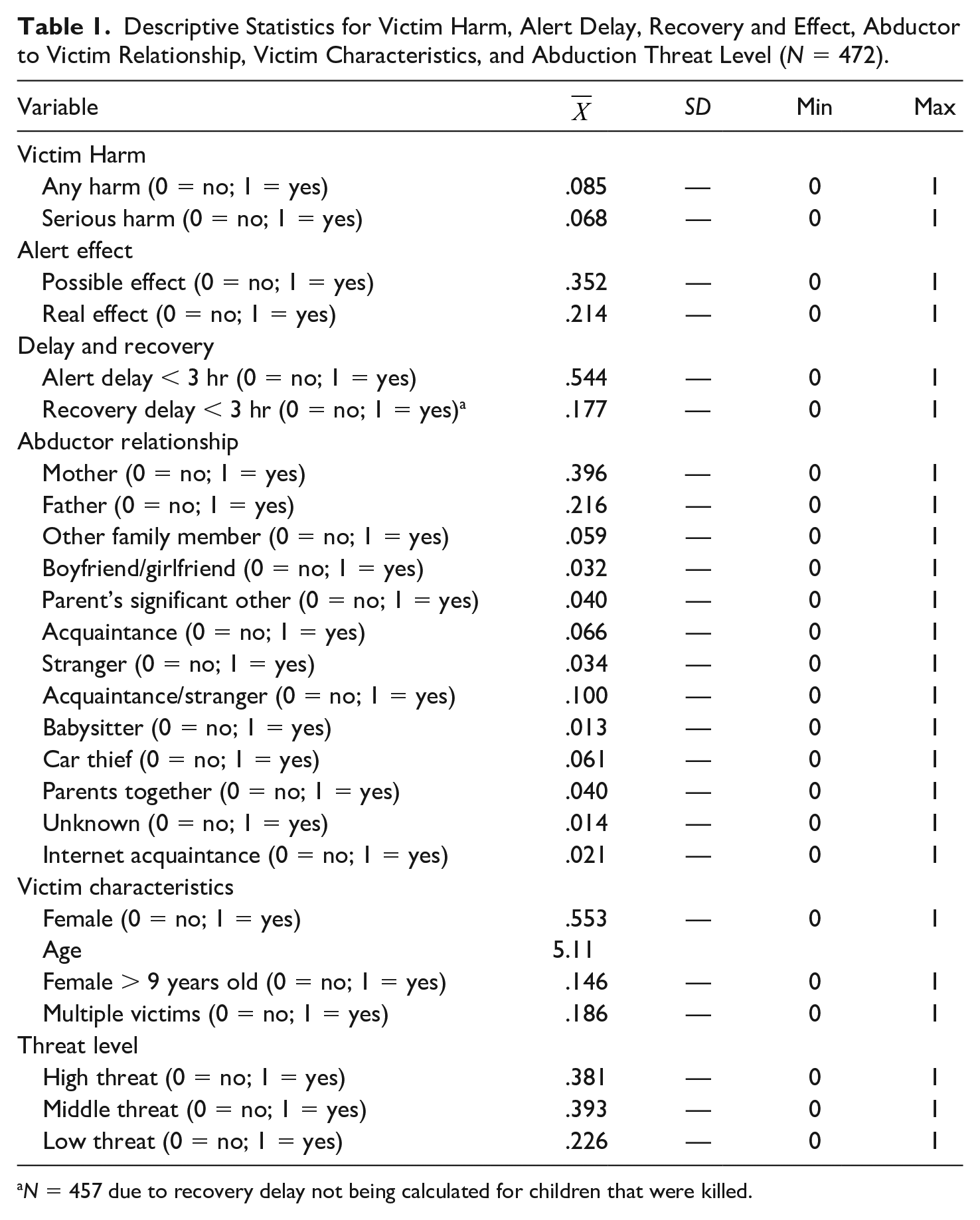
N = 457 due to recovery delay not being calculated for children that were killed.
The abductor’s relationship to the child is measured by a series of dichotomous variables (0 = no; 1= yes) for: mother; father; other family member; boyfriend/girlfriend; parent’s significant other; acquaintance; stranger; babysitter; car thief; both parents together; internet acquaintance; unknown. Time delays between abduction and alert (<3 hr), and abduction and recovery (<3 hr) are also dichotomous, (0 = no; 1 = yes), as is gender. Age is continuous.
Finally, we measure “threat level” as categorical: Low threat (coded as 1) includes cases involving no clear threat during the abduction; Medium threat (coded as 2) includes cases where abductors were known drug abusers, had histories of mental illness, were intoxicated during the incident, were known to have a violent/abusive past, made a threat of violence during the abduction, or demanded a ransom after the abduction. Medium threat also comprises cases where the child had a medical condition or was abducted by noncustodial parents. High threat (coded as 3) includes cases involving disingenuous internet contact with underage victims an assault or murder during the abduction, and those involving abductors engaged in unsavory romantic involvements or. Our multivariate models also include the interaction term of female victim 9 years old or older. This measure is suggested by other prior research showing young females are in fact disproportionately the target of harmful abduction situations, such as those involving sexual assault and/or death (Hanfland et al., 1997).
Analytic Strategy
We first provide the basic descriptive statistics and coding protocols of the dataset to give a general picture of the data and how they compare to prior reports and research on AMBER Alert. Second, following prior literature (Griffin et al., 2016; Williams et al., 2017), we construct logistic regression models to tease out the factors associated with harm in AMBER Alert cases. These results shed light on (a), the general apparent nature of AMBER Alerts in the sample and how they compare to earlier findings and (b) the factors associated with AMBER Alert outcomes, allowing for an assessment of the system’s utility in protecting children from harm in child abduction scenarios.
Third, we conducted difference of proportions tests to compare cases where there was an AMBER Alert “success” (again, where the Alert had some “effect” in facilitating recovery either because of a citizen tip or the offender was intimidated into surrendering the child, and the child was returned unharmed) versus “safe-recovery-no-effect” cases (again, where the Alert had no effect but the child[ren] were still recovered unharmed). By thus comparing the “success” cases with the “safe-recovery-no-effect” cases along all variables held in common, we are better able to determine whether substantive differences exist between the pools along known variables to shed light on how they might or might not vary on the technically unknowable variable of actual “threat” posed.
Results
Descriptive Statistics
The descriptive statistics in Table 1 are consistent with extant NCMEC annual summaries and prior scholarly research on the attributes of AMBER alert cases, although broad and exact comparisons across the datasets are not feasible owing to their extensive differences. In 21% of the cases, the evidence from the content analyses of our data suggested the Alert had some “effect” (and thus was a “success”—which again overlaps with, but is distinct from, safe recovery). If the “Possible Intimidation Effect” cases are treated as Intimidation Effect cases proper, the success rate in our data rises to 35%. The relationship of the abductor(s) to the child(ren) is also consistent with prior research, as the majority of the cases involved parents or other family members (71%) and other categories of offenders not initially suggestive of clear threat. Comparing our data with the NCMEC data is again extremely difficult because the latter’s data involve very different variables, are entirely aggregated and organized by year, and our data are coded down to the individual level and involve partial years (see footnote 2). However, the 71% rate for familial abductions in our data is consistent with the 65%, we calculated from the full NCMEC data years of 2012–2015, and for those same NCMEC data years, we calculated the center’s reported percentage of cases involving recovery within 3 hr after the child is reported missing to law enforcement as 13%. This figure is roughly consistent with our percentage of cases involving recovery within 3 hr after the abduction, which was under 18%. Time of abduction and time of the report of a missing child are of course often different, and the NCMEC data likely include the best possible estimates as ours often did, but the larger point is that both datasets concur that recovery in AMBER Alert cases is not typically rapid.
Logistic Regression Model Results
Table 2 shows the results of the logistic regression models predicting the two outcome variables: Any Harm or Serious Harm to the victims, with and without the Possible Intimidation Effect cases counted among the “success” cases, or four models total. Consistent with prior literature, the relationship between the abductor and the victim(s) is by far the most robust predictor. For instance, in all four models, regardless of whether Possible Intimidation Effect cases are counted as “successes,” the child is 6 to nearly 8 times (ORs = 6.07–7.76) more likely to suffer any or serious harm when the abductor or abductors are either strangers or acquaintances of the abducted children. This also makes intuitive sense because it stands to reason abducted children are not typically targets of intended harm in familial abductions. The correlation is not perfect of course as there are in fact a handful of cases in the data where a family member either seriously harmed or even killed the abducted child(ren). However, such cases are very rare, which also makes sense in light of prior research on child abduction in general showing that familial abduction cases almost never end in serious harm to the children abducted (Sedlak et al., 2002).
Logistic Regression Results for Any Harm and Serious Harm, by Real or Possible Alert Effect (N = 472).
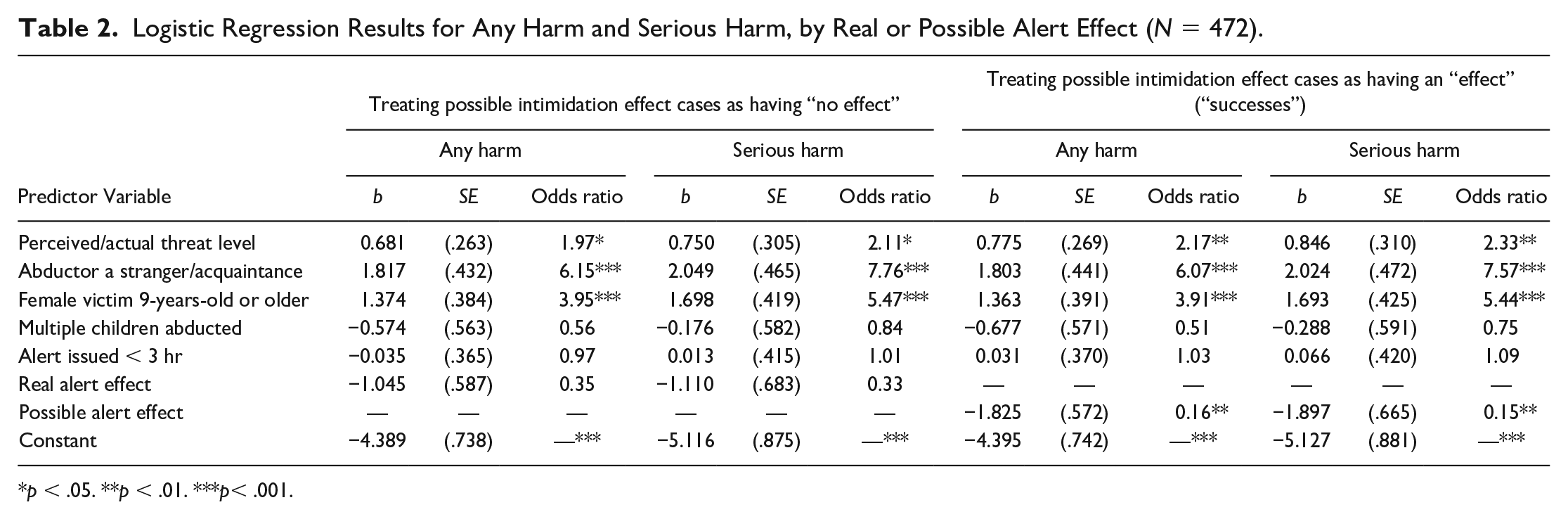
p < .05. **p < .01. ***p< .001.
Results further suggest that victim, offender, and contextual variables are also significant predictors of eventual harm, again regardless of whether the Possible Intimidation Effect cases are treated as “successes.” Females nine and older are nearly four to five-and-half times (ORs = 3.95–5.47) more likely to suffer any or serious harm. Also significant in all four models as a positive predictor of all measures of harm is the variable of Collapsed Threat. This is both intuitive and an apparent vindication of the coding procedures. Offenders with indications of prior violence and or sexual deviance were in fact more likely to inflict harm on the abducted children. For each unit increase in potential or actual threat, the odds of suffering harm nearly double. The presence of multiple child victims was a negative predictor in all four models but was significant in none of them. We speculate that multiple-victim abductions likely involve familial abductors less likely to inflict harm on the kidnapped children, although again this variable approached but did not achieve significance. Rapid AMBER Alert issuance (the AMBER Alert was issued within 3 hr of the abduction) was not a significant predictor of any measure of harm in any of the four models. This is also consistent with prior research and strongly suggests official response time is not a crucial factor in the determination of outcomes in Amber Alert cases.
Worth noting is that AMBER Alert Effect (again, where the Alert was a “success”) is in fact negatively and significantly associated with Harm or Serious Harm, but only when the Possible Intimidation Effect cases were counted as AMBER Alert “Successes.” At first blush, this does seem to suggest AMBER Alert could be an effective mechanism for reducing the likelihood of harm in child kidnapping cases involving AMBER Alerts. However, two crucial questions are begged regarding this finding. First, to what extent are the Possible Intimidation Effect cases, when treated as “successes” involving an AMBER Alert “effect,” in essence mathematically “borrowing” from the remaining “safe-recovery-no-effect” pool? This cannot be known of course, since it is impossible to know which, if any, of the Possible Intimidation Effect cases truly did involve Intimidation Effects proper, but it should be a cautionary consideration before it can be assumed with certainty that the significant finding for this variable suggests AMBER Alerts prevent harm.
The second question is also pertinent: Are children returned safely and unharmed in AMBER Alert “success” cases because AMBER Alert prevented harm? Or does some subset of AMBER Alerts have the opportunity to achieve an “effect” (and thus be “successful”) simply because the abductors in those cases were never inclined to hurt the children in the first place? Another way of thinking of it is to ask, is there any reason to believe children in AMBER Alert “success” cases were in more danger than children in AMBER Alert “safe-recovery-no-effect” cases who were also recovered unharmed—but for reasons unrelated to AMBER Alert? Because if they were not, it casts serious doubt on whether “successful” AMBER Alerts actually prevented harm. It is to that matter we now turn.
Difference of Proportions Tests Comparing Effect (“Success”) Cases With “Safe-Recovery-No-Effect” Cases
In an effort to shed light on these questions, we have also performed a partial replication of an earlier analytical strategy deployed in prior research on the effectiveness of the AMBER Alert system (Griffin et al., 2016). We ran difference of proportion tests comparing “success” cases (again, where the Alert had some “effect”) with “safe-recovery-no-effect” cases (again, where the Alert had no effect but the victim[s] were still recovered unharmed) to test the respective pools for any significant differences on all other measured variables. As with the logistic regression models, we ran comparisons where Possible Intimidation Effect cases were treated as “successes” and models where they were not. All cases in which the children were harmed were eliminated because all such cases are by definition AMBER Alert “failures” if the child was killed, and arguably at least partial “failures” if the children suffered nonlethal harm.
The logic of these difference of proportion tests is again to try to gain insight into the problematic concept of “actual threat” posed in AMBER Alert cases. Neither we as researchers nor officials engaged in the AMBER Alert issuance process can read the minds of abductors in child abduction cases before or after the fact unless the abduction ends in murder or harm, in which case intentionality is tragically clear. As researchers we have developed the crude estimation procedures explained above, while AMBER Alert issuance authorities are forced to speculate about an abductor’s intentions and the risk posed at the moment a particular missing child event is reported.
Table 3 presents the results of the difference of proportions tests. The results strongly suggest that, regardless of whether Possible Intimidation Effect cases are counted among them, “success” cases are highly comparable with the “safe-recovery-no-effect” cases, as they are not significantly different on all but a few measured factors. The comparability of the respective pools indirectly suggests they are likely, on average, comparable along with other factors not directly measurable, such as the elusive factor of perpetrator intention, or actual “threat.” 3
Difference of Proportions Tests—Excluding Cases Involving Victim Harm (N = 443).
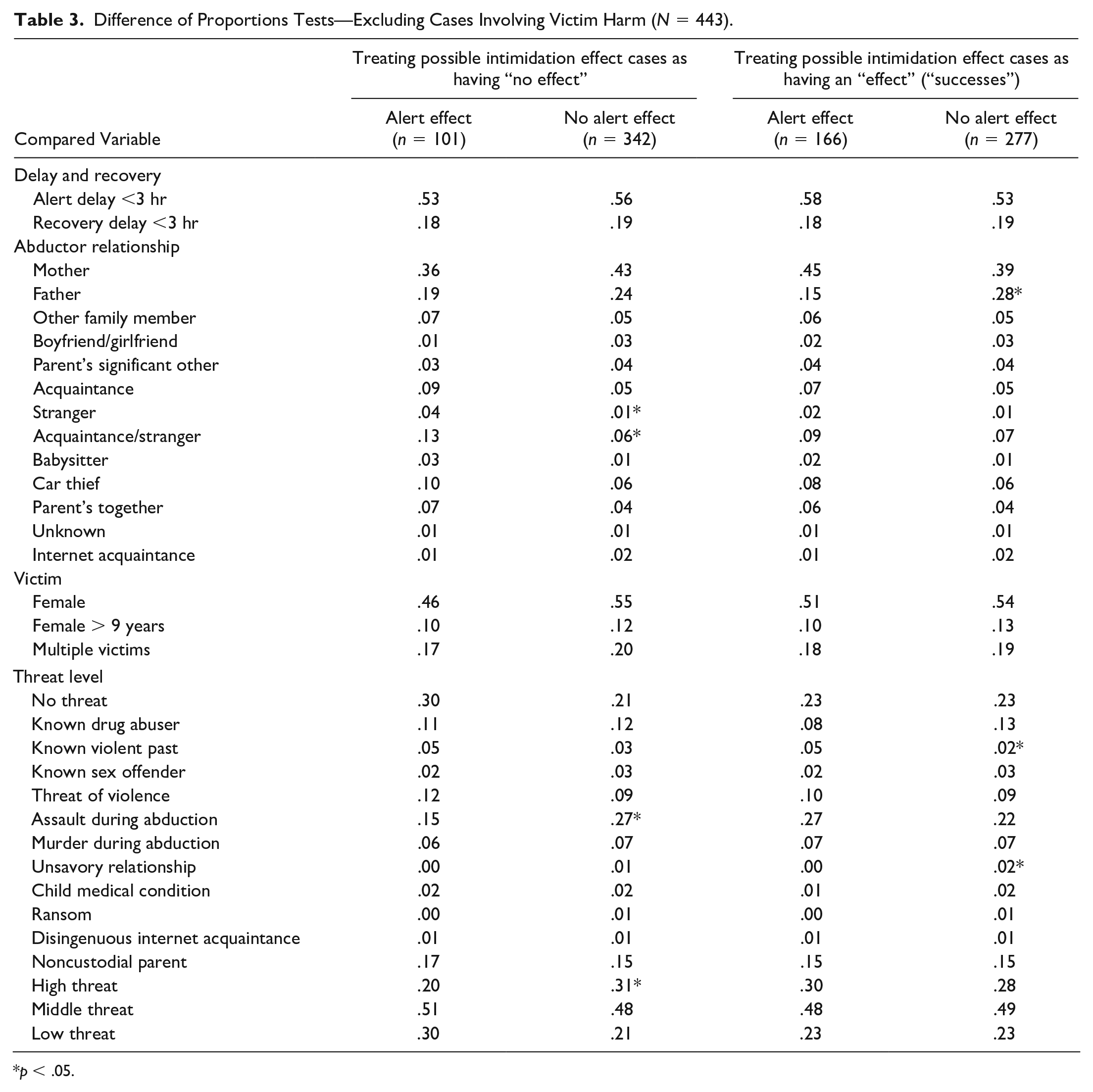
p < .05.
A crucial point to keep in mind when considering these findings is that the difference of proportions tests conducted in this analysis examined only “success” and “safe-recovery-no-effect” cases where all the child[ren] were returned unharmed. The constant across the compared pools of no harm to the child already might speak to something more profound than any statistical analysis. The children in both “success” and “safe-recovery-no-effect” cases were not harmed, very arguably, because from the onset, their abductors never intended to harm them, and whether the AMBER Alert in a particular case had an effect or not is simply immaterial relative to the crucial factor of perpetrator intention.
Discussion
Consistent with prior literature, the key variable predicting safe recovery in AMBER Alert cases is Relationship. Strangers and acquaintances are more likely to harm children in AMBER Alert cases; family members and other categories of offender, such as babysitters and unknown car thieves, are less so. Furthermore, more rapid recovery times are not associated with a lower likelihood of harm to abducted children in AMBER Alert cases. We hasten to iterate our news media-derived data can shed no direct light on the psychology of individual abductors. It is impossible to include variables such as “Murderous Intentions” or “Intending Sexual Assault.” Researchers, like AMBER Alert issuing authorities deciding in short time frames with incomplete information what constitutes “risk” in particular child abduction cases, are forced to use proxy measures such as the relationship between the abductor and the children and other factors mentioned in the news narratives, such as history of domestic violence, drug abuse, or sexual deviance. Besides the “common sense” intuition most observers would likely accept that mothers, fathers, grandparents, babysitters, aunts, uncles, and similar abductors do not routinely pose physical threats to any children they might abduct, survey evidence has (not surprisingly) confirmed that familial abductions almost never end with the murder of the abducted children (Sedlak et al., 2002). Despite the extensive media coverage of rare heinous cases, the overwhelming majority of child abductions results from interfamilial feuds and custody disputes where the children are caught between two familial factions, at least one and possibly both of which involve unstable scofflaws, but they are unlikely to harm members of their own family. It follows, again, there is no compelling evidence “successful” AMBER Alerts constitute “rescues” from imminent harm in such cases.
To argue against this inference and suggest AMBER Alert deserves the benefit of the doubt puts the system’s advocates and defenders in what appears to be a very awkward position for multiple reasons. First, it groundlessly suggests AMBER Alert system operators, who make issuance decisions in haste based on speculations about the risk posed, are somehow uniquely privy to the psychological state of the abductors and any environmental threats to the children relative to researchers with the benefit of hindsight and under no time constraints when searching for evidence of the threat. Second, it is empirically and logically incoherent to require proof of the negative that AMBER Alerts do not work. The blanket claim that AMBER Alert “saves lives” or “rescues” abducted children is not falsifiable, because no data exist on the psychological states of abductors or the physical threats posed in particular cases. Third, and related, is there a dangerous precedent set when crime control policies are granted presumptions of effectiveness based on preference and hope absent any “proof” to the contrary? If AMBER Alert enjoys this presumption, could not any array of policies then be deemed “effective” in the absence of disproof?
To argue the system is nonetheless “worth it if it saves one life,” still runs into a number of problems. First, there is the remaining open question of whether AMBER Alerts have saved any lives, as it is again impossible to know what “would have” happened in any particular AMBER Alert “success” case had no Alert been issued. Second, the argument that something is “worth it if it saves one life” can be applied to anything—such as say, requiring all K-through-12 students to wear body armor to improve their odds of survival in the event of a random school shooting (“Wouldn’t it be worth it if it saves one life?”)—while ignoring any cost-benefit analysis of such measures. Third and related, granting the system a pass based on hypothetical benefits ignores its multiple unresolved potential deleterious effects, such as its potential for swamping investigators with superfluous tips, placing system operators in impossible issuance dilemmas set up to be second-guessed, manipulation of the system by savvy offenders, the anecdotally suggested possibility of public attention pushing some abductors to become unhinged and even more dangerous, and the distraction of public attention from more pervasive threats to children (Griffin & Wiecko, 2015). To the authors’ knowledge, none of these potential drawbacks of the AMBER Alert system has been subjected to any empirical analysis.
Policy Implications
Although the results provided here are not promising for those hoping to see greater evidence of AMBER Alert effectiveness at preventing harm to abducted children, they are completely consistent with earlier findings in casting doubt on how much even “successful” AMBER Alerts really accomplish. The findings might be especially more poignant given they are derived from relatively recent data gathered after potential improvements in system efficiency and the expansion of AMBER Alert into social media. Thus, a number of potentially very important policy recommendations are suggested by the findings presented here.
First, at this point, after a number of examinations of the effectiveness of the AMBER alert system have failed to produce any compelling evidence the system prevents harm to abducted children, it might be time for public officials to reflect on how they discuss and portray AMBER Alert. As noted above, there is ample evidence AMBER Alert enjoys a presumption of efficacy in preventing harm to abducted children, but this is simply not supported by available data. We believe words such as “rescue” and “lifesaving” are exaggerated at best, and it might be safer and more realistic to simply acknowledge the limits of the AMBER Alert system and what it can actually accomplish. As has been pointed out, however, this might not be easy if the system’s existence and public deployment serve the important function of “crime control theater,” enabling public safety officials to visibly and symbolically advertise their commitment to addressing the emotionally loaded issue of child protection (Griffin & Miller, 2008; and see Zgoba, 2004).
Another potentially very important implication of these findings, which public officials in general and AMBER Alert operators, in particular, might do well to consider, is whether the AMBER Alert concept itself might suffer from unavoidable conceptual flaws. As noted in previous research, there appears to be a very ambitious presumption of how an AMBER Alert could actually prevent serious harm in a truly dangerous child abduction scenario. Several very good things (nearly immediate official knowledge of a kidnapping, rapid Alert issuance, and swift Alert effectiveness) need to occur nearly simultaneously, and that could simply be unrealistic (Griffin & Miller, 2008).
Thus, a counterintuitive but possibly reasonable suggestion in light of these findings is a reduction in the frequency of AMBER Alerts. System operators and designers might consider the possibility that AMBER Alerts should only be issued where there is an immediate knowledge of an abduction fitting one or more known high-risk templates (e.g., any time a female is abducted by a nonfamilial male), and where there is immediately usable information that could help the general public tangibly assist law enforcement. The argument for this approach is twofold. First of all, in situations where the information is poor and the possibility of rapid response is minimal, the AMBER Alert is unlikely to accomplish anything normal law enforcement would not accomplish anyway. Second, by limiting AMBER Alert issuances to these “clear-cut” cases, it gives the system the best chance to actually demonstrate “rescues” or even “lifesaving” success—if that is possible.
This suggestion, however, introduces its own potential problems. The first systematic examination of the AMBER Alert system (Hargrove, 2005) made a recommendation essentially identical to the one just proposed in this paper: AMBER Alerts should be restricted to serious cases instead of the familial and other apparently “trivial” situations where they were typically deployed. But the problem here is the cases the author of that early study deemed “trivial” were only known with certainty to be such after the fact, and how can issuing authorities be faulted for “erring on the side of caution” in such cases if they operate under the assumption an AMBER Alert could make a difference?
Establishing a more restrictive bar for AMBER Alert issuance also runs into potential political trouble. Suppose, for the sake of argument, a revamped issuance rule is to never issue Alerts if more than 3 hr have passed since the last time a missing child was seen since if the case is truly life-threatening, research has shown any window of opportunity has probably passed (Brown et al., 2006; Hanfland et al., 1997). 4 The problem here is that failure to issue AMBER Alerts in controversial cases has often resulted in bitter backlash (from citizens who have been led to believe AMBER Alerts “rescue” abduction victims) against public safety officials for seemingly devaluing some missing children (Griffin & Wiecko, 2015).
Therefore, any attempt to make the issuing criteria more restrictive would have to be accompanied by a more realistic public discourse about AMBER Alert effectiveness. Public safety officials and system operators would need to embrace and acknowledge the findings of this and prior research about the system’s apparent limits. They would have to start disseminating the disheartening messages that (a) the system usually contributes nothing when deployed and (2) even when it does contribute something it is rarely if ever in menacing cases. To date, they have been reluctant to do that, again possibly because the AMBER Alert system’s very existence is a powerful symbol, if nothing else, of official commitment to child safety (Griffin & Miller, 2008). Nonetheless, perhaps this bitter bill should be swallowed because as has been noted in prior research, the inflated expectations of the system are likely responsible for public outcry when the “silver bullet” of AMBER Alert is not deployed in cases that end horribly (Griffin & Wiecko, 2015). Thus, more realistic discourse and more restrictive issuing criteria might go hand in hand in considering the future of the AMBER Alert system.
Another possibly very important policy implication to emerge from these and other findings is the overall importance of what AMBER Alert symbolizes in terms of social priorities invested in threats to children. Although the AMBER Alert system is actually a very small part of overall American crime control inasmuch as it involves only a few hundred offenders and victims in any given year, its symbolic importance cannot be overstated. If social resources and investigative attention are disproportionately invested in a handful of cases deemed worthy of an AMBER Alert, then a diminished focus on the vast majority of threats to children is a very plausible outcome.
All of this was in fact anticipated in an early examination of the system’s political origins, where Zgoba (2004) argued the AMBER Alert system, inspired by moral panic over the legitimate but socially distorted goal of child safety, was hastily created and ultimately implemented nationwide by the 2003 federal PROTECT act without serious reflection on its likely empirical, conceptual, and policy discourse problems. Zgoba’s concerns at this point appear to have been prophetic, which invariably leads to yet another consideration. AMBER Alert could be a symbol, not just of misdirected social attention concerning endangered children specifically, but of how crime control policies are generally conceived, implemented, and regarded in larger American society.
This could be called the “AMBER Alert heuristic.” AMBER alert is by definition an attention-getter, and it could be time to consider it emblematic of larger dysfunctions in how crime control policy is conceived and implemented in the United States. Do symbolic policies enjoy a presumption of efficacy in the absence of compelling evidence precisely because of their visceral appeal? This again is the problem of “crime control theater” (Griffin & Miller, 2008), of which AMBER Alert is, at least based on the available evidence, a profound example (Miller et al., 2018; Sicafuse & Miller, 2010).
Conclusion
This article used data gathered from media accounts of a sample of relatively recent AMBER Alerts issued in the United States from 2012 to 2015. Basic descriptive statistics, logistic regression analyses to determine the drivers of safe recovery, and difference of proportions tests comparing “success” versus “safe-recovery-no-effect” cases yielded results very similar to available prior research on the AMBER Alert system. Most Alerts have no effect, perpetrator identity (and not system efficiency) appears to be the primary determinant of safe recovery, and “success” and “safe-recovery-no-effect” cases are largely comparable to each other on measurable attributes, strongly suggesting they are also comparable on the technically unknowable variable of the threat posed. This in turn suggests “successful” AMBER Alerts are not likely “rescuing” children from imminent harm.
These results buttress earlier findings that the AMBER Alert system is being oversold to the public, and a more tempered assessment of the system and even restructured issuing criteria are suggested. The findings also indicate that, as a likely example of “crime control theater,” the AMBER Alert system has significant lessons for the general public and policymakers about how policies to aid imperiled children in particular and crime control policies, in general, are assessed and discussed.
Footnotes
Declaration of Conflicting Interests
The author(s) declared no potential conflicts of interest with respect to the research, authorship, and/or publication of this article.
Funding
The author(s) received no financial support for the research, authorship, and/or publication of this article.
