




Abstract
Security guards outnumber police by almost 3 to 1, and this discrepancy has been growing steadily since the latter part of the 20th century. Security guards perform many of the same functions as police officers and may even carry weapons, but to what extent do states regulate the private security industry? This article compares the change in state regulation of private security, in particular the requirements for hiring security guards. The provisions of the states as of 1982, 1998, and 2015 are compared and evaluated. We are interested in determining what threshold requirements the states have seen fit to establish for employment in the security industry, and whether these threshold requirements provide adequate protection for the public.
Introduction
In the United Sates, private security officers outnumber the public police by almost a 3 to 1 ratio (Bureau of Labor Statistics, 2015d; Federal Bureau of Investigation, 2014). Security officers have coercive powers similar to the police, and many scholars have voiced concerns about this transfer of public power to private entities (Rushin, 2012; Shearing & Stenning, 1983; Sklansky, 1999). Due in part to this concern, states have enacted a variety of statutes designed to regulate the security industry (Meehan, 2015). These statutes target several areas of the security industry, and one of the most common areas of regulation is the hiring practices of security agencies. By controlling who is eligible to be hired as a security officer, a state can ensure a basic level of professionalism and ability in the security profession.
As with any law, the statutes concerning the hiring of security officers have changed over time to fit society’s needs. In 1998, Maahs and Hemmens conducted an analysis of the statutory regulation of security guard hiring practices and compared the state of the law in 1998 with the state of the law in 1982. This article serves as a replication and update of their research, in an effort to determine how these statutes have changed in the past 17 years. Our focus is on statutory exclusions and hiring requirements. It is our contention that hiring regulations for security guards have changed over time due to the unique occupational position of the security guard in the American economy.
Private Security: History and Development
Private police have existed for hundreds of years. Indeed, public police forces are a comparatively recent development, originating in Europe during the 19th century (Ricks, Tillet, & VanMeter, 1988). Prior to the development of a public police force, law enforcement activities, including investigation, pursuit, and apprehension, were conducted by private citizens. When the Anglo-Saxons settled in England, they set up a compulsory system of communal responsibility for law enforcement and community protection (Peel, 1971). Families were organized into groups, overseen by the shire reeve (from which the term sheriff is derived). The night-watchman and “hue and cry” system both developed about 1200. Under this system, if a felony was committed, every member of the community, upon notification, was required to help the sheriff pursue the fleeing felon (Peel, 1971).
Americans have historically utilized private security for several reasons. Before the rise of professional policing in the early 20th century, citizens often turned to private security and detective agencies for investigative, policing, and protection services. However, the use of private security and policing firms became tainted as some agencies were used for activities such as “strike busting” (Joh, 2006; Maahs & Hemmens, 1998; Peel, 1971; Sklansky, 1999). Despite this unfortunate association, private security continued to grow as crime rates rose and industry expanded. This growth continued throughout the century. By 1975, the number of private security personnel exceeded public law enforcement by almost 2 to 1 (National Advisory Committee on Criminal Justice Standards and Goals, 1976), and private security officers today outnumber the public police by a ratio of 3 to 1 (Bureau of Labor Statistics, 2015d; Federal Bureau of Investigation, 2014).
Regulation of Private Security
Due to the ubiquity and power of private security, the security industry is regulated in nearly every state in some way (Maahs & Hemmens, 1998; Meehan, 2015; Rushin, 2012). State legislatures began to enact statutes regulating the private security industry in the early part of the 20th century, largely in response to the tremendous growth of private security (National Advisory Committee on Criminal Justice Standards and Goals, 1976). By 1975, at least 38 states had some form of legislation controlling private security agencies. Review of these statutes indicated there was a tremendous diversity in the scope of coverage among the jurisdictions (National Advisory Committee on Criminal Justice Standards and Goals, 1976). Studies from this period were unanimous in calling for increased statutory regulation and state oversight of private security, as well as a nationalization of security industry standards and practices (Buikema & Horvath, 1984; Cunningham & Taylor, 1985; National Advisory Committee on Criminal Justice Standards and Goals, 1976; Newby, 1981).
The regulation of the private security industry through legislation not only represents the government’s attempt to control an enormous industry but also illustrates how the government and security professionals themselves view the private security industry. Meehan (2015) showed that these statutory regulations often result in a centralization of the security industry into larger firms, and the author also pointed out that some security professionals desire regulation to increase perceived professionalism. Furthermore, Thumala, Goold, and Loader (2011) showed that regulations and accreditation are seen by private security personnel as increasing the legitimacy of the security industry.
Legitimizing the private security industry remains a goal of both legislatures and security professionals. Many private security professionals seek to establish themselves as autonomous, trustworthy entities. One oft-cited method to effect this legitimization is to establish ties with the public police and foster government intervention (Berndtsson, 2012; Thumala et al., 2011). Security practitioners seek to establish these ties by securing government contracts, forming partnerships with police agencies, and presenting themselves as professional, pro-government entities. Berndtsson (2012) even illustrated that in the aftermath of 9/11, some private security agencies are instituting training programs related to counterterrorism to validate their roles of protectors of points of critical infrastructure.
One of the primary means by which legislatures and the private security industry have sought to increase the credibility and professionalism of private security is by instituting a variety of hiring requirements, including regulations excluding some individuals from being eligible to be hired as a security guard and regulations setting forth basic requirements for the position.
Hiring Regulations
The statutory and administrative regulations concerning the private security industry can be broken into three broad categories: (a) hiring regulations for security officers, (b) training regulations for security officers, and (c) licensing requirements for managers. This article deals with perhaps the most basic and important part of the various areas of statutory regulation—the hiring regulations for line-staff security officers.
Hiring regulations refer to the state statutes that set the minimum requirements for a person to obtain entry-level licensure to work as a private security officer. These statutes contain regulations related to the minimum qualities that an individual must possess to work as a security guard. States often require that individuals have a certain level of education, demonstrate a level of moral character, and have a clean criminal record to be licensed or hired as a private security guard (Maahs & Hemmens, 1998). These regulations have varied across different jurisdictions, but the occupational nature of guard position, which has been historically characterized by low pay and public ambivalence, has resulted in statutory regulations that establish only minimal licensure requirements (Maahs & Hemmens, 1998).
The statutory regulations concerning hiring practices represent a logical point for state intervention. Hiring regulations allow the state to set a baseline for the private security industry by defining the type of worker who can be entrusted with the coercive powers of the security officer. The Bureau of Labor Statistics (2015b) estimated that there are currently 1,077,520 private security officers in the United States.
Profile of the “Typical” Security Guard
The Rand Report (1972) and the Hallcrest study (1985) provided the first scholarly studies of private security guards. In 1972, the Rand Report described the “typical’ security guard as “an aging white male who is poorly educated and poorly paid.”
The Hallcrest study included a survey of security guards aimed at determining their motivation for taking the job. Reasons given for wanting to work as a security guard ranged from the obvious (“I needed a job”) to those related to the perceived nature of the work (“I like any kind of police work”). Twenty-eight percent of the security guards in the Hallcrest study admitted they took the job because they were unable to find other work. However, these studies perhaps unfairly characterized these officers and failed to focus on the coercive nature of private security (Shearing & Stenning, 1983; White & Gill, 2013)
The Bureau of Labor Statistics (2015d) estimated the current mean wage of the line-staff security officer at US$13.48 an hour, which constitutes an annual salary of US$28,040. The salaries of security officers are comparable with janitors and other grounds maintenance professionals (US$26,370), retail sales professionals (US$25,760), and unskilled factory workers (US$28,490). These wages are far below the national average of US$47,230 (Bureau of Labor Statistics, 2015b), and they firmly situate the line-staff security officer into the category of “unskilled laborer” (David, Katz, & Kearney, 2006).
More recent research has shown that the public does not automatically malign security officers (Nalla & Heraux, 2003; Van Steden & Nalla, 2010), but the industry itself seeks to counteract these once harmful conceptions by presenting professional images and seeking to legitimize themselves through government regulation (Mulone, 2013; Thumala et al., 2011).
All of this points out some of the potential problems inherent in hiring security guards. It is apparent that the private security industry draws much of its labor force from a poorly educated, lower income segment of society. While there are exceptions to this generalization, in general the private security industry draws from a limited labor pool. Given these circumstances, and acknowledging the impact that the actions of a security guard can have, it seems only logical that the states regulate who can become a security guard. Enacting minimum standards for employment eligibility provide at least a bare minimum. Granted, enacting minimal standards alone will not ensure the safety of the public, but it is at least a starting point.
Prior Research
The current research replicates and updates the work of Maahs and Hemmens (1998). Maahs and Hemmens conducted an analysis of the regulating hiring practices. The authors found that 82% of states had a statute that regulated some portion of the hiring process for security officers and that this represented a 16% increase in the amount of regulation as compared with a study published in 1982. The authors split their statutory analysis into two categories: (a) disqualifications that barred hiring an individual (such as a prior criminal conviction) and (b) the requirements for obtaining licensure.
The authors’ work at the time represented the only in-depth study of these statutory regulations, but since this study was published, other researchers have built upon their work. However, none of these studies have conduced an in-depth analysis of hiring procedures and often combine the different types of regulations into one article, which obfuscates the differences in patterns of regulations. For example, Rushin (2012) examined statutes related to hiring, training, operations, and management. Combining these vastly different areas of regulation makes it difficult to see the changes at each level. Finally, Meehan (2015) analyzed the economic impact of both statutory regulations and administrative rules, but he did not elucidate the specifics of these regulations.
Nalla and Crichlow (2014) provided the most relevant research on statutory regulation of the security field. They attempted to update the work of Maahs and Hemmens (1998). However, the authors failed to provide a clear methodology, combine statutes that regulate security managers and line officers, and comingle data sources. When explaining their methodology, the authors stated, “Data for 2010 were obtained from original statutes published online and telephone calls to security guard licensing organizations” (Nalla & Crichlow, 2014, p. 14). The authors failed to elucidate which online databases supplied their statutes, and they also failed to list which licensing agencies they contacted. The authors also failed to delineate between security “officer” and “manager.” Finally, the authors utilized city data to define the state-level statutory regulations for several jurisdictions. For example, the officers utilize the regulations for St. Louis, Missouri, to define the regulations for the entire state of Missouri. Nalla and Crichlow’s research provides some interesting findings, but the differences in methodology may explain the differences in our findings, which may be more accurate, focused, and relevant, and also update all of the categories featured in the original work by Maahs and Hemmens.
Our study provides a more directed analysis, designed to replicate and update the work of Maahs and Hemmens (1998). By understanding the changes in regulation, we provide two benefits for the academic and practitioner. First, our statutory analysis will illuminate how lawmakers and administrative regulators are responding to the increased demand for regulation by both society and the private security world. Second, this study will provide an accurate picture of the current state of statutory regulations of hiring practices. This will serve as a point of information for private security professionals. The examination of the changes in hiring regulations may also provide insight into the future of regulation.
Method
We utilized a two-step methodology to determine the current state of the statutory regulations for the hiring of security guards. First, using the LexisNexis legal database of state statutes, we conducted a keyword search in the current statutes of each state. To ensure that we found all applicable statutes, we utilized the following keywords: “Security Guard,” “Security Officer,” “Private Security,” and other variations of these terms. Next, we then conducted an Internet search of each state’s government website to find the applicable governing agency for private security agencies. We then utilized these additional governmental websites to find all applicable administrative regulations pertaining to these agencies. We then tabulated these results and compared them with the regulations in the 1998 analysis. Tables 1 to 3 present the results of these tabulations.
Restrictions for Criminal Behavior.

Note. The subscripts of the felony category refer to the length of time before this exemption becomes null. For example, X10 = a felony within the past 10 years. The subscripts of the misdemeanor category refer to the type or amount of misdemeanors needed to restrict licensure. A “0” in a category represents a restriction that was present in 1998 but no longer present in 2015. A bold entry represents a restriction that is new for 2015.
Substantive Exclusions.

Note. A “0” in a category represents a restriction that was present in 1998 but no longer present in 2015. A bold entry represents a restriction that is new for 2015.
Procedural Requirements.
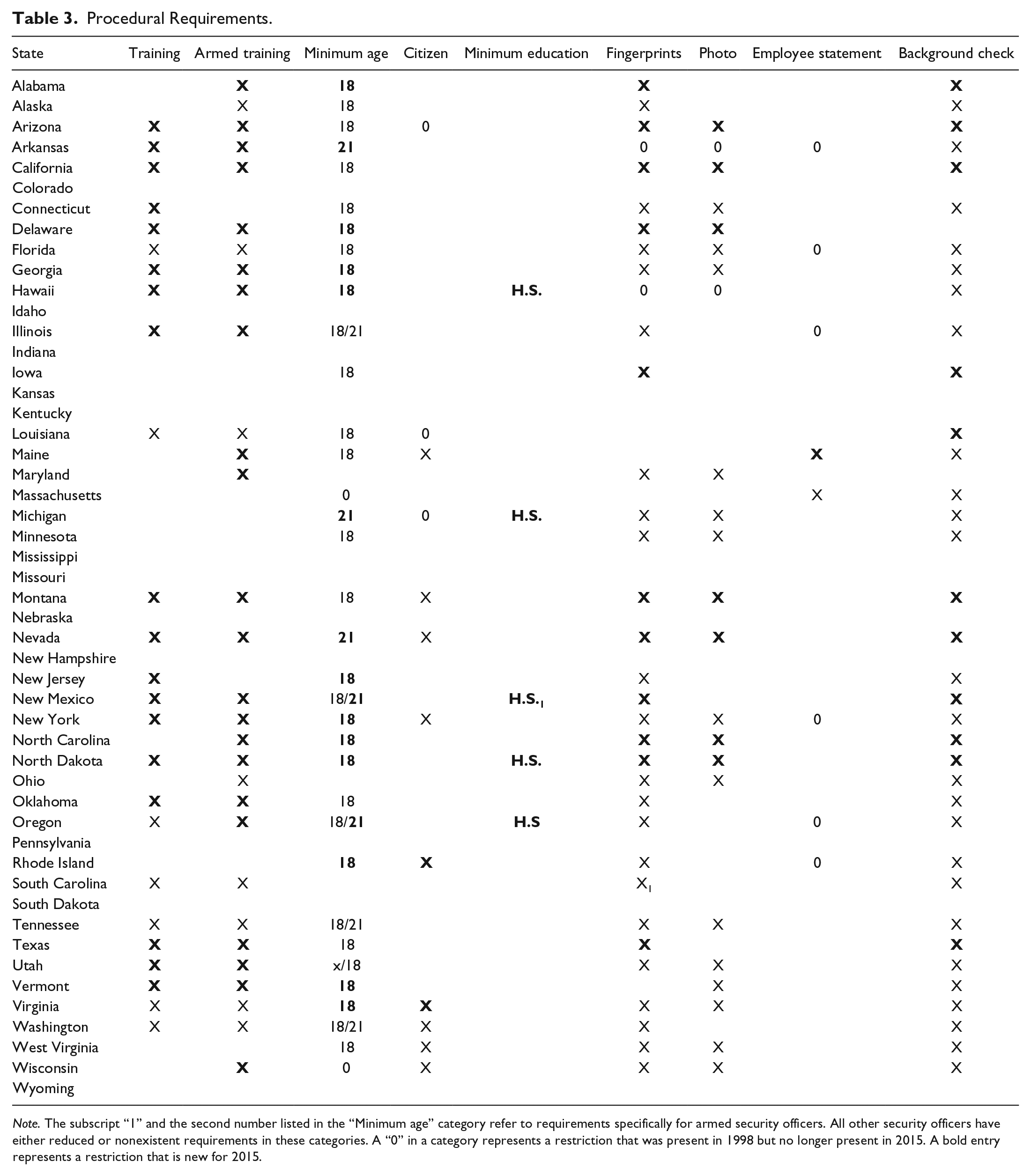
Note. The subscript “1” and the second number listed in the “Minimum age” category refer to requirements specifically for armed security officers. All other security officers have either reduced or nonexistent requirements in these categories. A “0” in a category represents a restriction that was present in 1998 but no longer present in 2015. A bold entry represents a restriction that is new for 2015.
Criminal Disqualifications
This study focuses upon three aspects of state statutes that regulate security guard employment. Table 1 presents the state statutes that restrict licensure for individuals with criminal convictions. Finally, we tabulated these restrictions into nine categories for ease of analysis and comparison. “Felony” refers to any statutory language that restricts an individual with a felony from obtaining a license. “Misdemeanor” refers to any language that restricts an individual with a misdemeanor from obtaining a license. The remaining categories refer to statutory language that restricts licensure for individuals who have been convicted of committing specific offenses. These restrictions at times replace the blanket language concerning the broad categories of “felony” or “misdemeanor, and at times augment the broader categories. For example, a state may have a broad “felony” restriction and also contain several specific categories that cover different misdemeanors or infractions.
Other Substantive Disqualifications
Table 2 presents the state statutory restrictions that exclude individuals who possess particular characteristics from security guard licensure. These concepts concern more substantive concerns that reflect an individual’s capability to act as a private security guard. We have subdivided these substantive concepts into six categories. “Morality” refers to statutory language that either requires an individual demonstrate proof of good moral character to become a security guard or prohibits the hiring of individuals who have demonstrated immoral behavior. “Substance Abuse” refers to language that prohibits the employment as a security guard for those who have a history of drug or alcohol addiction or abuse. “Mental Incapacitation” refers to language that prohibits individuals with mental illness or defect from obtaining a security guard license. “Parole/Probation” restricts individuals on probation or parole from obtaining licensure. “Trust/Honesty” refers to statutes requiring proof of trustworthiness or honesty. Finally, “Dishonorable Discharge” relates to statutes that restrict licensure for those individuals who have been dishonorably discharged from the military.
Procedural Requirements
Table 3 outlines the various procedural and bureaucratic requirements for obtaining a security guard license. “Training” refers to any statutory requirement that an individual complete a required training program before obtaining a license. “Armed Training” refers to a specific requirement for firearms training before being granted the right to carry a firearm while working as a security guard. “Citizen” requires an individual to show proof of citizenship or classification as a resident alien to be licensed as a security guard. “Minimum Education” requires an individual to show proof of having obtained a certain level of education to become a security guard. “Fingerprints” and “Photo” require an individual to submit these items during the application process. “Employee Statement” requires an applicant to provide either a verbal or written statement affirming his ability and character. Finally, “Background Check” requires the applicant to submit to a criminal background check concerning his past behavior.
Results
The statutory analysis reveals that the licensure process for private security guards is more regulated than it was in 1998. This pattern holds true across all three broadly defined categories in this study. In 1998, nine states (18%) featured no statutory regulation of security guards. Sixteen years later, this pattern still holds as nine states (18%) still do not regulate hiring practices, but these numbers obscure some changes in policy, as North Dakota and Alabama have now instituted regulations for security guard licensure, whereas Colorado and Nebraska no longer feature any requirements.
Although the number of states with regulations has remained the same, the amount of regulation has increased significantly. Twenty (40%) states increased the number of statutory restrictions for criminal convictions. Twenty-seven (54%) states have increased the number and type of noncriminal conviction disqualifications set forth in Table 2. Finally, 28 (56%) states have further increased the number of requirements for obtaining a license. The increase in requirements points to a general trend in further regulating the private security industry, and a more in-depth analysis of the specific categories in this study will illustrate which statutory areas are more of a concern for legislators.
Each of the categories in Table 1 reveals an increase in statutory exclusions from licensure. Since 1999, 10 states (+20%) have instituted new restrictions for felons. Thirty-nine states (78%) now bar felons from gaining a license. Five (+10%) states have instituted a restriction concerning misdemeanors. Fifteen (30%) states now have a restriction for misdemeanor convictions. Six (+12%) states have added a restriction concerning crimes of moral turpitude, whereas three (−6%) states no longer have this restriction. Nineteen (38%) states now feature a restriction for moral crimes. Three (+6%) states added a restriction for drug-related crimes. Nine (18%) states now feature a restriction for drug-related crimes. Four (+8%) states added a restriction concerning weapons-related offenses. Fourteen (28%) states now feature a restriction for weapons-related offenses.
Three (+6%) states added a restriction for theft-related crimes, and one (−2%) state no longer includes this restriction. Ten states (10%) now feature a restriction for theft-related crimes. Seven (+14%) states added a restriction for crimes related to dishonesty or fraud. Fourteen states (28%) now feature a restriction for dishonesty- and fraud-related offenses. Seven (+14%) states added a restriction related to crimes of violence with one (−2%) state no longer having this restriction. Fifteen (30%) states now have a restriction related to crimes of violence. Finally, three (+6%) states have recently instituted restrictions for sexual offenses with one (−2%) state no longer having this restriction. Ten (20%) states now have a restriction related to sexual offenses.
The other restrictions and requirements featured in Table 2 also show evidence of increased regulation of the security guard industry. Fourteen (+28%) states added a requirement of proof of moral character with two (−4%) states no longer featuring this requirement. Eighteen (36%) states now have a morality requirement. Twelve (+24%) states added an exclusion from licensure for those with substance abuse problems. Fifteen (30%) states now feature this exclusion. Twenty-one (+42%) states added an exclusion from licensure for those with mental illness. Twenty-three (46%) states now exclude the mentally incapacitated from holding a security guard license. Only one (2%) state now excludes those on probation and parole from obtaining license. This marks a decrease of one state (−2%) from 1999. Two (+4%) states added a requirement of proof of honesty and trustworthiness to obtain a license. Finally, five (+10%) states added an exclusion from licensure for the dishonorably discharged. Eight (+16%) states now feature this restriction.
All but two of the categories in Table 3 show an increase in the amount of restrictions. Eighteen (+36%) states added a requirement of training to obtain a security guard license. Twenty-four (48%) states now require some form of training for security guards. Twenty-two (+44%) states added a requirement of firearms training for an armed security guard license. Thirty (60%) states now feature this requirement. Seventeen (+34%) states instituted some sort of minimum age requirement for licensure with two (−4%) states no longer featuring this requirement. Thirty-three (66%) states now have a minimum age requirement. Two (+4%) states added a citizenship requirement, whereas three (−6%) states dropped the citizenship requirement. Nine (18%) states now have a citizenship requirement. Five (+10%) states now feature a minimum education requirement. Eleven (+22%) states added a requirement that applicants provide fingerprints during the licensing process, whereas one (−2%) state dropped this requirement. Thirty-two (64%) states now require the submission of fingerprints. Six (+12%) states added the requirement that applicants submit a photo during licensing with one (−2%) state no longer featuring this requirement. Twenty-one (42%) states now require a photo. One (+2%) state added a requirement that applicants submit a statement detailing their character and motivation to obtain a license with six (−12%) states no longer featuring this requirement. Only two (4%) states now require an individual to submit a personal statement during the licensing process. Nine (+18%) states added a requirement of a background check for licensure. Thirty-six (72%) states now feature this requirement.
Comparing the results of each table, we find that Table 2 features the highest average increase across categories. The substantive categories featured in this table demonstrate an average of nine states adding at least one restriction or requirement in each category. The procedural requirements in Table 3 show the next highest increase, with an average of eight states adding a new requirement in at least one category. Finally, the criminal exclusions in Table 1 illustrate an average increase of five states in at least one category. These results show an increase across each statutory area included in this study. The process of obtaining a security guard license is more regulated than it was in 1982 or 1998.
The results of the statutory analysis demonstrate that states have continued to increase the number and type of regulations concerning the hiring of security guards. The increase in substantive regulations indicates that states now routinely exclude certain individuals from licensure, which in turn implies that states only allow individuals of a certain quality to wield the coercive power of a security guard. Likewise, the increase in the regulations concerning criminal exclusions shows that states seek to exclude potentially dangerous individuals from the security occupation. Finally, the increase in procedural, or bureaucratic, regulations is further evidence that states seek to regulate who can become a security guard by establishing procedures related to criminal background checks, fingerprinting, and training. These regulations have increased since 1998, and they will most likely continue to increase in the future. We address the current impact of this trend as well as future implications in the next section.
Discussion
There is an increase in regulations across all the categories in this study. Examining specific categories also reveals certain trends. Only three categories across the entire study demonstrated a net decrease in regulations. The exclusion of those on probation and parole from licensure, the requirement of citizenship, and the requirement of personal statements are not as common as they were in 1998. Furthermore, the paucity of states still featuring these exclusions or requirements may show that these categories are on their way toward extinction.
The procedural or bureaucratic requirements of the licensing process show the biggest increase in regulation. Requirements concerning training, firearms training, and minimum age demonstrate the biggest increases in all the categories. Furthermore, the exclusion of felons, immoral persons, substance abusers, and the mentally ill from licensure also demonstrated large increases in regulation. The thrust of these increases is clear, and the states seem to be pursuing two interrelated goals.
First, states seem to be interested in increasing the procedural requirements of licensure to establish a minimum standard of operational conduct and knowledge for security guard. These increases speak to increased expectations of professionalization from the security industry. More states are requiring training to ensure that security guards display a minimum amount of procedural and substantive knowledge of the security industry as well as the criminal justice system.
Second, states are increasing regulations to exclude what may best be termed “undesirable characters” from obtaining a guard license. More states seek to exclude from the private security industry felons and other individuals with criminal records, as well as individuals deemed unfit due to some personal limitation. These exclusions also speak to a greater expectation of professionalization that is almost comparable with public law enforcement agencies. However, the routine lack of minimum education requirements and the decrease in citizenship requirements may classify the occupation of security guard as “unskilled.”
Earlier research revealed that security professionals sought increased regulation as a means of legitimizing their industry (Mulone, 2013; Thumala et al., 2011), but these professionals must produce a marketable service with a competitive price (White & Gill, 2013). Therefore, security professionals seek to hire individuals who will work for a low wage, which situates the line-staff security officer in the realm of unskilled labor (Bureau of Labor Statistics, 2015b; David et al., 2006). This may explain the paucity of states with education requirements. Only five states feature an education requirement to obtain a license, and these states require only a high school education. This is unusual considering the increases in the other procedural and substantive requirements, but it may be best explained by the costs of education for employers. The Bureau of Labor Statistics (2015a, 2015c) demonstrated that individuals with only a high school education made less than 50% of the average wage of those with bachelor’s degrees or higher. The disparity further increases as individuals without a high school education make only 44% of the average salary of those with bachelor’s degrees. The lack of educational requirements for line-staff security professionals ensures that agencies can continue to hire cheap sources of labor and provide a low-cost product. Given the coercive power of the security guard, this may give rise to some concern as essentially unskilled and uneducated individuals may be conducting the bulk of line-staff security work. However, states may be seeking to rectify this educational dilemma by requiring more in-depth training as training requirements for licensure are becoming more common.
Conclusion
States are increasing the statutory regulations related to the licensing process for private security guards. These requirements demonstrate that states expect the private security industry to be professional. Also, states desire to exclude criminals and other individuals who may not be able to satisfactorily complete the requirements of this occupation. If these trends continue, the private security industry will become more regulated in the future. It is reasonable to expect this trend to continue and the remaining states to follow the national trend to institute statutory regulations in the future. However, due to the situation of the private security industry in the market economy, security firms must ensure that they can provide a marketable product. These firms can make their service marketable by controlling labor costs and hiring unskilled, uneducated individuals. The increases in regulations still allow for firms to hire this cheap labor by not instituting educational minimums that would exclude unskilled laborers from the pool of hirable individuals.
Footnotes
Declaration of Conflicting Interests
The author(s) declared no potential conflicts of interest with respect to the research, authorship, and/or publication of this article.
Funding
The author(s) received no financial support for the research, authorship, and/or publication of this article.