



Abstract
In this article, we outline a brief overview of the growth and trends in scholarly literature devoted to the study of private policing and the private security industry in crime and security governance over the past five decades. More specifically, we draw attention to the scholarship addressing private policing and the shifts in the discourse of the subject of security governance during this time both from theoretical and thematic foci. In doing so, we identify potential future directions in which this field of private policing studies is moving.
Introduction
The nature and role of the government as the sole agent of social regulation in the governance of the state has been debated for many decades. The presence of multiple actors to regulate and govern both public and private spaces is well documented in recent decades. Post Keynesian political rationalities resulted in the dispersal of regulation (O’Mally & Palmer, 1996) and the appearance of policing functionaries in various forms that are referred to as “networked” (Crawford, 2006) or “nodal” (Shearing, 2001) governance. The first set of actors constitutes private security guards (PSGs) and corporate security personnel performing varieties of tasks, sometimes in uniforms, monitoring and regulating activity in public spaces geared toward compliance, crime prevention, and order maintenance. The second set of actors comes in the form of private citizens becoming the extended family of police under the auspices of community policing (Johnston, 2003). And, finally, the third group constitutes a combination of public- and private-sector actors (e.g., fusion centers which were established in the United States post 9/11) engaged in information gathering through state-established public–private partnerships.
In this article, we offer a brief overview of the growth and trends in scholarly literature devoted to the study of private policing and the private security industry in crime and security governance over the past five decades. More specifically, we draw attention to the scholarship addressing private policing and the shifts in the discourse of the subject of security governance during this time both from theoretical and thematic foci. In doing so, we identify potential future directions in which this field of private policing studies is moving.
Industry Growth Trends
Evidence for growing interest in the understanding of the nature, form, and shifts in security governance is linked to the growth in PSG industry strength and employment trends of PSGs vis-à-vis public law enforcement officers (PO; Van Steden & Sarre, 2007). Over the past several decades, many countries have witnessed a significant growth in the employment of private police 1 with some experiencing more than some others. Depending on how PSG strength is assessed, data from various countries around the world, drawn from multiple sources (Button, 2019; Nalla & Gurinskaya, 2017) over the past several decades, show a wide discrepancy in the ratio of PSGs and POs around the world (Figure 1). Some countries in Eastern Europe and Africa have a greater number of police officers per PSGs while many countries in Europe suggesting a strong reliance on public law enforcement for crime governance functions. Many countries in Western Europe and other developed and developing economies show a larger share of the PSGs relative to police officers with some countries, such as India and Guatemala, showing an even high discrepancy. These trends could possibly be explained by factors such as supply and demand for PSGs in new emerging global markets as well as governance deficiency in some others. Irrespective of the contributing factors, the fact remains that expansion in the employment and presence of PSGs engaged in security governance has become a common sight the world over. Although the data on the precise number of employees engaged in this industry are hard to ascertain, the top 10 multinational security guard companies around the world employ over 1.7 million personnel. G4S and Securitas sit as the two largest employers, operating in over 100 countries and accounting for close to 1 million employees (Button, 2019).
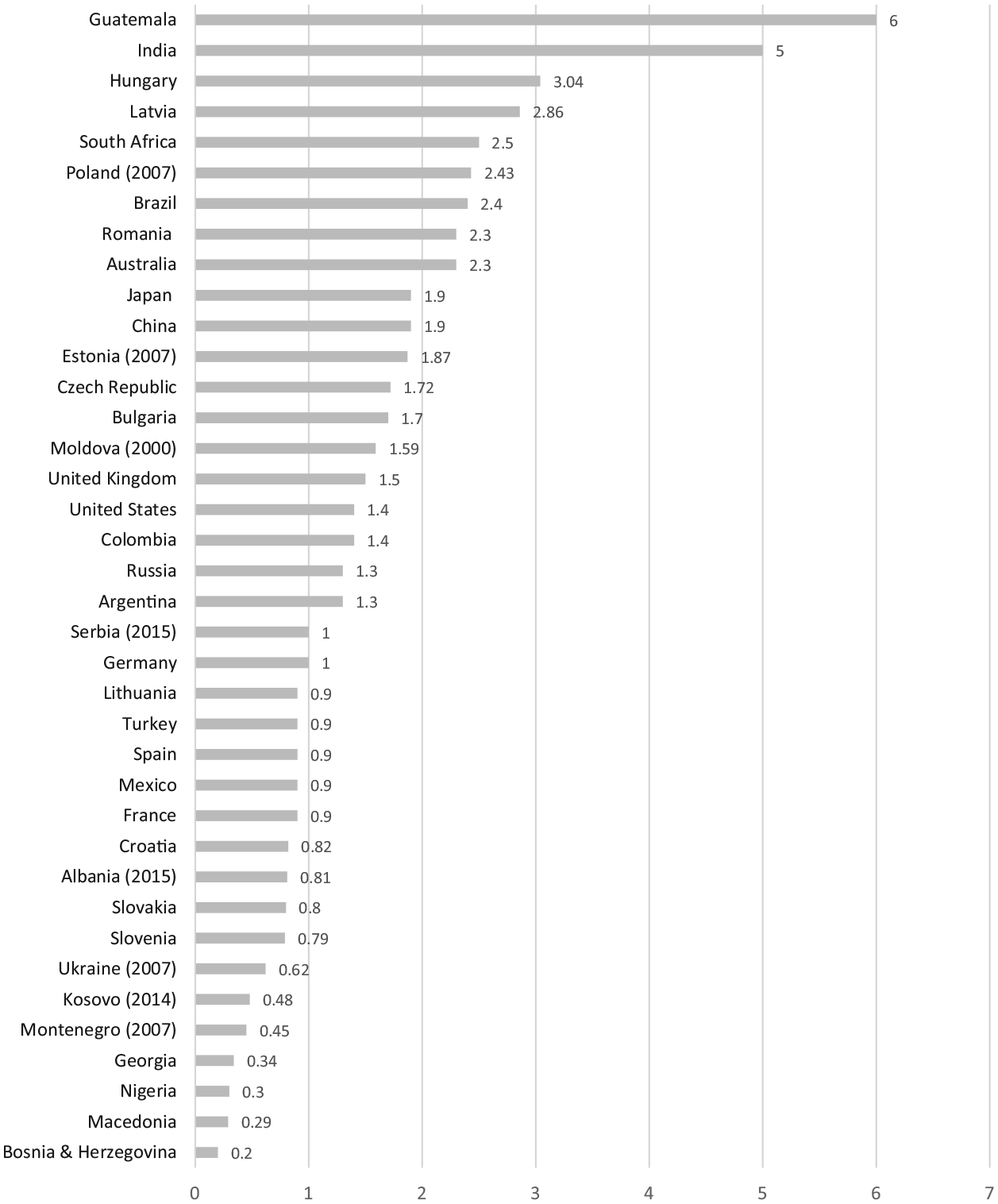
Ratio of private security guards per police officer from select countries.
The Expanding Scope and Thematic Shifts in Scholarship on Private Police
Along with the expansion of private police employment, scholarship addressing this topic over the past five decades has also expanded significantly. The earliest recorded exploration of private police was conducted by Shalloo (1933) in his doctoral dissertation at the University of Pennsylvania. His work explored the nature, function, and roles of railroad police, private police employed in coal and mining industries, private detectives, and private patrolmen. It was not until 30 years later that a second study on private police was published, which examined departmental store shoplifting and the associated losses calling attention to a growing crime problem (Cameron, 1964).
The 1970s, however, saw a revival of scholarship on private police with a focus on training and professional standards issues (Kakalik & Wildehorn, 1977). In addition, the role of PSGs and in-house contract personnel working as parallel to the public police was examined with the conclusion that although private police play a secondary role, they contribute to the crime prevention activities (Pennell, 1978). With the exception of a few articles (Becker, 1974; Spitzer & Scull, 1977), which explored the theoretical underpinnings of the growth of the PSG industry, most were devoted to describing the newfound industry and its role in crime prevention and private investigations.
Although the presence of multiple actors to regulate and govern public spaces was not a new phenomenon (Johnston, 2002), these new rules of engagement by actors in security and crime prevention work were characterized as the shifting nature of social control from the public to the private sector (Shearing & Stenning, 1983; Spitzer & Scull, 1977). The emphasis, however, was on comparing the increasing number of personnel employed in PSG industry relative to public police officers and raised questions about the efficacy of counting employees as well as the definitions of what constituted private security personnel.
These strongly held notions of shifts in public social control from the public sector to the private sector came under scrutiny in the early 1990s. Questioning what constitutes social control and who exercises regulation and supported with data, it was proposed that not just the private sector has increased but the state has expanded its reach and scope in its ability in social regulation (Nalla & Newman, 1991). Rather than viewing these employment shifts as swings in social control (Shearing & Stenning, 1983), Nalla and Newman (1991) argued that these trends should be read as the general expansion of the pervasive notion of policing functions in governance and crime prevention.
This set the tone for shifts in conceptual exploration of the phenomenon and the scrutiny of the role of the government in social regulation and the governance of crime. The 1990s saw more attention given to scholars to tease out the problematic distinctions between what is public and what is private and grappling with the concept of private police (Kempa et al., 1999) which continued well into the 2000s (Joh, 2005). The myth that crime governance is solely a state function was questioned (Garland, 1996), and the fact that multiple quasi-state, non-state players are actively engaged in crime control functions was brought into light (Rose & Miller, 1992). This form of shifting obligation for security provision from the state to the private citizen or “responsibilization” (Garland, 1996) has resulted in private sector players undertaking tasks not just for crime prevention but also being responsible for compliance to many state regulations that govern security and crime.
Scholars have suggested that these developments were partly a consequence of the shift from the welfare rehabilitative model of crime control to the neoliberal risk-based governance of security (Abrahamsen & Williams, 2007; White, 2012). Some have referred to this phenomenon of multiple regulatory actors in the public and private sectors as multilateralization of policing (Bayley & Shearing, 2001), while others have coined similar euphemisms such as networked governance (Crawford, 2006), patchwork policing (Crawford & Lister, 2004), third-party policing (Mazerolle & Ransley, 2006), and “force multipliers” (Ayling, 2007).
The early decades of the 21st century saw attention directed to developments related to government austerity, emphasis on pre-crime (Zedner, 2007), and the “new regulatory state” (Braithwaite, 2000). This came in the wake of the profound impact the neoliberal agenda of downsizing the government had on crime control. The governance of crime and security has undergone major transformations with the recognition of situational crime prevention techniques (Clarke, 1983), shifting crime control from the criminal to crime. Several other important shifts in the rationale and logic of current crime control have led to a growth in regulatory practices, creating spatial, temporal, and sectoral expansion of regulatory provisions resulting in expanding the scope of actors and targets of regulation as well as the types of tools to facilitate the governance of crime and security (Gurinskaya & Nalla, 2018).
Scholarship on Relationship Between Private Police, Citizens, and Public Police
Although the bulk of the attention was drawn by scholarship on developing and refining conceptual and theoretical implications of private policing, other critical but important areas began to emerge. The 1990s saw research exploring relationships between the public and private police (Nalla & Hummer, 1999a, 1999b; Sarre & Prenzler, 2000; Shearing, 1992), recognizing the importance of finding common ground in forming cooperative relationships in crime governance. Shearing (1992) suggested that public–private police relations at the time assumed a pluralist model where the “power is not wielded by a single subject, and there is no central source of command, no practical center of political life” (p. 422). Extending on Shearing’s pluralist model, Hummer and Nalla (2003, p. 89) suggested a more complex relationships between the two sectors calling it “cryptic” and cold fusion to describe the intricacy of cooperative relationships that “blur the boundaries” as it is unclear in some of these cooperative efforts when the police “sheds its formal role as agents of the state and assumes the role of civilians, and vise versa private security.” Following the 9/11 terrorist attacks on the World Trade Center in New York, the role played by private security was no longer limited to being junior collaborators with police. The creation of fusion centers to harness collaboration between public- and private-sector actors in crime governance and the increased acknowledgment of the positive outcomes with cooperative efforts drew the interest of policing scholars (Carter et al., 2017).
Research has also explored the interactions and relations between PSGs and citizens. Starting in the early 2000s, some research examined citizens’ evaluations of the PSG industry as well as their interactions and the related perceptions about satisfaction and trust in security guards (Nalla, Gurinskaya, & Rafailova, 2017; Nalla, Maxwell, & Mamayek, 2017). Limited but serious attention has been given in past decade related to the nature of security guards’ views of their work, job satisfaction, and the role of environmental and organizational factors in shaping guards’ attitudes toward citizens and their supervisors (e.g., Nalla, Paek, & Lim, 2017), as well as their perceptions of police legitimacy (Paek et al., 2019). Yet, another area that is important and has just seen attention being offered is matters relating to hazardous working conditions and workplace injuries for security guards (Hansen Löfstrand et al., 2016).
The Present Special Issue
Following these trends in the expanding literature on private police and private security industry, research published in this issue builds on the current issues and strengthens and identifies new directions that scholars are forging. We begin with Jennifer Wood’s analysis of the relationship of private police as it intersects with public police and relationship to public health. Acknowledging the dangers of exclusive focus of police on crime control can undermine certain vulnerable populations’ access to health and safety. Wood argues for recognizing the presence and role of private police as resources to promote public health.
Button has addressed emerging developments in cyberspace and the subsequent expansion of the role of private security in virtual domain. Button argues that akin to the “quiet revolution” in relation to PSGs that occurred in the 1970s and 1980s, private policing arrangements in cyberspace are emerging to be equally revolutionary. He argues, relative to the public police, private sector dominance of policing the cyber world is significant, suggesting the emergence of a “new” private security industry alongside the “old.”
Private policing has also firmly established its place and role playing alongside the public police in enhancing security in special zones such as Business Improvement Districts (BIDs), a common feature of present-day cities. Welsh and his colleagues examine the role of private security personnel and CCTV surveillance and argue that the schemes operated by PSG companies generate “larger crime prevention effects” relative to those operated by either the public police or those engaged by public–private collaborative partnerships. A similar finding comes out of the work of Amanda D’Souza, whose findings grounded in data from 76 semi-structured interviews, and over 170 hr of participant observations suggest that private police employed to deal with low-level disorder settings appeared to have achieved better results in order maintenance, suggesting a supportive role they can play along with public police.
Expanding on Button’s work on cyber security and the public–private relations, Meerts examines the role of private investigations and the extent to which they interact or exchange information with the public sector. Unlike the closer relationships apparent in private police involvement in what is generally considered the domain of public police, Meerts sees a clear divided line between the public and the private sectors when it comes to corporate investigations of internal norm violations, which in general tend to stay within the private sphere and rarely enter the criminal justice system. She argues that public–private relations are ad hoc and occur on a need basis, driven by pragmatic motives.
This Special Issue also features contributions relating to citizens’ views about private police. The first of these articles examines millennial’s attitudes toward PSGs in the Russian Federation. Unlike prior research, which explores various factors that explain citizens’ satisfaction with private officers, Gurinskaya and Nalla assess these relationships in context of perceptions of procedural fairness as well as citizens’ attitudes toward public police. Their findings suggest that Russian millennial’s attitudes toward PSGs, while favorable, are partially mediated by their satisfaction with public police. The second study on this theme by Haughton and her colleagues examined household loyalty toward private security providers in Jamaica, which has experienced a sharp increase in the employment of private police in recent decades. Their findings echo a familiar pattern prevalent in mainstream marketing research: good relationships between customers and security providers and service quality are key drivers for household loyalty among residents in this Caribbean Island.
The last three articles focus on issues relating to private police personnel. The first of these three by Saarikkomäki and Alvesalo-Kuusi examines ethnic minority youths’ encounters with PSGs. Drawing from interviews with 30 ethnic minority youth living in Finland, the authors explore their interactions with PSGs. The findings suggest that the minority youth perceive PSGs’ efforts as systematically biased against them, disenfranchising, and aimed at excluding them from city spaces. Moreira and Cardoso examine why young people obey security guards in Portugal. They conclude that compliance is linked to youth perceptions of the normative judgments of security guards and the role they play in protecting public interests. Finally, the last piece in this issue by Passonen examined PSGs’ own fear of crime and victimization in Finland. Findings show that PSGs experience high risk of victimization in roles they play as doormen and guards working in hospital and health care centers.
In conclusion, this Special Issue builds on existing contributions and explores emerging trends in the field of private police and security governance. It is worth noticing that this issue draws scholarship from countries that have received considerable coverage in the past (e.g., the United Kingdom, the United States) and others that had barely seen attention given to (e.g., Jamaica, Russia, Portugal). It highlights the continuing trend of the expansion of private security both in terms of growth industry engaged in social regulation and its extension to various public safety domains (health, cyberspace). Contributions to this Special Issue uncover the importance of citizens’ attitudes to private police for ensuring the democratic and effective delivery of security services.
Footnotes
Declaration of Conflicting Interests
The author(s) declared no potential conflicts of interest with respect to the research, authorship, and/or publication of this article.
Funding
The author(s) disclosed receipt of the following financial support for the research, authorship, and/or publication of this article: Anna Gurinskaya has received funding for research and publication of this article from the Russian Foundation for Basic Research (grant 18-011-00756 A “Study of citizens participation and building digital government”).