




Abstract
Jurisdictions across the Commonwealth of Virginia are working to broaden and refine the implementation of community-oriented alternative sentencing programs. From the perspective of practitioners, this article examines the statutory expansion of one such alternative sanction in Virginia—nonconsecutive day sentencing (“weekend” or “part-time” jail time)—as adopted in Senate Bill No. 36 during the General Assembly’s 2018 Regular Session. Presenting mixed-methods survey results from a large sample of correctional professionals across the Commonwealth, the study finds little practitioner support for the expanded application of weekend jail programming. Based on such stakeholder input, the article discusses anticipated adverse effects of the statutory amendments passed in SB36 and argues that practitioners, with the assistance of criminal justice researchers, must lend their expertise to legislators in policy development process from proposal through implementation.
Introduction: Virginia as Vanguard of “Tough on Crime” Initiatives
In recent decades, the “tough on crime” sentiment has generated aggressive policy reform all over the country (Sarre, 2005; Steen & Bandy, 2007), and leading the way in these punitive efforts was the Commonwealth of Virginia. In 1994, the General Assembly abolished discretionary parole (Va. Code §53.1-165.1) and reduced good time allowances to ensure that prison inmates served a minimum of 85% of their imposed sentence (Va. Code §53.1-32.1, §53.1-116, §53.1-189 through 202.4). In 1996, the age at which juveniles could be tried as adults in circuit court was lowered to 14 (Va. Code §16.1-269.1) and it was established that juveniles, once tried as adults, would be treated as adults in all future proceedings (Va. Code §16.1-271). In subsequent years, mandatory minimum and “three-time loser” sentencing schemes for dozens of offenses were also implemented. 1 By 2015, such practices resulted in a 700% prison population increase (American Civil Liberties Union of Virginia Annual Report, 2014), and at 115%, Virginia’s jails led the nation in the highest overall percentage of occupied capacity (Minton et al., 2015).
Immediate efforts to manage Virginia’s correctional facility overcrowding led to an increased use of double- and triple-bunking, lengthy waiting lists for treatment and educational programming, and increased inmate-to-staff ratios, all of which not only increased the potential for compromised facility safety and security but also left the problem of overincarceration far from resolved. It also resulted in astronomical corrections expenditures. By 2013, the state was spending approximately US$1.5 billion annually to operate overcrowded facilities (Justice Policy Institute, 2013), and the fiscal burden of paying for Virginia’s punitive efforts, especially within the broader context of a nationwide economic downturn, quickly became untenable. Like other states, Virginia was forced to confront the costly aftermath of well-intentioned but fundamentally ineffectual, wasteful, and counterproductive sentencing practices. Alternative sentencing shifted from luxury to cost-conscious, evidence-based necessity. Today, state legislatures play an increasingly vital role in implementing policies that balance consideration of jail populations and offenders’ needs, corrections costs, resource availability, and needs of the community, all while promoting the equitable administration of criminal justice (Lawrence & Lyons, 2011). “What works” is the rhetoric de rigueur du jour, and in encouraging the development and implementation of alternative sentencing strategies that are both economical and effective, the end goal is not “tough on crime” but “smart on crime.”
Presumably with these concerns in mind, Senate Bill No. 36 made significant provisionary changes during the 2018 General Assembly Regular Session to the practice of nonconsecutive day sentencing (e.g., “weekend,” “part-time,” or “non-continuous” jail time). Yet neither the bill’s patron nor any of the Senate or House Committees charged with considering SB36 actively solicited any expert input from correctional professionals on these statutory amendments. As it was precisely these corrections professionals around the Commonwealth who would ultimately be tasked with navigating these legislative changes, it follows that their opinions about and experiences with weekend jail time deserve consideration. Yet there is a general—and conspicuous—lack of attention among both legislators and researchers to jail staff perspectives regarding the “on-the-ground” sustainability of such legislative directives. Toward this end, the present study on Virginia jailors’ attitudes toward statutory expansion of weekend jail time in SB36 not only addresses a particular lacuna in criminological scholarship but also well illustrates the role that criminological research can play in better bridging the gap between legislators and stakeholders.
This article begins with a brief consideration of the broader penological climate and legislative milieu that precipitated Virginia’s shift toward community-oriented sentencing alternatives, of which weekend jail time pursuant to §53.1-131.1 is a salient part. Next, an overview of the extant literature on nonconsecutive day sentencing is presented, followed by an outline of the present study’s methodology. The article discusses the emergent themes in study participants’ opinions about and experiences with weekend jail time and, based on those findings, advocates for stronger collaborative ties among researchers, practitioners, and legislators. The article concludes with recommendations for future practitioner-oriented jail research and policy.
Legislative Background and Extant Literature
Following this “smart on crime” trend, the Commonwealth’s 2018 General Assembly Regular Session saw a number of policy changes aimed at alternative sanctions. Among these was statutory expansion of weekend jail time as adopted in Senate Bill No. 36. Governed by §53.1-131.1 of the Code of Virginia, its original intent was to allow offenders to serve non-continuous jail time—usually on the weekends—to keep them gainfully employed and was specified for use with misdemeanants, offenders convicted of traffic offenses, or offenses enumerated in Chapter 5 of Va. Code Title 20 (e.g., spousal abandonment, failure to pay child support). The sentence ineligibility of felons was specifically addressed in an Official Opinion from the Office of the Attorney General of the Commonwealth of Virginia Opinion No. 12-062, July 20, 2012. Based on the wording, original intent, and legislative history of the statute, the official advisory opinion stated, “Accordingly, it is my opinion that §53.1-131.1 does not authorize a trial court to order a person convicted of a felony to serve any confinement in jail on weekends or nonconsecutive days” (p. 3). Rather, the statute was and always had been intended to serve low-risk, nonviolent offenders. It has also often been considered a privilege (Kimberlin, 2014) and may in fact be an appropriate alternative sanction for many eligible offenders across the Commonwealth.
Senate Bill No. 36 (General Assembly Regular Session, 2018) amended §53.1-131.1 to read as follows, in relevant part: Any court having jurisdiction for the trial of a person charged with a misdemeanor
traffic offense
, any offense under Chapter 5 (§ 20-61 et seq.) of Title 20,
These statutory amendments accomplished the following: First, sentence eligibility was expanded to include individuals convicted of nonviolent felonies (pursuant to approval from the Commonwealth). Second, the condition requiring implementation strictly for the purposes of an offender to maintain employment was eliminated, authorizing the court to allow the weekend sentence for good cause. Finally, the period during which a sentence could be served on weekends or nonconsecutive days was restricted to the last 45 days of an offender’s sentence, subject to the Commonwealth’s approval. 2
Lauded by its sponsor as an affordable alternative to total incarceration with no foreseeable downsite, Senate Bill No. 36 was presented first to the Senate’s Rehabilitation and Social Services Committee and then to the House’s Committee for Courts of Justice. As explained by the bill patron, offenders could remain productive in their communities, and a decreased number of continuously jailed offenders would result in decreased jail housing costs. The bill’s impact statement indicated no anticipated adverse fiscal implications for any agencies or political subdivisions. With no solicited input from corrections professionals in either Committee, SB36 passed in both chambers as a “win-win” for everyone, and the bill was approved by the Governor on March 29, 2018 (effective July 1, 2018, Acts of Assembly, Chapter 535).
The lack of solicited practitioner input in amending Virginia’s weekend jail time statute, however, was not especially surprising. After all, as they are largely out of sight and out of mind, corrections professionals and the vital work that they do often go unnoticed or misunderstood among both legislators and the public alike. In a very real sense, corrections personnel are the “forgotten cops.” This is understandable, if not a luxury, as the average American has had no direct experience with jails or the people who work in them (Cecil, 2015; Clear et al., 2018). With a disproportionate scholarly focus on prisons, there is also a noticeable paucity of criminological research on jails. While research in a correctional setting is notoriously difficult to begin with (Brewer-Smith, 2008; Camp, 2005; O’Brien & Bates, 2003; Quina et al., 2007; Wakai et al., 2009), much of the literature on corrections staff has largely centered on job satisfaction, correctional ideology, and occupational role conflict (Kifer, Hemmens, & Stohr, 2003). There is a conspicuous dearth of scholarship focused on correctional staff assessments of the administration of jail policy and procedure, as well as jail personnel’s perspectives on the effects of legislative directives on day-to-day facility operations.
As regards the practice of weekend jail time in particular, it is altogether absent from corrections scholarship. A comprehensive search of nearly 100 years of peer-reviewed corrections scholarship yielded not a single weekend jail study of any sort. A broader literature search returned a single article in Corrections Magazine (May, 1978) and a single article in the American Criminal Law Review Online (Ainsworth, 2015). As far as the specific implications of weekend jail for corrections administrators and staff, the former noted only that it occasionally poses “logistical problems” (p. 29), and the latter focused instead on the appropriateness of weekend time for low-risk offenders. There is no scholarship on the sustainability of weekend sentences in jail administration, let alone jail staff perspectives on it.
A broader literature review using alternative and varying combinations of terminology (e.g., “nonconsecutive sentencing,” “non-continuous,” “part-time”) yielded the same results. Not even within the context of intermediate sanctions, alternative sentencing, graduated sanctions, or community corrections is weekend jail a point of scholarly focus. In short, jail scholarship in a general sense is somewhat limited; studies have not specifically examined correctional staff perspectives on the implementation of legislative directives, and weekend jail scholarship in particular is nonexistent. That the focus of this unprecedented study is corrections personnel perspectives on the “frontline” tenability of legislative changes makes it relevant for legislators, researchers, and the public alike.
Method
Virginia’s Jail “System”
Virginia’s jail system is so unsystematic that it is often characterized as not only fragmented but altogether “peculiar” (Virginia Legislative Jail Commission, 1937, as quoted in Blakely, 2010, p. 1). Much of this has to do with jurisdictional complexities and the distribution of oversight responsibility among numerous state agencies. While Virginia’s cities, towns, and counties are all required to have jails, they may additionally or alternatively participate in a regional jail authority (Va. Code
Study Participants and Response Rates
A 12-question online survey of mixed methods was developed, and survey links were emailed to agency heads at all of Virginia’s regional jails and all of Virginia’s sheriffs’ offices, whether or not the latter operated their own jails. A total of 146 3 study invitations were emailed. To encourage participation, the Virginia Regional Jail Association (VARJ) and the Virginia Sheriffs’ Association (VSA) endorsed the study among its member agencies. Whether or not their public safety responsibilities directly include jail management, member agencies of VARJ and VSA represent a large group of stakeholders who are directly affected by the General Assembly’s amendments to Va. Code §53.1-131.1 as approved in SB36. The web-based survey was made available for completion between November 6, 2016, and December 31, 2016, and halfway through data collection time frame, both organizations sent survey reminders to their members via private listservs.
Of the 123 sheriffs’ offices, 59% (n = 72) responded to the online survey, and 87% (n = 20) of 23 regional jails responded. Of these 72 responding sheriffs’ offices, 43% (n = 31) were jail-responsible. Upon completion of the online survey, 15 correctional staff members across 11 of these jails elected to participate further in follow-up comprehensive interviews. These 92 participating agencies served 84% (n = 112) of Virginia’s 95 counties and 38 independent cities, meaning that the majority of localities across the Commonwealth were represented in the study. Most study participants were sheriffs or superintendents, although occasionally these agency heads forwarded on their study invitations to other staff members for survey completion.
Survey Contents
Part I of the online survey asked participants about whether they ran a jail, whether their jail had weekend programming, and what challenges, if any, weekenders presented in day-to-day jail operations. Skip patterns were programmed into the questions for non-jail-responsible participants. Part II of the online survey asked participants about whether and to what extent they supported the inclusion of nonviolent felons in weekend sentencing eligibility, the expansion of weekend jail time for discretionary uses other than gainful employment, and the restriction of weekend time to the last 45 days of an offender’s sentence. Both survey Parts I and II consisted of both structured and open-ended questions. Part III of the online survey provided a sizable, open-ended response field in which participants were encouraged to share any further thoughts on Senate Bill No. 36 or any other aspect of weekend jail time. Finally, respondents were also invited to participate in a semi-structured follow-up interview. During these phone and in-person interviews, respondents were asked for more in-depth information about how weekend jail worked in their jails, what benefits and challenges it presented, whether and to what extent they would change weekend jail operations in their facility, and what they thought about the contents of Senate Bill No. 36.
Results: Current Use of Weekend Jail Time Pursuant to §53.1-131.1
Of those respondents who run jails as part of their day-to-day operations, 81% (n = 39) indicated that their jails regularly house offenders sentenced under §53.1-131.1 to weekend or nonconsecutive days in jail. The vast majority (93%; n = 85) of these respondents indicated further that offenders sentenced under §53.1-131.1 do their time primarily, but not always, on the weekends. Overall, the online survey found minimal support for weekend jail time, and follow-up interviews yielded more of the same negative feedback. Across both surveys and interviews, feedback from all 92 participants was surprisingly consistent in their disapproval, yielding not a single positive or supportive comment about the practice of weekend jail time in either current or future practice. This negative feedback did not differ appreciably by jail size, location, inmate-to-staff ratio, or degree of crowding. Table 1 shows respondents’ complaints about weekend jail time
Jailors’ Complaints About Weekend Programming.
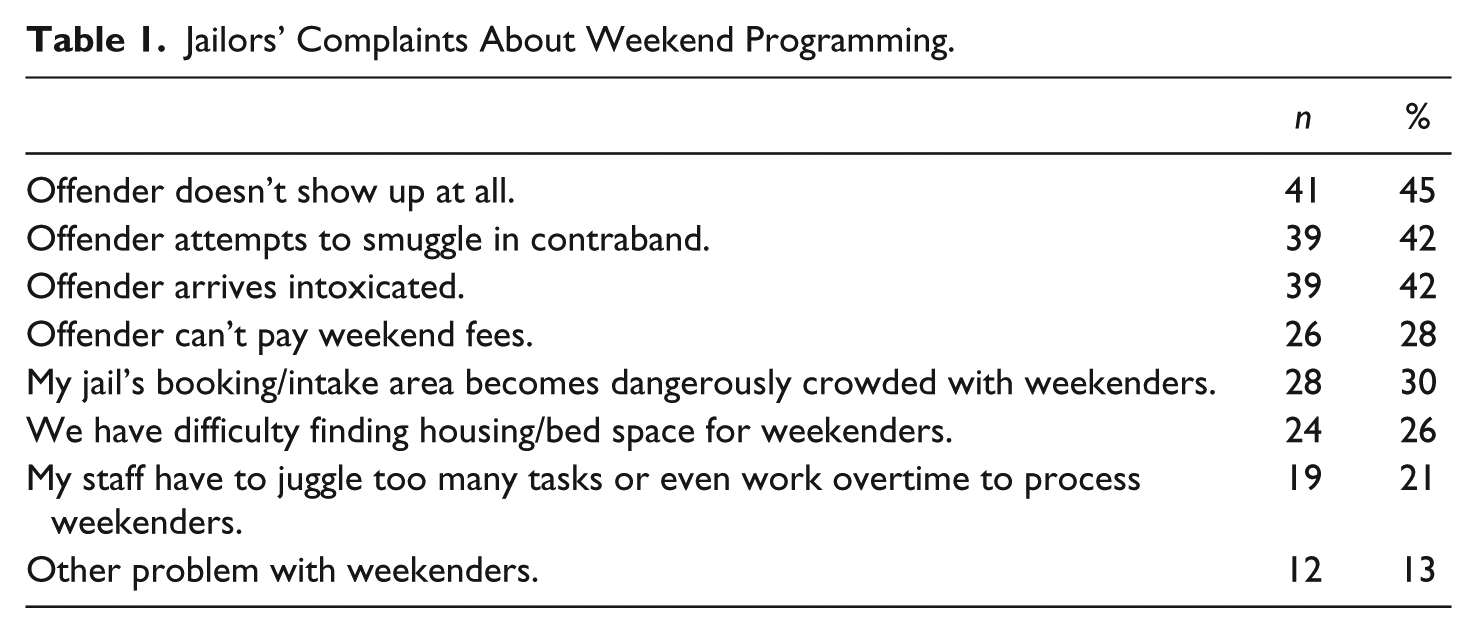
Aggregated, four clear themes emerged from these complaints: logistical and staffing difficulties, fiscal implications, safety and liability concerns, and discordant punishment philosophies. These themes are discussed in detail below.
Weekenders Present Logistical and Staffing Difficulties
Jail populations, compared with other correctional populations, are in a constant state of flux and look very different from one day, if not one hour, to the next (Chambliss, 2011; Subramian et al., 2015). Rapid population turnover already makes day-to-day jail operations fundamentally complex (Cunniff, 2002). This is even more so the case on weekends, which are the busiest time of the week for jails across the country due to an increase in the number of criminal events and resultant arrests typically concentrated over the weekend as opposed to the weekday (Andreson & Malleson, 2015). According to surveyed jailors, the addition of offenders sentenced to nonconsecutive days and/or weekends simply compounded the instability of jail populations, which, in turn, gave rise to a host of logistical and management challenges for local jails. One such concern reported among 26% (n = 24) of respondents was the provision of appropriate housing for weekenders. In a follow-up interview, one correctional administrator noted, Fridays are an absolute nightmare in my jail. Not only are Friday nights busy at the jail to begin with, we also have weekenders. We don’t always know exactly how many weekenders are going to show up—and it’s different every weekend—so not only is it difficult to plan housing space and weekend staffing, but there’s no consistency, so one weekend we’re fine and then the next weekend the booking area is overflowing for hours while we process and drug test people, we’re putting boats (jail mattresses) in the gym for extra housing because the pods are full, and my officers are stressed out working overtime . . . my officers don’t need the extra stress, and I don’t need the extra liability. (Respondent 69, regional jail superintendent, northern Virginia)
In addition to housing challenges, one civilian respondent felt that weekenders unduly burdened not only custodial staff but also clerical staff: My records staff spend hours doing nothing but processing [weekenders’] fee payments . . . it’s an immense amount of time and paperwork to accommodate a small fraction of people (weekenders) . . . and this [paperwork] is in addition to everything else staff have to do on a daily basis . . . then the offender violates weekend jail conditions, like say someone comes in and tests positive [for drugs], and then my staff has even more paperwork to process the violation, convert them to straight jail time for the violation, and refund fees . . . . (Respondent 81, community custody specialist, central Virginia regional jail)
Housing weekenders is a much more complicated matter than simply finding enough mattresses; there are major classification and medical concerns to consider. Moreover, weekenders increase staff workload in that they must be repeatedly booked and released on a weekly basis, as well as strip-searched, showered, and dressed out; medically screened and drug tested; in addition to having their property inventoried and paperwork processed. Thus, weekenders typically comprise a small portion of a jail’s population, but according to study participants, they take up a disproportionate amount of staff time and effort. In fact, many weekenders have violated the terms of weekend jail before even having begun the program: I would say half the time they (weekenders) come in and didn’t read their [weekend jail] paperwork [about weekend jail] and we have to turn them away . . . we’ve got them [weekenders] coming every day all day long and then when they finally show up to do their time we test them and at least half test positive for drugs so we don’t even get to the part of them being permitted to doing the weekends, then we have all the violation paperwork to process and regular straight time booking . . . it’s just a hassle and headache. (Respondent 3, regional jail superintendent, central Virginia)
Respondent 70, an administrator working in a southwestern sheriff-run jail, expressed similar frustration over the logistical issues associated with processing and managing offenders sentenced under §53.1-131.1: I barely have enough staff as it is, so when I get weekenders I’m not able to plan in advance for it, [it] drives my officers crazy especially on the night shift. Sometimes we have dozens of weekenders reporting on a Friday afternoon and they’re [the officers] processing until three, four in the morning. I’ve got two officers back there booking, and it’s a lot, and you run across a lot of errors in the booking process because they have to do everything and they’re constantly being interrupted . . . that’s a big security concern. People come in, they don’t have the papers or fees they’re supposed to have, the officer has to stop what they’re doing to explain it to them personally, then they go back to their job and fifteen minutes later the person comes back with papers and fees, maybe they’re right this time and maybe they’re wrong, either way the officer has to start the process all over again . . . . (Respondent 70, southwestern sheriff’s office administrator)
These weekender challenges were reported to increase staff stress and burnout. Jail staff turnover is already remarkably high; the State Compensation Board estimates that, among first-year deputy sheriffs for all Virginia localities, it is as high as 21.3%, and it remains high among ranked deputies and deputies past their first year of service (Virginia Sheriffs’ Association News, November 9, 2016). The added stress of weekenders can increase fiscal implications associated with hiring and training replacement officers, as well as the cost of sick days and the overtime paid out to cover those posts. Weekenders simply aggravate an environment in which working is already among the most stressful occupations (“Do You Have One of the 28 Most Stressful Jobs?” 2016; Kolmar, n.d.), and there are significant fiscal considerations associated with further overburdening officers who already have one foot out the door.
Other respondents also pointed out the added direct costs associated with housing, clothing, and feeding a disproportionate number of inmates on weekends. Virginia law authorizes jails to charge weekenders a certain fee to defray the costs of their keep, but the weekend jail program fee “shall not exceed that amount charged to the Compensation Board for purposes of reimbursement” (Va. Code. Ann. §53.1-131.1). This amounts to a maximum per diem program charge of US$4.00 per weekender, which is a meager contribution to the sizable costs of housing and caring for jail inmates across the Commonwealth. According to the Compensation Board’s FY2016 Annual Jail Revenues and Expenditures Report, jail operating costs per inmate per day during FY2016 ranged from US$46.17 (Piedmont Regional Jail, Farmville, VA) to US$215.64 (Fairfax County Jail, Fairfax, VA). A weekender program fee of US$4.00 per participant is but a drop in the proverbial bucket. In short, for surveyed jailors, weekenders were associated not only with increased staff stress but also with increased fiscal burden.
Weekenders Compromise Facility Safety and Increase Liability
Respondents were adamant, however, that their concerns about weekenders were not limited to issues of staff inconvenience or inconsistent crowding. Despite their officers’ best efforts, repeated booking and release of weekenders presents increased opportunities for offenders to circumvent jail security and smuggle in contraband. This creates dangerous—and potentially life-threatening—conditions. A Sheriff, operating a local jail in a western Virginia jurisdiction, elaborated on these security concerns: Weekenders creat[e] a dangerous and possibly deadly situation for officers and other inmates . . . Despite thorough strip searches, drugs, guns, needles, cigarettes, lighters, knives, and cell phones have all been detected after the fact. (Respondent 50, western Virginia sheriff)
Contraband drugs, especially when shared with other offenders, create risks of drug overdose, allergic reaction, and drug interaction, all of which increase a jail’s medical liability. Respondent 50 went on to illustrate with a vivid example: [We had] a female inmate sentenced to multiple weekends who, once housed, would sell medication [to other inmates] that was smuggled into the jail inside her body (she was strip-searched each time and nothing was apparent) . . . . When asked whether this was how she brought in drugs, she laughed and said she knew we did not have a doctor or search warrant when she came in. During the entire time she was in the jail, every single other person was put at risk . . . . (Respondent 50, western Virginia sheriff)
Equally frightening is the weekender who, knowing he cannot have another drink or hit until his Sunday release, shows up Friday night so intoxicated that he is unable even to articulate to the jail nurses what he has ingested: I’d say that happens at least once a month . . . one time we had a lady so drunk we had to put her in medical isolation, call in extra nurses, and specially assign an officer to overtime to sit and watch her all weekend. (Respondent 51, southwestern Virginia)
The Commonwealth of Virginia already spends millions resolving liability claims against jails and sheriffs’ departments—nearly US$39 million over the past 5 years (Evans & Kleiner, 2016)—and for surveyed jailors, the inclusion of disproportionate numbers of weekenders increased the liability risk for their jails and costs to taxpayers.
Weekenders Divert Fiscal and Staff Resources Away From Similar Community-Oriented Alternative Sentencing Programs
Nearly three quarters of (74%; n = 68) of respondents commented on the redundancy of weekend jail time. If a sentencing judge’s aim is to keep an offender employed, jailors felt that there was already sufficient programming and sentencing schemes within which this could be accomplished (e.g., work release programs, halfway houses, and residential reentry centers). In fact, of the 48 surveyed administrators who indicated that they oversee jails as part of their daily responsibilities, 77% (n = 37) indicated that their jail has an established work release program pursuant to Va. Code §53.1-131, and that for security purposes, they preferred their offenders to participate in work release rather than weekend programming. As offenders spend more time in jail than out working, there is increased supervision and structured monitoring of offenders and therefore fewer opportunities for security problems or program violations. Indeed, participants indicated that their work release programming was typically more controlled and structured in the following ways:
Returning to the jail on a daily, rather than weekly, basis affords offenders fewer opportunities to violate program conditions;
Monitoring offenders with GPS tracking devices that alert jail staff when an offender moves outside his designated area;
Requiring offenders to call in from work to the jail every day, and any time they leave their job site (e.g., to go off-site to lunch) an extra call to jail staff must be logged;
Regularly drug testing all offenders;
Routinely visiting and evaluating all offenders’ work sites;
Securely storing and monitoring all offenders’ work clothes and uniforms to minimize contraband smuggling.
These respondents also noted that home electronic monitoring (HEM) was another preferred sentencing alternative. Pursuant to Va. Code §53.1-131.2, “house arrest” has broader offender eligibility (e.g., traffic offenders, offenders charged with offenders under Chapter 5 [§20-61 et seq.] of Title 20, and offenders convicted of certain felonies) and is significantly less costly for the jails. Whether their jails were large or small, urban or rural, these respondents felt that both work release and house arrest obviated the need for weekend jail time which, in their view, was merely duplicative.
Weekend Jail Time Serves No Penological Purpose and Contributes to a Culture of Entitlement
More than one quarter (35%; n = 32) of respondents felt that weekend jail time was also not congruent with any discernable correctional aim. In their view, as weekenders spend more time out in the community than in jail, the interests of public safety were not served. By design, weekend jail is minimally inconvenient for the offender, thereby reducing the negative consequences associated with conviction of a crime. Although Virginia jails do not, as a rule, specifically and routinely track recidivism (in terms of re-bookings) or weekend program failure rates, these respondents observed that their weekenders are usually “repeat weekend customers,” and that weekend program failure seemed especially common after two or three court-ordered weekends. When their weekenders did flunk out, 45% (n = 41) of respondents indicated that it was most commonly because the weekenders simply stopped showing up to the jail. Unless being subsequently picked up on a show cause order or other criminal matter, these weekenders in essence self-determined the end of their own punishment. Thus, for these respondents, weekend jail time was hardly punitive.
Indeed, weekend jail is, by design, minimally intrusive, essentially allowing offenders to do jail time when it is convenient for them to do so. Punishment as deterrence, on the contrary, is intended to be inconvenient if not unpleasant. As one regional jail superintendent observed, [weekend jail] all but eliminates any adverse penalties such as time away from work, family, and daily functions; the average two-day sentence and the rest of the week at home with their families and friends, continuing to work (uninterrupted) means they incur no real consequences for their actions.
A corrections Captain in southwestern Virginia noted, [Weekend jail] is kind of like parenting in a sense; if you never discipline your kids, and you never follow through with punishment, and you just keep giving them what they want when they want it, eventually they start to feel entitled, and where’s the lesson in that?
Cruel and unusual punishment may be unconstitutional, but inconvenient and uncomfortable punishment is not. In fact, according to H. L. A. Hart (2008), pain and unpleasant consequences are the requisite first elements of state-inflicted punishment, and “. . . routine discomfort is ‘part of the penalty that criminal offenders pay for their offenses against society’ (Hudson v. McMillian, 503 U.S. at 9, 112 S. Ct. at 999 [1992], quoting Rhodes v. Chapman, 452 U.S. at 349, 101 S. Ct. at 2399 [1981]).
Respondent 26, a community corrections program manager in northwestern Virginia, made a similar point: “America on the whole is totally spoiled . . . why would inmates be any different?” Respondent 81, a community custody specialist in a central Virginia regional jail, echoed this sentiment: You know some of our weekenders start to feel really entitled about when they do their time. They show up the first two or three weekends like they’re supposed to, and then the excuses start rolling in. Emails, phone calls, voice mails. “I can’t come this weekend because I have company in town”; “It’s a holiday weekend can I please just come next weekend?”; “My babysitter cancelled on me”; et cetera et cetera. So then I have to spend time negotiating with them, or start violation paperwork. They act like they expect to be accommodated, and some of them get really mad when I won’t or can’t, like we’re all supposed to bend over backwards for them . . . (Respondent 81, central Virginia regional jail community custody specialist)
Indeed, scholars have long suggested that certain personality traits may influence an individual’s proclivity toward criminal behavior (cf. Barry et al., 2007; Hepper et al., 2014; Paulhus & Williams, 2002; Watson & Morris, 1991; Wulach, 1988), and narcissistic personality disorder (NPD) has been identified as one of those personality disorders prevalent among offenders (Wulach, 1988). As Campbell and Foster (2007) observed, a sense of entitlement and a lack of regard for others are some of the most maladaptive components of narcissism, the elements of which are clearly reflected in Respondent 81’s feedback. From the jailors’ point of view, allowing an offender to negotiate the specific weekly schedule within which he can make himself available for incarceration—and then expecting correctional staff to be able to cater to these self-interested special circumstances to the detriment of others—arguably accomplished little other than reinforcing the potential for an offender’s “Others Exist for Me Illusion.”
4
As Respondent 58, a lieutenant at a regional jail in southeastern Virginia, observed, I hear [weekenders] talk all the time on the pod about what a ‘joke’ it [weekend jail] is . . . they laugh about how they keep getting court-ordered weekend time and that it’s a great time to catch up on their sleep from partying during the week . . . .
These respondents felt that weekend jail time hardly emphasized offender accountability, responsibility for one’s harmful behaviors and choices, the importance of perspective-taking, and enhanced empathy for others, all of which are integral to both retributive and restorative paradigms of justice (cf. Wenzel et al., 2012). Weekend jail was, in their view, neither punitive nor rehabilitative: Our weekenders mostly sleep or watch TV all weekend; they definitely don’t do anything constructive. Sometimes we have [weekenders] who all know each other from previous weekends and it’s like one big party for them, they meet up again Friday nights and hang out chatting all night, it drives the other inmates crazy, especially the ones on work release who have to get up early to work the next morning. (Respondent 58, southeastern regional jail lieutenant)
Worse, remarked these respondents, their substance-abusing offenders sentenced to weekend jail time simply learned to confine their continued substance abuse to nonincarcerated weekdays, showing up appropriately sober for a weekend in jail. Like other states, Virginia is currently experiencing unprecedented rates of heroin and prescription opioid abuse, overdoses, and deaths (Cook & Brownstein, 2017). While the effects of heroin are longer lasting compared with other drugs, it has a short half-life and flushes relatively quickly out of a user’s system (Moeller et al., 2008). In fact, some studies suggest that heroin’s half-life is a matter of minutes—perhaps even as brief as two—as it is rapidly metabolized and eliminated from the body (Medical Letter, 2016). Even with heavy use, heroin may only be detectable in a simple urine test for as small a time frame as 2 to 5 hr post-ingestion (Standridge et al., 2010). It is certainly not impossible, then, that some heroin users may be able to ingest the drug within a matter of hours before checking into jail for the weekend—maybe even while he is on his way to jail—and still pass the jail’s drug screening. This leaves the clever weekender plenty of latitude to continue to abuse drugs while participating in nonconsecutive day sentencing.
Weekend time can further facilitate this by providing repeated opportunities for drug-abusing inmates to carefully scrutinize—and figure out how to bypass—a jail’s security protocols (Vieth, 2012). The more weekends an offender serves, commented study participants, the more familiar he may become with a jail’s routine operations, and it becomes easier for the weekender to calibrate his substance abuse accordingly. After all, a drug abuser in jail for the weekend only has to endure 48 hr of withdrawal before he is released and can use again; incarceration may hinder an offender’s ability to access drugs for a few days, but it does nothing to eradicate the addiction driving that substance abuse (Rich et al., 2015). These respondents felt that weekend jail, with its minimal inconvenience, predictability, and lack of rehabilitative structure, was fundamentally if not diametrically opposed to principles of effective treatment.
In sum, survey participants across the Commonwealth from both regional jail authorities and sheriffs’ offices alike spoke with remarkable consensus on weekend jail time. In their view, weekenders introduced a host of logistical challenges and safety concerns, and that brief weekly stints in jail were neither rehabilitative nor deterrent. In their view, weekend jail minimized the punitive inconvenience and unpleasantries of correctional treatment, subverting the fundamental purpose of punishment. Weekend jail time only effectively punished the correctional staff burdened with implementing it. In other words, it is their staff and taxpayers—not weekenders—who bore the multifaceted burdens of nonconsecutive day sentencing.
Results: Weekend Jail as Amended By Senate Bill No. 36
Nonviolent Felon Eligibility
Study participants were first asked whether they generally supported all the changes to Va. Code §53.1-131.1 as passed in SB36. Among those who did support statutory expansion, the majority (76%, n =19) were not jail-responsible. When specifically asked whether §53.1-131.1 eligibility should be expanded to include nonviolent convicted felons, the majority (68%, n = 49) disagreed. Summed up succinctly by one respondent, this related to how nonviolent felons are defined: As long as burglars, drug dealers, and felony DUI offenders are considered to be non-violent [felony] offenders, I cannot support this; these offenders are public safety menaces. . . . (Respondent 16, central Virginia sheriff)
Indeed, Va. Codes §17.1-805 and §19.2-297.1 enumerate felonies considered violent under Virginia law, leaving a fairly broad spectrum of crimes considered “nonviolent” felonies. “Nonviolent” felonies in Virginia include, but are not limited to, the following: unlawful possession of a concealed weapon; perjurious and/or false statements in firearm transaction records; unarmed breaking and entering with intent to commit certain misdemeanors; third or subsequent offense of driving while intoxicated; felony eluding of police; credit card theft, forgery, or fraud; simple drug possession; and prescription fraud. Each of these felonies is just as capable of causing significant injury or loss to victims and their communities and present serious public safety concerns. Lengthy prison terms are a possibility for all felonies—by definition—whether classified as “violent” or “nonviolent.” To these respondents in opposition to statutory expansion, it was counterintuitive that offenders convicted of prison-eligible crimes were presumed to pose such an insignificant threat to public safety that they, too, should be eligible to spend 5 out of 7 days per week of their sentences out of jail.
Expanded Judicial and Prosecutorial Discretion
More than half (54%, n = 40) of respondents also did not think that Courts should be allowed to authorize weekend sentences for good reasons other than to keep an offender employed. Participants justified their opposition to this provision, citing concerns about jail management, increased staff workload and burnout, liability and concomitant fiscal concerns, the existence of jail programming that already meets these needs (e.g., work release and house arrest, authorized in Va. Codes §53.1-131 and §53.1-131.2 respectively), unclear correctional goals (e.g., the lack of an identifiable punitive, deterrent, or rehabilitative purpose), or concern for increased inconsistency in sentencing practices across the Commonwealth: If anyone should be authorizing weekend jail time it should be the jailors, not the judges or prosecutors! It involves my county, my jail, my staff, my resources, and my inmates, so I should be part of the conversation. [The way it is now] I have absolutely no say . . . I don’t think they [judges and prosecutors] have any idea what they’re asking of us [jail staff] and I doubt some of them would care even if they did. (Respondent 3, regional jail superintendent, central Virginia)
Over one quarter (30%; n = 12) of these respondents also felt that the broad discretion currently entrusted to judges and prosecutors was sufficiently wide-ranging and therefore saw no need for statutory expansion. Respondent 69, a regional jail superintendent in northern Virginia, reported, Some judges [I’ve talked to] are very receptive when I’ve explained to them what a burden the weekenders are. But others get really defensive, they see it as someone trying to tell them how to do their jobs, and they fall back on that good old “safe harbor” of judicial discretion and do what they want to do. It really just depends on the relationship we have with that particular jurisdiction.
These respondents’ primary objections to increased court discretion were multidimensional and pragmatic. One such respondent was even suspicious—if not downright cynical—about the political motives for weekend jail time: I see them [defendants] lie all the time to the judge and tell them they have a job so the judge will give them weekends. Or they say that they just so happen to be “starting a new job this Monday.” I don’t think anyone verifies any of that. So he [the defendant] gets what he wants, and the judge and the prosecutor can walk away saying, “See how progressive and forward-thinking I am, my constituents are going to love this” and the defense attorney can say, “Look at what a great deal I got for my client!” and everybody walks away a winner. Except the jails, of course. The jails are the ones getting punished. (Respondent 22, booking/intake corrections sergeant, sheriff-run jail in central Virginia)
This participant’s perspective was hardly unconventional, given the fundamentally political nature of crime and justice. So firmly entrenched in politics is criminal justice that political ideology has been suggested to be the “permanent hidden agenda of criminal justice” (Miller, 1973, p. 142). Whatever their justification, these respondents clearly objected to SB36’s broadened court discretion.
Discretionary Allowance of up to 45 Days of Remaining Sentence to be Served Nonconsecutively
This final amendment to §53.1-131.1 under SB36 is another matter of court discretion. If a defendant is deemed eligible to serve nonconsecutive days/weekend jail time, the majority of respondents (65%, n = 60)—whether or not they ran their own jails—thought that the portion of that sentence to be served as such should be restricted to 30 days or fewer. As reflected in Table 2, the longer the restrictive time frame in which a defendant could serve nonconsecutive/weekend days, the less support there was among respondents.
Number of Remaining Sentenced Days to Which Weekend Jail Time Should be Restricted.
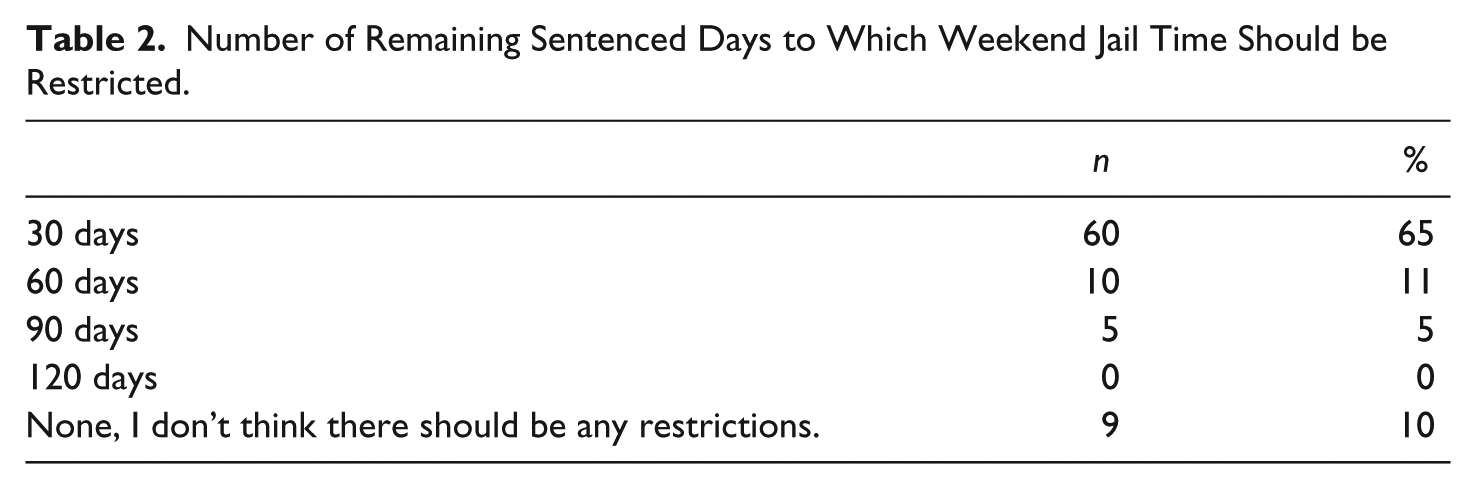
Forty-five days of nonconsecutive jail time done on weekends is roughly equivalent to half a calendar year, and such a sentence could be prohibitively difficult for both jails to implement and for weekenders to complete. Such a protracted noncontinuous sentence also increased liability, jail management challenges, and was largely ineffective in curbing recidivism. These respondents observed that their weekend program failure rates seemed to increase with the number of court-ordered nonconsecutive days. Some of their weekenders simply stopped reporting for weekend jail time, while others never even bothered to report for weekend jail time to begin with. Some weekenders had their sentences immediately commuted to “straight” jail time on the spot due to a failed drug or alcohol screening; others came back to jail arrested on new, unrelated charges. For these respondents, weekend jail looked good on paper and was a useful tool in helping offenders maintain gainful employment. In practice, however, it appeared to be quite another story: I think it [weekend jail] is just more trouble than it’s worth. Why would we want to expand it? People don’t take it seriously so they don’t show up; they get picked up and end up doing straight jail time anyway. It’s just a lot of hassle, you know, lots of extra paperwork and processing and overtime and all that. Why not just save everyone the trouble? We can put them [offenders] in our work release program and have them out to work the very next day if it’s work they’re worried about. Or even just probation. Better yet put them on house arrest and they can pay for their own keep. . . . (Respondent 81, sheriff’s office, southwestern Virginia)
Discussion
Surveyed staff members across the Commonwealth were not at all enthusiastic about weekend jail programming in current practice, and there was strong opposition to each and every provision in §53.1-131.1 as amended by SB36. Neither the 92 survey responses nor hundreds of hours of follow-up interviews yielded a single positive comment on SB36. When considered against the backdrop of Virginia’s endemic jail crowding, respondents’ many concerns as explored above were amplified, if not altogether disquieting. In a 2013 nationwide comparison, Virginia had the highest overall percentage of occupied overage jail capacity not only in the southern United States but in the entire country among all reporting jurisdictions (Minton & Zeng, 2016). The vast majority of Virginia’s jails (78%; n = 47) continue to operate regularly above rated operational capacity, and not just marginally so. The median capacity overage for all jails is 134% (133% and 136% for sheriff-run and regional jails, respectively). While this is well over rated capacity, 5 there are even jails regularly operating with over 3 times as many inmates as that for which they were approved. Crowding is a common denominator in most correctional management challenges (e.g., individual offender needs, understaffing, inadequate supervision, stress and burnout among officers, facility vulnerability, and adequacy of inmate conditions of confinement). Net of weekend jail time, it is more than fair to say that Virginia’s jailors already have their hands well full.
It is tempting—and frankly, logical—to argue that increased use of nonconsecutive day sentencing should unequivocally help to alleviate the overcrowding problem endemic to Virginia jails. This study, however, casts serious doubt on this. That is, Virginia’s jails may be less crowded during certain weekdays, but they nonetheless remain crowded. It is instead a matter of timing and degree of crowding. From the perspective of study participants, weekend jail simply shifts a portion of their inmate population to a jail’s busiest days of the week—weekends are precisely when scarce jail space is at its highest premium—thus contributing to an already highly concentrated volume of weekend jail traffic, from which a host of negative consequences flow. For jailors, the expansion of weekend jail time is therefore unnecessarily burdensome for frontline corrections officers and other jail staff, adversely affecting their day-to-day jail operations in terms of safety, security, liability, fiscal and staff resources, and jail management.
Beyond the logistical, management, and security problems that weekend jail programming creates, study participants also questioned its penological rationale. Program failure rates were reportedly high, making its role as a deterrent questionable. Substance abusers quickly learned to confine their illicit activities to week days, undermining any rehabilitative value. Offenders spent more time out of jail than in, undercutting any aims of incapacitation and public safety. Finally, as designed to be minimally inconvenient for offenders, weekend programming lacked punitive value. If the purpose of weekend jail was to keep offenders gainfully employed in the community, it was essentially duplicative in that house arrest, HEM, work release, probation, and day reporting were already on Virginia’s menu of intermediate sanctions available to eligible offenders.
Unsolicited executive summaries of this study’s findings were provided to members of the General Assembly, and on February 26, 2018, these findings were presented in Session as expert testimony in opposition to Senate Bill No. 36. Given the remarkably consistent position on weekend jail among the vast majority of responding public safety personnel around the state, legislators in Virginia’s General Assembly were easily poised to align their position with that of their corrections professional constituents. It was also a relatively straightforward and simple opportunity to make a fairly innocuous, data-informed policy decision. Indeed, such unequivocal like-mindedness on policy among corrections practitioners is rare, if not altogether striking—especially when it arises from stakeholders across a spectrum of such diverse agencies—and should be exploited when and where it occurs. Nonetheless, this study was met by lawmakers with unmistakable apathy. With a nonconsecutive day sentence limit lowered further from 90 to 45 days, the bill sailed through the Courts of Justice with a unanimous 16Y-0N vote. This left Virginia’s nonconsecutive day sentencing law amended without much meaningful consideration of professional insight from the very experts out in the field and on the frontlines of corrections whom lawmakers have now specifically burdened to carry out these policy changes.
Conclusions and Recommendations
The next logical step in research on nonconsecutive day sentencing is, obviously, to evaluate the actual effects of this particular legislative directive. Will the number of nonviolent felony weekenders and weekend sentences pursuant to a revised §53.1-131.1 actually increase? If so, will this increased number of weekenders appreciably affect jail operations in the detrimental ways anticipated by jailors around the Commonwealth? Based on their experiences with and opinions about the current practice of weekend jail programming, jailors are arguably in the best position to assess the potential effects after statutory expansion. Yet a significant limitation of the present study is the current inability to compare jailors’ anticipated outcomes with weekenders’ actual outcomes. Do weekenders’ actual program outcomes justify jailors’ scorn and suspicion? Will correctional administrators have been portentous in their anticipation of negative effects associated with an increased number of weekenders, or is their reticence simply due to organizational cynicism and dispositional resistance to change? Are these negative sentiments toward non-continuous jail time shared among weekenders, prosecutors, defense attorneys, and judges, or is it instead viewed among them more favorably? Would any significant micro-level variation in jailors’ opinions emerge when examined within the specific context of facility location or degree of crowding? Would jailors’ opinions on weekenders improve if their locality’s budget allowed for the hiring of more jail staff, or if facility crowding was significantly reduced? To what extent, if any, do Virginia jailors’ perspectives on weekend jail time align with the opinions of jailors around the country? This study presents the perspectives of one group of stakeholders, and in the pursuit of “smarter” and politically appealing alternatives to total incarceration, the answers to these more nuanced questions matter significantly.
Of course, the political appeal alone in criminal policy making of course hardly makes it “smart,” and the policy disconnect between lawmaker and practitioner remains cliché for a reason. As long as interest in data-driven, cost-effective, and results-based criminal justice policy remains de rigueur, researchers can and should do their part to bring lawmakers and stakeholders together where possible. This is true even if legislators’ ultimate policy decisions are buffeted more so by the capricious winds of political ideology and public opinion than scientific rigor. Indeed, lawmakers’ ultimate rejection of an opportunity to make a simple, data-based policy decision—such as that with Virginia’s nonconsecutive day sentencing—should not be used by criminologists as an excuse to sit amiably on the sidelines while impactful decisions are made. After all, it takes time to foster collaboration among legislators and their professional constituents in the field. Despite the debate among criminal justice researchers on whether and to what extent they should be involved in policy making, 6 the fact remains that criminal justice research must endeavor to bridge this gap between lawmakers and practitioners by independently generating data germane to both parties. Toward that end, this study on part-time jail time is a modest contribution.
What is ultimately done with germane data—if anything—is another matter. While Virginia legislators ultimately chose not to avail themselves of findings from this study and the expert input of criminal justice practitioners presented therein, the study represents a not insignificant contribution to an accumulating body of evidence that captures the complexities of “smart” alternative sentencing implementation from the perspective of on-the-ground line staff. Legislators are reminded that the human costs of a change in sentencing policy includes not only offenders but also the corrections practitioners on the frontlines to whom we have entrusted with implementing it. Out of sight and mind of the general public, jailors are the “forgotten cops” whose vital contributions to public safety often go overlooked. This is understandable, if not a luxury, as the average American has had no direct experience with jails or the people who work in them (Clear et al., 2018). This luxury should not, however, extend to policy makers, who cannot afford to overlook the welfare of criminal justice practitioners who will directly bear the brunt of turning policy into practice. If cost-effective, evidence-based solutions remain at the forefront of American “smart on crime” initiatives, then it is simply smart to solicit input from on-the-ground criminal justice experts in the decision-making process.
Courts have long recognized the wisdom in deferring to corrections experts, when and where appropriate. Even the Supreme Court has noted that corrections administrators “should be accorded wide-ranging deference in the adoption and execution of policies and practices that in their judgment are needed to preserve internal order and discipline and to maintain institutional security” (Bell v. Wolfish, 441 U.S. at 547 (1979). It is therefore not unreasonable to suggest that legislators do the same, when and where appropriate—and that researchers weigh in, when and where appropriate, for that matter—on legislative changes with such potentially direct and far-reaching consequences for corrections personnel. Lest jailors also become “forgotten cops” in the legislative arena—perhaps where it counts most—lawmakers at minimum owe them meaningful consideration before implementing policy changes that directly affect their frontline work and well-being.
Footnotes
Declaration of Conflicting Interests
The author(s) declared no potential conflicts of interest with respect to the research, authorship, and/or publication of this article.
Funding
The author(s) received no financial support for the research, authorship, and/or publication of this article.