



Abstract
Job stress is a problem in corrections. Although the very nature of correctional work is stressful, workplace variables also contribute to correctional staff job stress. The job demands-resource model holds that job demands increase negative outcomes (e.g., job stress) and decrease positive outcomes (e.g., job satisfaction), whereas job resources help increase positive outcomes and decrease negative outcomes. An ordinary least squares regression analysis of self-reported survey data from 322 staff at a Southern prison indicated that input into decision-making and quality supervision had statistically significant negative effects on job stress, whereas role overload and fear of victimization had significant positive effects. Instrumental communication, views of training, and role clarity all had nonsignificant associations with stress from the job in the multivariate analysis. The results partially supported the job demands-resources model; however, the specific work environment variables varied in terms of their statistical significance. Correctional administrators need to be aware of the contribution that workplace variables have on job stress and make changes to reduce staff job stress.
The operation of a safe, secure, and humane prison is a major responsibility, and staff play a vital role in that process. More than US$70 billion spent annually on U.S. prisons, and staffing typically accounts for between 70% and 80% of a prison’s operating budget (Camp & Gaes, 2002; Kincade, 2016; Tewksbury & Higgins, 2006). These percentages translate to annual expenditures of US$49 to US$56 billion for correctional staff alone. An estimated 475,000 individuals are employed in the more than 1,800 U.S. state and federal prisons, which hold approximately 1.5 million adult inmates (Bureau of Labor Statistics, 2016; Stephen, 2008). Staff, however, not only have an impact on the operations and functioning of the prison, but the reciprocal is also true—the prison workplace also affects the staff.
The correctional workplace is unique. It involves confining and controlling large numbers of individuals against their will, using only a small number of specially trained staff (Liebling & Arnold, 2004). Armstrong and Griffin (2004) contended that “few other organizations are charged with the central task of supervising and securing an unwilling and potentially violent population” (p. 577). In light of their importance and cost, it is no surprise that there has been a growth in research focusing on correctional staff. A significant number of these research projects have specifically examined the factors that contribute to the job stress experienced by these staff. While a completely unstressed staff may not be realistic, an overly stressed staff can lead to a poorly run prison, and efforts must be made to manage staff job stress to maximize the efficiency and effectiveness of the facility.
Job stress is typically defined as feelings of work-related psychological hardness, tension, frustration, and distress (Blevins, Cullen, Frank, Sundt, & Holmes, 2006; Cullen, Link, Wolfe, & Frank, 1985; Grossi, Keil, & Vito, 1996; Higgins, Tewksbury, & Denney, 2013). A major reason for exploring the predictors of job stress has been the harmful physical and psychological effects job stress has over time. Job stress has been associated with job burnout, lower commitment to the organization, reduced satisfaction from the job, greater risk of substance abuse, higher physical and mental health problems, diminished life satisfaction, poor work performance, more work absences, and increased chances of death (Cheek & Howard, 1984; Cheek & Miller, 1983; Dowden & Tellier, 2004; Finn, 1998; Stack & Tsoudis, 1997). The suicide rate of correctional staff is 39% higher than that of the general population (Kochanek, Murphy, & Xu, 2015). Moreover, correctional staff have an average life expectancy of 59 years, 16 years shorter than the U.S. average of 75 years, or approximately one-fifth shorter than normal. Prolonged job stress is considered one of the major reasons for this decreased life span (Tracy, 2004; Woodruff, 1993). In light of the documented damaging effects of prolonged stress, more research is needed to identify and confirm the factors that may raise or lower job stress for correctional staff. Although past studies have examined the predictors of correctional staff job stress, there remains a need for additional research.
The current study surveyed staff at a large prison in the southern United States to examine stress-related themes derived from prior studies of correctional worker stress. Due to the paucity of research in this area, replication of these past findings becomes critical (Easley, Madden, & Gray, 2013), because there is always the chance that single findings are due to random chance. In addition, examining how work environment variables are associated with job stress across a broad range of institutions is necessary to determine whether their predictive value is universal, or simply unique to specific locations or types of correctional facilities.
The current study focuses on a prison housing more than 4,000 adult male inmates at the time of the survey, making it one of the largest U.S. prisons in terms of inmate population (University of Albany, 2017). The prison holds a wide range of sentenced inmates, and the majority of staff at the prison are women, including those working as correctional officers. The current study explores the effects of the predictor variables of instrumental communication, input into decision-making, quality of supervision and training, role clarity, role overload, and fear of workplace victimization on the predicted variable of job stress.
Literature Review
The job demands-resources model provides the theoretical framework for why the work environment variables of instrumental communication, input into decision-making, quality of supervision, quality of training, role clarity, role overload, and fear of workplace victimization would affect job stress among correctional staff. The model separates the work environment variables into those related to job demands and those related to job resources (Bakker & Demerouti, 2007; Demerouti, Bakker, Nachreiner, & Schaufeli, 2001). The job demands-resources model grew from the job demands model proposed by Karasek (1979). Karasek (1979) defined job demands as “the psychological stressors involved in accomplishing the workload, stressors related to unexpected tasks, and stressors of job-related personal conflict” (p. 291). Karasek (1979) theorized that job demands that the worker cannot avoid, or has little control over, result in heightened psychological strain, which, in turn, raises the job stress level. As noted by Steiner and Wooldredge (2015), correctional staff frequently have little control over their jobs, such as responding to inmate fight, and, as such, are more likely to suffer job stress from job demands.
Demerouti et al. (2001) proposed the job demands-resources model. They built on the demands control model by arguing that workplace resources aid employees in doing their jobs, resulting in psychological positive feelings, whereas job demands hamper employees, resulting in psychological strain leading to job stress and burnout. The job demands-resources model acknowledges that there are a wide array of possible job demands and resources, all of which could possibly affect the job stress levels of correctional staff. Likewise, Demerouti and Bakker (2011) asserted “that every occupation has its own specific risk factors associated with work-related stress. These factors can be classified into two categories (i.e., job demands and job resources), thus constituting an overarching model that may be applied to various occupational settings, irrespective of the particular demand and resources involved” (p. 2). A related model is the job demand-control (or the demand-support) model, described by Steiner and Wooldredge (2015). The model tested by Steiner and Wooldredge (2015) is similar to the job demands-resources model in many respects, but includes an additional focus on job control (i.e., control or lack of control over inmates and rule enforcement). In addition, the job demand-control model includes the area of social support, theorizing that greater social support buffers the effects of job demands, resulting in lower correctional staff job stress. Specifically, their model predicts that greater demands, lower control, and less social support are associated with more adverse job outcomes, including stress. In a sense, greater job control and social support are workplace factors that Demerouti et al. (2001) see as job resources, as they aid people in doing their job.
Demerouti et al. (2001) defined job demands as “those physical, social, or organizational aspects of the job that require sustained effort and are therefore associated with physiological or psychological costs” (p. 501). Demerouti and Bakker (2011) indicated that job demands are “work circumstances that involve excessive or undesirable constraints that interfere with or inhibit an individual’s ability to achieve valued goals” (p. 4). Job demands are variables that place a psychological strain on a person, such as role overload and fear of being victimized at work (Demerouti et al., 2001). These demands can cause psychological strain, which can wear an employee down over time, thereby increasing the potential of experiencing job-related stress (Schaufeli & Taris, 2014).
Job resources refer to the work environment variables that help staff to accomplish work goals and aid them in being successful in their jobs (Hakanen & Schaufeli, 2012; Mauno, Kinnunen, & Ruokolainen, 2006). Demerouti et al. (2001) defined job resources as those physical, social, or organizational aspects of the job that may do any of the following: (a) be functional in achieving work goals; (b) reduce demands and the associated physiological and psychological costs; and (c) stimulate personal growth and development. (p. 501)
Job resources, therefore, can create a pleasant workplace with greater psychological investment in the workplace among staff; job resources thus help staff to be more effective in their jobs, to feel valued, and to grow professionally (Demerouti et al., 2001; Mauno et al., 2006). Suitable job resources can also mitigate job demands or assist staff in dealing with them more effectively (Demerouti & Bakker, 2011).
Conversely, working in an environment with scarce job resources can become an additional job demand in itself, becoming a negative influence that results in greater psychological stress and personal strain among workers, which increases the likelihood of job stress and other negative outcomes (Demerouti & Bakker, 2011; Hobfoll, 2002; Schaufeli & Taris, 2014). Essentially, job resources are variable, but, if present in sufficient quantities, they can support staff in being more effective in their jobs and allow them deal with job demands in a positive manner. In the end, adequate job resources increase the odds of positive outcomes and may decrease job-related stressors (Demerouti & Bakker, 2011; Demerouti et al., 2001).
In the current study, the job resources studied were instrumental communication, input into decision-making, quality of supervision, effective training, and role clarity. The job demands were role overload and fear of being victimized on the job. Instrumental communication is the perception that significant, relevant work information is provided about job tasks, equipment usage, regulations, and policies (Agho, Mueller, & Price, 1993). As noted by Lambert, Hogan, Barton, and Clarke (2002), instrumental communication “refers to the information that employees receive not only about their job, but also about organizational processes, issues, and concerns in general” (pp. 182-183). Instrumental communication is a job resource because it can help staff become more effective at their jobs by helping reduce their stress and frustrations and sending staff a message that they are valued and respected by the organization (Lambert, Hogan, Paoline, & Stevenson, 2008). In addition, instrumental communication can help staff mitigate job demands or provide information on how to minimize the negative effects of demands. Staff tend to be unhappy when they believe they have been ignored or left uninformed about issues at work, and adequate instrumental communications can serve to alleviate this situation (Lambert, Minor, Wells, & Hogan, 2016).
Although there is little research that examines this phenomenon, past research that suggests that the effects of instrumental communication on job stress may vary. Among staff at a Southern jail and Midwestern private correctional staff, instrumental communication was a negative predictor of job stress (Lambert et al., 2008); however, in another study of jail staff, instrumental communication was observed to have no significant relationship with job stress (Paoline, Lambert, & Hogan, 2015). Additional research is needed to determine whether instrumental communication is a negative predictor of stress from the job.
Input into decision-making refers to perceptions that staff have a voice in salient organizational matters (Paoline et al., 2015). Input allows staff to be more effective in their jobs (Slate & Vogel, 1997). Having a voice in the prison is likely to increase the level of positive psychological feelings from the job. Furthermore, input can help reduce the occurrence of job demands or to minimize their effects. A feeling of having little or no voice in organizational decision-making can lead to feelings of frustration, resentment, and powerlessness, which in turn heighten psychological strain, increasing job stress. Although there is support in the literature for this prediction (Paoline et al., 2015; Slate & Vogel, 1997; Whitehead & Lindquist, 1986), it is important to note that there have been a limited of number of studies that have examined the association between input into decision-making and correctional staff job stress.
The quality of the supervision is also important to the work environment. Good supervisors may be critical, but supportive supervision is a job resource. Quality supervision provides guidance, direction, control, and support, which are necessary for staff to do their jobs (Cherniss, 1980). Supervisors are an important resource in helping staff be successful at the jobs, as well as making work a more pleasant experience (Yang, Brown, & Moon, 2011). Quality supervision can aid staff in meeting job demands, and it may help buffer negative job effects, as well as provide guidance on how to cope with the more trying aspects of the job (Brough & Williams, 2007). Poor supervision, by contrast, is a job demand, making the job less pleasant, thereby contributing to job stress (Cullen et al., 1985; Yang et al., 2011). Quality of supervision has been reported in past studies to result in lower stress for correctional staff (Brough & Williams, 2007; Cullen et al., 1985; Griffin, 2006; Van Voorhis, Cullen, Link, & Wolfe, 1991).
The variable training focuses on the perception that the correctional organization provides quality and useful training for their staff. High quality training is more likely to provide staff with the knowledge and skills to be successful in their jobs and give them the tools necessary to manage the problems and demands that arise. Overall, this can result in raised positive psychological feelings toward the position and the facility (Cullen et al., 1985). A feeling that the training is of poor quality may lead to uncertainty about job tasks and increased job frustration and work problems (Griffin, 2001). Two studies of Midwestern correctional staff and Florida jail staff both indicated that perceptions of quality training were negatively related to stress from the job (i.e., as the perceptions of the training increased, job stress decreased; Griffin, 2001). Clearly, there is a need for additional research in this area. Although there are very few job stress studies that included a measurement of training quality, the few that exist indicate training views have a negative relationship with job stress.
Role clarity is the degree that job directions and expectations are clear to staff members (Allisey, Noblet, Lamontagne, & Houdmont, 2014; Hassan, 2013). Role clarity is the opposite of role stress, which results when role directions and expectations are vague or in conflict (Grossi & Berg, 1991). Role clarity is a job resource, because it leads to clear direction and expectations of what is expected at work. It allows staff to be more successful at their jobs, which increases the chances of positive psychological feelings. Role clarity can help avoid problems. Conversely, a lack of role clarity can result in frustration and the feeling of being unguided at work, increasing the likelihood of job stress. Little research exists to date on role clarity; there has, however, been research on role stress, which is seen as the opposite end of the continuum of role clarity. This past research indicates these role stressors are correlated to increased correctional staff job stress (Armstrong & Griffin, 2004; Cullen et al., 1985; Tewksbury & Higgins, 2006).
Role overload occurs when a staff member is required to do too many tasks in too short of a time period or without the proper equipment or resources (Triplett, Mullings, & Scarborough, 1996). In prison, some positions require too much work, or they require the worker to handle too many tasks simultaneously or to handle situations without the necessary equipment or support. Role overload is a job demand. Being overloaded can result in feeling overwhelmed and result in excessive stress (Triplett et al., 1996). In addition to psychological strain, role overload may result in diminished job success and contribute to frustration (Triplett et al., 1996). Overloaded and frustrated officers may engage in “passive coping mechanisms” that include reduction in their level of performance (Schaufeli & Bakker, 2004). Although there has been limited research to date on the effects of role overload on correctional staff job stress, this limited research suggests that role overload results in higher job stress (Triplett et al., 1996).
Fear of victimization refers to feeling at risk of being injured through the actions of another while on the job (Castle & Martin, 2006; Gordon, Proulx, & Grant, 2013; Griffin, 2001). As Lai, Wang, and Kellar (2012) noted, “there is no doubt that unexpected threats of violence, from either inmates or staff, are always prevalent in a correctional setting” (p. 15). Working in the corrections field can be dangerous, and the associated fear of victimization can be viewed as a job demand (Armstrong & Griffin, 2004; Cullen et al., 1985). Constant feelings of risk can wear on staff, resulting in apprehension and concern at work, which in turn can raise psychological tension and strain, increasing the level of job stress (Higgins et al., 2013). According to the job demands-resources model, perceptions of likely victimization on the job raise the chances of negative outcomes, including job stress. Fear of victimization has been reported to have a direct relationship with job stress among correctional staff (Armstrong & Griffin, 2004; Castle & Martin, 2006; Cullen et al., 1985; Triplett et al., 1996).
Hypotheses
The current study included five measures of job resources: instrumental communication, input into decision-making, quality of supervision, effective training, and role clarity. Among the Southern correctional staff included in the current study, instrumental communication was hypothesized to be a negative predictor of job stress (Hypothesis 1). Input into decision-making (Hypothesis 2), perceptions of quality supervision (Hypothesis 3), training views (Hypothesis 4), and role clarity (Hypothesis 5) were also hypothesized to have a negative relationship with correctional staff job stress. Regarding job demands, both role overload (Hypothesis 6) and fear of victimization (Hypothesis 7) were hypothesized to be positive predictors of job stress among correctional staff.
Method
Participants
In the spring of 2015, researchers secured institutional review board approval for a research project that involved surveying all staff members of a large Southern prison. The prison’s security level was medium and maximum, and this prison housed the death row for the state prison system. The prison was designed to house approximately 4,700 adult male inmates and was broken into seven separate units. At the time of the survey, the prison housed about 4,600 inmates and employed 720 staff. To reach the maximum number of staff, the researchers visited the prison during roll calls for each of the shifts across six separate days. A packet was distributed to all available staff, although some staff were not available during these visits because of vacation leave, administrative leave, and extended sick leave. The packet included a cover letter, an informed consent form, the survey instrument, a bifurcated raffle ticket, and a blank envelope.
The cover letter explained the nature of the study, assured respondents that participation was voluntary, explained that there was no reward for participation nor any punishment for declining to participate, that a person could skip any survey question and stop at any time, responses would be anonymous, and that the data set would be kept confidential and secure. Directions for returning the survey instrument and for participation in the raffle were provided. By returning half of the bifurcated raffle ticket, staff were offered a chance to win one of the 10 US$50 VISA gift cards. Respondents were entered in the raffle drawing regardless of whether or not they completed the survey. A drawing for the gift cards was conducted after the data collection period ended, and winners were notified. A blank, unmarked envelope was provided to return the survey, the informed consent form, and/or half of the raffle ticket. This envelope could be returned using one of the four locked boxes distributed around the prison, which could only be accessed by one of the researchers. Once removed from one of the four locked boxes, a member of the research team immediately separated the informed consent forms and the returned raffle tickets from the survey to make it impossible to link a particular staff member with a specific questionnaire. Of the 720 employed staff, 74% (n = 532) were custody/security staff and 26% (n = 188) were noncustody staff (e.g., counselors, teachers, medical staff). A total of 339 packets were distributed to custody/security staff and 188 packets were distributed to nonsecurity staff. A total of 322 completed surveys were returned for a response rate of 59%. For custody/security staff, the response rate was 68% (n = 218), and for nonsecurity staff, the response rate was 32% (n = 103). According to the human resources office of the prison, the participants appeared to be representative of the overall prison staff complement in terms of gender, age, position, tenure, and supervisory status. It was not possible to compare the participants and the overall staff on educational level.
Participant Demographics
In terms of gender, 74% the participants were women and 26% were men. The age was 40.07 years, with a standard deviation of 12.74. About 68% of those who completed the survey indicated that they were correctional officers and 32% worked in other positions. The mean tenure within their current position was 5.01 years, with a standard deviation of 5.64. In terms of formal educational level, 27% of the responding participants indicated that they had earned a high school diploma or general educational development (GED), 28% indicated that they earned college credits but not a degree, 19% indicated that they had earned an associate’s degree, 17% indicated that they had earned a bachelor’s degree, and 9% indicated that they had earned a graduate degree. Approximately 16% of those who responded indicated that they were a supervisor of other correctional staff. According to the human resources office, at the time of the survey within the entire prison workforce, 74% were correctional officers, 70% were women, and the average age of staff was approximately 38 years. Thus, the participants appeared to be representative of the overall correctional staff complement in terms of gender, age, and position.
Variables
Dependent variable
Job stress, the dependent variable, was measured using the following four items from Cullen et al. (1985): (1) A lot of time my job makes me very frustrated or angry; (2) I am usually under a lot of pressure when I am at work; (3) When I’m at work I often feel tense or uptight; and (4) I am usually calm and at ease when I’m working (reverse coded). The items were answered using a 6-point Likert-type scale ranging from strongly disagree (coded as 1) to strongly agree (coded as 6). Cronbach’s alpha, a measure of internal reliability, was .82 for the four items.
Independent variables
The personal variables included in these analyses were gender, age, position, tenure, educational level, supervisor status, and marital status. These personal characteristics were included more as control variables than explanatory variables as has been commonly done in past correctional staff research. Gender was measured as female (coded as 0) or male (coded as 1). Age was measured in continuous years. Position was measured as holding the position of correctional officer (coded as 1) or another position (coded as 0). Tenure in the current position was measured in continuous years. 1 Educational level was measured as possessing some type of college degree (coded as 1) or not (coded as 0). Supervisory status was measured as supervising other correctional staff (coded as 1) or being line staff (coded as 0). Marital status was measured as being married (coded as 1) or not currently married (coded as 0).
Additive indexes of the job resource variables of instrumental communication, input into decision-making, quality of supervision, training views, and role clarity were created by summing the individual items. Instrumental communication was measured using four items taken from Curry, Wakefield, Price, and Mueller (1986) and had a Cronbach’s alpha value of .93. Specifically, the instrumental communication items were the following: How informed are you about the following aspects of your job: (1) What is to be done; (2) How the equipment is used; (3) Rules and regulations; and (4) What you need to know to do the job correctly. The instrumental communication items were answered with very unfair (coded as 1), unfair (coded as 2), somewhat fair (coded as 3), fair (coded as 4), and very fair (coded as 5).
The items for input into decision-making, quality of supervision, training views, role clarity, role overload, and fear of victimization were answered using a 6-point Likert-type scale ranging from strongly disagree (coded as 1) to strongly agree (coded as 6). Input into decision-making was measured by three items adapted from Lambert and Hogan (2009) and had a Cronbach’s alpha value of .92. The three items were the following: (1) When there is a problem, management frequently consults with employees on possible solutions; (2) Management routinely puts employee suggestions into practice; and (3) Management often asks employees their suggestions on how to carry out job-related tasks and assignments. Quality of supervision was measured by five items from Griffin, Hogan, and Lambert (2012) and had a Cronbach’s alpha value of .92. The quality of supervision items were the following: (1) My supervisor gives me advance notice of changes; (2) My supervisor looks out for my personal welfare; (3) When decisions are made by my supervisor, persons affected are asked for their ideas; (4) My supervisor is friendly and approachable; and (5) My supervisor works hard to make it pleasant to work here. Training views was measured using a single item of “My organization offers meaningful, practical training.” Role clarity was measured using two items adapted from Rizzo, House, and Lirtzman (1970) and had a Cronbach alpha value of .76. The two items were the following: (1) I clearly know what my work responsibilities are; and (2) The rules that we are supposed to follow seem to be very clear.
The two job demand variables were role overload and fear of victimization. Role overload was measured with three items from Triplett et al. (1996) and had a Cronbach’s alpha value of .76. The three items for role overload were the following: (1) I am responsible for almost an unmanageable number of assignments and job duties; (2) I consider myself overworked on my job; and (3) I often receive an assignment without adequate resources and materials to get it done. Three items from Cullen et al. (1985) were used to measure fear of victimization and had a Cronbach’s alpha of .93. The three items were the following: (1) I work at a dangerous job; (2) My job is a lot more dangerous than most jobs in the community; and (3) At my job, there is a real risk of being hurt or injured.
Results
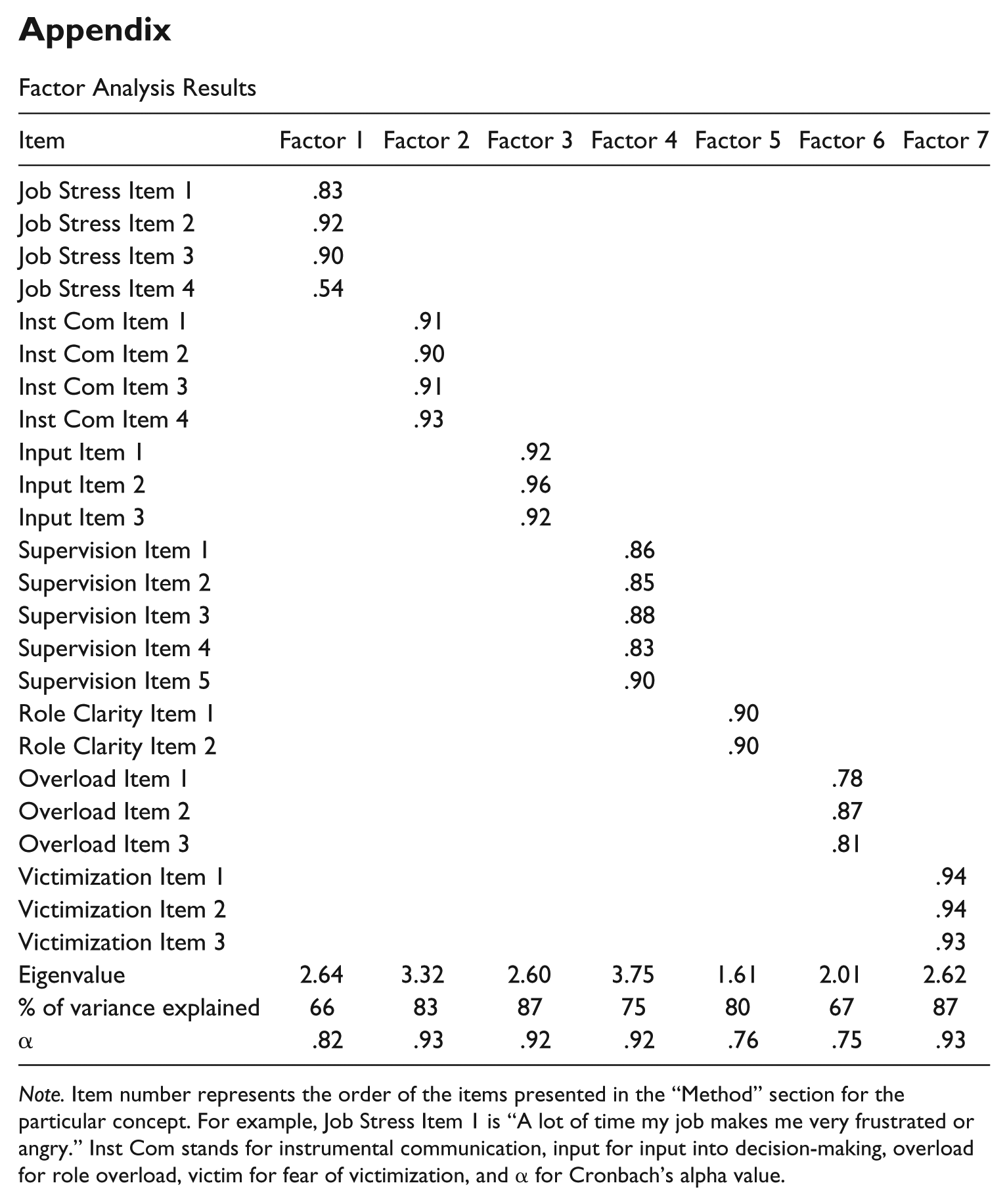
The descriptive statistics for the variables are presented in Table 1. There was significant variation in both the dependent and the independent variables (i.e., none were constants). The median and mean were similar to one another for each variable, which suggests that the variables were normally distributed. In addition, the skewness and kurtosis statistics, as well as other statistical tests, indicated a normal distribution. All the index variables had a Cronbach’s alpha value above .70, which is viewed as good. In addition, factor analysis for each index variable was conducted, and the items for each particular index loaded on a single factor indicating unidimensionality (Gorsuch, 1983). The factor analysis results are presented in the appendix.
Descriptive Statistics for Study Variables.
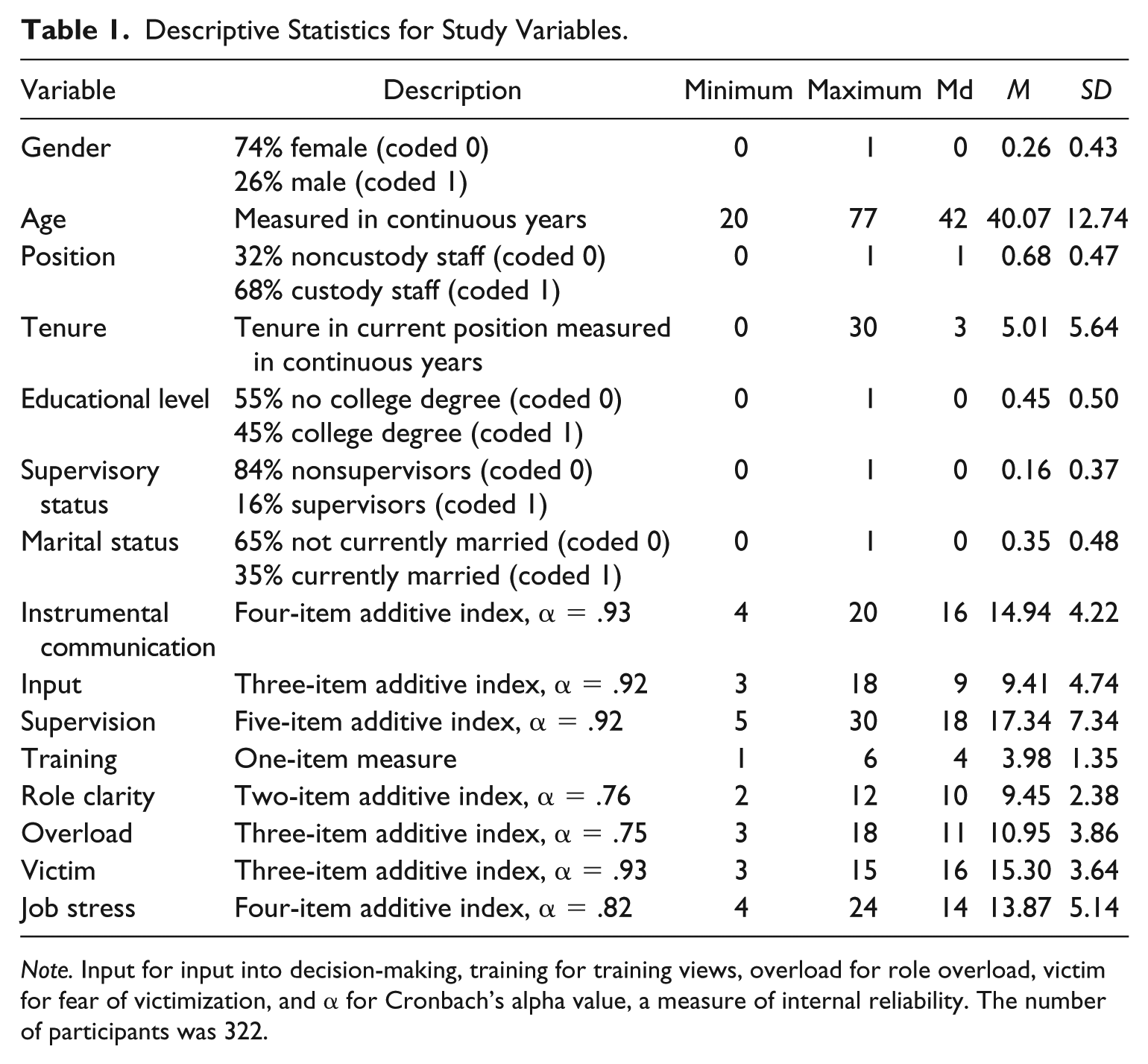
Note. Input for input into decision-making, training for training views, overload for role overload, victim for fear of victimization, and α for Cronbach’s alpha value, a measure of internal reliability. The number of participants was 322.
A correlation matrix of the study variables is presented in Table 2. As shown in the table, there were seven test variables with significant relationships with job stress. Among the personal characteristics, only position had a statistically significant positive correlation with job stress, with correctional officers overall reporting higher job stress than staff in other positions.
Correlations for Study Variables.
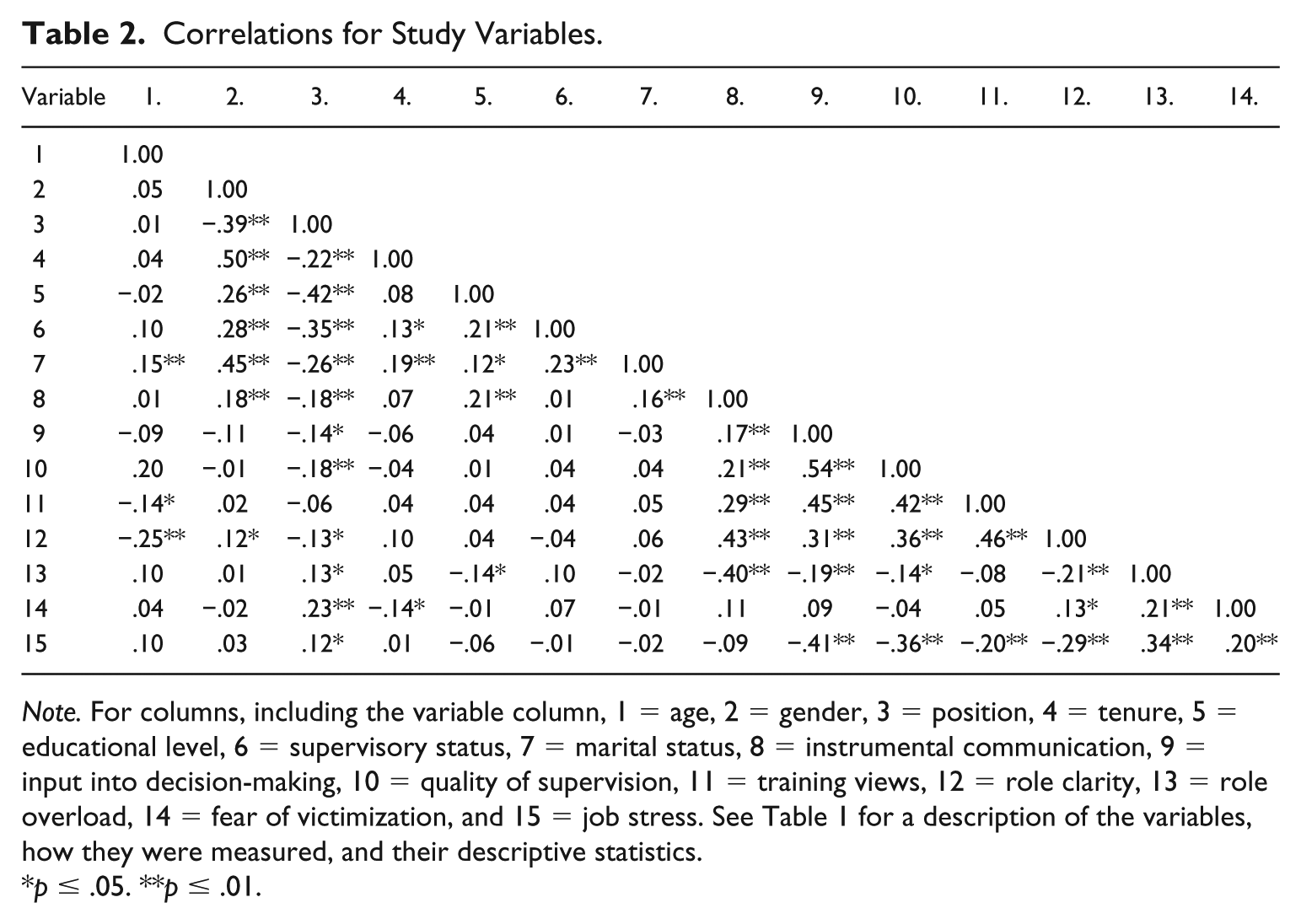
Note. For columns, including the variable column, 1 = age, 2 = gender, 3 = position, 4 = tenure, 5 = educational level, 6 = supervisory status, 7 = marital status, 8 = instrumental communication, 9 = input into decision-making, 10 = quality of supervision, 11 = training views, 12 = role clarity, 13 = role overload, 14 = fear of victimization, and 15 = job stress. See Table 1 for a description of the variables, how they were measured, and their descriptive statistics.
p ≤ .05. **p ≤ .01.
All four of the job resource variables, input into decision-making, quality supervision, training quality, and role clarity, were significantly negatively correlated with job stress. This indicates that those respondents who believed that they had little input into the decision-making, who perceived they did not receive quality supervision, who held a negative view of the adequacy of the training they had received, and who experienced poor role clarity also experienced significantly higher levels of job stress. Both job demand variables (role overload and fear of victimization) had significant positive correlations with job stress, which indicates increases in either of these variables was associated with a rise in reported stress from work. Finally, the correlations between the predictor variables are below .70, which indicates that there is no problem of collinearity (i.e., significant overlap in variance of between two predictor variables).
An ordinary least squares (OLS) regression equation was estimated with job stress as the predicted variable and the personal characteristics, the job resource, and the job demand measures as the predictor variables. The results of this multivariate regression analysis are reported in Table 3. Multicollinearity (i.e., when two or more independent variables share too much of an overlap) was not an issue. Multicollinearity is generally seen as a problem when variance inflation factor (VIF) scores exceed 10 (O’Brien, 2007). More conservative estimates suggest that VIFs not exceed 4 (O’Brien, 2007) or even 2.50 (Allison, 2012). As indicated in Table 3, none of the VIF scores were higher than 2.14. In addition, the issues of outliers, influential cases, normality, linearity and homoscedasticity of residuals, and independence of errors (all of which can affect the regression results) were tested and were determined not to be problematic (Berry, 1993; Tabachnick & Fidell, 2013).
Regression Results With Job Stress as the Dependent Variable.
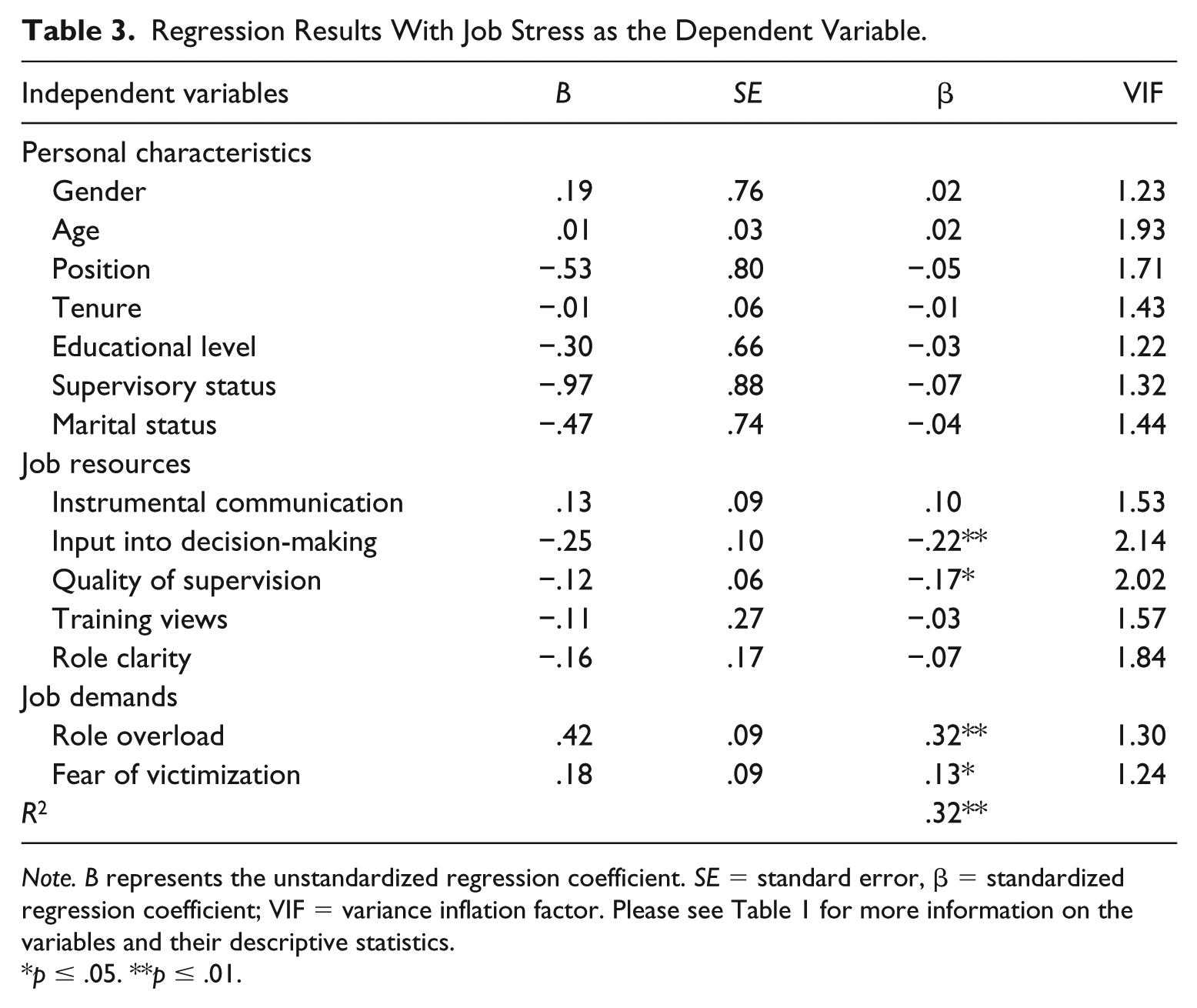
Note. B represents the unstandardized regression coefficient. SE = standard error, β = standardized regression coefficient; VIF = variance inflation factor. Please see Table 1 for more information on the variables and their descriptive statistics.
p ≤ .05. **p ≤ .01.
The R2 value for the regression equation was .32, which means the predictor variables explained about 32% of the observed variance of the job stress measure. None of the personal characteristics were statistically significant predictors of stress from the job. Among the job resource variables, input into decision-making and quality of supervision were both significant predictors of job stress once the shared effects of the other predictor variables were taken into account. An increase in either one of these two job demand variables was associated with less stress. Instrumental communication, training views, and role clarity were nonsignificant predictors once the shared effects of other predictor variables were accounted for in the multivariate regression model. Both job demand variables were significant positive predictors (i.e., increases in role overload and fear of victimization were associated with greater job stress). The absolute value ranking of the standardized regression coefficients (values in the β in Table 3) indicates the magnitude of effects. Role overload had the largest effect on job stress, followed by input into decision-making, quality of supervision, and fear of victimization.
As correctional officers are the largest group of staff in this study and at most correctional facilities, OLS regression was estimated with only correctional officers. Although the results are not reported in tabular format, similar findings in terms of the significant effects were observed for the subanalysis of correctional officers (e.g., quality of supervision had a significant negative effect, role overload has a significant positive effect, and instrumental communication had a nonsignificant effect). The R2 was .34, which is similar to that found for the overall group regression analysis. There was an insufficient number of cases to run a subanalysis of noncustodial staff.
Discussion and Conclusion
Overall, the results of the current study support the job demands-resources model for predicting job stress in terms of workplace stressors having negative effects on correctional staff in this large Southern prison. Four of the seven hypotheses were supported, and all observed relationships were in the expected directions. In sum, although the effects of the studied job variables differed in their effects and significance, as a group, there was support for the job demands-resources model. The results support the postulation that, in general, job demands are linked to higher job stress and job resources can lower stress from the job among the surveyed Southern correctional staff. Our findings indicate that the job demands-resources may be a viable theoretical framework for studying how workplace variables vary across different correctional settings.
As indicated by this model, the effects of specific workplace variables can differ between occupations and across organizations, as was the case in the current study. Of the two job demands, both had significant positive effects on job stress as hypothesized. Role overload had the largest sized effect on stress from the job of all the workplace variables, suggesting this variable is a major contributor stressor for the surveyed correctional staff. The direction of the association was positive, meaning the more a person felt he or she was experiencing role overload, the more stress from the job he or she reported. It makes sense that feeling overwhelmed at work would raise stress. Being asked to do too much in a limited time frame or without the proper equipment can be trying, and, in time, result in job stress. As three other past studies and our finding of a positive link between role overload and job stress, there is support for the contention that this job demand may be universal in contributing to stress from the job for correctional staff (Triplett et al., 1996).
Fear of victimization, the other job demand variable, also had a significant positive relationship with job stress. Being concerned about being hurt at work can psychologically wear on a person, raising a staff member’s stress level. Being afraid rarely results in positive outcomes and the current results support this contention. As previously indicated, fear of victimization has been reported to have a positive relationship with job stress among correctional staff in other correctional organizations (Armstrong & Griffin, 2004; Castle & Martin, 2006; Cullen et al., 1985; Steiner & Wooldredge, 2015; Triplett et al., 1996). It appears that this job demand may also be universal in helping raise stress of correctional staff.
Of the five job resources, only two, input into decision-making and quality of supervision, had significant effects. Input into decision-making had a significant negative relationship with the dependent variable and had the second largest sized effect. Allowing staff a voice in the organization sends a message that they are valued and trusted and can help reduce the occurrence of trying workplace demands. Input into decision-making could result in a positive psychological state of mind so staff ignore other negative aspects of the job (i.e., it is a buffer) or whether it reduced the occurrence of job demands, or combination of reasons. These data do not allow us to explore this question. Only future research can answer why allowing a voice in organizational decision-making has a negative association with correctional staff job stress. Our finding is consistent with the limited research done at other correctional locations, which suggests that this job resource may be an important variable in influencing job stress across different correctional institutions (Paoline et al., 2015; Slate & Vogel, 1997; Whitehead & Lindquist, 1986).
As hypothesized, quality supervision had a significant negative relationship with job stress. Quality supervision can both help with the occurrence of job demands as well as being a resource for staff to deal with job demands in a positive and productive manner. As with input into decision-making, it is unclear of the specific reasons why quality supervision has negative effect. This also needs to be examined by future research. As previously indicated, quality of supervision has been consistently reported in past studies to result in lower stress for correctional staff (Brough & Williams, 2007; Cullen et al., 1985; Griffin, 2006; Van Voorhis et al., 1991). With these findings of past research and the current study, it appears that this job resource may be more universal in its effects on the dependent variable rather than contextual.
Contrary to our hypothesis, instrumental communication, training views, and role clarity did not have significant direct effects on job stress. The current results could be due to random error; however, these variables might not have direct effects for the correctional staff studied, which could mean that the effects of these job resource variables could be contextual. For example, there has only been limited research to date on the link between instrumental communication and stress from the job among correctional staff. Two past studies, one with Florida jail staff and the other with Midwestern prison staff, found a negative association (Lambert et al., 2008; Paoline et al., 2015). The direct effects between instrumental communication and job stress could vary between the type and location of correctional institutions. Likewise, there has only been very limited research on how views of training are linked with job stress. Two past studies, one at a Midwestern private prison and another at a large urban jail, reported that views of quality training were related to lower stress from the job (Lambert et al., 2008; Paoline et al., 2015). Our findings indicate that there was no association.
We also observed no significant link between role clarity and job stress. We hypothesized that role clarity would reduce stress because past studies found a positive link between role strain (i.e., a combination of role ambiguity and role conflict) and job stress (Armstrong & Griffin, 2004; Cullen et al., 1985; Tewksbury & Higgins, 2006). The current finding could be due to contextual reasons or could be that we concluded that role clarity and role strain are opposite ends of the same continuum and would be similar in their effects but in opposite directions. It could be that role strain as a job demand has more of a direct effect than does role clarity as a job resource. Job demands could be more important than job resources for negative outcomes such as job stress and job resources are more important for positive outcomes such as job satisfaction. This needs to be examined by future research.
Although instrumental communication, training views, and role clarity did not have significant direct effects, this does not mean that they are unimportant workplace variables. They could have indirect effects. For example, instrumental communication, as reported in Table 2, had significant positive correlations with input into decision-making, quality of supervision perceptions, quality of training views, and role clarity, and a significant correlation with role overload. Furthermore, past research suggests these job resources are related to positive outcomes such as job satisfaction and organizational commitment (Keena, Lambert, Haynes, May, & Buckner, 2018).
None of the personal characteristics of gender, age, position, tenure, educational level, supervisory status, or marital status had significant associations with job stress in our study in the multivariate regression analysis. This supports the contention of the job demands-resources model that work environment factors are more important in accounting for salient outcomes, such as job stress, than are personal characteristics. In addition, the finding that personal characteristics were not significant predictors in the multivariate regression analysis is good news for correctional administrators. It is difficult and often illegal to change the demographic make-up of the staff. On the contrary, changing work environment job demands and resources is generally within the control of administrators.
This study offered a rare opportunity to compare job stress and its predictors among correctional staff employed in custodial positions with those employed in administrative positions. Because the type of position held by the employee had a weak bivariate association with job stress, and no significant impact on stress in the multivariate model, we believe this research makes an unexpected, perhaps counterintuitive contribution to the research in this area. The roles and daily activities of custodial and administrative positions are very different, and the stress levels of these groups may often be different as well, yet the stand-alone impact of the type of position in which an officer works on stress appears to be muted by job resources and job demand variables. Future research should use larger samples of both groups to see whether these findings are replicated among other correctional staff in institutions found elsewhere. Overall, the findings for the current prison with the majority of the staff being women are generally similar to past research that focused on prisons where the majority of the staff were men. Despite the atypical aspects of the prison workforce, it appears workplace factors are the dominant antecedents of job stress.
Assuming the findings are replicated, there are implications of the results of the current study. Correctional administrators need to be aware that input into decision-making, quality of supervision, role overload, and fear of victimization impact staff job stress. Efforts should be undertaken to allow greater voice in the organization and staff should be encourage to offer their input. It is important to note that seeking input does not bind administrators to make the requested changes. It may not be possible to make the suggested change or administrators may be aware of information that staff are not. Part of successful staff input into decision-making efforts is to have a real and honest dialogue with staff about reasons why ideas are instituted or not. Supervisors need to be made aware of the importance of quality supervision, which consists of consideration, fairness, support, approachability, structure, and opportunities for subordinates to provide input about their jobs to their supervisors. Training needs to be provided on a regular basis to help supervisors improve supervisor knowledge and skills in these areas. Supervisors should be rewarded for quality supervision. In addition, feedback should be obtained from staff of what qualifies as quality supervision.
Staff should also be asked what forces are causing the role overload for them and what could realistically be done to reduce its occurrence. Efforts should be undertaken to make sure tasks are fairly distributed across different posts, and, when they are not, changes should be made to reduce both role overload and role underload. Role underload is a job demand where a person is not assigned sufficient meaningful tasks, resulting in boredom and tedium for that staff member (Triplett et al., 1996). For example, one of the authors previously worked at a maximum security prison. An analysis showed the evening yard patrol position required the staff members to constantly walk the grounds, checking all doors and windows, as well as participating in two counts of inmates, resulting in role overload. Conversely, the evening armed patrol position required driving at low speeds (about 10 miles per hour) for 8 hr with little to do, resulting in role underload. The positions were reorganized so that they switched with one another during the shift to deal with the role overload and role underload issues.
Addressing fear of victimization is more difficult. There has been little research on the predictors of fear of victimization, and fear of victimization varies among staff, even at a single correctional facility (Gordon et al., 2013; Griffin, 2001). In Table 2, only a few variables had significant correlations with fear of being hurt at work. Staff holding the position of correctional officer tended (on average) to report greater fear, which makes sense, as many correctional officer posts require contact with inmates and enforcement of rules. Tenure had a negative correlation with fear, which suggests over time skills can be learned to reduce fear, or it could be highly fearful staff quit in the long run. Role overload had a positive correlation, which suggests that reducing this job demand should also held reduce fear of being victimized on the job. In addition, input from staff regarding why they have fear or not should be collected so specific changes can be made.
As with many research projects, the current study had limitations. It is a single study involving staff at a large Southern prison holding male inmates where women are the majority of staff, including correctional officers. As stated earlier, replication of the possible predictors of job stress is critical. Findings can be due to random error and predictors of job stress may vary across different correctional facilities, regions, and nations. While many of the job demand and resource variables had significant effects, as has been found in past research, there have been too few studies, including the current one, to conclude that these effects will hold true across all correctional institutions and subgroups. Future research should also examine whether the effects of job demands and resources on job stress are similar or different across groups, such as men and women or White and non-White staff. This type of subanalysis was not possible because of a limited number of cases. Future research should collect additional cases. Another limitation is that training views were measured with a single item and role clarity was measured using two items. Future research should use multiple indicators of these concepts to ensure that the different dimensions of training and role clarity are addressed. It could be that if they were measured in more depth, they would have significant negative effects on job stress. Likewise, the alpha values need to be improved as variables with low alpha values may affect the results. In the current study, alpha values for role clarity and role overload were .76 and .75, respectively, which is lower than reported by Triplett et al. (1996). It could be our alpha value for these two concepts was lower because of the atypical prison workforce or that we measured these latent concepts with two and three items, respectively. Future research should measure these concepts with new and more items to see whether the alpha values improve.
Furthermore, the R2 value from the multivariate analysis was .32, which means that about 68% of the observed variance in job stress is accounted for by other predictors. Future research needs to identify what these other variables are that affect correctional staff job stress as this information is necessary to make changes to reduce correctional staff job stress. Possible predictors include objective victimization (i.e., whether staff were physically assaulted), job control (i.e., perceived control over rule enforcement and inmates; see Steiner & Wooldredge, 2015), and family support and work-family conflict (Armstrong, Atkin-Plunk, & Wells, 2015). In the current study, unlike Steiner and Wooldredge (2015), we did not test the effects of job control (i.e., control over skill desertion and rule enforcement), which tends to be low in correctional institutions. Similarly, we did not test the effects social support (i.e., administrative support, supervisor support, coworker support, family support, and community support) in the current study, as was done by Armstrong et al. (2015) and Steiner and Wooldredge (2015). Our study examined how job demands, workplace factors which hamper staff in doing their jobs and place psychological strain on them (i.e., in our study, the job demands were role overload and fear of victimization), and job resources, which aid staff in doing their jobs (i.e., in our study, the job resources were instrumental communication, input into decision-making, quality of supervision, training views, and role clarity) are associated with job stress. It is clear that there are different job demands and job resources to be tested. Likewise, there are different theoretical models to be examined and guide future research. Studies are also needed to further explore the long-term effects of job stress on correctional staff, such as burnout, decreased job performance, greater work absenteeism, lower prosocial behavior (e.g., going beyond what is expected at work), greater chances of job turnover, more physical and mental health problems, and lower quality of life (e.g., life satisfaction and happiness). This line of study will provide more evidence of the critical need to explore and identify predictors of correctional staff job stress. Finally, another limitation was the use of a cross-sectional design for data collection. Cross-sectional survey designs do not empirically allow the demonstration of causality. As a result, we cannot conclude, for example, whether fear of victimization causes job stress or job stress causes fear of victimization. Future research should employ longitudinal survey designs to better assess how job demands and resources affect various outcomes, including stress. Clearly, more research is needed.
In closing, staff are a valuable and expensive resource for prisons and stress from the job is a real problem with significant consequences for both staff and the employing correctional organization. Research, therefore, needs to identify the variables that contribute to the job stress of correctional staff across a wide array of correctional institutions. Using the job demands-resources model as a theoretical foundation, the current study examined the effects of the job resource variables of instrumental communication, input into decision-making, quality supervision, training views, and role clarity and the job demand variables of role overload and fear of victimization on the job stress of staff at large and unique Southern prison. In a multivariate regression analysis, input into decision-making and quality supervision were associated with lower stress and role overload and fear of victimization were associated with great stress. Contrary to our hypotheses, instrumental communication, training views, and role clarity did not have significant positive effects on job stress in the multivariate regression analysis. Prison administrators need to be aware of issue of job stress and how to ultimately reduce it. The current findings suggest the need to intervene and reduce staff job stress. Doing nothing will never solve the problem. There is a need for greater research on the job stress of correctional staff. At the very least, it is hoped that the current results will spark continued interest by correctional administrators and scholars in improving the work environment for staff.
Footnotes
Appendix
Factor Analysis Results
| Item | Factor 1 | Factor 2 | Factor 3 | Factor 4 | Factor 5 | Factor 6 | Factor 7 |
|---|---|---|---|---|---|---|---|
| Job Stress Item 1 | .83 | ||||||
| Job Stress Item 2 | .92 | ||||||
| Job Stress Item 3 | .90 | ||||||
| Job Stress Item 4 | .54 | ||||||
| Inst Com Item 1 | .91 | ||||||
| Inst Com Item 2 | .90 | ||||||
| Inst Com Item 3 | .91 | ||||||
| Inst Com Item 4 | .93 | ||||||
| Input Item 1 | .92 | ||||||
| Input Item 2 | .96 | ||||||
| Input Item 3 | .92 | ||||||
| Supervision Item 1 | .86 | ||||||
| Supervision Item 2 | .85 | ||||||
| Supervision Item 3 | .88 | ||||||
| Supervision Item 4 | .83 | ||||||
| Supervision Item 5 | .90 | ||||||
| Role Clarity Item 1 | .90 | ||||||
| Role Clarity Item 2 | .90 | ||||||
| Overload Item 1 | .78 | ||||||
| Overload Item 2 | .87 | ||||||
| Overload Item 3 | .81 | ||||||
| Victimization Item 1 | .94 | ||||||
| Victimization Item 2 | .94 | ||||||
| Victimization Item 3 | .93 | ||||||
| Eigenvalue | 2.64 | 3.32 | 2.60 | 3.75 | 1.61 | 2.01 | 2.62 |
| % of variance explained | 66 | 83 | 87 | 75 | 80 | 67 | 87 |
| α | .82 | .93 | .92 | .92 | .76 | .75 | .93 |
Note. Item number represents the order of the items presented in the “Method” section for the particular concept. For example, Job Stress Item 1 is “A lot of time my job makes me very frustrated or angry.” Inst Com stands for instrumental communication, input for input into decision-making, overload for role overload, victim for fear of victimization, and α for Cronbach’s alpha value.
Acknowledgements
The authors thank the editor and anonymous reviewers for their comments and suggestions, which improved the article. The authors also thank Janet Lambert for editing and proofreading the article.
Declaration of Conflicting Interests
The author(s) declared no potential conflicts of interest with respect to the research, authorship, and/or publication of this article.
Funding
The author(s) received no financial support for the research, authorship, and/or publication of this article.