



Abstract
In this study, data were used from 322 employees at a large medium- and maximum-security prison in the Southern United States to examine the influence of job demands (dangerousness of the job, role overload, role ambiguity) and job resources (employee input into decision-making, instrumental communication, job variety) on employee job involvement. We also controlled for demographic characteristics (gender, age, position, tenure, and educational attainment). Drawing on the job demands–job resources model, four separate equations were estimated to assess the influence of job demands and job resources both separately and jointly. Overall, job resources (specifically, employee input into decision-making and job variety) have a stronger influence on job involvement than do job demands. The findings indicate that to boost employee job involvement in correctional settings, employers must implement policies and practices that facilitate the sharing of job resources in the work environment. Implications for policy and future research are also discussed.
There are approximately 758,000 correctional staff in the United States (Buehler, 2021). Roughly 392,600 of these staff are correctional officers in prisons and jails (Bureau of Labor Statistics, 2021) who are responsible for ensuring the control, supervision, and safety of incarcerated persons. Correctional staff include all those who work in a correctional facility, both custodial staff (e.g., correctional officers) and non-custodial staff (e.g., counselors, teachers, medical staff, food service workers, industry personnel, supervisors, managers, and administrators) (Lambert, Hogan, Barton, & Clarke, 2002). Collectively, correctional staff supervise over two million incarcerated individuals (Kluckow & Zeng, 2022). Correctional staff across the United States have demanding jobs, making sure that incarcerated individuals and the community are safe by operating safe, secure, and humane correctional institutions. Correction employees are a valuable and expensive resource. According to data from a national survey in 2015, U.S. state prisons in the 45 participating states cost taxpayers almost $43 billion, and most (68%) of these expenditures pertained to employees—that is, training, pay, overtime, and benefits (Mai & Subramanian, 2017). In fact, states allocated roughly $30 billion for correctional staff (Mai & Subramanian, 2017).
Ensuring correctional staff are motivated by (and involved in) their work is important (Griffin et al., 2010; Moon & Maxwell, 2004; Ricciardelli & Martin, 2017; Sorge et al., 2021). Job involvement refers to one’s emotional and cognitive state in relation to their job (Kanungo, 1982; Otu et al., 2022), and measures of job involvement examine the level of bond (i.e., connection) an employee has to their job (Lambert, Hogan, et al., 2020). In general, job involvement might be the result of either intrinsic motivation, such as ego, self-esteem, or other personal interest (Vroom, 1962), or extrinsic motivation, such as money, job security, or success (Seeman, 1971). Because of the nature of correctional work, lack of job involvement among correctional employees could lead to dangerous patterns for both the employees themselves and those they are meant to protect (Griffin et al., 2010), as uninvolved officers may be less likely to focus on those parts of the job most important to the safety and security of inmates. Identifying antecedents of job involvement is thus important in the field of corrections research (Lambert & Paoline, 2012).
Extant research has focused on job involvement as either a positive or negative outcome. For instance, studies have examined the role of employee job involvement in the form of job satisfaction and organizational commitment (Brown, 1996; Cooper-Hakim & Viswesvaran, 2005). Studies have also investigated how job involvement may lead to work–family conflict (Brown, 1996). In general, however, studies found that job involvement has a positive influence on both motivation (Brown, 1996; Kahn, 1992; Lawler & Hall, 1970) and employee performance (Rotenberry & Moberg, 2007). Based on a meta-analysis of 212 studies of job involvement, Brown (1996) concluded that when employees were engaged in their work, they tend to have more meaningful and fulfilling experiences, leading to improved work outcomes.
In the field of corrections, job involvement has been explored as an outcome (Lambert et al., 2013; Lambert, Hogan, et al., 2020; Lambert, Keena, et al., 2021; Lambert & Paoline, 2012) and as an antecedent (Griffin et al., 2020). As an outcome, studies found that employee trust in the organization, in the form of administrator trust (Lambert, Hogan, et al., 2020), management trust (Lambert, Keena, et al., 2021), and administrative support (Lambert & Paoline, 2012), positively influenced job involvement. In addition, quality of supervision and job variety tend to improve job involvement (Lambert et al., 2022). Conversely, role conflict (Lambert et al., 2013) and dangerousness of the job (Lambert et al., 2013; Lambert et al., 2022) tend to lower job involvement. Furthermore, Liu et al. (2020) found that both behavior-based and family-based work–family conflict had a negative influence on job involvement. As an antecedent, the benefits of job involvement may be limited. Griffin et al. (2010) found that higher levels of job involvement tend to increase employee burnout. In some instances, when correctional employees oversee disciplinary actions, the over-zealous employee may contribute to the dangerousness of the prison environment (Haggerty & Bucerius, 2021). While this research in the field of corrections has added to the literature, there has been little research on how job demands and resources under the job demands–job resources model relate to the job involvement of correctional staff.
Limited research has attempted to compare the influence of job demands versus job resources on job involvement. Previous studies of job involvement in corrections have employed various theoretical frameworks, such as the job strain model (Lambert et al., 2013), the person–environment fit theory (Lambert et al., 2013; Lambert & Paoline, 2012), or no theory at all (Griffin et al., 2010; Lambert, Hogan, et al., 2020; Lambert, Keena, et al., 2021). Only one published study has explored job involvement in association with job demands and resources in correctional settings (Lambert et al., 2022), with findings from that study suggesting that job resources tend to be more relevant than job demands in understanding job involvement.
The present study employed the job demands–job resources model to examine the individual and joint effects of job demands (dangerousness of the job, role overload, role ambiguity) and job resources (employee input into decision-making, instrumental communication, job variety) on the job involvement of correctional staff (both custodial and non-custodial staff) at a Southern U.S. prison. From a policy perspective, exploring the influence of job demands and job resources is relevant to (a) identifying effective ways to influence employee motivation on the job and (b) reducing the burden of work-related tasks that would improve employee performance effectiveness.
Literature Review
Job Involvement
The term job involvement refers to one’s emotional and cognitive state toward their job (M. Chen, 2019; Kanungo, 1982). Paullay et al. (1994) defined job involvement as when an employee “is cognitively preoccupied with, engaged in, and concerned with one’s present job” (p. 224). It is a person’s level of psychological identification and commitment with the job (Lambert & Paoline, 2012). Basically, job involvement is psychological identification with the job and the importance the job plays in an individual’s life (Brown, 1996; Otu et al., 2022). DeCarufel and Schaan (1990) pointed out that “an individual with a high degree of job involvement would place the job at the center of his/her life’s interests. The well-known phrase ‘I live, eat, and breathe my job’ would describe someone whose job involvement is very high” and that “persons with low job involvement would place something other than their jobs (e.g., family, hobbies) at the center of their lives” (p. 86). C.-C. Chen and Chiu (2009) contended that employees with high levels of job involvement have greater self-confidence, an ability to do their job with little supervision, and, consequently, higher work engagement and performance. Job involvement is theorized to result in organizational effectiveness across time (Otu et al., 2022). The involvement of employees with their own job is relevant to any organization, whether private, public, or not-for-profit, because higher levels of job involvement may enhance effectiveness and productivity (Brown, 1996; M. Chen, 2019).
Theoretically, on the continuum of motivation, involvement must be understood as a positive state of being (M. Chen, 2019; Otu et al., 2022). At the opposite end of the motivation continuum is alienation, which is a negative state of being (the absence of motivation) (Soffia et al., 2022). Early social scientists theorized that the emphasis on alienation in the study of societies became relevant only because of the emerging focus on individualism brought by the Enlightenment (see Simon-Ingram, 1991 on Rousseau’s theory of the social contract). In the sociological tradition, alienation had to be understood within the social context (the macro perspective). Durkheim (2005) explained alienation as the result of anomie, which he defined as the absence of social norms necessary to identify common culturally defined goals. While Rousseau was the first scholar to discuss alienation as an emotional state, Marx pioneered the analysis of alienation in the work environment. According to Marx (1992), the mechanization of tasks within industrial settings separates the worker from the final product of their labor, leading to alienation. Weber further explained that, if a work environment does not provide workers with autonomy, responsibilities, and incentives for achievement, workers will become disengaged and likely fall into a state of alienation (Gerth & Mills, 2014).
Unlike sociologists, psychologists have focused primarily on involvement rather than on alienation, prioritizing the positive aspect of motivation and using a micro-analytical approach (Otu et al., 2022). Lodahl and Kejnar (1965) provided the first formalized construct of job involvement. Their definition of job involvement had two dimensions: (a) involvement, which measured the extent to which an individual identified with their job, and (b) performance, which examined the impact of one’s performance on their self-esteem (Brown, 1996). Later, Saleh, and Hosek (1976) proposed a measure of job involvement that included (a) work as central life interest, (b) the degree of one’s participation on the job, (c) the extent to which job performance influenced one’s self-esteem, and (d) consistency of job performance in relation to one’s self-esteem.
Kanungo (1979) and Gorn and Kanungo (1980) argued for a reformulation of the job involvement scale that would clarify the difference between job involvement (specific to one’s job) and work involvement (general attitudes toward work) and distinguish between antecedents of job involvement (cause) and consequences of job involvement (effect). Kanungo (1982) proposed a narrow definition of job involvement to examine an employee’s emotional and cognitive state of being in reference to their job (Otu et al., 2022). The present study focused on job involvement as defined by Kanungo (1982) and examined the influence of both job demands and job resources on employee job involvement.
Job Demands and Resources
In the last 40 years, several studies have focused on the influence of work-related demands and resources among correctional officers (Cullen et al., 1985; Dowden & Tellier, 2004; Ferdik & Hills, 2018; Kinman et al., 2017; Triplett et al., 1996). Cullen and his colleagues (1985) employed an empirical model to examine the role of job demands, in the form of stressors such as role problems, dangerousness, and security level, and job resources, such as social support and individual coping strategies. The study used multivariate regression analyses to predict work stress, job dissatisfaction, and life-stress, as measured through standardized constructs. As Cullen et al. (1985) asserted, the study highlighted the “advantages of a causal framework which includes not only stressors but also coping mechanisms” (p. 524).
The Job Demand and Resource Model
Outside the criminal justice field, scholars have formalized the job demand and resource model (Bakker & Demerouti, 2007). The job demand and resource model provides a robust theoretical framework for the analysis of job involvement in that it permits examining the influence of both job demands and job resources on employee performance and experiences (Bakker & de Vries, 2021; Tummers & Bakker, 2021). Bakker and Demerouti (2007) contended that a comprehensive job demands model must include a wide range of job demands and provide a more balanced approach by also including job resources. The authors defined job demands as “those physical, psychological, social, or organizational aspects of the job that require sustained physical and/or psychological (cognitive and emotional) efforts or skills and are therefore associated with certain physiological and/or psychological costs” (p. 312). They argued that job resources are either/or: “(1) Functional in achieving work goals; (2) Reduce job demands and the associated physiological and psychological costs; (3) Stimulate personal growth, learning, and development” (p. 312). They reported that “resources are not only necessary to deal with job demands, but they also are important in their own right” (p. 312). In addition, Tummers and Bakker (2021) pointed out that job demands can result in negative health impairments, such as burnout, and job resources result in positive outcomes, such as greater motivation and work engagement. Corrections can be a demanding occupation that can result in psychological strain for staff, and job demands can further add to this psychological strain (Bakker and de Vries 2021; Ellison et al., 2022; Page & Robertson, 2021) determined that as job strains increase, the need for stable job resources increases, and stable job resources can reduce the chances of job burnout.
Schaufeli and Taris (2014) noted that “the job demands-resources model does not restrict itself to specific job demands or job resources, and it may be applied to any type of employment. It assumes any demand and any resource may affect employee health and well-being” (p. 44). For the current study, the job demand variables were perceived dangerousness of the job, role overload, and role ambiguity, while the job resource variables were input into decision-making, instrumental communication, and job variety.
Dangerousness of the Job
Perceived dangerousness of the job refers to feeling at risk of being hurt or injured on the job (Cullen et al., 1985; Ferdik, 2016 Lambert, Keena et al., 2020). 1 Perceived dangerousness is a job demand that can place psychological strain on correctional staff (Forman-Dolan et al., 2022; Grossi et al., 1996) and the perceived risk of being harmed can wear on a person over time (Castle & Martin, 2006; Cullen et al., 1985; Gordon & Baker, 2017) and lead to job dissatisfaction (Cullen et al., 1985). A person may also become less involved in the job because of the feeling of being at risk (Lambert et al., 2022). Perceived dangerousness of the job was hypothesized to have a negative association with correctional staff job involvement.
Role Overload
Role overload occurs when a person is required to do too many work tasks or is not given sufficient time to perform the tasks (Lambert, Keena et al., 2020; Schaufeli & Peeters, 2000; Triplett et al., 1996). Role overload is seen as a job demand because being overwhelmed often results in feeling psychologically strained and frustrated (Lambert et al., 2005, 2022), adding to other work-related stressors (Schaufeli & Peeters, 2000). Being strained at work is not a pleasant feeling, and the job is likely to be blamed (Lambert et al., 2022; Triplett et al., 1999). In turn, staff may become less connected and involved in the job because of this job demand (Lambert et al., 2013). Role overload was hypothesized to have a negative relationship with correctional staff job involvement.
Role Ambiguity
Role ambiguity refers to a lack of clarity about job expectations or how the work is to be done (Cullen et al., 1985; Griffin, 2001; Haynes et al., 2020; Lambert et al., 2005; Schaufeli & Peeters, 2000). Role ambiguity lies at the opposite end of the continuum from role clarity (Ferdik & Hills, 2018; Keena et al., 2020). Correctional staff are required to deal with numerous situations, some of which are new or rarely encountered; hence, role ambiguity is a possibility (Allard et al., 2003; Hogan et al., 2006; Konyk et al., 2021). Lack of clarity about work-related duties and expectations can become a significant source of stress among correctional officers (Cullen et al., 1985; Konyk et al., 2021). Not knowing what the job entails (or how to do the job) can be a job demand. Role ambiguity can result in strain and frustration (Allard et al., 2003; Haynes et al., 2020; Lambert et al., 2005). These undesirable feelings can result in a negative view of the job and weaken the psychological bond to the job, resulting in lower job involvement. Role ambiguity was hypothesized to have a negative relationship with correctional staff job involvement.
Input Into Decision-Making
Input into decision-making deals with the perception that the employing organization allows staff to contribute to decision-making (Dowden & Tellier, 2004; Lambert et al., 2017; Slate & Vogel, 1997). Input into decision-making is considered a job resource (Lambert, Berthelot, et al., 2021) because allowing staff a voice in salient organizational decisions empowers them and can make doing their jobs easier (Lambert, Berthelot, et al., 2021; Lambert et al., 2017). In addition, it sends a message that the organization values, respects, and trusts staff (Lambert, Berthelot, et al., 2021; Lambert, Hogan, & Jiang, 2008). A perceived lack of input can result in this job resource becoming a job demand because it can result in resentment and feeling devalued by the organization (Lambert, Berthelot, et al., 2021; Paoline et al., 2018). Allowing input not only should result in greater positive psychological feelings, but it should also result in greater involvement in the job because employees have a stronger voice at the job and in the organization (Lambert, Berthelot, et al., 2021). Input into decision-making was, therefore, hypothesized to have a positive association with job involvement for correctional staff.
Instrumental Communication
Instrumental communication is the perception that the organization provides information about the job, equipment, rules, policies, and any changes to them (Lambert, Berthelot, et al., 2021; Lambert, Hogan, Barton, & Clarke, 2002; Wells et al., 2021) and serves as a job resource because it provides staff with information that allows them to do their work and to be more successful (Lambert, Keena et al., 2020; Wells et al., 2021). It tends to make the job easier and more enjoyable, and salient communication also sends a message that staff are valued members of the organization rather than cogs in the machine (Lambert, Berthelot, et al., 2021; Lambert & Paoline, 2008). A lack of instrumental communication can be a job demand, making the job more difficult and less satisfying, causing the employee to be more prone to error (Lambert, Hogan, Paoline, & Stevenson, 2008; Wells et al., 2021). This job resource was hypothesized to have a positive influence on correctional staff job involvement.
Job Variety
Job variety is the amount of variation in the job (Curry et al., 1986; Lambert et al., 2022; Paoline et al., 2018). Jobs high on variety are at one end of the continuum, and monotonous jobs are at the other end (Keena et al., 2020; Lambert, 2004). Job variety is a job resource. It makes work more enjoyable and stimulating, resulting in greater enrichment (Lambert, 2004; Lambert et al., 2022). Job variety is more mentally stimulating for the employee (Lambert et al., 2022; Lambert, Hogan, & Jiang, 2008). It can result in greater job involvement because the job is more enjoyable, which can increase staff’s connection to the job (Lambert, 2004; Lambert et al., 2022). On the other hand, monotonous jobs can be a job demand because they often result in tedium, which can lead to errors because of boredom (Lambert, 2004; Lambert et al., 2022; Paoline et al., 2018). Job variety was hypothesized to have a positive relationship with job involvement among correctional staff.
The Present Study
In this study, we employed the job demand and resource model as formalized by Bakker and Demerouti (2007). Furthermore, we borrowed from Cullen et al.’s correctional officer demands and resources empirical model, as proposed in 1985. A review of the extant literature helped us identify a theoretical model that includes several forms of both job demands (perceived dangerousness of the job, role overload, and role ambiguity) and job resources (input into decision-making, instrumental communication, and job variety). Our belief is that examining the influence of such job demands and resources on correctional officers’ job involvement is relevant to ensure that prisons are safe and that incarcerated people’s needs are addressed throughout their stay in the correctional facility.
Method
Participants
Prior to data collection in 2016, the authors of this study secured human subjects approval from an Institutional Review Board to survey staff at a large medium- and maximum-security prison in the Southern United States. The prison housed approximately 4,600 male felony offenders and employed about 720 staff; due to leave (e.g., personal, sick, administrative) only 547 staff were available to receive the study packet. As noted by Lambert, Hogan, Barton, and Clarke (2002), there is no set definition in correctional studies of staff: “some correctional studies have only looked at correctional officers, whereas others have included a wide array of correctional staff excluding the top administration” (p. 119). Except for top administrators (i.e., warden, deputy wardens), staff holding different positions, including correctional officers, case managers, counselors, medical staff, food workers, industry personnel, and educational employees, were included in the current study. A wide array of correctional staff was surveyed because they actively work in the prison and their roles are critical for the safe, secure, and humane operation of the prison.
The study packet was distributed at roll call over the course of a week at the institution under study. The study packet included a consent form, a cover letter, a survey instrument, a bifurcated raffle ticket, and a return envelope. The cover letter explained the purpose of the study, that participation was voluntary, that staff could stop taking the survey at any time, that responses would be anonymous, and gave instructions on how to return the survey instrument, raffle ticket, and consent form. Regardless of whether the survey instrument was completed, staff could be part of a raffle for 10 $50 VISA gift cards by returning half of the bifurcated raffle ticket (i.e., the raffle ticket had two parts, one that was returned and the other kept by the staff member so they could claim the prize if the returned raffle ticket was selected). Staff could complete the survey at a time and place of their own choosing, including at work. After placing the consent form, survey instrument, and raffle ticket half into a provided envelope, the envelope could be returned to one of four locked boxes (that could only be opened by a member of the research team) on prison grounds. Raffle tickets and informed consent forms were immediately removed from the returned envelopes so there was no way to link an individual staff member with a survey instrument. A drawing for the gift cards was conducted after the data collection period ended.
Of the 547 provided study packets, 322 completed survey instruments were returned, a response rate of 59%. In terms of gender, 74% marked female. The mean age was 40.07 years, with a standard deviation of 12.74. In terms of position, 68% marked correctional officer and the other 32% worked in other positions (e.g., counselors/case managers, education/vocational specialists, medical personnel, industry/maintenance). The mean time in years for the current position was 5.01, with a standard deviation of 5.64. For educational level, 27% indicated that they had earned a high school diploma or GED, 28% indicated that they earned college credits but no degree, 19% indicated that they had earned an associate degree, 17% indicated that they had earned a bachelor’s degree, and 9% indicated that they had earned a graduate degree. The demographic information of the participants is presented in Table 1.
Descriptive Statistics for Study Variables.
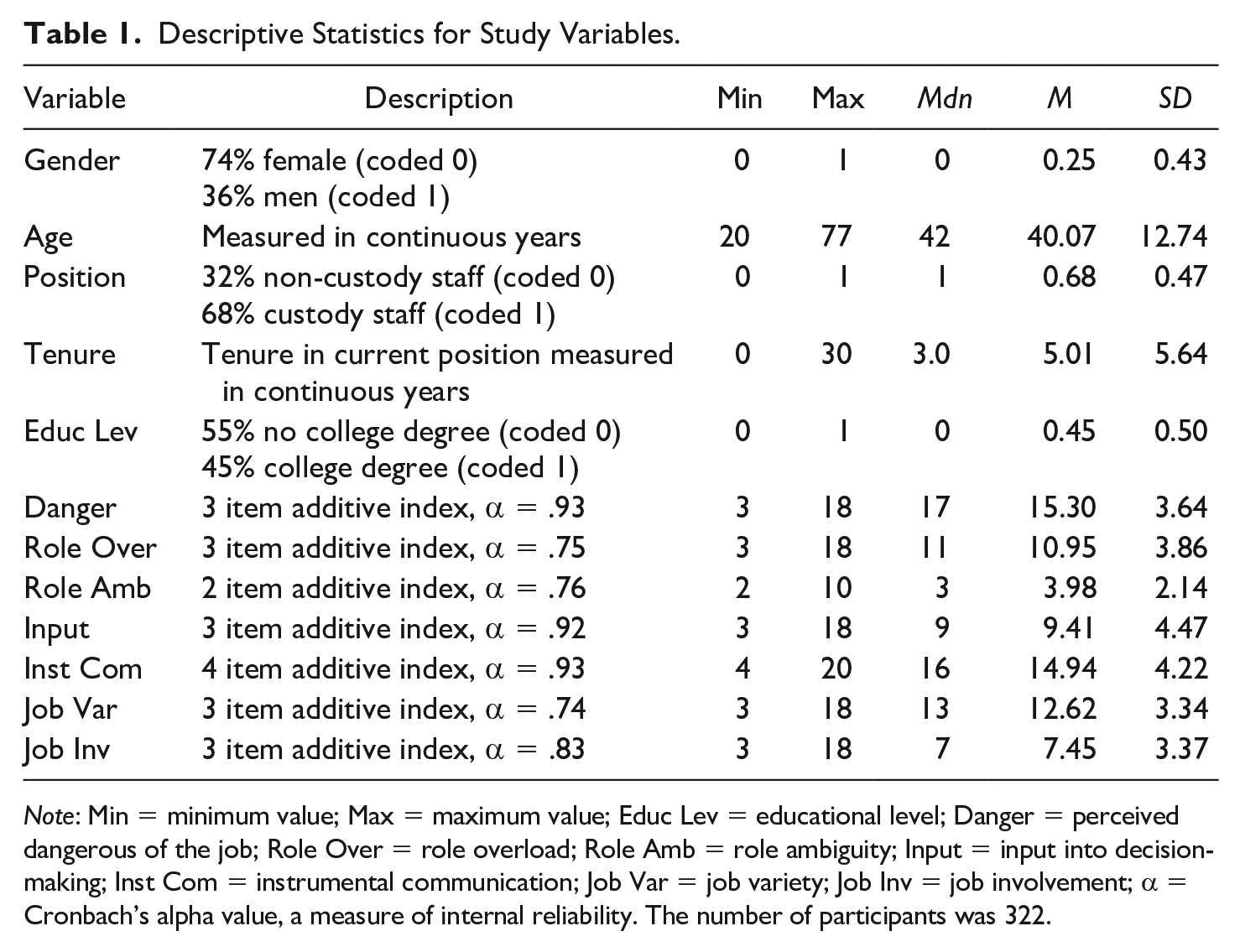
Note: Min = minimum value; Max = maximum value; Educ Lev = educational level; Danger = perceived dangerous of the job; Role Over = role overload; Role Amb = role ambiguity; Input = input into decision-making; Inst Com = instrumental communication; Job Var = job variety; Job Inv = job involvement; α = Cronbach’s alpha value, a measure of internal reliability. The number of participants was 322.
The participants appeared to be representative of the overall prison workforce based on information provided by the human resource office of the prison. In terms of the entire prison workforce, 70% were women, the average age was about 40, 70% held the position of correctional officer, and average tenure was slightly under 5 years. The human resources officer could not provide information about the educational level of the prison staff. No human resource personnel saw any of the completed survey instruments.
Variables
Dependent Variable
Job involvement was measured using three items from Kanungo (1982): (a) The major satisfaction in my life comes from my job; (b) The most important things that happen to me in my life usually occur on the job; and (c) I live, eat, and breathe my job. Response options included strongly disagree (coded 1), disagree (coded 2), somewhat disagree (coded 3), somewhat agree (coded 4), agree (coded 5), and strongly agree (coded 6). The job involvement items were entered into factor analysis using principal axis factoring and oblique rotation (Kim & Mueller, 1978). The factor analysis results suggested that the items had unidimensionality. The Eigenvalue for the resulting factor was 1.97, and the amount of variance explained was 65.60%. All the items loaded on the same factor with loading scores greater than .60. The responses to the three items were summed together to form an additive index of job involvement. The job involvement items had a Cronbach’s alpha value .84.
Independent Variables
The personal variables included in these analyses were gender, age, position, tenure, and educational level. Brown’s (1996) meta-analysis found that the association between job involvement and demographic characteristics was weak and not statistically significant. Brown (1996) concluded that across studies, “job involvement is not generally predictable from age group, length of time in the organization, education level, gender, marital status, or even salary” (p. 243). For the current study, the personal characteristics were included more as control variables than explanatory variables, as has been commonly done in past correctional staff research. See Table 1 for how these variables were measured.
The job demands in this study were perceived dangerousness of the job, role overload, and role ambiguity. The items for these job demands were answered using a 6-point Likert-type scale ranging from strongly disagree (coded 1) to strongly agree (coded 6). Perceived dangerousness of the job was measured using three items from Cullen et al. (1985): (a) I work at a dangerous job; (b) My job is a lot more dangerous than most jobs in the community; (c) At my job, there is a real risk of being hurt or injured. The items were entered into factor analysis using principal axis factoring and oblique rotation (Kim & Mueller, 1978). The factor analysis results suggested that the items had unidimensionality. The Eigenvalue for the resulting factor was 2.62, and the amount of variance explained was 87.19%. All the items loaded on the same factor with loading scores greater than .60. The responses to these items were added together to form an index that had a Cronbach’s alpha of .93.
Role overload was measured with three items from Triplett et al. (1996) and had a Cronbach’s alpha value of .76: (a) I am responsible for almost an unmanageable number of assignments and job duties; (b) I consider myself overworked on my job; (c) I often receive an assignment without adequate resources and materials to get it done. The role overload items were entered into factor analysis using principal axis factoring and oblique rotation (Kim & Mueller, 1978). The factor analysis results suggested that the items had unidimensionality. The Eigenvalue for the resulting factor was 2.01, and the amount of variance explained was 67.02%. All the items loaded on the same factor with loading scores greater than .60. The index for the job demand of role overload was formed by summing the responses to these items. Cronbach’s alpha for the index was .75.
Role ambiguity was measured using two items adapted from Rizzo et al. (1970): (a) I do not clearly know what my work responsibilities are; (b) The rules that we’re supposed to follow seem to be very clear (reverse coded). The role ambiguity items were entered into factor analysis using principal axis factoring and oblique rotation (Kim & Mueller, 1978). The factor analysis results suggested that the items had unidimensionality. The Eigenvalue for the resulting factor was 1.61, and the amount of variance explained was 80.51%. Both items loaded on the same factor; the factor loadings for the items were .78 and .75, respectively. The summed role ambiguity index had a Cronbach’s alpha of .76.
Input into decision-making, instrumental communication, and job variety were the job resource variables in the current study. Input into decision-making was measured by three items adapted from Lambert and Hogan (2009): (a) When there is a problem, management frequently consults with employees on possible solutions; (b) Management routinely puts employee suggestions into practice; and (c) Management often asks employees their suggestions on how to carry out job related tasks and assignments. The input into decision-making items were measured using a 6-point Likert-type scale ranging from strongly disagree (coded 1) to strongly agree (coded 6). The input into decision-making items were entered into factor analysis using principal axis factoring and oblique rotation (Kim & Mueller, 1978). The factor analysis results suggested that the items had unidimensionality. The Eigenvalue for the resulting factor was 2.60, and the amount of variance explained was 86.70%. All the items loaded on the same factor with loading scores greater than .80. The input items had a Cronbach’s alpha value of .92, and an additive index was created.
The four items measuring instrumental communication items were adapted from Curry et al. (1986) and had a Cronbach’s alpha value of .93. Respondents were asked how informed they were about the following aspects of their jobs: (a) What you need to know to do the job correctly; (b) What is most important about the job; (c) How the equipment is used; and (d) Rules and regulations. The instrumental communication items were measured using a 5-point scale of not informed at all (coded 1), informed very little (coded 2), informed somewhat (coded 3), informed (coded 4), and very well informed (coded 5). The instrumental communication items were entered into factor analysis using principal axis factoring and oblique rotation (Kim & Mueller, 1978). The factor analysis results suggested that the items had unidimensionality. The Eigenvalue for the resulting factor was 2.33, and the amount of variance explained was 83.29%. All the items loaded on the same factor with loading scores greater than .80.
Job variety was measured using three items adapted from Curry et al. (1986): (a) My job requires that I must constantly learn new things; (b) My job requires that I be very creative; and (c) My job has a lot of variety in it. The job variety items were measured using a 6-point Likert-type scale ranging from strongly disagree (coded 1) to strongly agree (coded 6). The job variety items were entered into factor analysis using principal axis factoring and oblique rotation (Kim & Mueller, 1978). The factor analysis results suggested that the items had unidimensionality. The Eigenvalue for the resulting factor was 1.97, and the amount of variance explained was 65.75%. All the items loaded on the same factor with loading scores greater than .60. Responses were summed together to form an additive index for this job resource, and the job variety items had a Cronbach’s alpha value of .74.
Analyses
Descriptive, bivariate, and multivariate analyses were conducted using data from the responding prison staff. Descriptive analyses were performed to provide descriptive statistics of all the study variables and to make sure that there were no issues for the bivariate and multivariate analyses. Bivariate correlations were calculated to explore associations between the independent variables and the dependent variable job involvement and to check for collinearity among independent variables. Multivariate analysis using ordinary least squares (OLS) regression was conducted to determine the influence of the independent variables on the dependent variable once shared effects were taken into account. The OLS regression analysis consisted of four equations. The first equation included only personal characteristics (control) as independent variables. The second equation included only job demands as independent variables. The third equation included only job resources as independent variables. The fourth equation entered all independent variables. The four equations were done to see the effects of each group of independent variables separately and collectively.
Results
The descriptive statistics for the variables are presented in Table 1. There was significant variation in both the dependent and independent variables (i.e., none were constants). The median and mean were similar to one another for each variable, indicating that the variables were normally distributed. In addition, skewness and kurtosis statistics also indicated a normal distribution. All the index variables had a Cronbach’s alpha value above .70, indicating each scale was a reliable measure (Frost, 2022; Hulin et al., 2001).
A correlation matrix is presented in Table 2. None of the five personal characteristic variables had a statistically significant correlation with the dependent variable, nor did perceived dangerousness of the job or role overload. Role ambiguity, however, had a significant negative correlation, which means increases in this job demand were associated with less involvement with the job. The job resource variables of input into decision-making, instrumental communication, and job variety each had significant correlations with job involvement, which means increases in any of these variables were related to higher job involvement. Input had the largest correlation (moderate to large size), followed closely by job variety (moderate size). Role ambiguity and instrumental communication had smaller correlations (small to moderate size).
Bivariate Correlations.

Note. Educ Lev = educational level; Danger = perceived dangerous of the job; Role Over = role overload; Role Amb = role ambiguity; Input = input into decision-making; Inst Com = instrumental communication; Job Var = job variety; Job Inv = job involvement.
p ≤ .05. ** p ≤ .01.
Four OLS regression equations were estimated with job involvement as the dependent variable. In Model 1, the only independent variables included were the personal characteristics. In Model 2, the independent variables were only the job demand variables. In Model 3, the independent variables were only the job resource variables. All the independent variables were entered in Model 4. The first three models were estimated to determine the influence that each of the three groups had on correctional staff job involvement separately, and the fourth model was to determine the collective effects when all the independent variables were entered in the regression analysis. The results for all four models are presented in Table 3. Multicollinearity was not a problem in any of the models. Multicollinearity is seen as a problem when variance inflation factor (VIF) scores exceed 5 (Tabachnick & Fidell, 2013). Based on the correlations (see Table 2) and the VIF statistics (see Table 3), there appeared to be no issue with multicollinearity. The highest VIF scores were 1.53, 1.13, 1.38, and 1.90 for Models 1, 2, 3, and 4, respectively. In addition, the issues of outliers, influential cases, normality, linearity and homoscedasticity of residuals, and independence of errors in the regression equations were tested for the models included here (Berry, 1993; Tabachnick & Fidell, 2013).
OLS Regression of the Effects of Personal Characteristics, Job Demands, and Job Resources on Correctional Staff Job Involvement.

Note. For Model 1, only the personal characteristics were entered in the regression analysis. For Model 2, only the job demand variables were entered into the regression analysis. For Model 3, only the job resource variables were entered into the regression analysis. For Model 4, all three groups of independent variables were entered into the regression analysis. B = unstandardized regression coefficient; β = standardized regression coefficient; VIF = variance inflation factor score; Dangerousness of job = perceived dangerousness of the job; Input into DM = input into decision-making; Instrumental Comm = instrumental communication; df = degrees of freedom. Please see Table 1 for more information on the variables and their descriptive statistics.
p ≤ .05. ** p ≤ .01.
For Model 1 (personal characteristics only), the R-squared value was .02, meaning that only 2% of the observed variance in the job involvement index was explained by the personal variables. Moreover, Model 1 failed to reach statistical significance, and none of the five personal characteristics had a significant relationship with the dependent variable. For Model 2 (job demand variables only), only 9% of the variance observed in the dependent variable was accounted for by the three job demand variables. Both perceived dangerousness of the job and role overload had nonsignificant relationships, although role ambiguity had a significant negative relationship with involvement. For Model 3, the three job resource variables explained about 30% of the variance in the dependent variable. All three job resource variables had significant positive relationships, which means an increase in any of them was associated with greater job involvement. Based on the absolute standardized regression coefficients (the value in the β column in Table 3), the size of the relationship of significant variables can be ranked from largest to smallest. Input into decision-making had the largest influence, followed by job variety, which had the second largest influence. Instrumental communication had the smallest influence, more than a third the size of input into decision-making. In Model 4 (full multivariate model including personal characteristics, job demands, and job resources), the independent variables accounted for approximately 32% of the observed variance in the dependent variable. None of the five personal characteristic variables or the three job demands variables had a significant association with job involvement. Input into decision-making and job variety had significant positive relationships. Instrumental communication had a nonsignificant relationship but came close to statistical significance (p = .07). Based on the standardized regression coefficients, input into decision-making had the largest influence, almost twice that of job variety, which had the second largest influence. 2
Discussion and Conclusion
Discussion of Results
Because correctional institutions are concerned with the safety of both incarcerated individuals and the public, building correctional staff job involvement is important. The current study borrowed from the job demand and resource model (Bakker & Demerouti, 2007) and used Cullen et al.’s theoretical model (1985) to examine how perceived dangerousness of the job, role overload, role ambiguity, input into decision-making, instrumental communication, and job variety were related to job involvement among staff at a Southern prison. The results support the job demands–resources model, though the effects of specific workplace variables differed. It is important that the current study used correctional staff in general and did not focus solely on correctional officers.
Based on the full multivariate regression analysis (i.e., Model 4 in Table 3), job resources appeared to play a greater role in shaping correctional job involvement than job demands. None of the three job demand variables had a significant influence on job involvement in the full model. Although not explored here, it may be that job demands have a stronger influence on negative outcomes (e.g., job burnout), and job resources have a stronger association with positive outcomes, such as job involvement.
The influence of the specific workplace variables differed, with only two of the six hypotheses supported. In the final model, only input into decision-making and job variety were significant predictors of job involvement. As argued earlier, input into decision-making sends a message that staff are trusted and respected (Lambert et al., 2017), and this input can help staff make changes to allow them to do their jobs better and be more successful, thus increasing job involvement. Job variety likely stimulates staff and results in greater enjoyment from the job (Lambert et al., 2022) and likely has a similar effect.
Contrary to our hypothesis, instrumental communication did not have a significant influence on job involvement in the full regression model. Only two past studies have examined the relationship between instrumental communication and job involvement among correctional staff. This finding mirrors those of Lambert and Paoline (2012) and Lambert et al. (2018), who observed that instrumental communication was not a significant influence in a multivariate analysis among jail staff. Consequently, it appears that instrumental communication does not have a direct association with job involvement for correctional staff.
Perceived dangerousness of the job did not have a significant association with the job involvement in either the bivariate or multivariate analyses, mirroring the findings of previous work with jail staff (Lambert & Paoline, 2012; Paoline et al., 2018). It is possible that staff perceive working in a prison as a risky endeavor and accept this as part of their job. Nevertheless, this nonsignificant finding is contrary to what was found by Lambert et al. (2013), who reported a positive relationship and Lambert et al. (2018) reported a negative relationship. This suggests that relationship between dangerousness of the job and job involvement may be contextual, varying by correctional facility. Contrary to expectations, role overload also was not a significant predictor of job involvement. This current finding of a nonsignificant association is similar to the limited past research (Lambert et al., 2013, 2018). Role ambiguity also did not have a significant association with involvement in the full model (i.e., Model 4 in Table 3) and is consistent with that reported by Lambert et al. (2013).
It is important to note that, as a group, personal characteristics explained the least amount of variance in the dependent variable, and none were significant predictors of job involvement in either the bivariate or the multivariate analyses. This is good news for administrators, because changing workplace variables is far easier (and more ethical) than trying to change personal characteristics.
Implications
The current results indicate that correctional administrators should focus efforts on increasing job resources by increasing input into organizational matters and increasing job variety. Staff need to be informed that their input is valued and sought, and that input will be considered (Slate & Vogel, 1997). In addition, input needs to be sought through mechanisms deemed as fair by staff and through two-way communication channels; however, employees need to understand that their input does not mean that all suggestions will be implemented, as some changes are not practically possible or under the control of administrators (Lambert, Berthelot, et al., 2021). Allowing input is often not an expensive undertaking and is often easy to do (with proper administrative motivation) in correctional settings (Lambert et al., 2017).
Increasing job variety also increases job involvement. One approach to increase job variety is job enlargement, where job duties and experiences are varied and expanded to make work more stimulating (Brief et al., 1976). Furthermore, supervisors and managers need to be trained on the importance of input and job variety and measures through which they may obtain input and increase variety and be rewarded for these efforts (Lambert et al., 2017; Paoline et al., 2018).
Limitations and Future Research Recommendations
The current study had limitations. Although all available staff at a single large Southern prison were studied, research at other prisons needs to be conducted to determine whether these results can be replicated. More research would help answer the critical question of whether the effects of specific job demand and resource variables are universal or contextual and situational (Otu et al., 2022). Future studies should consider measuring the latent variables with more and different items; each of our measures used two or three items because the length of the survey was restricted. Although the items used herein had acceptable reliability (Frost, 2022; Hulin et al., 2001), additional items may raise the Cronbach’s alpha value. In addition, the Cronbach’s alpha level for perceived dangerousness, input into decision-making, and instrumental communication were above .90, a level that Tavakol and Dennick (2011) argue indicates redundancy of some of the items. Using different items may address this issue and more broadly measure these latent concepts. While based on a theoretical model and past research, another limitation was the use of a cross-sectional design; to demonstrate causality empirically, a longitudinal design is needed (Otu et al., 2022).
Future research should also examine how other job demand variables, such as harassment, role conflict, job stress, and role underload, and job resource variables, such as organizational justice, organizational support, and job feedback, influence correctional staff job involvement (Lambert & Paoline, 2012; Lambert et al., 2022). Furthermore, other factors not considered should be examined as well. In the review process, it was pointed out that attitudes toward incarcerated individuals and correctional orientation (i.e., support for treatment and support for punishment) may be associated with job involvement. Correctional orientation and working regularly with incarcerated individuals likely are linked to the level of involvement. For example, staff who support treatment and enjoy interactions with incarcerated persons may have higher job involvement, and staff who support punishment and dislike working with incarcerated individuals may have lower job involvement. This needs to be studied. In addition, one of the anonymous reviewers suggested that grit (resolve) should be measured and that staff with higher levels of grit may be more involved in their job. We agree and recommend that measures of grit and other new variables be researched.
Future research should also continue to examine outcomes of involvement in the job, such as turnover/turnover intent, absenteeism, workplace deviance, organizational citizenship behaviors (i.e., going beyond what is expected), work performance, and life satisfaction (Lambert, Elechi, & Otu, 2021; Lambert et al., 2022; Otu et al., 2022). Explaining the connection between correctional staff and turnover intent is also important. If there is no bond and involvement with the job, it is likely a staff member desires to leave the job for another job with a greater connection (Griffin et al., 2020). In addition, it is likely that there is a reciprocal association between involvement and turnover intent, with those planning on leaving becoming less involved with the job. Clearly far more research is needed.
Conclusion
The results of the current study and past research results suggest that some workplace variables may be universal in their effects on correctional staff job involvement and others vary. This information is salient to correctional administrators interested in raising staff job involvement. Even with the limited past studies and the current study, there is a need for more research on workplace demand and resource variables effect job involvement. At the very least, it is hoped that the current study will spark interest in studying the job involvement among correctional staff, the heart and soul of a correctional institution, and that correction administrators will implement policies that encourage the use of specific job resources to boost employee job involvement.
Footnotes
Acknowledgements
The authors thank the editor and anonymous reviewers for their comments and suggestions, which improved the article.
Declaration of Conflicting Interests
The author(s) declared no potential conflicts of interest with respect to the research, authorship, and/or publication of this article.
Funding
The author(s) received no financial support for the research, authorship, and/or publication of this article.
Data Availability Statement
Research data are not shared in order to assure anonymity of respondents and the institution providing data for this study.
