



Abstract
A voluminous literature has detailed disparities in punishment related to extra-legal characteristics such as race, ethnicity, and sex. However, less research has investigated the specific contexts and conditions under which disparities in punishment emerge. Specifically, limited research to date has examined whether family characteristics influence sentencing both directly, and in interaction with race, ethnicity, and sex. The current study investigates this question using data on federal criminal sentences from the United States Sentencing Commission for fiscal years 2015–2017. Findings demonstrate that providing support for dependents generally has a positive association with the likelihood of being incarcerated and overall sentence length. Moreover, the positive association between support for dependents and punishment severity is concentrated among Black male and Hispanic male defendants. Among minority females and White defendants, having dependents has either a negative or null association with sentencing outcomes. Findings are discussed in the context of contemporary theoretical perspectives of punishment.
Introduction
Research about disparities in punishment has been a fundamental aspect of socio-legal scholarship for decades (Baumer, 2013; Mitchell, 2005; Ulmer, 2012). While extensive scholarly attention to this topic has resulted in a substantial increase in knowledge regarding the ways extra-legal characteristics such as race, ethnicity, and sex shape punishment decisions, there has been substantially less focus on whether disparities are conditional on other extra-legal characteristics. Indeed, only a few studies have considered if factors such as citizenship (Demuth, 2002; Light et al., 2014; Tillyer & Hartley, 2016; Valadez & Wang, 2017; Wolfe et al., 2011) or education (Franklin, 2017) condition the influence of race and ethnicity on sentencing outcomes.
One noteworthy factor that has gone overlooked is the role of a defendant’s financial support for family members in the sentencing process. Most research about sentencing outcomes in federal proceedings often includes a measure of providing financial support for dependents as a control variable (Feldmeyer & Ulmer, 2011; Freeborn & Hartmann, 2010; Johnson & Betsinger, 2009; Kim et al., 2018; Mustard, 2001; Tillyer et al., 2015; Ulmer et al., 2010; Ulmer & Johnson, 2017). Yet, there has been little research about whether support for financial dependents intersects with the sex or race/ethnicity of a defendant to affect criminal punishment (Bickle & Peterson, 1991; Farrell, 2004; Ortiz & Spohn, 2014; Stacey & Spohn, 2006). The limited attention to this topic is surprising as theories of judicial decision-making suggest that a criminal sentence might in part by influenced by “the disruption of ties to children and other family members” (D. Steffensmeier et al., 1998, p. 767). Furthermore, perceptions of family status might also be influenced by demographic characteristics of a defendant. For instance, sentencing decisions might vary based on the sex of a defendant due to the “the differing social costs arising from separating them [women] from their families” (Daly, 1987b, p. 287). Likewise, because of implicit biases, judges might be influenced by racial stereotypes pertaining to both criminal offending and family composition (Livingston, 2015; Ruggles, 1994; Wilson, 2009), that view minority males as involved in crime as being particularly irresponsible or absent caregivers (Daly, 1989). Furthermore, drawing on judicial attributions of minority criminal defendants as being particularly blameworthy and posing a danger to others (D. Steffensmeier et al., 1998, 2017), judges might potentially perceive Black and Hispanic caregivers as posing a greater physical, financial, or emotional threat to their family (Harrison & Willis Esqueda, 2001; Vasquez-Tokos & Norton-Smith, 2017).
Research about the ways race and family status characteristics shapes punishment decisions also holds implications for understanding how the consequences of criminal justice contact affect families. The rise of incarceration in the United States has corresponded with a considerable increase in the number of individuals with a family member incarcerated, with especially high rates of incarceration concentrated among Black and Hispanic families (Enns et al., 2019; Wakefield & Wildeman, 2014). Thus, assessing racial and ethnic disparities related to punishment of those with financial dependents is an important topic of inquiry, as evidence of harsher punishments for minority defendants with dependents relative to similarly situated Whites might be an unexplored mechanism of disparity whereby the criminal justice system influences the composition of families and exacerbates inequality across racial and ethnic lines.
Making use of recent data on federal sentences from the United States Sentencing Commission (USSC) from 2015 to 2017, the current study investigates the association between providing financial support for dependents and federal sentencing outcomes, as well as whether this relationship is moderated by a defendant’s sex and race/ethnicity.
Literature Review: Financial Dependents and Federal Criminal Sentencing
At the federal level, research often uses a measure of support for dependents as a control variable in multivariate models, although little theoretical consideration has been given to how this measure may influence sentencing outcomes (Feldmeyer & Ulmer, 2011; Freeborn & Hartmann, 2010; Kempf-Leonard & Sample, 2001; Kim et al., 2018; Mustard, 2001; Sorensen et al., 2014; Tillyer et al., 2015; Ulmer et al., 2010). However, a much smaller body of research has assessed whether the impact of dependents on sentencing outcomes is moderated by a defendant’s sex or race/ethnicity.
Although fairly dated, Bickle and Peterson’s (1991) study of federal forgery defendants in eight federal district courts from 1973 to 1978 found that while females were less likely than males to receive a prison sentence, male defendants who provided emotional support to the family were less likely to receive a prison sentence. Among females, providing emotional or economic support had no effect on likelihood of being sentenced to prison. In tests for interaction effects with race, Black females who provide more emotional support received greater leniency than White females. This effect was the opposite for just having dependents where White females received leniency but not Black females, suggesting that Black women only “benefit from performing the emotional support role well” (Bickle & Peterson, 1991, p. 390). 1
Using data from federal district courts in 1996–1997, Farrell (2004) found males with dependents were less likely to receive a judicial downward departure but more likely to receive a prosecutorial sponsored departure, while for females having dependents had no effect on the likelihood of receipt of either a judicial or prosecutorial departure. Albonetti (2002) found no statistically significant impact of having dependents on sentence length across any combination of sex and race/ethnicity in federal drug trafficking cases. Doerner and Demuth (2014) examined whether legal and extra-legal factors have the same impact on sentencing outcomes for male and female defendants in federal district court. Their results revealed that having dependents reduced the likelihood of incarceration for females, but not males. Moreover, having dependents did not affect sentence length decisions for either sex. Kempf-Leonard and Sample (2001) studied federal districts in the eighth circuit and found the opposite effects; having dependents had no impact on the incarceration decision for male and female defendants but sentences were significantly shorter for both males and females with dependents compared with those without.
Stacey and Spohn (2006) examined sentencing outcomes in three federal districts in the Midwest, finding that females with dependents were more likely to receive a downward departure for substantial assistance than those without dependents; this effect, however, was not present for male defendants. Using the same data, Ortiz and Spohn (2014), however, found that for defendants with previous criminal histories, having dependents had no effect on the likelihood of a departure for substantial assistance; tests for interaction effects between race and dependents similarly produced no statistically significant results.
Finally, it should be noted that sentencing processes comprise the interrelated decision-making practices of both prosecutors and judges (Ward et al., 2016). Prosecutors are an especially important influence in federal courts because under the federal sentencing guidelines, most convicted offenders receive a sentence of incarceration. Although the guidelines are only advisory (United States v. Booker, 2005), and judges give sentences that depart from the guideline range in a considerable percentage of cases (Ortiz & Spohn, 2014), prosecutors also influence sentencing decisions via their charging and plea bargaining decisions (Hartley & Tillyer, 2018). Because variables measuring prosecutorial charging decisions are not readily available, most research on sentencing outcomes attributes these decisions as the resulting from judicial discretion (Maddan & Hartley, 2018).
Although informative, limitations in the aforementioned studies hinder the ability to make definitive conclusions about different contexts in which providing support for dependents contributes to extra-legal disparities in sentencing outcomes. For instance, prior studies about this topic are dated, using data from the 1970s (Bickle & Peterson, 1991). Analyzing this relationship with contemporary data is important as sentencing reforms, such as sentencing guidelines, have sought to minimize disparity and encourage uniform punishment based on legally relevant factors (Frase, 2019). Even more recent studies use data sets that are nearly two decades old (Albonetti, 2002; Ortiz & Spohn, 2014; Sorensen et al., 2014), and research by Ortiz and Spohn (2014) is restricted to a few Midwestern jurisdictions. This limitation is noteworthy as Hispanic defendants make up increasingly larger shares of federal caseloads overtime (Light et al., 2014), with most cases concentrated in southwestern border jurisdictions (Hartley & Tillyer, 2012), and relatively few cases in the Midwest (Ulmer & Parker, 2019). Indeed, the compositions of federal caseloads have changed substantially over time, with just 24% of sentenced federal offenders being Hispanic in 1991, compared with over half by 2018 (Lopez & Light, 2009; United States Sentencing Commission, 2018). In addition, recent work has found that racial/ethnicity disparities in punishment are declining over time, in part because of changes to laws at the federal level (King & Light, 2019). Studies about this topic also use inconsistent coding decisions, generally comparing the difference between those with and without financial dependents or in a few cases considering the total number of financial dependents. This is an important caveat as racial differences in fertility rates and overall family size might influence judges’ perceptions of defendants (Livingston, 2015; Ruggles, 1994; Wilson, 2009). Relatedly, most studies examine whether providing support for dependents differs across sex or race, but rarely considers the intersectionality of a defendant’s race/ethnicity and sex in sentencing decisions (D. Steffensmeier et al., 2017).
Theoretical Framework
A large body of legal and empirical research has advanced knowledge regarding the numerous correlates of sentencing decisions, uncovering both legal and extra-legal factors that are influential of courtroom actor decision-making. The majority of studies have further concluded that despite policy attempts to inject equality into the sentencing process, unwarranted disparities related to legally irrelevant factors such as race, ethnicity, and sex still exist (Baumer, 2013; Ulmer, 2012), though disparities have waned over time (King & Light, 2019). Although several explanations have been presented to explain unwarranted disparity in the justice system, it is often attributed to the discretion afforded to judges and subsequent judicial formulations about the culpability of a defendant (Albonetti, 1987, 1991; Maddan & Hartley, 2018; D. Steffensmeier et al., 1998, 2017).
D. Steffensmeier and colleagues’ (1998) focal concerns perspective proposes that there are three primary (focal) concerns which enter into the minds of judges when making appropriate sentencing determinations for a defendant: (a) blameworthiness and culpability of the defendant, (b) a desire to protect the community, and (c) the practical constraints or consequences of sentencing. The focal concerns perspective purports that extra-legal characteristics influence judges’ sentencing decisions based on attributions linked to these focal concerns through defendant demographics like race, ethnicity, and sex. In other words, judges, in attempting to make appropriate determinations about blameworthiness, dangerousness, and incarceration constraints for any defendant, resort to a “perceptual shorthand” which relates these statuses to groups perceived to be “dangerous and crime prone” (D. Steffensmeier et al., 1998, p. 768). Despite recent calls that the perspective is lacking theoretical development and rigorous methodological testing (Lynch, 2019; Maddan & Hartley, 2018; Ulmer, 2019), findings from the focal concerns literature largely conclude that male and minority defendants receive harsher sentencing outcomes net of controls, purporting that male and minority defendants are perceived by judges to be the most dangerous and at risk for re-offense. As such the focal concerns of blameworthiness and community protection have been the most commonly cited as reason for these disparate outcomes.
The concept of practical constraints, however, has been an underutilized and less developed component of this theoretical perspective (Baumer, 2013; Maddan & Hartley, 2018; Ulmer, 2012). Some of the variables operationalized under this concept have included the size of the court and the court’s caseload (Kramer & Ulmer, 2009; Ulmer & Bradley, 2006), as well as jail bed availability (Johnson, 2006). D. Steffensmeier and colleagues (1998) original conceptualization of focal concerns proposed that disruption of ties to family members is a key practical constraint, and subsequent studies have similarly recognized that the number of dependents is “a factor that might mitigate sentences in that lengthy imprisonment might present an unwanted practical sentencing consequence” (Ulmer et al., 2010, p. 572). Recent research utilizing factor analysis to further operationalize the focal concerns perspective found that the concept of practical constraints loaded with the variables of sex, education, and number of dependents, among others (Maddan & Hartley, 2018). Moreover, prior qualitative research has also uncovered evidence that judges consider family characteristics in sentencing decisions. As put by one judge in Daly’s (1989, p. 17) study: I am loathe to incarcerate the family man and woman. It is harder to send someone off to jail who has family responsibilities. They are already conforming to society and the norms that we have at this time in society a great deal. They are showing some responsibility.
Accordingly, we hypothesize the following:
The focal concern of practical constraints also dovetails with the concept of familial paternalism (Daly, 1987a, 1987b, 1989). Familial paternalism asserts that the familial circumstances of a defendant might influence judicial sentencing decisions, and therefore females are treated more leniently than males because they are often the primary caregivers of children. Furthermore, female defendants who are married or have children would be treated with more leniency than females who do not have these family responsibilities, as decisions to impose sentencing leniency might be influenced by “assumptions that most women have young children and sending a mother to prison would be too disruptive to family life” (D. J. Steffensmeier, 1980, p. 349). Empirical research generally supports this proposition, as females who do not fit stereotypical gender roles based on marital status, employment, presence of children, type of crime, and criminal history receive harsher sentencing outcomes (Koeppel, 2014; Tillyer et al., 2015). Based on the above theoretical framework and prior empirical research, we hypothesize the following:
Although less research has focused how support for dependents might intersect with the race/ethnicity of a defendant to influence sentencing outcomes, there are reasons to believe that White defendants with dependents would receive greater leniency relative to Black and Hispanic defendants. A burgeoning body of research suggests that implicit biases can influence courtroom decision-making (Rachlinski et al., 2009; Richardson, 2017; Smith & Levinson, 2011). Notably, Rachlinski and colleagues (2009) suggest that trial court judges harbor the same types of implicit biases as others in society, and these perceptions of minority defendants as particularly dangerous, culpable, and of risk to public safety can influence punishment decisions (Albonetti, 1987, 1991; D. Steffensmeier et al., 1998). Moreover, these stereotypes might translate into a desire to protect household members, such that more severe punishment is reserved for minority defendants who have dependents as a means to punish those deemed as particularly irresponsible caregivers and to protect the family unit from potential danger. The influence of race along with family characteristics might be particularly important given stereotypes about loose sexual relations and evading family responsibility have plagued Black and Hispanic men in the United States for generations (Brown, 2011; Wilson, 2009). Accordingly, we anticipate the following:
Finally, any leniency based on family characteristics might differentially apply to men and women of different racial and ethnic groups. Drawing on racial stereotypes of men being “absent” or irresponsible in minority family structures, Daly (1989) proposes that among females, families ties or providing support for dependents should result in sentencing leniency for all racial/ethnic groups. However, for men, the mitigating effect for family ties or dependents should not extend to minority men. Building upon Daly’s (1989) perspective and the racial stereotypes regarding minority males as deficient caregivers discussed above, we propose the following:
Data and Method
This study uses data on individual defendants sentenced in federal district courts collected from USSC for fiscal years 2015–2017. 2 The federal court system contains 94 district courts across the entire United States and U.S. foreign territories. The USSC reports information for all cases that result in federal convictions and are subject to the federal sentencing guidelines each year. The data also contain a supplementary set of variables added for research purposes by the USSC’s Office of Policy Analysis. The scope of this study was limited to 90 districts (excluding foreign territories), which resulted in a sample size of 175,765 individuals sentenced in federal district court. Analyses of sentence length restrict the sample to 157,173 individuals (89.4%) that received a sentence of incarceration. 3
Dependent Variables
Consistent with prior research, sentencing outcomes are examined as a two-stage process, including (a) whether to incarcerate a convicted defendant, and (b) the sentence length conditional on incarceration (Light et al., 2014). Incarceration is coded as a dichotomous variable, where a value of 1 indicates a defendant was sentenced to prison and 0 represents a sentence to community supervision. Sentence length measures the number of months a defendant is sentenced to incarceration, ranging from 0 to 470 months. 4 Sentence length was log-transformed to account for the positive skew (Johnson & Betsinger, 2009; Light et al., 2014).
Independent Variables
Financial dependents is coded in two ways. First, a dichotomous indicator is used to capture whether a defendant had any financial dependents (1 = yes; 0 = no dependents). Second, a variable is included to measure the total number of dependents, top coded at 7 (99th percentile).
Moderating Variables
Race/ethnicity is coded using a series of dummy variables that indicate whether a defendant is non-Hispanic White (reference), non-Hispanic Black, Hispanic, or Other race. Sex is coded as a binary indicator of whether a respondent is male (reference) or female.
Control Variables
A series of legal and extra-legal variables are included to capture relevant sentencing considerations. Age is measured as the number of years old a defendant was at the time of sentencing. Citizenship is a binary variable indicating whether a defendant is a U.S. citizen (1 = U.S. citizen; 0 = not a U.S. citizen). Educational attainment is a categorical variable measuring whether a defendant’s highest education level was less than high school (reference), high school graduate, some college, and college graduate.
Presumptive sentence length measures the minimum number of months of incarceration recommended by the sentencing guidelines. The sentencing guidelines considers the 43-point scale of crime severity and the 6-point scale of criminal history, while accounting for relevant sentencing adjustments. Consistent with the recommendations of the USSC and prior research, a variable is also included for the 6-point criminal history scale (Johnson et al., 2008). Presentence detainment is a binary variable that measures whether a defendant was detained in custody before trial (1 = detained; 0 = not detained). Multiple counts is a binary indicator capturing whether a defendant was convicted of more than one criminal charge (1 = multiple counts; 0 = single count). Guilty plea is a binary variable measuring whether a defendant plead guilty (1 = plead guilty; 0 = did not plead guilty). A series of variables are included to account for departures from the recommended sentence. Upward departures measures cases in which sentences occurred above the recommended guidelines range (1 = upward departure; 0 = no upward departure). Substantial assistance departures include cases where the sentence fell below the recommended range because a defendant provided substantial assistance to the government in the prosecution of other federal criminal cases under Federal Rule 5K1.1 (1 = substantial assistance departure; 0 = no substantial assistance departure). Downward departure measures cases where sentences were below the recommended range due to a judicial departure (1 = downward departure; 0 = no downward departure). Within range identifies cases in which sentences were within the recommended range and serves as the reference category (1 = sentence within range; 0 = sentence not within range). Crime type is measured using a series of binary variables that distinguishes between drug (reference), violent, property, fraud, white-collar, firearm, immigration, and other crime types.
Analytic Approach
To evaluate the hypotheses related to the direct effects of having financial dependents on sentencing outcomes, we examine the influence of both measures of financial dependents on each outcome. Next, to assess our hypotheses related to whether the influence of dependents is moderated by race/ethnicity and sex, we incorporate relevant interaction terms. For the analyses of the likelihood of incarceration, we use logistic regression. For the analyses of the logged sentence length, we use ordinary least squares (OLS) regression. 5 All models include k − 1 dummy variables for the district and year of sentence to capture inter-district and inter-year variation in sentencing and remove interclass correlation that might exist among cases (Johnson & Betsinger, 2009; Light et al., 2014). 6
Results
Table 1 reports the descriptive statistics for the analytic sample. Overall, 89.4% of defendants were sentenced to a period of incarceration. Among those who were incarcerated, the average sentence length was 52 months. Approximately 64% of the sample has at least one dependent, and on average, defendants have 1.6 dependents. Table A1 reports select summary statistics about sentencing outcomes and dependents by sex and race/ethnicity. Approximately 65% of males have financial dependents compared with 58.5% of females. 7 Males have more financial dependents on average (1.67) compared with females (1.35). Hispanics are the most likely to have dependents (71%) and have the most dependents on average (1.93), while Whites are least likely to have any dependents (48%) and have the fewest deponents on average (1.00).
Summary Statistics (N = 175,765).

Note. SD = standard deviation.
Table 2 reports the results testing Hypothesis 1 by examining the sentencing outcomes regressed on our main variable of interest—financial dependents—and the set of control variables. Model 1 includes the binary indicator of whether a defendant has financial dependents on the likelihood of incarceration. Compared with those with no dependents, providing support for dependents increases the odds of incarceration by approximately 10% (OR = 1.100; p < .001). Model 2 indicates that the total number of dependents is positively associated with the likelihood of being sentenced to incarceration (OR = 1.035, p < .001). The results reported in Model 3 indicate there is no difference in the total sentence length between those who provide support for dependents and those who do not. However, in Model 4, the coefficient for total number of dependents is positively associated with sentence length (b = .003, p = .010). 8
Direct Effect of Dependents on Sentencing Outcomes.

Note. Ln = natural logarithm; OR = odds ratio; RSE = robust standard error.
p < .05. **p < .01. ***p < .001.
The results in Table 3 Panel A tests Hypothesis 2 by examining the interaction between a defendant’s sex and dependents status. Overall, little evidence emerges for leniency in sentencing outcomes for female defendants with dependents as the interaction effects reveal no statistically significant effects across sentencing outcomes. Table 3 Panel B tests Hypothesis 3 by assessing the interactions between support for dependents and a defendants’ race/ethnicity on sentencing outcomes. Regarding the likelihood of incarceration, the results in Model 1 demonstrate that when using the binary indicator of whether a defendant has financial dependents, Hispanic defendants (OR = 1.131, p = .018) are more likely to be sentenced to incarceration relative to White defendants. Similarly, in the interaction models using total number of dependents presented in Model 2, Black (OR = 1.048, p = .010) and Hispanic (OR = 1.053, p = .002) defendants face an increase in the odds of incarceration relative to White defendants. Model 3 presents a similar set of findings when examining sentence length. Using the binary measure of providing support for dependents, the interaction term demonstrates a positive association among Black (b = .050, p = .001) and Hispanic (b = .034, p = .004) defendants relative to White defendants. Likewise, in Model 4 there is a positive interaction coefficient for Black (b = .019, p < .001) and Hispanic (b = .012, p = .003) defendants relative to White defendants with the measure of total number of dependents. 9
Interaction Effects of Dependents by Sex and Race/Ethnicity on Sentencing Outcomes.

Note: Models include control variables for all variables included in Table 1: race (White—reference—Black, Hispanic, Other race), female, age, U.S. citizen, education (less than high school—reference—high school graduate, some college, college graduate), multiple counts, guilty plea, presentence detention, criminal history, presumptive sentence, guideline departures (no departure—reference—upward departure, substantial assistance departure, downward departure), offense type (drug—reference—violent, property, fraud, white-collar, firearm, immigration, other), year dummies, district dummies. Other race coefficients omitted in interest of space. Ln = natural logarithm; OR = odds ratio; RSE = robust standard error.
p < .05. **p < .01. ***p < .001.
Table 4 tests Hypothesis 4 by investigating the interaction between the measures of dependent status and race/ethnicity of the defendant for female and male subsamples. The results in Panel A show that among the female sample, there is no longer a statistically significant interaction between either measure of support for dependents and the race/ethnicity of defendants on the likelihood of incarceration or sentence length. The results in Panel B show that among male defendants, there is a positive interaction between race/ethnicity and providing support for dependents across sentencing outcomes. Both measures of dependents—having dependents and the total number of dependents—increases the likelihood of incarceration and sentence length for Black and Hispanic defendants relative to White defendants. 10
Interaction Effects of Dependents by Race/Ethnicity on Sentencing Outcomes (Female and Male Subsamples).
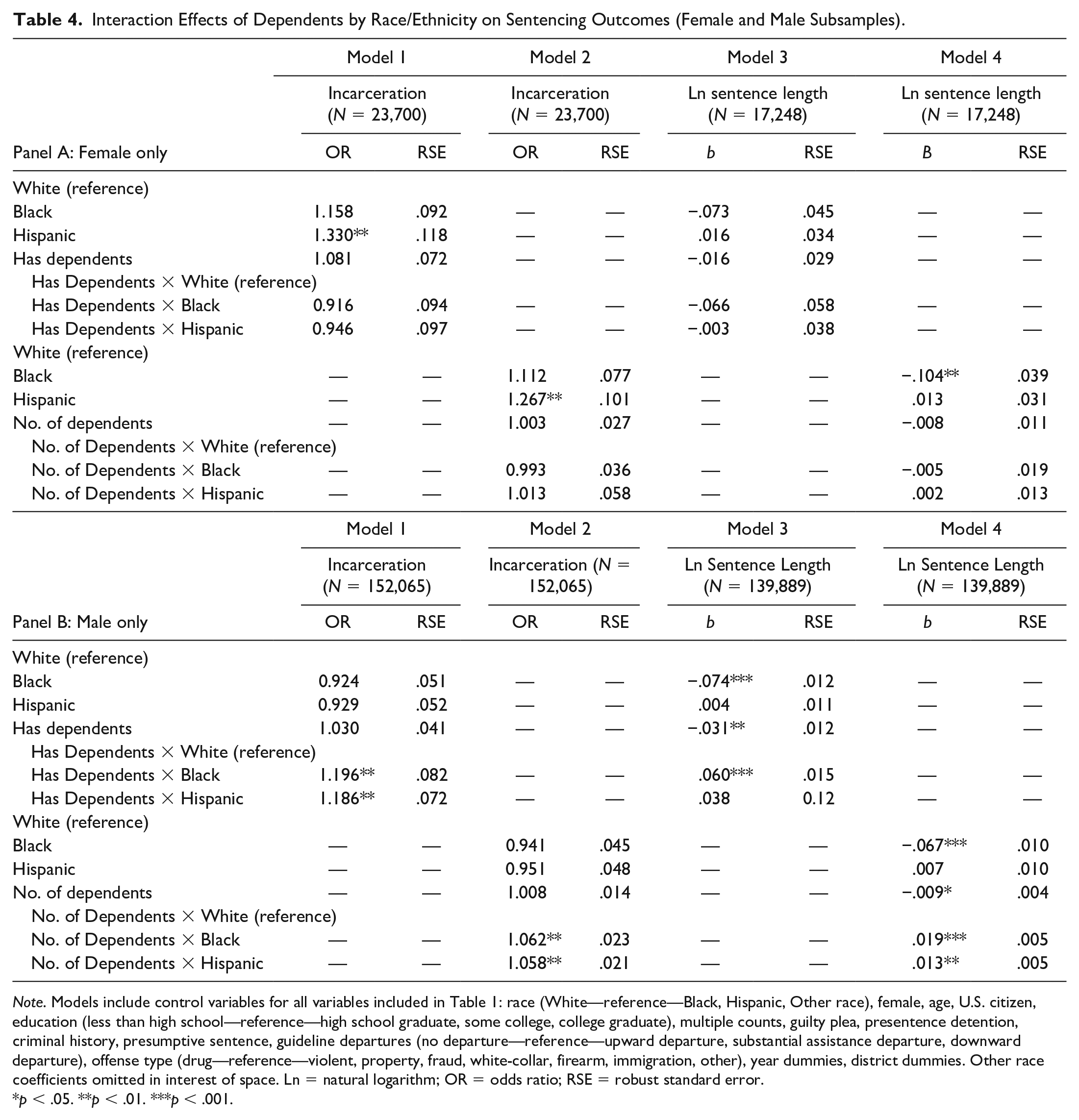
Note. Models include control variables for all variables included in Table 1: race (White—reference—Black, Hispanic, Other race), female, age, U.S. citizen, education (less than high school—reference—high school graduate, some college, college graduate), multiple counts, guilty plea, presentence detention, criminal history, presumptive sentence, guideline departures (no departure—reference—upward departure, substantial assistance departure, downward departure), offense type (drug—reference—violent, property, fraud, white-collar, firearm, immigration, other), year dummies, district dummies. Other race coefficients omitted in interest of space. Ln = natural logarithm; OR = odds ratio; RSE = robust standard error.
p < .05. **p < .01. ***p < .001.
Figure 1 illustrates the interaction of race/ethnicity and the number of dependents on the probability of incarceration and logged sentence length among the subsample of male defendants. At lower numbers of dependents, defendants receive less severe sentences. As the number of dependents increases, both the likelihood of incarceration and logged sentence length increases for Black and Hispanic defendants, while remaining relatively stable in the incarceration model, and decreasing in the log sentence length model for White defendants. The sentence length depiction in Figure 1 reveals that both the intercept and slope of the relationship between number of dependents and sentence length differs across race such that for those with no dependents, Black defendants receive the shortest sentences and Hispanics receive the longest. As the number of dependents increases, however, the slopes for Black and Hispanic defendants increase while the slope for White defendants decreases to reveal that at a higher number of dependents (four or more), Whites receive the shortest sentences, and Hispanics receive the longest. Converting the dependent variable of sentence length presented in Figure 1 back to the metric of individual months by using the exponential function, the sentence length results demonstrate that, although statistically significant, the metric effect is relatively small. For example, at zero dependents, the average sentence length for Whites, Blacks, and Hispanics males is 26.4, 24.7, and 26.6 months, respectively, and at seven dependents, they are 24.8, 26.6, and 27.4 months, respectively. Taken together, these results suggest that providing support for dependents yields a positive association with the likelihood of incarceration and sentence length, and that this positive effect is particularly concentrated among Black and Hispanic defendants, and more specifically among minority male defendants.
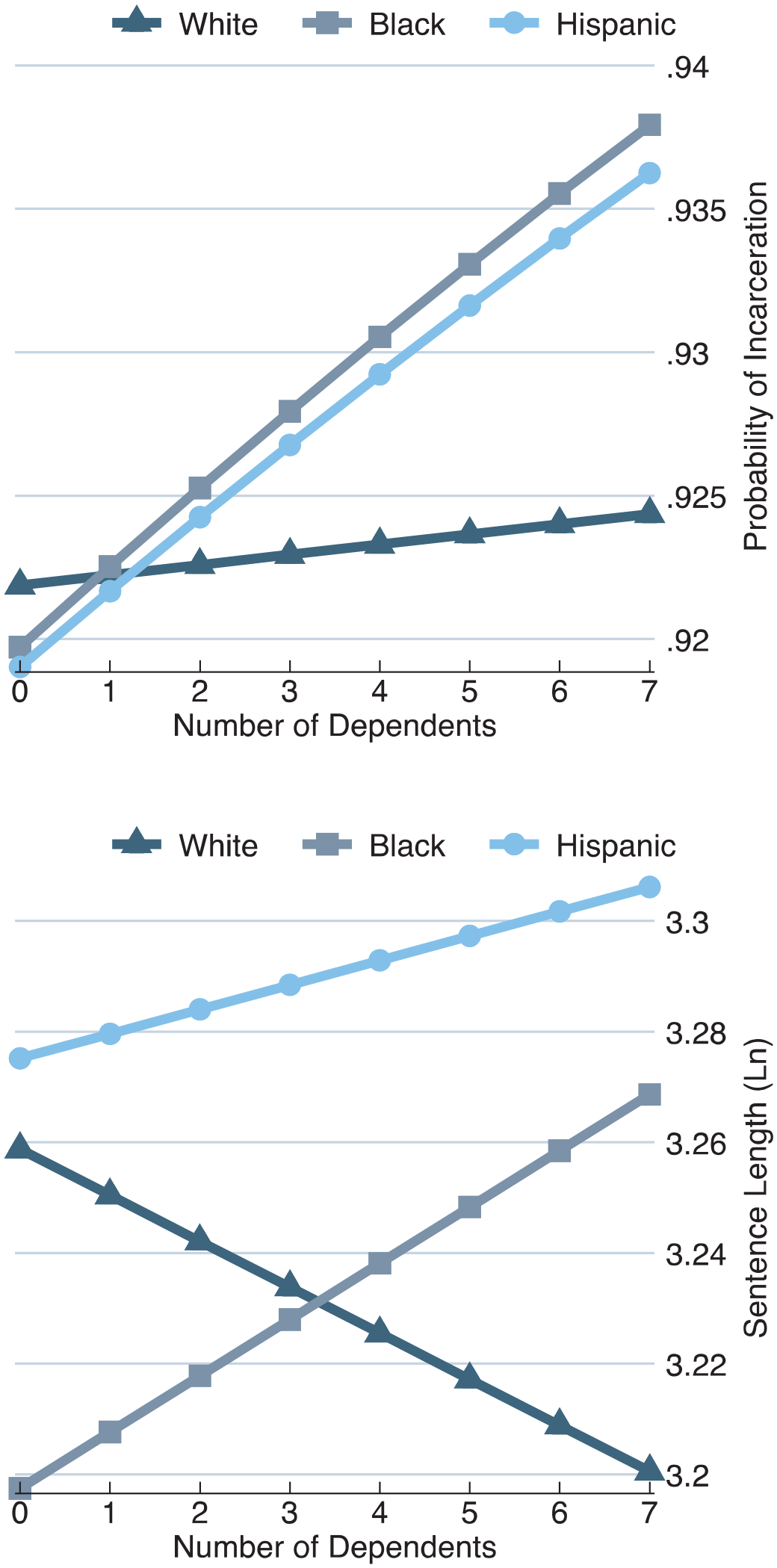
Number of dependents effect on the sentencing outcomes by race (male only).
Discussion
Although the USSC states that family circumstances are not relevant in a determination of an appropriate punishment, a defendant’s family ties and responsibilities have been increasingly cited by federal judges in sentencing decisions (Baron-Evans & Coffin, 2010). Moreover, theoretical frameworks, including the focal concerns perspective and familial paternalism suggest that family characteristics might influence courtroom decision-making both directly, and through interaction with other extra-legal characteristics such as race, ethnicity, and sex (Daly, 1987a, 1987b, 1989; D. Steffensmeier et al., 1998). The current study aimed to examine the direct effects of having dependents on federal sentencing outcomes, as well as examining whether the effect of having dependents is moderated by the race, ethnicity, and sex of a defendant.
Our first set of hypotheses proposed that providing support for dependents would be associated with lower odds of incarceration and shorter sentence lengths. Contrary to our hypotheses, our findings demonstrated that having any dependents increased the odds of incarceration, and both having dependents as well as the number of dependents yielded a positive association with sentence length. Based on these initial findings, we find no support for notion that financial support for dependents is a mitigating factor in the sentencing decisions of federal judges. Thus, rather than being a factor that serves to as a practical sentencing consequence or buffers against a defendant’s image as threatening (Ulmer et al., 2010), the findings suggest the opposite. It is possible that courtroom officials view those who are engaging in federal crime while providing support for dependents as particularly blameworthy for their actions and pose a threat to the well-being of their family and in many cases these perceptions are stronger than any practical constraints that will stem from separating an individual from their dependents through an incarceration sentence. Still, it is possible that this general pattern does not operate uniformly for all defendants, but instead varies based on characteristics such as race, ethnicity, and sex.
Our second set of hypotheses predicted that supporting dependents would be associated with lower odds of incarceration and shorter sentence lengths for female defendants compared with male defendants. Our results demonstrated there are no significant differences in incarceration and sentence length decisions between male and female defendants with dependents. These findings stand in contrast to familial paternalism which argues that the leniency afforded to females is due to their responsibilities as primary caregivers for dependent children (Daly, 1987a, 1987b, 1989). One possibility is that because we analyze more current data, the null sex effects might be reflective of a more contemporary view of both parents as responsible for child rearing, thus doing away with leniency for female caregivers found in earlier research. Furthermore, due to trends of increasing incarceration rates among female defendants (Travis et al., 2014), it is also possible that in the contemporary criminal justice system leniency toward female defendants in general, and for females with dependents specifically, has waned over time (Bontrager et al., 2013).
Next, we found general support for our third hypothesis, which anticipated that providing support for dependents would be associated with less severe punishment for White defendants compared with Black and Hispanic defendants. Hispanic defendants with dependents increased odds of incarceration compared with White defendants with dependents. Moreover, in our models testing interactions between race/ethnicity and total number of dependents, both Black and Hispanic defendants had larger odds of incarceration than White defendants. These race and ethnicity effects held across the sentence length decision models, as Black and Hispanic defendants with dependents, and those with more total dependents, were found to receive lengthier sentences than their White counterparts.
Although the metric effects across race/ethnicity were relatively minor, the fact that the number of dependents is positively associated with sentence lengths for Black and Hispanic defendants, and negatively associated with sentence length for White defendants reveals a context in which extra-legal disparities are present in federal sentencing. Whether judges believe that having dependents is a practical constraint to determining an appropriate sentence for White defendants with dependents, and to the contrary that minority defendants’ dependents need to be protected, cannot be determined with the data and models utilized in the current study. However, future research should explore whether this finding is because judges perceive minority defendants as posing a greater risk to their family members.
Notwithstanding the metric effects, the finding that minority defendants with dependents receive harsher punishment, highlights a unique way in which punishment disparities might generate consequences for the well-being of minority families in the United States. For instance, by 2012 an estimated 2.6 million children under the age of 18 years (one in 25 children) had a parent in prison or jail on any given day, including one in nine Black children (Sykes & Pettit, 2014). Accordingly, a burgeoning literature documents how incarceration alters family structure by removing family members from the household, with particularly harsh consequences for Black and Hispanic families (Wakefield & Wildeman, 2014). As minority defendants with dependents were found to receive more severe punishment, these results suggest that sentencing disparities contingent on race/ethnicity and family characteristics might play some role in reshaping household composition. Given the far-reaching consequences of having a family member incarcerated for the health, economic well-being, and development of a child (Turney & Goodsell, 2018; Wakefield & Wildeman, 2014), our results highlight the importance of examining disparities in criminal court outcomes as a mechanism whereby the criminal justice system influences the structure of minority families and exacerbates racial and ethnic inequality.
Finally, stemming from research examining the intersection of sex and race/ethnicity in generating disparate sentencing outcomes (D. Steffensmeier et al., 1998, 2017) and commentary that lenient outcomes by judges might not be given to all females (Daly, 1987a, 1987b, 1989), we also examined whether the race/ethnicity by dependents interaction effects were present across sex of defendants. In support of our fourth hypothesis, the findings revealed that the increased punishment severity for Black and Hispanic defendants with dependents is confined to male defendants only. For female defendants, results showed no significant interactions between the measures of dependents and race/ethnicity. For males, however, both Black and Hispanic defendants with dependents received harsher sentences across judicial sentencing decisions. 11 These more nuanced findings are in-line with the vast majority of previous research findings which demonstrate that the harshest punishments are reserved for male minorities in combination with other constellations of characteristics, such as being young, unemployed, charged with certain offenses (Mitchell, 2005; Spohn, 2000; Spohn & Holleran, 2000; D. Steffensmeier et al., 2017), and in this case, having dependents.
Moreover, our findings also show that the magnitude of racial and ethnic differences in the odds of incarceration and the length of sentence grow across the number of dependents a defendant has. For example, the visual display of interaction terms in Figure 1 demonstrates that at a lower number of dependents (i.e., one dependent), there are similar odds of incarceration across White, Black, and Hispanic defendants. As the number of dependents increases, however, the likelihood of incarceration increases for both Black and Hispanic defendants while the probability of incarceration for White defendants remains relatively stable across the number of dependents. Likewise, among defendants with a single dependent, Black defendants receive slightly shorter sentence lengths than White defendants, yet as the number of dependents increases, however, both Black and Hispanic defendants’ sentence lengths increase, whereas for White defendants the sentence length actually declines as the number of dependents increase. Finally, it is important to note that the Black and Hispanic slopes are similar for the incarceration outcome but differ in terms of sentence length. One explanation may be that because most defendants in federal district courts are sentenced to at least some period of incarceration, there is less variation in the incarceration outcome relative to the sentence length outcome.
This study carries important implications for theories of punishment. In particular, the focal concerns perspective predicts the harsher treatment of male and minority defendants via judicial attributions of dangerousness and need for community protection from defendants stereotypically thought to be more crime prone and at risk for re-offense. In relation to how having financial dependents influences judicial decisions, federal judges might view defendants who have responsibilities for dependents but are charged with federal offenses as violating their duty as a caregiver, and therefore they hand out harsher sentences under notions of community, or in this case, family protection. With respect to the interactive effects of race, ethnicity, and dependents, judges might mete out harsher punishments to minority, male caregivers because they perceive them as more blameworthy and a greater risk to the physical and/or emotional well-being of their family. The small increases in sentence lengths associated with increasing numbers of dependents, might reflect ideas that the defendant’s family would fare better without the criminal element at home, and therefore lengthier terms of incarceration are appropriate and warranted. Moreover, harsher sentences for male minority defendants with many dependents might also be rooted in stereotypes of Black and Hispanic men with large families as particularly irresponsible (Brown, 2011; Wilson, 2009).
In terms of policy implications, the findings suggest that because familial support for dependents appears to play a role in sentencing disparities, especially for minority males, there might be a need for more guidance about how to consider a defendant’s family circumstances. For instance, the new Model Penal Code: Sentencing (MPCS) approved by the American Law Institute in 2017 provides guidance regarding the best practices related to sentencing decisions (American Law Institute, 2017). In several ways, the document puts forth recommendations for courts “to consider a defendant’s ability to meet his or her basic needs and those of his or her family before imposing a sentence than can intensify their poverty [emphasis added]” (Reitz & Klingele, 2019, p. 44). A key recommendation that flows from the findings of this study is that explicit guidance should be provided to judges and prosecutors that require them to consider the consequences of an imposed sentence for the family members of a defendant. The defendant’s family history, including financial dependents, is included in the presentence investigation report (PSI). Therefore, federal sentencing policies could be amended to require a sentencing judge to engage in a discussion about the convicted offender’s familial situation with the probation officer who interviewed the offender prior to determining an appropriate sentence. Likewise, given the potential for implicit bias to influence sentencing decisions (Rachlinski et al., 2009), another beneficial approach might be to offer implicit bias training to courtroom workgroup members to reduce any biases that might stem intersection of defendant’s race and family characteristics. Given the findings of sentencing disparity among Black and Hispanic males with financial dependents, such policies can play a role in limiting inequities experienced by the families of minority men.
Indeed, imbedded within every criminal sentence is a decision of how long an individual would be separated from their family members. Lengthy incarceration sentences carry several potential consequences for family members of those incarcerated, and the financial hardships generated by a prison sentence can be exacerbated in cases when the person sentenced has financial dependents (Warren, 2009). As such, policy initiatives can be expanded to buffer against the removal of a financial provider from the household. A particularly beneficial policy is to expand access social welfare benefits for families with a household member incarcerated. Prior research finds that households with a parent incarcerated often become increasingly reliant on certain forms government assistance (i.e., food stamps, Medicaid, and State Children’s Health Insurance Program [SCHIP]), but not other types (i.e., Temporary Assistance for Needy Families [TANF]) possibly due to stricter eligibility criteria and ongoing program requirements (Sugie, 2012). Accordingly, policies that expand access to social welfare programs, especially cash assistance programs such as TANF might be particularly useful as such programs can buffer against sudden shocks to income that result after removing a source of income from a household (Iceland & Bauman, 2007).
There are several limitations in the current study worth noting. First, the measure of dependents in the USSC data include both children and adult dependents. Although the percentage of defendants with dependents in the years studied here comport with previous reports of the percentages of federal inmates with dependent minor children (Glaze & Maruschak, 2008), information on the relationship of dependents to the defendant are not available in the USSC data. Future work should assess the questions posed in this study using data that details the roles’ defendants play as caregivers (i.e., emotional support, financial support, etc.), as well as the specific types of dependents they provide support to. Second, the USSC data lack information about the amount of financial support provided. Accordingly, the current study assumes that defendants provide financial support to defendants, however we cannot definitively know whether a defendant claims to provide support, does in fact provide support, and the level of support provided. Third, the data does not contain information on potentially important characteristics such as socioeconomic status (SES). While the current study controls for educational attainment, which could proxy for SES, it remains possible that SES plays a role in explaining sentencing disparities of defendants with and without dependents. Fourth, the current study is limited by using a conviction only sample. Thus, future research can examine the role of dependents on punishment outcomes using samples of both convicted and non-convicted defendants. Finally, federal sentencing data differs from state data in several important ways. For instance, the federal system uses rigid sentencing guidelines and caseloads are often composed of a higher share of immigration and drug cases (United States Sentencing Commission, 2018). Therefore, it would be useful for future research to examine the questions posed in this study using data from state courts, including both those with and without sentencing guidelines.
There are also several avenues for future research to extend this work. Future research can assess whether social context conditions the influence of family characteristics on sentencing. Prosecutors are the gatekeepers to the criminal courts (Kerstetter, 1990), and hold important discretion related to whether to formally charge a defendant, the number and type of charges that will be sought, and whether, and with whom, to engage in plea bargaining (Albonetti, 1987; O’Neill-Shermer & Johnson, 2010). As these prior stage decisions ultimately affect final sentencing outcomes, future work can also extend this study by assessing the role of dependents on earlier stages, such as charging, plea bargaining, and bail decisions, to build a further understanding of cumulative differences in case processing based on family characteristics. Finally, we propose that additional qualitative research is needed to further understand how courtroom actors (both judges and prosecutors) view the role of familial dependents in the context of punishment decisions. Indeed, early research about this topic included rich qualitative narratives on judge’s perceptions on how families would be influenced by sentencing decisions (Daly, 1987a, 1987b).
While the findings of the current study demonstrated that providing support for dependents is generally associated with punishment severity for Black male and Hispanic male defendants, a clear priority of future research would be to invest in interviews with judges as a means of promoting a greater understanding of the underlying reasons for these disparities during sentencing decisions, as well as interviews with prosecutors considering that most criminal convictions occur via guilty plea and that the prosecutor is a central figure in shaping plea bargaining outcomes and sentencing recommendations (Johnson et al., 2016; Lynch, 2019).
Footnotes
Appendix
Summary Statistics by Sex and Race/Ethnicity.
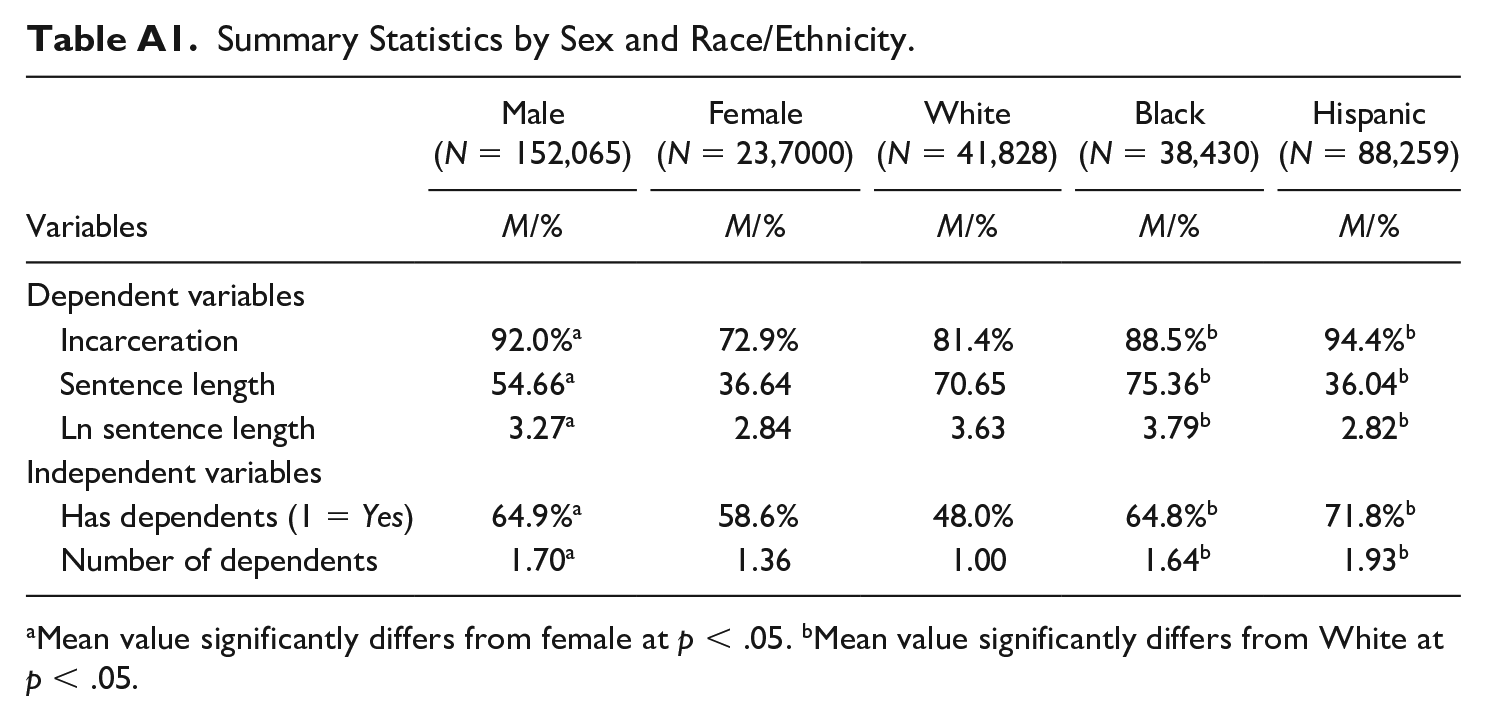
| Male (N = 152,065) |
Female (N = 23,7000) |
White (N = 41,828) |
Black (N = 38,430) |
Hispanic (N = 88,259) |
|
|---|---|---|---|---|---|
| Variables | M/% | M/% | M/% | M/% | M/% |
| Dependent variables | |||||
| Incarceration | 92.0% a | 72.9% | 81.4% | 88.5% b | 94.4% b |
| Sentence length | 54.66 a | 36.64 | 70.65 | 75.36 b | 36.04 b |
| Ln sentence length | 3.27 a | 2.84 | 3.63 | 3.79 b | 2.82 b |
| Independent variables | |||||
| Has dependents (1 = Yes) | 64.9% a | 58.6% | 48.0% | 64.8% b | 71.8% b |
| Number of dependents | 1.70 a | 1.36 | 1.00 | 1.64 b | 1.93 b |
Mean value significantly differs from female at p < .05. bMean value significantly differs from White at p < .05.
Declaration of Conflicting Interests
The author(s) declared no potential conflicts of interest with respect to the research, authorship, and/or publication of this article.
Funding
The author(s) received no financial support for the research, authorship, and/or publication of this article.
