



Abstract
The type and quantity of evidence in a case is a critical factor for deciding guilt but should have little or no influence on the sentencing determinations of judges post conviction; this is because case evidence goes to guilt decisions by triers of fact, whereas sentences are imposed upon those already convicted. This study examines the effects of evidentiary type and the total quantity of physical evidence in a case on length of custodial sentence. The results demonstrate that violent felony cases with forensic evidence and those cases with more varied pieces of physical evidence result in longer custodial sentences for convicted defendants. Thus, the findings indicate that inculpatory evidence in criminal trials has enduring effects post conviction and, more broadly, suggest that judicial discretion at sentencing is, at least in part, influenced by the judge’s confidence in the defendant’s guilt.
Criminologists and legal scholars have routinely lamented the substantial sentencing disparities that exist in the processing of criminal cases. Despite having been convicted of like offenses, defendants with similar criminal backgrounds tried in federal and state court systems receive widely disparate sentences (Ulmer, 2012; Wooldredge, 2010). Various rationales have been posited for these disparities, including the structure of sentencing guidelines (Frankel, 1972; Kramer & Ulmer, 1996), the mode of conviction (N. J. King, Soulé, Steen, & Weidner, 2005; Piehl & Bushway, 2007), racial and ethnic discrimination (Albonetti, 1997; Scott, 2011; Steffensmeier & Demuth, 2000), local organizational constraints (Ulmer, 2012), and various idiosyncrasies in the discretionary power of judges, among other sources of difference (Frankel, 1972; Wooldredge, 2010). With respect to judicial discretion, history shows that, of the many relevant sentencing factors, “each is capable of being answered, and is answered by sentencing judges, in contradictory or conflicting or at least differing ways” (Frankel, 1972, p. 5). Indeed,
judges carry their own experiences, biases, and foibles with them into the role; they vary widely in their explicit views and “principles” affecting sentencing; they vary, too, in the accidents of birth and biography generating the guilts, the fears, and the rages that affect almost all of us at times and in ways we often cannot know. (p. 7)
1
But whatever their causes, sentencing disparities result in a host of negative consequences, including the uneven administration of punishment, perceptions that the system is unjust, and resentment among prisoners, among others (Lynch, 2009; Tonry, 1996; Walker, 1993).
In theory, sentencing determinations should rely on legally relevant sentencing factors, including the seriousness of the offense and the defendant’s prior criminal record (Roberts, 1994; von Hirsch, 1992). In practice, however, extralegal factors such as the defendant’s race, age, and gender have been found to influence the punitiveness of sentences (Doerner & Demuth, 2010; Feldmeyer & Ulmer, 2011; Johnson, Stewart, Pickett, & Gertz, 2011; R. D. Peterson & Hagan, 1984). Although less attention has been directed at it as a source of disparity, there is some evidence that the confidence a judge has in a jury’s verdict may also affect the length of imposed sentences (Gertner, 1999). For example, in the case of U.S. v. Juarez-Ortega (1989), codefendants Juarez-Ortega and DeLuna were charged and tried together for two counts of distributing cocaine and one count of carrying a firearm during a drug trafficking offense; the weapons charge mandated a 5-year minimum consecutive sentence. DeLuna was convicted of all three charges, whereas Juarez-Ortega was convicted on both cocaine charges but acquitted on the weapons charge. Yet the judge imposed identical sentences upon each defendant. In justifying the sentence, the judge stated,
I have been disappointed in jury verdicts before but that’s one of the most important ones, because what it did, it set up a disparity in result between the two defendants . . . This firearm was used. [The jury] had to absolutely disregard the testimony of the government agent for no reason—no reason. (U.S. v. Juarez-Ortega, 1989, pp. 748-749)
Thus, the judge’s disagreement with the jury’s verdict for Juarez-Ortega resulted in both defendants being subject to the same penalty despite being convicted on varied counts (Gertner, 1999). The outcome of U.S. v. Juarez-Ortega suggests that judicial confidence in the correctness of a jury’s guilty verdict may influence sentence severity. 2
Confidence in the verdict may be partially or even primarily a function of the judge’s evaluation of the evidence garnered against the defendant. Indeed, a small body of research has spread beyond the characteristics of defendants and victims, courtroom working groups, and social and organizational contexts to explore the role of case-specific features, including strength of evidence, on case disposition, and, to a lesser extent, sentencing disparities (Baskin & Sommers, 2011, 2012; J. L. Peterson, Hickman, Strom, & Johnson, 2013; Spohn, 2000). This research shows that the strength of the evidence presented during the guilt phase of a criminal proceeding plays a critical role in case outcomes. In this study, we evaluate the extent to which evidentiary weight influences the custodial sentence length imposed upon convicted defendants in violent felony cases, exclusive of other legally relevant and extralegal factors and, in so doing, suggest that any such relationship is, at least in part, reflective of judicial confidence in guilt. 3
Legally Relevant Sentencing Factors
Determining the proper sentence to impose upon a criminal defendant requires the sentencing judge to balance various legally relevant factors, including seriousness of the offense and the defendant’s prior criminal history. The defendant’s willingness to plea bargain can also result in legally permissible sentence discounts. 4 Each of these criteria is discussed in turn.
Seriousness of Offense
The seriousness of the offense on which the defendant is convicted should influence the punitiveness of the punishment. Even among mala in se offenses, legislatures and courts recognize a crude rank ordering among crime types wherein murder, for example, is treated as more serious than theft. Determining both the objective seriousness of criminal offenses (Sellin & Wolfgang, 1964) and the amount of punishment that should be meted out for each offense is thorny and dependent upon the combination of utilitarian, expressive, and/or retributive principles of punishment that undergird the legal apparatus (Tonry, 2011). Certain acts, on their face, appear to justify more serious punishment than others (e.g., homicide vs. pick pocketing) based on principles of proportionality (von Hirsch, 1992, p. 77); yet the distinction in severity between other illegal activities (e.g., perjury vs. forgery) is much less obvious, even when an “anchor point”—or a “uniquely deserved penalty” for one—can be established. Moreover, the optimal absolute or “just” amount of punishment for each offense is rarely specified under relative approaches (Robinson, 2008). Even Federal Sentencing Guidelines and certain state penal laws, which provide sentencing ranges based on the nature and seriousness of the offense, vary widely across jurisdictions (see, for example, Criminal Law and Procedure, Ind. Penal Code, §35, 2015; Federal Sentencing Guidelines, 18 U.S.C. Section 3553(a)).
Within a retributivist or “just deserts” tradition, the seriousness of a given offense can be assessed, at least in part, based on the resulting harm to the victim and to society (Robinson, 2008; von Hirsch, 1992). As Spohn (2009) clarifies, under the principle of proportionality,
the amount of punishment imposed on the offender should be equal to the amount of harm done by the offender. If the harm is great, the punishment should be severe; if the harm is minor, the punishment should be lenient. (p. 19)
For this reason, a defendant who intends to commit a crime and takes a substantial step toward the completion of the crime but fails is typically subject to a lighter penalty than a defendant who successfully commits the offense. Thus, cases involving the identical actus reus and mens rea generally result in different legal consequences based on the extent of harm visited upon the victim. Both crime type and harm are therefore relevant determinants of offense seriousness.
Criminal History
State and federal courts commonly consider the defendant’s criminal history in determining the type and length of sentence to be imposed in specific cases (Bentham, 1789/1988; Federal Sentencing Guidelines, 18 U.S.C. Section 3553). Varying rationales are posited for using criminal history as a legally relevant sentencing criterion, including the elevated culpability of repeat offenders, deterrence, protection of the community, and decreased potential for effective rehabilitation (Morris, 1982; von Hirsch, 1992). Not surprisingly, prior research has found that both the criminal history of defendants and offense severity have some of the strongest influences on sentencing and sentencing departures (Bushway & Piehl, 2001; Kramer & Ulmer, 1996).
Mode of Conviction
Plea bargaining practices, which save organizational resources and elicit an acknowledgment of guilt, reward defendants who agree to relinquish their constitutional right to a trial with sentence consideration (Piehl & Bushway, 2007; Walsh, 1990). The average sentence for the vast majority of offenders in state court who pled guilty to violent felonies in 2006, for example, was 5 years shorter than for those convicted at trial (Edkins, 2011). Importantly, the extent of the “bargain” offered to defendants may be influenced by the quantity and quality of evidence available to prosecutors, wherein cases with weaker evidence can generate larger sentence and/or charge discounts because the perceived likelihood of conviction at trial—referred to as the “shadow of the trial” model—is lower (Kramer & Ulmer, 2002). 5 In general, cases that are pled out result in less punitive sentences compared with trial convictions on similar offenses and among like defendants.
Sociodemographic Factors in Sentencing
From a legal and equitable standpoint, neither defendant nor victim race should bear on the sentence following conviction. Yet prior studies conclude that race, especially of defendants, generally influences the type and severity of sentence imposed. Specifically, White defendants often receive more lenient sentences than their African American counterparts, controlling for other legally relevant criteria (Albonetti, 1997). White defendants are least likely to be incarcerated in federal court, and when incarcerated, they receive shorter sentences than both Black and Latino defendants (Everett & Wojtkiewicz, 2002; Steffensmeier & Demuth, 2000). Likewise, the U.S. Sentencing Commission (1991, 2011) and Ulmer, Light, and Kramer (2011), among others, contend that the decision of whether to sentence a defendant to probation or to a period of incarceration “is a[n additional] source of persistent and increasing disparity” between White and Black defendants (Scott, 2011, p. 1129).
Female offenders typically receive milder punishment upon conviction than male offenders. This disparity is most pronounced in decisions of whether to incarcerate or impose a sentence of probation; research shows that women are, on average, less likely to be sentenced to prison (Mustard, 2001; Rodriguez, Curry, & Lee, 2006). The empirical results on sentence length are more mixed, however, and dependent on crime type. For example, Mustard (2001) finds that gender biases are the strongest in drug trafficking and bank robbery cases, and the weakest in less serious types of offenses, such as larceny, fraud, and immigration violations.
The role of offender age on sentencing decisions is inconsistent (Freiburger & Hilinski, 2013; Steffensmeier, Ulmer, & Kramer, 1998). For example, Wu and Spohn (2009) conclude from their meta-analysis that the age of the offender fails to influence length of prison sentences. Yet other studies show that age interacts with race and gender to influence sentencing determinations (Freiburger & Hilinski, 2013; Spohn & Holleran, 2000; Steffensmeier et al., 1998). Doerner and Demuth (2010) find, for instance, that African American and Latino defendants who are also young and male receive more severe sentences than Whites, females, and older defendants. Indeed, young Black males are subject to the longest sentences, and young Latino males have the highest incarceration rates (Doerner & Demuth, 2010).
Finally, some studies illustrate that the demographic characteristics of the victim influence case dispositions and sentencing outcomes. For example, Baumer, Messner, and Felson (2000) argue that both the race and gender of homicide victims influence various stages of case processing, especially when cases are decided by a jury. In one of the most politically influential studies describing the effects of victim characteristics on case outcomes, Baldus, Pulaski, and Woodworth (1983) show that offenders of all races are significantly more likely to receive a death sentence when the victim is White. Consequently, the sociodemographic characteristics of both victims and offenders is expected to affect sentencing punitiveness.
Evidentiary Weight in Sentencing
The cumulative body of evidence, or the quantity and type of evidence available in a given case, is the major indicator of case strength (Spohn, 2000). Research shows that the nature and scope of evidence in cases can vary for a host of reasons, including the breadth of evidence objectively available for collection and analysis, the degree of effort directed at the case by law enforcement, the type of case, and the characteristics of victims and offenders (Cooney, 1994). Even so, a variety of evidentiary forms may be available in violent felony cases, either alone or in combination; these include witness-based evidence (e.g., eyewitnesses) and physical evidence (e.g., weapons), some of which require forensic examination in a crime lab (e.g., DNA).
Although the probative value and reliability of different quantities and types of evidentiary packages vary, a case’s evidentiary strength should theoretically influence only the decision to charge, plea bargain, or try the case and convict. Once the defendant has been found guilty, however, the type and quantity of evidence used to establish guilt becomes legally moot at the sentencing phase. The logic of viewing evidentiary weight as an extralegal sentencing characteristic grows from the defendant’s well-established Sixth Amendment right to have a jury factually determine all of the elements of the crime charged beyond a reasonable doubt (Alleyne v. U.S., 2013; Apprendi v. New Jersey, 2000; U.S. v. Gaudin, 1995). Once a jury legally renders a verdict, this constitutional mandate prevents judges from usurping the role of the jury by revisiting the issue of guilt during the sentencing phase. Thus, whether or not the sentencing judge personally agrees with the jury’s verdict based on perceptions of evidentiary strength (i.e., whether the types and amounts of evidence in a particular evidentiary package establish guilt beyond a reasonable doubt), it is not within his or her purview to sentence a defendant based on those perceptions. Instead, so long as there is a reasonable view of the evidence to support the conviction, considered in a light most favorable to the prosecution, the verdict stands (Jackson v. Virginia, 1979). A judge who substitutes his or her own perceptions of guilt for those of the jury, and adjusts punishment severity accordingly, is essentially appropriating the jury’s constitutionally mandated role and jeopardizing the finality of jury verdicts.
It is true, however, that certain evidence that speaks to aggravating or mitigating factors (often varying by jurisdiction and typically associated with a lower burden of proof) may be legally considered by sentencing judges (McMillan et al. v. Pennsylvania, 1986). For example, evidence that demonstrates the defendant’s cruelty to the victim is occasionally weighed by judges in their determinations but only in “atypical” or “unusual” cases (U.S. Sentencing Commission, 2015, p. 6). Real offense sentencing is another option in federal courts where judges can employ upward or downward departures from the sentencing guidelines to base sentences “upon the actual conduct in which the defendant engaged regardless of the charges for which he was indicted or convicted” (p. 6).
Although real offense sentencing and evidence illustrative of unique aggravating and mitigating factors allow a judge to consider conduct outside the scope of the actual conviction charge (as in U.S. v Juarez-Ortega, 1989), they do not permit a judge to arrogate the jury’s role by making factual determinations on the elements of the crime for which the defendant was convicted. 6 For example, DNA and eyewitness testimony are commonly used to identify defendants as perpetrators, and identification is a necessary element of the crime. Some judges may be persuaded by the perceived strength of DNA evidence (compared with reliability concerns associated with eyewitness testimony), and consequently, their confidence in the guilt of the accused is greater when the evidentiary package includes DNA. Nevertheless, the type of evidence employed by the prosecution to prove identification does not speak to the level of culpability of the offender or to the seriousness of the offense. Likewise, it does not constitute conduct outside the conviction charge, nor does it capture other aggravating or mitigating factors. In this case, DNA and eyewitness testimony are merely different mechanisms for establishing guilt; neither is relevant for determining the appropriate punishment upon conviction.
Although judges vary in their personal punishment philosophies (Forst & Rhodes, 1982), widely recognized system goals include, but are not limited to, deterrence, rehabilitation, retribution, and incapacitation (Carlsmith, Darley, & Robinson, 2002; Haist, 2009; Meyer, 1969). In theory, sentences should be calculated to further these specific punishment objectives, rather than on the nature of evidence used to substantiate elements of the crime. The goal of deterrence is not, for example, better served by incarcerating a convicted offender for longer when he or she is convicted on the basis of DNA versus eyewitness evidence. Instead, the offender is said to be deterred when his or her punishment is most parsimonious while offsetting the risk of recidivism, informs the public about the consequences of the act, and takes the offender’s past behavior into consideration (Bentham, 1789/1988). Thus, sentences that theoretically maximize deterrence should be based upon offense seriousness and the criminal history of the defendant; they should not be based upon the type or amount of evidence used in the guilt phase of case processing. When judges calibrate sentences to evidentiary weight, they are essentially assuming a fact-finding role beyond their purview. Importantly, this problem will result in extralegal sentencing disparities when one defendant benefits from a judge’s view that the evidentiary package is weak, whereas another suffers a more punitive sentence due to subjective assessments of case strength. Despite the extralegal nature of evidentiary weight in sentencing, a small body of research shows that the types of evidence presented in cases (Baskin & Sommers, 2010, 2011, 2012; J. L. Peterson et al., 2013; Peterson, Sommers, Baskin & Johnson, 2010; J. L. Peterson, Ryan, Houlden, & Mihajlovic, 1987; Sommers & Baskin, 2011), as well as the strength of evidence (Spohn, 2000), can influence a variety of case outcomes including sentence severity (Briody, 2004; J. L. Peterson, Mihajlovic, & Gilliland, 1984).
Evidentiary Type
Key types of evidence available in criminal cases include witness-based evidence, ranging from civilian eyewitnesses to victims and police officers, and physical evidence, some of which require forensic examination in crime labs. Occasionally, the prosecutor’s case in chief is based almost exclusively on witness testimony. These witnesses provide important probative information and identification evidence at trial, irrespective of the substantial concerns over both the credibility and reliability of witness testimony indicated in the scholarly and legal literatures (Loftus, 1974; Shermer, Rose, & Hoffman, 2011; Skolnick & Shaw, 2001). The effects of witness evidence on sentencing punitiveness are not well established; for example, one study has found that witness-based evidence is associated with longer sentences but only in aggravated assault cases (J. L. Peterson, Sommers, Baskin, & Johnson, 2010).
Violent felony cases may also contain physical evidence, such as weapons and blood, much of which require examination in a laboratory before its probative value can be assessed. Of all kinds of evidence, forensic evidence is viewed by juries as providing a strong and compelling component of the evidentiary package. DNA evidence and latent prints provide forms of forensic identification evidence that, for all intents and purposes, “strive to achieve conclusions of individualization, the reduction of the donor pool to a single source” (Cole, 2009, p. 235). Other forms of forensic identification evidence, including shoe prints, firearms, ballistics, handwriting samples, and bite marks, are believed to connect a piece of evidence “to the one and only finger, writing, teeth in the world that made the markings” (Saks & Faigman, 2008, p. 150). Despite the presentation of forensic evidence as objective and scientific, many standard forms involve speculative opinions and are based on weak scientific foundations (Saks & Faigman, 2008). Nonetheless, the public and the courts place a great deal of confidence in it.
In one of the earliest studies on the role of evidence in case outcomes, J. L. Peterson and colleagues (1987) find that the presence of scientific evidence did not affect prosecutors’ charging decisions or the likelihood of conviction, although it significantly influenced sentence severity in four of the six cities that they studied; more specifically, cases in which a lab report had been presented at trial resulted in sentences that were, on average, approximately 30 months longer compared with cases without a report. The presence of forensic evidence has also been shown to affect referral of a case to a prosecutor, the imposition of charges, conviction probability, and sentence length for convicted defendants (J. L. Peterson et al., 2013).
Quantity of Evidence
Although a handful of prior studies have begun to explore the relationship between various types of case evidence and sentence length (Peterson et al., 2010; Peterson et al., 1987), scholars have yet to consider the broader effects of evidence on sentencing phase outcomes in the typical violent felony cases that are routinely arbitrated in state court systems. For example, Spohn’s (2000) innovative project designed to disentangle whether racial disparities in case outcome are dependent on the seriousness of the case indicates that the presence of physical evidence fails to predict sentence length; yet the quantity of physical evidence amassed in cases was not evaluated in Spohn’s study. In one of the very few tests of evidence quantity by Heinrich, Thorton, Morgan, and Bouhana (2013), the amount of evidence collected in British terrorism cases prosecuted over nearly four decades is shown to have a small and marginally significant influence on the punitiveness of imposed sentences. However, this research focuses on an unusual sample of “only the most severe terrorist cases, with the longest sentences and the highest likelihood of utilizing forensic evidence” (Heinrich et al., 2013, pp. 98-99). Finally, although there is a small body of literature testing the shadow of a trial model in plea cases, which evaluates the influence of various types of evidence on acceptable plea sentences (Bushway, Redlich, & Norris, 2014), virtually no attention has been directed at why these associations might exist post conviction in cases disposed via trial.
The weight of the evidentiary package generally depends on the amount of evidence available in a case, wherein each additional piece of evidence (e.g., a knife on the sidewalk and drops of blood on the street nearby) increases case strength. Quality is related to quantity such that even weaker pieces of evidence can strengthen the case when they corroborate one another. For instance, forensic evidence resting on weaker foundations (e.g., bite marks) is bolstered by additional and related pieces of evidence (e.g., DNA). In the end, the quantity of evidence available in cases may be a reflection of case complexity, but it may also signal the willingness of law enforcement to devote resources to solving the case and bringing the perpetrator to justice (Cooney, 1994). In either scenario, each additional piece of evidence is expected to strengthen the merits of case and, thus, should elevate judicial confidence in the guilt of the accused.
Trials Versus Pleas
In trial cases, the sentencing phase is a distinct stage of case processing in which the fact finder’s evaluation of whether and how the evidentiary package establishes guilt is no longer relevant. Reexamining the strength of different forms and quantities of guilt-phase evidence after a verdict is tantamount to a judge revisiting the issue of the defendant’s guilt at sentencing. Instead, legally relevant factors (e.g., seriousness of offense, criminal history) should be the key determinants of punitiveness. By contrast, the determination of the conviction charge and the type and length of sentence the defendant will serve is generally completed concurrently in plea cases. In those instances, evidentiary strength is relevant to determining the charge and sentence associated with an acceptable plea, as court actors are influenced by the probability of conviction at trial in evaluating the plea charges and the sentence to offer or accept (Bushway et al., 2014). Therefore, evidentiary weight may be a legally relevant determinant of sentence in plea cases, insofar as it affects charge bargaining and estimates of the probability of conviction at trial, but its influence should be limited to the guilt phase of criminal trials.
Hypotheses
To contribute to the literature on the role of evidentiary weight in sentencing determinations, we estimate a measure of the total quantity of physical evidence in a case on the length of custodial sentences imposed upon convicted defendants, in addition to distinguishing by evidence type. In accordance with prior studies (J. L. Peterson et al., 1987; J. L. Peterson et al., 2010; J. L. Peterson et al., 2013), we expect that violent felony cases in which the direct evidence includes a forensic laboratory report and those cases with one or more eyewitnesses will lead to longer prison sentences for convicted defendants. Despite some reliability concerns, both types of evidence can be highly influential for the prosecution’s case (Loftus, 1974; Shermer et al., 2011; Skolnick & Shaw, 2001). We add to these expectations drawn from the extant literature a set of formal hypotheses around how the quantity and type of evidence operate post conviction, and in trial cases specifically:
Disentangling the extralegal role of evidentiary weight at sentencing from legally relevant considerations is important because a defendant convicted at trial on the basis of weaker evidence is no less culpable in the eyes of the law than a defendant convicted by a stronger evidentiary package. Judges who are influenced by evidence at sentencing are, in essence, revisiting the trier of fact’s judgment by imposing punishment proportional to their own confidence in culpability. Consequently, any effect of evidentiary weight at sentencing may generate disparate and unjust criminal justice outcomes.
Data and Method
This study analyzes data from a public-use data set titled Impact of Forensic Evidence on the Criminal Justice Process in Five Sites in the United States, 2003-2006 (J. Peterson & Sommers, 2010). 7 The data set consists of a random sample of reported crime incidents from Los Angeles County, California, and Indianapolis, Evansville, Fort Wayne, and South Bend in the State of Indiana between the years of 2003 and 2006, stratified by crime type (N = 4,205). Information on each case was collected from prosecutor case files, crime laboratory reports, and police incident and investigation reports for a sample of burglary (n = 1,263), aggravated assault (n = 859), homicide (n = 400), rape (n = 602), and robbery (n = 1,081) cases. As our study explores the influence of evidentiary weight on custodial sentence length in violent felony cases post conviction, we limit our investigation to cases in which defendants have been convicted of homicide, rape, robbery, or aggravated assault. 8 Of the 516 cases involving convictions on violent felonies, 23 (4.46%) were missing data on key variables. In the remaining 493 valid cases, 9 (1.83%) defendants received probationary sentences; these cases are both qualitatively distinct and exceedingly rare, and thus are excluded from the analyses (G. King & Zeng, 2001). The remaining 484 defendants received custodial sentences ranging in length from 1 to 2,760 months (or 230 years).
Ordinary least squares (OLS) regression models are employed to predict sentence length, which is an overdispersed count variable. 9 As sentence length is highly skewed, we transformed this variable by taking its natural log. This strategy enables us to estimate the relative strength of the effects of the various legally relevant and extralegal factors on custodial sentence severity for defendants convicted of violent felonies. Diagnostics reveal that there are no significant collinearity problems in the models reported below.
Dependent Variable
The dependent variable is a count of the number of months of incarceration to which the convicted defendant was sentenced, or sentence length. As shown in Table 1, defendants were sentenced to an average of 166.57 months of incarceration (or approximately 14 years), although sentences ranged dramatically from 1 to 2,760 months (SD = 300.28). After taking the natural log of sentence length, its distribution approximates a normal curve.
Descriptive Statistics (n = 484).

Untransformed.
Reference category.
Independent Variables
Legally relevant sentencing criteria
Three variables reflect legally relevant sentencing characteristics; these include offense seriousness, the defendants’ criminal history, and mode of conviction. Crime type is legally relevant for sentencing purposes and has generally been used to delineate appropriate sentencing ranges under both discretionary and mandatory sentencing regimes, as is victim injury or harm caused by the offense (Robinson, 2008; von Hirsch, 1992). Together, they provide a strong indicator of offense seriousness. We combine crime type with victim injury (measured by whether or not the victim received medical treatment) to operationalize offense seriousness. More than one quarter of the convictions are homicide cases in these data (26.0%; n = 126, see Table 1). The remaining cases are distinguished as follows: 7.4% are aggravated assaults in which the victim received medical treatment (n = 36); 27.3% are aggravated assaults in which the victim did not receive medical treatment (n = 132); 11.8% are rapes in which the victim received medical treatment (n = 57); 1.4% are rapes in which the victim did not receive medical treatment (n = 7); 2.9% are robberies in which the victim received medical treatment (n = 14); and 23.1% are robberies in which the victim did not receive medical treatment (n = 112).
The number of prior convictions in a defendant’s criminal history is included in the model. As shown in Table 1, defendants had an average of 5.2 prior convictions, although criminal conviction histories ranged from 0 to 78 (SD = 6.61). 10 Mode of conviction distinguishes cases disposed via plea agreement from convictions at trial. In the interests of efficiency, plea bargains are typically associated with shorter sentences because consideration at sentencing provides an incentive to plead guilty (Feeley, 1979; but see Bibas, 2004). Approximately two thirds of these convictions are resolved through a plea agreement (67.4%; n = 326), and the remaining third are decided at trial. 11
Evidentiary weight
Three evidentiary variables are included in the models: (a) presence of a forensic lab report, (b) quantity of physical evidence, and (c) presence of eyewitnesses. The measure of lab-examined forensic evidence captures the existence of any crime scene evidence examined in the case, such as firearms, latent prints, drugs, biological evidence (primarily blood), pattern evidence, generic objects, and natural and synthetic materials (J. L. Peterson et al., 2010); 41.9% of the cases (n = 203) involved the examination of physical evidence in a crime lab. The quantity of evidence is a sum of the amount of physical evidence collected in a case and submitted to the crime laboratory for analysis (including biological evidence, ballistic evidence, tangible evidence, drugs, blood, DNA, fingerprint, clothing, hair, tissue, fibers, gun, trace, cartridges, and other unspecified physical evidence). On average, 1.19 pieces of physical evidence were collected and submitted for analysis in these cases (SD = 1.75; range = 0-8). Finally, the presentation of eyewitness testimony, including that by victims themselves, may serve as a corroborating source of information that can strengthen the prosecution’s case. We distinguish cases with no eyewitnesses from those with any eyewitnesses; in total, slightly more than half of the cases (57.4%; n = 278) include eyewitnesses as part of the evidentiary package.
Control variables
Much research has found sentencing disparities by race that penalize African American and Latino defendants relative to White defendants (Feldmeyer & Ulmer, 2011; Johnson et al., 2011), and male defendants relative to female defendants (Mustard, 2001). Consequently, defendant race and sex are controlled. 12 In total, nearly half of all defendants sentenced to a term of incarceration are African American (48.1%; n = 233), and 12.6% are Latino 13 (n = 61). The vast majority of defendants are male (92.6%; n = 448). Victim race and gender are also controlled (Baldus et al., 1983; Baumer et al., 2000). In total, one third of the victims are African American (33.3%; n = 161), and 13.4% are Latino (n = 65). Nearly two thirds of the cases involve male victims (61.2%; n = 296). Finally, we include a variable distinguishing the site in which the cases are processed to control for systematic differences in the legal or procedural treatment of cases across state jurisdictions. We distinguish Los Angeles (38.2%; n = 185) from all Indiana locations (61.8%; n = 299). 14
Results
Before examining the multivariate models regressing custodial sentence length on the various legal, evidentiary, and control variables, we first explore the extent to which the type and quantity of evidence varies across the four violent crime categories. Table 2 shows that, on average, cases in which defendants are convicted of homicide have a larger and more variable quantity of physical evidence (M = 3.14) compared with rape (M = 1.25), robbery (M = 0.32), and aggravated assault (M = 0.36) cases. As might be anticipated, a significantly larger proportion of homicide convictions (86.5%) include lab-examined forensic evidence at the guilt phase, followed by rape (48.4%), robbery (25.4%), and aggravated assault (18.5%). Finally, a significantly larger proportion of both aggravated assault (66.7%) and homicide (72.2%) convictions are cases that involve one or more eyewitnesses compared with robbery (47.6%) and rape (23.4%) convictions.
Evidentiary Weight by Crime Type (n = 484).

Levene statistic in homogeneity of variance test is significant and thus equal variances cannot be assumed; Games Howell post hoc tests are conducted.
All mean differences are significant except the contrast between aggravated assault and robbery.
All mean differences are significant except the contrast between aggravated assault and homicide.
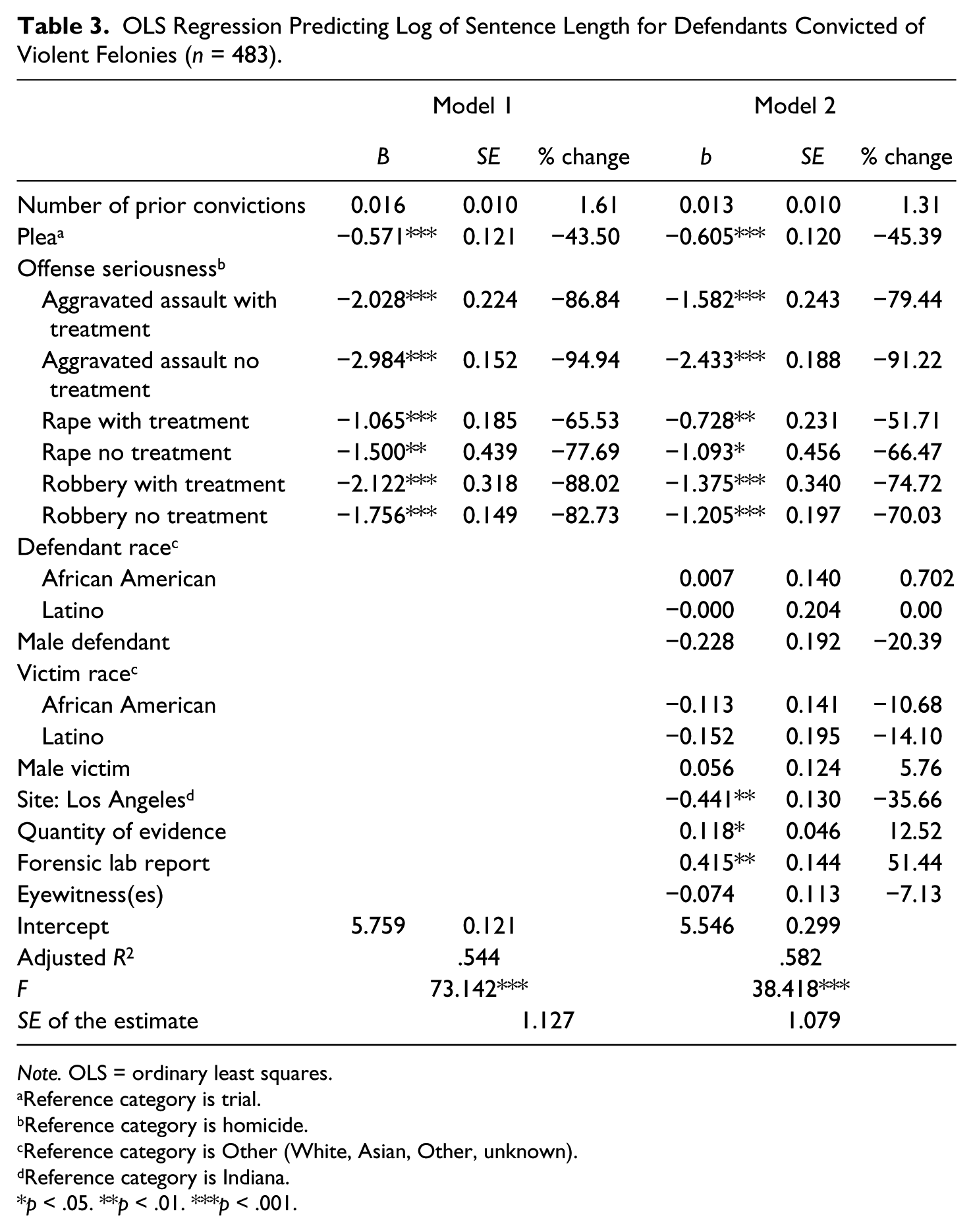
The OLS regression models are based on all homicide, rape, aggravated assault, and robbery convictions resulting in custodial sentences in the sample. For ease of interpretation, we exponentiate the estimated coefficients to calculate the percentage change in number of months sentenced for each independent variable. As the natural log of sentence length is the dependent variable, percent change in number of months sentenced is calculated according to the formula:

Model 1 in Table 3 estimates sentence length based solely on legally relevant sentencing criteria. The results largely confirm our expectations. Specifically, compared with homicide cases, defendants convicted of each of the other types of crime (i.e., aggravated assault with/without medical treatment, robbery with/without medical treatment, and rape with/without medical treatment) are, on average, sentenced to significantly shorter periods of incarceration. Furthermore, custodial sentences in those cases resolved via plea were, in general, 43.5% shorter in length compared with trial convictions. Finally, although the coefficient for number of prior convictions is in the expected direction, it is statistically insignificant.
OLS Regression Predicting Log of Sentence Length for Defendants Convicted of Violent Felonies (n = 483).
Note. OLS = ordinary least squares.
Reference category is trial.
Reference category is homicide.
Reference category is Other (White, Asian, Other, unknown).
Reference category is Indiana.
p < .05. **p < .01. ***p < .001.
In Model 2, we incorporate evidentiary weight, including the presence of forensic evidence, the presence of eyewitnesses, and the quantity of physical evidence in the case, as well as all of the control variables (see Table 3). In terms of evidence type, cases containing a forensic lab report, on average, result in a 51.4% increase in number of months sentenced compared with cases without such evidence, whereas the presence of eyewitness evidence is not a significant predictor of sentence length. The quantity of physical evidence in the case positively and significantly influences the length of the custodial sentence such that each additional piece of physical evidence results in a 12.5% increase in number of months sentenced, consistent with Hypothesis 1. These results suggest that sentencing decisions are influenced not only by the type of evidence available in a case (i.e., forensic evidence vs. witness-based evidence) but also by the total amount of physical evidence marshaled against the defendant, even after controlling for offense severity and other relevant factors at sentencing.
The remainder of the findings in Model 2 is largely in the expected direction with the exception of victim and defendant sociodemographic characteristics, which are insignificant. These null findings are consistent with Spohn’s (2000) conclusion that racial disparities may be least pronounced in more serious cases. Only mode of conviction, offense seriousness, and site are found to significantly affect sentence length beyond evidentiary weight. Defendants who plead guilty in violent felony cases are sentenced, on average, to 45.4% shorter periods of incarceration compared with those who are found guilty at trial, all else equal. In general, compared with those convicted of homicide, the custodial sentence imposed for defendants in the other violent felony types is between 51.7% (rape with injury) and 91.2% (aggravated assault without injury) shorter. Finally, cases in Los Angeles courts are associated with shorter sentences than those in the Indiana jurisdictions, controlling for known legal and extralegal sentencing factors.
The model estimated in Table 4 predicts sentence length exclusively for defendants convicted at trial (n = 157). 15 The results can therefore be interpreted as a purer reflection of judicial sentencing decisions post conviction, as plea negotiations in the shadow of the trial are removed. Trial convictions that involve a forensic lab report during the guilt phase result in an 82.2% increase in number of months sentenced compared with cases without lab reports. Furthermore, each additional piece of physical evidence results in a 16.2% increase in the number of months sentenced. These results provide strong support for Hypotheses 2 and 4. Contrary to Hypothesis 3, however, the effect of eyewitnesses on sentence length in trial cases is insignificant, just as it was in the full model (refer to Table 3).
OLS Regression Predicting Log of Sentence Length for Defendants Convicted of Violent Felonies at Trial (n = 157).

Note. OLS = ordinary least squares.
Reference category is homicide.
Reference category is Other (White, Asian, Other, unknown).
Reference category is Indiana.
p < .05. **p < .01. ***p < .001.
Victim and defendant demographic characteristics continue to show null effects, and cases in Los Angeles courts are associated with shorter sentences than cases in Indiana jurisdictions. Furthermore, all offense seriousness variables indicate a statistically significant reduction in number of months sentenced compared with homicide cases, with the exception of rape cases with treatment for medical injuries. Notably (and in contrast to prior models), the defendant’s criminal history has a small but statistically significant effect in convictions at trial, in that each additional prior conviction results in a 3.36% increase in the number of months sentenced.
Discussion
The extralegal influences of race, gender, and other ascribed characteristics on the sentences imposed by judges are well established, and a majority of scholarship in this area finds serious and troubling disparities in the punishments given to different types of offenders in similar kinds of cases. We contribute to that literature by investigating additional sources of extralegal sentencing disparities, in the form of the quantity and type of evidence available in violent felony cases. In the end, both the presence of forensic evidence and the quantity of physical evidence lengthen custodial sentences for convicted defendants. These findings provide cause for concern because the type and quantity of evidence used to establish elements of the crime at the point of conviction, especially in trial cases, should have little or no bearing on the severity of sentence imposed by judges, once offense severity is considered. In other words, although the nature and scope of evidence amassed in criminal cases is imperative for bringing offenders to justice, the quality and strength of evidence loses legal relevance at the point of conviction. This is because sentencing is not a time to reevaluate whether elements of the crime were established beyond a reasonable doubt during the guilt phase but, instead, a time to determine the appropriate sentence to impose on a defendant already adjudicated guilty.
When judges use evidentiary strength as a basis for their decisions in the sentencing phase post trial, they are in effect revisiting the guilt-phase decisions of the trier of fact and are thus overstepping to evaluate the merit of the case after it has already been decided. This undermines the “finality” of jury decisions, a sacred legal doctrine. Yet judges are shown to be more punitive with defendants when the evidentiary package includes more pieces of physical evidence and when at least some of that evidence is subject to forensic examination in crime labs. Alternatively, cases without forensic evidence and cases containing fewer pieces of physical evidence are associated with shorter sentences, perhaps as a means of partially mitigating perceived guilt-phase injustices. We therefore argue that the influence of type and quantity of guilt-phase evidence on sentencing severity suggests that judicial sentencing decisions may be motivated, at least in part, by a judge’s confidence in the accuracy of the verdict.
Setting aside scholarly concerns over the reliability and validity of the forensic analyses performed by criminalists (Saks & Koehler, 2005)—concerns not necessarily shared by the public or courtroom actors—there are other, more basic reasons that this pattern of findings is worthy of attention. For example, Cooney (1994) argues that evidence is socially produced; that is, evidence in criminal cases is dependent on law enforcement priorities and efforts, as well as the ability of victims and defendants to attract witnesses in support of their cause. Thus, according to Cooney (1994), the status characteristics of the parties to the offense actually produce specific types of evidentiary packages. The degree of effort exerted by law enforcement to not only collect multiple types of physical evidence during their investigations but also to expend resources on forensic examination of some or all of that evidence may help to clarify certain of the sentencing disparities often directly attributed to the race and class of victims and offenders. Said differently, part of the explanation for racial and class disparities in sentencing may rest on their indirect influence through evidentiary weight.
Our findings regarding forensic evidence and witness-based evidence, respectively, help to inform the manner in which evidentiary weight acts on discretionary judicial decisions. Lab-examined forensic evidence refers to a wide array of physical evidence including firearms, drugs, latent prints, generic objects, biological evidence (primarily blood), natural and synthetic materials, and pattern evidence (J. L. Peterson et al., 2010). Forensic evidence is recovered by the police and brought to the crime lab for testing, and care is taken to preserve the chain of custody and ensure that the item being tested has not been contaminated (J. L. Peterson et al., 2010). Once in the lab, trained personnel experienced in forensic testing use standardized procedures to conduct their analyses (even if some of these procedures rest on shaky scientific foundations; Saks & Koehler, 2005). The results of forensic analyses are evaluated using ostensibly objective criteria; therefore, forensic evidence is shown to influence judicial punitiveness at sentencing arguably because the apparent objectivity of the evidence bolsters judicial confidence in the guilt of the accused.
The existence of a null association between witness-based evidence and sentence length suggests that this evidentiary form, by contrast, has no discernible effect on the postconviction confidence of judges. Compared with forensic evidence, witness-based evidence is less objective and subject to greater credibility and reliability concerns. Determining credibility is a complex process that involves considerations about whether the witness has a stake in the outcome of a case, his or her trustworthiness, and the relationships between the witness, the defendant, and the victim (Loftus, 1974; Shermer et al., 2011). Likewise, the background (e.g., criminal history) and perceived competence a witness shows on the stand can influence whether the jury or judge believes the testimony (Shermer et al., 2011). Each of these factors may help to explain why, unlike forensic or physical evidence, the presence of eyewitness evidence during the guilt phase fails to influence decisions in postconviction settings.
Importantly, we find that evidence type and quantity affect sentence length even for cases disposed via trial. In the posttrial arena, sentencing decisions are not negotiated or predetermined (except within broad sentencing guideline ranges) but, instead, are the primary domain of the trial judge and therefore reflect genuine processes of judicial discretion. Compared with pleas, trials provide judges with the greatest opportunity to observe and evaluate all of the evidence presented in a case. A presiding trial judge is in the position to hear the words and observe the demeanor of witnesses firsthand, to view and examine physical evidence presented at trial, and to evaluate the testimony of forensic experts. Moreover, the trial judge may observe evidence that he or she ultimately deems to be inadmissible at a pretrial hearing—evidence that even juries do not have the opportunity to observe. This higher degree of exposure to the evidence enables judges to form opinions about their strengths and weaknesses and to evaluate the general quality of evidence establishing guilt. We argue that the penalty in sentence length associated with evidentiary strength for defendants convicted at trial is reflective of increased judicial confidence in the verdict for two reasons: First, exposure to multiple pieces of physical evidence provides mounting corroboration of guilt, and second, forensic evidence is perceived to be more objective and less impeachable than are other kinds of evidence.
A number of limitations of this study require consideration. First, some may argue that the effect of evidentiary weight on sentencing may not actually operate through judicial discretion as we have suggested, even though it appears to do so. Instead, the effect of evidence on sentence length may be more a function of prosecutorial discretion in charging or bargaining decisions. For example, when judges routinely show deference to prosecutorial sentence recommendations, they signal predictability in the bargaining process to involved parties (i.e., prosecutors and defense attorneys; Worden, 1995). Judges in these courtroom contexts also may be more amenable to sentencing recommendations of prosecutors post trial. Even if this were true, it does not deny the problematic role of evidentiary weight on sentencing decisions in the postconviction arena. In the end, because evidentiary weight is found to increase sentence length for defendants convicted at trial, where judges have greatest exposure to the evidence, the argument that the relationship between evidence and sentence severity is driven mostly or entirely by earlier stage processes and actors is undercut (Bushway et al., 2014). More importantly, it is post verdict in trial cases that prosecutors are least influential at sentencing and judges have the greatest discretionary powers.
Second, the small body of research emerging in this area leaves substantial gaps in our knowledge about evidentiary effects on later case outcomes as yet unaddressed; the data employed here provide no information on a wider range of prospective witnesses, the plea process, offense degrees, or defendant confessions. In future work, the blunt measure of witness-based evidence used in this study should be broadened to incorporate expert witnesses, police witnesses, character witnesses, and the like to capture a more complete picture of witness-based evidence in the case. Likewise, more specific information on the plea process is necessary to ascertain the extent to which charge bargaining, sentence bargaining, or both are incorporated into the conviction charges in different jurisdictions; these kinds of bargaining may have substantive effects on empirical analyses of back-end case processing when, for example, offense seriousness is systematically underestimated in the context of charge bargaining. Moreover, within general offense categories (i.e., aggravated assault, robbery, homicide, and rape), different degrees in law are associated with various sentencing ranges in most jurisdictions, and thus, the inclusion of offense degree may be helpful in providing a more comprehensive measure of crime severity. We have attempted to remedy this problem by combining information on medical injury with crime type, but our measure of offense seriousness is still limited. Information on defendant confessions, which are often determinative in case dispositions, may also shed light on the additional processes by which evidentiary type influences sentence severity.
Third, our analyses of the influence of evidentiary weight on sentencing decisions is limited to convictions that resulted in periods of incarceration and does not include cases involving probationary sentences. The felonies examined in this study are serious and violent offenses against another person resulting in custodial sentences in more than 98% of the cases; therefore, the prevalence of probationary sentences is very small. Nonetheless, examining the role of evidentiary weight in predicting sentences of probation versus incarceration represents an important area for future research.
Finally, our analyses explored the nature and extent of inculpatory evidence collected and examined in violent felony cases on sentence length. Yet especially in the case of trials, defense counsel can introduce additional pieces of evidence for consideration by fact finders. They may also provide alternative interpretations of the inculpatory evidence offered by the prosecution in support of guilt. These possibilities are further expected to vary by the socioeconomic and demographic characteristics of victims and defendants, suggesting an important avenue of future research (Cooney, 1994). In the end, future studies should distinguish the quality, objectivity, nature, scope, and direction (e.g., inculpatory, exculpatory, or mixed) of evidence to further unpack its role in criminal prosecutions.
Despite these limitations, taken in their entirety, the results of this study suggest that evidentiary weight plays an influential role in sentencing decisions. Although case evidence is expected to affect decisions during the guilt phase of criminal cases, it can lead to unwarranted disparities if it is employed erroneously during sentencing. In such instances, judicial discretion operates as a tool to circumvent the jury’s fact-finding role by ameliorating perceived injustices deemed to have occurred during an earlier phase of criminal justice processing (by assigning shorter sentences in cases with fewer pieces of inculpatory evidence, for example). Despite the fact that sentencing judges are expected to view convicted defendants as guilty beyond a reasonable doubt during the sentencing phase, judges may consciously or otherwise have a difficult time separating their feelings about the defendant’s guilt from their obligation to impose a proportional and “just” sentence.
Footnotes
Declaration of Conflicting Interests
The author(s) declared no potential conflicts of interest with respect to the research, authorship, and/or publication of this article.
Funding
The author(s) received no financial support for the research, authorship, and/or publication of this article.