




Abstract
High-profile school shootings provoke public outcry and calls for policy responses to gun violence in schools. However, policy makers face pressure from diverse stakeholders with distinct agendas, and in some areas, there is little empirical research to guide policy makers’ decisions. Active shooter drills are one such example of a hotly debated policy response in need of further study. As a preliminary step to filling this research gap, this mixed-methods study investigated how school districts in Florida have implemented active shooter drills following legislation passed after the Marjory Stoneman Douglas High School shooting in Parkland, Florida. We analyzed school safety specialists’ perceptions and reports of drill procedures and their alignment with best practices. The majority of the districts surveyed aligned with Best Practices established by the National Association of School Psychologists and National Association of School Resource Officers. Implications for future research and considerations for the implementation of active shooter drills are discussed.
After the Marjory Stoneman Douglas High School shooting in Parkland, Florida, a familiar debate over policy responses to school-based gun violence was revived. One focus of media coverage revealed a wide range of perspectives concerning the topic of active shooter drills. Highly publicized incidents of realistic drills that included props and simulations of actual shooting incidents drew support from some and outrage from others (Asmelash, 2020; Christakis, 2019; Ebbs, 2018; Hopkins, 2019). Amid the wider public debate on how to effectively prevent and respond to rampage shootings, Florida passed one of the most comprehensive state legislative responses to school shootings in history. Characterized by a broad aim to increase school and law enforcement cooperation, Florida Senate Bill 7026, or the Marjory Stoneman Douglas High School Public Safety Act (MSDHSPSA), required districts to designate a school safety specialist position charged with promoting school safety and security (Florida K-20 Education Code, 2019). The legislation also mandated monthly active shooter drills to be conducted as part of each district’s emergency management plan and emphasized active shooter drill training as an important component of the professional training of school safety specialists in part due to the systematic shortcomings that contributed to shooting at Marjory Stoneman Douglas High School (MSDHS). The incident at MSDHS was the fault of the assailant. Although there is only one individual to blame, there were several deficiencies leading up to this shooting. The MSD Commission Report (2019) outlines some key causes leading up to the event and the basis for new legislation in Florida schools. Some of the causes include the inadequate reporting of mental health warning signs based on the perpetrator’s mental and behavioral health issues and how these issues were addressed by the school system. In addition, there was little physical security, few security measures and policies, and faulty behavioral threat assessment measures. Furthermore, on the day of the attack, the response by law enforcement and the school’s resource officer was lacking and flawed.
Previous legislative responses to school shootings have been criticized for adopting approaches with little empirical support. These critiques suggest that in an effort to quell moral outrage, policies are created that ultimately serve private security companies and broader political goals more than they protect students (Addington, 2009; Burns & Crawford, 1999; Goode & Ben-Yehuda, 2010). Florida’s increased emphasis on active shooter drills and parallel creation of a district-level position for school safety specialists warrant investigation into how districts have approached active shooter drills in response to MSDHSPSA. To add to our understanding of how policy and leaders can effectively promote safe learning environments for students, we used a mixed-methods design to investigate (a) how districts have implemented active shooter drills following MSDHSPSA, (b) how those drills align with National Association of School Psychologists (NASP) and National Association of School Resource Officers (NASRO) practices, and (c) the perceived strengths and weaknesses in current active shooter drill practices.
Literature Review
The term “active shooter” is a law enforcement term used to describe an individual who is attempting to kill others in a populated area (Federal Bureau of Investigation, 2019). Because the shooter is “active,” both civilians and law enforcement may have to interact (or avoid interaction) with the shooter, with potential to affect the outcome. The vast majority of students and staff will likely never have to respond to a real-life active shooter situation (National Center for Education Statistics [NCES], 2019). However, the horrific nature of the rare active shooter incident on a school campus situates school shootings as a top policy concern for many parents and students (Graf, 2018). Policy responses to mass school shootings have evolved over the past few decades to include a number of approaches, but there has been little research conducted into the implementation of these approaches, particularly concerning the increasingly used measure of active shooter drills (King & Bracy, 2019).
Policy Responses to Mass School Shootings
Attention to school security and active shooter prevention and mitigation measures have steadily increased since the Columbine shooting in 1999 (King & Bracy, 2019). Before Columbine, The Gun Free Schools Act (1994) was the first major federal legislative attempt to curb school gun violence and introduced zero tolerance policies for firearm possession on a school campus. Preventive measures that have seen increases since Columbine include school-based law enforcement, surveillance, threat assessment, and emergency preparedness (King & Bracy, 2019).
Law enforcement measures have sought to increase the presence of law enforcement on campuses as evidenced by increases in school resource officers across the United States (Musu-Gillette et al., 2018). Surveillance measures include the use of entry-point systems to limit and record entrance to campuses and school cameras. Although law enforcement and surveillance measures have seen increased use since Columbine, there is little empirical evidence of their effectiveness in preventing school shootings (Addington, 2009; Jonson, 2017; King & Bracy, 2019).
A more promising policy response to school shootings that has grown in popularity is threat assessment (Cornell, 2020; King & Bracy, 2019). Threat assessment represents a more comprehensive approach to violence prevention that entails identifying potential threats and their seriousness and developing intervention plans to treat underlying causes and protect potential victims (Jimerson & Cornell, 2010). The threat assessment approach is supported by evidence that school shooters often discuss their plans beforehand (O’Toole, 2000; Vossekuil, 2004) or engage in other patterned behavior (Madfis, 2017). Cornell and colleagues (2012) investigated the effectiveness of school threat assessments as it pertains to disciplinary outcomes. They examined 201 students that made threats of violence during school hours. The schools in the experimental group used the Virginia Student Threat Assessment Guidelines while those in the control group conducted business as usual. Using logistical regression analysis, it was found that students in the group with the threat assessment guidelines were more likely to be referred for counseling services and a parent conference and less likely to receive a long-term suspension or alternative school placement. This study emphasizes the importance of adequate school threat assessment. Following the Sandy Hook massacre, President Obama created the “Now Is the Time” initiative as a comprehensive approach to preventing gun violence. Specific to the mitigation of mass shooting at schools, one outcome of the “Now Is the Time” initiative was the creation of the Guide for Developing High-Quality School Emergency Operations Plans, which was intended to be used by planning teams to inform school emergency management plans (U.S. Department of Education [USDOE] et al., 2013). Among a broad range of other recommendations for school emergency plans, the USDOE guidance emphasized threat assessment teams as “one of the most useful tools a school can develop” to identify and address troubling behavior (p. 62).
The Parkland shooting prompted the most recent major federal response to school-based gun violence. Approximately 1 month after Parkland, the Federal Commission on School Safety was established, and the Students, Teachers, and Officers Preventing School Violence Act (STOP) was passed. The Federal Commission on School Safety was formed to research school safety and recommend solutions. The Commission’s final report covered a broad range of best practices and recommendations—including the use of law enforcement, surveillance measures, and threat assessments—but emphasized the role of state and local education authorities in identifying solutions that work for their context (DeVos et al., 2018). The STOP Program was introduced before the Parkland shooting as part of an ongoing effort to apply lessons learned since the 2012 shooting at Sandy Hook Elementary School. STOP provides grant funding to increase school security by (a) developing anonymous tip lines, (b) increasing school and law enforcement collaboration, (c) creating threat assessment teams, and (d) training staff and students to prevent school violence.
Active Shooter Drills
While each of the aforementioned policy responses to school shootings deserves further scrutiny in research, the focus of this study is another measure that has seen increased use since Columbine: active shooter drills. Rooted in the principles of situational crime prevention, active shooter drills are a type of emergency preparedness, a last line of defense designed to improve survivability when other measures to prevent guns and attackers from entering campuses have failed (Jonson, 2017). They differ from other measures intended to curb school gun violence because they require students to actively engage in an imagined violent scenario. Federal guidance on emergency operation plans suggests that when faced with an active shooter situation, “training provides the means to regain your composure, recall at least some of what you have learned, and commit to action” (USDOE et al., 2013, p. 63). However, the School Safety Commission report includes the caveat that “each community must determine for itself” whether or not to conduct active shooter drills (DeVos et al., 2018, p. 146). The most recent NCES SURVEY reported 92.4% of public schools have a written plan describing procedures to be performed in active shooter emergencies, compared with 79% in 2003–2004 (Diliberti et al., 2019).
Active shooter drill is an umbrella term that includes three distinct approaches to emergency preparedness: (a) lockdown drills, (b) options-based drills, and (c) full-scale simulation drills (National Association of School Psychologists and National Association of School Resource Officers (NASP & NASRO), 2021). As the name implies, lockdown drills involve locking all doors, turning off the lights, and staying silent and out of sight until the all-clear is given. Options-based drills emphasize responsivity to active shooter scenarios as they evolve and are designed to equip drill participants with options to actively respond to shooters based on the particulars of a given situation. Options might include lockdown, running, or fighting or distracting the armed assailant. Some options-based training has led to critical missteps and decision making by school personnel. In Dorn (2018), administration and staff missed more than 50% of critical action steps after being provided 3 hr of active shooter training. Full-scale simulation drills involve sensorial components such as props, simulated gunfire, or announcements indicating the shooter’s movements. These types of drills may involve law enforcement and are intended to closely simulate the actual active shooter situation to evaluate the effectiveness of protocols.
Advocates of active shooter drills cite the importance of active learning for preparing students to respond in emergency situations (Miltenberger et al., 2020). There is some evidence that when drills are repeated and implemented correctly, students feel more prepared for an active shooter (Schildkraut et al., 2020; Schildkraut & Nickerson, 2020; Zhe & Nickerson, 2007), particularly when employing a behavior skills training (BST) approach (Dickson & Vargo, 2017; Johnson et al., 2005; Miltenberger et al., 2020). BST is a type of individual instruction that incorporates direct instruction, modeling, rehearsal, and feedback (Miltenberger, 2012; Ward-Horner & Sturmey, 2012). Due to the rehearsal aspect, BST has been associated with drill approaches to teaching safety skills (e.g., Dickson & Vargo, 2017; Johnson et al., 2005). However, there is limited evidence of the effectiveness of drills for preparing students for chaotic and frightening real-life situations involving an active shooter
Critics of active shooter drills point out that the Parkland shooter received the same active shooter training as his victims and may have strategically attacked at a time when students were in the hallway (Hopkins, 2019). Other critics, including the National Educators’ Association and the American Federation of Teachers, cite concerns that drills, especially highly sensorial ones, may have adverse mental health consequences (Dorn, 2018; Everytown Research & Policy, 2020; Walker, 2020). Noting a lack of empirical research regarding both positive and negative outcomes of school-based armed assailant drills, The NASP and NASRO identify “an individual’s cognitive and developmental levels, personality, history of adverse or traumatic experiences, and psychological makeup” as factors that may increase the potential for harm as a result of active shooter drills (NASP & NASRO, 2021, p. 3). Active shooter drills may retraumatize students who previously have had adverse childhood experiences, and students who live in an environment where gun violence is prevalent may have heightened chances of experiencing adverse effects (Schonfeld et al., 2017). Moreover, faculty and staff may experience adverse effects from participating in active shooter drills, although there is also evidence that faculty and staff may have increased feelings of preparedness following active shooter drills (Schildkraut & Nickerson, 2020).
Schildkraut and Nickerson (2020) utilized the Standard Response Protocol Extended Edition that provides schools with precise guidelines rather than a range of options to address emergency situations (lockouts, lockdown, and sheltering and holding in place). Using this approach, students and staff felt more prepared for drills but their perception of safety did not improve. Research that details student and teacher perceptions of active shooter drills uncovered negative emotions and anxiety are associated with active shooter drills (Huskey & Connell, 2020; Schildkraut & Nickerson, 2020). Furthermore, there is a difference in racial characteristics surrounding school safety and active shooters, with students who are White reporting a higher sense of safety following drills than students who are Black or multiracial, respectively (Schildkraut et al., 2020).
NASP and NASRO Practices
The lack of empirical research makes it challenging to identify a research-based set of recommended practices regarding active shooter drills. However, given the increased frequency of active shooter drills, in 2014, NASP and NASRO partnered to create a guidance document offering best practice considerations for schools that choose to participate in active shooter and armed assailant drills. With input from the ALICE Training Institute and Safe and Sound Schools: A Sandy Hook Initiative, their guidance (updated in 2017) includes considerations and steps for conducting drills (NASP & NASRO, 2021). The report makes multiple mentions of the rarity of school shootings (accounting for less than 1% of all school-age homicides) and suggests that in some cases, the negative psychological impacts may outweigh potential benefits, especially when resources are targeted toward costly prevention of unlikely scenarios instead of more pressing needs. If schools choose to conduct drills, the guidance encourages schools to implement drills that result in feelings of empowerment, not fear or anxiety.
The NASP and NASRO (2017) offer a number of considerations for how schools can appropriately approach active shooter drills before, during, and after drills. General practices include the importance of considering developmental levels and previous trauma experiences and including mental health professionals during all stages of armed assailant drill preparation. To prepare for drills, school staff should be taught to recognize trauma responses. School staff and parents should be able to opt out of drills if they feel it may not be beneficial for them or their children. However, there should be alternative options to ensure that those who need to opt out understand procedures.
Before drills, discussions-based exercises provide a low-stress and economical way to discuss safety scenarios using developmentally appropriate modifications and evaluate student and staff readiness to respond to emergencies (NASP & NASRO, 2021). Similarly, slow-motion walk-throughs offer an opportunity for participants to rehearse the procedures for responding to active shooter emergencies. When deemed appropriate, real-time drills should be pre-announced with emphasis that it is not an actual emergency. Drills that include simulation stimuli (e.g., airsoft guns, airhorns, or simulated gunfire) represent a more advanced type of training that may empower some participants but be traumatic for others. Specific guidance about drills including simulation emphasizes the importance of considering developmental appropriateness and evaluating the potential for physical and psychological harm. After any type of drill, debriefing sessions should be conducted to address concerns and questions. Schools should always provide access to mental health professionals to support students or staff experiencing an emotional or physical reaction to the drill. This support provides necessary processing for participants.
The practices identified in the NASP and NASRO guidance were developed through the joint expertise of key stakeholders; however, there was scant evidence to draw from regarding the actual effectiveness of active shooter drills or specific approaches to those drills. Despite the limited empirical evidence, active shooter drills are increasingly used to ensure the safety of students, but considerable discretion is granted to local education authorities in deciding how to implement drills. This is exemplified in the case of Florida, where, following the 2018 Parkland shooting, legislation was passed that required active shooter drills.
The Florida Context
Florida became the spotlight of national media attention following the 2018 shooting at MSDHS in Parkland (Nass, 2018). Sparked by the shooting, a student-led movement to prevent gun violence reignited public debate on how policy can be used to curb gun-related deaths, particularly in schools. The students’ focus was primarily targeted at increasing standards for gun ownership and limiting the influence of the gun lobby (March for Our Lives, 2020). Amid the movement and intense public debate, less than a month after the Parkland shooting, then Governor Rick Scott signed Senate Bill 7026 into law. The bill included a number of provisions, including the controversial decision of arming teachers, banning the sale of bump fire stocks that make it easier to rapidly fire weapons, appropriating money for school hardening (making it difficult to gain access to school campuses), and school mental health assistance.
Although not a focus of the student movement, another provision required that districts develop emergency plans that included active shooter drills to be conducted as often as other drills. Florida fire prevention codes follow the National Fire Protection Association’s (NFPA, 2020) requirements for emergency action plans. Fire drills, and therefore, active shooter drills per SB 7026, must be conducted at least monthly. SB 7026 also required district superintendents to designate school safety specialists to create violence prevention and intervention policies. An associated statute (1001.212) required the development of a school safety specialist training program “based on national and state best practices” that includes active shooter training. However, there is limited research to support practices for active shooter drills, and districts have a great deal of autonomy in drill implementation, including whether or not students and staff may be told in advance of upcoming drills or allowed to opt out. Given the centrality of the newly appointed district-level school safety specialists in implementing active shooter drills, there is a need to understand how school safety specialists report and perceive active shooter drill practices.
Research Questions (RQs)
Method
An explanatory sequential mixed-methods design (Ivankova et al., 2006) was conducted to explore school safety specialist perceptions of active school shooter drills. After receiving the requisite institutional review board (IRB) approval, the first phase of the study (descriptive), included a survey canvasing school safety specialists to identify variables related to active shooter drills (e.g., frequency, stakeholder factors, and general practices). In the second phase of the study (qualitative), school safety officers were individually interviewed to further elaborate on practices related to active shooter drills.
Two data sources were considered in this study: (a) the School Safety Specialist Survey and (b) one-to-one interviews. After the survey was developed, IRB approval was obtained, a link to the survey was disseminated to all School Safety Specialists in Florida through email, and confidentiality was offered with publication anonymity. Data were collected, and an initial analysis of the survey was conducted to inform the interview process. Phone interviews were conducted, transcribed, analyzed, and verified. The survey was administered through Qualtrics, and a link was sent to 74 potential participants (67 school safety county specialists and seven lab schools) in the state of Florida via email. A total of (N = 21) county district specialists responded while no lab schools responded. The resulting response rate of 31% was based on the number of respondents divided by the possible 67 counties (Phillips et al., 2017). The districts represented by respondents composed 43% of Florida’s K–12 enrollment and represented a wide range of geographic locales, including large, urban districts and small, rural districts.
After survey analysis, those who indicated that they would like to participate in a follow-up interview (n = 6) were contacted to schedule phone interviews. The six interview participants represented districts from each region of the state, including small districts located in the panhandle and larger districts located outside metropolitan areas in central and south Florida (Table 1). The School Safety Specialists interviewed were hired by their districts following the passage of SB 7026. Their prior positions included backgrounds in local law enforcement, emergency management, and school or district administration. Interviews lasted approximately 30 min and were recorded and transcribed to facilitate analysis.
District Size of the Interviewed Participants.
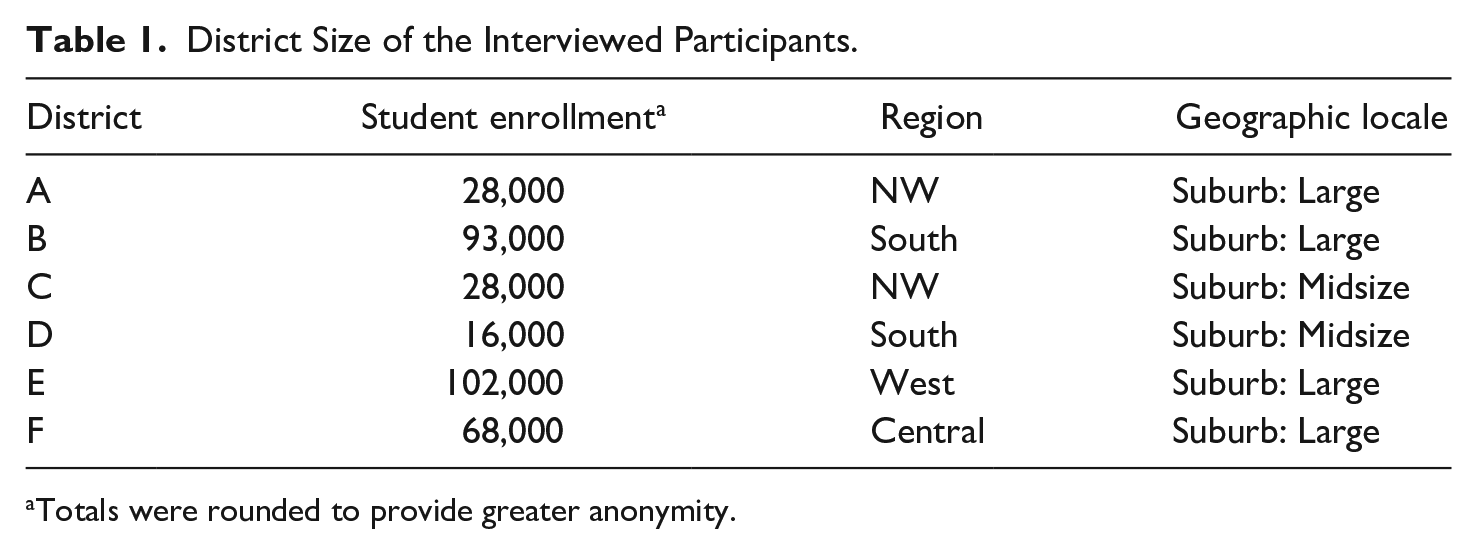
Totals were rounded to provide greater anonymity.
Instrument Development
The survey was developed by the research team, and the design of the survey was developed with specific guidance from the NASP and NASRO (2020) published Best Practice Considerations for Armed Assailant Drills in Schools guide. The survey went through several iterations after multiple systematic reviews by the authors. The resulting 25-item survey begins with three questions regarding participants’ professional background. The content of the next 14 questions related to active shooter drill protocols at the participants’ respective school districts. These questions were closed-ended with an additional text entry option for 10 out of 14 responses. The last portion of the survey asked eight 5-point, Likert-type scale questions in which participants rated their level of agreement (from strongly disagree to strongly agree) regarding a variety of statements on the impact of active shooter drills.
Interviews consisted of 14 to 16 questions each and were developed after analyzing survey data to identify themes of further interest. Five questions pertained to the career background of school safety specialists, four questions asked about their policy perceptions, and five to seven questions asked about the development and enactment of active shooter drill policies in the district. Of the policy development and enactment questions, four were standard for all interviewees, and an additional one to three questions were tailored to interviewees based on their survey responses.
Data Analysis
To analyze survey data, descriptive statistics were computed for each item. To analyze interview data, qualitative content analysis was used to identify themes related to the RQs (Schreier, 2014). Interview transcripts were read and analyzed. Two main themes emerged: perceptions and implementation practices. These themes were present in each of the practice areas found in the recommended practices of the NASP and NASRO guide. Transcribed interviews were placed in a coding sheet to allow for ease of coding. After coding, a final pass through the interview transcripts was conducted to search for negative instances and identify statements that further clarified survey or interview findings.
Findings
The findings for this study are presented and discussed in the order of the RQs; both survey and interview responses were analyzed sequentially.
Alignment With NASP and NASRO Practices
Findings indicated that the school districts represented in the study practices are mainly aligned with the best practice guidance suggested by NASP and NASRO (2021) in the published practice guide. Areas of misalignment include pre-drill procedures, modifications for developmental appropriateness, explicit attention to mental health considerations, and post drill processing. In interviews, school safety specialists identified a variety of strengths to their districts’ current approach, often emphasizing district-specific modifications and highlighting the measures designed to reduce fear instead of increase anxiety. Challenges cited by safety specialists include the potential for burnout due to the frequency of drills and the difficulty of creating a standard approach for diverse schools across the district.
Drill preparation
The NASP and NASRO guidance recommended that students and staff are notified in advance when drills are going to be conducted because notification may help minimize the risks for students and staff who believe an unannounced drill is real. A few respondents indicated that teachers are told in advance (n = 11, 52.4%), and a slight minority of respondents (n = 10, 48%) indicated that students are told in advance when there is going to be an active shooter drill. Those who responded “not sure” elaborated that schools may have discretion concerning advanced notification or there may be a mix of announced and unannounced drills.
Interview data revealed a variety of approaches to advanced notification. In an interview, the school safety specialist from District F explained that their district practice includes announced drills the first 3 months and then transitions to unannounced drills to instill more confidence in staff and students to respond in an unexpected emergency, because “you’re not going to know in advance when there is an emergency going to happen.” District Specialist D explained that teachers preferred to know about drills beforehand so they can prepare to perform “correctly,” as teachers are accustomed to scrutiny and evaluation regarding their instruction. However, from the safety specialist’s perspective, unannounced drills make it possible to evaluate “what is working and what’s not” in a context more closely resembling the actual emergency. In an opposing example, the school safety specialist from District E described giving teachers a packet at the beginning of the year that explains drill procedures, why they are conducted, how to discuss them with students, and the schedule of drills—much of which is posted online for parents to access. However, the schedule gives a general indication of when the drill will be conducted (e.g., early February), omitting exact time and date. This specialist explained that giving an indication of when drills will be conducted was a decision based on research and in consultation with student services and other stakeholders. The packet serves to ensure that teachers have the tools to conduct a discussion with students prior to the drill. The district specialist elaborated, “we’re not here to traumatize kids. We are here to give them some tools.”
Although active shooter response training for substitute teachers is not explicitly listed as a recommendation in the best practice guidance by NASP and NASRO (2021), it is recommended that substitute teachers be oriented to the school building and campus layout to mitigate confusion in light of a drill (NASP & NASRO, 2021, Appendix 1). Most districts indicated that substitute teachers (n = 18, 85%) and volunteers (n = 12, 55%) were trained to respond to active shooters.
Another recommendation from NASP and NASRO (2021) best practice guide suggested there be an option to opt out of drill procedures for those who do not feel it would be beneficial to them. Most districts (n = 14, 67%) indicated that there are not alternative options for students or teachers who would like to opt out of drill procedures. This finding is divergent from the recommendations outlined in the NASP and NASRO (2021) guidance. In alignment with the stance that “participation should never be mandatory” (NASP & NASRO, 2021, p. 1), parental consent should be required for drill participation. Consent options include parent permission, in which parents return a permission slip giving consent to participate; passive consent, in which parents return a form only if they do not wish for their child(ren) to participate; and parent notification, which notifies parents but does not include a consent form, meaning parents must go out of their way to opt out. Most districts (n = 12, 55%) indicated they do not require consent. Districts that do require consent utilize passive consent (n = 2, 9%), parental notification (n = 7, 32%), or other means (n = 1, 4%). The fact that most responding districts do not give an option for non-participation likely stems from the state’s monthly drill requirement. In an interview, District Specialist D expressed the belief that per the law, it was not possible for a student to opt out, just as students are not allowed to opt out of fire drills.
Finally, another practice consideration for pre-drill procedures recommends that before walkthrough drills, tabletop exercises be conducted to talk through safety scenarios in a low-stress environment. Most districts (n = 19, 91%) responded that they do provide guidance for how to facilitate conversations before drills. “Other” responses (n = 2, 10%) were explained by the use of partnerships with outside providers whose training may include guidance on tabletop exercises. In interviews, specialists who stated guidance was provided reported using the guidance of training partners such as ALICE, Civilian Response to Active Shooter Events (CRASE), and the “I Love You Guys Foundation” when asked about how conversations are conducted before drills. However, it was not clear that pre-drill tabletop conversations were incorporated into district policy concerning drill procedures.
Drill procedures
The NASP and NASRO (2021) guidance described simulation drills as the most advanced type of active shooter training and warn that they may be traumatic for some participants. Forty-two percent (n = 8) of districts reported using simulation techniques. However, six out of eight further explained that the only simulation used is PA announcements (e.g., shooter location tracking). Only one district reported using props and elaborated that props are only used when there are no students on campuses. Interview respondents uniformly expressed disagreement with highly sensorial drill procedures.
Most districts (n = 15, 71%) surveyed responded that they have different procedures in place for active shooter drills for younger students. Respondents explained these differences could take the form of age-appropriate videos, PowerPoints, or the use of differentiated language to explain the drill process to younger students. In interviews, several specialists mentioned the need to adapt drills for older students in ways that engage them. For example, the safety specialist from District C explained, With the younger kids, we are a little bit more tender and we don’t simulate gun fire. We don’t simulate explosions. We don’t simulate screaming and running and bad guys in the hallway yelling and stuff, so that’s good for them. For the older kids we don’t do that either, but with the older kids we are a little more stern with them. They can become complacent with it. They think it’s a joke. They get on their cell phones, so that age we really work with them to make sure they take it seriously and stay off their cell phones, and we explain it a little more to them. We give them a little more detail.
The specialist from District A explained the difference in approach more practically: “You’re not gonna have a bunch of kindergartners try and tackle a guy who comes into a room.” Interviewed specialists described differentiating descriptions of how to run, fight, and hide, based on the age of students. The specialist in District F described using the kindergarten mascot to discuss drill procedures and giving older students more advanced training on how to respond in specific circumstances.
Another consideration included in the NASP and NASRO (2021) best practice report concerned differentiated drill procedures for students with neurodiversity. The guidance includes an appendix that lists considerations for individuals with neurodiversity, including differing physical abilities that might impede mobility or access to instructions, sensory challenges that may increase a distress reaction or limit ability to respond to instruction, and unique abilities that may affect understanding of instructions and comprehension of the situation. Most districts (n = 14, 67%) responded that they do have different procedures in place for students with neurodiversity or differing physical abilities.
Most respondents referred to differentiated plans for students with more severe or notable varying physical abilities or neurodiversities (e.g., students who use a wheelchair for mobility) or students in self-contained classrooms or specific schools. However, it was unclear how plans may be differentiated for, say, a student on the autism spectrum who is the only student with neurodiversity in a mainstream classroom. Furthermore, respondents described leaving specific teachers or administrators to develop a differentiated plan instead of a district-wide approach considering students with neurodiversity. While this level of individualization may be helpful for developing plans for a wide range of students, a lack of specific district guidance may limit accountability or consistency and inclusivity throughout a school district.
Post-drill procedures
The NASP and NASRO (2021) recommended that after a drill, students and staff should have access to mental health professionals, and staff should be knowledgeable about recognizing trauma that may occur as the result of a drill. Most districts (n = 14, 68%) indicated that they do provide training on how to recognize and respond to trauma as a result of drills. Those that responded “other” (n = 4, 18%) explained that teachers receive general training on mental health and recognizing trauma or indicated that training was designed to eliminate a trauma response. Similarly, 81% (n = 17) of respondents reported that they provide guidance for teachers or staff on how to facilitate discussions with students about their emotional response to a drill.
Interviews revealed a bit of a paradox regarding the recognition of trauma as a result of drills. All respondents explained that their district trained teachers and staff on how to recognize trauma, inclusive of but not specific to active shooter drills. Mental health training for teachers was required by SB 7026. Yet, collaboration with mental health experts was repeatedly identified as a challenge. An exception is the safety specialist from District E, who described an intentional effort to collaborate with student services to build networks between school counselors, social workers, law enforcement, and educators. They explained, “If before the drill, they’re all happy and playing around and afterwards they’re all of a sudden a clamshell, we have very often called the school counselor who calls the social worker.” The safety specialist credits relationships that have taken over 2 years to build, which clarify steps for seeking help, elaborating, “So the high school kid who has PTSD or something like that, they’re going to think ‘I know exactly who to talk to’, whether it’s for a drill or anything else.”
Perceived Strengths and Weaknesses
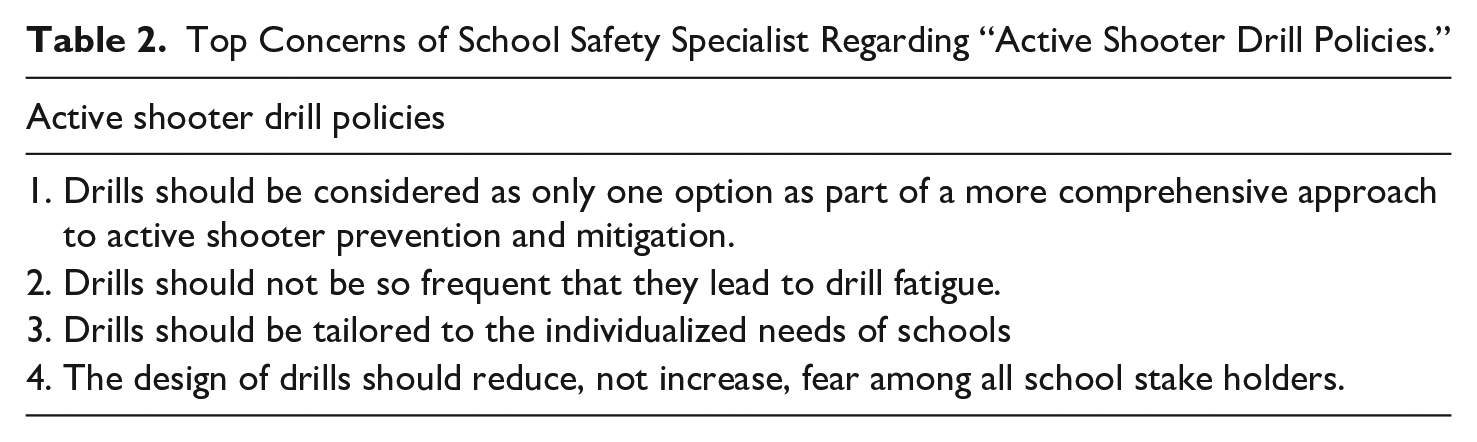
The second RQ was aimed at understanding school safety specialists’ perspectives regarding the affordances and constraints of their current active shooter drill policies and practices. Analysis of interviews with six school safety specialists suggested consensus regarding the benefits of active shooter drills and law enforcement collaboration, but also identified a number of challenges in the current approach (see Table 2).
Top Concerns of School Safety Specialist Regarding “Active Shooter Drill Policies.”
Strengths
All school safety specialists interviewed spoke positively about the benefits of active shooter drills, although most emphasized the role of drills as only one component of a broader effort to support school violence threats. Interviewees described drills as ways to increase situational awareness, with benefits beyond school safety, and saw drills as supplemental to school-based threat assessment measures. Specialists emphasized drills as a means to give teachers and students options for how to respond in emergency situations.
Importantly, all interviewees emphasized that drills should be designed to reduce, not increase, fear, and references to the potentially negative consequences of hyper-realistic drills were common among all participants. Regarding their approach to drills, the specialist from District B explained, “we wanted it to be valuable, but it doesn’t have to be frightening to do it.” Referencing media stories about drills that used simulated gun shots and demarcated “Kill Zones” in classrooms, the respondent continued to emphasize that they “don’t want to terrorize kids” and described “softening” the language used to describe actions such as identifying safe places to hide. The specialist from District A suggested they would not comply with a policy that required hyper-realistic drills: “I think that anything that tries to push up to active shooter drills with cops running around and students in the hallways is absolutely ridiculous and I’ll fight against that.”
In each case, school safety specialists expressed pride in district-specific approaches to implementation of the state requirement for active shooter drills. For example, one specialist (District F) described the benefits of combining fire and lockdown drills, explaining that in addition to efficiency, the combined approach prepares teachers to respond in situations where an assailant might use a fire alarm to trick students into leaving classrooms. Fire drills in their district begin with a lockdown, followed by an evacuation once an administrator confirms the fire drill. In District F, the safety specialist emphasized the use of the latest technology and modernizing the approach and infrastructure they inherited. In almost all districts, specialists described adapting existing district-specific procedures or resources to integrate plans for active shooter drills.
Challenges
A common challenge described by school safety specialists concerned developing a standard approach to active shooter drills for diverse schools and students with varying needs across the district. The challenge seems to stem from tensions between the need to present a district-wide approach, while enabling teachers and administrators to develop options that work for their context. Tailoring drills to fit school and district needs was frequently mentioned as a strength. For example, the safety specialist in District A explained, “I don’t do a one-size-fits-all. The laws come out one-size-fits-all. The boots on the ground—we’re doing it in a manner that makes sense to the end-users. That’s teachers and students.” On the contrary, the specialists from Districts B and E explained that it was important to develop a consistent message and described the challenge of crafting a common language and a generic drill procedure—with associated training—that can be adapted to fit individual scenarios. For example, the specialist from District E describes developing a “cookie cutter” approach to training that can now be built upon, “we have a very good foundational piece and then schools have now learned how to personalize it for their campuses and they’re taking ownership of that.” Explains the specialist from District F, “You’re dealing with humans and you need to let them make decisions based on what they’re facing—the threat they’re facing.” Several interview respondents described a goal of streamlining training for drills so that teachers, administrators, staff, and SROs will have exposure to the same basic approach.
Another way the tension between a standardized and context-dependent approach was evident was through discussion of tailoring drills and drill discussions to specific age groups and abilities. Although most districts reported adapting drill procedures to diverse age groups and abilities, in interviews, most respondents described persistent challenges, such as finding ways to account for students with varying cognitive abilities following an evacuation and engaging older students who may have participated in dozens of drills since entering schools.
The number one challenge referenced by all specialists was drill fatigue, which stems from an update to the Marjory Stoneman Douglas Act requiring at least as many active shooter drills as fire drills, which is once monthly (Federal Bureau of Investigation (FLDOE), 2019). Respondents expressed uniform concern that the frequency requirement decreases the value of drills, a phenomenon already witnessed with older students. As one respondent (District B) explained, “I just don’t want it to be just that they were putting a number on a paper. You know, you had X number of drills. I want them [drills] to mean something.” Another specialist (District E) lamented that given their frequency, fire drills are already meaningless, especially for students, and expressed concern that if active shooter drills continue to be required with the same frequency, they will “become very robotic.” Another interviewee (District F) described actively advocating for the legislature to reduce the number of drills.
Discussion
The general alignment between NASP and NASRO (2021) Best Practice Considerations for Armed Assailant Drills in Schools practices and reported practices suggested that the creation of a district-level school safety specialist position and the required training have, to some extent, helped bridge research and practice in regard to active shooter drills. However, misalignment and challenges are noted, and much more research is needed to understand the multifaceted impact of active shooter drills and whether or not the potential for harm outweighs benefits. Although the focus of this study was on district approaches to an active shooter policy in a single state, findings may be used to inform potentially fruitful directions for policy, practice, and research more broadly, especially given the increased prevalence of active shooter drills around the United States. A limitation of the study was that the data for this study included 31% of the counties representing 43% of the schools in the state of Florida. Conversely, the school districts that replied are general representative of other districts in the state sans local nuances.
Throughout the following discussion, it is important to note that this study did not collect evidence for whether or not active shooter drills should be practiced in schools. Rather, the focus of the investigation was how a statewide active shooter drill policy is being implemented. The findings may be used to inform approaches to active shooter drills if/when they have already been selected as a school safety measure.
Implications for Policy
Federal guidance regarding preparation for active shooter scenarios leaves considerable discretion to local education authorities in determining if and how to conduct active shooter drills (USDOE, 2013). Accordingly, Florida created a statewide policy mandating drills but gave districts some autonomy in how to implement the policy (FLDOE, 2019). Essentially, the state mandated the quantity but not the quality of drills. All of the interviewed school safety specialists criticized the frequency of drills. Too many drills may not increase actual safety or perceived safety, because frequent drills may result in more reminders of the threat of violence (Walker, 2020) or, conversely, drill fatigue, where the drills are no longer taken seriously. Furthermore, mandating the frequency of drills makes it difficult for students and staff with prior trauma experiences to opt out of drill experiences that may be emotionally distressing (Schonfeld et al., 2017).
Furthermore, the state’s focus on quantity without an emphasis on quality led to variations in the way drills were implemented. While this flexibility is aligned with federal guidance on context sensitivity and mostly praised by school safety specialists, a more proactive approach to establishing guiding principles could help deter drill practices that fail to minimize potential for harm. The position of school safety specialists may be one-way Florida sought to ensure drill quality. In this study, some evidence supports that this approach did lead to drill policies aligned with evidence of NASP and NASRO’s best practices guidance. The survey indicated more alignment than misalignment with these practices, and all interviewees demonstrated knowledge of research and resources related to mitigating negative consequences of active shooter drills. However, there was evidence of practices that could impede goals of a safe school climate for all students, including inattention to the potential of trauma as a result of a drill and procedures to address diverse student needs.
Given the potential for negative consequences of active shooter drills and the limited fiscal resources with which most schools must operate, careful attention should be given to implementation of active shooter policies. The observed variations in approaches to drills suggest that if policy makers at the state, district, and school level decide to adopt active shooter drills as part of their emergency management plans, they should acknowledge potential negative effects of drills (e.g., trauma experiences and increased perception of fear) and consider measures that address the quality of drills as well as the quantity. Results support the need for flexibility in designing drills that meet unique school and student needs but suggest that flexibility should be balanced with guidance on mitigating potential negative consequences.
Although districts are moving to include policy additions that incorporate active shooter drills, it should be noted that these instances are rare. Districts need to be mindful that fear and negative emotions should not be the only source driving policy change and can actually lead to unintended negative consequences (Madfis, 2016).
Implications for Practice
Another implication of this analysis is that schools and districts practicing active shooter drills may need support in two key areas: (a) strengthening partnerships with mental health professionals in the design and implementation of drills and (b) building capacity to support students with diverse neurological needs. While most survey respondents reported efforts to mitigate the potential for trauma following a drill, survey and interview responses indicated a need to further involve mental health experts in guidance regarding pre and post drill procedures. Relatedly, findings point to a need to identify ways to consider the needs of students with neurodiversity in drill designs. Survey and interview results both indicated that school safety specialists struggled to balance the need for a standardized approach with the reality of diverse student and school contexts, particularly for students with neurodiversity. Developing and disseminating research-based guidelines that consider family and community concerns could help schools and districts scaffold drills in ways that minimize potential for harm.
Implications for Research
Ultimately, adequately supporting the implications of this study requires more research into the processes and outcomes of active shooter drills. The present study is limited by its focus on the perspective of one type of stakeholder and how Florida’s active shooter drill policy has been implemented and understood by the agents charged with organizing its implementation. We saw this is a crucial first step to future research focused on how active shooter drills affect teachers, students, and families. In addition to indicating the actual procedures that districts employ, the focus on school safety specialists provided evidence of how these key implementing agents interpret and frame the policy. The ways in which school safety specialists make sense of the active shooter drill policy affect not only prescribed drill procedures but also how values surrounding the policy are communicated and represented to other stakeholders (Spillane et al., 2002).
To further understand if and how active shooter drills should be implemented, more research should be conducted nationally to consider stakeholder perspectives regarding drills, particularly students, caregivers, and teachers, and when appropriate, how specific approaches to active shooter drills are experienced by different stakeholders and populations. There has been evidence that students’ anxiety and lack of perception of safety rise after active shooter drills. Further research should examine when students become anxious and what factors contribute to this anxiety (time of assessment and violence rate where the school is located; Schildkraut & Nickerson, 2020). Further investigation into the policy development process may provide insight into whose interests are represented when active shooter drills are adopted as a school safety measure. The shared goal of creating safe learning environments for students should be leveraged to engage stakeholders in creating policy, research, and practice collaborations that effectively advance understanding of how to support safe school environments.
Footnotes
Declaration of Conflicting Interests
The author(s) declared no potential conflicts of interest with respect to the research, authorship, and/or publication of this article.
Funding
The author(s) received no financial support for the research, authorship, and/or publication of this article.
