




Abstract
This article argues that Eastern Europe continues to be defined and redefined not just by the actual patterns of socio-economic and political reproduction of the distant and proximate regimes governing the region but also through the perceptions of such legacies as generating fundamental similarities. Such perceived similarities, whether or not closely mapped on the objective parallels among countries in Eastern Europe, facilitate intra-region diffusion that results in (further) spatio-temporal socio-economic and political similarities specific to the region. To illustrate this relationship between precommunist and communist legacies, intra-region diffusion, and the production of Eastern Europe, the article examines Slovakia’s diffusion entrepreneurship in the wave of electoral breakthroughs in Eastern Europe in the late 1990s and early 2000s. This article contributes to the literatures on Eastern Europe and comparative democratization in two main ways. First, it adds to the work on the impact of spatio-temporal dependence on transition outcomes, such as democratization, in Eastern Europe. Second, by doing so, the article also documents the impact of an understudied set of democracy promoters—the Eastern European countries.
Memo 98 is a Slovak (election) media-monitoring group, which played an important role in the 1998 Slovak democratization campaign and the subsequent improvement in the quality of Slovak democracy. Since then, Memo 98 has participated in election observation missions and media-related trainings in a number of Slovakia’s neighbors. Memo 98 reports that it seeks to aid their pro-democratic oppositions primarily because their local rulers are “postcommunist dictators who abuse the law to restrict civic and political freedoms, much like Slovakia’s [illiberal pre-breakthrough ruler] Meciar” had done. 1 Together with other Slovak nongovernmental organizations (NGOs) and with some Slovak government officials, Memo 98 has helped spread abroad the Slovak “electoral breakthrough” model centered on a civic campaign to expose electoral fraud and mobilize the citizenry to defend democracy. These Slovak efforts have had little success in autocracies such as Belarus but have contributed to the electoral breakthroughs in countries such as Croatia, Serbia, and Ukraine in the 2000s.
Memo 98’s efforts to support democratization abroad are a good example of how the perceived fundamental similarities among the Eastern European countries—legacies of their shared pre-communist, communist, and post-communist history—facilitate regime change diffusion among these countries. 2 In its diffusion entrepreneurship, Memo 98 is not unique among Slovakia’s NGOs, and neither is Slovakia among other Eastern European countries or the wave of electoral breakthroughs among other waves of regime change in Eastern Europe. 3
This article uses the democratization diffusion entrepreneurship of the Slovak NGO sector to illustrate a broader argument—that Eastern Europe continues to be defined and redefined not just by the actual patterns of socio-economic and political reproduction of the distant and proximate regimes governing the region but also through the perceptions of such legacies as generating fundamental similarities. Such perceived similarities, whether or not closely mapped on objective parallels among countries in Eastern Europe, facilitate intra-region diffusion that speaks to the ways in which its peoples define it as a distinctive space and that results in (further) spatio-temporal socio-economic and political similarities specific to the region.
This article thus contributes to the literatures on Eastern Europe and on comparative democratization by adding to the work on the production of Eastern Europe as a region and on the significance of the shared communist, as well as pre- and post-communist, experiences of peoples in this space for this production. Also, by documenting that activists from new democracies seek to spread their democratization best practices to countries perceived to be similar, the article also contributes to the work on the impact of the spatio-temporal dependence of transition outcomes, such as democratization, in Eastern Europe and in general. Studying this diffusion further adds to the work examining the activities of the newly democratic Eastern European countries not just as recipients but also as providers of democracy support.
Intra-region Diffusion as Bridging Temporal and Spatial Dependence
Following the collapse of communism in Eastern Europe and the proliferation of work analyzing the spatial and temporal dependence of various transition outcomes, the question of Eastern Europe as a distinctive socio-economic and political space received a prominent place in the comparative politics literature, which began debating whether “transitology should be grounded.” 4
Some argued that “what distinguished state socialism from . . . other forms of dictatorship were its social structure, its ideology and ideological spectrum, its political economy, its configuration of political and economic elites, its pattern of civil-military relations and its position in the international hierarchy of power and privilege . . . [, that is,] virtually every dimension that economists, sociologists and political scientists recognize as important.” 5 Moreover, these authors found that the “boundary separating the authoritarian past from the liberalized present is a very porous one in Eastern Europe.” 6
Accordingly, scholars in this tradition have weighed in on the explanatory leverage of historical legacies (such as bureaucratic capacity 7 or informal regimes 8 ) compared to and combined with the dynamics of transitional politics in accounting for transition outcomes (such as democratization, 9 political party development, 10 or financial institutions 11 ). These authors have also assessed the relative importance of and interactions among various proximate and distant historical legacies—from the imprint of several decades of communism to the pre-communist socio-economic and political development of the countries in this region. 12 For example, some in this volume argue that there is a distinctive and fairly uniform communist imprint in areas such as primary education and the importance of the state sector in the economy, whereas in other areas of socio-economic development, either communism was unable to reverse longer term intraregional differences (for instance, GDP/capita) or its initially distinctive developmental imprint (on income equality, for example) has been fundamentally reshaped by post-communist economic reforms. 13
In addition to the works focusing on temporal path dependence, there has been some work that puts forth spatial dependence explanations of transition outcomes, such as democratization, and more generally of the distinctiveness of Eastern Europe as a region. Some have argued that the location of a country—including distance from the West, the regime in contiguous countries, and the flow of information and resources into a country—changes the nature of the transition dilemmas and influences both the available and actual choices of elites. 14 The focus of this literature has been primarily on the passive and active diffusion leverage 15 of the West (namely, its serving as a model for emulation and learning and its deliberate conditionality and support for democratization, respectively) 16 and only indirectly—on the passive leverage of the neighboring Eastern European new democracies. Similarly, studies of the wavelike propagation of regime change in Eastern Europe in 1989–1993 and 1998–2005 have found that many of the transitions in the region produced a set of practices that were spread across borders by some of its organizers and borrowed by aspiring transition organizers in other countries but explain the spatial progression of regime change primarily through wave dynamics and politics in adopter countries. 17
To take stock: Most of the studies on the importance of historical legacies have focused on actual temporal and spatial patterns of socio-economic and political reproduction and have overlooked the explanatory leverage of the perceptions of such similarities for the reproduction of Eastern Europe as a distinctive space. Moreover, most of the work on the impact of diffusion on transition outcomes documents the importance but does not examine the active leverage of regional (Eastern European) actors over transition outcomes in their neighborhood. While a few recent studies have begun analyzing the efforts of the new Eastern European democracies in spreading democracy abroad, 18 this work has yet to theorize their influence on the spatial unevenness of regime diffusion in the region and its production as a distinctive geopolitical space at particular times.
Yet, it could be expected that such intra-region diffusion entrepreneurs play an important role in the reproduction of Eastern Europe as a region. These activists and their states can be expected to purposefully spread democratization best practices to certain recipient countries over others, thereby influencing—though, of course, not solely determining—the spatial progression of regime change. This sharing of experiences is likely to focus on and to be welcomed primarily in countries perceived to be historically and politically “close,” 19 since such perceived similarities make diffusion both more likely and more successful. These perceptions can be constructed not just by successful and aspiring organizers of regime change but also by brokers providing political, moral, or financial support for the sharing of best practices between these organizers. 20 Whether brokered or not, the construction of “closeness” would likely be rooted in various proximate and distant historical legacies, namely, shared membership in and experiences under the different political regimes that ruled the region in the last few centuries. This is not to say that cross-regional diffusion rarely takes place but rather that its rate, and thus transformative impact, are much smaller than that of intra-region diffusion, in part because of the fewer perceived similarities between countries across different regions.
Intra-region regime diffusion, however, not only builds on but also reinforces region specificity since such diffusion contributes to—though, again, is not solely responsible for—the perception of and the actual production of political institutions specific to particular regions at particular times. Where successful, such regime change is likely to result in a similar mode of transition as well as in the empowerment of a similar set of domestic opposition actors. This same type of actors is likely to be empowered, if possibly to a lesser degree, even in countries with attempted but unsuccessful regime change in line with the diffused transition model. Moreover, in both the countries swept by the regime change wave and in the countries perceived as similar to them, the incumbent elites might further respond in similar ways to defeat or preempt these regime change campaigns. 21 It is in this wave–counter-wave dialectic that a region, such as Eastern Europe, is reproduced at given times as a distinctive space both as experienced by its peoples and as defined by actual resultant spatio-temporal political similarities.
Legacies and Intra-region Diffusion
To illustrate the importance of intra-region diffusion for the production of the region, this article uses a case study. It focuses on Slovakia’s diffusion entrepreneurship in the wave of electoral breakthroughs in Eastern Europe as a crucial but typical case of the relationship of interest. 22 Crucial cases are those “that, on all dimensions except the dimension of theoretical interest, is predicted to achieve a certain outcome, and yet does not” and that as a result, provide strong evidence of the relationship between the dimension of theoretical interest and the outcome of interest. 23 Slovakia represents a crucial case because it has actively spread its democratization best practices abroad—efforts that are surprising if one takes into account the theoretical factors ordinarily used to explain a country’s activism as a democracy promoter. Therefore, in documenting the importance of perceived intra-region similarities for motivating Slovakia’s diffusion entrepreneurship, this article provides strong evidence of the relationship between these perceptions and intra-region diffusion. At the same time, Slovakia is a typical case because it is paradigmatic of and thus well suited to illustrate the phenomenon of intra-region diffusion entrepreneurship and how it in turn contributes to the reproduction of Eastern Europe as a region. 24
In its diffusion entrepreneurship, Slovakia is not unique among the Eastern European countries. The two most recent regional waves of regime change—the collapse of communism in the late 1980s and early 1990s and the electoral breakthroughs in the late 1990s and early 2000s—unfolded in part through export and emulation/learning. Poland and the Baltic countries were exporters especially important for the spreading of the first of these waves, while Slovakia and Serbia, for the second. 25 In addition to the Slovak entrepreneurship in this second wave, Bulgaria and Romania exported their experience to Slovakia and Serbia; Serbia, to Georgia and Ukraine; Slovakia, Serbia, and Georgia, to Ukraine; and Ukraine, to Kyrgyzstan. 26 Moreover, bridging the two waves, Poland, the Czech Republic, and the Baltic countries shared their own democratization best practices with several of the countries that (successfully or unsuccessfully) carried out an electoral breakthrough, including Slovakia, Serbia, Ukraine, Belarus, Georgia, and Moldova. 27
While not atypical, this Slovak diffusion entrepreneurship still represents something of a puzzle. Slovakia was initially a democratization laggard and is not necessarily a regional normative leader expected by recipients or donors to spread democracy abroad. Slovakia is also a small and young state, economically dependent on the EU and energy dependent on Russia, and therefore, not necessarily expected to have the ambitious and proactive foreign policy that diffusion entrepreneurship requires. Further, the Slovak civil society is relatively young and resource poor and consequently not expected to actively seek to overcome the political, financial, and cultural costs of undertaking transnational activism. Slovakia is thus a crucial case in terms of theory building: its active but surprising diffusion entrepreneurship demonstrates the importance of perceived intra-region similarities in motivating intra-region diffusion, which in turn contributes to the production of actual and perceived spatio-temporal political similarities and as a result, to the production of Eastern Europe as a region.
More specifically, the article studies the diffusion activities of the Slovak civil society because it was with its efforts that Slovak official/state democracy promotion began and that Slovakia helped secure some democratization gains in the region. 28 The time period covered in this article is the years of the electoral breakthrough wave and its counter-wave—1998–2006. It should be noted, however, that Slovak NGO (and state) efforts to spread democracy abroad continued after the wave’s unfolding and had similar motivations and spatial patterns. 29 The arguments of this article thus can be expected to hold beyond the critical junctures of intense diffusion represented by regime change waves.
The case study relies on interviews with multiple representatives of all fifteen Slovak civic groups with sustained democracy support programs abroad in the period of interest. 30 These accounts were supplemented with interviews with Slovakia’s key foreign policymakers for the period covered and with other knowledgeable observers of the activities of the Slovak civic groups studied, such as their recipients and donors among others. The broader discussion of Slovakia’s role in the electoral breakthrough wave and its counter-wave and their importance to the production of the region is further based on secondary sources.
Slovakia’s Efforts and Impact as a Diffusion Entrepreneur
Slovakia was initially a democratization laggard but emerged as a democratization diffusion entrepreneur immediately after its own breakthrough. In response to the attempts of the ruling illiberal, nationalist elites to concentrate power in their own hands in the mid-1990s, the civic and political opposition in Slovakia began preparing a “nonpartisan public initiative, designed to help ensure free and fair elections”—the OK98 campaign, which featured the formation of a cohesive opposition, public debates about the costs of the regime and the necessary democratization reforms, campaigns to register voters and get out the vote (especially among the youth), and the deployment of both domestic and international election monitoring and exit polls. 31 The campaign ensured that the 1998 election marked a turnover in power and the development of a national consensus about Slovakia’s democratization.
The potential of the Slovak breakthrough to serve as a model for defeating illiberal incumbents reigning over “electoral/hybrid democracies” was immediately recognized by its organizers, by other prodemocracy activists in the region, and by a few U.S. donors who had supported the OK98 campaign. In late 1998, Freedom House provided support for several of the OK98 organizers to share their campaign experience with other Eastern European democratic activists. 32 At the request of oppositions throughout the post-communist region, prominent OK98 activists subsequently led a number of additional exchanges and seminars. Several Slovak NGOs built on these consultancies to launch full-fledged democracy promotion programs, and within five years the number of groups running such programs was more than a dozen. 33
These Slovak NGOs primarily cooperated with and trained/advised civic and to a lesser degree political elites abroad, supplying information, political support, volunteers, and at times funding. The Slovak activists helped with media and election monitoring, voter mobilization (including registration and get-out-the-vote campaigns and especially youth mobilization), pre- and post-election debates, and civic and political coalition building. The Slovak activists not only shared Slovakia’s democratization (and EU integration) experience with civic and political oppositions abroad but also monitored, “named and shamed,” and sometimes even trained foreign governments. In addition to spreading democratic norms and practices themselves, the NGOs also mobilized the Slovak public as well as the Slovak government and the European Union, the Council of Europe, and the Organization for Cooperation and Security in Europe. As a result, the Slovak activists helped pro-democratic forces in several neighboring countries to organize, successful and unsuccessful, electoral breakthroughs—Croatia (2000), Serbia (2000), Belarus (2001 and 2006), and Ukraine (2004).
As previously discussed, the Slovak activists were not the only external actors in these cases—they cooperated and at times even competed with other NGOs and state actors from both new and established democracies (especially the United States and the EU) among the latter. Similarly, Slovakia did not play the most important role among these external actors spreading democracy to these recipient countries. Like some of these other external actors, however, Slovakia helped shape the preferences and strategies of incumbent and opposition actors in these recipient countries. It empowered a similar set of domestic actors as the ones who organized the Slovak electoral breakthrough by improving their capacity through training, providing them with tested Slovak democratization innovations, and as a result changing their and their regime’s expectations that regime change is possible (as it had been in Slovakia). This is not to imply that the Slovak diffusion entrepreneurship was always successful or the most important factor behind the success of some of the Eastern European electoral breakthroughs. Rather, the Slovak case study is to provide an illustration of how countries in the region, motivated by perceived similarities with other Eastern European countries, seek to spread political innovations and best practices and in the process contribute to the production of the region as a distinctive political space.
The Slovak example and training contributed to the development of a united civic campaign in preparation for the 2000 election in Croatia as well as for the development of its main organizers, such as Citizens Organized to Monitor Voting (GONG) and the Civic Coalition for Free and Fair Elections (Glas 99). 34
The Slovak civic democracy promoters also helped strengthen the two main civic pillars of the 2000 Serbian democratization campaign: the Center for Elections and Democracy and the student movement Otpor, committed to challenging Milošević’s authoritarian hold over the Serbian polity. In addition, the Slovak activists worked with the Slovak foreign policy makers to mobilize a number of international organizations and foundations to support political change in Serbia, launching in 1999 the so-called Bratislava Process. 35 The Slovak embassy in Belgrade, together with the Slovak NGOs active in Serbia, also contributed to the unity of the anti-Milošević opposition. 36
Slovakia was similarly but less actively involved in Ukraine’s 2004 electoral breakthrough: the Slovak activists trained the Ukrainian opposition and especially its Yellow Pora wing, which even used a slogan created in Slovakia—“I vote, therefore I am.” The Slovak government further provided support for the activities of the Slovak activists in Ukraine, encouraged the unification of the political opposition in the country, and pressured the Ukrainian regime to guarantee free and fair elections. 37
Finally, the Slovak activists helped the Belarusian civil society to organize two “electoral breakthroughs” by providing similar support and training as they had in Serbia and Ukraine and by additionally involving the EU to supply support to the opposition and to criticize the regime. 38 Still, the opposition campaign attempts were unsuccessful in changing the Belarusian regime.
More broadly, the Slovak NGOs have also supported the development of a broader swath of civil society groups abroad. The Slovak activists cooperated with public interest groups speaking on behalf of different constituents and think-tanks producing reform ideas, helped organize a number of public debates abroad about the reform processes in neighboring countries, and assisted in youth and grassroots mobilization to improve their political competition.
Legacies and Slovak Diffusion Entrepreneurship
When asked how they began their transnational work, 83 percent of Slovak activists, whether they were solidarity-driven or strategically motivated, remarked on the importance of their “similarities” with or “closeness” to colleagues abroad.
The formal and informal ties of the Slovak activists to other pro-democratic activists abroad (often supported by the same Western donors or working in other branches of the same organization) allowed the Slovak activists to discover and recognize similarities and shared aspirations with certain activists abroad. As a result, many Slovak activists reported perceiving a sense of “duty” and a “moral responsibility” to assist such foreign colleagues. This solidarity motivated many of by the Slovak organizations with the necessary capacity to begin supporting democracy abroad sharing of Slovak democratization best practices. As a majority of Slovak activists explained, “there are still some similar countries, which are still authoritarian.” 39
In addition to such solidarity-driven intra-region diffusion of democracy, there were other, if fewer, Slovak democracy promotion projects that were motivated by available Western funding and subcontracting and the prestige and legitimacy of partnering with certain Western donors. To obtain such resources, frequently in order to secure the survival, maintenance, or growth of their organization, the Slovak activists proposed to “export [their] best practices” in “similar” countries where—these NGOs argued in front of their sponsors—these practices would “work.” In other words, even when they were driven by more pragmatic/strategic considerations, the Slovak NGOs were still mostly spreading their interpretation of various democratic practices in countries perceived to be similar.
On the recipient side, 73 percent of a representative sample of Serbian, Ukrainian, and Belarusian recipients of the Slovak activist assistance reported that one of their most important strengths as democracy promoters was the relevance of their democratization experience and expertise given the similarities between Slovakia and the recipients’ own country. 40 Many recipients commented, “We have a lot in common with them [the Slovak activists], so it is easy for us to understand how they managed their reforms and even to imagine implementing similar reforms.” Another commonly shared sentiment among recipients was that “they [the Slovak activists] are welcomed here because they have a good understanding of our life—after all, their life was not all that different from ours not that long ago.” 41 Last, a majority of these recipients noted that the Slovak democratization experience helped “change our [the recipients’] minds about many issues” because “we see with our own eyes that change is possible in a country similar to ours, even though such change seemed unthinkable before.” 42
The Slovak efforts to spread democracy abroad were rooted in three principal types of perceived similarities: (1) a history of communism/post-communism; (2) a history of imperialism/postimperialism; and (3) experience with illiberal, nationalist, and/or internationally isolated regimes—with most recipient countries defined as “similar” falling into more than one of these categories. 43 The geography of Slovak activism (see Figure 1) corroborates these activist narratives.
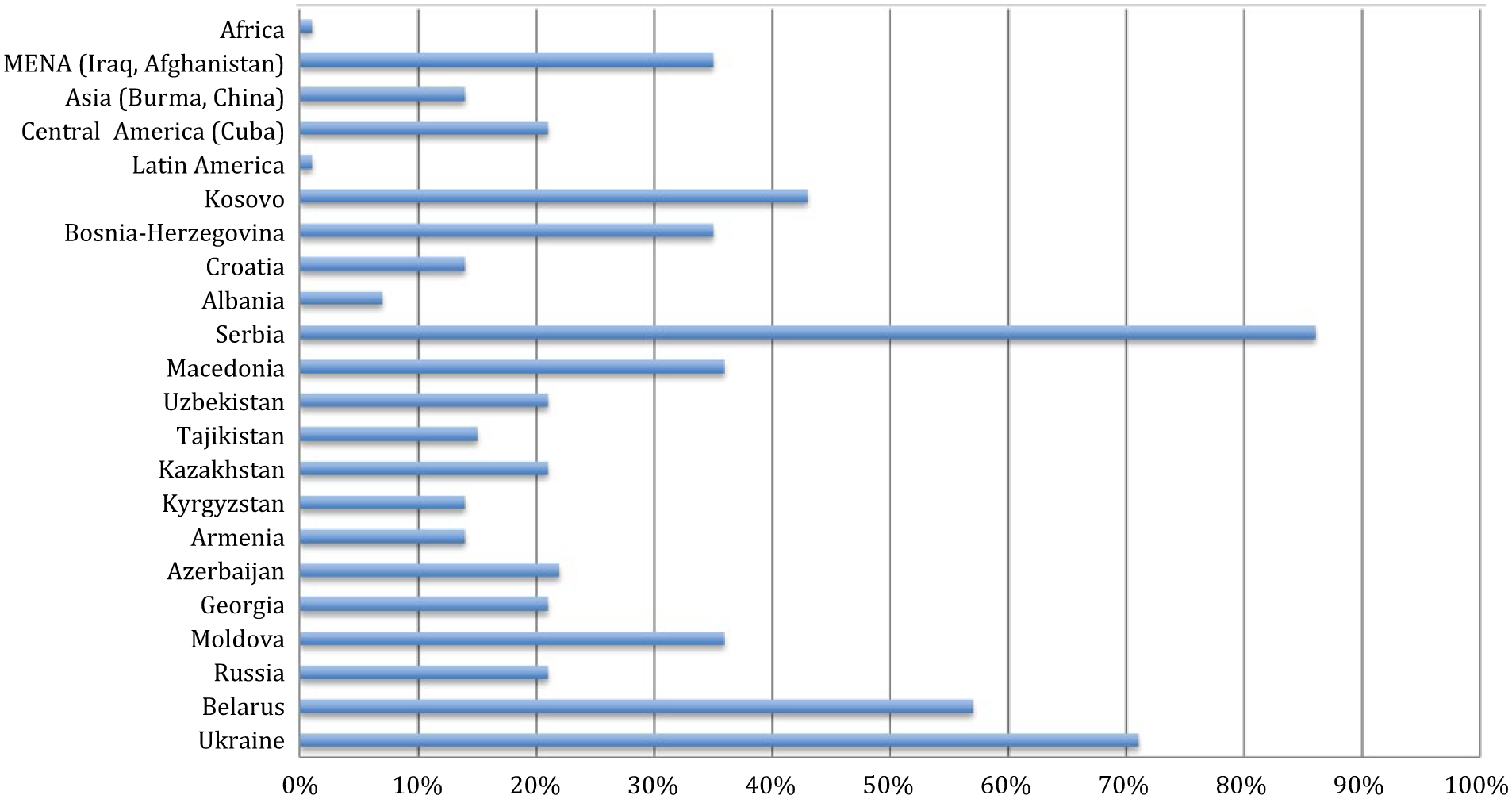
Percentage of Slovak NGOs with projects in target country out of all Slovak democracy-promoting NGOs
Eighty-six percent of the Slovak groups studied in this article were active in Serbia as the “closest” to Slovakia of all post-communist countries. Activists reported that these perceptions are based on “close mentality,” a product of the shared history Slovakia and the Western Balkans countries have in the Austro-Hungarian Empire, cooperation in the Small Entente, and then the “special ties” between Czechoslovakia and Yugoslavia. In addition, the Western Balkans countries are understood to be “small nations” struggling with nationalism, “arrested transitions,” and “setbacks on the road to the EU”—all experiences that the Slovak activists noted Slovakia to have had as well. 44 As a result, most Slovak activists consider these countries “kindred peoples,” among which Serbia has a privileged position because of the privileged position Slovakia and its minority has enjoyed for decades in Serbia.
Additionally, 71 and 57 percent of Slovak activists worked in Ukraine and in Belarus, respectively. A majority of the activists involved in these countries noted that although they are both large states and traditionally part of the Northeastern European space, they are nonetheless similar to Slovakia because they too are “new” European states that emerged at the end of the Cold War in the wake of a collapsed communist empire/federation and had initially made “hesitant progress toward democracy and EU integration.” 45 These similarities between Slovakia on the one hand and Ukraine and Belarus on the other were initially articulated by some of the U.S. donors who introduced these activists to each other, and these ideas were quickly embraced by a number of Slovak activists.
In other words, the assumed similarities between the Slovak activists and their partners abroad were often based on the multiple, and overlapping, legacies of the various distant and proximate regimes governing Eastern Europe. For example, according to the Slovak activists, Slovakia and its priority recipient, Serbia, share the experience of being new democracies implementing EU accession reforms, polities-successors of a nationalist hybrid post-communist regime, and peoples-subjects within the Austro-Hungarian empire. Also, even according to the Slovak activists themselves, some of the perceived similarities motivating their diffusion efforts (the Slovak-Serbian ones, for instance) mapped more closely onto actual socio-economic and political similarities than others (the Slovak-Ukrainian/Belarusian ones, for example). 46 In fact, some fairly strong intra-regional differences have developed over time—East Central Europe, South Eastern Europe, Eastern Europe, South Caucuses, Central Asia, etc. Still, perceptions of lasting legacies, however objective or subjective, motivated and facilitated Slovak diffusion entrepreneurship.
The similarities between Slovakia and other Eastern European countries perceived by the Slovak activists influenced in which countries the Slovak activists would seek to spread Slovakia’s democratization model. The similarities perceived by some of these countries allowed the Slovak activists to make a difference there (as discussed in the previous section), with the Slovak example and assistance helping some local actors to secure democratization gains that earlier seemed beyond imagination. Therefore, in addition to wave dynamics and politics in adopter countries, Slovakia’s active democracy promotion efforts contributed to the uneven pattern of the spatio-temporal diffusion of the electoral breakthrough wave that defined Eastern Europe as a distinctive political space in the late 1990s and early 2000s. The failed Belarusian regime change attempts, however, are a reminder of the limits of diffusion entrepreneurship, such as the Slovak example, and of the importance of wave dynamics and domestic politics in accounting for democratization.
Slovak Diffusion Entrepreneurship and the Production of Eastern Europe
Slovakia was one of the several Eastern European diffusion entrepreneurs whose activities, together with the emulation/learning efforts on the part of aspiring “electoral revolutionaries” and with support by actors external to the region (such as the United States), unleashed a regime change wave that reinforced the political similarities and the perceptions of such fundamental similarities among the countries in the region. 47 As discussed in the section on Slovakia’s efforts and impact as a diffusion entrepreneur, these resultant objective similarities included not only a similar mode of transition (electoral breakthrough) but also the empowerment of a similar set of domestic actors—civic groups involved in the political process (such as think tanks, watchdog groups, media and election monitors, etc.). According to scholars of the electoral breakthrough wave, these civic actors were empowered, if to a lesser degree, even in countries where they were unsuccessful in changing the regime. 48
In addition to such objective similarities, the electoral breakthrough wave created broader perceptions of continuing commonalities within the post-communist space. It was not just the countries participating in the wave that were considered to share such fundamental similarities but also most of the other countries that were part of the former Soviet Bloc and former Yugoslavia. While their oppositions were unsuccessful or did not organize an electoral breakthrough, their regimes participated in a counter-wave, unleashed by the electoral breakthrough wave. Belarus, Russia, Uzbekistan, Azerbaijan, and Kazakhstan for example, responded to the spread of regime change in their neighborhood by introducing a set of similar policies/institutions meant to prevent the organization of breakthroughs in their country. 49 These policies included cracking down on opponents and perpetrating electoral fraud in similar ways but different from the ones exposed during electoral breakthroughs, the establishment of pro-regime youth movements, and restricting the work of NGOs receiving external support and especially those necessary for implementing electoral breakthroughs. This counter-wave was again based on an assumption of similarities between the countries that experienced democratic breakthroughs and those that tried to preempt them: these incumbents felt threatened and sought to consolidate their power precisely because they perceived enough important such similarities and consequently feared the wave spreading to their country. 50 It was in this wave–counter-wave dialectic that Eastern Europe was reproduced as a distinctive space in the late 1990s and early 2000s both objectively and as a shared experience of its peoples.
Cross-Region Similarities and Diffusion
The articulation of much more superficial similarities (i.e., “electoral/hybrid democracies”) between some of the Eastern European countries and countries in other regions allowed for the cross-regional diffusion of the electoral breakthrough model. Some of its core features were invented and rehearsed in Chile and the Philippines 51 before the model was assembled and deployed in Eastern Europe and then made its way to the Middle East and North Africa region. As demonstrated by the geographic priorities of the Slovak NGOs, however, the rate of such inter-region diffusion is much lower than the rate of intra-region diffusion. This is in part because of the fewer actual and perceived similarities between countries across different regions and the consequent need for and risks around greater adaptation of the diffused practice.
It is also despite the diffusion brokerage of powerful actors such as the United States. 52 For example, U.S. encouragement, subcontracting, and abundant funding made available to encourage Slovak democracy work in Iraq did not produce sustained Slovak activism in this country beyond the end of the occasional project. As many of the involved Slovak activists explained, there are few “important” similarities between Slovakia and these countries. 53
Alternative Explanations
Could the electoral breakthrough wave and its spatio-temporal progression have been the work of powerful international actors orchestrating regime change in Eastern Europe rather than a product of regime change export and emulation/learning, motivated by the perceived similarities among the countries in the region? Certainly, the United States played an important role in introducing electoral breakthrough organizers to other Eastern European activists interested in organizing similar campaigns. Also, autocrats in the region have denounced these breakthroughs as U.S. orchestrated.
While the United States brokered the diffusion of the “electoral breakthrough” model and provided financial and technical assistance that helped develop the capacity of various Eastern European political and civic constituencies for reform, 54 there is no strong evidence that the United States orchestrated the electoral breakthrough wave. Previous studies on this topic 55 suggest that U.S. efforts to promote regime change in Eastern Europe were often limited, contradictory, and uneven, given the shifting geographic and competing national foreign policy priorities of the United States. The relevant U.S. efforts were also decentralized and even disorganized since there were a number of U.S. actors who sought to play a role. Perhaps more importantly, the United States actively promoted regime change in countries that include both cases of successful (Slovakia, Croatia, and Serbia) and failed (Belarus) electoral breakthroughs. Similarly, the United States also refrained from supporting regime change in countries that succeeded (Georgia and Kyrgyzstan) and in countries that failed (Armenia and Azerbaijan) in carrying out electoral breakthroughs. 56
Consider also the limited U.S. influence in steering the Slovak diffusion efforts, illustrated by the variable success of U.S. introductions of several Slovak groups to Ukrainian, Belarusian, and Iraqi activists. To take the difference in region between these Slovak recipients out of the equation, it should be noted that some of the same Slovak groups that chose not to sustain their support to Iraq have eagerly looked for funding to assist fellow activists in other third world countries such as Cuba, China, and Burma, since a history of communism/post-communism is one of the principal types of perceived similarities that underlie the Slovak efforts to spread democracy abroad.
Conclusion
The efforts of the Slovak activists to support the democratization of neighboring countries, perceived to be similar, by sharing Slovakia’s democratization best practices are a good illustration of how regional actors facilitate intra-region diffusion and contribute to its spatio-temporal unevenness. Studying this diffusion and the perceptions that motivate it offers a glimpse into how peoples in a region define it as a distinctive political space and what they perceive to be the legacies of proximate and distant regimes that have produced fundamental similarities among the countries in the region.
More broadly, examining the efforts of the new Eastern European democracies in spreading democracy abroad also moves the literature beyond the study of democracy promotion as a project of the “Western” economically developed and politically established democracies. Studying these efforts is an opportunity to rethink the overlooked role and impact of regional actors in the process of democratization and in maintaining the liberal international order, 57 reinforced and propagated through the democracy promotion efforts of regional actors, such as the Eastern European new democracies. Explaining these efforts further contributes to the literature on diffusion by answering previously unanswered questions, including (1) why certain actors, such as Memo 98 and the Slovak state, emerge as diffusion entrepreneurs looking to spread their regime change innovations and (2) why some norm adopters become norm promoters—Slovakia, for example, was in the early and mid-1990s a recipient of Western support but subsequently emerged as a noteworthy democracy promoter.
Eastern Europe represents an optimal region for pursuing this research agenda. It features (1) some of the most active democracy promoters among all new democracies born in the third wave of democratization as well as (2) a good amount of variation in the support the new democracies in Eastern Europe provide for democratization abroad. The region thus provides not only cases that are paradigmatic of the phenomenon of interest but also the variation necessary for painting a representative picture and solving a number of puzzles related to this phenomenon. 58 Such a research agenda can also build on a rich literature on Euro-Atlantic democracy promotion in Eastern Europe. 59 This agenda can also add to and move forward the work on “the pivotal role that non-Western regions and powers have played in maintaining international order since at least the end of the Cold War.” 60