



Abstract
The What Works Clearinghouse guidelines for high-quality professional development were used to develop a Tell, Show, Try, and Apply (TSTA) method of training. This method was used to train teachers to align instruction to grade-level content for students with severe developmental disabilities. A total of 193 teachers of students who participate in alternate assessment based on alternate achievement standards from three states participated in the first 2 days of training. A subset of 37 teachers participated in a 3rd day of training and submitted products from classroom applications. The impact of the TSTA training was evaluated to determine its effect on teachers’ instructional fidelity across three content areas (e.g., English language arts [ELA], mathematics, science) with their own students. In addition, generalization to new academic content aligned to grade-aligned standards developed by the teachers was taken. Results indicated that the professional development was effective not only in increasing teachers’ knowledge of alignment but also grade-aligned instruction with generalization across content. Future research questions and practical application also are discussed.
Keywords
During the past two decades, there has been a strong focus on school accountability, including not only student achievement but also teacher competency. The No Child Left Behind (NCLB) Act of 2001 (2002) raised the expectation for all students to show adequate yearly progress and for teachers to be highly qualified in their area of expertise. Early in the discussions of accountability, experts realized that the classroom teacher would be the key factor in student achievement (Ball & Cohen, 1999, Borko, 2004; Cohen & Hill, 2000). To meet higher student expectations, teachers would require extensive training, support, and guidance (Ball & Cohen, 1999; Putnam & Borko, 1997; Wilson & Berne, 1999).
This realization that teachers were significantly important to improving student outcomes created a new commitment to professional development for front-line personnel in classroom settings. For example, the National Council of Teachers of English (1996) and the National Board for Professional Teaching Standards (1989) established standards for professional teachers and teaching (Wilson & Berne, 1999). NCLB established criteria that teachers must meet to be considered “Highly Qualified” and required states to provide “high-quality” professional development. This high-quality professional development should (a) be sustained, intensive, and content focused; (b) be aligned with and directly related to state academic content standards, student achievement standards, and assessments; (c) improve teacher knowledge in the subject that they teach; (d) increase teacher understanding of instructional strategies based on scientifically based research; and (e) be regularly evaluated to assess the impact on teacher effectiveness and student achievement.
Although it is clear that professional development can guide teachers to improved instructional practices and increased student learning, there is not yet an evidence-base that establishes how teachers learn from professional development nor how this teacher learning affects student achievement (Desimone, Porter, Garet, Yoon, & Birman, 2002; Fishman, Marx, Best, & Tal, 2003). In a report prepared for the Institute of Education Sciences (IES), Yoon, Duncan, Lee, Scarloss, and Shapley (2007) identified more than 1,300 studies related to professional development for teachers. Of the studies examined, only 9 met What Works Clearinghouse evidence standards. Although only 9 studies met evidence standards, those studies showed moderate effects on student achievement (Yoon et al., 2007), demonstrating the impact of professional development on student achievement. The studies identified by Yoon et al. had a number of common characteristics. First, the studies that showed the greatest effects provided more than 14 hours of professional development. Second, 8 of the 9 studies provided some type of follow-up session that supported the main professional development session. Third, rather than a “train the trainer” approach, professional development was provided directly to the teachers.
Consistent with the findings of Yoon et al. (2007), the need for “follow-up” sessions to ensure generalization in teacher training is critical. Teachers need not only to gain new knowledge but also to apply it with new content, novel settings, and with additional students. This generalization may be the key to sustainability. Odom (2009) addressed the dilemma that when a practice is utilized without the “essential elements” in classroom settings, in ways dissimilar to their intended application, evidence-based research practices likely will not produce the positive outcomes demonstrated by researchers.
Identifying effective professional development for teachers of students with severe developmental disabilities is especially critical in this era of accountability. Of the nine professional development studies identified by Yoon et al. (2007), none targeted teachers of students with moderate to severe disabilities. Although current expectations are for students with severe developmental disabilities to show adequate yearly progress in language arts, mathematics, and science using alternate assessment based on alternate achievement standards (AA-AAS), the focus on academic curriculum is a recent phenomenon (Browder et al., 2003). Until NCLB (2002) required alternate assessments in these areas, many states focused their alternate assessments on the specialized functional life skills targeted in students’ Individual Education Programs (IEP) rather than the state’s academic content standards (Thompson, Johnstone, Thurlow, & Altman, 2005). Teachers of students with severe disabilities have reported mixed reactions to the idea of access to general curriculum for this population (Agran & Alper, 2000). These reactions may be due in part to the lack of professional development on how to achieve this access. For example, most textbooks in severe disabilities used in preservice training have only minimal coverage of academic instruction. In addition, because no research exists on how to design professional development for teachers of this student population on academic instruction, educational leaders have no guidelines for how best to train in-service teachers to meet the high standards of alternate assessments.
The purpose of the current study was to evaluate a method of professional development to train teachers in teaching content aligned with grade-level standards for students with significant cognitive disabilities who participate in AA-AAS. The professional development was based on recent literature reviews on teaching core academics to this population in the areas of literacy, mathematics, and science. Browder, Spooner, Ahlgrim-Delzell, Harris, and Wakeman (2008) found 68 studies of mathematics in their comprehensive review; however, most focused on numbers and operations or money management, whereas limited studies focused on the other standards of mathematics identified by the National Council of Teachers of Mathematics (2002). Courtade, Spooner, and Browder (2007) completed a search of the literature using key terms from the National Science Education Standards (NSES; National Research Council (NRC), National Academy of Sciences, 1996) and found 11 studies in which science content (i.e., weather words, first aid skills, relative position) was taught to this population. In a more recent review of the science literature, Spooner, Knight, Browder, Jimenez, and DiBiase (2011) identified components of systematic instruction (i.e., the use of task analysis and time delay in particular) to be evidence-based practices in teaching science to students with severe developmental disabilities. Browder, Wakeman, Spooner, Ahlgrim-Delzell, and Algozzine (2006) found 128 studies on teaching literacy (i.e., phonics, phonemic awareness, comprehension, fluency, vocabulary) to students with severe developmental disabilities; however, most focused on sight words, whereas few focused on the other areas of literacy as identified by the National Reading Panel (NRP).
The professional development in the current study also was gleaned from interventions used in newer research on teaching literacy (Browder, Mims, Spooner, Ahlgrim-Delzell, & Lee, 2008; Browder, Trela, & Jimenez, 2007), mathematics (Browder et al., 2010; Jimenez, Browder, & Courtade, 2008), and science (Browder et al., 2010; Jimenez, Browder, & Courtade, 2009). Courtade, Browder, Spooner, and DiBiase (2010) taught middle school special education teachers to implement a 12-step task analysis to instruct students with moderate intellectual disabilities to complete guided-inquiry-based science lessons. In addition, Browder et al. (2010) investigated the effects of task-analytic instruction in the content areas of mathematics (i.e., algebra, geometry, data analysis, measurement) and science (i.e., inquiry, physical science, earth and space science, life science) in a quasiexperimental group design with special education teachers randomly assigned to either mathematics or science treatment group. Results show that students made gains in their respective content area and researchers suggest task-analytic instruction as an effective strategy to teach core content skills to students with moderate and severe disabilities. These recent studies, together with the comprehensive literature reviews, suggest the use of systematic instruction strategies such as task analysis and time delay, or a system of least prompts can be applied to academic content instruction. Specifically, we selected the skills of using a task analysis in three applications for: (a) a story-based lesson in language arts, (b) a literacy-based lesson in mathematics, and (c) an inquiry-based lesson in science. We also chose to train the teachers to use a strategy to extend state standards described by Browder, Spooner, Wakeman, Trela, and Baker (2006) that we call “work it across.”
Using the literature on the qualities of effective professional development identified by Yoon et al. (2007), we then created a method for conveying these strategies to the teachers. The professional development included training on how the strategy could be implemented using videos and demonstrations with materials. Components to be implemented included providing information on the key findings of the research to date on each topic (T-tell) and then modeling those components for the teachers (S-show). Next, we had the teachers use the strategy in a role-play or planning activity (T-try). Finally, the teachers were given specific assignments to apply these strategies with their students (A-apply).
The following two research questions guided this study:
Research Question 1: What are the effects of Tell, Show, Try, and Apply (TSTA) professional development on in vivo applications of systematic instruction with the teachers’ own students in three content areas (i.e., English language arts [ELA], mathematics, and science)?
Research Question 2: What are the effects of TSTA professional development on generalization of systematic instruction to new content with the teachers’ own students in three content areas (i.e., ELA, mathematics, and science)?
Method
Participants and Setting
Teachers
Three states (two Southeastern, one Western) were invited to participate in the research. In total, 193 participants were invited to attend the first 2 days of a 3-day professional development series. To be eligible to attend the trainings, teachers needed to be serving 3rd- through 11th-grade students classified as having moderate, severe, or profound developmental disability or autism and who were participating in their states’ accountability system by taking AA-AAS (sometimes called the “1%”).
In addition, each state invited a subset of teachers from the first 2 days of training to attend a final 3rd day (Day 3) of more intensive training and to provide products to be used to evaluate the applications of the training with their students. In all, 37 teachers across the three states were identified by state special education administrators to participate in the 3rd day of training. Of the 37 teachers who received intensive training on Day 3, 21 provided evidence of teacher and student learning. Of the 16 teachers who participated in the training and did not submit evidence, 6 teachers (in one state) were not granted local Institutional Review Board (IRB) support to participate in the study and 10 chose to drop out of the study due to personal reasons (e.g., sickness, change of job duties).
A demographic survey was administered to these 21 participating teachers via email, with a response rate of 62%. Based on survey data, teachers participating in this study all taught in a self-contained classroom (100%) and 54% of teachers taught in urban school systems. Teachers indicated that they currently had an average of 2.6 paraprofessionals in their classroom on a daily biases, with a range of 1 to 7 paraprofessionals. Teachers participating in the study had an average of 7.4 years experience teaching special education. All teachers had a teaching license in the area of special education, with an undergraduate degree in special education (92%) or a master’s degree in special education (62%). Finally, 23% noted any professional development they had attended pertaining directly to the population of students (e.g., use of communication systems, community-based instruction, Treatment and Education of Autistic and Communication related handicapped Children [TEACCH]). Due to the unique nature of the TSTA professional development training package, none of the teachers had previously participated in the specific strategies taught during the 3 days.
All 3-day trainings were conducted in a central location (e.g., city in middle of state) within each respective state. The professional development took place in large conference centers, where teachers were seated around large round tables in groups of five to eight people per table. This setup allowed for teachers to work in small groups and role-play in pairs.
Students
Each teacher from the Day 3 training recruited one or two of their students who were classified as having a moderate, severe, or profound intellectual disability or autism and was currently participating in AA-AAS. A total of 49 students with moderate or severe developmental disability participated in the study. All assessments and interventions with students were conducted by the student’s classroom teacher within the special education classroom.
Professional Development Package
The trainings consisted of three full day (i.e., 7 hours) on-site trainings. Up to 75 teachers in each state attended the first 2 days. During both days, the presenters (coauthors) followed the TSTA training model. That is, the presenter would give basic information on a strategy from research (Tell) and then provide a model through video or other materials (Show). Next, the teacher would try the strategy in role-play or planning simulation (Try). Finally, the teachers were given ways to use the strategies in their classrooms (Apply). The 3rd day was devoted to the “Apply” segment of the training to help the subgroup teachers prepare for the products to be submitted from their applications. This strategy was implemented with the key strategies of (a) extending state standards (“work it across”), (b) using a story-based lesson for language arts, (c) using a literacy-based lesson for mathematics, and (d) using an inquiry-based science lesson. To help teachers remember the three academic content strategies, the components of each were introduced as “formulas” which are shown in Figure 1. These applications will now be described in more detail (see Figure 1).

Formulas for the content areas of English language arts, mathematics, and inquiry science
Extending state standards
In the morning of the 1st day, the teachers learned to extend state standards to plan an instructional objective for students with severe developmental disabilities who might communicate with different levels of proficiency. The strategy presented was called “work it across” in which the teacher begins with the expectations for the grade-level achievement and then creates examples for students who communicate at an abstract symbolic level, concrete symbolic level, or who are beginning with symbols (see example in Browder, Ahlgrim-Delzell, Courtade-Little, & Snell, 2006). The presenter gave background information on access (Tell), and then demonstrated how to extend a standard (Show). The participants then filled in a “work it across” table based on student symbolic levels (Try). Teachers had to know how to extend a standard to complete the generalization assignment.
Story-based lessons for language arts
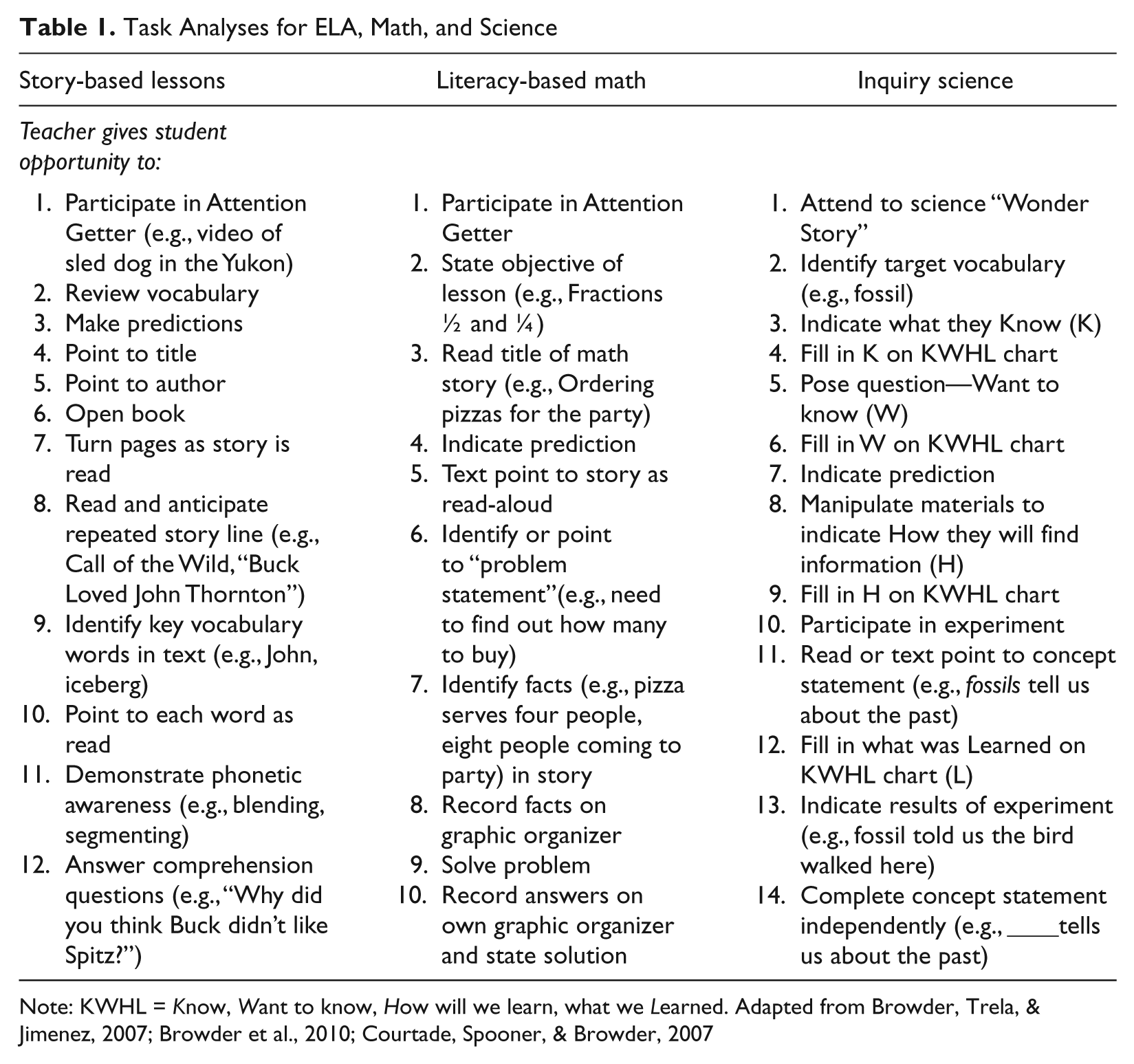
On Day 1 of the training, the teachers learned to use a read-aloud approach to teach a story-based lesson based on the research of Browder et al. (2007). Specifically, teachers learned to use a 12-step task analysis (see Table 1, column 1) using systematic instruction (i.e., least intrusive prompts) to teach grade-aligned literature (e.g., Call of the Wild, Because of Winn-Dixie) to their students. The presentation of information gave the research and background on this approach (Tell). Teachers then viewed videos of story-based lessons with a variety of students and age levels (Show). Afterwards, they role-played implementing a story-based lesson using adapted books and other materials provided (Try). The application for this strategy was to individualize and implement the story-based lesson task analysis provided (Apply). Finally on Day 3 of the training, additional videos were presented and teachers were trained to fidelity (90% or greater on all steps) on the task analysis using materials given by the researchers (e.g., elementary adapted novel, task analysis with specific notes for each step and materials [e.g., vocabulary cards, repeated story line] for Because of Winn-Dixie).
Task Analyses for ELA, Math, and Science
Literacy-based lessons for mathematics
In the morning of Day 2 of training, the teachers learned the strategy of teaching a literacy-based mathematics lesson based on the work of Jimenez et al. (2008) and Browder et al. (2010). Specifically, teachers were instructed to use a 10-step task analysis (see Table 1, column 2) using systematic instruction (i.e., least intrusive prompts) to teach grade-aligned mathematics content (e.g., linear equation, coordinate plane) to their students. After presenting background information and research on literacy-based mathematics instruction (Tell), the presenters used student videos to model how to use a read-aloud of a mathematics problem and then teach each computation step (Show). The teachers role-played conducting a literacy-based mathematics lesson using materials provided to teach solving an algebraic equation (Try). The application for this strategy was to apply the mathematics task analysis with their students and generalize it to new mathematics standards (Apply). Finally on Day 3 of the training, additional videos were presented and teachers were trained to fidelity (90% or greater on all steps) on the task analysis using materials given by the researchers (e.g., elementary adapted mathematics story, task analysis with specific notes for each step, graphic organizer, and manipulatives for a lesson on data analysis).
Inquiry-based science
In the afternoon of Day 2 of training, the final strategy the teachers learned was to conduct an inquiry-based science lesson based on the research of Jimenez et al. (2009), Courtade et al. (2010), and Browder et al. (2010). Specifically, teachers were instructed to use a 12-step task analysis (see Table 1, column 3) using systematic instruction (i.e., time delay, least intrusive prompts) to teach grade-aligned science content (e.g., chemical reactions, plate tectonics) to their students. After presenting background information and research on inquiry-based science instruction (Tell), the inquiry-based science lesson was then modeled using a video of a science lesson (Show). Next, the teachers role-played the science lesson using an experiment related to precipitation (Try). The application was to apply the science lesson to their students and generalize it to new standards (Apply). Finally on Day 3 of the training, additional videos were presented and teachers were trained to fidelity (90% or greater on all steps) on the task analysis using materials given by the researchers (e.g., secondary adapted science wonder story [i.e., adapted text with picture vocabulary]), task analysis with specific notes for each step, KWHL graphic organizer (Know, Want to know, How will we learn, what we Learned), and science materials (e.g., packet of Kool-Aid, concept statement, picture symbols for key vocabulary) for a lesson on chemical reactions).
Dependent Variables
There were three dependent variables: an alignment quiz, use of the task analyses with real students, and generalization of the task analyses to new state standards. All 193 teachers in Days 1 and 2 took the alignment quiz. Only the 21 teachers who stayed for Day 3 submitted evidence for classroom application and generalization.
Alignment quiz
The quiz had two parts. In the first, the respondent answered eight yes/no questions about alignment. Each question described an instructional strategy (e.g., teaching students at all grade bands to point to quarter) and asked if this was alignment to a state standard. If not, the respondent was asked to give the reason why it did not align (e.g., skill should change across grade bands and match grade-level content). Respondents received one point for a correct answer and one for an accurate reason. These eight questions were derived from the eight alignment criteria described by Browder, Wakeman, and Flowers (2009) and Wakeman, Browder, Jimenez, and Mims (2010). In the second section, the respondent reviewed ELA, mathematics, and science content standards and then listed two skills to teach that would align to the content standards. Finally, they filled in the three components of the formula for teaching each of the academic lessons as shown in Figure 1, which were strategies used to help them remember how to teach to the standards. Content validity of the quiz was evaluated by matching the quiz items to the intended outcomes of the treatment intervention. Interrater agreement was evaluated by having 67 quizzes independently scored by two raters. Item agreement ranged from 61% to 100% with a mean of 96%. Exploratory factor analysis was used to reduce the number of quiz items to a few factors that would be used as outcome variables in the analyses (Tabachnick & Fidell, 2007). Three factors were extracted from the 33 response items using principal components with an orthogonal rotation. The first factor, the Knowledge domain, included all the true/false items and the explanation that accompanied the teachers’ responses (16 responses) and had a Cronbach’s alpha of .76. The second factor, Formula domain, included all the open-response items that asked the teachers to complete the ELA, mathematics, and science formulas (9 responses with Cronbach’s alpha of .92). The final Skill Factor domain included the ELA, mathematics, and science constructed-response items of skills, and had a Cronbach’s alpha of .73 (see Figure 1).
Application of task analysis with fidelity
The 21 teachers who participated in the 3rd day were asked to submit evidence of their ability to apply the task analyses trained for teaching ELA, mathematics, and science through making videotapes of applications in their classroom. The researchers viewed these videotapes and scored each step of the applicable ELA, mathematics, or science task analysis as occurring or nonoccurring. A second observer scored a subset of the tapes. Interrater agreement was calculated as the number of agreements divided by agreements plus disagreements × 100%.
Generalization of the task analyses
Teachers also were asked to submit evidence of their ability to generalize these generic task analyses (Table 1) to new content standards. The same method was used to score these tapes for occurrence or nonoccurrence of each step of the task analysis. To be able to make this generalization, the teacher would have had to determine how to extend the state standard and then address the skill using the formula for teaching and generic task analysis.
Design
The effectiveness of this TSTA professional development was examined using a within-group experimental design (Creswell, 2005). For the alignment quiz, participants completed the measure before and after the training in a pretest/posttest design. For the classroom measures, we used a posttest-only design based on an assumption that the teachers’ knowledge of how to teach the skills would be too low to recruit pretest videos of teaching this content.
Results
Alignment Quiz
The pretest (n = 193) and posttest (n = 150) results for the three factors on the alignment quiz are shown in Table 2. Because teachers were not identified, the pretest scores could not be linked to the posttest scores, and three independent t tests were used to determine differences between the pretest and posttest scores. Due to the inability to link the pretests and posttests scores of participants, the statistical assumption of independence was violated and a statistical adjustment for correlated residuals was not made to any of the analyses. All statistical tests should be interpreted with caution. There were statistically significant increases for all three domains. The largest increase was found in the Formula domain, with 63% increase in the number of correct items. There was a 22% increase in number of correct items for the Knowledge domain and 16% increase for the correct items for the Skill domain. Also, the pretest Formula (<1%) and Skill domain (12.5%) scores were extremely low indicating, as had been expected, that very few of the teachers knew how to plan for teaching grade-level content (see Table 2).
Percentage Correct on Pretest, Posttest, and Gain for the Alignment Quiz

p < .001
Teacher Fidelity of Task Analyses
Of the 21 teachers who submitted evidence, only 11 teachers submitted evidence in both the first level (task analyses in ELA, mathematics, science) and the second level of evidence submission (generalization of task analyses in ELA, mathematics, science). The number of videos submitted by each of the 11 teachers ranged from one content area to three for all three content areas with a total of 30 videos across content areas. The mean percentage of steps that occurred for teaching the academic lesson using the task analysis in ELA (n = 10) was 90% with a range of 64% to 100%; in mathematics (n = 9) the mean was 84% with a range of 60% to 100% and in science (n = 11) the mean was 85% with a range of 46% to 100% (see Figure 2).
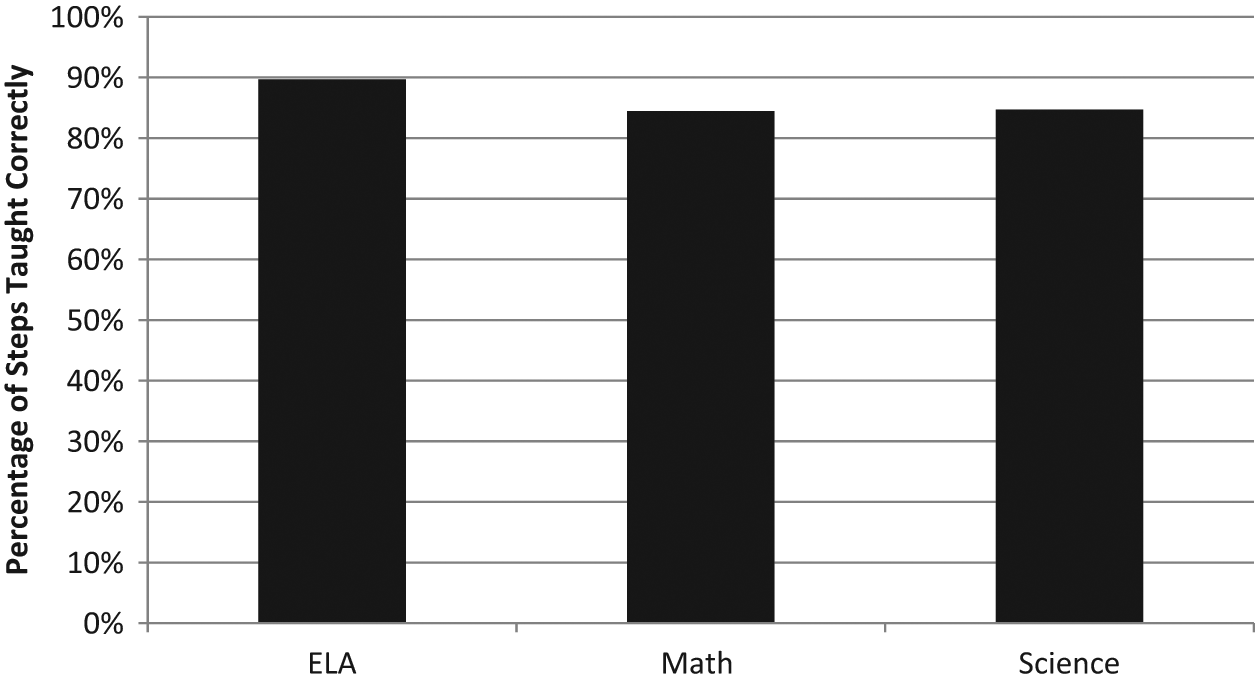
Percentage of steps teachers taught correctly for each of the task analyses (researcher-developed lessons)
Interrater reliability (IRR) was collected in ELA for 60% of the videos with a mean of 100% agreement. For mathematics, 33% of the videos were coded for IRR with a mean of 100% agreement and in science 36% were coded a mean of 100% agreement.
Generalization of Task Analyses to New Standards
The number of videos submitted for new standards were consistent across teachers; 9 of the 11 teachers who completed the first round of videos completed one video per content area, with a total of 18 video submissions. The mean percentage of steps generalized to a new standard using the task analysis in ELA (n = 9) was 84% with a range of 36% to 100%; in mathematics (n = 9) the mean was 83% with a range of 64% to 100% and in science (n = 9) the mean was 91% with a range of 69% to 100% as shown in Figure 3. IRR for ELA was obtained for 33% of the generalization videos with a mean of 100% agreement. For mathematics, IRR was obtained for 33% of the videos with a mean of 90% agreement and for science, 44% of the videos with 100% agreement (see Figure 3).
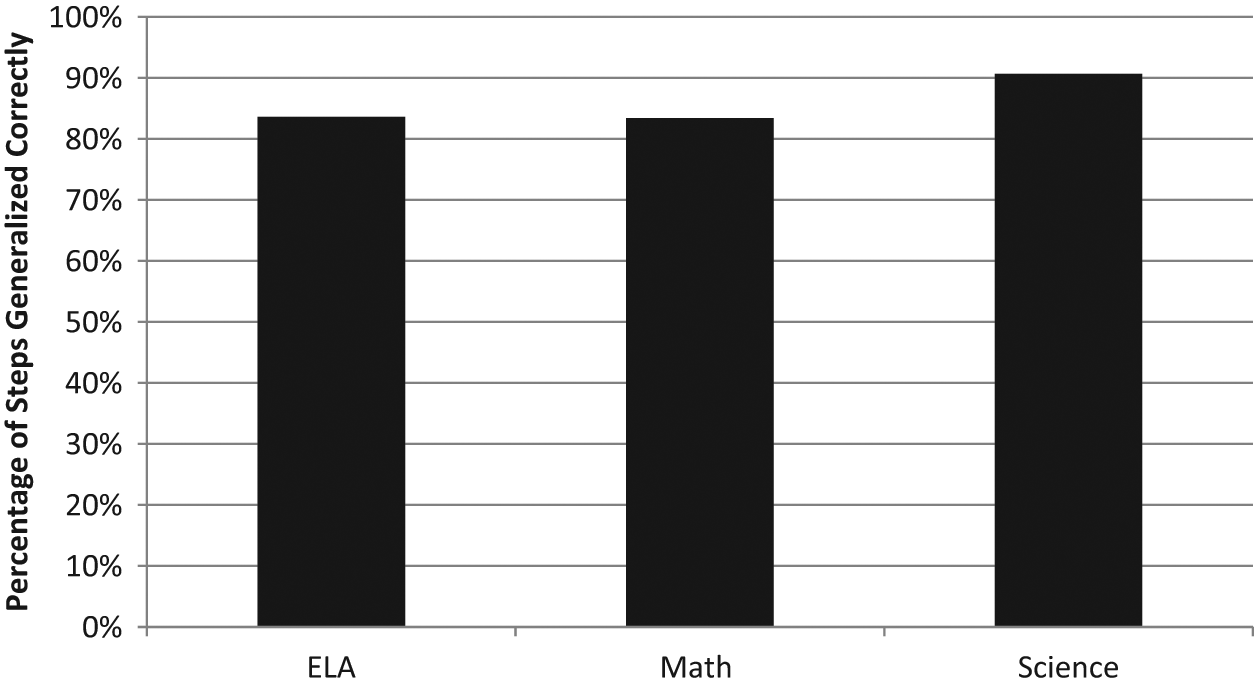
Percentage of steps of task analysis generalized to new standards (teacher-developed lessons)
Discussion
The purpose of this investigation was to develop a method for professional development, based on the What Works Clearinghouse guidelines for high-quality professional development, which we titled the TSTA method. We applied this method to train teachers to align instruction to grade-level content (i.e., ELA, mathematics, and science) for students with severe developmental disabilities. The larger group who participated in the first two professional development days demonstrated increased knowledge of alignment. The subset of teachers who practiced applications on a 3rd day and submitted products from their classrooms were able to use the task-analytic instruction approaches for story-based lessons, literacy-based mathematics, and inquiry-based science modeled in the training, and then to generalize these skills to their own classrooms, as well as to new state standards. These outcomes have important implications for planning how teachers are trained.
Methods for Professional Development
The TSTA method of professional development used the criteria for high quality described by Yoon et al. (2007). The first criterion is that professional development should be intensive (at least 14 hours). The TSTA professional development provided an intensive 3 days of training (total of 21 hours). The first 2 days of training focused on the larger group of teachers and the 3rd day focused on a select group of teachers to implement targeted practices in the classroom. The training for each day lasted for 7 hours with a focus on extending standards, ELA, mathematics, and science. The large-group professional development, that had as many as 75 participants in each group, was effective for the demonstration of knowledge of instructional alignment in 14 hours of training. The 3rd day’s additional 7 hour practice session may have been a crucial component for the overall outcomes obtained. On this 3rd day, the teachers viewed more video examples and practiced each task analysis in a role-play until they could teach 90% or more of the steps correctly. What is unknown in this study is whether these teachers could have made these applications if they had only had the first 2 days, 14 hours of training, without the additional application day. One option for future research in this area would be to conduct a follow-up survey for all participants when only a subset would be providing products to demonstrate applications. Although self-reporting may not be as reliable as the direct observations of the DVD applications used with the smaller group, it could provide some evidence for the applications that occurred with just 2 days of training.
A second finding identified by Yoon et al. (2007) from research on effective professional development is that the most effective studies had some type of follow-up with participants. The follow-up for the teachers in the current research was the submission of the videotaped lessons for the measurement of their teaching fidelity for each task analysis. The teachers frequently emailed to describe what their submission would be and to ask what was expected. Requiring teachers to submit evidence of instructional changes may be a key component in increasing the effectiveness of professional development. The challenge is that scoring these materials and providing feedback is a time-consuming enterprise. In contrast, we were not able to score the products in the current study until the school year was complete due to time constraints. Despite this limitation, the teachers may have benefited from the submission of products with only informal emailed feedback. Future research is needed to determine whether receiving data-based feedback (e.g., scores on occurrence of each step of the task analysis) improves teacher performance compared with simply submitting products with informal feedback.
Yoon et al. (2007) also found that effective professional development is provided directly to the teacher rather than through a “train the trainer” approach. In our study, we provided direct contact time with the teachers who were expected to apply the instructional procedures. Although some states planned for these teachers to share their new skills with other teachers, the potential impact of this dissemination is unknown. One option would be for all teachers to have direct access to the experts who provide training through the use of technology (asynchronous or synchronous communication).
Finally, a key component of the current professional development package was that it trained teachers to generalize the task-analytic interventions across students and contents. Interventions that can be used to address multiple state standards with multiple students are especially needed for teachers of students in alternate assessment who must find ways to make content accessible for students with a range of entry skills. In the current study, 11 teachers provided evidence that they could implement the task analyses in the content areas not only with the standard provided in training but also to new content. Providing multiple examples in training and the opportunity to practice the target skills may have been key factors in the teachers being able to demonstrate this generalization.
Content for Professional Development
NCLB noted the need for high-quality professional development that is aligned with state academic content standards and improves teacher knowledge in the subjects they teach. In the TSTA professional development, all content presented (i.e., ELA, mathematics, and science) was aligned to state standards for Grade Bands 3 to 5, 6 to 8, and 9 to 12. The presenters also made reference to each state’s specific standards to promote teacher familiarity with these standards. One of the challenges for special education teachers is to become highly qualified in content area instruction or to learn to collaborate with general education teachers who are highly qualified. Teachers of students on AA-AAS must be qualified to teach elementary-level academic content under NCLB (2002). Our professional development did not try the impossible task of developing teacher qualification in three general content areas in 2 to 3 days. Instead, we provided a template for instruction in three core content areas that had applicability for use with multiple state standards and grade levels (story-based lessons, literacy-based mathematics, and inquiry-based science) and was based on prior research in literacy (Browder et al., 2007), mathematics (Browder et al., 2010; Jimenez et al., 2008), and science (Browder et al., 2010; Courtade et al., 2010; Jimenez et al., 2009). We also provided teachers’ skills to extend the general curriculum based on individual student needs, such as symbolic levels of communication and response modes (Browder et al., 2006) One important outcome is that most of the teachers were able to generalize their planning skills to new standards, real classrooms, and across academic areas (e.g., chemistry to the life cycle). Ongoing collaboration with general educators will be important for these teachers to continue to develop instruction that aligns with state content standards.
In planning which teaching strategies to present to teachers, it is important to choose those that have a strong research base. It also is important that the strategies developed by researchers are implemented in ways intended by the investigators as noted by Odom (2009) to produce the greatest instructional outcomes. As seen in prior research (Browder et al., 2007; Browder et al., 2010; Courtade et al., 2010; Jimenez et al., 2009), task-analytic instruction has been powerful in teaching academic skills in literacy, mathematics, and science.
Limitations of the Current Study
The current study provided evidence of the impact of professional development on teachers but did not apply an experimental design with controls for threats to internal and external validity. In future research, it is important to include a control condition, for example, by comparing results for teachers who receive professional development on another topic. Although we considered this option, we found it difficult to plan comparable intensity of professional development with our given resources (e.g., money to travel to states to present). We also were not able to evaluate teachers’ ability to use the task analyses prior to training. In contrast, our assumption that teachers would have limited knowledge of how to teach the state standards was verified by the low pretest scores on the alignment quiz. Without this knowledge, teachers would have been unlikely to produce a video of teaching state standards.
A second limitation is that all of the measures in the current study were created by the researchers. Because professional development often has uniquely developed content, this may be true of most research in this area. In contrast, studies that replicate the measures or provide some support for technical adequacy are needed. For example, we offered a factor analysis for the alignment quiz and provided IRR scores for all measures. These measures may have been further strengthened through an expert content analysis or through test–retests with a sample of teachers not involved in the study.
An additional limitation of the pre/post alignment quiz measure is the threat to internal validity of the measure. The same alignment quiz was given to all participants of the Day 1 and 2 large-group trainings, with only a 2 day delay from pre to post data. Different items were not used on the posttest due to the nature of the specific material taught during the training. The feasibility of asking teachers to complete more than two (i.e., pre and post) alignment quizzes during the professional development did not seem appropriate or the best use of the instructional time allotted during the trainings. While typically the possibility of participants becoming familiar with the outcome measures would be perceived as a treat to the validity of the data, in this situation of professional development, it would be useful for educators to know what skills they are to be learning and to which ones they should pay special attention.
A third limitation was the lack of teacher and student data. Although 37 teachers were trained to fidelity in Day 3 of the training package, only 21 teachers submitted evidence implementation fidelity of the task analyses. In addition, only 11 of those 21 teachers completed multiple levels of evidence (fidelity of task analyses and generalization of those task analyses). Due to low participation rates (30%), data should be interpreted with caution; however, practical application of the strategies and methods employed during the training package were found with high fidelity as well as generalization across content. Furthermore, although we encouraged teachers to collect student data and some submitted this data, there was insufficient evidence to be able to make inferences. In future research, it would be helpful to have student performance measures for each target skill at multiple points in time to show improvement. An alternative would be to use the students’ alternate assessment scores from one year to the next. For example, Browder, Karvonen, Davis, Fallin, and Courtade-Little (2005) found that training teachers to use their instructional data to make instructional decisions improved state alternate assessment scores.
Finally, all teacher’s videos submitted were in self-contained settings. We provided additional incentives after the initial videos were scored for teachers to submit plans with general education teachers and applications to the general education setting. With these incentives, an additional eight teachers submitted inclusive applications; however, only four were actually videos of instruction in general education settings. Most were planning for future opportunities. Because of this low number, these videos were not included in the data scored for this report. Research suggests that only 11% of students with intellectual disability are fully included for 79% or more of the school day (Smith, 2007). Teachers were able to apply the methods trained to their current self-contained settings but would probably need to be trained with a school team to make inclusive applications more feasible.
Summary
Overall, the TSTA professional development model was effective in training teachers to teach grade-aligned ELA, mathematics, and science content to students with severe developmental disabilities. The components of the professional development included those strongly recommended by NCLB and What Works Clearinghouse (Yoon et al., 2007). Furthermore, the professional development focused on strong research and evidence-based practices to teach academic content. The TSTA professional development increased teacher knowledge of understanding alignment, knowledge of the skills to teach, and knowledge of recommended ways to teach academic lessons. Second, as a result of the TSTA professional development, teachers were able to apply and generalize the use of story-based literacy lessons, literacy-mathematics lessons, and inquiry-science lessons, using a task-analytic approach. Future research should focus on additional rigorous research on professional development focused on preparing teachers of students with significant disabilities on teaching grade-aligned academic content.
Footnotes
Authors’ Note
The conceptualization and analysis for this project took place while Bree Jimenez was lead research associate for project manager of Project MASTERY at the University of North Carolina (UNC) at Charlotte and while Victoria Knight and Pamela Mims were research associates at UNC Charlotte.
Declaration of Conflicting Interests
The author(s) declared no potential conflicts of interests with respect to the research, authorship, and/or publication of this article.
Funding
The author(s) disclosed receipt of the following financial support for the research, authorship, and/or publication of this article: Support for this research was provided in part by Grant No. R324AQ080014 from the U.S. Department of Education, Institute of Education Sciences, awarded to the University of North Carolina at Charlotte. The opinions expressed do not necessarily reflect the position or policy of the Department of Education, and no official endorsement should be inferred.