



Abstract
Persistent teacher shortages have led states to promulgate policies to support alternative pathways into teaching and hence supplement supply. Such alternatives may differ from traditional preparation in many ways, but each tends to tap non-traditional participants. Currently, the Individuals with Disabilities Education Act (IDEA) requires that special education teachers (SET) be fully certified and, if not, that they be enrolled in high-quality alternative preparation. The purpose of this study was to identify state policies supporting alternative route programs and to organize them into mutually exclusive conceptual models. We also determined whether and under what circumstances these models satisfy IDEA Part B assurances concerning SETs who are not fully certified. We identified 174 policies across 48 states and grouped them into eight models, two of which offer good potential for addressing the IDEA assurances. We discuss the implications of these findings for states and, with regard to design, alternative route providers.
Keywords
In 1975, the Education of All Handicapped Children Act established the right of students with disabilities (SWDs) to a free appropriate public education (free and appropriate public education [FAPE]), generating immediate demand for services and for teachers and other professionals to provide them. Teachers specially prepared to work with SWDs had been few in number, and the infrastructure needed to prepare more was lacking (Kleinhammer-Tramill et al., 2014). Thus, at its inception, special education was in a special education teacher (SET) shortage hole, one from which it has yet to escape. Boe (2006) was first to use Office of Special Education Programs (OSEP) data to describe the problem and his analysis—in which the proportion of not fully certified SETs hovered at 10% from 1987 to 1988 to 2002 to 2003—established both the magnitude of the problem and its persistence.
Prior to 2006, SET shortage was defined by the percentage of teachers who were not fully certified. However, the 2004 reauthorization of the Individuals with Disabilities Education Act (IDEA, 2004) changed the metric and required instead that all SETs be highly qualified (a datum first reported in 2006). To be considered highly qualified, IDEA stipulated that SETs must be fully certified, have passed state certification examinations, or be enrolled in a high-quality alternative teacher preparation program that includes professional development and intensive supervision. In all subsequent OSEP personnel data (through 2016–2017), SET shortage was defined as the proportion of SETs who are not highly qualified. Although the term highly qualified was removed from IDEA when ESSA (the Every Student Succeeds Act, P. L 114-95, 2015) was enacted, the designation of teachers enrolled in ARs as being fully qualified has been retained, at least temporarily.
Defining SET shortage with OSEP personnel data has become a long-standing tradition in SET labor market research. Boe and his colleagues (Boe, 2006; Boe & Cook, 2006; Boe et al., 2007, 2008) were first to describe SET shortages in this manner, and their analyses date back to the late 1980s. In their analyses, SET shortage hovered at 10% (Boe & Cook, 2006) and increased gradually through the early 2000s. (It should be noted that estimates based on OSEP data may well result in an underestimation of SET shortage. For one thing, whether states include substitute teachers and teachers with emergency or conditional licensure in their counts is unclear). Dewey et al. (2017) extended these time series, demonstrating that although SET shortage declined during and after the Great Recession of 2008, it never fell far below 5%. Yet in 2016 to 2017, the most recent year for which data are available, the proportion of all SETs who were not highly qualified had grown, reaching 8.1%, as can be seen in the time series extension of Boe and Cook and Dewey et al. in Figure 1.
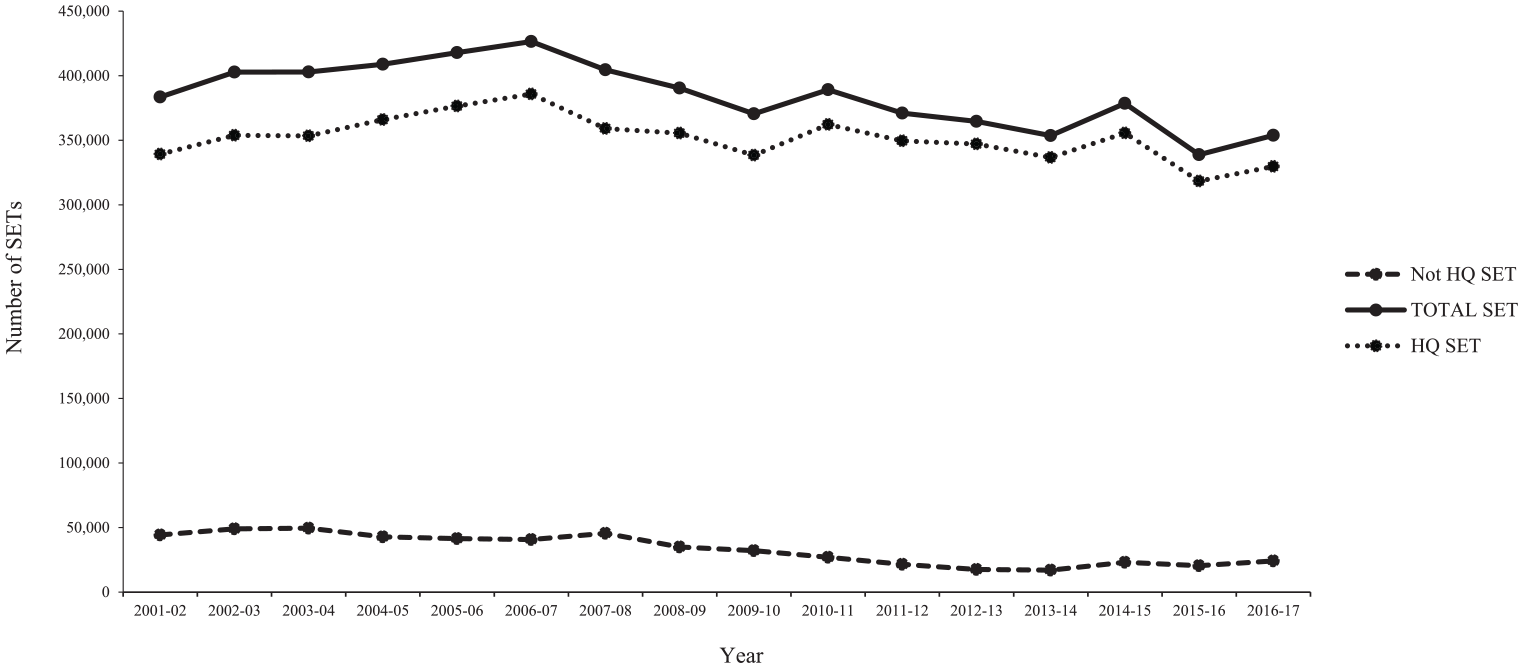
Total SET employment and highly qualified status from 2001 to 2002 to 2016 to 2017.
Alternative routes (ARs) have been used by states for decades to address many aspects of teacher shortage, including the problem of staffing high poverty schools and Science Technology, Engineering, and Mathematics (science, technology, engineering and mathematics [STEM]) classrooms. The severity and intractability of SET shortages have contributed to the general problem and the proliferation of ARs. Indeed, over a decade ago, Rosenberg et al. (2007) reported AR programs in 35 states and the District of Columbia. In 2010, Feistritzer identified programs in 48 states, and, by 2014, Connelly and associates considered them “ubiquitous” (p. 217). ARs were intended to supplement—and perhaps diversify—supply by accommodating non-traditional trainees—individuals who had foregone traditional preservice preparation. In the special education literature, AR preparation has a long history, and a substantial body of research has grown up around it. For example, Sindelar et al. (2004) compared graduates of a traditional preservice preparation program with graduates of two different ARs: a university-district partnership and district add-on program. (The add-on program was designed for certified teachers to add special education certification.) On observations conducted during their first year of teaching, teachers from all three programs met minimum standards, although traditional program graduates were rated higher than AR graduates on several instructional variables. On the other hand, principals’ favored AR graduates, particularly from partnership programs, perhaps because of their experience and maturity.
The generality of these findings was substantiated in a subsequent literature review, in which Rosenberg and Sindelar (2005) concluded that ARs, except for abbreviated, short-cut programs, were capable of producing teachers as competent as graduates of traditional preparation routes. In a subsequent review (Connelly et al., 2014), AR programs were also shown to tap non-traditional populations of trainees (and hence supplement supply). Other research (Rosenberg et al., 2007; Sindelar et al., 2012) also has demonstrated the success of some AR programs in recruiting diverse training cohorts. Connelly et al. described internship programs as the most common model of AR preparation—and the most clearly conforming to IDEA requirements for highly qualified designation. In such programs, practicing teachers who lack credentials are provided training that leads to full certification.
Teacher shortages have never been as severe as they seem to be in this post-recession era (Sutcher et al., 2016), and AR programs are very much in the conversation about strategies for addressing them. Although ESSA allows states to establish their own standards for teachers and many have lowered the bar to entering the profession, IDEA has retained the essence of the highly qualified requirement for SETs, and with it, the stipulation that uncertified teachers enrolled in high-quality AR preparation be considered fully qualified. To date, no analysis of state AR policy vis-à-vis these IDEA provisions has been conducted.
Conceptual Framework
In Figure 2, we present the conceptual framework guiding our study. This framework is based on an assurance—Assurance 14—that states must satisfy when applying for IDEA Part B funds. Explicitly, they must indicate whether all SETs are fully certified or, if not, that all others are enrolled in high-quality AR preparation. By answering yes to “We assure that all of our SETs are fully certified,” states are assuring that all these teachers: (a) have obtained full certification by completing traditional or alternate preparation or by obtaining a passing score on the state special education licensure assessment; (b) have not had special education certification or licensure requirements waived on an emergency, temporary, or provisional basis; and (c) hold at least a bachelor’s degree. If states cannot declare all their SETs have met the above requirements, they must select no and provide additional documentation promising teachers who are not fully certified hold at least a bachelor’s degree and are currently enrolled in an alternate preparation program that meets federal requirements. Such programs must (a) provide high-quality professional development that is sustained, intensive, and classroom-focused; (b) provide rigorous supervision that consists of structured guidance and regular continuing support or teacher mentoring; (c) allow candidates to assume teacher functions only for a specified period of time not to exceed 3 years; and (d) require candidates to demonstrate satisfactory progress toward full certification (Collaboration for Effective Educator Development, Accountability, and Reform [CEEDAR] Center, n.d.). These guidelines provide a framework for our study. They are essential in helping to improve our understanding of which currently existing alternate preparation models offer the potential for meeting federal guidelines. Only models that meet all four guidelines comply with IDEA specifications for ARs for less than fully certified teachers.
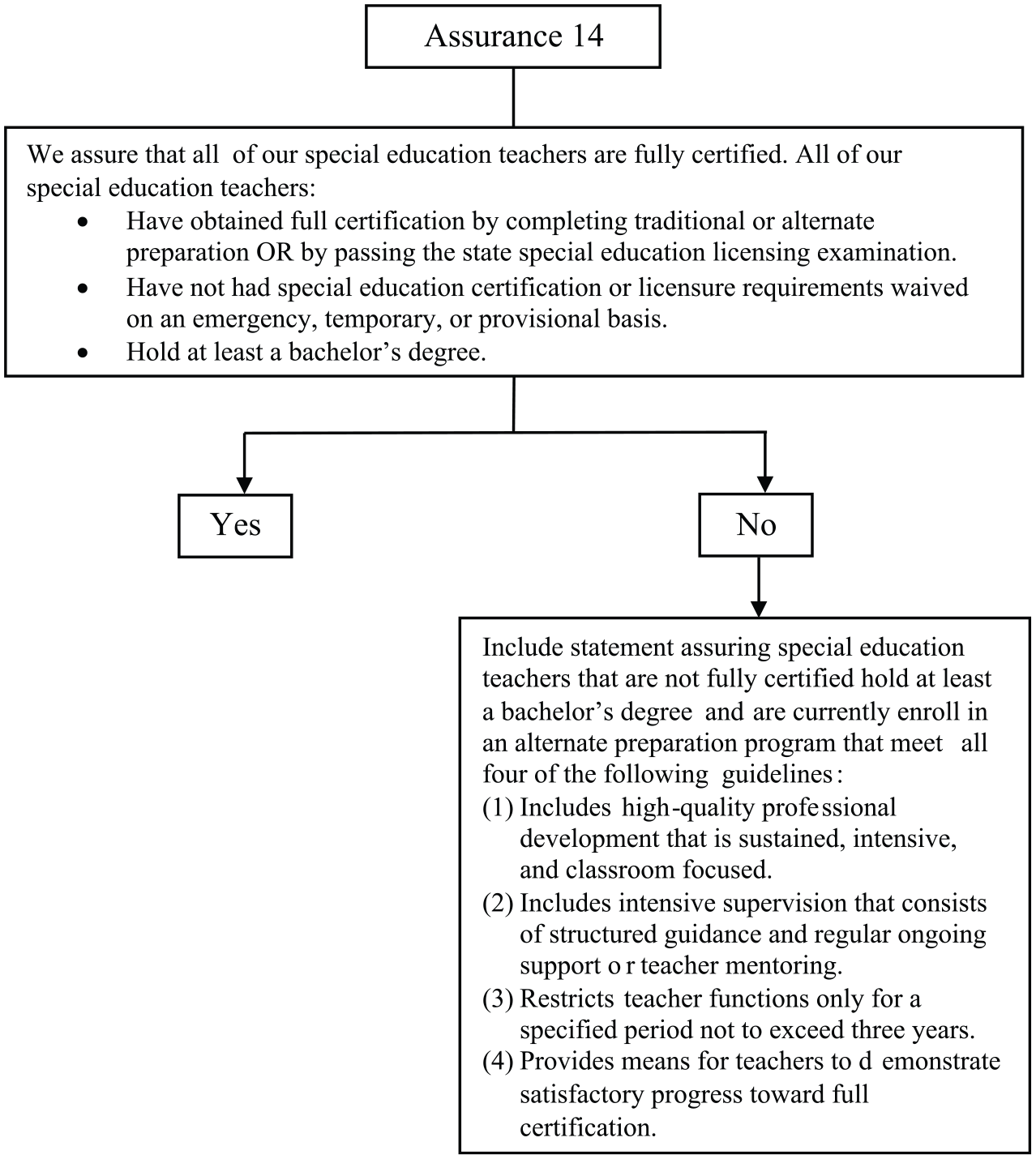
IDEA assurance 14 requirements.
Purpose and Research Questions
The purpose of this study is threefold. First, we identify states that currently have established alternate route teacher preparation policy. We define AR preparation as all routes leading to certification that do not require completion of an approved, pre-service teacher education program. Second, we describe and organize alternative preparation policies and the models they support. Finally, we examine which of the models meet mandates of Assurance 14 or have the potential to do so. Our study, therefore, is guided by the following research questions:
How many states currently have one or more policies in place allowing alternatives to traditional teacher preparation?
What are the common conceptual models of alternate route teacher preparation programs found in state policy?
Which of these conceptual models address—or have the potential to address—requirements for Assurance 14?
Method
Data Collection
In March 2018, two of the authors independently conducted electronic searches of all 50 state Departments of Education (DOE) websites to obtain policy documents authorizing APs. We omitted programs that included reciprocity agreements with other states or required National Board Certification, as both require a traditional license. We also recorded data from policy documents as well as extensive notes to explain complexities and idiosyncrasies in the policies.
Data Coding
We developed a coding manual to ensure that we coded policies consistently. Working independently, two of the authors coded programs from 25 states each on several features, including program title, eligibility, program and testing requirements, and time limitations for program completion. We entered these data into two separate Excel databases. To estimate inter-rater reliability, we conducted a second round of coding in which we exchanged states and, using the coding manual, coded them independently. Inter-rater reliability was 90%. With discussion, we reconciled all differences and then merged the two databases to create a single file comprising all authorized AR policies across the 50 states.
Data Vetting
Between March and July of 2018, we endeavored to contact all 50 states’ departments of education by email, telephone, or both, to verify the accuracy of the information in the database. We first emailed DOE licensure and certification personnel seeking assistance. To non-responders, we sent a second email request in April. If a response was still not received after the second email message, we phoned the DOE contact to ask for assistance with vetting. Ultimately, via email and telephone, we affirmed the correctness (or corrected misinformation) for 35 states. When unable to contact DOE personnel, we also reached out to university colleagues in those states and, with them, vetted three additional states. For these 38 contacts, we documented all communications and took extensive notes as evidence on which to base our decisions. We were unsuccessful in confirming the accuracy and currency of policies for the remaining 12 states.
Program Classification
After vetting, we divided states equally and independently sorted policies into conceptual groups based on commonalities in their titles, eligibility, or program specifications. We met to discuss the sets of categories, reconcile differences in our categorizations, and come to an agreement about classification. After accounting for overlapping categories and discussing disagreements in the grouping of programs, we arrived at eight final mutually exclusive conceptual models. We operationally define these models in Table 1. Finally, we individually grouped the program policies in our assigned states into these eight categories.
Definitions, Frequency (N), and Percentage (%) of the Eight Identified Conceptual Models.
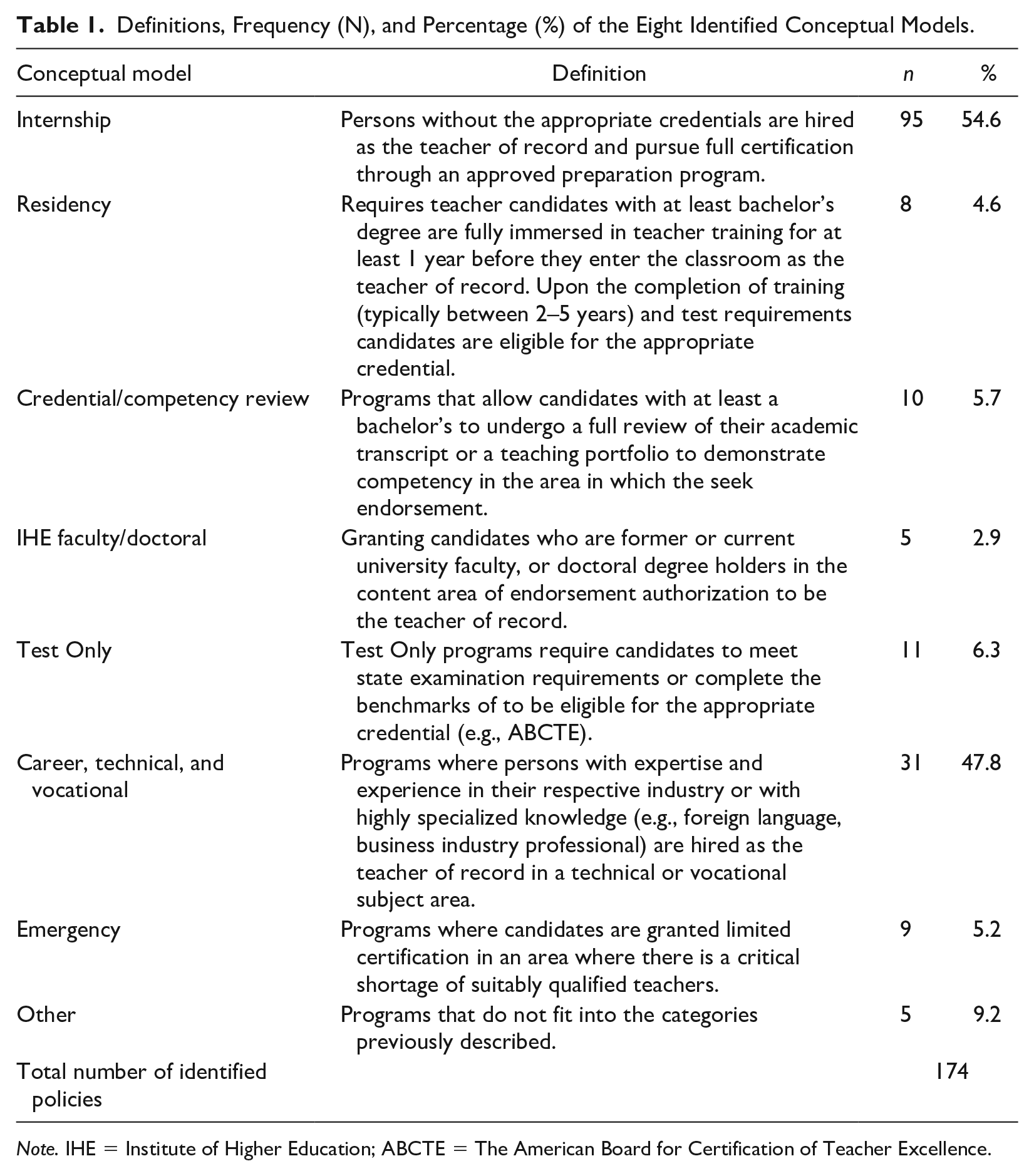
Note. IHE = Institute of Higher Education; ABCTE = The American Board for Certification of Teacher Excellence.
Inter-Rater Agreement and Data Analysis
To ensure accuracy and consistency, we assessed inter-rater agreement among the three coders by switching assigned states and conducting a second round of coding. Inter-rater agreement was initially 93%. After discussion and deliberation, differences again were reconciled. We then merged the three databases together to create a single file for analysis. We conducted frequency counts by model and determined the modal and mean number of program policies across states.
Assurance 14 analysis
We used criteria based on the requirements of Assurance 14 to determine which of the six relevant conceptual models best satisfied IDEA’s criteria for high-quality AR preparation. (We excluded two designations from this analysis—Other, for obvious reasons, and the Career, Technical, and Vocational models. Although commonplace, such policies were not germane to our purposes.) We generated a checklist comprising four dichotomous (i.e., yes/no) items corresponding directly to Assurance 14 guidelines. We each then independently used the checklist to evaluate the extent to which each policy satisfied IDEA requirements.
In effect, we evaluated each policy to determine whether it included (or, depending on the quality of implementation, had the potential to include) these elements: (a) a bachelor’s degree requirement; (b) high-quality professional development that is sustained, intensive, and classroom-focused; (c) intensive supervision that consists of structured guidance and regular ongoing support or teacher mentoring; and (d) a 3-year time limitation. Models must have met all four requirements to satisfy the IDEA criteria for high-quality AR preparation. To obtain inter-rater agreement, we cross-checked and compared each other’s results. The overall level of agreement was 100%.
Results
We found AR policies in 48 states—all but Alaska and Massachusetts. For these 48 states, we identified 174 policies that met our inclusion criteria, only one of which was designed specifically for SET preparation. The mean and modal number of policies across these states was 3.6 and 3.0, respectively. The number of policies within states ranged from 1 (in six states) to 11 (in one). From the 174 policies, 8 conceptual models emerged, including what we termed Internship (n = 95); Residency (n = 8); Credential/Competency Review (n = 10); University (Institute of Higher Education [IHE]) Faculty/Doctoral (n = 5); Test Only (n = 11); Career, Technical, and Vocational (n = 31); Emergency (n = 9); and Other (n = 5). We present summary statistics in Table 1. The complete database is available at www.ceedar.org.
The most common AR policy approach was the internship model, in which practicing but unlicensed teachers complete training while teaching. Forty-three states (90%) used at least one such model. Twenty-eight states (58%) had policies permitting career, technical, and vocational programs, and eight (17%) authorize residency and test only models. Six states (13%) had policies that authorized credential/competency review and, separately, emergency certification. Finally, five (10%) states had policies that allowed licensure for IHE faculty or other individuals with doctoral degrees.
Assurance 14 Compliance
We present the results of the evaluation of the six conceptual models using the checklist based on Assurance 14 guidelines in Table 2. Our analysis revealed that although all models required candidates to have (or obtain) a bachelor’s degree, only residency and internship models offered reasonable potential for meeting all four of IDEA’s Assurance 14 criteria. That said, not all of the policies for internship programs addressed the guideline addressing mentorship. In fact, of the 95 internship policies we found, only 16 (17%) explicitly required participants to participate in a mentorship program as part of their training requirements.
Results of Conceptual Model Evaluation Using Assurance 14 Guidelines.
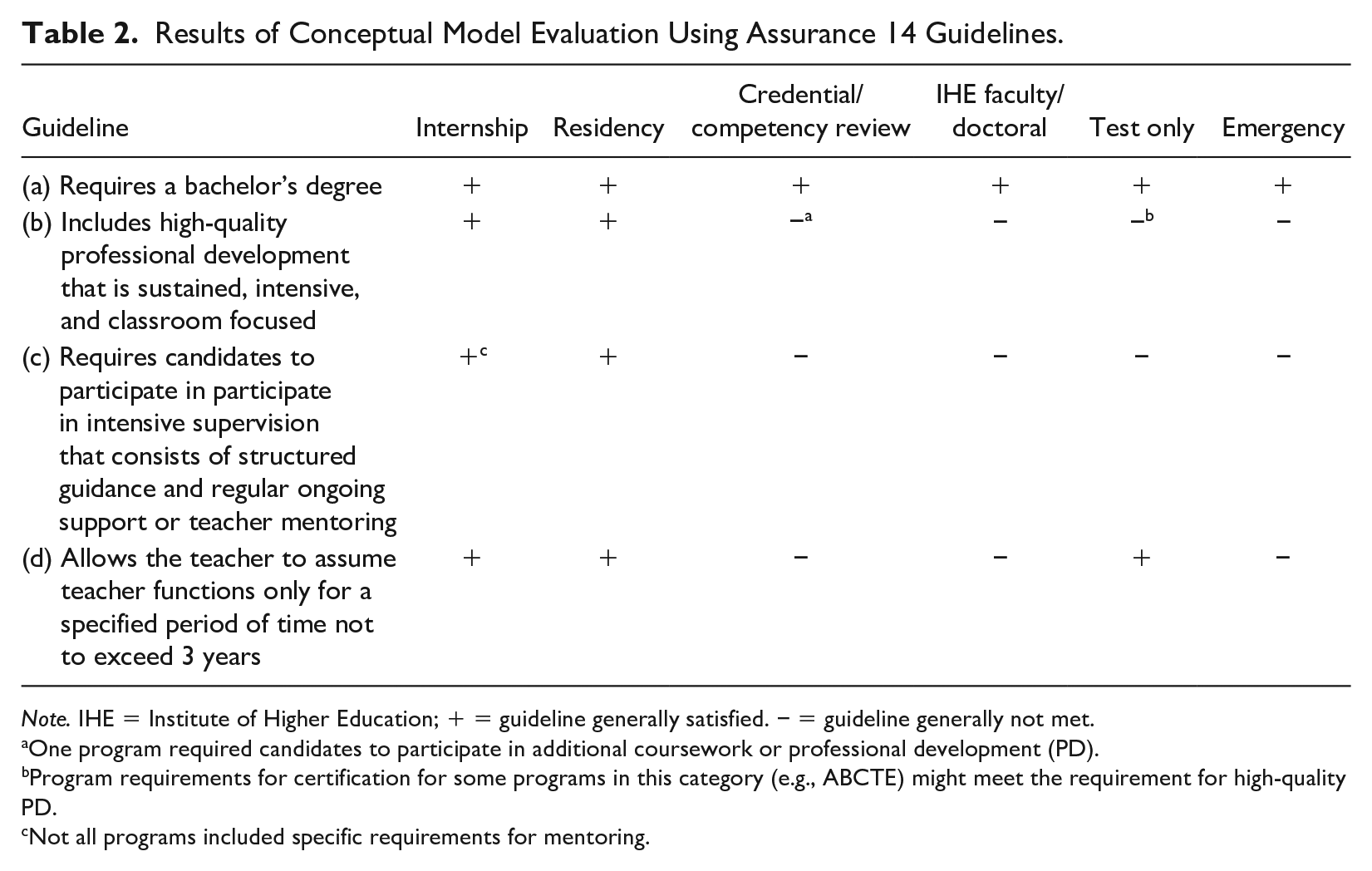
Note. IHE = Institute of Higher Education; + = guideline generally satisfied. − = guideline generally not met.
One program required candidates to participate in additional coursework or professional development (PD).
Program requirements for certification for some programs in this category (e.g., ABCTE) might meet the requirement for high-quality PD.
Not all programs included specific requirements for mentoring.
Two conceptual models—Credential/Competency Review and Emergency—did not require candidates to receive classroom-focused professional development or to participate in intensive supervision under the guidance of a mentor, and, in this sense, failed to meet two criteria. Our analysis also revealed that although programs based on Test Only models satisfied guideline four, they generally did not require candidates to receive intensive supervision or mentoring.
Findings also showed some states combined elements from several models. For example, Mississippi’s American Board for Certification of Teacher Excellence (ABCTE) policy—the ABCTE is a test-only option—also requires candidates as teachers of record to complete a year-long mentoring program and additional course requirements or training. Taken together, these requirements satisfy Assurance 14 criteria. By contrast, in Florida, the ABCTE certificate is used as a part of the prerequisites for a candidate’s professional competency review by an employing school district. In Arkansas, one way candidates may obtain a teaching license is to be within six of months of completing their bachelor’s degree and fulfilling the ABCTE program requisites. As a result, we classified Arkansas’s approach as a test-only model.
Discussion and Implications
Over the years, chronic teacher shortages have forced states to find ways to supplement the supply of new SETs from traditional preparation programs, and many have authorized and implemented ARs. Our study represents an initial attempt to identify state policies that authorize ARs and classify them into mutually exclusive conceptual categories based on features related to eligibility, program, and testing requirements. Furthermore, we considered whether these prototypes satisfied Assurance 14 requirements for uncertified SETs.
Our results demonstrate that 48 states authorize ARs, and 42 authorize more than one. States with AR policies average 3.6 distinct routes. Our findings agree precisely with Feistritzer’s (2010) and are consistent with earlier estimates (Rosenberg et al., 2007) and the presumption of growth. It must be noted, however, that both the Feistritzer’s and Rosenberg and associates’ estimates were counts of states with programs, not policies. However, it is not surprising that state-by-state counts of programs correspond reasonably well to counts of policies.
A key finding is that alternative entry policies relevant to special education require candidates to have at least bachelor’s degree. However, because ESSA has eliminated the highly qualified requirement and, with it, any federal minimum standard for teachers, states are now free to set their own standard, some have begun to hire teachers who lack bachelor’s degrees. Cano (2017), for example, reported dozens of these teachers working in Arizona schools. However, because of IDEA’s Assurance 14, the requirements that all SETs be fully certified or enrolled in an AR program remain in effect for SETs, and states annually must affirm to the U.S. Department of Education that all SETs have bachelor’s degrees.
Our findings suggest that the internship model is by far the most commonplace approach to AR preparation; in fact, 43 of the 48 states (approximately 90%) offer at least one version of the internship model. This finding is encouraging, given that this conceptual model emerged as having good potential for addressing Assurance 14 stipulations. Internship models generally require candidates to hold at least a bachelor’s degree, complete required coursework through an approved teacher preparation program, and receive intensive mentoring and supervision. They must demonstrate competency through states’ standard evaluation processes, many of which include classroom observations and examinations. Candidates serve as teachers of record and have 3 years to earn state certification. However, because internship programs may or may not require candidates to receive intensive supervision, states seeking to leverage existing internship program policies to meet Assurance 14 guidelines should ensure that districts who hire interns provide intensive mentorship.
The internship model is rooted in and makes the most sense in disciplines where content knowledge is as important—if not more important—than pedagogy, as in mathematics and science. Conceptually, the internship model fits less well with special education, where instructional methodology, adaptations, and individualization of instruction outweigh content knowledge (although SETs provide instruction to students in all content areas and need knowledge in multiple disciplines [Council for Exceptional Children, 2008]). SETs also are expected to have knowledge of pedagogical practices and of specialized technical areas (i.e., functional behavioral assessment, individualized education programs, positive behavioral interventions, and supports) that are required to serve SWDs successfully (Council for Exceptional Children, 2008). Given the complexities of the work, some preparation seems essential before allowing novices into special education positions as teachers of record. It is hard to envision a novice succeeding in special education teaching without at least a boot-camp learning experience. Therefore, it is advised that internship models for addressing SET shortages be designed with this in mind.
Our analysis demonstrates that the residency model, by definition, addresses Assurance 14 stipulations. Residencies represent a step forward from the internship model in the sense that most, if not all, training occurs before participants serve as the teacher of record. Residents also work under the guidance of a mentor teacher, a condition, as we have seen, that is possible but not assured in the internship model. As a result, residencies address the most significant limitation of internships: The assignment of interns as teachers of record.
Residencies allow candidates to develop the skills, knowledge, and dispositions necessary for effective classroom practice—on a preservice basis. They also are clinically rich, a program characteristic that offers an advantage over much traditional, campus-based preparation. On the other hand, residencies are not without shortcomings vis-à-vis internship programs. For one thing, interns make teachers’ salaries (or some substantial portion thereof), whereas residents, when they are employed, are most likely to serve as paraprofessionals—and earn far less than interns. Second, the quality of residencies depends on the competence of mentor teachers, and, in some districts, highly competent and willing mentor teachers may be in short supply.
Given the increased interest in residency programs (Guha et al., 2017; Hammerness et al., 2016), it was surprising to us that only eight states currently authorize such programs via policies. Although these modest numbers may result from its recent emergence, it may also be the case that some states do not consider residency programs as AR preparation. Indeed, residency programs are preservice in nature and presumably require completion of extensive teacher training that may satisfy full program requirements.
In the end, ARs have not supplemented the supply of SETs and eliminated SET shortage, but they may be a necessary element of a comprehensive plan. After all, ARs do provide access to teaching for non-traditional students—career changers, for example—who are unlikely to return to campus to complete preservice preparation. SET shortages have proven impervious to other powerful interventions. For instance, OSEP annually invests $80 to $90 million of Part B Personnel Preparation funds to improve the quality and quantity of the special education workforce and has for decades—with no discernible impact on shortage.
Limitations
A significant limitation of our study is the substantial number of states whose policies we were unable to vet. As we mentioned, we had no recourse, but to include in our database website information from the states we were unsuccessful in reaching. Our concern derives from the reality that websites are not always current, and information from them can be incomplete or erroneous. In fact, we learned from the states we vetted how commonly websites were likely to be out-of-date and how dramatic differences between current policy and website information can be. Also, in our analysis, we focused on state policy that was readily identifiable as supporting alternative preparation routes. By focusing on policy, we failed to capture the remarkable diversity of programs that such policies have inspired.
Furthermore, not all AR programs require specific policy authorization or rely on a single authorization. For example, one of the authors worked collaboratively with a Florida district to develop and implement a step-up preparation program for paraprofessionals. Over three school years and two summers, we offered an undergraduate program with a special education major to 19 paraprofessionals with associates’ degrees. Although this undergraduate program per se was not an approved preparation program and did not lead to certification, state policy entitled participants who completed it—who completed any bachelor’s degree program with a special education major, in fact—to be employed as SETs—as these 19 trainees were. After 2 years of successful classroom performance, state policy allowed the district to recommend individuals for full professional certification, as 18 of these trainees were. We suspect adaptations and workarounds of this sort are commonplace, even though they are not readily discernible in policy.
Footnotes
Declaration of Conflicting Interests
The author(s) declared no potential conflicts of interest with respect to the research, authorship, and/or publication of this article.
Funding
The author(s) received no financial support for the research, authorship, and/or publication of this article.
