



Abstract
In this investigation, we surveyed 51 faculty members who were involved in teacher preparation programs in the area of extensive support needs (ESN) across a range of institutions of higher education. We asked participants to respond to questions related to the quality and quantity of program content focused on communication instruction and supports for students with ESN. Overall, findings indicated variability in the quality and quantity of teacher preparation–related communication instruction. In addition, participants described barriers related to teacher preparation in this area.
One of the most critical functions of education is to prepare students to communicate effectively across a diverse and expansive range of opportunities. Unfortunately, many students with disabilities, especially those with extensive support needs (ESN), often face difficulties acquiring communication repertoires sufficient for gaining maximum benefit from their school experience and ultimately, achieving high quality of life outcomes (Carter et al., 2012). Students with ESN include the population of students who receive special education services under the eligibility categories of intellectual disability, autism, and multiple disabilities and, due to their pervasive and significant support needs, are often eligible to take their state’s alternate assessment (Taub et al., 2017). Many of these students present with complex communication needs (Andzik et al., 2018), requiring intensive intervention and carefully planned environmental supports, and unfortunately, some graduate from school with no conventional form of communication with which to navigate their adult lives (Kearns et al., 2011).
Students’ inability to effectively communicate with others may have extensive and lasting negative effects on their success in multiple areas. Those with ESN and fewer communication skills may have less access to academic content and high-quality instruction (Kearns et al., 2011; Kurth et al., 2016; Pennington & Courtade, 2015), are more likely to receive instruction in restrictive educational settings (Kleinert et al., 2015), and have fewer opportunities to develop strong peer networks (Feldman et al., 2016; Kurth et al., 2016). These learners with complex communication needs may be more likely to engage in challenging behavior to access or escape items, activities, or interactions, thereby reducing their opportunities for success in natural environments (Lauderdale-Littin et al., 2013; Snell et al., 2010). Finally, data indicate that adults with ESN face challenges in postsecondary settings, as they are more likely to be unemployed (Bush & Tassé, 2017; Wei et al., 2018), experience isolation (McCausland et al., 2018), and live dependent on support from family members or community agencies (Friedman et al., 2013; Shattuck et al., 2012). These poor outcomes are likely compounded for those with complex communication needs, for which conventional forms of self-advocacy may be more difficult.
In light of the importance of communication for students with ESN, researchers have suggested that communication instruction is an essential component of educational programming for this population of students (Pennington et al., 2016) and that students’ communication challenges are amenable to intervention, with many students benefiting from augmentative and alternative communication (AAC) systems to supplement or replace speech (Goldstein, 2002; Snell et al., 2006, 2010; Walker & Snell, 2013). Unfortunately, the available research literature suggests that students with ESN may not receive adequate communication instruction or support in the classroom. For example, Chung and colleagues (2012) observed 16 students with ESN who were reported to use AAC devices. They noted that students rarely used their AAC devices and that the devices were unavailable to the students for 60% of the observations. Similarly, Kurth and colleagues (2016) observed nine teachers and 19 high school students in self-contained programs for students with ESN. They reported that students had few opportunities to respond and were passive observers during instructional activities. They noted a “worrisome” (p. 11) lack of communication support and that students with the most complex communication needs received fewer instructional opportunities. Their findings corroborated previous studies demonstrating passive engagement and limited opportunities to respond during instruction among students with ESN (Pennington & Courtade, 2015). Finally, Mellman and colleagues (2010) conducted structured interviews and observations to examine communication practices around three students identified as using speech-generating devices (SGDs). They noted students’ limited use of their SGDs, few opportunities for social interactions, and frequently missed opportunities by the educational team to promote communication.
Several factors may impede teachers’ implementation of communication instruction in the classroom. First, teachers may perceive that the delivery of communication instruction falls under the purview of the related services (i.e., speech-language pathologist [SLP]) and thus, may abdicate implementation responsibility. Although SLPs are an essential part of the educational planning team, they often have little time for direct service delivery and may have insufficient knowledge related to supporting students with ESN and AAC systems (Iacono & Cameron, 2009; Matthews, 2001; Pennington et al., 2016). Second, teachers may have limited access to technical assistance and support for implementing AAC systems (Lund & Light, 2007). This is especially problematic in light of the rapid evolution and refinement of digital technologies for use with students with and without disabilities (Light & McNaughton, 2012). Third, teachers may face a range of practical barriers including finding time to collaborate with related service staff, training and supporting paraprofessionals, staff turnover, and lack of administrative support (Soto et al., 2001). Finally, teachers may have inadequate training in the delivery of communication instruction for their students with ESN (Costigan & Light, 2010), especially those with cross-categorical certifications (Ruppar et al., 2016).
Researchers have recommended that teacher preparation programs prepare educators to meet the communication needs of students with ESN. In a recent report from the U.S. Department of Education’s CEEDAR center, Peckham-Hardin and colleagues (2018) suggested that teachers are uniquely positioned to implement communication intervention procedures, monitor progress, and provide feedback to the educational team in relation to the effectiveness of intervention. They recommended teachers use systematic instruction procedures, assess student preferences, consider student motivation, provide multiple opportunities to respond in natural contexts, and program for generalization. This report was consistent with previous work highlighting the importance of teacher preparation in communication intervention for students with ESN. For example, Ryndak et al. (2001) interviewed 20 faculty members within nationally recognized teacher preparation programs to obtain information related to the content expertise considered essential for teachers to meet the needs of students with ESN. All respondents reported that knowledge related to speech-language pathology and AAC systems to be important. Similarly, Ruppar and colleagues (2018) described their prior research on faculty and expert teacher perceptions of practices and expertise required to meet the needs of students with ESN. They proposed multiple core practices that should be developed within teacher preparation programs including the use of systematic instruction to improve students’ communication skills.
Despite the importance of and calls for teacher preparation in the area of communication for students with ESN, it is unclear as to whether teacher training programs have responded. Therefore, the purpose of this study was to investigate the level and types of training in the area of communication for students with ESN provided in a national sample of teacher education programs. Specifically, this study addressed the following research questions: What are the perceptions of faculty members related to (a) who is responsible for the planning and implementation of communication instruction for students with ESN, (b) the amount of coursework focused on communication instruction for students with ESN within their teacher preparation program, (c) the types of content presented within in their training program, and (d) the preparedness of their graduates in providing communication instruction?
Method
Participants
Survey participants included 51 faculty members who were involved in nationally accredited teacher preparation programs across a range of public (92.3%) and private (7.7%) institutions of higher education (IHE) at the time of the study. Each participant represented a different teacher preparation program. To be eligible for participation, faculty were required to have knowledge of coursework available through teacher preparation programs leading to certification in ESN (i.e., programs focused on intellectual disability, autism, and/or multiple disabilities). Participants represented different geographic regions of the United States as follows: the West (30.7%), the South (28.9%), the Northwest (23.1%), and the Midwest (17.3%). Participants described their IHE as having an equal focus on research and teacher preparation (36.5%), primarily focused on research (32.7%), or primarily focused on teacher preparation (28.9%); one (1.9%) participant was unsure of the focus. In terms of the teacher candidates enrolled in these programs, a majority of participants reported that teacher candidates were from both rural and urban/suburban areas equally (46.2%) or primarily urban or suburban areas (34.6%). Fewer participants indicated that teacher candidates were from primarily rural areas (17.3%) and one participant (1.9%) was unsure of the area.
Survey Instrument
A 15-item online survey was developed to address the research aims set forth in the previous section. Table 1 provides a detailed description of each survey item and corresponding response options. The survey items were organized under four categories as follows: (a) characteristics of IHE (Items 1–3; that is, location, research/teacher preparation focus, and teacher candidates groups), (b) faculty perceptions of roles for planning and implementing communication instruction (Items 4 and 5), (c) characteristics of coursework focused on communication instruction for students with ESN (Items 6–12; that is, inclusion, quantity, instructors, and content of coursework), and (d) faculty perceptions of teacher candidate preparedness to deliver communication instruction for students with ESN (Items 13 and 14). The final survey item (Item 15) was open-ended and allowed participants to clarify previous responses and/or add information not addressed in other items.
Survey Items.
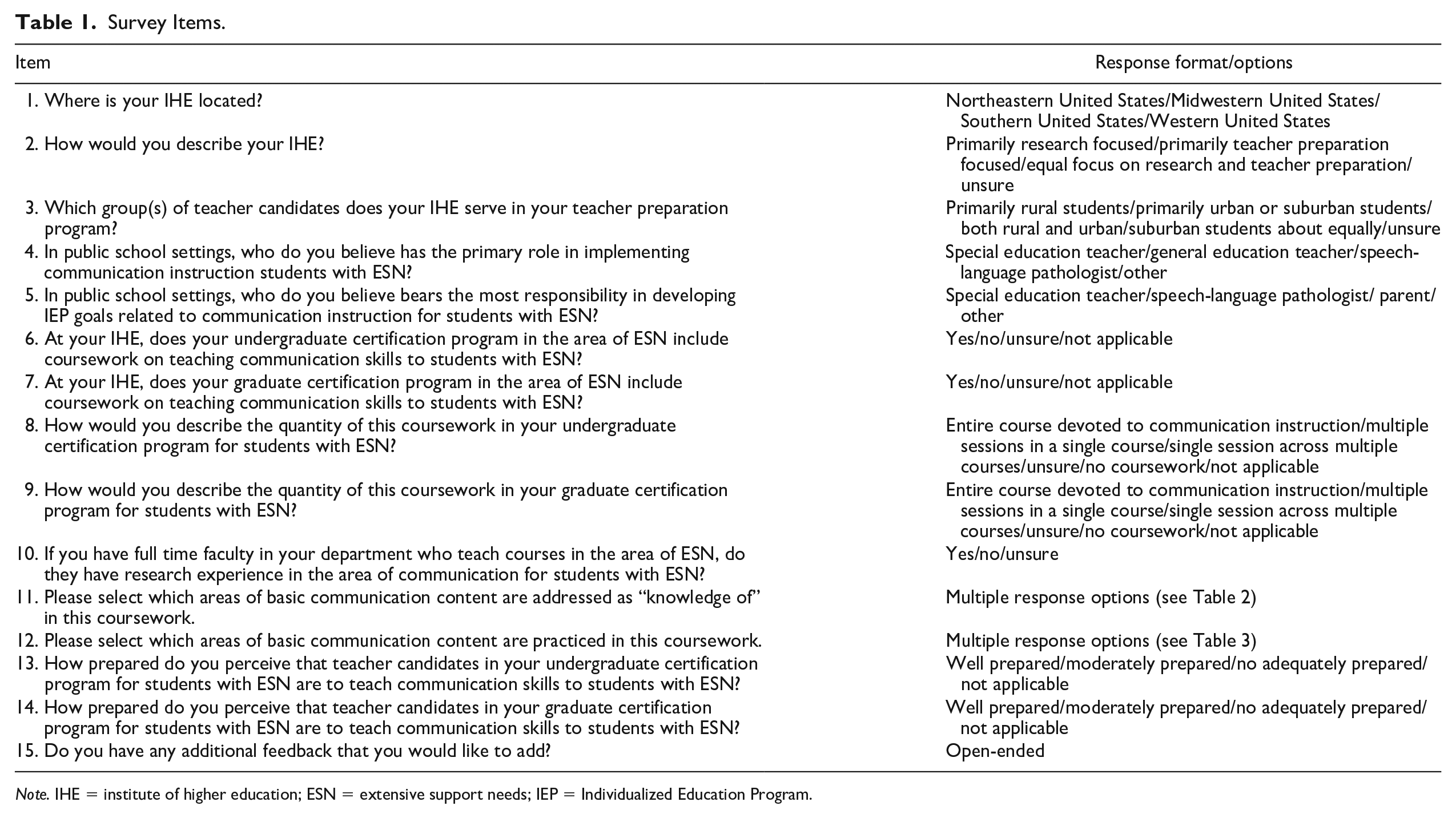
Note. IHE = institute of higher education; ESN = extensive support needs; IEP = Individualized Education Program.
The items pertaining to the content of coursework were based on the current literature addressing best instructional practices in developing communicative competence for students with ESN (e.g., Brown et al., 2020; Johnston et al., 2012; National Autism Center, 2015; Peckham-Hardin et al., 2018; Wong et al., 2015). For the purposes of the survey, the coursework was defined as an entire course dedicated to communication instruction, one or more course sessions dedicated to communication instruction, or embedded content related to communication instruction. For Items 11 and 12, the participants were asked to identify content areas (see Table 2) that were addressed to develop teacher candidates’ knowledge of communication instruction and those that were practiced within the course. The study defined activities that promote knowledge as the presentation of content and subsequent assessment of content knowledge and activities that promote practice of content as application-based activities (e.g., role-play, application of skills in response to case studies or video examples) and subsequent assessment of performance.
Communication Intervention Content Within Coursework: Knowledge.

Note. Additional responses from four participants: multimodal augmentative and alternative communication systems, working with families, considering cultural variables, multiliteracy strategies, presuming competence, facilitated communication, and controversial treatments.
Prior to finalizing the survey, five experts were recruited to review the draft survey for both content and survey design. All five experts were faculty members in the area of ESN. A “think aloud” cognitive interview approach was used (Willis, 2015), whereby experts completed the online survey while an interviewer prompted the expert to “think aloud” to gain an understanding of the expert’s thought processes. The goal of the cognitive interview process was to determine whether (a) the survey addressed the research aims, (b) the list of instructional practices was complete, and (c) additional or different items and/or response options were needed to address the research aims. In terms of survey design, the cognitive interview process also allowed for identification of potential sources of response error (Willis, 2015). During each interview, the researcher recorded the expert’s responses and subsequently made changes to the instrument. The final version of the survey was available on SurveyShare, a secure online survey platform.
Survey Distribution
Initially, the study relied on purposeful sampling to recruit participants. Based on the professional knowledge of faculty members who were involved in teacher preparation in the area of ESN, the study developed a list of potential participants representing different teacher preparation programs across the United States. Subsequently, the study distributed this initial list to four experts who had extensive experience in teacher preparation and research in the field of ESN. Each expert was asked to confirm whether the list was comprehensive and, if not, to recommend additional faculty members who were qualified to provide information about coursework focused on communication instruction offered through their teacher preparation program. The final list included 96 faculty members, each representing a different IHE. The study also relied on snowball sampling to identify and recruit additional faculty members not included on the initial list. Each survey participant had the option to nominate a faculty member at a different IHE to complete the survey. A total of 20 participants nominated an additional faculty member; this nomination process resulted in recruitment of five additional faculty members.
Three rounds of survey invitations were sent via SurveyShare over the course of 4 weeks. For those participants who did not respond within 1 week of receiving the initial survey invitation, a follow-up survey invitation was sent. For participants who did not respond to the second invitation, a third invitation was sent at 4 weeks. Incentives were not offered for participation. Of the 101 faculty who received survey invitations, 52 (51.5%) consented to participate in the study. Before completing the survey, participants answered a question to indicate whether they were faculty in a teacher preparation program that led to certifying candidates to teach students with ESN. All but one (n = 51) indicated they were faculty members involved in such programs, and therefore were eligible to participate in the survey.
Data Analysis
After collecting data over a 4-week period, responses were downloaded into Microsoft Excel. Next, basic descriptive statistics were calculated (i.e., frequencies, percentages) to analyze responses to close-ended items by totaling the frequency of responses for each response option and calculating a percentage. As the survey included two multiple-choice formats (i.e., one response option and multiple response options), total percentages exceed 100% for responses to multiple response options items. Finally, open-ended responses were grouped to analyze responses for common themes.
Results
Responsibility for Planning and Implementing Communication Intervention
The faculty were asked to identify the roles of school professionals and other stakeholders who they perceive to be primarily responsible for (a) planning communication instruction through Individualized Education Program (IEP) goal development and (b) implementing instruction to promote communication among students with ESN. A majority of faculty participants reported that special education teachers (39.2%) and SLPs (39.2%) bear the most responsibility in developing IEP goals for communication. Ten participants (19.6%) identified “other” roles, which focused solely on collaborative teaming among a number of stakeholders (e.g., students with ESN, parents, special education teachers, SLPs). For example, one participant indicated that planning for communication instruction is a “collaborative effort between the families, the related service providers, educators and all members of the IEP team. Because communication is fundamental to all aspects of education, every member of the IEP team should be involved.” Only one participant (2%) indicated that parents hold primary responsibility for planning.
In terms of implementing communication instruction, participants most often identified special education teachers (64.7%) as primary instructors to support communication for students with ESN. Fewer participants identified school personnel in “other” roles (21.6%) and SLPs (13.7%) as primary instructors. Other roles included paraprofessionals but most often reflected communication instruction delivered by a team of school personnel (e.g., general education teachers, special education teachers, peers, SLPs). This team-based approach is captured in the following response: Communication instruction needs to be implemented across the school day and needs to be transdisciplinary in nature. This includes speech therapy and specialized intervention with the special educator, but also communication instruction is implemented by the general education classroom teacher, the instructional assistant, and even the peers.
Quantity of Coursework Related to Communication Interventions
Participants were also asked to describe the quantity of coursework related to teaching communication skills to students with ESN within their programs. Forty-three participants described coursework within undergraduate programs. Nearly a third of participants (30.7%) reported having an entire undergraduate course dedicated to communication instruction, 25.6% reported providing content across multiple sessions in a single course, 28.2% offered single sessions across multiple courses, and 5% offered no content. Ten percent of participants were unsure at what level this content was embedded in their undergraduate program. Eight participants provided “other” responses. Four of these participants provided clarifying statements for their selections, three indicated that their programs offered multiple sessions within multiple courses, and one participant reported that they offered an entire course focused on the social/pragmatic communication needs of students with autism spectrum disorder.
Forty-eight participants described coursework within graduate programs. Of those participants, 40.6% reported having an entire graduate course, 20.8% reported providing content across multiple sessions in a single course, 37.5% offered single sessions across multiple courses, and 2% offered no content. Nine participants provided “other” responses. Four of these participants indicated that communication coursework was not required but contingent on their graduate program. For example, two participants indicated that coursework could be taken as a part of an endorsement or add-on certificate (i.e., assistive technology and autism spectrum disorder). Four respondents reported having multiple sessions in multiple courses and one reported though they required a communication course in the autism program, they would like the course to be required for their teachers of students with intellectual disability.
Communication Intervention Content With Coursework
Knowledge
Fifty-one participants identified basic areas of communication addressed as “knowledge” within their programs. Results are clustered by percent of programs reporting to include specific content items (see Table 2). The most commonly identified content items (identified by over 90% of participants) were as follows: augmentative alternative communication (96.1%), functional communication training (92.16%), assessment of student communication skills (90.2%), environmental arrangement strategies (90.2%), and behavioral teaching techniques (90.2%). Less than 50% of participants reported addressing the following areas: staff training to support responsivity (35.3%), sign language (31.4%), and aided language stimulation (35.3%). Four participants provided additional content areas including multimodal AAC systems, working with families, considering cultural variables, multiliteracy strategies, presuming competence, facilitated communication, and controversial treatments.
Practice
Forty-nine participants identified basic areas of communication practiced within their programs (see Table 3). The most commonly identified content items (identified by over 60% of participants) were as follows: assessment of communication skills (67.3%), augmentative alternative communication (67.3%), behavioral teaching techniques (67.3%), and environmental arrangement strategies (63.3%). The least commonly identified items were developmental views of language (20.4%), staff training to support responsivity (16.3%), sign language (16.3.%), and eye gaze and scanning (24.5%). Two participants provided additional practice areas including ecological assessment, person-centered planning, discrepancy analysis, and talking with families about communication support needs.
Communication Intervention Content Within Coursework: Practice.

Note. Additional responses from two participants: ecological assessment, person-centered planning, discrepancy analysis, and talking with families about communication.
Preparedness of Graduates in Communication Intervention
Finally, the faculty were also asked to rate the preparedness of their graduates to teach communication skills to students with ESN. Thirty-six participants ranked the preparedness of graduates from undergraduate programs. The majority of participants (63.9%) rated graduates as moderately prepared, and a third (33.3%) as not adequately prepared. A single participant (2.8%) rated graduates as well prepared. Forty-eight participants ranked the preparedness of graduates from graduate programs. The majority of participants (62.5%) rated graduates as moderately prepared, 20.8% as well prepared, and 16.7% as not adequately prepared.
Additional Faculty Member Feedback
Nine participants responded to the final question of the survey soliciting additional feedback. Overall, the participants reiterated the importance of providing content related communication instruction within teacher preparations programs. For example, one participant noted, “Communication access and support is one of the most critical needs of students with ESN in school settings and should be a primary emphasis within teacher training programs.” Four participants cited difficulties related to the provision of communication instruction within programs. Multiple participants expressed that providing communication content may be more difficult in cross-categorical or undergraduate programs. Two participants described frameworks for the delivery of communication supports. One participant expressed the importance of teaching communication content within a behavioral framework, whereas another contraindicated a behavioral approach and cited the importance of a “humanistic” approach that presumes competence. Finally, one participant expressed their frustration as a new faculty member: “It is challenging to add additional instruction and practice in a program that already exists and was developed without attention to communication in the slightest.”
Discussion
In light of the importance of communication skills for all learners, researchers and professional organizations have called for an increased focus on communicative competence for those with ESN (e.g., Calculator, 2009; National Joint Committee for the Communicative Needs of Persons With Severe Disabilities, 1992). Unfortunately, data suggest that this call may have largely gone unheard by those serving students with ESN in the classroom (e.g., Kurth et al., 2016). One plausible explanation is that teacher education programs may have inadequately prepared teachers to meet this charge through implementation of high-quality communication instruction in their classrooms. This investigation sought to examine the level and types of content in the area of communication for students with ESN provided in teacher education programs.
Overall, participants indicated that content related to communication instruction was addressed to varying degrees within their preparation programs. Nearly a third of undergraduate programs and 40% of graduate programs offered courses entirely focused on communication instruction. Programs often provided multiple sessions within or across courses. Three programs (i.e., two undergraduate and one graduate) were reported to offer no communication coursework in their certification program. Although these findings reflect a small minority of programs and may not reflect experiences with communication instruction offered in practicum or student teaching placements, they are troubling in that a failure to adequately prepare a single educator can have a detrimental and lasting negative impact on a large number of students. This deleterious impact may be increased exponentially when programs fail to prepare large numbers of teachers.
Despite a majority of participants citing the inclusion of communication content in their programs, few indicated that their graduates were well prepared to teach communication skills to students with ESN. In fact, a third of participants rated undergraduate program completers, and 16.6% rated graduate program completers as not adequately prepared. The difference between undergraduate and graduate programs may reflect different levels of program specialization. For example, some graduate programs may have produced add-on certifications focused only on content related to ESN. These findings illuminate a potential variable contributing to low levels of communication support in classrooms and ultimately, poor outcomes for some students with ESN. They may speak to broader challenges within teacher preparation programs related to dosage, delivery format, and instructional procedures. This survey solicited participants to identify content presented in their programs, but did not ask about the length of content exposure, whether content was delivered face to face or online (synchronously or asynchronously), whether students received immediate feedback on their performance of a particular skill, or whether students received opportunities to practice the skills in natural settings during field-based experiences, for example. The survey did not attempt to capture information related to strategies for facilitating generalization to applied settings (Markelz et al., 2017). Participants may have reported having courses or multiple sessions related to communication intervention and support but may have still failed to prepare their students to be successful in meeting the needs of all students in their classrooms.
An emphasis on content knowledge over practice was reflected in participants’ selection of content areas included within their programs. Participants were asked to identify items covered as knowledge (i.e., instructors present content and students are assessed by speaking or writing), and then as practice (i.e., students engage in application activities [e.g., role-play, apply skills in response to case studies or video examples] and are assessed on their performance). Data indicated a stark difference between the delivery of content as knowledge and practice. A majority of participants reported including the majority of the content as knowledge within their programs but fewer reported including content practiced in their programs. In fact, only a third of items were identified as practiced by more than 50% of participants, suggesting that pre-service teachers may have little opportunity to practice critical communication intervention skills before entering the classrooms. Again, this paints a bleak picture of teacher preparation in this area as researchers previously have identified the disconnect between teacher training involving lecture and demonstration only and actual classroom implementation (Joyce & Showers, 2002).
Although participants reported variability in the quantity and perhaps, the quality of teacher preparation in communication intervention, they seemed to emphasize evidence-based practices within their programs. For example, participants most often identified the inclusion of well-established practices in their programs including behavioral teaching techniques, environmental arrangement strategies, SGDs, AAC, picture exchange communication system, and milieu teaching. Unfortunately, the findings may suggest a focus on a limited set of response topographies as fewer participants reported content related to the use of sign, scanning, or eye gaze, though it is possible that these particular response topographies were covered in coursework that addressed AAC more broadly. These response forms are critical for students for whom other topographies may not be practical (e.g., visual impairment and physical disability). In addition, one of the least-reported content areas was staff training to support responsivity. This is worrisome, as many programs for students with ESN are supported by educational teams that include general education teachers and paraprofessionals who may need additional training. In the absence of communicative partners that effectively respond to and reinforce student interactions, many evidence-based practices in communication are likely rendered ineffective.
Interestingly, one participant reported preparing teachers to implement facilitated communication, a practice deemed ineffective by researchers and contraindicated by professional organizations (e.g., American Speech-Language-Hearing Association, Association for Behavior Analysis International, American Association on Intellectual and Developmental Disabilities). It is concerning that a participant reported to steer away from the broad consensus related to the credibility of facilitated communication, but more so that faculty may be serving as a direct conduit for the delivery of pseudoscientific practices to teachers of one of the most vulnerable populations of students. It runs counter to the Council for Exceptional Children’s (2015) initial preparation standards indicating that beginning educators must “select, adapt, and use a repertoire of evidence-based instructional strategies to advance learning on individuals with exceptionalities” (p. 5).
Finally, several participants provided insight into the challenges that faculty face in the delivery of communication instruction content in their programs. Several indicated that there may be limited time to cover all necessary content within their training programs, especially for those within cross-categorical programs. These findings highlight a looming problem in the field of special education: a market-driven reduction in the length of teacher preparation programs (Darling-Hammond, 2005). The potential negative effects of these leaner programs on teacher classroom performance likely are compounded by increasingly fewer incentives (e.g., state mandates and pay increases) for teachers to seek additional preparation (Will, 2018). Interestingly, several participants provided responses that may suggest that teacher education programs may address issues related to their students’ limited exposure to communication instruction content by offering programs add-ons or additional endorsements (e.g., assistive technology and autism spectrum disorder).
Implications for Practice
This review yielded several implications for teacher education programs. First, teacher educators should evaluate current programs related to serving students with ESN to determine whether they incorporate sufficient coursework to ensure teacher competency in the area of communication instruction. This review suggests that an increased emphasis on communication instruction may be achieved in multiple ways including the addition of specialized courses, content across multiple courses, and specific field-based activities. To the extent possible, program faculty should align current and additional communication content with practice-based field experiences to promote the acquisition and generalization of intervention-related teacher behaviors (Markelz et al., 2017).
Second, the review suggests teacher preparation program faculty to look beyond CEC standards to identify specific competencies related to communication interventions and supports. Although these standards provide meaningful guidance for special educator teacher preparation, they provide limited detail in the area of communication intervention. The survey recommends teacher educators seek additional resources in developing their particular program competencies. For example, De Fonte and Boesch (2016) offer a detailed list of special education teacher AAC competencies, linked to CEC standards and the extant literature on AAC training. Similarly, Peckham-Hardin and colleagues (2018) provide communication practice recommendations for students with ESN within the CEEDAR centers’ innovation-configuration documents.
Third, the review suggests teacher educators seek guidance and collaboration from faculty and practitioners in other related fields (e.g., speech-language pathology, applied behavior analysis, deaf and hard of hearing) to enhance their programs’ communication content. These fields have established their own practitioner competencies related to communication and interdisciplinary collaboration and might facilitate more comprehensive programs for all involved. Interdisciplinary collaboration within preparation programs might serve to model effective interdisciplinary practice in the field (Miller & Stayton, 2006; Weiss et al., 2020).
Finally, some programs may not have access to faculty with expertise in the area of communication intervention and supports. This case suggests faculty members consult with colleagues at other institutions and local service providers in designing new coursework that is both evidence-based and practical. They might consider working with other regional institutions to develop a digital coursework cooperative in which programs for students with ESN can share teaching resources and expertise.
Limitations and Future Research Directions
There are a few limitations that should be considered when interpreting findings from this survey study. First, as the study relied on faculty self-report, responses may not reflect actual practice taking place in teacher preparation programs. Similarly, the study surveyed one faculty member per program and therefore, perspectives were limited to that of one individual from each IHE. It is possible that other faculty members within these programs might offer different perspectives due to the scope of their roles and involvement in the program. Future research should consider the perspectives of multiple stakeholders, including a range of faculty members, clinical educators responsible for overseeing field-based experiences, and graduates of teacher preparation programs. Second, this study did not specify whether “coursework” included practicum or student teaching experiences. As a result, faculty participants might have omitted content provided within these field experiences.
Third, the survey sample might not be representative of all undergraduate and graduate programs offering certification in ESN. Although the study followed a rigorous recruitment process (i.e., initial expert review of sample and subsequent snowball sampling) to assemble a comprehensive list of faculty representatives from institutions in all 50 states, the final list of programs was not exhaustive and those who completed the survey did not represent all 50 states. Fourth, the study did not collect separate data on the content delivered within undergraduate and graduate programs. These data might have provided more insight related to patterns of content delivery across program levels and whether programs might need to prioritize program improvement efforts at existing undergraduate or graduate programs. Finally, as noted in the previous section, the study did not collect information regarding characteristics of teacher preparation strategies beyond communication instruction content. To understand the most effective teacher preparation approaches, additional work is needed to examine the dosage of training and training format necessary to adequately prepare teachers to be effective instructors in promoting communicative competence among students with ESN. Importantly, this includes evaluating the extent to which teacher candidates and novice teachers transfer skills to applied settings where communication instruction is delivered to students with ESN. In addition, understanding whether and how the type of program (i.e., cross-categorical program vs program with specific focus on ESN) affects teacher preparedness in this area (e.g., Ruppar et al., 2016) will provide stakeholders with important information to guide decision-making around instructional and field-based programming.
Conclusion
Communicative competence is essential for students with ESN to promote a self-determined life. Despite some discouraging findings, one can glean from the study data a few reasons for optimism. Most faculty members reported to understand the important role that teachers play in supporting the everyday communication needs of students with ESN and emphasized evidence-based strategies within their programs. In addition, the majority reported their pre-service teachers were at least moderately prepared to deliver communication instruction upon graduation. Certainly, our optimism is tempered by the variability in quantity and quality across programs, the programs that provide no communication instruction, and those that may promote pseudoscientific practice, but we acknowledge that teacher education is a complex endeavor wrought with competing contingencies. We also acknowledge that students with ESN and complex communication needs may represent a minority voice among those contingencies with the design of preparation programs. It is hoped that the current investigation, along with the work of other colleagues in the field, serve to magnify the voices of these students and those faculty members committed to supporting them in advocating for stronger programming to promote communicative competence within teacher education programs.
Footnotes
Declaration of Conflicting Interests
The author(s) declared no potential conflicts of interest with respect to the research, authorship, and/or publication of this article.
Funding
The author(s) received no financial support for the research, authorship, and/or publication of this article.
