




Abstract
We used 14 years of state licensure and classroom data from Virginia to follow 19,878 special education teachers (SETs) who completed either the alternative route (AR) internship or traditional programs. Findings reveal that a greater percentage of SETs of color participated in AR programs compared to traditional licensure programs, while a greater percentage of White SETs completed traditional programs. SETs of color attained approximately three fewer years of service time if they completed the AR program compared to traditional programs. For White SETs, a difference of less than 1 year was found. For SETs from AR programs who did not complete 27 credit hours of university coursework, attrition occurred at higher rates within the first 3 years of service. Implications for future research on AR internship programs and teachers of color are provided, informing both policy and practice.
Keywords
Effective teacher recruitment and retention policies should result in classrooms filled with a diverse cadre of teachers who work within the field for prolonged periods of time. However, schools in the United States (U.S.) have struggled to fill special education teachers (SETs) positions, especially SETs from racially/ethnically marginalized backgrounds (Billingsley & Bettini, 2019; Scott, Brown, et al., 2021). Schools report an inability to fill SET positions (National Center for Educational Statistics, 2020; Pennington et al., 2019; Sutcher et al., 2019). The difficulties are likely to increase as demand for SETs is predicted to increase until at least 2028 (National Center for Education Statistics, 2020; Pennington et al., 2019; United States Bureau of Labor Statistics, 2021). The persistent need for SETs has driven state and district administrators to focus on unconventional strategies to create a larger pool of well-prepared and effective SETs. This includes a more racially/ethnically diverse group of candidates to fill vacant classrooms. In some cases, this means adopting unconventional strategies like alternative routes to licensure programs to get SETs into classrooms to fill vacancies.
Alternative Routes to Licensure Programs for SETs
Alternate route programs (ARs) provide individuals with an option to become a SET with minimal, or in lieu of, traditional education preparation in colleges and universities (Fenstermacher, 1990; Myers et al., 2020). AR programs also serve a vast range of clientele. For example, some ARs exist to serve historically underrepresented teacher candidates. Programs such as these may provide scholarships through residency or internship models to recruit new teachers from local communities (Jackson & Watson, 2021). States have enacted internship models to diversify the teacher workforce and support students of color (Rogers et al., 2019). Other ARs, such as Teach for America (TFA), cater to graduates from top institutions of higher education to teach in low-income schools (Thomas, 2018). TFA provides 5 weeks of preservice training coupled with ongoing professional development. TFA has produced mixed results, with positive outcomes on student math achievement but no improvements for reading, attendance, promotion, or discipline, and negative effects on behavior (Glazerman et al., 2006). In addition, SETs often require a different and more expansive training than programs like TFA are able to provide (Thomas, 2018).
Internship Pathway for SETs
ARs for SETs are defined in the Individuals with Disabilities Education Improvement Act (2004), and states must establish ARs that meet IDEIA standards of quality (See Myers et al., 2020). As a result, individual programs like TFA are intermixed with other ARs. Myers and colleagues (2020) examined 48 state-level policies, and noted that 43 states utilize an internship model for SETs. Internship pathways allow individuals with college degrees (in any field) to work as SETs of record, providing they (a) are mentored by a fully qualified SET and (b) complete college coursework for full licensure within a 3-year period.
Virginia uses an internship model, and it is the state with the oldest discrete AR for SETs (Scott, 2019). As such, the program is codified in law as a pathway to licensure program for individuals with bachelor’s degrees (in any subject) who are assigned as teachers of record in special education classrooms, under the mentorship of a fully licensed SET, while the individual attends and completes coursework in an approved university program (Virginia Teacher Licensure, 2006). Like similar programs, the Virginia program aims to increase the general supply and diversity of SETs while meeting the conditions defined in IDEIA (Chamberlin-Kim et al., 2019; Fenstermacher, 1990; Karge & McCabe, 2014; Myers et al., 2020; Pennington et al., 2019; Scott, 2019).
Recruitment SETs of Color
Teachers of color are vastly underrepresented in schools (Bettini et al., 2018; Billingsley et al., 2019; Pennington et al., 2019). Internships have been used as a strategy to increase the number of underrepresented SETs in classrooms across the U.S. (Karge & McCabe, 2014; Scott, 2019). As a recruitment tool, internship programs have been found to be a key component for recruiting Black male SETs from within local communities because Black male SETs prefer internship programs (Scott, 2019; Scott & Alexander, 2019; Scott et al., 2019).
Research on internship programs is limited, especially studies that compare traditional to AR programs and SETs of color (Scott, Powell, et al., 2021). There is some evidence suggesting that ARs with internship programs can increase the supply of SETs of color (Boe et al., 2007; Connelly et al., 2014; Myers et al., 2020; Robertson & Singleton, 2010; Scott, Powell, et al., 2021; Thomas, 2018). For example, Robertson and Singleton (2010) found higher urban employment rates for SETs of color when they participated in ARs. Still, as Scott, Powell, and colleagues (2021) noted, the recruitment of SETs of color requires further scrutiny.
Retention of SETs of Color
Although important, recruitment is only part of the story. Attrition contributes to the overall SET shortage, with as many as a fifth of SETs leaving the field within the first years of service (Billingsley & Bettini, 2019; Scott, Powell, et al., 2021). Much of the existing research focuses on overall teacher attrition/retention (Billingsley & Bettini, 2019). SET preparation appears to be a key component needed for increasing retention, with the type and amount of coursework serving as a key indicator for success (Billingsley & Bettini, 2019; Thomas, 2018). Thomas (2018) theorized as much when they criticized the TFA programs for not providing SETs with enough training in special education. In addition, the type of preparation and support provided to SETs of color may be a significant factor relating to retention, and the internship model, which includes teaching while completing the coursework, may contribute to SET retention. Scott and Alexander (2019) pointed out that Black SETs liked college and the coursework associated with an internship program because the content overlapped with the real-world classroom experiences.
Although the literature describes preparation as a key component for retention, almost none of the published literature examines the impact of internship models (or any AR models) on the retention of SETs. In fact, Billingsley and Bettini (2019) located two intervention studies relating to retention, and neither study looked at the preparation model as a variable. For instance, Feng and Sass (2018) found longer service times when SETs were offered loan forgiveness in exchange for service time. Similarly, Clotfelter et al. (2008) found inconclusive support for providing bonuses to teachers to add special education to their endorsements. Scott, Powell, and colleagues (2021) also found limited quantitative research examining the retention of teachers of color. They did cite a study by Robertson and Singleton (2010) where participants in an AR program showed higher levels of attrition. For example, Karge and McCabe (2014) found that SETs who participated in an internship program served in the classroom for 10 years or more. Given that one key difference in the internship model is its requirement to complete coursework, internship programs may show different levels of attrition relative to coursework completion.
Given the need for more quantitative studies examining internships, we conducted a secondary data analysis to examine the recruitment and retention of SETs, particularly SETs of color, who participated in an AR internship program. We aimed to answer the following research questions related to Virginia:
Method
The purpose of the study was to examine the relative career service time of SETs, with a particular focus on SETs of color, who completed either an AR or traditional pathway program. Ultimately, states provide the regulatory framework for ARs to exist, and some states have embedded additional training into the AR pathways. Because different types of ARs make comparisons difficult (Chamberlin-Kim et al., 2019; Whitford et al., 2018), we purposely selected a single state that used a consistent definition for ARs. Virginia was selected for two reasons. It was the first state to adopt a dedicated AR internship pathway for SETs (Scott, 2019), and Virginia maintains a detailed longitudinal database based on an annual census of SET licenses and classroom level assignments (Virginia Department of Education [VDOE], 2021).
Data from a restricted-access data set managed by the Virginia Department of Education (VDOE, 2021) were used for analysis. The VDOE provided the data in two separate files. In both files, the 34,684 individual special educators were assigned the same unique research identification number, which allowed the researchers to merge data across both files. The first file contained 97,374 SET-licensure events (e.g., when an individual applied for a license, renewed, or changed license type or endorsements) for 34,684 individuals. The dates of the SET-licensure events occurred between 2005 and 2014. In addition, the first file included applicant demographics (e.g., race, gender, age) and endorsement areas (e.g., Special Education, English, mathematics). The second file contained annual state census data for the years 2005 through 2019. The data were composed of 394,480 separate teacher-of-record-assignment events for the 34,684 individual SETs.
Data Preparation
The preparation work and analysis were conducted using IBM’s SPSS Statistics Ver. 27. The data were restructured so that annual assignments could be viewed as a sole case. Individual teacher identification numbers were used to map the career pathways of special educators during the observation timeframe. Individuals were classified as SET if any fraction of the assignment directly indicated special education (e.g., special education math grade 8 vs. U.S. History Grade 9). Identification numbers were also used to match teacher demographics, special education licenses, and teacher of record assignments for each observed school year. Initially, the researchers identified 34,684 individual SETs in the data set, but it was impossible to determine the start date and the pathway (traditional or AR) for individuals who were employed prior to 2006. Therefore, it was necessary to eliminate 14,239 teachers from the analysis. This left 19,878 remaining SETs for analysis.
Independent variables
Pathway to licensure
To assign SETs to pathways, the researchers used the VDOE license prefixes. SETs from the traditional pathway had licenses with prefixes that indicated “Collegiate Professional” (i.e., completed an undergraduate teaching program) or “Postgraduate Professional” (i.e., completed a university teaching program and held a master’s degree). SETs who obtained a license through the Virginia Internship Pathway, regardless of program (e.g., Teach for America, Troops to Teachers) were identified if they started teaching in Virginia with one of the following prefixes: “Statement of Eligibility,” (e.g., the division superintendent waived the traditional licensure requirements), “Conditional,” (e.g., held a teaching license with a general education endorsement in another content area) or “Provisional” (e.g., provided with 3 years to complete the 27 credit hours of university work in special education.)
The research team conducted a secondary data analysis of the unpublished, longitudinal teacher licensure database that included SETs from traditional and internship programs (VDOE, 2021). Since the researchers also wanted to understand differences within internship programs, individuals were divided into one of two subgroups. Individuals who left the special education classroom with an AR license (statement of eligibility, conditional, or provisional) were placed into an “incomplete” group because they did not finish the requirements for full licensure. The second subgroup included individuals who remained in a special education classroom with a renewed license (collegiate professional or postgraduate) indicating they had graduated from a university-sponsored internship program, or they completed the requirements of an internship program by completing the minimum required 27 credit hours of university coursework.
Race
At the time of licensure, individuals self-identified their race using one of seven racial codes used for federal data monitoring (see VDOE, 2021). To simplify analysis and to increase statistical power, the federal codes were collapsed into the following categories. (1) “Teachers of Color” (TOC) included Asian, Alaskan Natives and Pacific Islanders, Black/African American, and Hispanic/Latinx (non-white). (2) “White,” included individuals who identified as white or Hispanic/Latinx (white). (3) “other” included individuals who indicated a multiple racial designation, other, or unknown.
Internship completion
AR participants in the data set were also coded using recertification information. The VDOE recorded the change in an individual’s certification status when they attempted to renew their provisional license or if they declined to renew their license. As part of the certification review, VDOE reviewed transcripts and recorded a change in license status from “provisional” to “collegiate professional or postgraduate.” If the license designation changed, the individual had completed 27 credit hours of VDOE approved university coursework and a separate variable was coded as “complete” to designate that the individual had completed the 27 credit hours of VDOE approved coursework. If the designation remained “provisional” or changed to another designation (e.g., conditional or statement of eligibility), the individuals were coded as “noncompleters.” Similarly, we could see that some individuals obtained a second “provisional” license in a separate endorsement area; these individuals were coded as noncompleters.
Dependent variable-cumulative service time (Ŝ)
One of the primary purposes of the study was to compare SETs’ total cumulative service time for those who followed the traditional and alternative certification. Service time (Ŝ) was defined as the length of time that an individual SET was assigned to a special education position during the timeframe of 2006 to 2019. A year of service was counted if a teacher was assigned as a “teacher of record” for any special education teaching assignment for each year during the observation period. A teacher who worked in one Virginia district for a year, left the field for 3 years, and then returned to the field for another year was accounted for as having “2 years” of service. We were able to observe and account for teachers who changed assignments or schools within Virginia; however, we were unable to account for teachers who may have moved to schools outside of Virginia. The method helped to account for mobility between schools within Virginia, pauses in employment or pauses in assignment as a SET of record (e.g., an SET moved temporarily to a general education or administrative assignment).
Analysis
For the first research question, we examined the proportional distribution of participants across racial categories. Specifically, we were curious to see if AR programs were effective at recruiting racially diverse special education candidates after assigning participants to the AR and traditional groups. For analysis, we examined three racial categories (1—White, 2—non-White, and 3—not reported) and two pathway programs (Traditional and AR). We used the null hypothesis (H0 = no differences between racial groups and pathways), and we selected a Pearson’s Goodness of Fit test.
We were also interested in comparing the service times of SETs. Survival, also known as time-to-event analysis, is a biostatistical and biomedical technique used to estimate a participant’s time to an event set of observational data where the observed participants may continue to serve beyond the observation period, requiring data to be censored (Allison, 2019; Goel et al., 2010; Singer & Willett, 2003). Because we were interested in comparing two treatments (AR internship & traditional pathways) as opposed to hazard or attrition risk (e.g., Singer & Willett, 2003), we selected the semiparametric Kaplan and Meier (1958/2012) analysis paired with a log rank (Mantel–Cox) test. The Kaplan–Meier test was simple to understand and ideal for treatment comparisons (Allison, 2019). Similar studies which examined special education teacher service time included the Kaplan–Meier test (e.g., Goff et al., 2018; Sullivan et al., 2017; Theobald et al., 2020). In one teacher time-to-event study, Feng and Sass (2018) used the test to compare a financial incentive “treatment” to a “nontreatment” in Florida.
In each case, we assumed no difference in service time between teachers who received certification through traditional or alternate pathways. The next four tests examined the differences in service times between alternately certified SETs who completed or did not complete the 27 credit hours of coursework. In total, eight separate Mantel–Cox tests were performed, so the value used to determine significance was adjusted using Bonferroni correction (p = .006) (see VanderWeele & Mathur, 2019). Left censoring was not necessary because only individuals who began working in a classroom after 2006 were included in the study.
Results
The population size (N) for each categorical variable, and the percentage of censored data are presented in Table 1 (note that the data set represented a census of all special educators working during the observation period). Teachers’ ages for the first year of teaching ranged between 20 and 60 years, with a mean age of 33.9 years and a standard deviation of 9 years. Most SETs were identified in the study as female 7,457 (79.6%), with 1,911 males (20.4%). Notably, just under half (9,482; 47%) of the observed SETs completed an AR program, and the remaining 10,396 (53%) had participated in a traditional licensure program. Table 1 displays the frequencies of each racial group across traditional and AR programs. Also, Table 1 shows the frequency within AR programs of SETs who completed the 27 credit hours and those who completed less than the 27 credit hours.
1. Are individuals in different racial categories in Virginia participating proportionally across Traditional and AR internship SET training programs?
Summary of Cases of Individuals Observed Exiting or Remaining (Censored) SET Assignments Between 2006 and 2019.
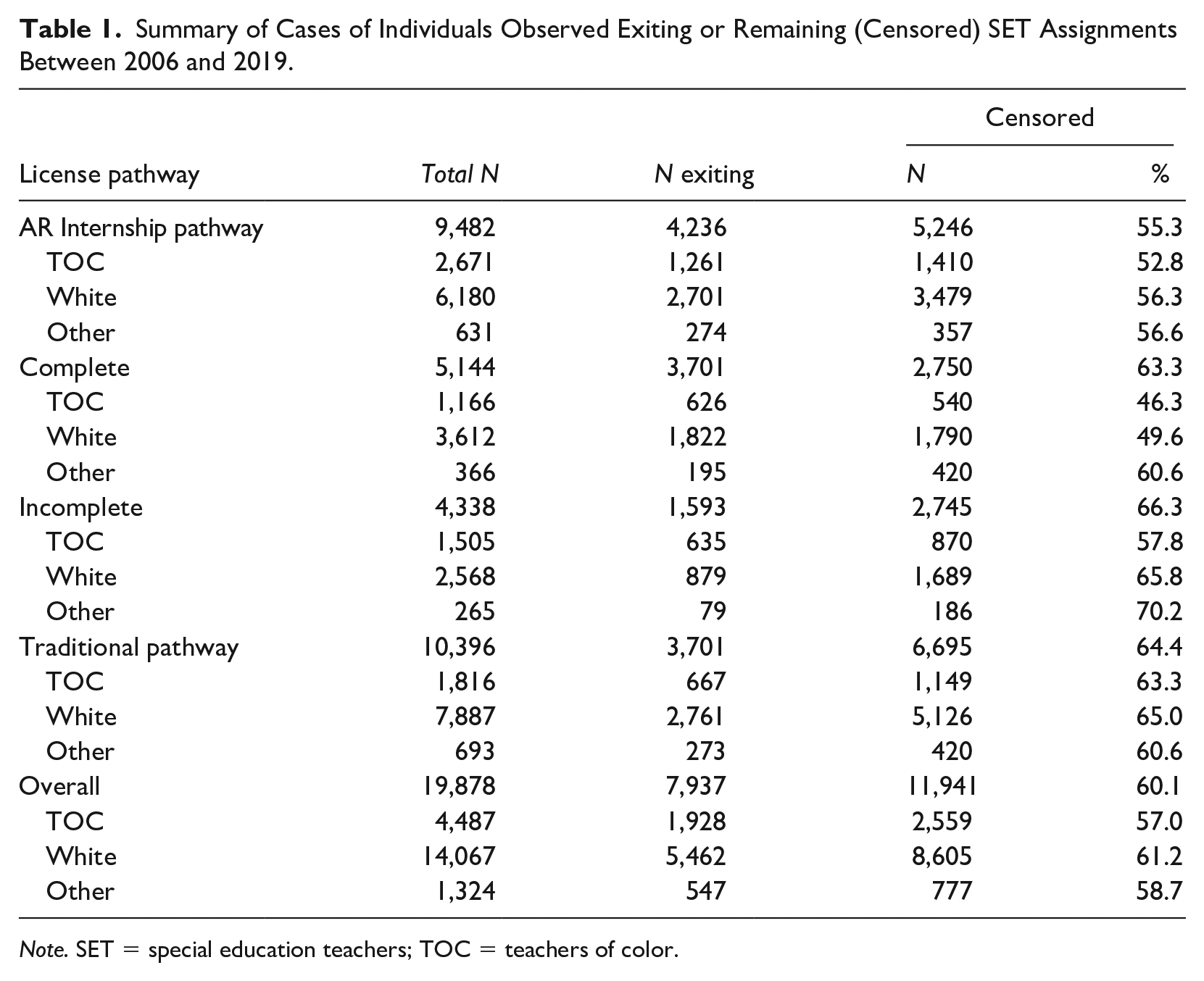
Note. SET = special education teachers; TOC = teachers of color.
To answer the question, data distribution was reviewed. The Pearson chi-square goodness of fit test which showed statistically significant differences between groups, X2(2, 19,878) = 331.64, p < .001,; therefore, the null hypothesis was rejected. The overall effect size using Cramér’s V was moderate (V = 0.09) (See Akoglu, 2018). A greater percentage of SETs of color participated in ARs (28%, n = 2,671) compared to traditional licensure programs (17.5%, n = 1,816). Inversely, SETs who identified as white were disproportionately distributed, with fewer individuals participating in ARs (65%, n = 680) compared to traditional programs (75.9%, n = 7,887). Individuals who did not identify (Other) racial categories accounted for relatively equal shares of both programs, with 6.6% of individuals participating in both AR and traditional programs compared to 693 out of 10,396.
2. Do Virginia special educators from AR Internship programs have different lengths of service time than those from a traditional pathway and are there differences between racial/ethnic groups?
We compared the years of service for SET who entered special education using an alternate or traditional pathway to licensure. The estimated length of service time for the observed period between 2005 and 2019 is displayed in Table 2. Figure 1 displays the censored data with the estimates of service for traditional and alternate pathway groups. Overall traditional and AR pathway groups showed significant statistical differences; therefore, the null hypothesis was rejected, X2(1, 19,878) = 112, p < .001;
intern
=7.99;
Special Education Teacher Estimates of Assigned Service Time as a Special Education Teacher.

Note. Estimated mean service time (
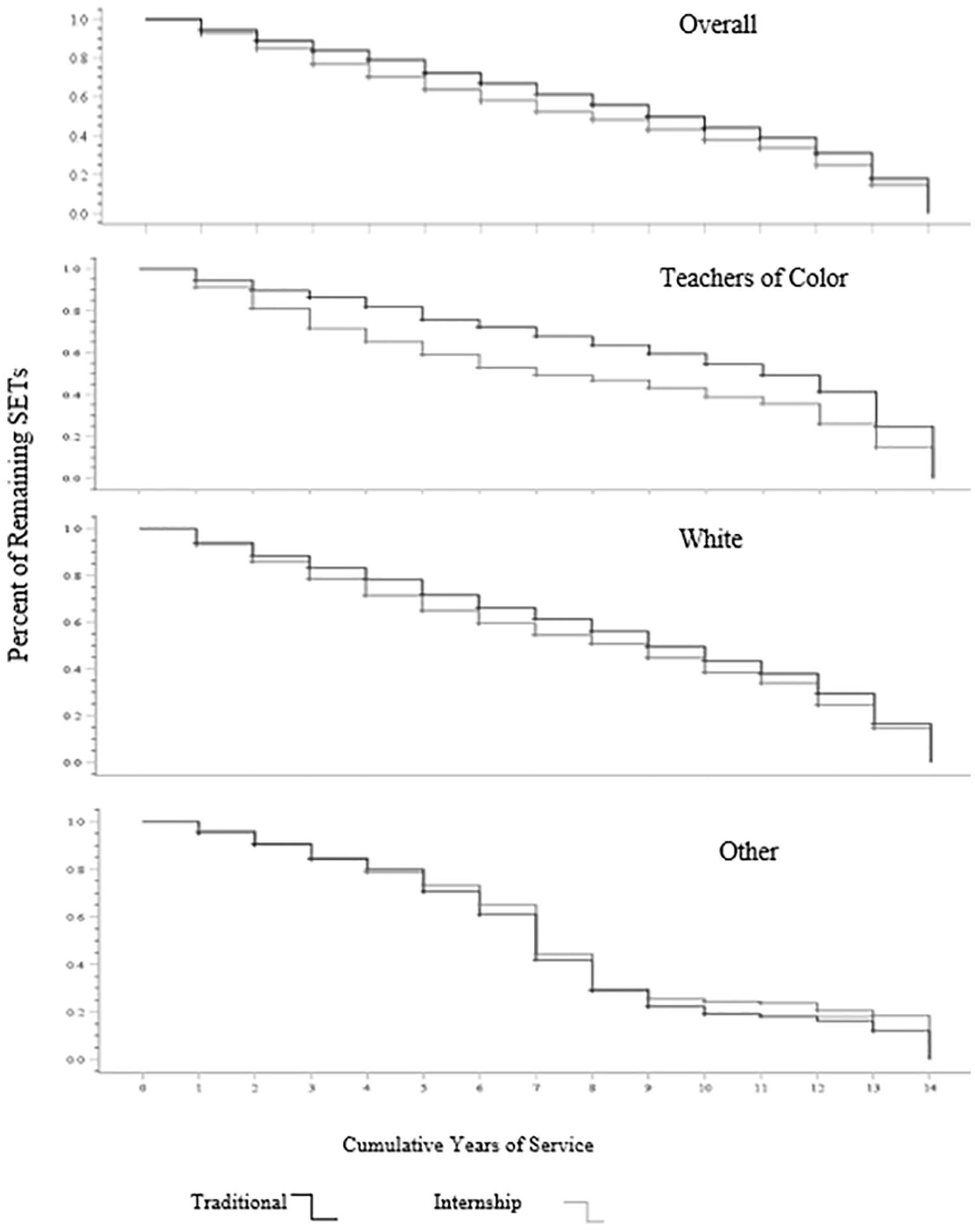
Cumulative service times for special education teachers (SETs) in traditional and internship licensure programs.
When comparing the AR completers to those completing traditional training programs within racial groups, the results were mixed. There was an approximate 2-year difference between the sets of teachers of color. Individuals in the SETs of color group showed statistically significant differences with almost three fewer years of service in the AR compared to the traditional program, X2(1, 4,487) = 105, p < .001;
3. Is attrition/retention different for AR internship program participants who completed and those who did not complete the teacher preparation coursework within 3 years of starting an internship program?
The Virginia policies related to ARs provide SETs with 3 years to complete the 27 credit hours of coursework, so we ran a second Kaplan–Meier test for individuals who completed and did not complete the coursework. Figure 2 displays the estimated service with censored data for both groups.
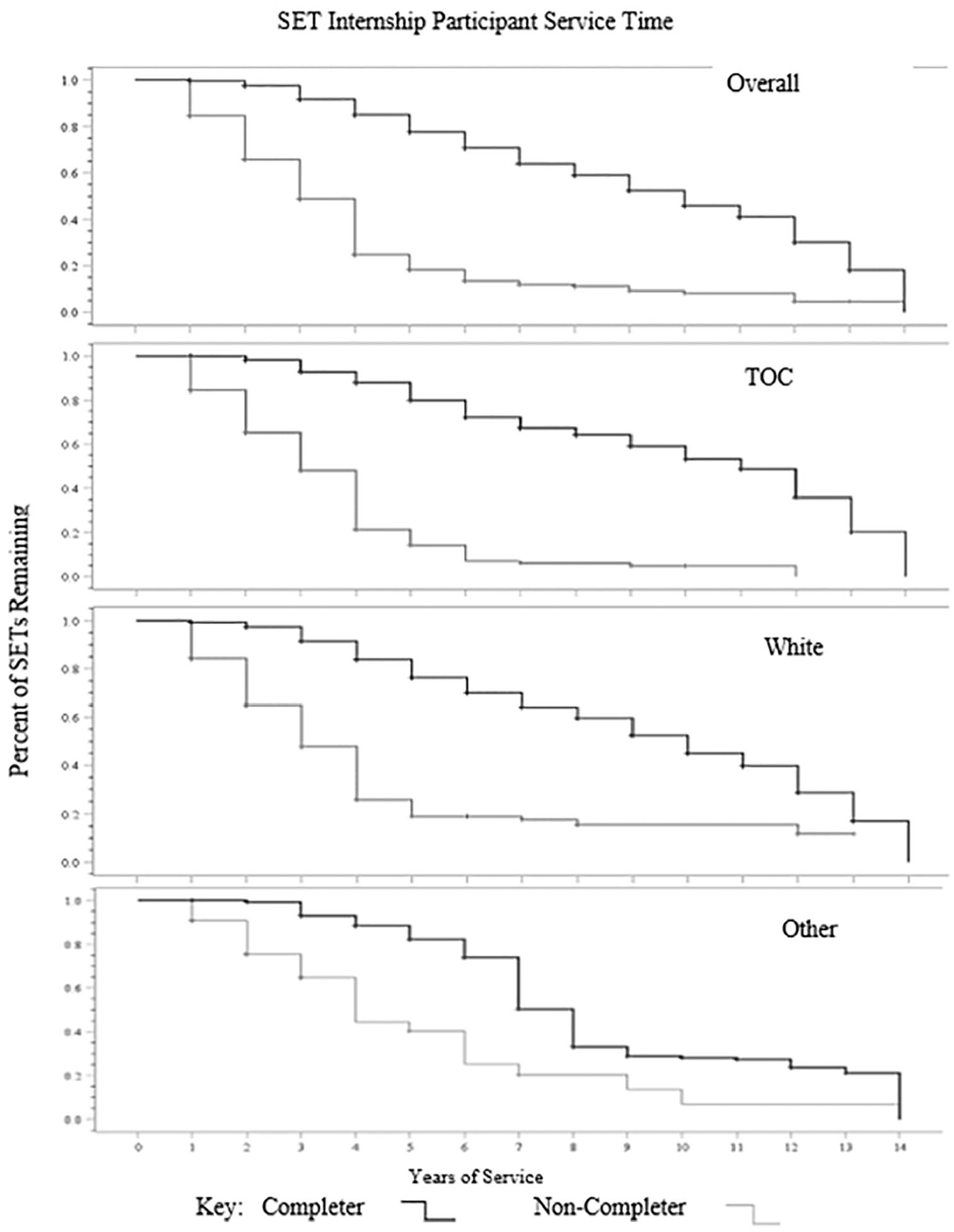
Cumulative service times for internship participants who completed and did not complete 27 credit hours of coursework.
Visual analysis of the graph shows decreases in service time for noncompleters, with attrition occurring at greater rates within the first 3 years of service. Individuals in the noncompleter group accounted for approximately 20% of the losses in the first year, 20% of the losses in the second year, and 60% of the losses in the third year. Service times were statistically significantly (X2[1, 19,878] = 2,180, p < .0001;.
Discussion
We examined SETs years of service after participating in AR internship and traditional pathway programs in Virginia. Our analysis shows that ARs with the internship disproportionally recruits more SETs of color, and although overall mean cumulative service times were lower, their practical, long-term impact was negligible, amounting to less than 1 year of extra service. In addition, the difference in cumulative service times were eliminated if the AR participants completed a minimum of 27 credit hours of coursework at a college or university. The same pattern existed for SETs who identified as White or “of color.” Overall findings suggest that ARs can serve as a tool to supplement the supply of SETs produced by traditional programs.
ARs using the internship model appear to benefit SETs of color. Initial recruitment was higher for SETs of color who participated in ARs. This would support findings from Scott and colleagues (2019) that some SETs of color view ARs favorably as a route to becoming a teacher. Our study only conditionally supports Brownell and Sindelar’s (2018) assertion that it may be necessary to use ARs in the short run to solve the SET shortage. ARs may be a valuable tool for filling SET positions as a temporary solution, and ARs may be useful for recruiting SETs. However, attrition rates for internship participants were higher, and attrition has long been a contributing factor to the overall demand for SETs (Billingsley & Bettini, 2019; Boe et al., 2013; Carver-Thomas & Darling-Hammond, 2017; García & Weiss, 2019).
We also note that the pattern of attrition is similar for both internship and traditional pathway programs, but this appears to be only part of the story. A deeper analysis showed that participants who did not complete the 27 credit hours of coursework accounted for more than a fifth of all SETs observed leaving the special education classroom in years 1, 2, and 3. In addition, when SETs of color completed the 27 credit hours as part of an internship program, they were observed to be teaching 2 years longer than SETs of color who completed traditional pathways.
We recognize that the benefit of ARs for SETs of color should be tempered because the longer service times associated with SETs of color may indicate a systemic problem within the schools. For example, SETs of color may experience implicit biases blocking their early exit from the special education classroom to enter into positions of leadership outside the classroom (Scott, Powell, et al., 2021). Setting aside any systemic concerns, recognizing the merits of increasing diversity in the SET and the promise of AR internship-based programs, we believe that some changes to policy and research are warranted.
Recommendations for Policy, Practice, and Research
If addressing SET attrition is a key component for reducing the SET teacher shortages, then addressing the attrition within AR internship programs will be part of the solution. Special education funding concerns are likely to remain a significant factor contributing to attrition for all SETs (e.g., Boe et al., 2013; Brownell & Sindelar, 2018; Feng & Sass, 2018; Peyton et al., 2021; Scott et al., 2019).
Identifying funding sources for SETs who enroll in AR internship programs may be helpful. This is particularly important for increasing the number of underrepresented minority candidates (Scott et al., 2019). It might be necessary to create or expand state-level loan programs (Feng & Sass, 2018), or link participants to other existing sources of funds. For example, the Teacher Assistance for College and Higher Education (TEACH) grant program (US Code 20 subpart 9) provides up to $4,000.00 per year to individuals who complete coursework needed for a teaching license. Alternatively, local educational authorities could provide tuition reimbursements as part of a SET’s contract or as a benefit provided by the school district. Human resources could help set up automatic deposits to a college savings account under US Code 26 Sec. 529. The 529 accounts are investment accounts that earn tax-free interest and can be applied to college tuition. Finally, states and university-based programs might explore securing funds that lower the tuition associated with internships (e.g., Teacher Quality Partnership) or provide support to participants through the early years of their careers (e.g., Reagan et al., 2021).
Given the scarcity of research on the service times of SET teachers, replication studies should be conducted that examine internship service times across other states and nationally. Future investigations should also disaggregate data by racial/ethnic categories, as few research studies about SET attrition and retention have investigated race or included racial/ethnic categories in their analyses (Billingsley et al., 2019; Scott, Powell, et al., 2021). For example, do internship programs target participants of color, and/or are these individuals drawn to these programs because of the flexibility, costs, or other program variables?
Because most states collect and maintain teacher certification data, it is likely that similar longitudinal studies could be replicated in the future. That being said, a few policy tweaks would provide researchers with the ability to explore more nuanced research questions. We would specifically recommend that state licensure agencies collect, document, and classify ARs using the language and definitions described by Myers and colleagues (2020). A common set of definitions would allow for an easier examination of the outcomes of different types of programs. Similarly, we recommend collecting and documenting the brand names associated with the pathways (e.g., Teach for America, Troops to Teachers). Finally, in cases where internship programs are utilized, and in cases where a state like Virginia is already conducting a census of teacher licensures and assignments, we recommend documenting the amount and type of annual college coursework completed. Even without modifications to the data collection system, there are more opportunities to use teacher licensure data sets to answer fundamental questions relating to recruitment, attrition, and retention.
Finally, we point out that researchers should continue to explore questions of recruitment, retention, and attrition using other research methods. Qualitative approaches might add context and identify variables not documented in existing data sets. In addition, the opportunity to conduct observations to verify teacher self-report as well as student achievement could provide a clearer picture of the quality of SET internship programs.
Limitations
Secondary data analysis by design is limited to the data available. In the case of this study, data were limited to observations between 2006 and 2019, and our analysis of effectiveness was limited to teacher service times. The Virginia data set treated all ARs equally and channeled different programs into the internship. This means we were unable to distinguish between individuals who started the internship program after being recruited by name brand AR programs (e.g., Teach for America, Troops to Teachers). Furthermore, our observations were limited to the data set, and SETs may have continued to serve longer than the observation period. In addition, the data set was from one state, Virginia, and the pattern may or may not generalize to other states, particularly if those other states have different definitions and/or configurations for their internship programs. Future studies may use similar data sets gathered by other states to confirm the results. The data set also did not allow us to account for individuals who had more than six credit hours of special education coursework but less than 27 credit hours when they started working as SETs in the classroom or individuals who transferred into Virginia from another state, and we did not account for the pattern of mobility (when and where SETs relocate). Additionally, it was not possible for us to use the existing data to follow SETs who left Virginia to teach in another state (Billingsley & Bettini, 2019; Goff et al., 2018; Sullivan et al., 2017; Theobald et al., 2020).
Finally, we would like to acknowledge that our study only focused on the cumulative service time as an outcome. Large data sets like the one utilized in this study provide researchers with the opportunity for a more robust exploration of attrition and the correlating variables contributing to hazard risks. Teacher mobility, school leadership, community growth, and salary may correlate to attrition and mobility (Billingsley et al., 2019; Boe et al., 2013; Goff et al., 2018; Sullivan et al., 2017; Theobald et al., 2020).
Similarly, the categorical groups of white teachers and teachers of color are constructs defined by the researchers and based on the constructs used by the state when gathering SET application data. This data set does not provide the opportunity for more targeted analysis of SETs, their route to licensure, and time in service for specific populations (i.e., Black or Latinx SETs). More importantly, this study measured effectiveness by examining participation rates under the assumption that traditional and AR internship pathways engaged in different recruitment and retention strategies. Future research might want to examine the strategies used by each program to recruit new teachers and to retain them once hired. Finally, we did assume that increased service times of SETs are a sign of effectiveness and did not consider SETs who go on to administrative positions.
Conclusion
Even though this study analyzed data from one state, there are some important lessons learned. First, the study found that AR internship programs are useful for recruiting SETs of color. More interestingly, SETs in Virginia who completed the AR internship matched or exceeded the service times of individuals who obtained licensure through traditional degree programs. Similarly, teachers of color stayed in teaching positions for longer periods of time when they completed an internship program. While we do not know why they remained in their positions, sometimes for a longer period than their traditionally prepared peers, it is a positive finding. Those most likely to leave are those who do not complete the program coursework. Conversely, those who moved on to complete a degree after earning their initial license from internship coursework had the highest retention rates, which can indicate a strong commitment to their profession. There remain additional questions that the field needs to explore regarding the differences between various AR internship and traditional programs, but the findings of this study indicate that the prognosis for solving SET teacher shortages is not unsolvable.
Footnotes
Acknowledgements
The authors would like to acknowledge Kristina Keithley, a student at King’s College, who assisted them in the preparation of this document.
Author’s Note
Data used for analysis were provided by the Virginia Department of Education, Office of Research, James Monroe Building, 101 N 14th Street Richmond, VA 23219. Preliminary findings of this study were provided to the Virginia Department of Education via the Aspiring Special Education Leadership Academy.
Declaration of Conflicting Interests
The author(s) declared no potential conflicts of interest with respect to the research, authorship, and/or publication of this article.
Funding
The author(s) received no financial support for the research, authorship, and/or publication of this article.
